

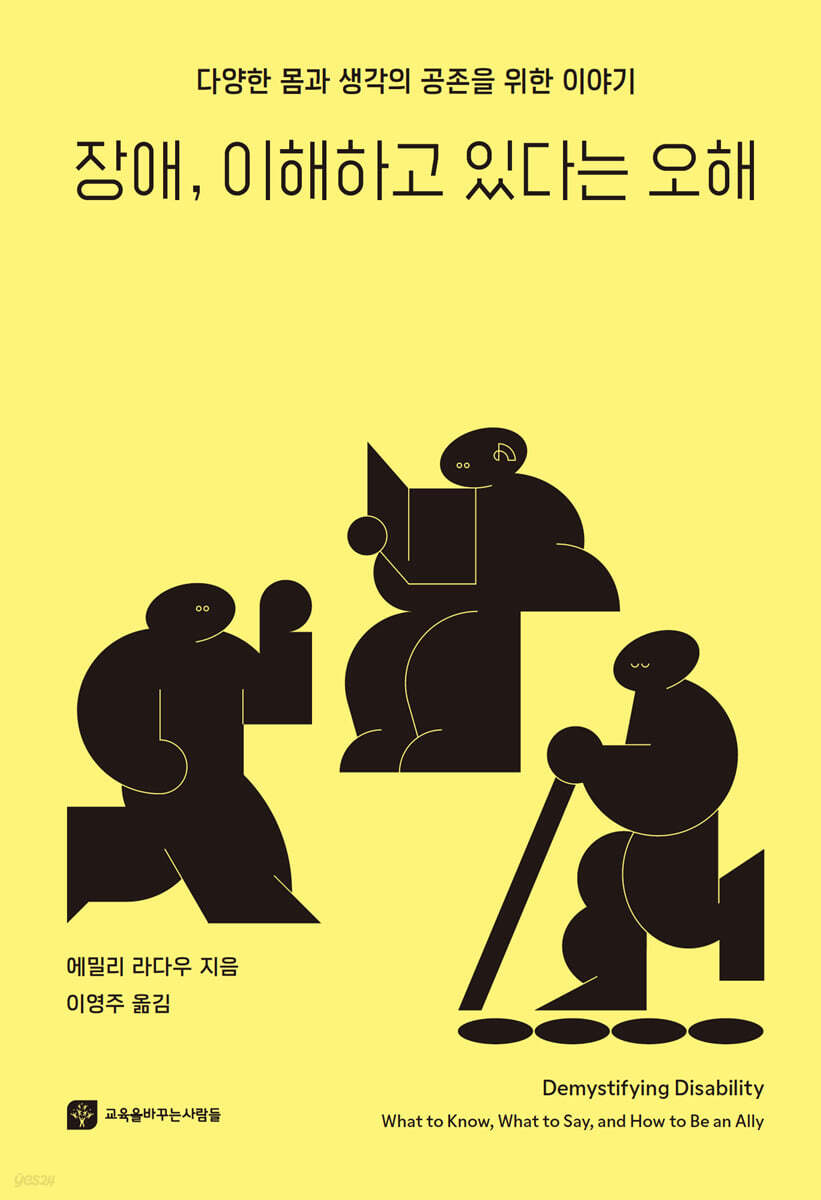
Disability, the misconception that you understand
 |
Description
Book Introduction
A story about the coexistence of diverse bodies and minds
Disability, the misconception that you understand
When you hear the word "disability," what feelings come to mind? Do you feel fear, dread, or a sense that it has nothing to do with you, or perhaps even a sense of relief? Do you feel sorry for someone with a disability? Do you feel like they deserve protection and consideration? For a long time, disability has been treated as a serious flaw or misfortune.
Throughout history, disabilities have been seen as monsters, and the media has exploited them as a means of making money.
But this is a clear misunderstanding and a wrong prejudice.
Disability is not a special someone's story.
More than a billion people worldwide have a disability, and anyone can experience a temporary or permanent disability.
That is why this book is not a book for the disabled, but a book for everyone.
Author Emily Radau, a human rights activist with a congenital disability, draws on her own life and work to create a three-dimensional and realistic account of disability.
Why the term "differently abled" is problematic, why referring to a wheelchair as "that person" is offensive, and how the media's practice of consuming disability as a sensational story undermines the dignity of those affected—all these questions are answered with real-life examples and experiences.
For him, disability is just one aspect of life.
There is a great deal of diversity in the world, and because of that diversity, each person has a different identity.
Disability is also one of those diversities.
The author points out the prejudices and ignorance surrounding disability, one by one, and forces us to face the truth.
This book is a guide that will help readers examine their own perspectives on disability by raising sharp questions about the social structure centered around the non-disabled, unconscious discriminatory language, and inaccessible spaces and systems.
Disability, the misconception that you understand
When you hear the word "disability," what feelings come to mind? Do you feel fear, dread, or a sense that it has nothing to do with you, or perhaps even a sense of relief? Do you feel sorry for someone with a disability? Do you feel like they deserve protection and consideration? For a long time, disability has been treated as a serious flaw or misfortune.
Throughout history, disabilities have been seen as monsters, and the media has exploited them as a means of making money.
But this is a clear misunderstanding and a wrong prejudice.
Disability is not a special someone's story.
More than a billion people worldwide have a disability, and anyone can experience a temporary or permanent disability.
That is why this book is not a book for the disabled, but a book for everyone.
Author Emily Radau, a human rights activist with a congenital disability, draws on her own life and work to create a three-dimensional and realistic account of disability.
Why the term "differently abled" is problematic, why referring to a wheelchair as "that person" is offensive, and how the media's practice of consuming disability as a sensational story undermines the dignity of those affected—all these questions are answered with real-life examples and experiences.
For him, disability is just one aspect of life.
There is a great deal of diversity in the world, and because of that diversity, each person has a different identity.
Disability is also one of those diversities.
The author points out the prejudices and ignorance surrounding disability, one by one, and forces us to face the truth.
This book is a guide that will help readers examine their own perspectives on disability by raising sharp questions about the social structure centered around the non-disabled, unconscious discriminatory language, and inaccessible spaces and systems.
- You can preview some of the book's contents.
Preview
index
Translator's Note
Entering
Chapter 1: What is Disability?
Chapter 2 Disability: A Part of Being Human
Chapter 3: History of the Disability Rights Movement
Chapter 4: Disability-Centricism and Accessibility
Chapter 5: Etiquette for Dealing with Disabilities
Chapter 6 Disability in the Media
In conclusion
Entering
Chapter 1: What is Disability?
Chapter 2 Disability: A Part of Being Human
Chapter 3: History of the Disability Rights Movement
Chapter 4: Disability-Centricism and Accessibility
Chapter 5: Etiquette for Dealing with Disabilities
Chapter 6 Disability in the Media
In conclusion
Detailed image

Into the book
The author says:
Disability is never a tragedy (or a touching story of overcoming tragedy), an inferiority, a shameful or worthless thing.
It is simply 'an aspect of human existence', 'a natural part of life experience', 'a constantly evolving experience', 'a unique way of life'.
I was quite surprised by these words, which struck me with even greater weight because they came after a lifetime of living with a disability.
As a mother of a disabled child, with eyes and ears wide open, it was a powerful language that dispelled the internalized feelings of discouragement, fear, and helplessness that I had unknowingly developed.
--- From the Translator's Note
Don't assume that just because you know one person with a disability, you know all people with disabilities.
He is just a disabled person.
A person with a disability may be considered an expert on that disability, but their experiences with disability are unique to them.
This book is also just one of many books about disability.
--- p.16~17
Anyone can experience a disability in life.
Sometimes they experience temporary disabilities, such as fractures, and other times they experience disabilities such as hearing loss, hearing paralysis, and brain damage.
For non-disabled people, the thought of becoming disabled is actually terrifying.
I can understand.
It's natural to be afraid of the unknown, but the thought that my body could change in ways beyond my control can be truly overwhelming.
Unfortunately, these fears often turn into prejudice against people with disabilities.
Because it's difficult to accept that someone else's reality can become your own.
--- p.56~57
Some of the terms called '-ism' are so widely used that everyone is familiar with them as terms that indicate discrimination against a specific group.
Words like sexism, ageism, homophobia, transphobia, and xenophobia.
Unfortunately, we live in a world where these terms continue to be repeated.
But what is often left out of these conversations about discrimination is discrimination against people with disabilities, ableism.
--- p.100
Accessibility is about ensuring that people with disabilities have the same opportunities and support as people without disabilities so that they can live well.
It's about removing barriers to participation and understanding, enabling everyone, regardless of ability, to experience the world around them in a way that suits both body and mind.
Accessibility does not mean special treatment or benefits.
--- p.112
Respecting personal space is a fundamental rule of interaction, but it seems to be too often ignored when dealing with people with disabilities.
In my case, strangers would come up to me and casually put their arms on my wheelchair as if it were their own armrest.
It may seem like a small thing, but the wheelchair is an extension of my body and a means of transportation for me.
If someone touches my wheelchair or puts weight on it, I feel trapped even though I'm not sitting in it.
--- p.131
We are socialized to understand 'the absence of disability' as the default human condition.
This means that if something does not appear to be physically disabled, it is usually assumed that it is not disabled.
I was the same way, but now I'm trying really hard to change.
Let's throw away all stereotypes and preconceptions about disabilities.
About both things that appear to be disabled and things that are not thought to be disabled.
Don't guess at random.
Instead, please include courtesy and accessibility for people with disabilities in all your interactions.
--- p.150
Program producers know very well what the majority of viewers want.
In other words, 'the weirder, the better.'
These types of programs are sometimes educational, but usually rely on society's morbid curiosity about "other bodies" and "other minds."
Unfortunately, programs like these not only reinforce prejudice, but also serve as a conduit for curiosity to quickly devolve into cruelty.
--- p.186
Many schools, businesses, and organizations host disability awareness and empathy training events where non-disabled participants can experience disability.
Ask the person to wear earplugs to understand hearing loss or a blindfold to understand vision loss, and ask them to push a wheelchair or use crutches to walk.
People often say that people learn through experience, but I can say this clearly.
This approach is by no means helpful in understanding the experiences of people with disabilities.
It is impossible to understand the experiences and identity that span a person's entire life through a simple simulated experience.
Disability is never a tragedy (or a touching story of overcoming tragedy), an inferiority, a shameful or worthless thing.
It is simply 'an aspect of human existence', 'a natural part of life experience', 'a constantly evolving experience', 'a unique way of life'.
I was quite surprised by these words, which struck me with even greater weight because they came after a lifetime of living with a disability.
As a mother of a disabled child, with eyes and ears wide open, it was a powerful language that dispelled the internalized feelings of discouragement, fear, and helplessness that I had unknowingly developed.
--- From the Translator's Note
Don't assume that just because you know one person with a disability, you know all people with disabilities.
He is just a disabled person.
A person with a disability may be considered an expert on that disability, but their experiences with disability are unique to them.
This book is also just one of many books about disability.
--- p.16~17
Anyone can experience a disability in life.
Sometimes they experience temporary disabilities, such as fractures, and other times they experience disabilities such as hearing loss, hearing paralysis, and brain damage.
For non-disabled people, the thought of becoming disabled is actually terrifying.
I can understand.
It's natural to be afraid of the unknown, but the thought that my body could change in ways beyond my control can be truly overwhelming.
Unfortunately, these fears often turn into prejudice against people with disabilities.
Because it's difficult to accept that someone else's reality can become your own.
--- p.56~57
Some of the terms called '-ism' are so widely used that everyone is familiar with them as terms that indicate discrimination against a specific group.
Words like sexism, ageism, homophobia, transphobia, and xenophobia.
Unfortunately, we live in a world where these terms continue to be repeated.
But what is often left out of these conversations about discrimination is discrimination against people with disabilities, ableism.
--- p.100
Accessibility is about ensuring that people with disabilities have the same opportunities and support as people without disabilities so that they can live well.
It's about removing barriers to participation and understanding, enabling everyone, regardless of ability, to experience the world around them in a way that suits both body and mind.
Accessibility does not mean special treatment or benefits.
--- p.112
Respecting personal space is a fundamental rule of interaction, but it seems to be too often ignored when dealing with people with disabilities.
In my case, strangers would come up to me and casually put their arms on my wheelchair as if it were their own armrest.
It may seem like a small thing, but the wheelchair is an extension of my body and a means of transportation for me.
If someone touches my wheelchair or puts weight on it, I feel trapped even though I'm not sitting in it.
--- p.131
We are socialized to understand 'the absence of disability' as the default human condition.
This means that if something does not appear to be physically disabled, it is usually assumed that it is not disabled.
I was the same way, but now I'm trying really hard to change.
Let's throw away all stereotypes and preconceptions about disabilities.
About both things that appear to be disabled and things that are not thought to be disabled.
Don't guess at random.
Instead, please include courtesy and accessibility for people with disabilities in all your interactions.
--- p.150
Program producers know very well what the majority of viewers want.
In other words, 'the weirder, the better.'
These types of programs are sometimes educational, but usually rely on society's morbid curiosity about "other bodies" and "other minds."
Unfortunately, programs like these not only reinforce prejudice, but also serve as a conduit for curiosity to quickly devolve into cruelty.
--- p.186
Many schools, businesses, and organizations host disability awareness and empathy training events where non-disabled participants can experience disability.
Ask the person to wear earplugs to understand hearing loss or a blindfold to understand vision loss, and ask them to push a wheelchair or use crutches to walk.
People often say that people learn through experience, but I can say this clearly.
This approach is by no means helpful in understanding the experiences of people with disabilities.
It is impossible to understand the experiences and identity that span a person's entire life through a simple simulated experience.
--- p.203
Publisher's Review
Reading this book, I was reminded of a novel where I cried while watching a disabled male protagonist suffer because he thought his lover's life would be ruined because of him.
I remember the sermon that said that without the noble sacrifice of teacher Sullivan, Helen Keller's 'miracle' would not have happened.
All the thoughts I've had about disabled parking spaces, seats, and elevators came to mind.
If I hadn't read this book, would I have been able to come up with these thoughts?
This book reminds us that prejudice against disabilities is broader and deeper than we think.
There are many books that talk about disability and people with disabilities.
They say that living with people with disabilities requires consideration and protection for them.
The author also considers such thinking to be a wrong prejudice.
Just as women's individuality has not been respected in a long-standing patriarchal, male-centered society, a society centered on non-disabled people does not treat disabled people equally.
Living as a disabled person in a world dominated by ableism is not something that can be simply thought of as 'inconvenient'.
As a human being, you have the right to be respected and live freely.
Everyone has the freedom to receive the education they want and choose their career.
Disabled people had to fight for their lives to obtain this basic right.
Visiting restaurants and theaters, using public transportation, going to the polls on election day, and commuting to and from school were all tasks that required new laws and systems for people with disabilities.
What the author criticizes is this reality and the perception of disability and people with disabilities.
To those who believe that people with disabilities are somehow 'wrong' and fall short of 'normal', the author calls such thinking 'false ableism'.
Chapter 1 introduces various perceptions surrounding the concept of disability.
We are all equal human beings, living in the world in our own unique ways. Just as the various toppings on the dough create the identity of a pizza, disability is also just one of the toppings that make up human identity.
For a very long time, people with disabilities have not been recognized as full-fledged citizens and have been treated as an outcast.
Disability has been treated as a flaw or a stain on life.
There are quite a few expressions and ways of thinking that we use without thinking today that still have traces of that.
In Chapter 2, the author explains why this is a problem and what other expressions can replace it.
Chapter 3 tells the story of human rights activists who have worked to improve laws and systems to combat discrimination and wrong practices against people with disabilities.
It will deeply move and inspire people with disabilities, and it will make people without disabilities realize how precious the freedoms and rights they now enjoy are.
Chapter 4 talks about the ableism that surrounds us.
Numerous examples of public facilities, transportation systems, work environments, and social services that fail to take accessibility for people with disabilities into account are introduced through the perspective of the author, who has personally experienced these situations.
There are countless stories floating around in the media that are designed to make fun of disabilities or to elicit sympathy.
People accustomed to ableism fail to recognize this fact, and even disabled people are made to feel that their lives are worthless.
By introducing and pointing out these 'subtle yet blatant' non-disabledisms one by one, the author hopes to make people clearly recognize why they are problematic.
Chapter 5 deals with etiquette when dealing with people with disabilities.
Perhaps this is the most pressing issue we face in our daily lives.
There are many cases where people ask rude questions and give advice under the guise of consideration, and excessively invade and interfere in personal space.
The author's argument is concise.
Treat your non-disabled colleagues, friends, and family with the same common sense you would use to treat them.
All I have to do is respect that person's words and thoughts as if they were my equal.
Chapter 6 is about disability as reflected in the media.
Media is not only inseparable from human life, but also has a powerful influence.
If you have a negative perception of disability, it is likely due to distorted images portrayed in the media.
Many examples of how disabilities are addressed in advertisements, newspapers and magazines, television programs, and published books encourage readers to reflect on themselves.
Another negative influence of the media is that treating people with disabilities kindly is exaggerated into a great good deed or noble act, rather than the 'normal behavior'.
Because kindness is not an act of charity for the poor disabled, but a basic social skill for dealing with others.
The world we live in is filled with people of diverse genders, races, ages, and socioeconomic statuses.
All of them have the right to be respected as equal persons.
The personality and rights of minorities should not be ignored simply because people of a certain gender, race, age, or status make up the majority.
This is the author's argument.
It is not a request for special sympathy or consideration for the disabled.
It's just that we need to equip ourselves with what we need to be happy in a world where we all live together, and that we need to acknowledge that people with disabilities are also human beings equal to us.
I remember the sermon that said that without the noble sacrifice of teacher Sullivan, Helen Keller's 'miracle' would not have happened.
All the thoughts I've had about disabled parking spaces, seats, and elevators came to mind.
If I hadn't read this book, would I have been able to come up with these thoughts?
This book reminds us that prejudice against disabilities is broader and deeper than we think.
There are many books that talk about disability and people with disabilities.
They say that living with people with disabilities requires consideration and protection for them.
The author also considers such thinking to be a wrong prejudice.
Just as women's individuality has not been respected in a long-standing patriarchal, male-centered society, a society centered on non-disabled people does not treat disabled people equally.
Living as a disabled person in a world dominated by ableism is not something that can be simply thought of as 'inconvenient'.
As a human being, you have the right to be respected and live freely.
Everyone has the freedom to receive the education they want and choose their career.
Disabled people had to fight for their lives to obtain this basic right.
Visiting restaurants and theaters, using public transportation, going to the polls on election day, and commuting to and from school were all tasks that required new laws and systems for people with disabilities.
What the author criticizes is this reality and the perception of disability and people with disabilities.
To those who believe that people with disabilities are somehow 'wrong' and fall short of 'normal', the author calls such thinking 'false ableism'.
Chapter 1 introduces various perceptions surrounding the concept of disability.
We are all equal human beings, living in the world in our own unique ways. Just as the various toppings on the dough create the identity of a pizza, disability is also just one of the toppings that make up human identity.
For a very long time, people with disabilities have not been recognized as full-fledged citizens and have been treated as an outcast.
Disability has been treated as a flaw or a stain on life.
There are quite a few expressions and ways of thinking that we use without thinking today that still have traces of that.
In Chapter 2, the author explains why this is a problem and what other expressions can replace it.
Chapter 3 tells the story of human rights activists who have worked to improve laws and systems to combat discrimination and wrong practices against people with disabilities.
It will deeply move and inspire people with disabilities, and it will make people without disabilities realize how precious the freedoms and rights they now enjoy are.
Chapter 4 talks about the ableism that surrounds us.
Numerous examples of public facilities, transportation systems, work environments, and social services that fail to take accessibility for people with disabilities into account are introduced through the perspective of the author, who has personally experienced these situations.
There are countless stories floating around in the media that are designed to make fun of disabilities or to elicit sympathy.
People accustomed to ableism fail to recognize this fact, and even disabled people are made to feel that their lives are worthless.
By introducing and pointing out these 'subtle yet blatant' non-disabledisms one by one, the author hopes to make people clearly recognize why they are problematic.
Chapter 5 deals with etiquette when dealing with people with disabilities.
Perhaps this is the most pressing issue we face in our daily lives.
There are many cases where people ask rude questions and give advice under the guise of consideration, and excessively invade and interfere in personal space.
The author's argument is concise.
Treat your non-disabled colleagues, friends, and family with the same common sense you would use to treat them.
All I have to do is respect that person's words and thoughts as if they were my equal.
Chapter 6 is about disability as reflected in the media.
Media is not only inseparable from human life, but also has a powerful influence.
If you have a negative perception of disability, it is likely due to distorted images portrayed in the media.
Many examples of how disabilities are addressed in advertisements, newspapers and magazines, television programs, and published books encourage readers to reflect on themselves.
Another negative influence of the media is that treating people with disabilities kindly is exaggerated into a great good deed or noble act, rather than the 'normal behavior'.
Because kindness is not an act of charity for the poor disabled, but a basic social skill for dealing with others.
The world we live in is filled with people of diverse genders, races, ages, and socioeconomic statuses.
All of them have the right to be respected as equal persons.
The personality and rights of minorities should not be ignored simply because people of a certain gender, race, age, or status make up the majority.
This is the author's argument.
It is not a request for special sympathy or consideration for the disabled.
It's just that we need to equip ourselves with what we need to be happy in a world where we all live together, and that we need to acknowledge that people with disabilities are also human beings equal to us.
GOODS SPECIFICS
- Date of issue: June 1, 2025
- Page count, weight, size: 216 pages | 140*200*20mm
- ISBN13: 9788997724383
- ISBN10: 899772438X
You may also like
카테고리
korean


korean

![GQ KOREA Mark (Monthly): December [2025]](http://librairie.coreenne.fr/cdn/shop/files/8ef265dbbfbf186523ed75ba7319009d.jpg?v=1765340328&width=3840)


