

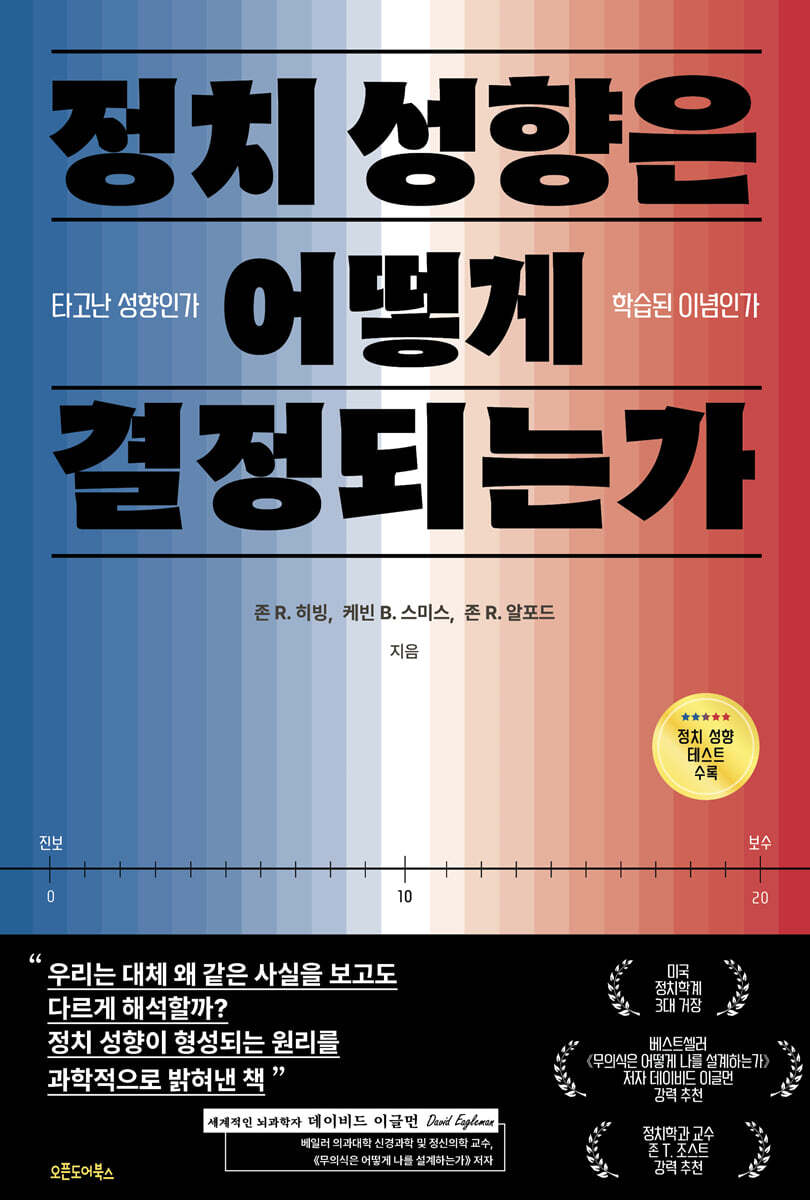
How is political orientation determined?
 |
Description
Book Introduction
★★★ Highly recommended by world-renowned neuroscientist David Eagleman.
★★★ A book that has drawn attention from US politicians, including Senator Bob Kerrey.
★★★ The Science of Conservatism and Progressivism, According to U.S. Political Science Experts
From mindset and brain structure to genes
Two political tendencies that have taken different paths,
A new scientific approach that illuminates the differences and history
We want the truth whenever something politically related happens.
But the truth that is revealed is sometimes harsh.
Because the truth is never on anyone's side.
Yet, if the truth does not stand on their side, people tend to dismiss it as a lie.
Even if research is based on systematic scientific procedures, if the results conflict with their political beliefs, people are quick to label the research as pseudoscience.
However, "How Are Political Tendencies Determined?" is scientific in that it reveals in detail that our political tendencies have a biological basis.
In fact, it seems difficult to determine political inclinations from a scientific perspective.
In 2013, a report in Korea that conservative supporters had larger biceps muscles (also known as acromion) than liberals was met with public criticism.
However, recent brain imaging techniques have revealed differences in brain structure and function according to political orientation through the size of the amygdala and the responsiveness of neural networks.
However, the limitation remains that the relationship between these differences and political tendencies was not clearly revealed.
However, with the advancement of scientific research methods, including neuroscience, we have succeeded in securing tangible evidence for topics that seemed unprovable in the scientific field.
Building on this trend, "How Are Political Tendencies Determined?" explores the biological basis of political beliefs from a variety of perspectives, including brain science, neuroscience, genetics and epigenetics, and evolutionary theory.
This book does not deny the influence of the environment by being immersed in scientific evidence of 'innateness', nor does it portray each camp negatively by leaning towards a specific tendency.
I am simply making an objective estimate of the basic characteristics of conservatives and progressives and where the differences originate.
But the fact that political leanings may have been determined before the body was formed may sound frustrating to some.
This is because it is generally believed that political inclinations are the product of experiences and thoughts experienced in the flow of life, that is, higher-order mental activity.
But the authors say the news is rather hopeful.
Although we have now gone too far down different paths, recognizing and acknowledging that our thinking was fundamentally different will help us avoid excessive polarization and reach a minimal level of agreement.
★★★ A book that has drawn attention from US politicians, including Senator Bob Kerrey.
★★★ The Science of Conservatism and Progressivism, According to U.S. Political Science Experts
From mindset and brain structure to genes
Two political tendencies that have taken different paths,
A new scientific approach that illuminates the differences and history
We want the truth whenever something politically related happens.
But the truth that is revealed is sometimes harsh.
Because the truth is never on anyone's side.
Yet, if the truth does not stand on their side, people tend to dismiss it as a lie.
Even if research is based on systematic scientific procedures, if the results conflict with their political beliefs, people are quick to label the research as pseudoscience.
However, "How Are Political Tendencies Determined?" is scientific in that it reveals in detail that our political tendencies have a biological basis.
In fact, it seems difficult to determine political inclinations from a scientific perspective.
In 2013, a report in Korea that conservative supporters had larger biceps muscles (also known as acromion) than liberals was met with public criticism.
However, recent brain imaging techniques have revealed differences in brain structure and function according to political orientation through the size of the amygdala and the responsiveness of neural networks.
However, the limitation remains that the relationship between these differences and political tendencies was not clearly revealed.
However, with the advancement of scientific research methods, including neuroscience, we have succeeded in securing tangible evidence for topics that seemed unprovable in the scientific field.
Building on this trend, "How Are Political Tendencies Determined?" explores the biological basis of political beliefs from a variety of perspectives, including brain science, neuroscience, genetics and epigenetics, and evolutionary theory.
This book does not deny the influence of the environment by being immersed in scientific evidence of 'innateness', nor does it portray each camp negatively by leaning towards a specific tendency.
I am simply making an objective estimate of the basic characteristics of conservatives and progressives and where the differences originate.
But the fact that political leanings may have been determined before the body was formed may sound frustrating to some.
This is because it is generally believed that political inclinations are the product of experiences and thoughts experienced in the flow of life, that is, higher-order mental activity.
But the authors say the news is rather hopeful.
Although we have now gone too far down different paths, recognizing and acknowledging that our thinking was fundamentally different will help us avoid excessive polarization and reach a minimal level of agreement.
- You can preview some of the book's contents.
Preview
index
ㆍSeo Moon│Inherited Conflict
Chapter 1: Uncomfortable Companionship
Dynamics of Conflict┃Politics and Science┃The Spectrum of Ideology┃Think Probabilistically┃Leibniz's Nonsense┃The Truth Revealed┃Is Fighting the Only Answer?
Chapter 2: What Controls Our Thoughts?
Political Inbreeding┃Political Fluidity┃The Dominance of Universality┃Ideology is 'Us'
Chapter 3: What determines normality?
Diversity and Irrationality┃The Trend of the Assumption of Unity┃The Trap of Locke and Gladwell┃The Age of Dichotomy is Over┃The Biology of Behavior┃The World of Difference
Chapter 4: The Politics of Preference
Taste is ideological┃Authoritarian political tendencies┃Personality that determines taste┃Receptor of moral sense┃Correlation between politics and personality┃Humans are political animals
Chapter 5: Conflicting Views
Gaze and Social Response┃The Standard for Conceiving the World┃The Answer Lies in Focus┃Where the Eyes Linger┃The Difference in Perception┃Acquisition and Utilization of Information┃The Created Reality
Chapter 6│Is Our Nature Our Destiny?
The Human Body's Information Processing System┃Politics and the Brain┃Physics That Make You Sweaty┃Imprinted Hatred and Outgroups┃The Politics Behind the Face┃Negativity Bias and Conservatism┃The Roots of Political Difference
Chapter 7│Is the environment ultimately meaningless?
The Power of Genes | Is Political Inclination Inherited? | Twins' Political Inclinations | Genetic Variation in Political Beliefs | Epigenetic Changes | Inconvenient Truths | Evolving Conventional Wisdom
Chapter 8: The History of Eruption
Conditions for Survival┃What Are You Trying to Deny?┃Genetic Variation According to Environment┃Group Selection and Genetic Diversity┃Selective Pressure and Political Tendency┃Antagonistic Symbiosis┃Genes Are Not Everything┃Evolution's Chaos
Chapter 9: How far have we come?
The Heritability of Political Tendency┃The Sociobiology Debate and Genetic Identity┃A Tale of Two Cities┃Fallen by Illusion┃Let's Acknowledge Differences┃Language that Persuades Differences┃Let's Embrace Our Innate Tendencies┃What is a Desirable Political System?
Conclusion│Under different realities
A Word to Progressives┃A Word to Conservatives┃Change Continues
ㆍAppendix│Political Tendency Diagnostic Test
ㆍReferences
Chapter 1: Uncomfortable Companionship
Dynamics of Conflict┃Politics and Science┃The Spectrum of Ideology┃Think Probabilistically┃Leibniz's Nonsense┃The Truth Revealed┃Is Fighting the Only Answer?
Chapter 2: What Controls Our Thoughts?
Political Inbreeding┃Political Fluidity┃The Dominance of Universality┃Ideology is 'Us'
Chapter 3: What determines normality?
Diversity and Irrationality┃The Trend of the Assumption of Unity┃The Trap of Locke and Gladwell┃The Age of Dichotomy is Over┃The Biology of Behavior┃The World of Difference
Chapter 4: The Politics of Preference
Taste is ideological┃Authoritarian political tendencies┃Personality that determines taste┃Receptor of moral sense┃Correlation between politics and personality┃Humans are political animals
Chapter 5: Conflicting Views
Gaze and Social Response┃The Standard for Conceiving the World┃The Answer Lies in Focus┃Where the Eyes Linger┃The Difference in Perception┃Acquisition and Utilization of Information┃The Created Reality
Chapter 6│Is Our Nature Our Destiny?
The Human Body's Information Processing System┃Politics and the Brain┃Physics That Make You Sweaty┃Imprinted Hatred and Outgroups┃The Politics Behind the Face┃Negativity Bias and Conservatism┃The Roots of Political Difference
Chapter 7│Is the environment ultimately meaningless?
The Power of Genes | Is Political Inclination Inherited? | Twins' Political Inclinations | Genetic Variation in Political Beliefs | Epigenetic Changes | Inconvenient Truths | Evolving Conventional Wisdom
Chapter 8: The History of Eruption
Conditions for Survival┃What Are You Trying to Deny?┃Genetic Variation According to Environment┃Group Selection and Genetic Diversity┃Selective Pressure and Political Tendency┃Antagonistic Symbiosis┃Genes Are Not Everything┃Evolution's Chaos
Chapter 9: How far have we come?
The Heritability of Political Tendency┃The Sociobiology Debate and Genetic Identity┃A Tale of Two Cities┃Fallen by Illusion┃Let's Acknowledge Differences┃Language that Persuades Differences┃Let's Embrace Our Innate Tendencies┃What is a Desirable Political System?
Conclusion│Under different realities
A Word to Progressives┃A Word to Conservatives┃Change Continues
ㆍAppendix│Political Tendency Diagnostic Test
ㆍReferences
Detailed image

Into the book
Don't feel lucky that you're not from the United States.
Your political idols are not much different from a battlefield, where they burn each other with flamethrowers and destructive language beneath the American flag.
If you were asked to provide examples of politics from a certain era and context, you would find plenty of examples, even without delving deep into the details, of the Berkeley-Vidal debate, where opponents criticized each other's political consciousness and even resorted to physical confrontation.
--- p.8
In fact, differences in political leanings stem not from deceptive conspiracies or irrational disregard for logic and truth, but from the very nature of being human.
So conservatives are not lazy, ignorant conservatives, and progressives are not lazy, ignorant conservatives.
--- p.9∼10
People want to believe that their decisions and opinions are rational, but in reality, they are not.
In this way, unconscious physiological and psychological responses to our surroundings influence our attitudes and behavior.
It may seem beautiful to imagine everyone achieving political unity and singing the same song as one at the center of harmony, but it is actually a very dangerous illusion.
--- p.37
We aim to present empirical evidence demonstrating that psychological, cognitive, biological, and genetic factors are deeply associated with political differences.
Before that, we need to prove the claim that politics is universal, while humanity is changeable.
--- p.48
If political beliefs and their names are merely created to address issues or ideas that have been floating around in a particular culture for hundreds of years, it seems difficult indeed to secure political universality.
We are political animals, but people seem to form unique perspectives based on their cultural and historical positions.
--- p.62
Ideology is us.
Just as with human relationships, there can be no end to ideology.
This is not limited to the social elite, but also applies to communication between individuals.
Issues and labels that are specific to the context within which they are embedded drain our focus and energy.
So sometimes our gaze is not directed to the fundamental principles involved.
--- p.80∼81
There are big differences between each person.
Not everyone is born on the same line.
We are all born with many unique qualities, and the environments we encounter add to our individual uniqueness.
Academic and social consensus holds that this individuality is not particularly persistent or biological.
--- p.115
Progressives are characterized by a passion for newness and novelty, a passion for self-expression, a tolerance for difference, and an interest in stimulation.
Conservatives, on the other hand, are distinguished by their commitment to order, the pursuit of safety for both family and group, and loyalty or patriotism to tradition and group.
--- p.148
The results of differences in perception by political orientation may be somewhat less clear than the attention patterns.
However, there is evidence that conservatives perceive disgusting and threatening images more negatively, and positive images more positively.
Vigil's study similarly suggests that Republican undergraduates tend to view emotionally ambiguous faces as more threatening or dominant than Democratic undergraduates.
--- p.199
Disgust has a distinct biological signature.
One of them is activation of the sympathetic nervous system, which can also be detected by galvanic skin response.
--- p.182
The highly evolved intelligence of humans is accustomed to instinctively ignoring the genetic influences on our behavior rather than seeking the real reasons for our behavior and political beliefs.
In other words, our superior brains are better at creating stories that deny the connection to biological influences than at denying the biological influences themselves.
--- p.240
Most modern people are rarely plagued by life-threatening worries like those of the distant past.
As a result, modern people can extend their scope of social contact and ethical concern beyond the confines of family and kinship to include people and animals.
--- p.295
Once established, political leanings are remarkably stable.
The idea that people's political leanings become more conservative as they age is nothing more than a myth.
A student with an innate political inclination will never change his or her political leanings, and a student without such inclinations will lack the foundation for change.
--- p.320
Conservatives and liberals, who have fundamentally different innate tendencies, both believe and believe in facts that support their tendencies, even if they are not true.
Once a false belief is formed, it is very difficult to correct it.
There are so many cases where people only believe what they want to believe.
--- p.333
The two different groups must acknowledge the reality that they are 'subspecies' to move forward in a better direction.
It is more realistic to acknowledge that they are completely different rather than to find what they have in common.
The belief that people divided on both sides of a fork in the road can reach an agreement is naive.
There is no evidence that these arguments will ultimately work among those with strong political positions.
If you want results, you have to act in the reality that is right in front of you, not in the ideal.
Your political idols are not much different from a battlefield, where they burn each other with flamethrowers and destructive language beneath the American flag.
If you were asked to provide examples of politics from a certain era and context, you would find plenty of examples, even without delving deep into the details, of the Berkeley-Vidal debate, where opponents criticized each other's political consciousness and even resorted to physical confrontation.
--- p.8
In fact, differences in political leanings stem not from deceptive conspiracies or irrational disregard for logic and truth, but from the very nature of being human.
So conservatives are not lazy, ignorant conservatives, and progressives are not lazy, ignorant conservatives.
--- p.9∼10
People want to believe that their decisions and opinions are rational, but in reality, they are not.
In this way, unconscious physiological and psychological responses to our surroundings influence our attitudes and behavior.
It may seem beautiful to imagine everyone achieving political unity and singing the same song as one at the center of harmony, but it is actually a very dangerous illusion.
--- p.37
We aim to present empirical evidence demonstrating that psychological, cognitive, biological, and genetic factors are deeply associated with political differences.
Before that, we need to prove the claim that politics is universal, while humanity is changeable.
--- p.48
If political beliefs and their names are merely created to address issues or ideas that have been floating around in a particular culture for hundreds of years, it seems difficult indeed to secure political universality.
We are political animals, but people seem to form unique perspectives based on their cultural and historical positions.
--- p.62
Ideology is us.
Just as with human relationships, there can be no end to ideology.
This is not limited to the social elite, but also applies to communication between individuals.
Issues and labels that are specific to the context within which they are embedded drain our focus and energy.
So sometimes our gaze is not directed to the fundamental principles involved.
--- p.80∼81
There are big differences between each person.
Not everyone is born on the same line.
We are all born with many unique qualities, and the environments we encounter add to our individual uniqueness.
Academic and social consensus holds that this individuality is not particularly persistent or biological.
--- p.115
Progressives are characterized by a passion for newness and novelty, a passion for self-expression, a tolerance for difference, and an interest in stimulation.
Conservatives, on the other hand, are distinguished by their commitment to order, the pursuit of safety for both family and group, and loyalty or patriotism to tradition and group.
--- p.148
The results of differences in perception by political orientation may be somewhat less clear than the attention patterns.
However, there is evidence that conservatives perceive disgusting and threatening images more negatively, and positive images more positively.
Vigil's study similarly suggests that Republican undergraduates tend to view emotionally ambiguous faces as more threatening or dominant than Democratic undergraduates.
--- p.199
Disgust has a distinct biological signature.
One of them is activation of the sympathetic nervous system, which can also be detected by galvanic skin response.
--- p.182
The highly evolved intelligence of humans is accustomed to instinctively ignoring the genetic influences on our behavior rather than seeking the real reasons for our behavior and political beliefs.
In other words, our superior brains are better at creating stories that deny the connection to biological influences than at denying the biological influences themselves.
--- p.240
Most modern people are rarely plagued by life-threatening worries like those of the distant past.
As a result, modern people can extend their scope of social contact and ethical concern beyond the confines of family and kinship to include people and animals.
--- p.295
Once established, political leanings are remarkably stable.
The idea that people's political leanings become more conservative as they age is nothing more than a myth.
A student with an innate political inclination will never change his or her political leanings, and a student without such inclinations will lack the foundation for change.
--- p.320
Conservatives and liberals, who have fundamentally different innate tendencies, both believe and believe in facts that support their tendencies, even if they are not true.
Once a false belief is formed, it is very difficult to correct it.
There are so many cases where people only believe what they want to believe.
--- p.333
The two different groups must acknowledge the reality that they are 'subspecies' to move forward in a better direction.
It is more realistic to acknowledge that they are completely different rather than to find what they have in common.
The belief that people divided on both sides of a fork in the road can reach an agreement is naive.
There is no evidence that these arguments will ultimately work among those with strong political positions.
If you want results, you have to act in the reality that is right in front of you, not in the ideal.
--- p.337
Publisher's Review
Fate and will: what separates conservatives from progressives?
Crossing the border between two irreconcilable camps
Talking about conservatism and progressivism with modern science
Our appearance, which is woven with complete ‘self’,
Is it genetic planning or environmental influence?
Dissecting the "Political Animal" Through Nature and Nurture
The golden age of 'splitting'
There is a saying that has become a buzzword in relation to political issues.
It is called 'galachigi', and although the exact etymology is different, it refers to a strategy in Baduk to disperse forces by preventing the opponent from making a house.
In a similar vein, division has become a common sentiment in each social group, causing hatred and conflict across various social classes, including gender, generation, religion, economic status, occupation, and political orientation, within the community.
This kind of culture has long been established as a new social problem, as discrimination arising from differences expands into hatred.
Conflicts between men and women, rich and poor, businesses and workers, and the young and the middle-aged have existed since ancient times, but the conflict between conservatives and progressives has a history so deep that it encompasses all of these conflicts.
According to philosopher Martha Nussbaum, disgust stems from a primal defense mechanism that protects us from things as dirty as excrement.
In other words, disgust can be said to be an emotion that avoids infection and contamination from something that threatens oneself.
The challenge is to extend these feelings to the societal level.
As a result, 'projective disgust' occurs, in which an object inferior to oneself is identified with the object of one's primal disgust, even though it is not actually dangerous.
Political philosopher Hannah Arendt says that the soil of hatred that feeds on fear is formed by problems in social structure as well as personal moral issues.
Accordingly, we live a life where hatred is taken for granted.
It is generally known that hatred toward out-groups is most pronounced among conservatives.
Because conservatives place more weight on the stability of the group.
In contrast, the perception that progressives pursue openness to newness and diversity has been ingrained for quite some time.
However, even liberals who are tolerant of outgroups are quick to criticize and slander conservatives when they meet them.
This conflict shows no signs of abating as it escalates into 'polarization', or political polarization.
In an age of hatred fueled by conflicting emotions, "How Are Political Tendencies Determined?" presents a way to understand one another through the lens of science.
Genetic Copies and 'Nature vs. Nurture'
Naturally, we are all genetic copies of someone else.
This book says that our personality, tastes, and even political leanings are genetic.
So what about identical twins, whose genetic similarity between siblings is striking? The lives of identical twins Jim Lewis and Jim Springer, adopted into separate families just four weeks after birth, were remarkably similar.
They were all similar in their preferred cigarettes, beers, car brands, vacation spots, and even their favorite and least favorite subjects, hobbies, and chronic illnesses during their school days.
There was no need to mention occupation, IQ, personality, or job aptitude.
The case of identical twins who grew up in such different environments clearly demonstrates the influence of genes.
Similarly, twin studies conducted by the authors show that identical twins are generally more similar in their positions on political issues than fraternal twins.
Meanwhile, the case of children who were raised with different parents at birth shows even more interesting facts.
This is the case of Kay Lynn Reed and Deanne Angel.
Kay Lynn Reed, unlike her conservative father, considers herself a centrist, but she says she is progressive on gender equality issues.
Of course, we cannot be certain of her biological parents' political leanings, as she added that her somewhat progressive tendencies stemmed from her college years.
But this case flies in the face of the common belief that our environment determines everything about us.
In conclusion, the hypothesis that even our internal realms, including our tastes, are already set at the genetic level is gaining ground.
This suggests that there is a realm of ‘nature’ within us that cannot be changed even through ‘parenting.’
Does this mean the influence of the environment is irrelevant? The authors argue that once established, political leanings remain unchanged, and that conspiracy theories peddled by the American far-right, claiming that media and education brainwash children and youth into adopting certain tendencies, are false.
This underscores the undesirability of downplaying the role of heredity while ignoring the mounting evidence that there are innate tendencies that shape our thinking.
However, they also urge us not to forget that small differences inherent in genes, including epigenetics, can be amplified by environmental factors.
Political inclinations are generally considered to be largely acquired, as they are established in adulthood.
But the truth is that genes are at the heart of it, and the environment plays a role in amplifying the initial limited genetic variation.
ㆍEvolution of the political animal
'Man is by nature a political animal.' This is Aristotle's famous proposition.
The essential human characteristics of possessing language, communicating with others, and maintaining community serve as the source of politics and the basis for its propositions.
From primitive society to modern society, "How Are Political Tendencies Determined?" portrays humans as so-called "political animals" from the perspective of selective pressure.
Ultimately, the history of conservatism and progressivism is not limited to the French Revolution of the late 18th century.
This book explains that the history of political orientation begins even earlier, in the Pleistocene era.
In the harsh world of nature, primitive humans lived in a world fraught with danger in acquiring and distributing resources to achieve their goal of survival.
In modern times, as factors that threaten human life, such as disease and war, have noticeably decreased, humanity has expanded the scope of its ethical concerns from the individual to the entire planet.
As we travel through this historical path, humanity has been divided into conservatives who value the stability of their own group and progressives who pursue innovation and diversity.
However, they have been enemies for a long time due to differences in opinions.
Ultimately, the authors argue that it is better to acknowledge the present by calling people belonging to the two tendencies subspecies, and that it is more realistic to find solutions in the current situation rather than in an ideal.
As such, "How Are Political Tendencies Determined?" illuminates the reality of conservatism and progressivism, which have long maintained a symbiotic, hostile relationship, from a balanced perspective.
This book critically examines existing research on the human mind, including behavioral psychology, evolutionary psychology, social psychology, and classical microeconomics.
At the same time, it explores the biological basis of political beliefs based on various scientific fields such as brain science, neuroscience, genetics and epigenetics, and evolutionary theory.
By recognizing the existence of innate tendencies that cannot be changed by environment alone, we will be able to view humanity and politics from a more open perspective.
This book will serve as a cornerstone for a better future for our community by helping us understand each other's characteristics and principles of behavior at a time when political conflict is intensifying.
Crossing the border between two irreconcilable camps
Talking about conservatism and progressivism with modern science
Our appearance, which is woven with complete ‘self’,
Is it genetic planning or environmental influence?
Dissecting the "Political Animal" Through Nature and Nurture
The golden age of 'splitting'
There is a saying that has become a buzzword in relation to political issues.
It is called 'galachigi', and although the exact etymology is different, it refers to a strategy in Baduk to disperse forces by preventing the opponent from making a house.
In a similar vein, division has become a common sentiment in each social group, causing hatred and conflict across various social classes, including gender, generation, religion, economic status, occupation, and political orientation, within the community.
This kind of culture has long been established as a new social problem, as discrimination arising from differences expands into hatred.
Conflicts between men and women, rich and poor, businesses and workers, and the young and the middle-aged have existed since ancient times, but the conflict between conservatives and progressives has a history so deep that it encompasses all of these conflicts.
According to philosopher Martha Nussbaum, disgust stems from a primal defense mechanism that protects us from things as dirty as excrement.
In other words, disgust can be said to be an emotion that avoids infection and contamination from something that threatens oneself.
The challenge is to extend these feelings to the societal level.
As a result, 'projective disgust' occurs, in which an object inferior to oneself is identified with the object of one's primal disgust, even though it is not actually dangerous.
Political philosopher Hannah Arendt says that the soil of hatred that feeds on fear is formed by problems in social structure as well as personal moral issues.
Accordingly, we live a life where hatred is taken for granted.
It is generally known that hatred toward out-groups is most pronounced among conservatives.
Because conservatives place more weight on the stability of the group.
In contrast, the perception that progressives pursue openness to newness and diversity has been ingrained for quite some time.
However, even liberals who are tolerant of outgroups are quick to criticize and slander conservatives when they meet them.
This conflict shows no signs of abating as it escalates into 'polarization', or political polarization.
In an age of hatred fueled by conflicting emotions, "How Are Political Tendencies Determined?" presents a way to understand one another through the lens of science.
Genetic Copies and 'Nature vs. Nurture'
Naturally, we are all genetic copies of someone else.
This book says that our personality, tastes, and even political leanings are genetic.
So what about identical twins, whose genetic similarity between siblings is striking? The lives of identical twins Jim Lewis and Jim Springer, adopted into separate families just four weeks after birth, were remarkably similar.
They were all similar in their preferred cigarettes, beers, car brands, vacation spots, and even their favorite and least favorite subjects, hobbies, and chronic illnesses during their school days.
There was no need to mention occupation, IQ, personality, or job aptitude.
The case of identical twins who grew up in such different environments clearly demonstrates the influence of genes.
Similarly, twin studies conducted by the authors show that identical twins are generally more similar in their positions on political issues than fraternal twins.
Meanwhile, the case of children who were raised with different parents at birth shows even more interesting facts.
This is the case of Kay Lynn Reed and Deanne Angel.
Kay Lynn Reed, unlike her conservative father, considers herself a centrist, but she says she is progressive on gender equality issues.
Of course, we cannot be certain of her biological parents' political leanings, as she added that her somewhat progressive tendencies stemmed from her college years.
But this case flies in the face of the common belief that our environment determines everything about us.
In conclusion, the hypothesis that even our internal realms, including our tastes, are already set at the genetic level is gaining ground.
This suggests that there is a realm of ‘nature’ within us that cannot be changed even through ‘parenting.’
Does this mean the influence of the environment is irrelevant? The authors argue that once established, political leanings remain unchanged, and that conspiracy theories peddled by the American far-right, claiming that media and education brainwash children and youth into adopting certain tendencies, are false.
This underscores the undesirability of downplaying the role of heredity while ignoring the mounting evidence that there are innate tendencies that shape our thinking.
However, they also urge us not to forget that small differences inherent in genes, including epigenetics, can be amplified by environmental factors.
Political inclinations are generally considered to be largely acquired, as they are established in adulthood.
But the truth is that genes are at the heart of it, and the environment plays a role in amplifying the initial limited genetic variation.
ㆍEvolution of the political animal
'Man is by nature a political animal.' This is Aristotle's famous proposition.
The essential human characteristics of possessing language, communicating with others, and maintaining community serve as the source of politics and the basis for its propositions.
From primitive society to modern society, "How Are Political Tendencies Determined?" portrays humans as so-called "political animals" from the perspective of selective pressure.
Ultimately, the history of conservatism and progressivism is not limited to the French Revolution of the late 18th century.
This book explains that the history of political orientation begins even earlier, in the Pleistocene era.
In the harsh world of nature, primitive humans lived in a world fraught with danger in acquiring and distributing resources to achieve their goal of survival.
In modern times, as factors that threaten human life, such as disease and war, have noticeably decreased, humanity has expanded the scope of its ethical concerns from the individual to the entire planet.
As we travel through this historical path, humanity has been divided into conservatives who value the stability of their own group and progressives who pursue innovation and diversity.
However, they have been enemies for a long time due to differences in opinions.
Ultimately, the authors argue that it is better to acknowledge the present by calling people belonging to the two tendencies subspecies, and that it is more realistic to find solutions in the current situation rather than in an ideal.
As such, "How Are Political Tendencies Determined?" illuminates the reality of conservatism and progressivism, which have long maintained a symbiotic, hostile relationship, from a balanced perspective.
This book critically examines existing research on the human mind, including behavioral psychology, evolutionary psychology, social psychology, and classical microeconomics.
At the same time, it explores the biological basis of political beliefs based on various scientific fields such as brain science, neuroscience, genetics and epigenetics, and evolutionary theory.
By recognizing the existence of innate tendencies that cannot be changed by environment alone, we will be able to view humanity and politics from a more open perspective.
This book will serve as a cornerstone for a better future for our community by helping us understand each other's characteristics and principles of behavior at a time when political conflict is intensifying.
GOODS SPECIFICS
- Date of issue: April 3, 2025
- Page count, weight, size: 400 pages | 440g | 152*225*30mm
- ISBN13: 9791173740275
- ISBN10: 1173740279
You may also like
카테고리
korean


korean

![GQ KOREA Mark (Monthly): December [2025]](http://librairie.coreenne.fr/cdn/shop/files/8ef265dbbfbf186523ed75ba7319009d.jpg?v=1765340328&width=3840)


