

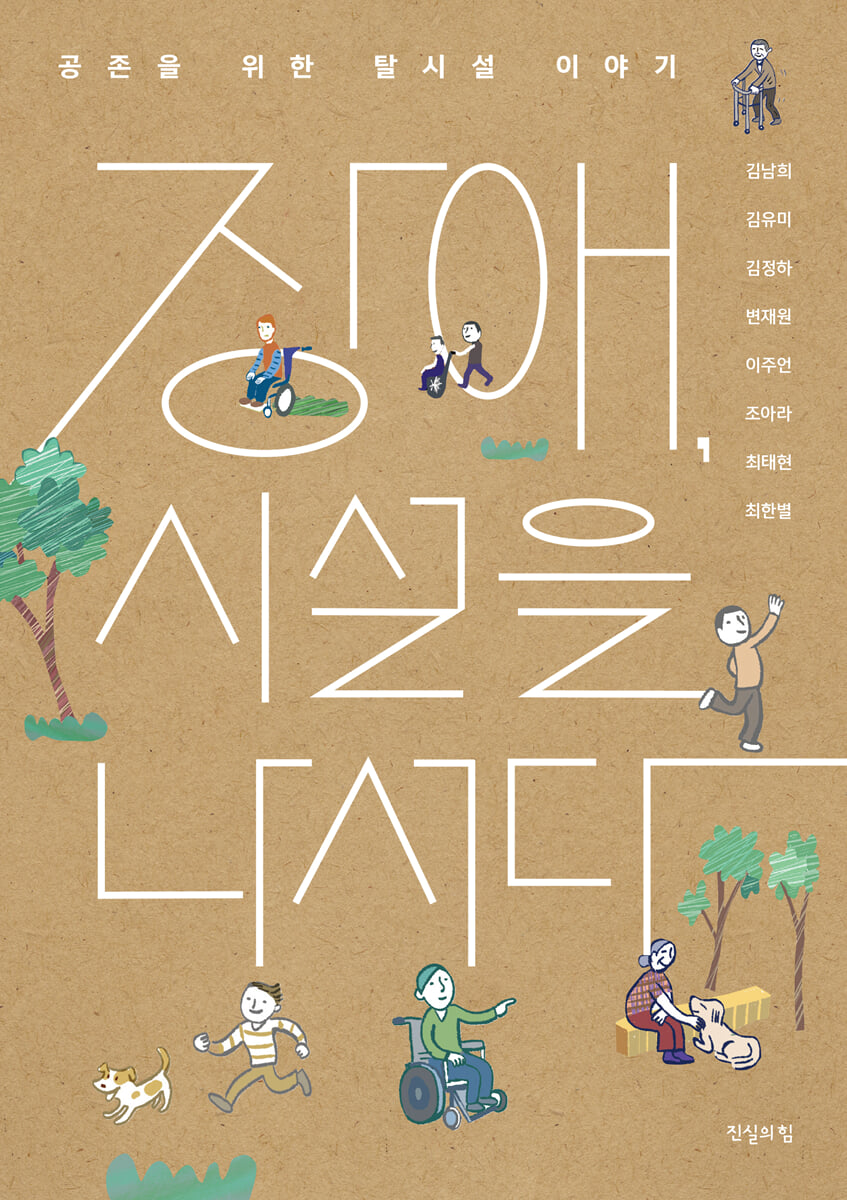
Disability, leaving the facility
 |
Description
Book Introduction
Challenging the stereotype that people with disabilities must live in institutions.
From facility history to policy alternatives,
An extremely 'realistic' introduction to deinstitutionalization
"Can people with disabilities leave institutions and live well with non-disabled people in their neighborhoods?" This question feels unfamiliar, and the term "deinstitutionalization," which aims for such a society, seems unfamiliar because we perceive institutions as such natural and obvious entities.
The idea that 'disabled people who cannot live on their own should live in institutions' is a logic that justifies the reality of countless disabled people staying in institutions and is common sense that applies throughout our society.
Although reports of abuse and human rights violations occurring in facilities are frequent, the perception that "there is no alternative to facilities" remains persistent.
“Disability, Leaving the Facility” directly challenges this common notion.
The authors, comprised of activists and scholars who advocate for the deinstitutionalization of persons with disabilities, cover the entire spectrum of deinstitutionalization discourse, including research on the origins, history, and characteristics of institutions, examples of foreign countries that have already moved toward deinstitutionalization, questions and counterarguments about deinstitutionalization, and policy alternatives necessary for deinstitutionalization.
It also includes the voices of those involved who have proven through their lives and existence why deinstitutionalization is necessary.
This proves that deinstitutionalization is not just an idealistic claim, but a 'realistic' story that began long ago and has produced alternatives and results.
In that sense, 『Disability, Leaving the Facility』 is a record that delicately captures the future already created by those deinstitutionalized and activists, and ‘news from the world beyond the facility.’
The drawings (8 panels) by cartoonists Seung-ha Yoo and In-hye Hwang, which capture the past and present of those who have left the facility with a warm gaze, visually convey the reality of the facility and life after leaving the facility well.
The need for deinstitutionalization, as the authors explain, is not limited to people with disabilities.
There are people in Korean society who could be sent to institutions at any time, such as children, the homeless, the mentally ill, and the elderly.
In particular, in a reality where the population aged 65 and over is already over 20% and the number of nursing homes and hospitals is rapidly increasing, we are faced with the question of 'how to live together with vulnerable people.'
"Disability, Leaving the Facility" offers hints and answers to this question, persuasively demonstrating the possibility of a world where "diverse bodies come together to embrace and care for each other's vulnerabilities" (Kim Ji-hye, author of "The Benevolent Discriminationist").
From facility history to policy alternatives,
An extremely 'realistic' introduction to deinstitutionalization
"Can people with disabilities leave institutions and live well with non-disabled people in their neighborhoods?" This question feels unfamiliar, and the term "deinstitutionalization," which aims for such a society, seems unfamiliar because we perceive institutions as such natural and obvious entities.
The idea that 'disabled people who cannot live on their own should live in institutions' is a logic that justifies the reality of countless disabled people staying in institutions and is common sense that applies throughout our society.
Although reports of abuse and human rights violations occurring in facilities are frequent, the perception that "there is no alternative to facilities" remains persistent.
“Disability, Leaving the Facility” directly challenges this common notion.
The authors, comprised of activists and scholars who advocate for the deinstitutionalization of persons with disabilities, cover the entire spectrum of deinstitutionalization discourse, including research on the origins, history, and characteristics of institutions, examples of foreign countries that have already moved toward deinstitutionalization, questions and counterarguments about deinstitutionalization, and policy alternatives necessary for deinstitutionalization.
It also includes the voices of those involved who have proven through their lives and existence why deinstitutionalization is necessary.
This proves that deinstitutionalization is not just an idealistic claim, but a 'realistic' story that began long ago and has produced alternatives and results.
In that sense, 『Disability, Leaving the Facility』 is a record that delicately captures the future already created by those deinstitutionalized and activists, and ‘news from the world beyond the facility.’
The drawings (8 panels) by cartoonists Seung-ha Yoo and In-hye Hwang, which capture the past and present of those who have left the facility with a warm gaze, visually convey the reality of the facility and life after leaving the facility well.
The need for deinstitutionalization, as the authors explain, is not limited to people with disabilities.
There are people in Korean society who could be sent to institutions at any time, such as children, the homeless, the mentally ill, and the elderly.
In particular, in a reality where the population aged 65 and over is already over 20% and the number of nursing homes and hospitals is rapidly increasing, we are faced with the question of 'how to live together with vulnerable people.'
"Disability, Leaving the Facility" offers hints and answers to this question, persuasively demonstrating the possibility of a world where "diverse bodies come together to embrace and care for each other's vulnerabilities" (Kim Ji-hye, author of "The Benevolent Discriminationist").
- You can preview some of the book's contents.
Preview
index
Starting the story
First Voice: Jo Sang-ji
They have a voice too
The way our ancestors speak
Children with disabilities, ancestors
Entered a nursing home at the age of fifteen
Jo Sang-ji's mother, Lee Hae-ok
To the community
01_ What kind of space is the facility?
What is the facility?
Type of facility
Facility features and facilities
Institutional culture
How was the facility formed?
The origins and present of the facility
The Growth of Institutions: A Cartel of Silence Between Nations, Institutions, and Communities
Structure of the facility
A closed space that creates its own order
Operational structure of social welfare corporation facilities
Incentive structure for expanded reproduction of facilities
staff in the facility
02_ Hold the State Responsible for Facilities
State, another entity in the institutional society
Justification of the facility
The state supports but does not take responsibility
The dire cost of facility maintenance
Facility policy and facility sustainability
Second Voice: Park Man-sun
A world reunited after 49 years
Daily life at the facility
Just a word I was afraid of, deinstitutionalization
Deinstitutionalization and big laughter
Draw a map of your life
03_ Countries that moved ahead toward deinstitutionalization
Why did they choose deinstitutionalization?
Canada: Recognition, Apology, and Compensation
New Zealand: A thorough investigation
United States: From Litigation to Legislation
Sweden: From a Eugenics State to a Leading Deinstitutionalization Nation
What was discovered 30 years ago: The effects of deinstitutionalization.
The emergence of international norms
UN Convention on the Rights of Persons with Disabilities
Deinstitutionalization Guidelines Including Emergency Situations
Third voice: We are doing well!
Speak, express, live
Karaoke and back of the head bangs
04_ Responding to concerns surrounding deinstitutionalization
Argument for deinstitutionalization
Does the person really want this?
The right to self-determination enshrined in law
Is choosing a facility also an exercise of self-determination?
Are you saying that you will investigate my ability to be independent because I am disabled?
Deinstitutionalization: How do you know if you really want it?
There were also some families who opposed it?
What families really want
Deinstitutionalization is de-family care
Isn't it dangerous outside the facility?
The life of activist Park Hyeon
Where is it less dangerous?
Is it a question of location or a question of relationships?
What about the jobs of the people working at the facility?
Deinstitutionalization, is it really okay?
I heard it costs a lot of money, is it possible?
Can we live together?
05_ How far has the deinstitutionalization policy come?
Deinstitutionalization for the realization of dignity
Deinstitutionalization and Housing Rights
Housing: A Prerequisite for Deinstitutionalization
Housing Prerequisites for Deinstitutionalization Policy: Housing First
Housing after Deinstitutionalization: Supported Housing and Self-Reliance Settlement Grants
Deinstitutionalization and Income Security
Deinstitutionalization and pensions
Deinstitutionalization and Labor
Deinstitutionalization and activity support
Activity Support Policy
From ‘decision support’ to ‘decision making’
Deinstitutionalization and Independent Living: The Ultimate Goal
Challenges toward self-reliance
The Last Voice: An Invitation from Activists
The possibility of deinstitutionalization
Human rights of facility residents
Give them a chance too
The changes they brought
Imagining greater change
I hope the facility is not our grave
Here's the house: Beyond the cost
Imagine a tomorrow together
annotation
Timeline of the Deinstitutionalization Movement
First Voice: Jo Sang-ji
They have a voice too
The way our ancestors speak
Children with disabilities, ancestors
Entered a nursing home at the age of fifteen
Jo Sang-ji's mother, Lee Hae-ok
To the community
01_ What kind of space is the facility?
What is the facility?
Type of facility
Facility features and facilities
Institutional culture
How was the facility formed?
The origins and present of the facility
The Growth of Institutions: A Cartel of Silence Between Nations, Institutions, and Communities
Structure of the facility
A closed space that creates its own order
Operational structure of social welfare corporation facilities
Incentive structure for expanded reproduction of facilities
staff in the facility
02_ Hold the State Responsible for Facilities
State, another entity in the institutional society
Justification of the facility
The state supports but does not take responsibility
The dire cost of facility maintenance
Facility policy and facility sustainability
Second Voice: Park Man-sun
A world reunited after 49 years
Daily life at the facility
Just a word I was afraid of, deinstitutionalization
Deinstitutionalization and big laughter
Draw a map of your life
03_ Countries that moved ahead toward deinstitutionalization
Why did they choose deinstitutionalization?
Canada: Recognition, Apology, and Compensation
New Zealand: A thorough investigation
United States: From Litigation to Legislation
Sweden: From a Eugenics State to a Leading Deinstitutionalization Nation
What was discovered 30 years ago: The effects of deinstitutionalization.
The emergence of international norms
UN Convention on the Rights of Persons with Disabilities
Deinstitutionalization Guidelines Including Emergency Situations
Third voice: We are doing well!
Speak, express, live
Karaoke and back of the head bangs
04_ Responding to concerns surrounding deinstitutionalization
Argument for deinstitutionalization
Does the person really want this?
The right to self-determination enshrined in law
Is choosing a facility also an exercise of self-determination?
Are you saying that you will investigate my ability to be independent because I am disabled?
Deinstitutionalization: How do you know if you really want it?
There were also some families who opposed it?
What families really want
Deinstitutionalization is de-family care
Isn't it dangerous outside the facility?
The life of activist Park Hyeon
Where is it less dangerous?
Is it a question of location or a question of relationships?
What about the jobs of the people working at the facility?
Deinstitutionalization, is it really okay?
I heard it costs a lot of money, is it possible?
Can we live together?
05_ How far has the deinstitutionalization policy come?
Deinstitutionalization for the realization of dignity
Deinstitutionalization and Housing Rights
Housing: A Prerequisite for Deinstitutionalization
Housing Prerequisites for Deinstitutionalization Policy: Housing First
Housing after Deinstitutionalization: Supported Housing and Self-Reliance Settlement Grants
Deinstitutionalization and Income Security
Deinstitutionalization and pensions
Deinstitutionalization and Labor
Deinstitutionalization and activity support
Activity Support Policy
From ‘decision support’ to ‘decision making’
Deinstitutionalization and Independent Living: The Ultimate Goal
Challenges toward self-reliance
The Last Voice: An Invitation from Activists
The possibility of deinstitutionalization
Human rights of facility residents
Give them a chance too
The changes they brought
Imagining greater change
I hope the facility is not our grave
Here's the house: Beyond the cost
Imagine a tomorrow together
annotation
Timeline of the Deinstitutionalization Movement
Publisher's Review
Facilities, spaces that deprive us of autonomy
It is difficult to define in one word what a facility is.
The target population is diverse, including the disabled, the elderly, children, and the homeless, and even facilities for the same disabled have different purposes, sizes, and operating methods.
Still, there are core elements that encompass all facilities.
The point is that it does not guarantee individual autonomy.
Those staying at the facility are under the 'management' of the facility manager and staff.
The cycle of waking up at a set time, eating at a set time, and sleeping at a set time repeats.
I can't even do small things freely.
“Every time I bring someone I love, I have to get permission from the facility, and even if I want to sleep with that person, marry them, or have children, there is nothing I can do arbitrarily within the facility.” (p. 196) In this way, people with disabilities are deprived of the right to lead their own lives within the facility.
This is proven by the words of Sangji Jo, a person with brain damage who spent his childhood in a nursing home.
He says that because thinking about the facility was painful, stopping to think was part of 'adapting' to the facility.
“There is no need to think about it in the facility.
There's nothing to worry about.
Because you just have to do what the facility tells you to do.
I didn't even have to think about what I wanted to eat.
Because you can't eat it in the facility anyway.
…I started to think less and less because thinking about it made me miserable.
Isn't that adaptation?
I try not to think about it because there's nothing I can do about it.
“I think that accepting and giving up on the fact that I would have to live in the facility until I died was part of adapting to the facility.” (pp. 36-37)
This reality overturns our perception that 'people with disabilities must go to facilities because they cannot be independent.'
“It is not that people with disabilities enter facilities because they are incapacitated/powerless, but rather that they become incapacitated/powerless because they enter a facility where they cannot do anything” (p. 59).
Disabled people who are rendered powerless in this way easily become targets of violence and abuse carried out in the name of 'control'.
This is a problem that cannot be solved by reducing the number of people living in the same room or improving activity programs.
Therefore, this book argues that the facility problem is not limited to a few facilities where abuse and human rights violations occur, but rather a problem of the facilities themselves, “where control, coercion, discrimination, and violence are inherently inevitable” (p. 151).
Furthermore, he emphasizes that to solve the facility problem, people with disabilities must leave the facility and live together with non-disabled people in the community.
What the countries that have moved ahead with deinstitutionalization have proven
The authors show that even the so-called advanced countries' facilities do not guarantee human rights, through examples from foreign countries that have already chosen that path.
Representative examples include Huronia (Canada), where 3,000 developmentally disabled people were overcrowded in a building that could accommodate 1,400 people and forced to do things like scrubbing the floor, resulting in huge ulcers on the residents' hands and knees; Lake Alice Psychiatric Hospital (New Zealand), where children and adolescents were subjected to various physical and sexual abuses, including physical confinement, and drug abuse; and Penhurst State School (USA), where residents' broken bones were left untreated and people were kept in rooms and hosed down instead of bathed.
However, after witnessing abuse and human rights violations at the facilities, countries such as Canada, New Zealand, and the United States, despite many twists and turns, moved toward closing the facilities.
Since then, many scholars have studied the effects of deinstitutionalization and discovered that living in the community is better for both the individuals involved and society as a whole than living in an institution.
For example, Dr. James Conroy's study of 1,154 people who had lived in the Pennhurst facility and returned to the community found that their independence increased, and the number of people who reported high life satisfaction doubled.
In addition, various studies on deinstitutionalization have proven that, among large-scale facilities, small-scale facilities, and local communities, 'life in the local community is clearly the best form of life.'
Concerns and objections surrounding deinstitutionalization
Although there are already examples of countries moving towards deinstitutionalization and studies demonstrating the positive effects of deinstitutionalization, concerns surrounding deinstitutionalization clearly exist.
There are many concerns about the feasibility and practicality of deinstitutionalization, such as whether the people involved truly want to leave the facility, what to do with the jobs of the facility staff, and whether the increased budget can be sustained.
“Disability, Leaving the Facility” also provides answers to these questions.
Let's look at just two things.
The first question is, 'Can people with disabilities really live well in the community?'
These concerns arise from both people with disabilities and the community.
First, there is the possibility that the disabled person may be at risk of becoming a victim of crime after leaving the facility.
Some worry that if a caregiver abuses a person with a disability, a home alone may be more dangerous than a facility.
But the authors say we should turn the question around and ask, instead of where is safer for people with disabilities, how can we create safe spaces for people with disabilities? The answer lies in “relationships.”
“Safety is not achieved through a change in location, but through strengthening relationships.” (p. 196) This means that if family and friends frequently visit a person with a disability and show interest in his or her daily life and health, and if the people around him or her know about it, it will be difficult for anyone to treat him or her carelessly.
However, in terms of strengthening relationships, residential facilities for the disabled have many disadvantages compared to private homes.
Facilities for the disabled are often located on the outskirts of the city, making it difficult for people to get to them. Even if the facilities are located in the city, there may not be a suitable space to meet visitors in person, or outsiders may need permission from the manager to visit.
However, in reality, even people with disabilities who have successfully left institutions often fail to form sufficient social relationships, so it cannot be said that the community is necessarily safer than institutions.
Therefore, we must consider ways for people with disabilities within the community to build relationships with various community members.
This is because deinstitutionalization is not simply a matter of moving living space to the community, but rather “a matter of forming life relationships in the community and living as a member of that society” (p. 226).
Conversely, there are concerns that people with disabilities may be dangerous, but there are also claims that people with disabilities may engage in challenging behaviors that are harmful to themselves and others, thereby compromising the safety of their communities.
However, the study by James Conroy, introduced earlier, shows that even people with severe developmental disabilities with challenging behaviors lived without any problems after returning to the community.
A study of people with developmental disabilities who moved from Daegu City Hope Center's residential facility for the disabled and a study of people who moved from Hyangyu House to support housing for the disabled also show that this claim is exaggerated.
In fact, sending a disabled person with severe challenging behavior to an institution can cause even bigger problems or make sending them at all impossible.
The fact is that people with disabilities who have very challenging behaviors have a harder time staying in institutions or are not accepted at all.
The very environment of having to live in the same space with many people under set rules and controls can further encourage challenging behavior in people with developmental disabilities because it increases stress.
And when signing admission contracts, facility operators often include conditions that allow residents to be evicted if their challenging behavior causes harm to other residents or staff, or even deny admission altogether (p. 237).
There are also frequent concerns that families of people with disabilities may oppose deinstitutionalization.
There are families who actually oppose deinstitutionalization, arguing that it places a heavy burden on the family, and this happens often in reality.
However, the authors argue that what is truly important to families is not whether they are institutionalized or deinstitutionalized, but the happiness of the person with a disability, and that deinstitutionalization is one means to achieve this.
Of course, there is a clear premise here.
To ensure that deinstitutionalization does not place an unmanageable burden on families, the government must provide various information, including support services available after deinstitutionalization, and move toward "socialized care" in which people with disabilities are cared for together.
Only when the state, which has been a key player in facility policy but has not taken responsibility, takes on its role can we create a society where people with disabilities and their families can live happily and prosperously in their local communities.
The state as an entity that guarantees the rights of persons with disabilities
The state bears a significant responsibility for the fact that Korea's disability policy has become centered on facilities.
The state's attitude toward the facility can be summarized as 'supportive but not responsible'.
In a structure where private organizations deliver social welfare services and the state provides subsidies, the state's role is limited to support, management, and supervision.
However, while support such as inheritance tax and gift tax exemption, corporate tax reduction for profit-making businesses, and support for facility operating costs and personnel expenses worked well, management and supervision did not work well.
Meanwhile, abuse and violence have occurred in many facilities.
"Disability, Leaving the Institution" demands that the state do its part to ensure that people with disabilities can live humane lives, and presents policy alternatives for deinstitutionalization.
We propose specific policies necessary in three aspects: housing, income, and activity support, including expanding public rental housing, including housing for the disabled that provides both housing support services and living space; guaranteeing jobs that allow people with disabilities to generate income and build relationships with others in the workplace; and improving activity support services that do not adequately consider the needs of people with developmental disabilities.
Budget analysis also shows that such a policy is feasible.
It is often thought that deinstitutionalization costs a huge amount of money, but the money spent on pensions and activity support services, which account for the majority of the deinstitutionalization budget, is not strictly speaking a pure deinstitutionalization budget.
This is because pensions are received not only by people with disabilities but also by all citizens who fall below a certain income standard, and the activity support service budget is not paid to the disabled themselves, but rather to social welfare workers who support the activities of the disabled.
It should also be taken into account that deinstitutionalization will reduce the budget allocated to residential facilities for the disabled.
One study estimates that if the 28,000 people with disabilities currently living in facilities were to leave at once, the additional net budget needed would be approximately 374.6 billion won.
This figure is less than 0.06% of the total national budget expenditure of 657 trillion won in 2024.
The authors argue that the budget burden is not large because it is being implemented over 20 years according to the government's roadmap for facilities for the disabled.
In this way, 『Disability, Leaving the Facility』 proves that deinstitutionalization is not just a normative argument, but a realistic alternative possible here and now.
Strong evidence of deinstitutionalization: the voices of those involved
This book also contains the voices of those who left the facility and began to live as their true selves after returning to the community.
Their voices are in themselves powerful evidence of why deinstitutionalization is necessary.
Mr. Park Man-soon's story shows why the logic that "you can't force someone out if they don't want to" is flawed.
Having spent 49 years in Ingangwon, he used to get angry at the mere mention of the word “independence” and say, “I’m going to live in Ingangwon,” but now he waves off the words “Come back to Ingangwon” and says, “My room in the independent housing is the best.”
When they say they want to stay in the facility, it doesn't mean that the facility is good, but that they have been isolated and cut off from society for too long, and that they are afraid of going outside the facility.
Only after gaining the opportunity to experience life outside the facility did Park Man-soon find what he truly desired: the freedom he had been denied in the facility.
Kim Mi-young (pseudonym)'s 'back of the head puff' is a counter-argument to the claim that 'the facilities are better anyway.'
Because of his disability, he had to be bedridden for long periods of time and needed high-quality medical care and assistance with daily living, but this was not possible in a facility where one staff member assists several people.
On cold days, I couldn't travel or go out because I was afraid of catching a cold.
After leaving the facility, Kim Mi-young was able to freely go for walks in other neighborhoods, and as she had more time for social activities than before, her 'hair back' naturally came back to life.
“This is the change that occurred when Kim Mi-young, who was part of the facility residents group, acquired the status of a citizen of the community.” (p. 186)
Moon Seok-young asks, "What if disabled people can't live properly after leaving the facility?" in response to the question, "But isn't it true that not all non-disabled people live well?"
Additionally, it is emphasized that even if a person with a disability cannot live properly outside the facility, that is not a reason for them to remain in the facility.
“No one knows what we can do until we try it ourselves.
So please help us get out of the facility and live.
Some people ask what will happen if we leave the facility and can't live.
But not all non-disabled people live well.
We too are people who can cultivate the strength to live in the region.
“Even though it is difficult and tiring to live outside the facility, I never want to go back to it.” (p. 290)
People with Disabilities: Fellow Citizens with the 'Right to Fail'
“Disability, Leaving the Facility” is an indictment that exposes that “the previous claim that you are admitted to the facility because you have a disability or lack ability is not consideration, but exclusion” (p. 294), and is also “a wonderful invitation that contains the hope of crossing with you into a world that allows risk and failure even for people with disabilities” (Jang Il-ho, author of “Visit of Sadness”).
The argument that disabled people may fail to become independent in the community has served as a justification for institutionalizing disabled people.
However, this book actually argues for guaranteeing the 'right to fail' to people with disabilities.
Not only in Korea, but also in American society, those involved in the independent living movement for people with disabilities have called for the right to fail.
This is because the possibility of ‘failure to become independent’ is often raised as the biggest reason why the independent living of disabled people cannot be recognized.
But for people with disabilities, a life without even the possibility of failure meant being unable to make any decisions on their own.
If relying solely on the help of others is the only way to live without failure, then having the right to fail is understood as regaining self-determination. (p. 275)
When people with disabilities have the same opportunity as non-disabled people to “fail, take risks, and live ‘humanly’” (Kim Ji-hye), other people who may be sent to institutions at any time can also be guaranteed the rights they deserve as citizens.
The waves push everyone up.
The wave of disability rights activism, centered on deinstitutionalization, is serving as a source of democratic energy that elevates the rights of all citizens who transcend the boundaries of institutional life, including not only people with disabilities but also the elderly, the homeless, and children. (p. 307)
In this way, 『Disability, Leaving the Facility』 expands beyond the stories of people with disabilities inside and outside the facility to a story of a world where vulnerability is not a reason for exclusion.
This book cautiously invites us into a world beyond the facility, urging us to move toward a world where diverse bodies coexist, welcoming all vulnerabilities, rather than where you and I each live independently.
It is difficult to define in one word what a facility is.
The target population is diverse, including the disabled, the elderly, children, and the homeless, and even facilities for the same disabled have different purposes, sizes, and operating methods.
Still, there are core elements that encompass all facilities.
The point is that it does not guarantee individual autonomy.
Those staying at the facility are under the 'management' of the facility manager and staff.
The cycle of waking up at a set time, eating at a set time, and sleeping at a set time repeats.
I can't even do small things freely.
“Every time I bring someone I love, I have to get permission from the facility, and even if I want to sleep with that person, marry them, or have children, there is nothing I can do arbitrarily within the facility.” (p. 196) In this way, people with disabilities are deprived of the right to lead their own lives within the facility.
This is proven by the words of Sangji Jo, a person with brain damage who spent his childhood in a nursing home.
He says that because thinking about the facility was painful, stopping to think was part of 'adapting' to the facility.
“There is no need to think about it in the facility.
There's nothing to worry about.
Because you just have to do what the facility tells you to do.
I didn't even have to think about what I wanted to eat.
Because you can't eat it in the facility anyway.
…I started to think less and less because thinking about it made me miserable.
Isn't that adaptation?
I try not to think about it because there's nothing I can do about it.
“I think that accepting and giving up on the fact that I would have to live in the facility until I died was part of adapting to the facility.” (pp. 36-37)
This reality overturns our perception that 'people with disabilities must go to facilities because they cannot be independent.'
“It is not that people with disabilities enter facilities because they are incapacitated/powerless, but rather that they become incapacitated/powerless because they enter a facility where they cannot do anything” (p. 59).
Disabled people who are rendered powerless in this way easily become targets of violence and abuse carried out in the name of 'control'.
This is a problem that cannot be solved by reducing the number of people living in the same room or improving activity programs.
Therefore, this book argues that the facility problem is not limited to a few facilities where abuse and human rights violations occur, but rather a problem of the facilities themselves, “where control, coercion, discrimination, and violence are inherently inevitable” (p. 151).
Furthermore, he emphasizes that to solve the facility problem, people with disabilities must leave the facility and live together with non-disabled people in the community.
What the countries that have moved ahead with deinstitutionalization have proven
The authors show that even the so-called advanced countries' facilities do not guarantee human rights, through examples from foreign countries that have already chosen that path.
Representative examples include Huronia (Canada), where 3,000 developmentally disabled people were overcrowded in a building that could accommodate 1,400 people and forced to do things like scrubbing the floor, resulting in huge ulcers on the residents' hands and knees; Lake Alice Psychiatric Hospital (New Zealand), where children and adolescents were subjected to various physical and sexual abuses, including physical confinement, and drug abuse; and Penhurst State School (USA), where residents' broken bones were left untreated and people were kept in rooms and hosed down instead of bathed.
However, after witnessing abuse and human rights violations at the facilities, countries such as Canada, New Zealand, and the United States, despite many twists and turns, moved toward closing the facilities.
Since then, many scholars have studied the effects of deinstitutionalization and discovered that living in the community is better for both the individuals involved and society as a whole than living in an institution.
For example, Dr. James Conroy's study of 1,154 people who had lived in the Pennhurst facility and returned to the community found that their independence increased, and the number of people who reported high life satisfaction doubled.
In addition, various studies on deinstitutionalization have proven that, among large-scale facilities, small-scale facilities, and local communities, 'life in the local community is clearly the best form of life.'
Concerns and objections surrounding deinstitutionalization
Although there are already examples of countries moving towards deinstitutionalization and studies demonstrating the positive effects of deinstitutionalization, concerns surrounding deinstitutionalization clearly exist.
There are many concerns about the feasibility and practicality of deinstitutionalization, such as whether the people involved truly want to leave the facility, what to do with the jobs of the facility staff, and whether the increased budget can be sustained.
“Disability, Leaving the Facility” also provides answers to these questions.
Let's look at just two things.
The first question is, 'Can people with disabilities really live well in the community?'
These concerns arise from both people with disabilities and the community.
First, there is the possibility that the disabled person may be at risk of becoming a victim of crime after leaving the facility.
Some worry that if a caregiver abuses a person with a disability, a home alone may be more dangerous than a facility.
But the authors say we should turn the question around and ask, instead of where is safer for people with disabilities, how can we create safe spaces for people with disabilities? The answer lies in “relationships.”
“Safety is not achieved through a change in location, but through strengthening relationships.” (p. 196) This means that if family and friends frequently visit a person with a disability and show interest in his or her daily life and health, and if the people around him or her know about it, it will be difficult for anyone to treat him or her carelessly.
However, in terms of strengthening relationships, residential facilities for the disabled have many disadvantages compared to private homes.
Facilities for the disabled are often located on the outskirts of the city, making it difficult for people to get to them. Even if the facilities are located in the city, there may not be a suitable space to meet visitors in person, or outsiders may need permission from the manager to visit.
However, in reality, even people with disabilities who have successfully left institutions often fail to form sufficient social relationships, so it cannot be said that the community is necessarily safer than institutions.
Therefore, we must consider ways for people with disabilities within the community to build relationships with various community members.
This is because deinstitutionalization is not simply a matter of moving living space to the community, but rather “a matter of forming life relationships in the community and living as a member of that society” (p. 226).
Conversely, there are concerns that people with disabilities may be dangerous, but there are also claims that people with disabilities may engage in challenging behaviors that are harmful to themselves and others, thereby compromising the safety of their communities.
However, the study by James Conroy, introduced earlier, shows that even people with severe developmental disabilities with challenging behaviors lived without any problems after returning to the community.
A study of people with developmental disabilities who moved from Daegu City Hope Center's residential facility for the disabled and a study of people who moved from Hyangyu House to support housing for the disabled also show that this claim is exaggerated.
In fact, sending a disabled person with severe challenging behavior to an institution can cause even bigger problems or make sending them at all impossible.
The fact is that people with disabilities who have very challenging behaviors have a harder time staying in institutions or are not accepted at all.
The very environment of having to live in the same space with many people under set rules and controls can further encourage challenging behavior in people with developmental disabilities because it increases stress.
And when signing admission contracts, facility operators often include conditions that allow residents to be evicted if their challenging behavior causes harm to other residents or staff, or even deny admission altogether (p. 237).
There are also frequent concerns that families of people with disabilities may oppose deinstitutionalization.
There are families who actually oppose deinstitutionalization, arguing that it places a heavy burden on the family, and this happens often in reality.
However, the authors argue that what is truly important to families is not whether they are institutionalized or deinstitutionalized, but the happiness of the person with a disability, and that deinstitutionalization is one means to achieve this.
Of course, there is a clear premise here.
To ensure that deinstitutionalization does not place an unmanageable burden on families, the government must provide various information, including support services available after deinstitutionalization, and move toward "socialized care" in which people with disabilities are cared for together.
Only when the state, which has been a key player in facility policy but has not taken responsibility, takes on its role can we create a society where people with disabilities and their families can live happily and prosperously in their local communities.
The state as an entity that guarantees the rights of persons with disabilities
The state bears a significant responsibility for the fact that Korea's disability policy has become centered on facilities.
The state's attitude toward the facility can be summarized as 'supportive but not responsible'.
In a structure where private organizations deliver social welfare services and the state provides subsidies, the state's role is limited to support, management, and supervision.
However, while support such as inheritance tax and gift tax exemption, corporate tax reduction for profit-making businesses, and support for facility operating costs and personnel expenses worked well, management and supervision did not work well.
Meanwhile, abuse and violence have occurred in many facilities.
"Disability, Leaving the Institution" demands that the state do its part to ensure that people with disabilities can live humane lives, and presents policy alternatives for deinstitutionalization.
We propose specific policies necessary in three aspects: housing, income, and activity support, including expanding public rental housing, including housing for the disabled that provides both housing support services and living space; guaranteeing jobs that allow people with disabilities to generate income and build relationships with others in the workplace; and improving activity support services that do not adequately consider the needs of people with developmental disabilities.
Budget analysis also shows that such a policy is feasible.
It is often thought that deinstitutionalization costs a huge amount of money, but the money spent on pensions and activity support services, which account for the majority of the deinstitutionalization budget, is not strictly speaking a pure deinstitutionalization budget.
This is because pensions are received not only by people with disabilities but also by all citizens who fall below a certain income standard, and the activity support service budget is not paid to the disabled themselves, but rather to social welfare workers who support the activities of the disabled.
It should also be taken into account that deinstitutionalization will reduce the budget allocated to residential facilities for the disabled.
One study estimates that if the 28,000 people with disabilities currently living in facilities were to leave at once, the additional net budget needed would be approximately 374.6 billion won.
This figure is less than 0.06% of the total national budget expenditure of 657 trillion won in 2024.
The authors argue that the budget burden is not large because it is being implemented over 20 years according to the government's roadmap for facilities for the disabled.
In this way, 『Disability, Leaving the Facility』 proves that deinstitutionalization is not just a normative argument, but a realistic alternative possible here and now.
Strong evidence of deinstitutionalization: the voices of those involved
This book also contains the voices of those who left the facility and began to live as their true selves after returning to the community.
Their voices are in themselves powerful evidence of why deinstitutionalization is necessary.
Mr. Park Man-soon's story shows why the logic that "you can't force someone out if they don't want to" is flawed.
Having spent 49 years in Ingangwon, he used to get angry at the mere mention of the word “independence” and say, “I’m going to live in Ingangwon,” but now he waves off the words “Come back to Ingangwon” and says, “My room in the independent housing is the best.”
When they say they want to stay in the facility, it doesn't mean that the facility is good, but that they have been isolated and cut off from society for too long, and that they are afraid of going outside the facility.
Only after gaining the opportunity to experience life outside the facility did Park Man-soon find what he truly desired: the freedom he had been denied in the facility.
Kim Mi-young (pseudonym)'s 'back of the head puff' is a counter-argument to the claim that 'the facilities are better anyway.'
Because of his disability, he had to be bedridden for long periods of time and needed high-quality medical care and assistance with daily living, but this was not possible in a facility where one staff member assists several people.
On cold days, I couldn't travel or go out because I was afraid of catching a cold.
After leaving the facility, Kim Mi-young was able to freely go for walks in other neighborhoods, and as she had more time for social activities than before, her 'hair back' naturally came back to life.
“This is the change that occurred when Kim Mi-young, who was part of the facility residents group, acquired the status of a citizen of the community.” (p. 186)
Moon Seok-young asks, "What if disabled people can't live properly after leaving the facility?" in response to the question, "But isn't it true that not all non-disabled people live well?"
Additionally, it is emphasized that even if a person with a disability cannot live properly outside the facility, that is not a reason for them to remain in the facility.
“No one knows what we can do until we try it ourselves.
So please help us get out of the facility and live.
Some people ask what will happen if we leave the facility and can't live.
But not all non-disabled people live well.
We too are people who can cultivate the strength to live in the region.
“Even though it is difficult and tiring to live outside the facility, I never want to go back to it.” (p. 290)
People with Disabilities: Fellow Citizens with the 'Right to Fail'
“Disability, Leaving the Facility” is an indictment that exposes that “the previous claim that you are admitted to the facility because you have a disability or lack ability is not consideration, but exclusion” (p. 294), and is also “a wonderful invitation that contains the hope of crossing with you into a world that allows risk and failure even for people with disabilities” (Jang Il-ho, author of “Visit of Sadness”).
The argument that disabled people may fail to become independent in the community has served as a justification for institutionalizing disabled people.
However, this book actually argues for guaranteeing the 'right to fail' to people with disabilities.
Not only in Korea, but also in American society, those involved in the independent living movement for people with disabilities have called for the right to fail.
This is because the possibility of ‘failure to become independent’ is often raised as the biggest reason why the independent living of disabled people cannot be recognized.
But for people with disabilities, a life without even the possibility of failure meant being unable to make any decisions on their own.
If relying solely on the help of others is the only way to live without failure, then having the right to fail is understood as regaining self-determination. (p. 275)
When people with disabilities have the same opportunity as non-disabled people to “fail, take risks, and live ‘humanly’” (Kim Ji-hye), other people who may be sent to institutions at any time can also be guaranteed the rights they deserve as citizens.
The waves push everyone up.
The wave of disability rights activism, centered on deinstitutionalization, is serving as a source of democratic energy that elevates the rights of all citizens who transcend the boundaries of institutional life, including not only people with disabilities but also the elderly, the homeless, and children. (p. 307)
In this way, 『Disability, Leaving the Facility』 expands beyond the stories of people with disabilities inside and outside the facility to a story of a world where vulnerability is not a reason for exclusion.
This book cautiously invites us into a world beyond the facility, urging us to move toward a world where diverse bodies coexist, welcoming all vulnerabilities, rather than where you and I each live independently.
GOODS SPECIFICS
- Date of issue: March 4, 2025
- Page count, weight, size: 332 pages | 452g | 148*210*20mm
- ISBN13: 9791198505644
- ISBN10: 1198505648
You may also like
카테고리
korean


korean

![GQ KOREA Mark (Monthly): December [2025]](http://librairie.coreenne.fr/cdn/shop/files/8ef265dbbfbf186523ed75ba7319009d.jpg?v=1765340328&width=3840)


