

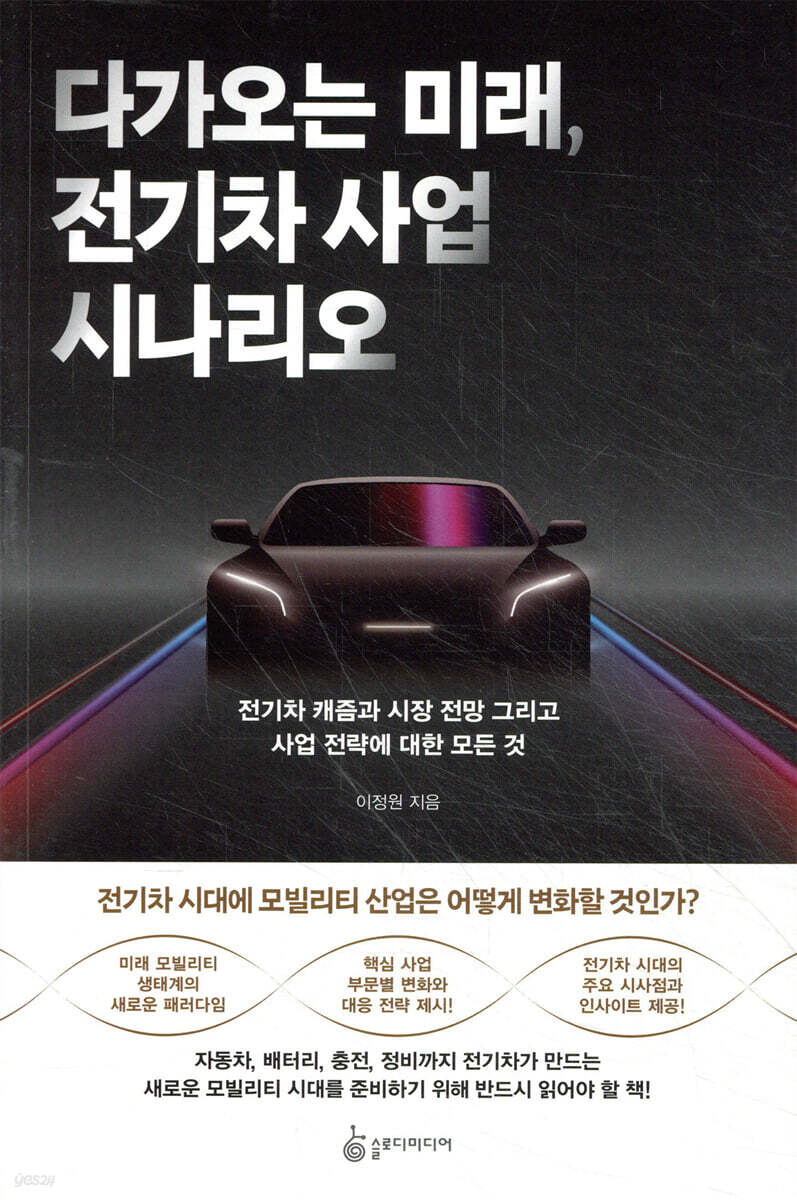
The coming future: electric vehicle business scenarios
 |
Description
Book Introduction
Lee Jeong-won, a future mobility expert, says:
Changes and prospects in the electric vehicle era
It will provide important implications and insights to many people!
Electric vehicles are made of cars, batteries, charging, and maintenance.
A must-read to prepare for the new era of mobility!
This book began with a consideration of what changes will occur in the automobile industry and what preparations are needed for each business sector when the era of full-scale electric vehicles arrives.
Having worked in the strategic departments of global companies, including automakers and mobility platform providers, for over 15 years, I have personally experienced the changes in the automotive industry brought about by electrification.
Some of these changes are well known to people, while others have not yet had a significant impact.
Furthermore, by focusing solely on the marketability of electric vehicles, we are missing out on the status and future direction of each major business.
Looking at the books on electric vehicles currently published in Korea, they are sufficient to satisfy people's interest in electric vehicles and Tesla, but they are somewhat lacking in understanding the changes that electrification will bring.
This book begins with an analysis of the electric vehicle chasm, the biggest topic in the electric vehicle market, and the electric vehicle market outlook, and then covers the changes in the mobility ecosystem that will emerge in the full-fledged electric vehicle era.
In addition, it presented a strategy for changes and future directions in the core business sectors of electric vehicles: automobiles, batteries, charging, maintenance, tires, and waste batteries.
As a current employee in the mobility industry, I hope this book will be of some help to companies and managers preparing for the electric vehicle era.
Changes and prospects in the electric vehicle era
It will provide important implications and insights to many people!
Electric vehicles are made of cars, batteries, charging, and maintenance.
A must-read to prepare for the new era of mobility!
This book began with a consideration of what changes will occur in the automobile industry and what preparations are needed for each business sector when the era of full-scale electric vehicles arrives.
Having worked in the strategic departments of global companies, including automakers and mobility platform providers, for over 15 years, I have personally experienced the changes in the automotive industry brought about by electrification.
Some of these changes are well known to people, while others have not yet had a significant impact.
Furthermore, by focusing solely on the marketability of electric vehicles, we are missing out on the status and future direction of each major business.
Looking at the books on electric vehicles currently published in Korea, they are sufficient to satisfy people's interest in electric vehicles and Tesla, but they are somewhat lacking in understanding the changes that electrification will bring.
This book begins with an analysis of the electric vehicle chasm, the biggest topic in the electric vehicle market, and the electric vehicle market outlook, and then covers the changes in the mobility ecosystem that will emerge in the full-fledged electric vehicle era.
In addition, it presented a strategy for changes and future directions in the core business sectors of electric vehicles: automobiles, batteries, charging, maintenance, tires, and waste batteries.
As a current employee in the mobility industry, I hope this book will be of some help to companies and managers preparing for the electric vehicle era.
index
Recommendation 05
Prologue: Electric Vehicles: A New Paradigm for the Automotive Industry 08
Chapter 1: Electric Vehicles: A New Turning Point in the Mobility Ecosystem
17 Reasons Why We Should Pay Attention to Electric Vehicles
The Electric Vehicle Chasm: What Does It Mean? 21
When will the era of full-scale electric vehicles arrive? 28
Chapter 2: Automakers: Key Players Driving the Electric Vehicle Market
From the automotive industry to the mobility industry, 37 automakers at the center of it all.
Who Will Take Hegemony in the Electric Vehicle Era? 43
Who are the key players shaping the electric vehicle era? 48
Chapter 3: How far will the electric vehicle battery business grow?
The electric vehicle battery business: the true leader of the electric vehicle era.
How Are Electric Vehicle Batteries Evolving? 61
Who Will Lead the Future of Electric Vehicle Battery Business? 73
Chapter 4: Electric Vehicle Charging Business: A High-Value-Added Business Growing Alongside the Electric Vehicle Market
Charging Electric Vehicles: A Perennial Challenge in the Electric Vehicle Era 85
Who Will Lead the Electric Vehicle Charging Business? 94
How Will Electric Vehicle Charging Infrastructure Evolve? 109
Chapter 5: The Auto Repair Business Needs a Survival Strategy in the Electric Vehicle Era
The Automotive Industry's Core: Automotive Maintenance 121
The Electric Vehicle Era: A Major Crisis for the Auto Repair Business 127
What are the new automotive maintenance business models for the electric vehicle era? 138
Chapter 6: What are the emerging businesses in the electric vehicle era?
The electric vehicle tire war has already begun. 149
Could electric vehicle lubricants become a new growth engine for oil refineries? 154
Recycling electric vehicle batteries completes the battery business value chain.
Mobility services need to adjust their pace to prepare for the electric vehicle era. 166
Epilogue: The Electric Vehicle Era is Coming 170
Conclusion 174
References/Reference Sites 177
Prologue: Electric Vehicles: A New Paradigm for the Automotive Industry 08
Chapter 1: Electric Vehicles: A New Turning Point in the Mobility Ecosystem
17 Reasons Why We Should Pay Attention to Electric Vehicles
The Electric Vehicle Chasm: What Does It Mean? 21
When will the era of full-scale electric vehicles arrive? 28
Chapter 2: Automakers: Key Players Driving the Electric Vehicle Market
From the automotive industry to the mobility industry, 37 automakers at the center of it all.
Who Will Take Hegemony in the Electric Vehicle Era? 43
Who are the key players shaping the electric vehicle era? 48
Chapter 3: How far will the electric vehicle battery business grow?
The electric vehicle battery business: the true leader of the electric vehicle era.
How Are Electric Vehicle Batteries Evolving? 61
Who Will Lead the Future of Electric Vehicle Battery Business? 73
Chapter 4: Electric Vehicle Charging Business: A High-Value-Added Business Growing Alongside the Electric Vehicle Market
Charging Electric Vehicles: A Perennial Challenge in the Electric Vehicle Era 85
Who Will Lead the Electric Vehicle Charging Business? 94
How Will Electric Vehicle Charging Infrastructure Evolve? 109
Chapter 5: The Auto Repair Business Needs a Survival Strategy in the Electric Vehicle Era
The Automotive Industry's Core: Automotive Maintenance 121
The Electric Vehicle Era: A Major Crisis for the Auto Repair Business 127
What are the new automotive maintenance business models for the electric vehicle era? 138
Chapter 6: What are the emerging businesses in the electric vehicle era?
The electric vehicle tire war has already begun. 149
Could electric vehicle lubricants become a new growth engine for oil refineries? 154
Recycling electric vehicle batteries completes the battery business value chain.
Mobility services need to adjust their pace to prepare for the electric vehicle era. 166
Epilogue: The Electric Vehicle Era is Coming 170
Conclusion 174
References/Reference Sites 177
Detailed image

Into the book
Unlike internal combustion engine vehicles, electric vehicles do not have engines or transmissions, and instead generate power by supplying electric energy from high-voltage batteries to electric motors.
It is a zero-emission vehicle that does not use any fossil fuels while driving and therefore does not emit carbon dioxide (CO2) or nitrogen oxides (NOx). It also has no engine, so it produces almost no noise and has minimal vibration.
In other words, it can be seen as an eco-friendly car that has a battery and motor instead of an engine and transmission, and does not produce air pollution.
This fact has very important implications from the perspective of environmentally friendly management, which is becoming increasingly important.
--- p.17
The electric vehicle charging business is also an emerging business area.
Although it is not yet at the level of replacing existing gas stations, the trend is to expand its business areas to include charger development, charging station construction, and charging service operation in line with the growth of the electric vehicle market.
No matter how many electric vehicles are sold, it is meaningless if there is a lack of charging infrastructure.
If there are not enough charging stations and charging is inconvenient, electric vehicles will be rejected by people.
Therefore, charging operators, automakers, and even the government are investing and supporting the construction of electric vehicle charging infrastructure, and the project will continue to expand.
There are also sectors that see the electric vehicle market as an opportunity and are expanding their business by producing products specifically for electric vehicles.
The most notable of these companies is a tire manufacturer.
Tire manufacturers are currently responding to the market by developing and producing products specifically for electric vehicles more actively than anyone else. Electric vehicle tires, in particular, are expected to see high demand due to their shorter replacement cycles than those for internal combustion engine vehicles.
If tire companies can successfully establish electric vehicle tires in the market, they will have secured a huge business opportunity.
--- p.19
In 2024, the biggest topic in the electric vehicle market was the 'Chasm'.
The chasm refers to a phenomenon in which demand for a cutting-edge technology product or service temporarily stagnates or declines in the initial market, dominated by a small number of innovative consumers, before reaching widespread use by the general public.
Products that cross the chasm become popular, while those that don't end up being the exclusive domain of a select few early adopters or disappear from the market.
The growth of the electric vehicle market began to slow in the second half of 2023 and began to decelerate significantly in 2024, triggering a slump for automakers and electric vehicle-related companies.
And as this phenomenon continued longer than expected, the term 'electric vehicle chasm' began to emerge.
So, has the electric vehicle market really reached a crisis point called the chasm?
--- p.21
There are also business areas that require close collaboration with automakers to emerge as players in the electric vehicle era.
The maintenance business, which has been a core pillar of the automobile industry, will face a crisis due to the electric vehicle era.
As the proportion of electric vehicles, which require less maintenance than internal combustion engine vehicles, increases, the profitability of maintenance businesses will decline, and small and medium-sized businesses will find it difficult to continue operating.
In response, automakers are preparing electric vehicle-centric maintenance and service systems, and existing repair shops must collaborate with automakers to explore new avenues.
While uncompetitive maintenance centers will disappear, those that implement maintenance models suited to the electric vehicle era will be able to grow even larger than they are now.
--- p.49
From the perspective of automakers, it would be regrettable to have to source high-voltage batteries, a key component of electric vehicles, from other companies.
However, the battery technology and expertise possessed by battery manufacturers are something that no other company can secure in a short period of time.
Of course, not all battery manufacturers can take advantage of this opportunity.
Battery manufacturers will face new challenges whenever electric vehicle market trends change or automakers' electric vehicle strategies shift.
Companies that fail to prepare adequately are bound to lose their competitiveness in the market.
--- p.59
The next thing to watch is the next-generation electric vehicle battery.
It goes without saying that the emergence of an innovative product that changes the market landscape instantly turns existing products and the companies that produce them into latecomers.
Representative examples include Apple's iPod and iPhone, which we are all familiar with, and Tesla's Model S.
The next-generation battery that is currently receiving the most attention in the electric vehicle battery market is undoubtedly the 'all-solid-state battery'.
An all-solid-state battery is a secondary battery in which the electrolyte that allows electricity to flow between the positive and negative electrodes is solid.
Since the electrolyte is solid, it has the advantage of being much less susceptible to impact than conventional lithium-ion batteries, having a high energy density, and containing no flammable substances, making it significantly less likely to catch fire.
Large-scale implementation is also possible.
Although the development of materials and manufacturing processes that can maximize the performance of solid electrolytes has not yet been completed, and mass production technology is lacking, production costs are expected to be high. However, not only existing battery manufacturers but also automobile manufacturers are making significant efforts to invest in and develop technologies for all-solid-state batteries.
--- p.70
From this perspective, the charging infrastructure operated by CPO companies will not be able to fulfill its role as the number of electric vehicles on the road increases.
This is because it is not a standalone charging station, but rather installed in the parking lot of a public institution, apartment, or commercial building, making it suitable for urgent charging or for short-term charging when visiting the area.
Moreover, it is somewhat burdensome for CPO companies to lease or purchase land and operate a standalone charging station of a certain size or larger.
Personally, I believe that as the electric vehicle market enters maturity, the business competitiveness of CPO companies that supported the initial growth of the electric vehicle market will actually decline.
Looking at the domestic market alone, there are over 100 CPO companies, and excluding the top companies, the rest are essentially small businesses.
Therefore, only large CPO companies with solid business foundations and financial structures are likely to survive.
--- p.97
So what's the solution to declining maintenance revenue? The reality is, there's no clear answer.
This is something that must be accepted as the era of electric vehicles arrives, and it is also a benefit given to electric vehicle customers in terms of reducing vehicle maintenance costs.
Ultimately, the automakers will have to step up.
From an electric vehicle management perspective, we need to develop service products that are worth the money customers are willing to pay.
For example, this involves selecting essential items to check for vehicle quality control, creating a service product that includes benefits for replacing certain consumables such as air conditioner filters, wiper blades, and tires, and selling it to customers at a reasonable price.
This allows customers to benefit from vehicle quality management, while maintenance facilities can generate consistent revenue and increase customer retention through regular maintenance services.
--- p.131
As the electric vehicle market grows, the profitability and technological capabilities of the auto repair sector are facing problems, which is not a good sign for the auto industry as a whole.
If the maintenance business, one of the core pillars of the automobile industry, is shaken, it could have a negative impact on the automobile industry itself.
With the number of vehicles on the road increasing worldwide, it is impossible for automakers' maintenance centers alone to service all vehicles and customers.
As electric vehicles proliferate and regular repair shops disappear, repair wait times will increase and customer dissatisfaction will increase.
Ultimately, the automotive maintenance system will face great chaos.
Therefore, automobile manufacturers must lead their maintenance businesses in a direction that will further develop the automobile industry from a long-term perspective.
We must not spare investment and support in maintenance projects, including electric vehicle maintenance training and the establishment of information sharing systems.
--- p.122
In summary, we need to build specialized electric vehicle maintenance facilities to fill the maintenance gap that will emerge as small-scale maintenance facilities disappear, and create a new business structure by expanding our business areas to include maintenance, customization, and parts sales.
And, by creating a platform that responds to electric vehicle maintenance needs through mobile services based on online channels that maximize people's convenience, we must be able to present a new business model, different from the current one.
There is still plenty of time.
By focusing on the pace of electrification, defining the optimal EV maintenance model, and establishing an operational system that improves profitability and customer retention, we can lead the automotive maintenance market in the EV era.
--- p.145
As the proportion of electric vehicles increases, the production of electric vehicle batteries increases, and interest in certain fields naturally increases.
This is the field of ‘electric vehicle waste battery recycling.’
In particular, the value of recycling electric vehicle waste batteries is expected to be higher than that of recycling engines or transmissions from existing internal combustion engine vehicles, making the business attractive.
For example, waste batteries with a residual value of 70-80% or more can be reused as ESS, and when disassembled into cells, they can be reused to produce small batteries for micro-mobility, etc.
And since electric vehicle batteries contain materials such as lithium, cobalt, nickel, and manganese, their value is expected to be high in terms of securing key raw materials for manufacturing electric vehicle batteries.
--- p.160
There is no need to be impatient as we look towards the coming era of electric vehicles.
A radical shift to electric vehicles or service innovations could actually have negative consequences.
Now is the time to adjust the pace for the future.
All we need to do is refine the existing mobility service system and gradually prepare a strategy and roadmap for transitioning to electric vehicles.
The key is to discover new business opportunities in the electric vehicle-centric mobility ecosystem, including how to maximize service profitability, how to utilize electric vehicle data, and what services can be used with newly launched electric vehicles such as PBVs.
Even in the era of electric vehicles, people's need for mobility services will increase, creating more business opportunities.
It is a zero-emission vehicle that does not use any fossil fuels while driving and therefore does not emit carbon dioxide (CO2) or nitrogen oxides (NOx). It also has no engine, so it produces almost no noise and has minimal vibration.
In other words, it can be seen as an eco-friendly car that has a battery and motor instead of an engine and transmission, and does not produce air pollution.
This fact has very important implications from the perspective of environmentally friendly management, which is becoming increasingly important.
--- p.17
The electric vehicle charging business is also an emerging business area.
Although it is not yet at the level of replacing existing gas stations, the trend is to expand its business areas to include charger development, charging station construction, and charging service operation in line with the growth of the electric vehicle market.
No matter how many electric vehicles are sold, it is meaningless if there is a lack of charging infrastructure.
If there are not enough charging stations and charging is inconvenient, electric vehicles will be rejected by people.
Therefore, charging operators, automakers, and even the government are investing and supporting the construction of electric vehicle charging infrastructure, and the project will continue to expand.
There are also sectors that see the electric vehicle market as an opportunity and are expanding their business by producing products specifically for electric vehicles.
The most notable of these companies is a tire manufacturer.
Tire manufacturers are currently responding to the market by developing and producing products specifically for electric vehicles more actively than anyone else. Electric vehicle tires, in particular, are expected to see high demand due to their shorter replacement cycles than those for internal combustion engine vehicles.
If tire companies can successfully establish electric vehicle tires in the market, they will have secured a huge business opportunity.
--- p.19
In 2024, the biggest topic in the electric vehicle market was the 'Chasm'.
The chasm refers to a phenomenon in which demand for a cutting-edge technology product or service temporarily stagnates or declines in the initial market, dominated by a small number of innovative consumers, before reaching widespread use by the general public.
Products that cross the chasm become popular, while those that don't end up being the exclusive domain of a select few early adopters or disappear from the market.
The growth of the electric vehicle market began to slow in the second half of 2023 and began to decelerate significantly in 2024, triggering a slump for automakers and electric vehicle-related companies.
And as this phenomenon continued longer than expected, the term 'electric vehicle chasm' began to emerge.
So, has the electric vehicle market really reached a crisis point called the chasm?
--- p.21
There are also business areas that require close collaboration with automakers to emerge as players in the electric vehicle era.
The maintenance business, which has been a core pillar of the automobile industry, will face a crisis due to the electric vehicle era.
As the proportion of electric vehicles, which require less maintenance than internal combustion engine vehicles, increases, the profitability of maintenance businesses will decline, and small and medium-sized businesses will find it difficult to continue operating.
In response, automakers are preparing electric vehicle-centric maintenance and service systems, and existing repair shops must collaborate with automakers to explore new avenues.
While uncompetitive maintenance centers will disappear, those that implement maintenance models suited to the electric vehicle era will be able to grow even larger than they are now.
--- p.49
From the perspective of automakers, it would be regrettable to have to source high-voltage batteries, a key component of electric vehicles, from other companies.
However, the battery technology and expertise possessed by battery manufacturers are something that no other company can secure in a short period of time.
Of course, not all battery manufacturers can take advantage of this opportunity.
Battery manufacturers will face new challenges whenever electric vehicle market trends change or automakers' electric vehicle strategies shift.
Companies that fail to prepare adequately are bound to lose their competitiveness in the market.
--- p.59
The next thing to watch is the next-generation electric vehicle battery.
It goes without saying that the emergence of an innovative product that changes the market landscape instantly turns existing products and the companies that produce them into latecomers.
Representative examples include Apple's iPod and iPhone, which we are all familiar with, and Tesla's Model S.
The next-generation battery that is currently receiving the most attention in the electric vehicle battery market is undoubtedly the 'all-solid-state battery'.
An all-solid-state battery is a secondary battery in which the electrolyte that allows electricity to flow between the positive and negative electrodes is solid.
Since the electrolyte is solid, it has the advantage of being much less susceptible to impact than conventional lithium-ion batteries, having a high energy density, and containing no flammable substances, making it significantly less likely to catch fire.
Large-scale implementation is also possible.
Although the development of materials and manufacturing processes that can maximize the performance of solid electrolytes has not yet been completed, and mass production technology is lacking, production costs are expected to be high. However, not only existing battery manufacturers but also automobile manufacturers are making significant efforts to invest in and develop technologies for all-solid-state batteries.
--- p.70
From this perspective, the charging infrastructure operated by CPO companies will not be able to fulfill its role as the number of electric vehicles on the road increases.
This is because it is not a standalone charging station, but rather installed in the parking lot of a public institution, apartment, or commercial building, making it suitable for urgent charging or for short-term charging when visiting the area.
Moreover, it is somewhat burdensome for CPO companies to lease or purchase land and operate a standalone charging station of a certain size or larger.
Personally, I believe that as the electric vehicle market enters maturity, the business competitiveness of CPO companies that supported the initial growth of the electric vehicle market will actually decline.
Looking at the domestic market alone, there are over 100 CPO companies, and excluding the top companies, the rest are essentially small businesses.
Therefore, only large CPO companies with solid business foundations and financial structures are likely to survive.
--- p.97
So what's the solution to declining maintenance revenue? The reality is, there's no clear answer.
This is something that must be accepted as the era of electric vehicles arrives, and it is also a benefit given to electric vehicle customers in terms of reducing vehicle maintenance costs.
Ultimately, the automakers will have to step up.
From an electric vehicle management perspective, we need to develop service products that are worth the money customers are willing to pay.
For example, this involves selecting essential items to check for vehicle quality control, creating a service product that includes benefits for replacing certain consumables such as air conditioner filters, wiper blades, and tires, and selling it to customers at a reasonable price.
This allows customers to benefit from vehicle quality management, while maintenance facilities can generate consistent revenue and increase customer retention through regular maintenance services.
--- p.131
As the electric vehicle market grows, the profitability and technological capabilities of the auto repair sector are facing problems, which is not a good sign for the auto industry as a whole.
If the maintenance business, one of the core pillars of the automobile industry, is shaken, it could have a negative impact on the automobile industry itself.
With the number of vehicles on the road increasing worldwide, it is impossible for automakers' maintenance centers alone to service all vehicles and customers.
As electric vehicles proliferate and regular repair shops disappear, repair wait times will increase and customer dissatisfaction will increase.
Ultimately, the automotive maintenance system will face great chaos.
Therefore, automobile manufacturers must lead their maintenance businesses in a direction that will further develop the automobile industry from a long-term perspective.
We must not spare investment and support in maintenance projects, including electric vehicle maintenance training and the establishment of information sharing systems.
--- p.122
In summary, we need to build specialized electric vehicle maintenance facilities to fill the maintenance gap that will emerge as small-scale maintenance facilities disappear, and create a new business structure by expanding our business areas to include maintenance, customization, and parts sales.
And, by creating a platform that responds to electric vehicle maintenance needs through mobile services based on online channels that maximize people's convenience, we must be able to present a new business model, different from the current one.
There is still plenty of time.
By focusing on the pace of electrification, defining the optimal EV maintenance model, and establishing an operational system that improves profitability and customer retention, we can lead the automotive maintenance market in the EV era.
--- p.145
As the proportion of electric vehicles increases, the production of electric vehicle batteries increases, and interest in certain fields naturally increases.
This is the field of ‘electric vehicle waste battery recycling.’
In particular, the value of recycling electric vehicle waste batteries is expected to be higher than that of recycling engines or transmissions from existing internal combustion engine vehicles, making the business attractive.
For example, waste batteries with a residual value of 70-80% or more can be reused as ESS, and when disassembled into cells, they can be reused to produce small batteries for micro-mobility, etc.
And since electric vehicle batteries contain materials such as lithium, cobalt, nickel, and manganese, their value is expected to be high in terms of securing key raw materials for manufacturing electric vehicle batteries.
--- p.160
There is no need to be impatient as we look towards the coming era of electric vehicles.
A radical shift to electric vehicles or service innovations could actually have negative consequences.
Now is the time to adjust the pace for the future.
All we need to do is refine the existing mobility service system and gradually prepare a strategy and roadmap for transitioning to electric vehicles.
The key is to discover new business opportunities in the electric vehicle-centric mobility ecosystem, including how to maximize service profitability, how to utilize electric vehicle data, and what services can be used with newly launched electric vehicles such as PBVs.
Even in the era of electric vehicles, people's need for mobility services will increase, creating more business opportunities.
--- p.169
Publisher's Review
A must-read for anyone working in the mobility industry!
When will the era of full-scale electric vehicles arrive?
And what changes will the electric vehicle era bring?
The automotive industry will ultimately be reorganized around electric vehicles. With environmentally friendly management, including ESG (Environment, Social, Governance) management and carbon neutrality, becoming increasingly important worldwide, electrification is an inevitable trend.
The overall direction of electrification will never change, as automakers, battery manufacturers, oil refiners, parts suppliers, and even charging stations are allocating investments and resources to expand electric vehicles.
Therefore, questioning and analyzing electrification is a waste of time.
The important thing is to know what to do and how to do it in the electric vehicle era and to prepare for it.
The key is strategy and execution.
Through environmental analysis, including national electric vehicle policies, automakers' electrification strategies, electric vehicle sales trends, and consumer responses, we must establish short- to mid- to long-term business strategies and pursue key tasks to achieve them.
What each business area needs to do to prepare for the electric vehicle era has already been decided.
Battery manufacturers must establish a roadmap to strengthen product competitiveness to secure leadership in electric vehicle battery technology and develop differentiated response strategies for each automaker to secure business.
Electric vehicle charging operators must analyze the timing of full-scale expansion of charging infrastructure and define the most ideal electric vehicle charging model.
To achieve this, we must lead the development of ultra-fast chargers, construction of charging stations, and advancement of charging services.
Automotive repair businesses must clearly recognize the business crisis posed by electric vehicles and seek ways to foster specialized electric vehicle mechanics and address the decline in repair profitability.
Key business sectors, including tires, electric vehicle lubricants, waste battery recycling, and mobility services, must establish business systems to strengthen their market competitiveness and not miss new opportunities in the electric vehicle era.
When will the era of full-scale electric vehicles arrive?
And what changes will the electric vehicle era bring?
The automotive industry will ultimately be reorganized around electric vehicles. With environmentally friendly management, including ESG (Environment, Social, Governance) management and carbon neutrality, becoming increasingly important worldwide, electrification is an inevitable trend.
The overall direction of electrification will never change, as automakers, battery manufacturers, oil refiners, parts suppliers, and even charging stations are allocating investments and resources to expand electric vehicles.
Therefore, questioning and analyzing electrification is a waste of time.
The important thing is to know what to do and how to do it in the electric vehicle era and to prepare for it.
The key is strategy and execution.
Through environmental analysis, including national electric vehicle policies, automakers' electrification strategies, electric vehicle sales trends, and consumer responses, we must establish short- to mid- to long-term business strategies and pursue key tasks to achieve them.
What each business area needs to do to prepare for the electric vehicle era has already been decided.
Battery manufacturers must establish a roadmap to strengthen product competitiveness to secure leadership in electric vehicle battery technology and develop differentiated response strategies for each automaker to secure business.
Electric vehicle charging operators must analyze the timing of full-scale expansion of charging infrastructure and define the most ideal electric vehicle charging model.
To achieve this, we must lead the development of ultra-fast chargers, construction of charging stations, and advancement of charging services.
Automotive repair businesses must clearly recognize the business crisis posed by electric vehicles and seek ways to foster specialized electric vehicle mechanics and address the decline in repair profitability.
Key business sectors, including tires, electric vehicle lubricants, waste battery recycling, and mobility services, must establish business systems to strengthen their market competitiveness and not miss new opportunities in the electric vehicle era.
GOODS SPECIFICS
- Date of issue: March 15, 2025
- Page count, weight, size: 178 pages | 152*225*20mm
- ISBN13: 9791167852441
- ISBN10: 1167852443
You may also like
카테고리
korean


korean

![GQ KOREA Mark (Monthly): December [2025]](http://librairie.coreenne.fr/cdn/shop/files/8ef265dbbfbf186523ed75ba7319009d.jpg?v=1765340328&width=3840)


