

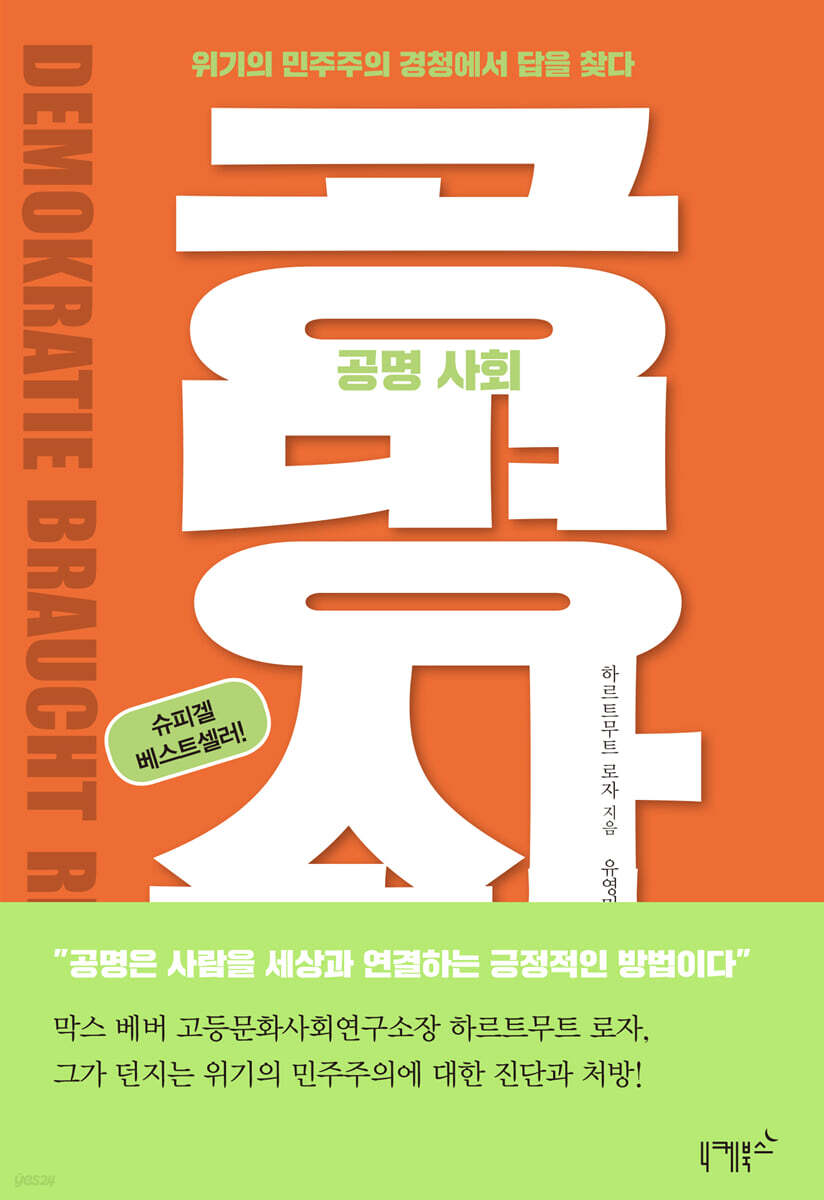
resonant society
 |
Description
Book Introduction
Intensifying social conflict and communication gaps
A solution that will unite society beyond alienation
Democracy is collapsing.
The shadows of dictatorships and totalitarianisms seeking to exercise imperial power loom over the world.
Can democracy be restored? If so, how? Amidst the conflicting opinions of scholars, Hartmut Rosa, German sociologist and director of the Max Weber Institute for Advanced Culture and Society, has proposed an unexpected solution.
In his book, "Resonant Society," based on a speech given at an invitation to a Catholic parish in Germany, he advocates the hope of rebuilding democracy through its relationship with religious, particularly Christian, values.
A sociologist discusses the crisis of democracy amidst religion and seeks solutions.
The author, who has pointed out the accelerating world, now proposes resonance as a solution, adding that the values that form the basis of resonance can be found in religion.
Of course, religion in modern society has clear light and dark sides.
Apart from the legitimate criticisms directed at religious groups that have become commercially and exclusively corrupt, it is clear that the fundamental values of religion can contribute to democracy.
He emphasizes that in this era where “only winning matters and other voices are blindly excluded,” in the midst of a democratic crisis, the path to restoring democracy is to strive to become “a being who listens and is approachable by others,” in other words, to create a society where resonance is possible.
The alienation that permeates today's society hinders even the exchange of opinions, let alone discussions that advance the common good.
In such situations, it is difficult for individuals to form positive relationships with others and the rest of the world.
This book examines the background to the threat to democracy in our society due to alienation and explores ways to resolve this crisis.
The capitalist market economy fails to create the values that sustain society.
Regardless of religion, political affiliation, or personal values, this is a time when solidarity is needed to restore the socio-political system.
A solution that will unite society beyond alienation
Democracy is collapsing.
The shadows of dictatorships and totalitarianisms seeking to exercise imperial power loom over the world.
Can democracy be restored? If so, how? Amidst the conflicting opinions of scholars, Hartmut Rosa, German sociologist and director of the Max Weber Institute for Advanced Culture and Society, has proposed an unexpected solution.
In his book, "Resonant Society," based on a speech given at an invitation to a Catholic parish in Germany, he advocates the hope of rebuilding democracy through its relationship with religious, particularly Christian, values.
A sociologist discusses the crisis of democracy amidst religion and seeks solutions.
The author, who has pointed out the accelerating world, now proposes resonance as a solution, adding that the values that form the basis of resonance can be found in religion.
Of course, religion in modern society has clear light and dark sides.
Apart from the legitimate criticisms directed at religious groups that have become commercially and exclusively corrupt, it is clear that the fundamental values of religion can contribute to democracy.
He emphasizes that in this era where “only winning matters and other voices are blindly excluded,” in the midst of a democratic crisis, the path to restoring democracy is to strive to become “a being who listens and is approachable by others,” in other words, to create a society where resonance is possible.
The alienation that permeates today's society hinders even the exchange of opinions, let alone discussions that advance the common good.
In such situations, it is difficult for individuals to form positive relationships with others and the rest of the world.
This book examines the background to the threat to democracy in our society due to alienation and explores ways to resolve this crisis.
The capitalist market economy fails to create the values that sustain society.
Regardless of religion, political affiliation, or personal values, this is a time when solidarity is needed to restore the socio-political system.
- You can preview some of the book's contents.
Preview
index
Introduction: What kind of society do you want to live in?
A society over-reliant on growth
A vicious cycle of acceleration, heat generation, and exhaustion
The promise of modernity has collapsed.
Give me a listening heart
Hearing someone's voice that is very different from yours
Resonance connecting with the world
Translator's Note: A World Where Small Voices Can Reach
A society over-reliant on growth
A vicious cycle of acceleration, heat generation, and exhaustion
The promise of modernity has collapsed.
Give me a listening heart
Hearing someone's voice that is very different from yours
Resonance connecting with the world
Translator's Note: A World Where Small Voices Can Reach
Detailed image

Into the book
“Therefore, as the author says, democracy needs religion.
As this book suggests, I hope that religion will realize its precious heritage, return to the spirit that constitutes its essence, and recover a listening heart.
So, I hope that I can become a small spark that can make this society a resonant society.
I hope that the spirit of religion that has been restored can spread throughout society.
Religion, along with many other valuable elements, possesses elements that open up a sense of resonance, and as the author emphasizes, “a society that forgets that such resonance is possible is hopeless.”
It's a short book, but it contains a lot.
I recommend reading it carefully.”
--- From the "Translator's Note"
Unfortunately, the dominant political system in a society often believes that people will fill in the huge gaps it has created in the social safety net.
That is why the solidarity participation of many people, whether from a church background, a humanitarian background, a desire to be good neighbors, a left-wing background, or a right-wing background, is all the more important.
At the same time, it is our collective task to transform politics and society so that alienation is no longer an essential feature of society.
--- From "Preface: What Kind of Society Do We Want to Live In?"
A society is modern only when it can be dynamically stabilized.
Dynamically stable means that society relies on continuous, systemic and structural growth to reproduce and institutionally maintain the status quo.
What's even more absurd is that we don't want to grow like this because we're greedy.
The reason we need growth is because without growth, the overall social structure can no longer be sustained.
If we decide not to grow any more, overnight we'll see a surge in unemployment and a surge in business closures.
The country's tax revenue will also decrease.
At the same time, spending is increasing.
We need to restore growth momentum and, above all, support the unemployed.
Then we will no longer be able to properly provide pensions and maintain the health care system.
The overall welfare system is becoming lax, and the budget for the cultural sector is no longer sufficient.
--- From "A Society Over-Reliant on Growth"
As you struggle to survive in an unstable job, you keep hearing, “We need to grow.
If all we hear is, "We have to get better," and if all of this puts pressure on individuals, then anyone who continues to have different opinions, wants different things, loves different things, believes different things, or does anything differently, will only become a stumbling block.
People like that should keep their mouths shut.
--- From "The Vicious Cycle of Acceleration-Heat Generation-Exhaustion"
I keep feeling like I'm not good enough, that I'm not satisfied with myself, and that I need to become someone completely different.
There is no longer a sense of progress toward a good life and a successful relationship with the world through continuous growth.
We now realize that even as we develop and grow, the promises we make are not fulfilled.
--- From "The Promise of Modernity Has Collapsed"
I've always said that democracy only works when each person has a voice.
But lately I've become increasingly convinced that we need ears that can hear those voices.
It is not enough to have a voice and to speak out.
We also need ears to hear other voices.
Furthermore, we need to have a listening heart, a willingness to listen to others and respond to them, along with listening ears.
--- From "Give Me a Listening Heart"
So what do we need in this society? I believe it needs to be able to hear the call of others again, to be someone others can talk to, to experience self-efficacy and the power of influencing others even when the outcome is uncertain.
In my view, the fundamental idea of Christianity is that at the root of my existence lies not a silent universe, a cold mechanism, naked chance, or even a hostile opponent, but a responsive relationship.
“I have called you by name, you are mine.” If this is not an appeal to resonance, what is?
As this book suggests, I hope that religion will realize its precious heritage, return to the spirit that constitutes its essence, and recover a listening heart.
So, I hope that I can become a small spark that can make this society a resonant society.
I hope that the spirit of religion that has been restored can spread throughout society.
Religion, along with many other valuable elements, possesses elements that open up a sense of resonance, and as the author emphasizes, “a society that forgets that such resonance is possible is hopeless.”
It's a short book, but it contains a lot.
I recommend reading it carefully.”
--- From the "Translator's Note"
Unfortunately, the dominant political system in a society often believes that people will fill in the huge gaps it has created in the social safety net.
That is why the solidarity participation of many people, whether from a church background, a humanitarian background, a desire to be good neighbors, a left-wing background, or a right-wing background, is all the more important.
At the same time, it is our collective task to transform politics and society so that alienation is no longer an essential feature of society.
--- From "Preface: What Kind of Society Do We Want to Live In?"
A society is modern only when it can be dynamically stabilized.
Dynamically stable means that society relies on continuous, systemic and structural growth to reproduce and institutionally maintain the status quo.
What's even more absurd is that we don't want to grow like this because we're greedy.
The reason we need growth is because without growth, the overall social structure can no longer be sustained.
If we decide not to grow any more, overnight we'll see a surge in unemployment and a surge in business closures.
The country's tax revenue will also decrease.
At the same time, spending is increasing.
We need to restore growth momentum and, above all, support the unemployed.
Then we will no longer be able to properly provide pensions and maintain the health care system.
The overall welfare system is becoming lax, and the budget for the cultural sector is no longer sufficient.
--- From "A Society Over-Reliant on Growth"
As you struggle to survive in an unstable job, you keep hearing, “We need to grow.
If all we hear is, "We have to get better," and if all of this puts pressure on individuals, then anyone who continues to have different opinions, wants different things, loves different things, believes different things, or does anything differently, will only become a stumbling block.
People like that should keep their mouths shut.
--- From "The Vicious Cycle of Acceleration-Heat Generation-Exhaustion"
I keep feeling like I'm not good enough, that I'm not satisfied with myself, and that I need to become someone completely different.
There is no longer a sense of progress toward a good life and a successful relationship with the world through continuous growth.
We now realize that even as we develop and grow, the promises we make are not fulfilled.
--- From "The Promise of Modernity Has Collapsed"
I've always said that democracy only works when each person has a voice.
But lately I've become increasingly convinced that we need ears that can hear those voices.
It is not enough to have a voice and to speak out.
We also need ears to hear other voices.
Furthermore, we need to have a listening heart, a willingness to listen to others and respond to them, along with listening ears.
--- From "Give Me a Listening Heart"
So what do we need in this society? I believe it needs to be able to hear the call of others again, to be someone others can talk to, to experience self-efficacy and the power of influencing others even when the outcome is uncertain.
In my view, the fundamental idea of Christianity is that at the root of my existence lies not a silent universe, a cold mechanism, naked chance, or even a hostile opponent, but a responsive relationship.
“I have called you by name, you are mine.” If this is not an appeal to resonance, what is?
--- From "Resonance Connecting with the World"
Publisher's Review
A society that consumes people and is at a standstill
Burnout swept through the illusion of growth.
The logic of modern growth promised social progress and a better life for each individual.
The belief that my labor would develop the society I live in and that society would reward me in return was the driving force behind the rapid development of society.
But for now, when we must rely on growth to maintain the status quo, such a belief is nothing more than a deceptive slogan.
The insistence that society must become faster, taller, and more numerous in every field to survive, even when further growth and development are meaningless, creates a social compulsion.
Of course, this has a major impact on the worsening instability of the social structure as the social system itself becomes increasingly inefficient.
The author defines the characteristics of modern society as 'galloping stillness'.
We are running to grow, but on the other hand, society is rigid because it has lost its sense of movement.
The world has already developed beyond what is necessary for survival.
However, continuous growth is necessary to maintain jobs, collect taxes, and maintain welfare systems.
This is because the moment society stagnates, the institutional pressure it receives becomes extreme.
Change and progress have been a constant flow throughout human history, but modern society is the first to require yearly growth simply to maintain the status quo.
Humans, burdened with the burden of acceleration and innovation, cannot help but form an aggressive relationship with the world.
Corporations destroy the environment beyond repair in their quest to increase sales, and individuals are oppressed by precarious employment, ineffective welfare, and conflict with the outside world.
All of these vicious cycles have made extreme selfishness, which only cares about one's own well-being and that of one's group, the dominant attitude in modern society.
Burnout is also a widespread social disease in the same context.
According to the author, who considers a 'good life' to be a 'life without alienation,' our society is currently in a situation where no one can enjoy a good life.
Humans and human society are wandering around, unable to figure out how they should exist and what kind of relationships they should have with other beings.
In the present, where competition continues for individual survival rather than for common interests, the room for understanding or comprehension is bound to become increasingly narrow.
A promise to listen even if you can't believe it
Democracy requires a listening heart.
Democracy cannot function properly in such an aggressive environment.
Democracy promises a society where everyone can express their opinions with their own voice, but if those voices are not listened to, they will only disperse into empty cries.
The divisions that have crept across society have created a gap between people, and groups with different opinions have begun to be defined as enemies.
In Korean society, it is common, if not natural, for the two major political parties to be at odds with each other.
They treat others like criminals without even trying to hear their perspectives.
Even if it is an unreasonable claim, there is bound to be some basis for it, but they simply criticize it without considering the context that led to the different position.
Such conflicts cannot be resolved by completely subduing the other group.
This is a time when we need a 'listening heart' that wants to hear and respond to what others say.
Hartmut Rosa seeks to bridge the gap in dialogue with a republican understanding of democracy.
It sets the premise that mutual contact and communication bring about change, and dreams of a situation where citizens with different opinions come together to speak and listen to each other's opinions.
Of course, conversations that change people are not that simple.
It requires a commitment to allow someone with a different opinion to speak to me, and a commitment to listen to what they have to say.
The author emphasizes the importance of being able to be someone others can talk to, and explains this with the concept of resonance.
Change happens when we connect with another being and resonate with them.
In this book, resonance means relating to the world in a non-aggressive way, and can be described by four characteristics: stimulation, self-efficacy, change, and uncontrollability.
For example, when a family gathers at Christmas and tries to connect with the Holy Family of Jesus, Mary, and Joseph and the sacred message of Christmas, conflict often arises rather than resonating.
A conversation that only reinforces existing opinions does not lead to resonance.
Resonance is hearing a completely different voice that gives you a strange feeling you never thought of before.
Self-efficacy means connection with others, and by connecting with others, humans overcome alienation and feel alive.
When you open yourself to connect with someone, a change occurs, allowing you to see and hear the world differently.
However, resonance cannot be forced.
In modern society, where people want to maximize profits with minimal investment, resonance, which cannot guarantee results, is being ignored as an inefficient means.
“At our root lies a relationship of response.”
Religious rituals are the optimal space for resonance to occur.
Hartmut Rosa invokes religion as a resonant background and place.
The space and characteristics that religion provides do not pose a threat to democracy.
It is therefore interesting to note that, free from the growth-oriented obsession, we can be reminded of the possibility of a different way of relating, and in particular, the closeness of the overall thinking and tradition of religion to resonance and its practice.
Even if we think of prayer alone, religious practice presupposes a promise of a responsive relationship to the very foundation of human existence.
When I call someone, the belief that they will hear me and call me back forms the basis of the relationship.
There are currently differing opinions regarding the social status of religion.
Is religion merely an anachronistic institution that hinders growth in global competition? Or is it merely a superstition, something we can freely follow privately but should be kept as silent as possible in public? Whenever problems within religion are raised, the question of whether religion can guarantee social justice and goodwill continues. However, religion, or at least its religious characteristics, have a positive impact on how people relate to the world.
Hartmut Rosa poses these questions for the development and recovery of modern society.
What would modern society look like without religion? Aside from the crisis facing the churches of this land, if religious characteristics no longer resonate in a democratic society, societal recovery is a distant prospect.
The author finds hope for the restoration of democracy in religious resources and also in resonance.
Burnout swept through the illusion of growth.
The logic of modern growth promised social progress and a better life for each individual.
The belief that my labor would develop the society I live in and that society would reward me in return was the driving force behind the rapid development of society.
But for now, when we must rely on growth to maintain the status quo, such a belief is nothing more than a deceptive slogan.
The insistence that society must become faster, taller, and more numerous in every field to survive, even when further growth and development are meaningless, creates a social compulsion.
Of course, this has a major impact on the worsening instability of the social structure as the social system itself becomes increasingly inefficient.
The author defines the characteristics of modern society as 'galloping stillness'.
We are running to grow, but on the other hand, society is rigid because it has lost its sense of movement.
The world has already developed beyond what is necessary for survival.
However, continuous growth is necessary to maintain jobs, collect taxes, and maintain welfare systems.
This is because the moment society stagnates, the institutional pressure it receives becomes extreme.
Change and progress have been a constant flow throughout human history, but modern society is the first to require yearly growth simply to maintain the status quo.
Humans, burdened with the burden of acceleration and innovation, cannot help but form an aggressive relationship with the world.
Corporations destroy the environment beyond repair in their quest to increase sales, and individuals are oppressed by precarious employment, ineffective welfare, and conflict with the outside world.
All of these vicious cycles have made extreme selfishness, which only cares about one's own well-being and that of one's group, the dominant attitude in modern society.
Burnout is also a widespread social disease in the same context.
According to the author, who considers a 'good life' to be a 'life without alienation,' our society is currently in a situation where no one can enjoy a good life.
Humans and human society are wandering around, unable to figure out how they should exist and what kind of relationships they should have with other beings.
In the present, where competition continues for individual survival rather than for common interests, the room for understanding or comprehension is bound to become increasingly narrow.
A promise to listen even if you can't believe it
Democracy requires a listening heart.
Democracy cannot function properly in such an aggressive environment.
Democracy promises a society where everyone can express their opinions with their own voice, but if those voices are not listened to, they will only disperse into empty cries.
The divisions that have crept across society have created a gap between people, and groups with different opinions have begun to be defined as enemies.
In Korean society, it is common, if not natural, for the two major political parties to be at odds with each other.
They treat others like criminals without even trying to hear their perspectives.
Even if it is an unreasonable claim, there is bound to be some basis for it, but they simply criticize it without considering the context that led to the different position.
Such conflicts cannot be resolved by completely subduing the other group.
This is a time when we need a 'listening heart' that wants to hear and respond to what others say.
Hartmut Rosa seeks to bridge the gap in dialogue with a republican understanding of democracy.
It sets the premise that mutual contact and communication bring about change, and dreams of a situation where citizens with different opinions come together to speak and listen to each other's opinions.
Of course, conversations that change people are not that simple.
It requires a commitment to allow someone with a different opinion to speak to me, and a commitment to listen to what they have to say.
The author emphasizes the importance of being able to be someone others can talk to, and explains this with the concept of resonance.
Change happens when we connect with another being and resonate with them.
In this book, resonance means relating to the world in a non-aggressive way, and can be described by four characteristics: stimulation, self-efficacy, change, and uncontrollability.
For example, when a family gathers at Christmas and tries to connect with the Holy Family of Jesus, Mary, and Joseph and the sacred message of Christmas, conflict often arises rather than resonating.
A conversation that only reinforces existing opinions does not lead to resonance.
Resonance is hearing a completely different voice that gives you a strange feeling you never thought of before.
Self-efficacy means connection with others, and by connecting with others, humans overcome alienation and feel alive.
When you open yourself to connect with someone, a change occurs, allowing you to see and hear the world differently.
However, resonance cannot be forced.
In modern society, where people want to maximize profits with minimal investment, resonance, which cannot guarantee results, is being ignored as an inefficient means.
“At our root lies a relationship of response.”
Religious rituals are the optimal space for resonance to occur.
Hartmut Rosa invokes religion as a resonant background and place.
The space and characteristics that religion provides do not pose a threat to democracy.
It is therefore interesting to note that, free from the growth-oriented obsession, we can be reminded of the possibility of a different way of relating, and in particular, the closeness of the overall thinking and tradition of religion to resonance and its practice.
Even if we think of prayer alone, religious practice presupposes a promise of a responsive relationship to the very foundation of human existence.
When I call someone, the belief that they will hear me and call me back forms the basis of the relationship.
There are currently differing opinions regarding the social status of religion.
Is religion merely an anachronistic institution that hinders growth in global competition? Or is it merely a superstition, something we can freely follow privately but should be kept as silent as possible in public? Whenever problems within religion are raised, the question of whether religion can guarantee social justice and goodwill continues. However, religion, or at least its religious characteristics, have a positive impact on how people relate to the world.
Hartmut Rosa poses these questions for the development and recovery of modern society.
What would modern society look like without religion? Aside from the crisis facing the churches of this land, if religious characteristics no longer resonate in a democratic society, societal recovery is a distant prospect.
The author finds hope for the restoration of democracy in religious resources and also in resonance.
GOODS SPECIFICS
- Date of issue: February 28, 2025
- Page count, weight, size: 96 pages | 126g | 128*187*10mm
- ISBN13: 9791198887894
- ISBN10: 1198887893
You may also like
카테고리
korean


korean

![GQ KOREA Mark (Monthly): December [2025]](http://librairie.coreenne.fr/cdn/shop/files/8ef265dbbfbf186523ed75ba7319009d.jpg?v=1765340328&width=3840)


