

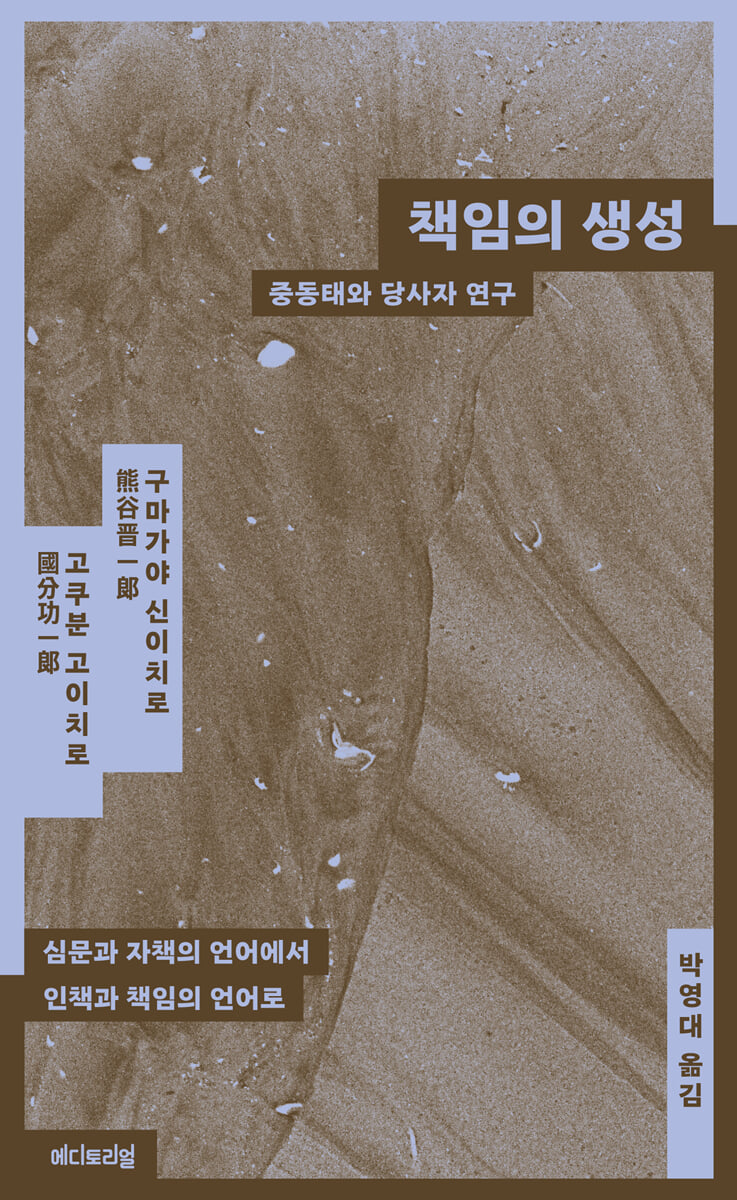
The Creation of Responsibility: A Study of the Middle East and the Parties
 |
Description
Book Introduction
『The Creation of Responsibility: Middle Eastern Tense and Participant Research - From the Language of Interrogation and Self-Reproach to the Language of Responsibility and Accountability』 is the first work of public lectures and book compilation of joint research by Koichiro Kokubun, who has continuously challenged the philosophy of everyday questions that are easy to overlook, and Shinichiro Kumagaya, a person with cerebral palsy, former pediatrician, and currently a prominent researcher in the field of disability party research.
The two authors, who have visited Korea as experts in their respective fields, convey the following message to readers in the preface to the Korean edition.
"If you read this book, you'll feel that 'studying (yourself),' 'living with various difficulties,' and 'taking action to transform society' are not so different." "If readers can experience this 'back and forth'—starting from various sites in Korean society, moving toward the concept of the Middle East and the knowledge of the parties involved, and then returning from there to their own sites to understand and reflect—then there would be nothing more joyful than this."
Thanks to the tireless efforts of people with disabilities, elevators have been installed in subways and ramps have been installed throughout public facilities, allowing non-disabled people to also benefit.
But this is not enough.
Compared to physical disabilities, invisible disabilities are often still hidden, are still in their infancy stages, and are often left entirely to individual effort.
One of them would be the realm of 'words' that we use unconsciously in our daily lives.
This book visualizes a certain aspect of language, which, like the architecture of the past, is a structure accumulated through the experiences and agreements of many people.
These days, the feeling that language doesn't adequately express me is not limited to minorities.
We will all find ourselves in these fascinating scenes, examined through the microscope of philosophy and the study of the parties concerned, of the relationship between language and responsibility, which is difficult to grasp unless we pay close attention.
The two authors, who have visited Korea as experts in their respective fields, convey the following message to readers in the preface to the Korean edition.
"If you read this book, you'll feel that 'studying (yourself),' 'living with various difficulties,' and 'taking action to transform society' are not so different." "If readers can experience this 'back and forth'—starting from various sites in Korean society, moving toward the concept of the Middle East and the knowledge of the parties involved, and then returning from there to their own sites to understand and reflect—then there would be nothing more joyful than this."
Thanks to the tireless efforts of people with disabilities, elevators have been installed in subways and ramps have been installed throughout public facilities, allowing non-disabled people to also benefit.
But this is not enough.
Compared to physical disabilities, invisible disabilities are often still hidden, are still in their infancy stages, and are often left entirely to individual effort.
One of them would be the realm of 'words' that we use unconsciously in our daily lives.
This book visualizes a certain aspect of language, which, like the architecture of the past, is a structure accumulated through the experiences and agreements of many people.
These days, the feeling that language doesn't adequately express me is not limited to minorities.
We will all find ourselves in these fascinating scenes, examined through the microscope of philosophy and the study of the parties concerned, of the relationship between language and responsibility, which is difficult to grasp unless we pay close attention.
- You can preview some of the book's contents.
Preview
index
Recommendation
Preface to the Korean edition
Introduction - Everyday Life at the End of Life
Study of the West's dynamics and the parties involved
To begin with
Previous situation of the party's research
From a "Medical Model" to a "Social Model"? The Background of the Paradigm Shift
Invisible, incomprehensible disabilities? Who am I?
Parties' Research and Parties' Sovereignty
Go out into the area with symptoms
Externalization and the Power of Peers
From 'exemption' to 'responsibility'
The Premise of "Study on People with Developmental Disabilities"? Empowerment of Disability
The Difficulty of 'Bundling' and 'Summarizing'
'This is it' and imagination
Q&A
① Regarding the separation of residence between normal people and ASD patients
② Can psychoanalysis improve ASD symptoms?
③ Ayaya Satsuki, isn't she suffering from depression?
④ Regarding ASD employment
⑤ About the disability at the core of ASD
⑥ Regarding cases where the prediction error increases
Chapter 1: The Origin of Will and Responsibility
Inconvenient everyday language to use
The World of the Middle East and a Study of the Parties
'Active' and 'passive' are new grammatical rules
Definition of Middle Eastern
Three meanings of the Middle Eastern tense
From active/middle voice to active/passive voice
The Birth of 'Will'
Will and Creation from Nothing
Will, choice, responsibility
The Communism of Action: Deleuze and the "Righteous Heart"
Wounds and Fate
Prediction Error and Trauma
When the cover of memory opens
Human Nature/Human Fate
A program called '12 Steps'
Power and Involuntary Consent
The affordance of the viscera, the body living in the Middle East
The Middle East is not salvation
The Law of Necessity and 'Freedom'
Conatus and the Study of the Parties
To rely is to hate
'Me' and 'Wound'
Familiarity with 'Saliency'
Loss of the Schizophrenia Paradigm
Q&A
① It is difficult to conduct research on the parties involved.
② Could there be a connection between the disappearance of the Middle East and the birth of Buddha?
③ On the history of active, passive, and Middle Eastern medicine
Chapter 2: The Middle East and the Creation of the Subject
Will is 'cutting off', cutting off.
Decision support and desire formation support
Molar and molecular states
The utility of "want to do it," "do it for now," and "carelessly"
Phenomenology and Developmental Disabilities
Phenomenology of the Other and the Study of the Parties
Creation and schematization of the subject
Prediction Error and 'This is it'
Prediction, diagram, imagination
Is 'Typing' that great?
Fetal body diagram
Conatus and imagination
Attention to the internal organs
Q&A
① Does ‘I’ come from anywhere?
② Shouldn’t Conatus be disbanded?
Chapter 3: Self, Others, and Society
To maintain oneself, one must go against conatus.
Conatus and 'Easing Boredom'
Consumption and waste or input and output
Consciousness and sense of self
The original self, the core self, and trauma
The 'autobiographical self' needs an other.
You can't exist on a desert island.
Conditions that are well suited to typing
Why the majority is the majority
Autism as a Negative of 'Core Competencies'
forced anti-Middle Eastern lifestyle
Parties' research and parties' movements
Cognitive Behavioral Therapy and Participant Research
neoliberal prudence
Denial and consumer behavior regarding wounds
Q&A
① Isn’t the process of cognitive behavioral therapy inherently subjective?
② How are sex, wounds, and the Middle East related?
③ Regarding ‘wounds’ and ‘others’
Chapter 4: Middle Eastern and Responsibility
'Will' and the Study of the Parties
The philosophy of 'using'
Reading Plato's Alcibiades
The Birth of Platonism
abuse and use
Taste the water, taste the body
Domination and Freedom
The Activity Support Workers Movement and the Sovereignty of the Parties
Responsibility and Responsibility
Baseless 'belief'
A change program in the '12 steps'
Responsibility lies solely with the Middle East.
Q&A
① How can I become friends with an activity support worker?
② Aren’t conversations in the business world only active?
③ Aren’t cognitive behavioral therapy love books dangerous?
Solitude, thoughts, words
The text that appears
Translator's Note: Understanding and Embracing My 'This Life' in a New Way
Preface to the Korean edition
Introduction - Everyday Life at the End of Life
Study of the West's dynamics and the parties involved
To begin with
Previous situation of the party's research
From a "Medical Model" to a "Social Model"? The Background of the Paradigm Shift
Invisible, incomprehensible disabilities? Who am I?
Parties' Research and Parties' Sovereignty
Go out into the area with symptoms
Externalization and the Power of Peers
From 'exemption' to 'responsibility'
The Premise of "Study on People with Developmental Disabilities"? Empowerment of Disability
The Difficulty of 'Bundling' and 'Summarizing'
'This is it' and imagination
Q&A
① Regarding the separation of residence between normal people and ASD patients
② Can psychoanalysis improve ASD symptoms?
③ Ayaya Satsuki, isn't she suffering from depression?
④ Regarding ASD employment
⑤ About the disability at the core of ASD
⑥ Regarding cases where the prediction error increases
Chapter 1: The Origin of Will and Responsibility
Inconvenient everyday language to use
The World of the Middle East and a Study of the Parties
'Active' and 'passive' are new grammatical rules
Definition of Middle Eastern
Three meanings of the Middle Eastern tense
From active/middle voice to active/passive voice
The Birth of 'Will'
Will and Creation from Nothing
Will, choice, responsibility
The Communism of Action: Deleuze and the "Righteous Heart"
Wounds and Fate
Prediction Error and Trauma
When the cover of memory opens
Human Nature/Human Fate
A program called '12 Steps'
Power and Involuntary Consent
The affordance of the viscera, the body living in the Middle East
The Middle East is not salvation
The Law of Necessity and 'Freedom'
Conatus and the Study of the Parties
To rely is to hate
'Me' and 'Wound'
Familiarity with 'Saliency'
Loss of the Schizophrenia Paradigm
Q&A
① It is difficult to conduct research on the parties involved.
② Could there be a connection between the disappearance of the Middle East and the birth of Buddha?
③ On the history of active, passive, and Middle Eastern medicine
Chapter 2: The Middle East and the Creation of the Subject
Will is 'cutting off', cutting off.
Decision support and desire formation support
Molar and molecular states
The utility of "want to do it," "do it for now," and "carelessly"
Phenomenology and Developmental Disabilities
Phenomenology of the Other and the Study of the Parties
Creation and schematization of the subject
Prediction Error and 'This is it'
Prediction, diagram, imagination
Is 'Typing' that great?
Fetal body diagram
Conatus and imagination
Attention to the internal organs
Q&A
① Does ‘I’ come from anywhere?
② Shouldn’t Conatus be disbanded?
Chapter 3: Self, Others, and Society
To maintain oneself, one must go against conatus.
Conatus and 'Easing Boredom'
Consumption and waste or input and output
Consciousness and sense of self
The original self, the core self, and trauma
The 'autobiographical self' needs an other.
You can't exist on a desert island.
Conditions that are well suited to typing
Why the majority is the majority
Autism as a Negative of 'Core Competencies'
forced anti-Middle Eastern lifestyle
Parties' research and parties' movements
Cognitive Behavioral Therapy and Participant Research
neoliberal prudence
Denial and consumer behavior regarding wounds
Q&A
① Isn’t the process of cognitive behavioral therapy inherently subjective?
② How are sex, wounds, and the Middle East related?
③ Regarding ‘wounds’ and ‘others’
Chapter 4: Middle Eastern and Responsibility
'Will' and the Study of the Parties
The philosophy of 'using'
Reading Plato's Alcibiades
The Birth of Platonism
abuse and use
Taste the water, taste the body
Domination and Freedom
The Activity Support Workers Movement and the Sovereignty of the Parties
Responsibility and Responsibility
Baseless 'belief'
A change program in the '12 steps'
Responsibility lies solely with the Middle East.
Q&A
① How can I become friends with an activity support worker?
② Aren’t conversations in the business world only active?
③ Aren’t cognitive behavioral therapy love books dangerous?
Solitude, thoughts, words
The text that appears
Translator's Note: Understanding and Embracing My 'This Life' in a New Way
Detailed image

Into the book
For those who do not have clear answers to questions such as, “Who am I?”, “Where is the range that I can change through my own efforts?”, and “Where is the range that I cannot change?”, together with colleagues (colleagues are used to mean ‘others with similar experiences as oneself’)
Of course, since no one else has had the exact same experience, it means that in a sense it is a similar experience) It is quite difficult to research it alone.
Before we 'change' society, we aim to first 'know' what kind of people we are, together with colleagues who have similar experiences.
The activity that aims to ‘know’ before ‘change’ is the research of the parties involved.
--- p.32
The idea of 'will as the source of action' raises further problems.
What does it mean to act of one's own free will? To act of one's own free will, not under duress or coercion from others, means that the starting point of that action lies within oneself.
And to regard the will as the starting point of action means to regard the will as a pure source.
--- p.90
To add to what Professor Kokubun said earlier, some people with autism spectrum disorder experience a large amount of molecular affordances coming from inside and outside the body that rise to consciousness.
In a sense, this is a 'Middle Eastern' state, where there is no disconnection, no will.
However, as already introduced, the process of adjusting these affordances is very cumbersome for all of them to come to mind, and the coordination and 'bundling' of the vast amount of information inevitably takes time, so Ayaya says that she leads a stagnant daily life.
--- p.165
I am an internist and I mainly treat lifestyle-related diseases and diabetes.
[…] I think what most of us do as a treatment is to move on to ‘doing it once.’
In other words, the core of treatment is for medical staff to impose a rule that states that ramen cannot be eaten late at night, or for patients to create their own rules.
But it rarely works out well.
So, I think that the key to healing might actually be our transition into the world of the Middle East, that is, our inadvertent stepping into the world of the Middle East.
--- p.199
Social change is costly, so we try to achieve it through self-regulation.
This is the so-called 'neoliberal' way of thinking.
Mr. Hirai describes it as "advanced liberalism," but he suppresses state spending as much as possible, praises individual agency by saying, "Self-determination is important after all," and shifts the contradictions of society onto individuals by saying, "But it's your responsibility."
To put it very simply, it is a point about such problems.
--- p.247
It is difficult for me to use my body with cerebral palsy without 'tasting' my own body.
“Move, you punk,” the main character Shotaro says, trying to move his body as if he were controlling “Tetsujin 28” with a remote control, but it doesn’t move.
If you try to dominate or control, it doesn't work well.
Rather, there must be a sense of being able to listen to what state the body is in now, so to speak, to pick up the rising movement.
Of course, since no one else has had the exact same experience, it means that in a sense it is a similar experience) It is quite difficult to research it alone.
Before we 'change' society, we aim to first 'know' what kind of people we are, together with colleagues who have similar experiences.
The activity that aims to ‘know’ before ‘change’ is the research of the parties involved.
--- p.32
The idea of 'will as the source of action' raises further problems.
What does it mean to act of one's own free will? To act of one's own free will, not under duress or coercion from others, means that the starting point of that action lies within oneself.
And to regard the will as the starting point of action means to regard the will as a pure source.
--- p.90
To add to what Professor Kokubun said earlier, some people with autism spectrum disorder experience a large amount of molecular affordances coming from inside and outside the body that rise to consciousness.
In a sense, this is a 'Middle Eastern' state, where there is no disconnection, no will.
However, as already introduced, the process of adjusting these affordances is very cumbersome for all of them to come to mind, and the coordination and 'bundling' of the vast amount of information inevitably takes time, so Ayaya says that she leads a stagnant daily life.
--- p.165
I am an internist and I mainly treat lifestyle-related diseases and diabetes.
[…] I think what most of us do as a treatment is to move on to ‘doing it once.’
In other words, the core of treatment is for medical staff to impose a rule that states that ramen cannot be eaten late at night, or for patients to create their own rules.
But it rarely works out well.
So, I think that the key to healing might actually be our transition into the world of the Middle East, that is, our inadvertent stepping into the world of the Middle East.
--- p.199
Social change is costly, so we try to achieve it through self-regulation.
This is the so-called 'neoliberal' way of thinking.
Mr. Hirai describes it as "advanced liberalism," but he suppresses state spending as much as possible, praises individual agency by saying, "Self-determination is important after all," and shifts the contradictions of society onto individuals by saying, "But it's your responsibility."
To put it very simply, it is a point about such problems.
--- p.247
It is difficult for me to use my body with cerebral palsy without 'tasting' my own body.
“Move, you punk,” the main character Shotaro says, trying to move his body as if he were controlling “Tetsujin 28” with a remote control, but it doesn’t move.
If you try to dominate or control, it doesn't work well.
Rather, there must be a sense of being able to listen to what state the body is in now, so to speak, to pick up the rising movement.
--- p.289
GOODS SPECIFICS
- Date of issue: February 14, 2025
- Page count, weight, size: 344 pages | 342g | 126*205*18mm
- ISBN13: 9791190254373
- ISBN10: 1190254379
You may also like
카테고리
korean


korean

![GQ KOREA Mark (Monthly): December [2025]](http://librairie.coreenne.fr/cdn/shop/files/8ef265dbbfbf186523ed75ba7319009d.jpg?v=1765340328&width=3840)


