

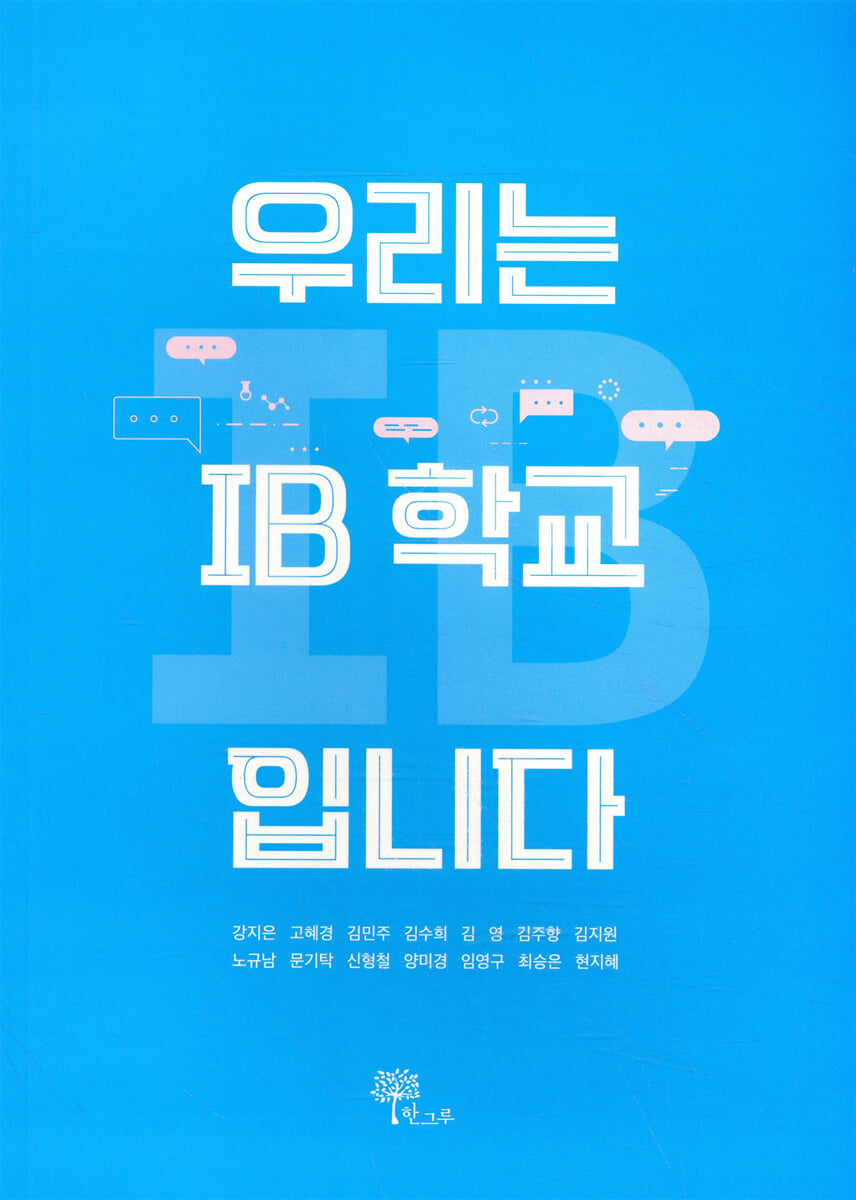
We are an IB school
 |
Description
Book Introduction
The IB's Three-Year Record: A New Educational Path
Reflecting today's desire for innovation and change in public education, interest in IB schools is heating up nationwide.
Eleven provincial and metropolitan offices of education are preparing to introduce the Korean IB curriculum, and as of March 2024, more than 300 schools have already introduced or plan to introduce the IB curriculum.
This book contains the story of Jeju Pyoseon High School, which introduced IB education in 2021 and passed official certification as an IB World School.
I hope this report, written over the past three years, will be helpful to readers who are considering or interested in IB education.
Part 1, “Changes in the Educational Paradigm,” contains the background and educational philosophy behind the introduction of the IB educational program.
We reflect on the essence of learning and explore ways to achieve true growth.
Part 2, "Introduction to the IB Education Program," contains analysis, understanding, and preparation for full-fledged IB education.
“Part 3: IB Subject-Specific Objectives and Characteristics of Assessment” specifically presents the subject-specific assessment objectives and elements of the IB program that differentiate it from conventional education.
In "Sharing Real Cases of IB Classes Part 4," teachers provide examples of teaching and learning processes they have implemented in actual classes.
In addition, we included honest stories from teachers who participated in the IB education program at Pyo Seon High School through Q&A.
Above all, as a school in a rural area, Pyoseon High School has taken on the challenge of achieving balanced regional development and resolving educational imbalances through the introduction of the IB educational program.
The passion and struggles of teachers to become a leading IB school are fully captured in this book.
This book was selected for the Jeju Special Self-Governing Province Office of Education's 2024 'Our Teachers' Book Publication Support Project' and is scheduled to be distributed to schools of all levels in the future.
Reflecting today's desire for innovation and change in public education, interest in IB schools is heating up nationwide.
Eleven provincial and metropolitan offices of education are preparing to introduce the Korean IB curriculum, and as of March 2024, more than 300 schools have already introduced or plan to introduce the IB curriculum.
This book contains the story of Jeju Pyoseon High School, which introduced IB education in 2021 and passed official certification as an IB World School.
I hope this report, written over the past three years, will be helpful to readers who are considering or interested in IB education.
Part 1, “Changes in the Educational Paradigm,” contains the background and educational philosophy behind the introduction of the IB educational program.
We reflect on the essence of learning and explore ways to achieve true growth.
Part 2, "Introduction to the IB Education Program," contains analysis, understanding, and preparation for full-fledged IB education.
“Part 3: IB Subject-Specific Objectives and Characteristics of Assessment” specifically presents the subject-specific assessment objectives and elements of the IB program that differentiate it from conventional education.
In "Sharing Real Cases of IB Classes Part 4," teachers provide examples of teaching and learning processes they have implemented in actual classes.
In addition, we included honest stories from teachers who participated in the IB education program at Pyo Seon High School through Q&A.
Above all, as a school in a rural area, Pyoseon High School has taken on the challenge of achieving balanced regional development and resolving educational imbalances through the introduction of the IB educational program.
The passion and struggles of teachers to become a leading IB school are fully captured in this book.
This book was selected for the Jeju Special Self-Governing Province Office of Education's 2024 'Our Teachers' Book Publication Support Project' and is scheduled to be distributed to schools of all levels in the future.
- You can preview some of the book's contents.
Preview
index
Prologue: Pyoseon High School's Challenge to Become an IB-Type Rural School of the Future
Part 1: Shifts in the Education Paradigm
I decided to find a solution in IB.
Reflecting on the essence of learning
Looking at education with a long-term perspective of two years
Ask for the 'solution' rather than the 'correct answer'
The path we walk together is happy
Part 2: Introduction to the IB Education Program
A clear understanding of the IB educational program was a priority.
Examining the Direction of the IB Education Program
Distinguishing the Stage-by-Stage Elements of the IB Education Program
Realizing the need for a teaching-learning approach
Understanding the Diploma Program
Part 3 IB Subject-Specific Objectives and Assessment Features
I was troubled when I first saw the IB Education Program Guide.
Each subject's objectives, assessment goals, and assessment elements
- IB Core (Core Course)_Theory of Knowledge
- Group 1: Language A_IB Language and Literature
- Group 2: Language acquisition_IB English
- Group3: Individuals and societies_IB History
- Group 4: Science_IB Biology
- Group 5: Mathematics_IB Mathematical Analysis and Approach
- Group 6: The Arts_IB Visual Arts
Sharing real-life examples from Part 4 IB classes
We also grew while thinking about the design of IB curriculum classes.
Course outline design for each subject, unit planner, and actual class
- IB Core (Core Course)_Theory of Knowledge
- Group 1: Language A_IB Language and Literature
- Group 2: Language acquisition_IB English
- Group3: Individuals and societies_IB History
- Group 4: Science_IB Biology
- Group 5: Mathematics_IB Mathematical Analysis and Approach
- Group 6: The Arts_IB Visual Arts
Q&A
Epilogue: Valuable Reflections Gained from IB Schools
Part 1: Shifts in the Education Paradigm
I decided to find a solution in IB.
Reflecting on the essence of learning
Looking at education with a long-term perspective of two years
Ask for the 'solution' rather than the 'correct answer'
The path we walk together is happy
Part 2: Introduction to the IB Education Program
A clear understanding of the IB educational program was a priority.
Examining the Direction of the IB Education Program
Distinguishing the Stage-by-Stage Elements of the IB Education Program
Realizing the need for a teaching-learning approach
Understanding the Diploma Program
Part 3 IB Subject-Specific Objectives and Assessment Features
I was troubled when I first saw the IB Education Program Guide.
Each subject's objectives, assessment goals, and assessment elements
- IB Core (Core Course)_Theory of Knowledge
- Group 1: Language A_IB Language and Literature
- Group 2: Language acquisition_IB English
- Group3: Individuals and societies_IB History
- Group 4: Science_IB Biology
- Group 5: Mathematics_IB Mathematical Analysis and Approach
- Group 6: The Arts_IB Visual Arts
Sharing real-life examples from Part 4 IB classes
We also grew while thinking about the design of IB curriculum classes.
Course outline design for each subject, unit planner, and actual class
- IB Core (Core Course)_Theory of Knowledge
- Group 1: Language A_IB Language and Literature
- Group 2: Language acquisition_IB English
- Group3: Individuals and societies_IB History
- Group 4: Science_IB Biology
- Group 5: Mathematics_IB Mathematical Analysis and Approach
- Group 6: The Arts_IB Visual Arts
Q&A
Epilogue: Valuable Reflections Gained from IB Schools
Into the book
When looking at the classroom situation where IB classes are taking place, the ‘student’ is always at the center.
This is the same for any subject.
The beginning of class may begin with the teacher opening the door, but he or she will soon give up the seat.
And based on the students' intellectual curiosity and spirit of inquiry, there will be heated Q&A sessions and group communication, that is, discussions and debates.
This was because students did not acquire subject knowledge only through teachers.
Sometimes I satisfied my intellectual curiosity by researching the information I needed to learn through various learning materials, and sometimes through online searches.
Additionally, the communication through group discussions and debates that took place almost every hour provided a very interesting educational experience, allowing students to clearly and systematically construct their own unique thoughts while acknowledging and accepting the differences in perspectives and viewpoints.
--- p.26
I wanted to give them a chance to fail.
I wanted to show that if you fall and stumble, just get back up.
I believed that I could grow further through the process of falling and getting back up again.
I thought it would be enough to remind us that our current experiences and learnings in life are just the beginning.
I think education may seem like a 'sprint', but it's actually a 'long-distance race'.
Our education is a set of [6 years of elementary school + 3 years of middle school + 3 years of high school = 12 years].
Even if we run in elementary school, we may stop in middle school.
I know that I can take a break, solve problems, recharge my energy, and walk again in high school.
I also know that even if I had difficulty walking until high school, I will be able to walk again at some point after graduation, and that my steps then will be more confident and powerful than my previous steps.
I think this context is also reflected in the Diploma in IB education.
--- p.33
The IB education aims to cultivate ‘students who can contribute to world peace.’
The '10 Ideal Talents' are the embodiment of this, and the tool that can make it a reality is 'ATL (Approaches to Learning)'.
It is very difficult to make the best choice by synthesizing the interests of people of different nationalities and cultures.
It is also very difficult to use one's knowledge to achieve personal goals beyond 'me' and to benefit all of us, 'us'.
Nonetheless, I felt that IB education strongly demanded that all of this be made realistically possible.
So the decision our school made about what to do was a 'challenge'.
This is the same for any subject.
The beginning of class may begin with the teacher opening the door, but he or she will soon give up the seat.
And based on the students' intellectual curiosity and spirit of inquiry, there will be heated Q&A sessions and group communication, that is, discussions and debates.
This was because students did not acquire subject knowledge only through teachers.
Sometimes I satisfied my intellectual curiosity by researching the information I needed to learn through various learning materials, and sometimes through online searches.
Additionally, the communication through group discussions and debates that took place almost every hour provided a very interesting educational experience, allowing students to clearly and systematically construct their own unique thoughts while acknowledging and accepting the differences in perspectives and viewpoints.
--- p.26
I wanted to give them a chance to fail.
I wanted to show that if you fall and stumble, just get back up.
I believed that I could grow further through the process of falling and getting back up again.
I thought it would be enough to remind us that our current experiences and learnings in life are just the beginning.
I think education may seem like a 'sprint', but it's actually a 'long-distance race'.
Our education is a set of [6 years of elementary school + 3 years of middle school + 3 years of high school = 12 years].
Even if we run in elementary school, we may stop in middle school.
I know that I can take a break, solve problems, recharge my energy, and walk again in high school.
I also know that even if I had difficulty walking until high school, I will be able to walk again at some point after graduation, and that my steps then will be more confident and powerful than my previous steps.
I think this context is also reflected in the Diploma in IB education.
--- p.33
The IB education aims to cultivate ‘students who can contribute to world peace.’
The '10 Ideal Talents' are the embodiment of this, and the tool that can make it a reality is 'ATL (Approaches to Learning)'.
It is very difficult to make the best choice by synthesizing the interests of people of different nationalities and cultures.
It is also very difficult to use one's knowledge to achieve personal goals beyond 'me' and to benefit all of us, 'us'.
Nonetheless, I felt that IB education strongly demanded that all of this be made realistically possible.
So the decision our school made about what to do was a 'challenge'.
--- p.41
Publisher's Review
Interest in IB education is growing nationwide.
Eleven city and provincial offices of education have signed business agreements with the IB headquarters to introduce the Korean IB curriculum.
As of March 2024, 333 schools have already implemented or are preparing to implement the IB program, and this number is expected to exceed 400 by June.
It is growing at an unprecedented rate worldwide.
Why are so many schools adopting the IB curriculum in such a short period of time? It doesn't seem to be a simple matter of numbers or speed. I think about the fervent desires embedded in the fervent interest in the IB program.
We see a desire for change in education.
A desperate desire for future education is read.
The desire for a new education seems to be exploding through the internationally recognized IB education.
In an era of transition beyond change and innovation, IB education is a rare opportunity.
We hope that this can serve as a catalyst and driving force for change in schools and innovation in education.
Compared to 2021, when the Daegu and Jeju Offices of Education first introduced IB education, the experience is refreshing.
Even at that time, there was widespread skepticism about introducing international-level IB education at Pyoseon High School, located in a rural area.
In 2021, after two years of preparation, Pyoseon High School was officially recognized as an IB World School.
In the first year, recruiting new students was a challenge. We didn't even have a separate class for students who applied for the IB program.
It wasn't a selective education program for a select few elite students.
Indeed, could students from rural areas like Pyoseon High School truly keep up with the demanding IB curriculum? Taking on this unfamiliar path, uncharted territory, was bound to be a process of overcoming anxiety and doubt.
The articles published here document the dedicated efforts of teachers over the past three years to implement the IB program. They also document Pyo Seon High School's efforts to transform public education through IB education.
We hope that our experiences and cases will serve as helpful reference material for those who are new to IB education or are interested in it.
As we are just taking our first steps, I ask for your continued interest and support for the challenges ahead, rather than the achievements of the past three years.
- From the prologue
Eleven city and provincial offices of education have signed business agreements with the IB headquarters to introduce the Korean IB curriculum.
As of March 2024, 333 schools have already implemented or are preparing to implement the IB program, and this number is expected to exceed 400 by June.
It is growing at an unprecedented rate worldwide.
Why are so many schools adopting the IB curriculum in such a short period of time? It doesn't seem to be a simple matter of numbers or speed. I think about the fervent desires embedded in the fervent interest in the IB program.
We see a desire for change in education.
A desperate desire for future education is read.
The desire for a new education seems to be exploding through the internationally recognized IB education.
In an era of transition beyond change and innovation, IB education is a rare opportunity.
We hope that this can serve as a catalyst and driving force for change in schools and innovation in education.
Compared to 2021, when the Daegu and Jeju Offices of Education first introduced IB education, the experience is refreshing.
Even at that time, there was widespread skepticism about introducing international-level IB education at Pyoseon High School, located in a rural area.
In 2021, after two years of preparation, Pyoseon High School was officially recognized as an IB World School.
In the first year, recruiting new students was a challenge. We didn't even have a separate class for students who applied for the IB program.
It wasn't a selective education program for a select few elite students.
Indeed, could students from rural areas like Pyoseon High School truly keep up with the demanding IB curriculum? Taking on this unfamiliar path, uncharted territory, was bound to be a process of overcoming anxiety and doubt.
The articles published here document the dedicated efforts of teachers over the past three years to implement the IB program. They also document Pyo Seon High School's efforts to transform public education through IB education.
We hope that our experiences and cases will serve as helpful reference material for those who are new to IB education or are interested in it.
As we are just taking our first steps, I ask for your continued interest and support for the challenges ahead, rather than the achievements of the past three years.
- From the prologue
GOODS SPECIFICS
- Date of issue: November 30, 2024
- Page count, weight, size: 303 pages | 180*250*30mm
- ISBN13: 9791168671935
- ISBN10: 1168671930
You may also like
카테고리
korean


korean

![GQ KOREA Mark (Monthly): December [2025]](http://librairie.coreenne.fr/cdn/shop/files/8ef265dbbfbf186523ed75ba7319009d.jpg?v=1765340328&width=3840)


