

Local Life Trends
 |
Description
Book Introduction
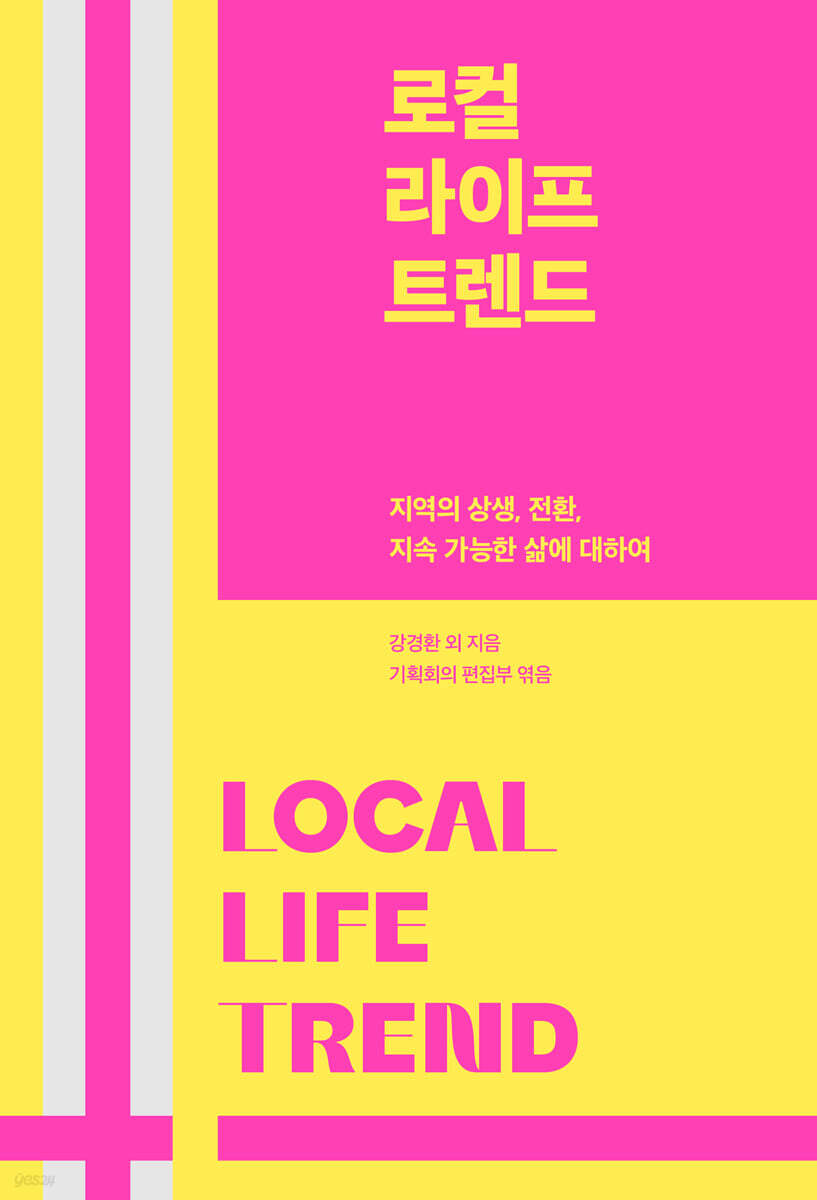
Recently, there has been a noticeable trend of seeking possibilities in the region.
The number of young people moving to the region in search of a new life is also increasing.
The COVID-19 pandemic has confirmed the potential for remote work, and regions and provinces have emerged as new lifelines, known as "locals."
This book analyzes what is happening in Korea's local communities and why they are happening, linking 'local' to five topics: 'value,' 'business,' 'content,' 'branding,' and 'magazine,' and forecasts the future of local communities.
Additionally, it contains vivid stories of actual experiences or developments by experts in various fields who are currently engaged in local-related activities in each region.
I hope that the publication of this book will spark active, healthy local discourse in Korean society.
The number of young people moving to the region in search of a new life is also increasing.
The COVID-19 pandemic has confirmed the potential for remote work, and regions and provinces have emerged as new lifelines, known as "locals."
This book analyzes what is happening in Korea's local communities and why they are happening, linking 'local' to five topics: 'value,' 'business,' 'content,' 'branding,' and 'magazine,' and forecasts the future of local communities.
Additionally, it contains vivid stories of actual experiences or developments by experts in various fields who are currently engaged in local-related activities in each region.
I hope that the publication of this book will spark active, healthy local discourse in Korean society.
- You can preview some of the book's contents.
Preview
index
Opening remarks: Local is a territory where life transitions are possible. _Park Woo-hyun
Part 1 Local X Value
Why I'm Talking Local Now_Jo Hee-jung
The Power of Local Content to Prevent Regional Extinction_Mo Jong-rin
How to Grow Local Content_Jeon Jeong-hwan
I am a publisher in Daegu_Shin Jung-hyun
Part 2 Local X Business
A Small Business Comes Together_Jeong Su-gyeong
Discovering the locals through interviews and connecting them through stories_Kwak Hyo-jeong
The road to publication is everywhere_Yoo Jeong-mi
Part 3 LocalXContent
New Wave, Local Wave_Kim Kyung-hee
99 Regional Archives Creating New Solidarity_Jeon Jeong-mi
How Long Can Local Publishing Last?_Dilution
Local Kim Seon-min, the subject of genre fiction
Part 4 Local X Branding
A true local brand created by local residents: 'Village Hotel 18th Street'_Kang Kyung-hwan
Incheon Rescue Operation: Dreaming of Work and Life in the Region_Kwon Hye-yeon
Local is not a brand, but a place to live_Jeong Yong-taek
The Present and Future of Local Branding_Jeon Chung-hoon
Part 5 Local X Magazine
A Day in the Life of a Local Planner Exploring Traditional Markets_Kim Ae-rim
A Journey to Find Stories of Ordinary Life, Local Space_Jeong Ji-yeon
Why Japanese Magazines and Turns?_Yang Seok-won
Author Profile
Part 1 Local X Value
Why I'm Talking Local Now_Jo Hee-jung
The Power of Local Content to Prevent Regional Extinction_Mo Jong-rin
How to Grow Local Content_Jeon Jeong-hwan
I am a publisher in Daegu_Shin Jung-hyun
Part 2 Local X Business
A Small Business Comes Together_Jeong Su-gyeong
Discovering the locals through interviews and connecting them through stories_Kwak Hyo-jeong
The road to publication is everywhere_Yoo Jeong-mi
Part 3 LocalXContent
New Wave, Local Wave_Kim Kyung-hee
99 Regional Archives Creating New Solidarity_Jeon Jeong-mi
How Long Can Local Publishing Last?_Dilution
Local Kim Seon-min, the subject of genre fiction
Part 4 Local X Branding
A true local brand created by local residents: 'Village Hotel 18th Street'_Kang Kyung-hwan
Incheon Rescue Operation: Dreaming of Work and Life in the Region_Kwon Hye-yeon
Local is not a brand, but a place to live_Jeong Yong-taek
The Present and Future of Local Branding_Jeon Chung-hoon
Part 5 Local X Magazine
A Day in the Life of a Local Planner Exploring Traditional Markets_Kim Ae-rim
A Journey to Find Stories of Ordinary Life, Local Space_Jeong Ji-yeon
Why Japanese Magazines and Turns?_Yang Seok-won
Author Profile
Into the book
Reflecting on the role of the Joyful City Research Institute, we opened a bookstore called ‘Gyeongwon-dong#’, where people meet people.
We filled the bookshelves with topics related to the agendas, hobbies, and careers of people who want to tell their stories, and created a community space where people who want to hear and share their stories can meet.
(Omitted) In Gyeongwon-dong#, you can rent bookshelves and operate like Shibuya○○ Bookstore.
Those who borrow bookshelves are called 'bookcase owners'.
The bookstore owners are colleagues who decorate Gyeongwon-dong# together.
We opened up the entire space, and the bookstore owners opened their own bookstores, workshops, and art galleries.
Of course, bookstore owners should also visit their space once every three months to consider management and see if their space is doing well and what else is needed.
--- p.63~64
I thought that in order to help the village, we had to make it a place where people could stay in the village somehow, and if possible, it had to be a place where people could stay for two or three nights, not just one.
As I was walking down the alley with that thought in mind, I started to imagine the tall hotel being knocked down.
If the alley I walk through is an elevator and a hallway, then I imagined that if I were to think of walking down the alley as taking the elevator up and then walking down the hallway to enter a room in a traditional lodging facility, then this could also be called a 'hotel'.
While I was thinking about it like that, I named the Chinese restaurant at the entrance of the alley, 'Gukilbanjeom', in English as 'Chinese Restaurant Gukil', and my imagination of a 'lying hotel' was completed.
--- p.140
“In Japan, the first contract remains in the minds of both landlords and tenants,” says Ayako Kamimoto, a real estate appraiser in Kyoto, about why the Landlord and Tenant Protection Act, which protects tenants, remains in place.
It's not right to try to change that.
The old legal ideology that tenants should be protected remains.
So, the context is still continuing in that way,” he said.
It is said that there are more than 30,000 100-year-old stores remaining in Japan.
Without strong laws protecting the vulnerable tenants and a culture that respects those laws, many of Japan's old shops and local culture would have disappeared.
We filled the bookshelves with topics related to the agendas, hobbies, and careers of people who want to tell their stories, and created a community space where people who want to hear and share their stories can meet.
(Omitted) In Gyeongwon-dong#, you can rent bookshelves and operate like Shibuya○○ Bookstore.
Those who borrow bookshelves are called 'bookcase owners'.
The bookstore owners are colleagues who decorate Gyeongwon-dong# together.
We opened up the entire space, and the bookstore owners opened their own bookstores, workshops, and art galleries.
Of course, bookstore owners should also visit their space once every three months to consider management and see if their space is doing well and what else is needed.
--- p.63~64
I thought that in order to help the village, we had to make it a place where people could stay in the village somehow, and if possible, it had to be a place where people could stay for two or three nights, not just one.
As I was walking down the alley with that thought in mind, I started to imagine the tall hotel being knocked down.
If the alley I walk through is an elevator and a hallway, then I imagined that if I were to think of walking down the alley as taking the elevator up and then walking down the hallway to enter a room in a traditional lodging facility, then this could also be called a 'hotel'.
While I was thinking about it like that, I named the Chinese restaurant at the entrance of the alley, 'Gukilbanjeom', in English as 'Chinese Restaurant Gukil', and my imagination of a 'lying hotel' was completed.
--- p.140
“In Japan, the first contract remains in the minds of both landlords and tenants,” says Ayako Kamimoto, a real estate appraiser in Kyoto, about why the Landlord and Tenant Protection Act, which protects tenants, remains in place.
It's not right to try to change that.
The old legal ideology that tenants should be protected remains.
So, the context is still continuing in that way,” he said.
It is said that there are more than 30,000 100-year-old stores remaining in Japan.
Without strong laws protecting the vulnerable tenants and a culture that respects those laws, many of Japan's old shops and local culture would have disappeared.
--- p.159
Publisher's Review
“The discovery of the local is an exit strategy from the urban competitive system.”
Why Local Culture Matters in Our Lives, According to Local Activists
Korea is the so-called 'Seoul Republic', with important facilities and resources related to politics, economy, and culture concentrated in Seoul.
As a result, real estate prices in Seoul are skyrocketing and competition for jobs is intensifying.
But since there are no suitable jobs in the region, I have no choice but to survive in Seoul.
Especially for young people, Seoul is like a battlefield.
However, in Japan, which had experienced population decline and the disappearance of rural areas before Korea, the phenomenon of exodus from the city, especially among the younger generation, became more pronounced after the Great East Japan Earthquake of 2011.
As more and more people leave the cities and head to the countryside, changes begin to appear in Japan's once-drowsy regions.
A similar phenomenon is occurring in Korean society.
In the past decade, especially during the COVID-19 pandemic, more and more people have been exploring opportunities in their local communities.
In particular, there has been a noticeable increase in the number of young people moving to the region in search of a new life.
The COVID-19 pandemic has confirmed the potential for remote work, and as regions are recognized as spaces for healing and trendy culture, they have emerged as new living spaces.
In this book, we analyze what is happening in Korea's local communities now, why it is happening, and predict the future of local communities.
Additionally, experts from various fields currently working locally in each region share vivid stories from their own experiences and developments.
Those who moved their activities to local areas to find possibilities speak
Coexistence, transformation, and sustainable living in the region
"Local Life Trend" is a collection of local special feature articles serialized in the publishing magazine "Planning Meeting."
Defining what 'local' is isn't easy, but it's easy to understand it as meaning 'a place other than a large city like Seoul', like a province or region.
But what is clear is that the local we talk about these days is not the opposite of a big city.
In other words, local no longer means the outskirts, the provinces, or the countryside.
This book discusses local in relation to five topics: 'value', 'business', 'content', 'branding', and 'magazine'.
Chapter 1, 'Local X Value', analyzes the economic, social, and cultural factors that led to the local's status and considers what is needed for a sustainable local life.
We also examine the importance of local content towns, local communities, and local publishers, and their impact on local communities, using real-world examples.
Chapter 2, ‘Local X Business’, introduces unique businesses that take place in the region.
We introduce a shared bookstore that operates on a system of renting out individual bookshelves, a case of moving to Jeju Island to hold a local branding workshop and create a local magazine, and a series created through collaboration between five publishers in different regions, and discover the meaning of local business in the process.
Chapter 3, ‘Local X Content’ focuses on those who create content with local themes.
It covers stories of people who create novels, documentaries, urban legends, and comics on local topics, the realities and challenges faced by publishers based in the region, and what needs to change for local publishing to survive.
Chapter 4, ‘Local X Branding’, looks at local branding cases.
We talk about 'Village Hotel 18th Street', which started with a wild imagination and has become a true local brand, 'Incheon People Rescue Operation', a social salon that started with the thought that it would be nice to just eat, play, and live in my own neighborhood, the problems of urban regeneration projects in Korea and local regeneration projects that can be carried out without worrying about gentrification as seen in the case of Japan, the changing process of local branding, and the present and future.
Chapter 5, 'Local X Magazine', is about a magazine created with a local theme.
We introduce magazines that contain the small stories of neighborhood neighbors, magazines that tell the life stories of ordinary people through the medium of 'space', and magazines that cover local Japanese culture.
Typically, media such as dramas, movies, and documentaries highlight only the local trendy culture and peaceful image as a healing space, but this book does not only talk about the positive aspects of local life.
It also criticizes the realistic difficulties discussed by those working in the region and the problems inherent in support programs and policies operated in the region.
Because each region has its own unique culture, emotions, and environment, it is difficult to apply success stories of regional revitalization uniformly.
However, based on these cases, it is entirely possible to devise methods suited to the culture and environment of each region, and I hope that the publication of "Local Life Trends" will serve as a catalyst for a healthy local discourse in Korean society.
Why Local Culture Matters in Our Lives, According to Local Activists
Korea is the so-called 'Seoul Republic', with important facilities and resources related to politics, economy, and culture concentrated in Seoul.
As a result, real estate prices in Seoul are skyrocketing and competition for jobs is intensifying.
But since there are no suitable jobs in the region, I have no choice but to survive in Seoul.
Especially for young people, Seoul is like a battlefield.
However, in Japan, which had experienced population decline and the disappearance of rural areas before Korea, the phenomenon of exodus from the city, especially among the younger generation, became more pronounced after the Great East Japan Earthquake of 2011.
As more and more people leave the cities and head to the countryside, changes begin to appear in Japan's once-drowsy regions.
A similar phenomenon is occurring in Korean society.
In the past decade, especially during the COVID-19 pandemic, more and more people have been exploring opportunities in their local communities.
In particular, there has been a noticeable increase in the number of young people moving to the region in search of a new life.
The COVID-19 pandemic has confirmed the potential for remote work, and as regions are recognized as spaces for healing and trendy culture, they have emerged as new living spaces.
In this book, we analyze what is happening in Korea's local communities now, why it is happening, and predict the future of local communities.
Additionally, experts from various fields currently working locally in each region share vivid stories from their own experiences and developments.
Those who moved their activities to local areas to find possibilities speak
Coexistence, transformation, and sustainable living in the region
"Local Life Trend" is a collection of local special feature articles serialized in the publishing magazine "Planning Meeting."
Defining what 'local' is isn't easy, but it's easy to understand it as meaning 'a place other than a large city like Seoul', like a province or region.
But what is clear is that the local we talk about these days is not the opposite of a big city.
In other words, local no longer means the outskirts, the provinces, or the countryside.
This book discusses local in relation to five topics: 'value', 'business', 'content', 'branding', and 'magazine'.
Chapter 1, 'Local X Value', analyzes the economic, social, and cultural factors that led to the local's status and considers what is needed for a sustainable local life.
We also examine the importance of local content towns, local communities, and local publishers, and their impact on local communities, using real-world examples.
Chapter 2, ‘Local X Business’, introduces unique businesses that take place in the region.
We introduce a shared bookstore that operates on a system of renting out individual bookshelves, a case of moving to Jeju Island to hold a local branding workshop and create a local magazine, and a series created through collaboration between five publishers in different regions, and discover the meaning of local business in the process.
Chapter 3, ‘Local X Content’ focuses on those who create content with local themes.
It covers stories of people who create novels, documentaries, urban legends, and comics on local topics, the realities and challenges faced by publishers based in the region, and what needs to change for local publishing to survive.
Chapter 4, ‘Local X Branding’, looks at local branding cases.
We talk about 'Village Hotel 18th Street', which started with a wild imagination and has become a true local brand, 'Incheon People Rescue Operation', a social salon that started with the thought that it would be nice to just eat, play, and live in my own neighborhood, the problems of urban regeneration projects in Korea and local regeneration projects that can be carried out without worrying about gentrification as seen in the case of Japan, the changing process of local branding, and the present and future.
Chapter 5, 'Local X Magazine', is about a magazine created with a local theme.
We introduce magazines that contain the small stories of neighborhood neighbors, magazines that tell the life stories of ordinary people through the medium of 'space', and magazines that cover local Japanese culture.
Typically, media such as dramas, movies, and documentaries highlight only the local trendy culture and peaceful image as a healing space, but this book does not only talk about the positive aspects of local life.
It also criticizes the realistic difficulties discussed by those working in the region and the problems inherent in support programs and policies operated in the region.
Because each region has its own unique culture, emotions, and environment, it is difficult to apply success stories of regional revitalization uniformly.
However, based on these cases, it is entirely possible to devise methods suited to the culture and environment of each region, and I hope that the publication of "Local Life Trends" will serve as a catalyst for a healthy local discourse in Korean society.
GOODS SPECIFICS
- Date of issue: November 19, 2024
- Page count, weight, size: 220 pages | 240g | 128*188*15mm
- ISBN13: 9791190812610
- ISBN10: 1190812614
You may also like
카테고리
korean


korean

![GQ KOREA Mark (Monthly): December [2025]](http://librairie.coreenne.fr/cdn/shop/files/8ef265dbbfbf186523ed75ba7319009d.jpg?v=1765340328&width=3840)


