

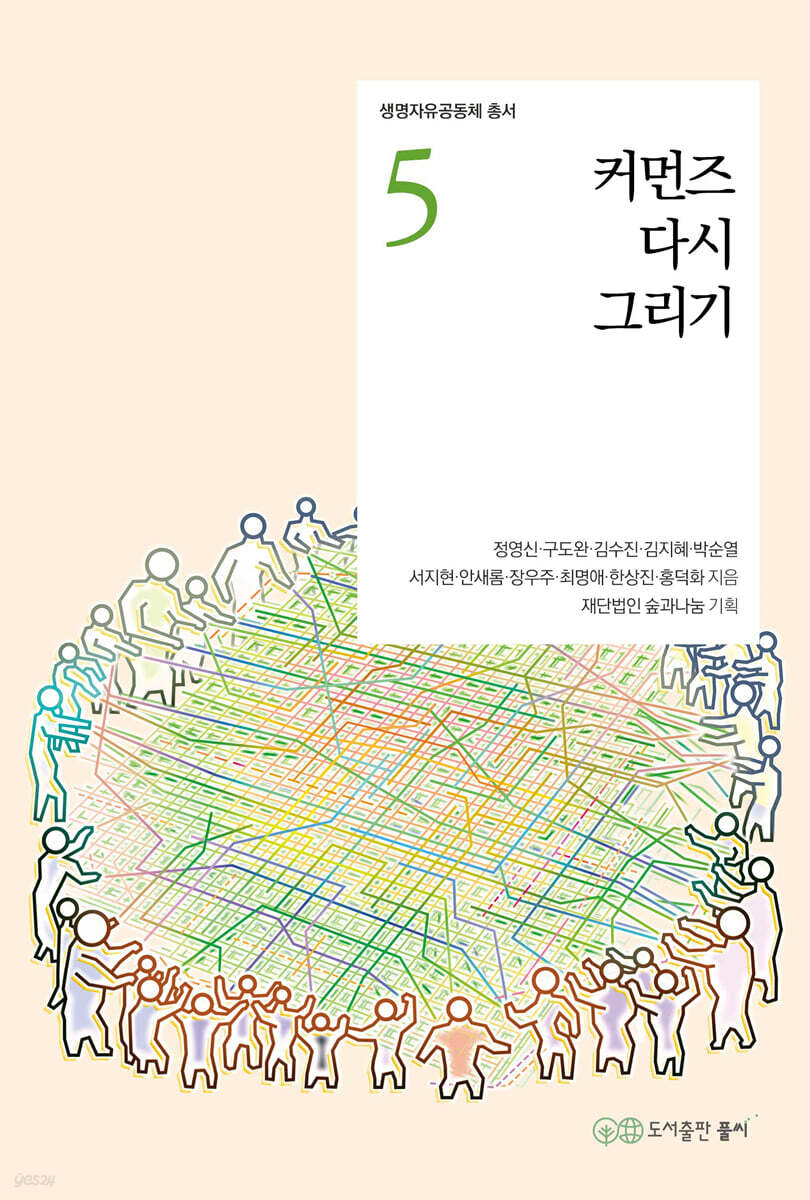
Redrawing the Commons
 |
Description
Book Introduction
The 'Forum Life Freedom Community', a research community established within the Forest and Sharing Foundation, edits the papers presented at the forum every year and publishes the Life Freedom Community Series.
In 2020, we published our first book, 『Questions for a New Era of the Life-Freedom Community』, followed by 『Questions of Transition, Transition of Questions (2021)』 and 『Politics of Transition, Ten Perspectives (2022)』. Last year, we published 『Climate Crisis, at the Crossroads of Transition (2023)』.
The title of the fifth series is “Redrawing the Commons (2024).”
As the title suggests, this series deals with the 'commons'.
The ten essays in this book seek to understand the commons, an emerging alternative discourse, from various perspectives.
How can we approach the commons? What do we see when we add the word "commons" to reality? And how can we think about the commons in a new way?
In 2020, we published our first book, 『Questions for a New Era of the Life-Freedom Community』, followed by 『Questions of Transition, Transition of Questions (2021)』 and 『Politics of Transition, Ten Perspectives (2022)』. Last year, we published 『Climate Crisis, at the Crossroads of Transition (2023)』.
The title of the fifth series is “Redrawing the Commons (2024).”
As the title suggests, this series deals with the 'commons'.
The ten essays in this book seek to understand the commons, an emerging alternative discourse, from various perspectives.
How can we approach the commons? What do we see when we add the word "commons" to reality? And how can we think about the commons in a new way?
- You can preview some of the book's contents.
Preview
index
Preface 5
Preface 7
Part 1.
Transition of the Living World and the Commons
Chapter 1: Ecological Reconstruction of Urban Commoning: A Case Study of Eunpyeong, a Transition Village 21
Chapter 2: The Hansalim Movement Through the Eyes of the Commons 52
Chapter 3: The Meaning of Community as Seen Through the Transformation of Peruvian Andean Peasant Communities 91
Part 2.
Transition beyond humanity and the commons
Chapter 4: Creating Urban Commons with Otters 117
Chapter 5: The Formation of Ecological and Social Commons by Humans and Beyond Humans 154
Part 3.
Energy Transition and the Commons
Chapter 6: Carbon Neutrality and Energy Transition: Standing Between the Commons and Unearned Income 179
Chapter 7: Energy Transition and Energy Commons 215
Part 4.
Commons and the Shift of Concepts
Chapter 8: How Fits the Commons into Modern Society? (253)
Chapter 9: The Commons as a Zone Between: The Spatiotemporal and Non-Representational Properties of the Commons 298
Chapter 10: The Debate on the Concept of the Commons and a Relational Approach to the Commons 324
supplement
Forum Program 374
About the Author 381
Preface 7
Part 1.
Transition of the Living World and the Commons
Chapter 1: Ecological Reconstruction of Urban Commoning: A Case Study of Eunpyeong, a Transition Village 21
Chapter 2: The Hansalim Movement Through the Eyes of the Commons 52
Chapter 3: The Meaning of Community as Seen Through the Transformation of Peruvian Andean Peasant Communities 91
Part 2.
Transition beyond humanity and the commons
Chapter 4: Creating Urban Commons with Otters 117
Chapter 5: The Formation of Ecological and Social Commons by Humans and Beyond Humans 154
Part 3.
Energy Transition and the Commons
Chapter 6: Carbon Neutrality and Energy Transition: Standing Between the Commons and Unearned Income 179
Chapter 7: Energy Transition and Energy Commons 215
Part 4.
Commons and the Shift of Concepts
Chapter 8: How Fits the Commons into Modern Society? (253)
Chapter 9: The Commons as a Zone Between: The Spatiotemporal and Non-Representational Properties of the Commons 298
Chapter 10: The Debate on the Concept of the Commons and a Relational Approach to the Commons 324
supplement
Forum Program 374
About the Author 381
Into the book
Through the example of 'Transition Village Eunpyeong,' the community women who participated in the urban garden shared ecological sensitivity through the 'act' of farming and ecological values through contact with nature... This urban women's community with such an ecological orientation can be said to be flexible, open, and still experimental.
--- p.21
Han Sallim is a movement that maintains the boundaries of 'us' while forming and reconstructing commons that go beyond them, and creating a world where all life can survive.
--- p.87
Through a case study of a Peruvian peasant community that has undergone internal and external changes in the process of constant interaction with the external society, we consider the meaning of the “(fluid) us” discussed in the commons theory.
--- p.97
The commons is not a closed space for common beings or a no man's land open to all beings with nothing in common, but a place created through the process of overlapping, encountering, and intertwining the paths of moving beings.
As a space between, the commons begins by leaving ‘room’.
--- p.319
In the commons beyond the human, non-humans will not be summoned to fulfill human needs, but will live in spaces that have been considered human, visit them, or respond to human invitations.
--- p.145~146
Rather than focusing on deep ecology, I understand the planetary perspective to encompass Earth-world systems theory. This is because I want to emphasize that the human world's problem of worsening working conditions for delivery riders due to extreme heat is linked to the climate crisis and the threat to the survival of beings beyond humans due to the logic of construction-oriented real estate development.
--- p.173
In the competition surrounding the energy transition path, the commons is (re)formed through activities that resist the exclusive ownership or monopoly of specific resources and (re)arrange them within the relationship of common (ours) and public (everyone's).
--- p.189
Energy commons can truly function well and realize its value when it actively leverages the market.
...
The energy commons concept, which excludes marketization, fails to reflect the current trends in the electric power industry and overlooks the technical and physical conditions for integrating distributed, variable renewable energy into the power system.
--- p.231
The overlap or overlapping of different understandings and values regarding objects that are established differently in each social system, that is, how to understand the commonalities of the systems, is at the core of the discussion on commons, including the discussion on the Gyeongui Line Commons.
--- p.287~288
The concept of commons is controversial.
That doesn't mean the concept of commons is still vague.
Rather, it means that people in various locations have different desires to call the commons, and the social realities that lead to them.
...
(Therefore) the commons should not be defined through any value orientation that is attached to it.
Rather, we can explain the various commons that exist in reality by focusing on a general form that can contain such diverse value orientations.
--- p.21
Han Sallim is a movement that maintains the boundaries of 'us' while forming and reconstructing commons that go beyond them, and creating a world where all life can survive.
--- p.87
Through a case study of a Peruvian peasant community that has undergone internal and external changes in the process of constant interaction with the external society, we consider the meaning of the “(fluid) us” discussed in the commons theory.
--- p.97
The commons is not a closed space for common beings or a no man's land open to all beings with nothing in common, but a place created through the process of overlapping, encountering, and intertwining the paths of moving beings.
As a space between, the commons begins by leaving ‘room’.
--- p.319
In the commons beyond the human, non-humans will not be summoned to fulfill human needs, but will live in spaces that have been considered human, visit them, or respond to human invitations.
--- p.145~146
Rather than focusing on deep ecology, I understand the planetary perspective to encompass Earth-world systems theory. This is because I want to emphasize that the human world's problem of worsening working conditions for delivery riders due to extreme heat is linked to the climate crisis and the threat to the survival of beings beyond humans due to the logic of construction-oriented real estate development.
--- p.173
In the competition surrounding the energy transition path, the commons is (re)formed through activities that resist the exclusive ownership or monopoly of specific resources and (re)arrange them within the relationship of common (ours) and public (everyone's).
--- p.189
Energy commons can truly function well and realize its value when it actively leverages the market.
...
The energy commons concept, which excludes marketization, fails to reflect the current trends in the electric power industry and overlooks the technical and physical conditions for integrating distributed, variable renewable energy into the power system.
--- p.231
The overlap or overlapping of different understandings and values regarding objects that are established differently in each social system, that is, how to understand the commonalities of the systems, is at the core of the discussion on commons, including the discussion on the Gyeongui Line Commons.
--- p.287~288
The concept of commons is controversial.
That doesn't mean the concept of commons is still vague.
Rather, it means that people in various locations have different desires to call the commons, and the social realities that lead to them.
...
(Therefore) the commons should not be defined through any value orientation that is attached to it.
Rather, we can explain the various commons that exist in reality by focusing on a general form that can contain such diverse value orientations.
--- p.364
GOODS SPECIFICS
- Date of issue: November 1, 2024
- Page count, weight, size: 384 pages | 152*225*30mm
- ISBN13: 9791198480828
- ISBN10: 1198480823
You may also like
카테고리
korean


korean

![GQ KOREA Mark (Monthly): December [2025]](http://librairie.coreenne.fr/cdn/shop/files/8ef265dbbfbf186523ed75ba7319009d.jpg?v=1765340328&width=3840)


