

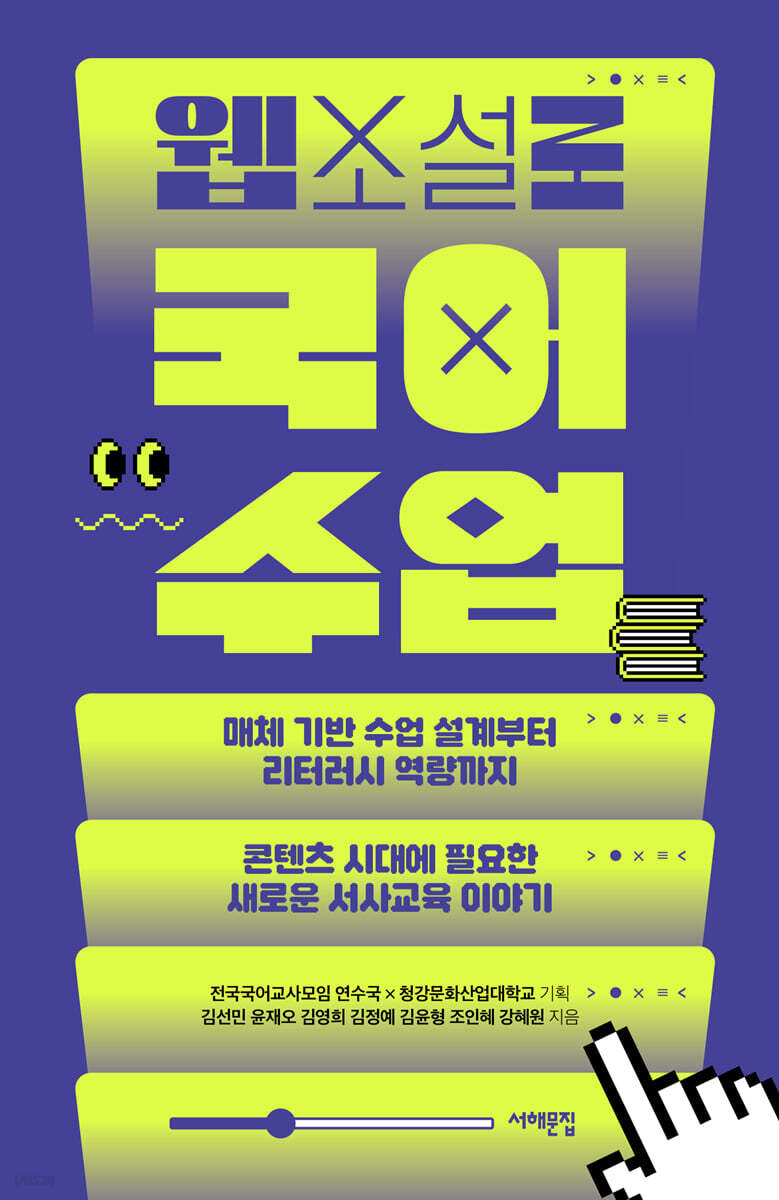
Korean language classes through web novels
 |
Description
Book Introduction
“The video just needs to be played.
“You have to think while reading.”
In an age of content overflowing with things to see and read,
A Web Novel Class for Those Teaching Written Language
In an era where we enjoy content such as reels, shorts, webtoons, and games, the objects and forms of reading have changed significantly.
Children now read images and videos instead of written language, and read linearly instead of structurally.
Don't read it over and over again.
Although the content is also a 'narrative', it is difficult to develop the narrative ability to follow and reflect on the story's path by reading it.
Web novels are one of the new contents that have emerged in this trend, and they are the medium that most clearly shows the tension between narrative and content.
What educational impact and prospects can we expect from incorporating web novels into Korean language classes? This book realistically presents the design of creative writing, literature, classics, and career courses using web novels as a subject matter, and the transformations students experience.
We will discuss specifically what goals can be achieved in the Korean language department when reading and writing together materials and formats that were difficult to access in existing literature.
Exploring and critically approaching how to understand and utilize web novels is a task that will soon consider the future after traditional narrative education (reading education) based on paper books.
These are also useful examples for preparing classes in the media area of the 2022 revised curriculum.
Web novels are also packed with tips on how to engage with unfamiliar teachers and help run classes smoothly.
This is the first volume of the 'Content Literacy Series' planned by the National Korean Language Teachers Association Training Department, which focuses on narrative education, and Cheonggang Cultural Industries University, a leading institution and cradle of Korean content creation. The following volumes are planned to be 'Theater' and 'Webtoon'.
“You have to think while reading.”
In an age of content overflowing with things to see and read,
A Web Novel Class for Those Teaching Written Language
In an era where we enjoy content such as reels, shorts, webtoons, and games, the objects and forms of reading have changed significantly.
Children now read images and videos instead of written language, and read linearly instead of structurally.
Don't read it over and over again.
Although the content is also a 'narrative', it is difficult to develop the narrative ability to follow and reflect on the story's path by reading it.
Web novels are one of the new contents that have emerged in this trend, and they are the medium that most clearly shows the tension between narrative and content.
What educational impact and prospects can we expect from incorporating web novels into Korean language classes? This book realistically presents the design of creative writing, literature, classics, and career courses using web novels as a subject matter, and the transformations students experience.
We will discuss specifically what goals can be achieved in the Korean language department when reading and writing together materials and formats that were difficult to access in existing literature.
Exploring and critically approaching how to understand and utilize web novels is a task that will soon consider the future after traditional narrative education (reading education) based on paper books.
These are also useful examples for preparing classes in the media area of the 2022 revised curriculum.
Web novels are also packed with tips on how to engage with unfamiliar teachers and help run classes smoothly.
This is the first volume of the 'Content Literacy Series' planned by the National Korean Language Teachers Association Training Department, which focuses on narrative education, and Cheonggang Cultural Industries University, a leading institution and cradle of Korean content creation. The following volumes are planned to be 'Theater' and 'Webtoon'.
- You can preview some of the book's contents.
Preview
index
Planning Notes _ Eom Ki-ho (sociologist, professor at Cheonggang Cultural Industries College)
Prologue _ Kim Seon-min (Professor, Web Novel Creation Department, Cartoon Content School, Cheonggang Cultural Industries College)
01 Because we both love stories
― Discovering Lifelong Readers: A New Seed: Conversing About Books Through Web Novels
A world where it's fortunate to read even web novels
With a heart to learn from each other
Sharing Our Web Novel History
Don't turn your back on paper books
Telling the Truth in a Virtual World: The Power of Web Novel Format - Read Together "If You Don't Debut, You'll Catch a Deadly Disease"
A good book to share a lot of stories with - What the conversation in the book "Our Garden" awakened
The joy of having a narrative of my own creation, not one presented by others.
How you read it matters
02 Erasing the line drawn between the book and me
― Reading web novels that cause cracks in thinking
“Bang!” came to the literary creation class.
The beginning was shallow
In the midst of a terrifying attraction _[Periods 1-3] Writing a reading journal for 〈Omniscient Reader's Viewpoint〉
Asking Interesting Questions _[4th-5th Period] Group Discussion where everyone talks
It may not be a literacy issue - the meaning of smooth, clever writing
Reading in the Middle of Chaos: Unexpected Educational Benefits
An experience that is easy to evaluate and lacks compassion _ [Session 6] Writing a book review draft
Reaching the Novel's Goal _ [Session 7] A Book Review That Encourages Us to Look at the Other Side of Humanity and the World
What becomes clear when we acknowledge the role of story
03 Cliché Help
― Web novel creation that invites anyone to the joy of writing.
What's needed is typicality, not originality.
One Second Before Debuting as a Web Novel Writer _[Part 1] The Meaning of Reader-Centered Writing
Lv.0 What kind of web novels do people like? _[Periods 2-4] Exploring web novels by genre
Lv.1: Finding Clichés in the Vast Ocean! _[Periods 5-6] Genre Writer Group Discussion
Lv.2 Using genre clichés for a clear and intuitive story [7-12 lessons]
Lv.3 Are Clichés Just for Readers? _[Lessons 13-15] Writing Loglines and Synopses
Our unspoken messages, but ones we wanted to say
Exciting, web novel episode 1 is revealed!
A funny story succeeds
[Reference] Web Novel Creation Activity Sheet for Middle School Students
04 Web Novel Class to Save the World
― A literature class that brings together the desires of the times with the values of coexistence, together with classmates from the 5060s.
But not at school!
To teach web novels in regular classes
The two managers' haphazard entry into web novels
I'm interested in social issues, but... I'm just an individual.
A New Path Opened by Fantasy _ [Session 1] Connecting Sustainable Development Goals and Web Novels
Unexpected Quests _ [2nd and 3rd Sessions] Reading "Farming Alone in the Tower"
What motivation and abilities will solve this problem? _[Session 4] Characteristics of the protagonist
In what world can this be solved? _[Session 5] Elements of Worldview Formation
From a Petty Citizen to a Practitioner _[Session 6-7] Finding the Causes of Social Problems
Come Play, My Other World _[Periods 8-9] Solving Social Problems with Fantasy Elements
It was possible because it was a web novel.
[Interview] "I'm no longer afraid of any type of class.": A review of the class partner of a reckless junior, Director Oh Ae-kyung.
05 To you who prepares for the future with content
― A web novel writing project that captures one's own stories, dreams, and desires.
You guys liked web novels this much?
Infinitely expanding seed content
From illustrations and webtoons to games and dramas
Finding the genre you want to write in (feat.
Chat GPT) _[1st Session] Exploring Interest Content and Web Novels
Building a World of My Taste on Keywords _[Second Session] Designing the Worldview and Story Outline
Time to understand the life you haven't lived _[3rd period] Character design
Setting the Story Direction _[Session 4-5] Completing the Synopsis
As I write, it becomes my story, right? _Web novel creation, no different from pure literature creation.
Another evolution of career writing
[Reference Material] Web Novel Writing Project Assignments Collection
06 Is this a timeless story?
― Exploring the Value of Classic Novels and the Future of Web Novels through Discussion Questions
Web novels are unfamiliar and classic novels are boring.
Classic novels and web novels are similar?
Let's get familiar with web novels _ [Lessons 1-4] Understanding the characteristics of web novels
People of the Joseon Dynasty also loved cider! _[Periods 5-8] The Charm of Classical Novels
"Is it right for the weak to die first?" _[Lessons 9-12] Critical Reading of Web Novels
"Is achievement under unfair conditions fair?" _[Lessons 13-18] Finding the questions that run through classic novels and web novels
Beyond the triumph of good over evil and the fleeting dream: The value of classics as revealed by web novels.
Can Web Novels Become Classics? _[Lessons 19-20] The Qualities of a Classic
A New Imagination Connecting Past and Present: "Heungbu's Youngest Son"
Adding web novels to classic novels
Looking forward to questions for a broader and deeper reading
[Reference] Web novels that are great to read alongside classic novels.
main
Prologue _ Kim Seon-min (Professor, Web Novel Creation Department, Cartoon Content School, Cheonggang Cultural Industries College)
01 Because we both love stories
― Discovering Lifelong Readers: A New Seed: Conversing About Books Through Web Novels
A world where it's fortunate to read even web novels
With a heart to learn from each other
Sharing Our Web Novel History
Don't turn your back on paper books
Telling the Truth in a Virtual World: The Power of Web Novel Format - Read Together "If You Don't Debut, You'll Catch a Deadly Disease"
A good book to share a lot of stories with - What the conversation in the book "Our Garden" awakened
The joy of having a narrative of my own creation, not one presented by others.
How you read it matters
02 Erasing the line drawn between the book and me
― Reading web novels that cause cracks in thinking
“Bang!” came to the literary creation class.
The beginning was shallow
In the midst of a terrifying attraction _[Periods 1-3] Writing a reading journal for 〈Omniscient Reader's Viewpoint〉
Asking Interesting Questions _[4th-5th Period] Group Discussion where everyone talks
It may not be a literacy issue - the meaning of smooth, clever writing
Reading in the Middle of Chaos: Unexpected Educational Benefits
An experience that is easy to evaluate and lacks compassion _ [Session 6] Writing a book review draft
Reaching the Novel's Goal _ [Session 7] A Book Review That Encourages Us to Look at the Other Side of Humanity and the World
What becomes clear when we acknowledge the role of story
03 Cliché Help
― Web novel creation that invites anyone to the joy of writing.
What's needed is typicality, not originality.
One Second Before Debuting as a Web Novel Writer _[Part 1] The Meaning of Reader-Centered Writing
Lv.0 What kind of web novels do people like? _[Periods 2-4] Exploring web novels by genre
Lv.1: Finding Clichés in the Vast Ocean! _[Periods 5-6] Genre Writer Group Discussion
Lv.2 Using genre clichés for a clear and intuitive story [7-12 lessons]
Lv.3 Are Clichés Just for Readers? _[Lessons 13-15] Writing Loglines and Synopses
Our unspoken messages, but ones we wanted to say
Exciting, web novel episode 1 is revealed!
A funny story succeeds
[Reference] Web Novel Creation Activity Sheet for Middle School Students
04 Web Novel Class to Save the World
― A literature class that brings together the desires of the times with the values of coexistence, together with classmates from the 5060s.
But not at school!
To teach web novels in regular classes
The two managers' haphazard entry into web novels
I'm interested in social issues, but... I'm just an individual.
A New Path Opened by Fantasy _ [Session 1] Connecting Sustainable Development Goals and Web Novels
Unexpected Quests _ [2nd and 3rd Sessions] Reading "Farming Alone in the Tower"
What motivation and abilities will solve this problem? _[Session 4] Characteristics of the protagonist
In what world can this be solved? _[Session 5] Elements of Worldview Formation
From a Petty Citizen to a Practitioner _[Session 6-7] Finding the Causes of Social Problems
Come Play, My Other World _[Periods 8-9] Solving Social Problems with Fantasy Elements
It was possible because it was a web novel.
[Interview] "I'm no longer afraid of any type of class.": A review of the class partner of a reckless junior, Director Oh Ae-kyung.
05 To you who prepares for the future with content
― A web novel writing project that captures one's own stories, dreams, and desires.
You guys liked web novels this much?
Infinitely expanding seed content
From illustrations and webtoons to games and dramas
Finding the genre you want to write in (feat.
Chat GPT) _[1st Session] Exploring Interest Content and Web Novels
Building a World of My Taste on Keywords _[Second Session] Designing the Worldview and Story Outline
Time to understand the life you haven't lived _[3rd period] Character design
Setting the Story Direction _[Session 4-5] Completing the Synopsis
As I write, it becomes my story, right? _Web novel creation, no different from pure literature creation.
Another evolution of career writing
[Reference Material] Web Novel Writing Project Assignments Collection
06 Is this a timeless story?
― Exploring the Value of Classic Novels and the Future of Web Novels through Discussion Questions
Web novels are unfamiliar and classic novels are boring.
Classic novels and web novels are similar?
Let's get familiar with web novels _ [Lessons 1-4] Understanding the characteristics of web novels
People of the Joseon Dynasty also loved cider! _[Periods 5-8] The Charm of Classical Novels
"Is it right for the weak to die first?" _[Lessons 9-12] Critical Reading of Web Novels
"Is achievement under unfair conditions fair?" _[Lessons 13-18] Finding the questions that run through classic novels and web novels
Beyond the triumph of good over evil and the fleeting dream: The value of classics as revealed by web novels.
Can Web Novels Become Classics? _[Lessons 19-20] The Qualities of a Classic
A New Imagination Connecting Past and Present: "Heungbu's Youngest Son"
Adding web novels to classic novels
Looking forward to questions for a broader and deeper reading
[Reference] Web novels that are great to read alongside classic novels.
main
Detailed image
.jpg)
Into the book
“Somin, have you read any interesting novels lately?”
"no."
“Don’t you like webtoons and web novels?”
"yes."
“So what do you usually do with your phone?”
“I watch YouTube.”
“You like animation, but you don’t read webtoons?”
"yes.
You just have to play the video, but you have to think about the text while reading it.
“It’s annoying.”
After hearing Somin's words, I realized that children who are completely isolated from the written word do not read webtoons or web novels.
--- p.32
By giving web novels the role of "interesting stories," we could easily tell children who complain that novels aren't fun to read that the fun of this genre lies in a different realm.
After analyzing the details and discovering meaning, I was able to add, “This is the fun that only novels have.”
I began to teach the pure literature I love in a way that was more 'appropriate to its form' than before.
--- p.96~97
Although the level of creativity varied, by combining clichés to create a general framework for the story, they were all able to complete the work at a similar pace.
For students who had no story to write about, clichés served as the first step toward creation.
For students who had so many stories they wanted to write, clichés became landmarks that showed them the direction of their stories.
Students who wanted to write a story that readers would love but were hesitant, believed in the cliché and started writing.
--- p.115
The eyebrows of children searching for social issues never straightened.
Among them, Yunhee stood out as she sighed in disbelief while reading a newspaper article.
“Why are you so angry?”
“Sir, there is no air conditioning in the office, and it takes 15 minutes to get to the break room where there is air conditioning, but the break time is 30 minutes.
This is telling me not to rest!”
Yunhee, who was angry, chose 'Strengthening policies to create good jobs' as a detailed goal.
And we found a blind spot in our country's industrial safety and health law.
(…) Each and every person who seriously faced the problem and sought a solution was not an individual as a common citizen, but a practitioner striving to take action.
Given the task of translating the problem I was struggling with into another world, I looked at the cause of the problem from various angles and thought about why it wasn't being fixed despite the solutions available, or what the fundamental cause was.
If the assignment had been, "Write a paper exploring a social problem and suggesting a solution," students would have searched for keywords like "poverty," "inequality," and "education," as they have done before, and used the data they found to write their papers.
Rather than containing the will to truly solve the problem, it would have contained the will to match the intention of the teacher who provided the performance evaluation topic.
--- p.173~175
In the past, when teaching career-related writing classes to children at school, we had them choose books related to their career interests, read them, and write book reviews or research reports.
It was very meaningful to write specific articles based on information about the job, but I always felt regretful that I couldn't directly participate in related work.
In that respect, the web novel writing project, which is closely related to various content fields, was useful as a way for children to actually produce content closely related to careers and occupations they are interested in, such as web novel writers, game designers, cover designers, illustrators, directors, producers, and game scenario writers.
It also gave me time to discover my own desires.
--- p.219~220
In web novels created by students, characters from classic novels are reborn with new goals.
Heungbu becomes Joseon's greatest animal communicator (inspired by Heungbu's healing of a swallow's leg), and after amassing great wealth and winning a fight with the king, he abolishes the caste system.
Heroes like Hong Gil-dong, Jeon Woo-chi, and Hong Gye-wol have the goal of ruling the world beyond Joseon.
(…) It was touching to see the characters in classical novels moving freely and independently.
It was even better because the stories the students created were interesting.
What was appealing was that, through web novels, we could create an interesting narrative by slightly twisting the content of a classic novel that everyone knows.
I felt like I had discovered another way to inherit classical literature in a modern way by discovering the narrative power of classical novels and adapting it to the current context.
"no."
“Don’t you like webtoons and web novels?”
"yes."
“So what do you usually do with your phone?”
“I watch YouTube.”
“You like animation, but you don’t read webtoons?”
"yes.
You just have to play the video, but you have to think about the text while reading it.
“It’s annoying.”
After hearing Somin's words, I realized that children who are completely isolated from the written word do not read webtoons or web novels.
--- p.32
By giving web novels the role of "interesting stories," we could easily tell children who complain that novels aren't fun to read that the fun of this genre lies in a different realm.
After analyzing the details and discovering meaning, I was able to add, “This is the fun that only novels have.”
I began to teach the pure literature I love in a way that was more 'appropriate to its form' than before.
--- p.96~97
Although the level of creativity varied, by combining clichés to create a general framework for the story, they were all able to complete the work at a similar pace.
For students who had no story to write about, clichés served as the first step toward creation.
For students who had so many stories they wanted to write, clichés became landmarks that showed them the direction of their stories.
Students who wanted to write a story that readers would love but were hesitant, believed in the cliché and started writing.
--- p.115
The eyebrows of children searching for social issues never straightened.
Among them, Yunhee stood out as she sighed in disbelief while reading a newspaper article.
“Why are you so angry?”
“Sir, there is no air conditioning in the office, and it takes 15 minutes to get to the break room where there is air conditioning, but the break time is 30 minutes.
This is telling me not to rest!”
Yunhee, who was angry, chose 'Strengthening policies to create good jobs' as a detailed goal.
And we found a blind spot in our country's industrial safety and health law.
(…) Each and every person who seriously faced the problem and sought a solution was not an individual as a common citizen, but a practitioner striving to take action.
Given the task of translating the problem I was struggling with into another world, I looked at the cause of the problem from various angles and thought about why it wasn't being fixed despite the solutions available, or what the fundamental cause was.
If the assignment had been, "Write a paper exploring a social problem and suggesting a solution," students would have searched for keywords like "poverty," "inequality," and "education," as they have done before, and used the data they found to write their papers.
Rather than containing the will to truly solve the problem, it would have contained the will to match the intention of the teacher who provided the performance evaluation topic.
--- p.173~175
In the past, when teaching career-related writing classes to children at school, we had them choose books related to their career interests, read them, and write book reviews or research reports.
It was very meaningful to write specific articles based on information about the job, but I always felt regretful that I couldn't directly participate in related work.
In that respect, the web novel writing project, which is closely related to various content fields, was useful as a way for children to actually produce content closely related to careers and occupations they are interested in, such as web novel writers, game designers, cover designers, illustrators, directors, producers, and game scenario writers.
It also gave me time to discover my own desires.
--- p.219~220
In web novels created by students, characters from classic novels are reborn with new goals.
Heungbu becomes Joseon's greatest animal communicator (inspired by Heungbu's healing of a swallow's leg), and after amassing great wealth and winning a fight with the king, he abolishes the caste system.
Heroes like Hong Gil-dong, Jeon Woo-chi, and Hong Gye-wol have the goal of ruling the world beyond Joseon.
(…) It was touching to see the characters in classical novels moving freely and independently.
It was even better because the stories the students created were interesting.
What was appealing was that, through web novels, we could create an interesting narrative by slightly twisting the content of a classic novel that everyone knows.
I felt like I had discovered another way to inherit classical literature in a modern way by discovering the narrative power of classical novels and adapting it to the current context.
--- p.263~264
Publisher's Review
Web novels in the classroom
Read together?
ㆍHow is it different from reading pure literature?
ㆍHow to read web novels during regular class time?
ㆍWhat kind of help can I get in creative writing, literature, classics, and career classes?
ㆍCan web novels also be the seeds that create lifelong readers?
Web novels are a medium that incorporates diverse content and reconstructs it within text, and their foundation is in traditional narrative forms such as folktales, legends, and tales.
It means that it contains stories that people have been reading with great enjoyment for the longest time.
"Korean Language Classes with Web Novels" critically examines whether this meta-complex text can alleviate the media polarization resulting from the diversification of content and strengthen students' literacy skills.
The result is a web novel class that six teachers from the National Korean Language Teachers Association Training Center attempted in their classrooms.
The authors explore whether web novels can attract children who actively seek to escape the act of 'reading'.
It is a text that overcomes the situation where the ultimate goal of reading education cannot be achieved even after reading a book, and it is a tool that lowers the threshold for creative classes that both students and teachers find difficult, and achieves various educational effects.
This content transcends the stereotype that "web novels are stimulating, mass-produced entertainment," and demonstrates its usefulness in narrative education and in preparing for classes in the media area of the 2022 revised curriculum.
We also included a friendly guide from Kim Seon-min, a professor of web novel creation at Cheonggang Cultural Industry College who has serialized numerous web novels on Kakao Page and published novels of various genres.
You can see at a glance the media characteristics and detailed genres of web novels, as well as a list of web novels that can be read together in the classroom and key considerations when introducing web novels into Korean language classes.
Beyond the frame of literacy and media literacy
Exploring the Future Beyond Traditional Narrative Education
Narrative education is crucial in fostering individuals who can “walk in others’ shoes” and create subjects who can construct and live their own lives narratively.
The book also says that a new form of narrative called web novels makes this possible.
After reading modern novels, students who stood in a place where the book could not shake them and 'evaluated' the characters encountered the web novel "Omniscient Reader's Viewpoint" and jumped into the middle of the confusion that the text brought.
Connect characters with your own life, discover multiple perspectives surrounding a single question, and make three-dimensional judgments.
Children who confined themselves to the status of students and considered themselves petit bourgeois, are reborn as practitioners who are genuinely interested in and passionately participate in solving social problems such as poverty, labor, and food through the protagonists and worldviews of web novels.
Meanwhile, the clichés of web novels help middle school students who have given up on writing because they can't think of a story to write, to take the first step toward writing.
By designing characters and stories based on comments, experiencing reader-centered writing, and completing synopses, children encounter desires they never knew existed within the clichés they have come to expect.
The writing project utilizing web novels and ChatGPT provides an opportunity for high school students who dream of becoming webtoon/web novel writers, illustrators, game scenario writers, producers, etc. to experience work directly related to their career paths and further concretize the direction they should take.
By reading classic novels and web novels together, readers can rediscover the value of classics that they once considered boring and predictable. They can also discover the narrative power of classics by making characters from classic novels, once confined by the limitations of their time, into protagonists of web novels.
The authors do not claim that web novels are superior to traditional Korean language classes.
It also honestly conveys the reactions and variables that children can experience in web novel classes.
Nevertheless, web novels are a medium that encourages students to read narratives more deeply and broadly, write more easily and freely, and show that they are a place to discover lifelong readers who freely move between pure literature and web novels.
"Korean Language Classes with Web Novels" will be a useful guide for teachers who are concerned about how to cultivate the literacy skills necessary in this content age, where readers constantly seek out new narratives, read only the conclusion when bored, and completely eliminate narrative for the sake of public enjoyment.
Read together?
ㆍHow is it different from reading pure literature?
ㆍHow to read web novels during regular class time?
ㆍWhat kind of help can I get in creative writing, literature, classics, and career classes?
ㆍCan web novels also be the seeds that create lifelong readers?
Web novels are a medium that incorporates diverse content and reconstructs it within text, and their foundation is in traditional narrative forms such as folktales, legends, and tales.
It means that it contains stories that people have been reading with great enjoyment for the longest time.
"Korean Language Classes with Web Novels" critically examines whether this meta-complex text can alleviate the media polarization resulting from the diversification of content and strengthen students' literacy skills.
The result is a web novel class that six teachers from the National Korean Language Teachers Association Training Center attempted in their classrooms.
The authors explore whether web novels can attract children who actively seek to escape the act of 'reading'.
It is a text that overcomes the situation where the ultimate goal of reading education cannot be achieved even after reading a book, and it is a tool that lowers the threshold for creative classes that both students and teachers find difficult, and achieves various educational effects.
This content transcends the stereotype that "web novels are stimulating, mass-produced entertainment," and demonstrates its usefulness in narrative education and in preparing for classes in the media area of the 2022 revised curriculum.
We also included a friendly guide from Kim Seon-min, a professor of web novel creation at Cheonggang Cultural Industry College who has serialized numerous web novels on Kakao Page and published novels of various genres.
You can see at a glance the media characteristics and detailed genres of web novels, as well as a list of web novels that can be read together in the classroom and key considerations when introducing web novels into Korean language classes.
Beyond the frame of literacy and media literacy
Exploring the Future Beyond Traditional Narrative Education
Narrative education is crucial in fostering individuals who can “walk in others’ shoes” and create subjects who can construct and live their own lives narratively.
The book also says that a new form of narrative called web novels makes this possible.
After reading modern novels, students who stood in a place where the book could not shake them and 'evaluated' the characters encountered the web novel "Omniscient Reader's Viewpoint" and jumped into the middle of the confusion that the text brought.
Connect characters with your own life, discover multiple perspectives surrounding a single question, and make three-dimensional judgments.
Children who confined themselves to the status of students and considered themselves petit bourgeois, are reborn as practitioners who are genuinely interested in and passionately participate in solving social problems such as poverty, labor, and food through the protagonists and worldviews of web novels.
Meanwhile, the clichés of web novels help middle school students who have given up on writing because they can't think of a story to write, to take the first step toward writing.
By designing characters and stories based on comments, experiencing reader-centered writing, and completing synopses, children encounter desires they never knew existed within the clichés they have come to expect.
The writing project utilizing web novels and ChatGPT provides an opportunity for high school students who dream of becoming webtoon/web novel writers, illustrators, game scenario writers, producers, etc. to experience work directly related to their career paths and further concretize the direction they should take.
By reading classic novels and web novels together, readers can rediscover the value of classics that they once considered boring and predictable. They can also discover the narrative power of classics by making characters from classic novels, once confined by the limitations of their time, into protagonists of web novels.
The authors do not claim that web novels are superior to traditional Korean language classes.
It also honestly conveys the reactions and variables that children can experience in web novel classes.
Nevertheless, web novels are a medium that encourages students to read narratives more deeply and broadly, write more easily and freely, and show that they are a place to discover lifelong readers who freely move between pure literature and web novels.
"Korean Language Classes with Web Novels" will be a useful guide for teachers who are concerned about how to cultivate the literacy skills necessary in this content age, where readers constantly seek out new narratives, read only the conclusion when bored, and completely eliminate narrative for the sake of public enjoyment.
GOODS SPECIFICS
- Date of issue: November 15, 2024
- Page count, weight, size: 275 pages | 322g | 130*200*18mm
- ISBN13: 9791192988993
You may also like
카테고리
korean


korean

![GQ KOREA Mark (Monthly): December [2025]](http://librairie.coreenne.fr/cdn/shop/files/8ef265dbbfbf186523ed75ba7319009d.jpg?v=1765340328&width=3840)


