

Faces of the Court
 |
Description
Book Introduction
Arrest, not guilty, guilty, sentence, imprisonment, trial, sentence… Cases brought before a criminal court are usually summarized in one word or sentence.
To those outside the courtroom, a criminal court is nothing more than a place to determine guilt or innocence, but beyond the lines of an article and the sentence, there exist blurred and blurred 'faces' in the courtroom.
Judge Park Joo-young, who brought readers to tears with “Some Reasons for Sentencing,” wrote and wrote again, sniffling, to remember the stories of the faces that came to the criminal court for various reasons.
He, who maintained hope even in the midst of pain and despair, expressed his tearful consolation through words and writing in “Faces of the Court.”
To those outside the courtroom, a criminal court is nothing more than a place to determine guilt or innocence, but beyond the lines of an article and the sentence, there exist blurred and blurred 'faces' in the courtroom.
Judge Park Joo-young, who brought readers to tears with “Some Reasons for Sentencing,” wrote and wrote again, sniffling, to remember the stories of the faces that came to the criminal court for various reasons.
He, who maintained hope even in the midst of pain and despair, expressed his tearful consolation through words and writing in “Faces of the Court.”
- You can preview some of the book's contents.
Preview
index
prolog
Chapter 1: People Who Endure Irreparable Loss
People who talk to themselves
Last roll call
La Llorona
Things poverty doesn't know
Just one person
Chapter 2: Is the world getting better every day?
Beautiful Boy
It's the first time I've heard of it
weak will
Left of Samjeongmok
lunar eclipse
Chapter 3: The Ideology and Justice That Saves People
We are both early morning
You are the law
Please move your feet
Symptoms
Judges and Writing
fighting skills
Epilogue
Chapter 1: People Who Endure Irreparable Loss
People who talk to themselves
Last roll call
La Llorona
Things poverty doesn't know
Just one person
Chapter 2: Is the world getting better every day?
Beautiful Boy
It's the first time I've heard of it
weak will
Left of Samjeongmok
lunar eclipse
Chapter 3: The Ideology and Justice That Saves People
We are both early morning
You are the law
Please move your feet
Symptoms
Judges and Writing
fighting skills
Epilogue
Detailed image
Into the book
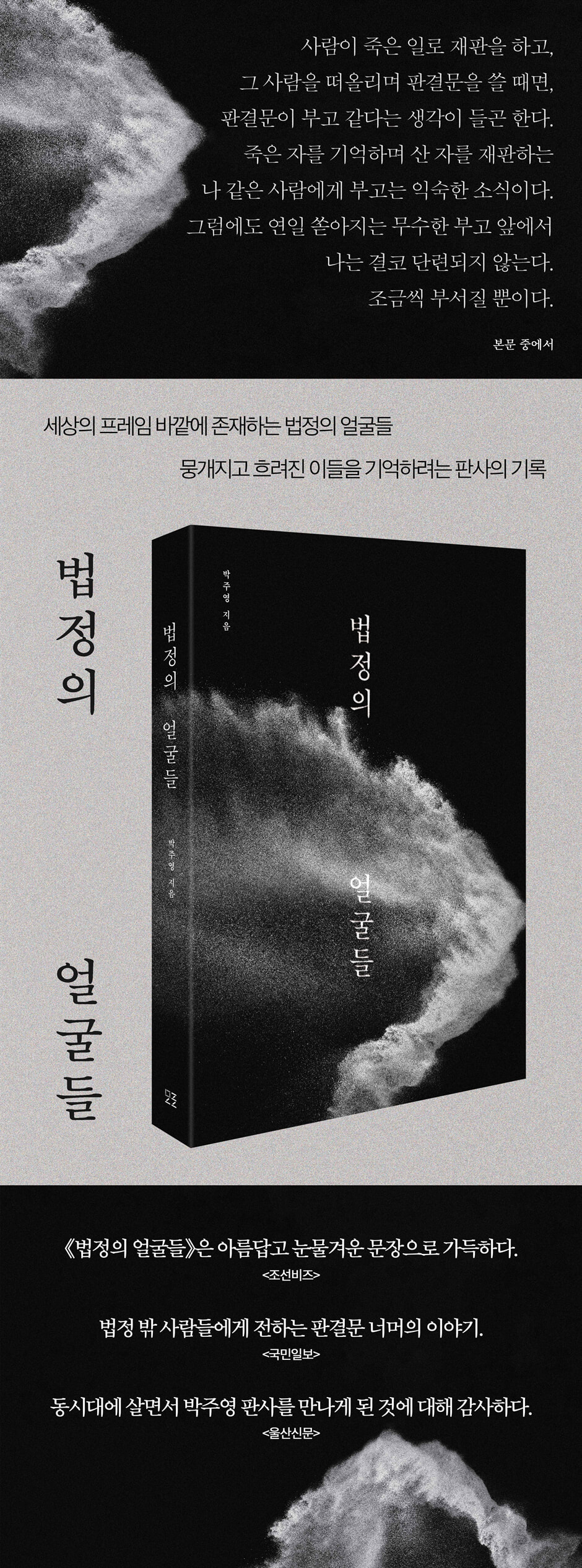
If there was just one person on earth who would listen to his story, if only he could instill that belief in him, he would be able to live.
Because his life is also a socially meaningful story, as long as there are people who listen to it seriously, the story cannot stop.
The cruelest thing a person can do to another person is to leave them to talk to themselves.
--- p.32~33
The charges listed on the verdict cover do not even cover one-hundredth of the actual case.
The victim's tears, pain, shattered daily life and future, and time that no longer flows are all omitted.
The victim's time stops for a moment.
It seems to flow for a moment, but then it returns to that point again.
Without retribution for the harm done and consideration from those around them, they cannot flow back.
--- p.66
Whenever I sit in court over a death and write a verdict while thinking of that person, I often think of the verdict as an obituary.
For someone like me who remembers the dead and judges the living, obituaries are familiar news.
Yet, I am never disciplined in the face of the countless obituaries that pour in every day.
It just breaks down little by little.
--- p.123
It goes without saying, but not a single person should be missed.
Every proposition is refuted by exactly one counterexample.
The proposition that penguins cannot fly can be broken with just one flying penguin.
Even if there is just one case of overcoming drug addiction, it is difficult to give up on treating drug addicts.
If you accumulate just a few such cases, you will never be able to give up.
Not to be rhetorical, but I truly believe that if I can save just one person, I can save the world.
When one person changes, the world changes.
This is why I can't give up on even one person.
--- p.195
Even in a jury system, a majority vote of 10 to 2 or 11 to 1, which modifies the unanimity, is often considered to be beyond reasonable doubt.
But that's not the case with out-of-court majority decisions.
Corporate governance, elections, and policy decisions are all decided by a single vote.
In a winner-take-all society, this system causes too much pain to the losers even with a very small loss.
Even at this very moment, many life-or-death decisions are being made by a single vote under the pretext of efficiency.
While the few who are easily cut off will stay behind with only a few bullets and a grenade to fight the monster and die quickly, the majority will run far away.
--- p.289
Even at this very moment, countless women are being beaten, stabbed, secretly filmed, the footage traded, stalked, and killed in their homes, subway stations, and parks.
From my perspective, where I live in the breathtaking realities of everyday abuse and murder, feminism is not a platitude.
--- p.316
Just as Justice Ginsburg demonstrated how individuals can endure an era and fight against the absurdity of the world, I believe that a society must also adopt the right stance to navigate such times.
I'm not sure exactly what it is, but at least one thing is clear.
Not neglecting the individual fighting alone in an unjust world, not sacrificing even a single person.
Because his life is also a socially meaningful story, as long as there are people who listen to it seriously, the story cannot stop.
The cruelest thing a person can do to another person is to leave them to talk to themselves.
--- p.32~33
The charges listed on the verdict cover do not even cover one-hundredth of the actual case.
The victim's tears, pain, shattered daily life and future, and time that no longer flows are all omitted.
The victim's time stops for a moment.
It seems to flow for a moment, but then it returns to that point again.
Without retribution for the harm done and consideration from those around them, they cannot flow back.
--- p.66
Whenever I sit in court over a death and write a verdict while thinking of that person, I often think of the verdict as an obituary.
For someone like me who remembers the dead and judges the living, obituaries are familiar news.
Yet, I am never disciplined in the face of the countless obituaries that pour in every day.
It just breaks down little by little.
--- p.123
It goes without saying, but not a single person should be missed.
Every proposition is refuted by exactly one counterexample.
The proposition that penguins cannot fly can be broken with just one flying penguin.
Even if there is just one case of overcoming drug addiction, it is difficult to give up on treating drug addicts.
If you accumulate just a few such cases, you will never be able to give up.
Not to be rhetorical, but I truly believe that if I can save just one person, I can save the world.
When one person changes, the world changes.
This is why I can't give up on even one person.
--- p.195
Even in a jury system, a majority vote of 10 to 2 or 11 to 1, which modifies the unanimity, is often considered to be beyond reasonable doubt.
But that's not the case with out-of-court majority decisions.
Corporate governance, elections, and policy decisions are all decided by a single vote.
In a winner-take-all society, this system causes too much pain to the losers even with a very small loss.
Even at this very moment, many life-or-death decisions are being made by a single vote under the pretext of efficiency.
While the few who are easily cut off will stay behind with only a few bullets and a grenade to fight the monster and die quickly, the majority will run far away.
--- p.289
Even at this very moment, countless women are being beaten, stabbed, secretly filmed, the footage traded, stalked, and killed in their homes, subway stations, and parks.
From my perspective, where I live in the breathtaking realities of everyday abuse and murder, feminism is not a platitude.
--- p.316
Just as Justice Ginsburg demonstrated how individuals can endure an era and fight against the absurdity of the world, I believe that a society must also adopt the right stance to navigate such times.
I'm not sure exactly what it is, but at least one thing is clear.
Not neglecting the individual fighting alone in an unjust world, not sacrificing even a single person.
--- p.378
Publisher's Review
Faces of the court that exist outside the frame of the world
The writings of a judge who remembers the dead and judges the living
★ Recommended by novelist Jang Kang-myeong
People who endure irreparable loss
The best attitude we should adopt in a world seething with damage
In late 2019, Judge Park Joo-young, author of “Faces of the Court,” was assigned to handle an “attempted suicide assistance” case.
He wrote a verdict that called for public attention to save the defendants who had attempted suicide several times in their 20s, and he also sent them a separate message called "Words of Request," which contained a person's earnest request rather than the language of the law.
This verdict, which brought tears to the eyes of the young defendants standing in the cold and heavy courtroom, became a hot topic at the time and is still talked about today, deeply resonating with many.
The author has seen the faces of these people over and over again in court.
A young man who harmed himself while embracing an unbearable wound, a child who lost his life after being beaten by a guardian who should have been loved, a high school girl who was sexually assaulted for a long time, an elderly man who was about to go to prison because he had no money... Their lives are either not explained at all or are only mentioned in a single headline, such as, "Stealing bread from a convenience store... Sentenced to 1 year in prison."
But the damage the parties inflict on the world, on their guardians, and on inherited poverty lasts a lifetime.
In the end, we have no choice but to live with the irreparable loss.
Can't we change this revolving door-like reality, where these people constantly turn and reappear? The author argues, "The richer and broader the narrative, the greater and richer the lyricism.
Ultimately, he says, “our first task is not to imagine and express the indescribable lyricism, but to trace and unearth the countless buried narratives.”
Behind the damage that is consumed for a moment by regret and sadness, there exists a specific life narrative.
The best attitude we can take is to carefully record the invisible narrative and suffer together.
“If there is no news, there is no problem.
The first thing we must do to ensure that the deaths of Seo Hyun-i, Jeong In-i, Kim Yong-gyun, and Israel were not in vain is to record and publicize their deaths.
Social outrage, appropriate punishment, and improvements in the legal and medical systems will follow.”
Is the world getting better every day?
How to avoid evil tricks
The criminal cases the author encounters are “a messy mix of contexts, such as justice and injustice, perpetrator and victim, personal responsibility and social responsibility.”
The defendant, who suffered from mental illness and killed his mother, did not know who he was or where he stood, and the child who committed the crime and was brought to court had been wandering outside the home since elementary school.
Even if they commit the same crime, children without guardians go to juvenile detention centers, and those without guardians go home.
The drug-addicted defendant desperately tries to quit drugs, but is caught in an entrapment investigation and ends up back in court.
People who commit crimes are often compared to devils or monsters.
The author even goes so far as to describe the court as “a place like an ocean where all kinds of evil flows in.”
However, just as Arthur in the movie Joker was not Joker from the beginning, not all evildoers who appear in court were evil from the beginning.
In a world where persistent and vicious violence only reaches downward, where people not only ignore the sick and the diseased but also mock and condemn them, and where not only poverty but also crime is passed down through generations, evil manifests itself little by little, gradually.
In the courtroom, evil surges like a wave, but outside the courtroom, evil is everywhere.
Because evil is inherent in all of our nature.
The author says that in order to avoid becoming darkened by the countless evils, big and small, that exist within and around us, “we need empathy, conscience, a sense of guilt, and shame.”
It doesn't really matter that I think I'm different from those devils, that I'm not a bad person.
“What is always important is to be aware of evil.”
“To discern evil and injustice and avoid repeating them, I must always be vigilant and reflect on whether I am stepping on or trampling on anyone, whether someone is suffering because of me, and whether I am in fact a fraudulent robot.
······What evil truly seeks is for good to continue living without knowing evil.
“The moment good realizes evil, evil disappears with a bang.”
The ideology and justice that saves people
The desire to move towards a slightly better world
The job of a judge in a criminal court is to determine guilt or innocence according to the law.
For people whose conflicts have erupted and brought them to court, the most important thing is whether the judge will take their side.
To get the judge on their side, some people try to find out about the judge's private life and past outside the courtroom.
People sitting in the courtroom for their own reasons ask the judge with their expressions and eyes.
“Which side are you on?” The judge, caught up in the silent screams, buries his head in the verdict.
The world's cries are louder and noisier.
Freedom or equality, growth or distribution, feminism or not, support or oppose homosexuality, justification or practicality... We can always stand on one side or the other, but we take sides, divide into camps, and then persistently question them.
“Which side are you on?” But just as feminism is not a platitude to the author, who “is on the suffocating scene where someone is abused and murdered every day,” in a world rife with violence, the only thing that matters is that everyone joins forces to stop crime and protect lives.
What is the right stance to take in order to overcome an absurd society where everyone fights over who is right, where everyone is unjust, and justice has vanished? The author suggests, "Not neglecting the individual fighting alone in an unjust world, not sacrificing even a single person."
In an age of sharp conflict and full of hatred and resentment, the ideology must be human.
Readers of Faces of the Court will know.
In the end, all we should desire is a world that is slightly better than the one we have now.
The writings of a judge who remembers the dead and judges the living
★ Recommended by novelist Jang Kang-myeong
People who endure irreparable loss
The best attitude we should adopt in a world seething with damage
In late 2019, Judge Park Joo-young, author of “Faces of the Court,” was assigned to handle an “attempted suicide assistance” case.
He wrote a verdict that called for public attention to save the defendants who had attempted suicide several times in their 20s, and he also sent them a separate message called "Words of Request," which contained a person's earnest request rather than the language of the law.
This verdict, which brought tears to the eyes of the young defendants standing in the cold and heavy courtroom, became a hot topic at the time and is still talked about today, deeply resonating with many.
The author has seen the faces of these people over and over again in court.
A young man who harmed himself while embracing an unbearable wound, a child who lost his life after being beaten by a guardian who should have been loved, a high school girl who was sexually assaulted for a long time, an elderly man who was about to go to prison because he had no money... Their lives are either not explained at all or are only mentioned in a single headline, such as, "Stealing bread from a convenience store... Sentenced to 1 year in prison."
But the damage the parties inflict on the world, on their guardians, and on inherited poverty lasts a lifetime.
In the end, we have no choice but to live with the irreparable loss.
Can't we change this revolving door-like reality, where these people constantly turn and reappear? The author argues, "The richer and broader the narrative, the greater and richer the lyricism.
Ultimately, he says, “our first task is not to imagine and express the indescribable lyricism, but to trace and unearth the countless buried narratives.”
Behind the damage that is consumed for a moment by regret and sadness, there exists a specific life narrative.
The best attitude we can take is to carefully record the invisible narrative and suffer together.
“If there is no news, there is no problem.
The first thing we must do to ensure that the deaths of Seo Hyun-i, Jeong In-i, Kim Yong-gyun, and Israel were not in vain is to record and publicize their deaths.
Social outrage, appropriate punishment, and improvements in the legal and medical systems will follow.”
Is the world getting better every day?
How to avoid evil tricks
The criminal cases the author encounters are “a messy mix of contexts, such as justice and injustice, perpetrator and victim, personal responsibility and social responsibility.”
The defendant, who suffered from mental illness and killed his mother, did not know who he was or where he stood, and the child who committed the crime and was brought to court had been wandering outside the home since elementary school.
Even if they commit the same crime, children without guardians go to juvenile detention centers, and those without guardians go home.
The drug-addicted defendant desperately tries to quit drugs, but is caught in an entrapment investigation and ends up back in court.
People who commit crimes are often compared to devils or monsters.
The author even goes so far as to describe the court as “a place like an ocean where all kinds of evil flows in.”
However, just as Arthur in the movie Joker was not Joker from the beginning, not all evildoers who appear in court were evil from the beginning.
In a world where persistent and vicious violence only reaches downward, where people not only ignore the sick and the diseased but also mock and condemn them, and where not only poverty but also crime is passed down through generations, evil manifests itself little by little, gradually.
In the courtroom, evil surges like a wave, but outside the courtroom, evil is everywhere.
Because evil is inherent in all of our nature.
The author says that in order to avoid becoming darkened by the countless evils, big and small, that exist within and around us, “we need empathy, conscience, a sense of guilt, and shame.”
It doesn't really matter that I think I'm different from those devils, that I'm not a bad person.
“What is always important is to be aware of evil.”
“To discern evil and injustice and avoid repeating them, I must always be vigilant and reflect on whether I am stepping on or trampling on anyone, whether someone is suffering because of me, and whether I am in fact a fraudulent robot.
······What evil truly seeks is for good to continue living without knowing evil.
“The moment good realizes evil, evil disappears with a bang.”
The ideology and justice that saves people
The desire to move towards a slightly better world
The job of a judge in a criminal court is to determine guilt or innocence according to the law.
For people whose conflicts have erupted and brought them to court, the most important thing is whether the judge will take their side.
To get the judge on their side, some people try to find out about the judge's private life and past outside the courtroom.
People sitting in the courtroom for their own reasons ask the judge with their expressions and eyes.
“Which side are you on?” The judge, caught up in the silent screams, buries his head in the verdict.
The world's cries are louder and noisier.
Freedom or equality, growth or distribution, feminism or not, support or oppose homosexuality, justification or practicality... We can always stand on one side or the other, but we take sides, divide into camps, and then persistently question them.
“Which side are you on?” But just as feminism is not a platitude to the author, who “is on the suffocating scene where someone is abused and murdered every day,” in a world rife with violence, the only thing that matters is that everyone joins forces to stop crime and protect lives.
What is the right stance to take in order to overcome an absurd society where everyone fights over who is right, where everyone is unjust, and justice has vanished? The author suggests, "Not neglecting the individual fighting alone in an unjust world, not sacrificing even a single person."
In an age of sharp conflict and full of hatred and resentment, the ideology must be human.
Readers of Faces of the Court will know.
In the end, all we should desire is a world that is slightly better than the one we have now.
GOODS SPECIFICS
- Date of issue: November 5, 2024
- Page count, weight, size: 384 pages | 140*210*18mm
- ISBN13: 9791198972507
You may also like
카테고리
korean


korean

![GQ KOREA Mark (Monthly): December [2025]](http://librairie.coreenne.fr/cdn/shop/files/8ef265dbbfbf186523ed75ba7319009d.jpg?v=1765340328&width=3840)


