

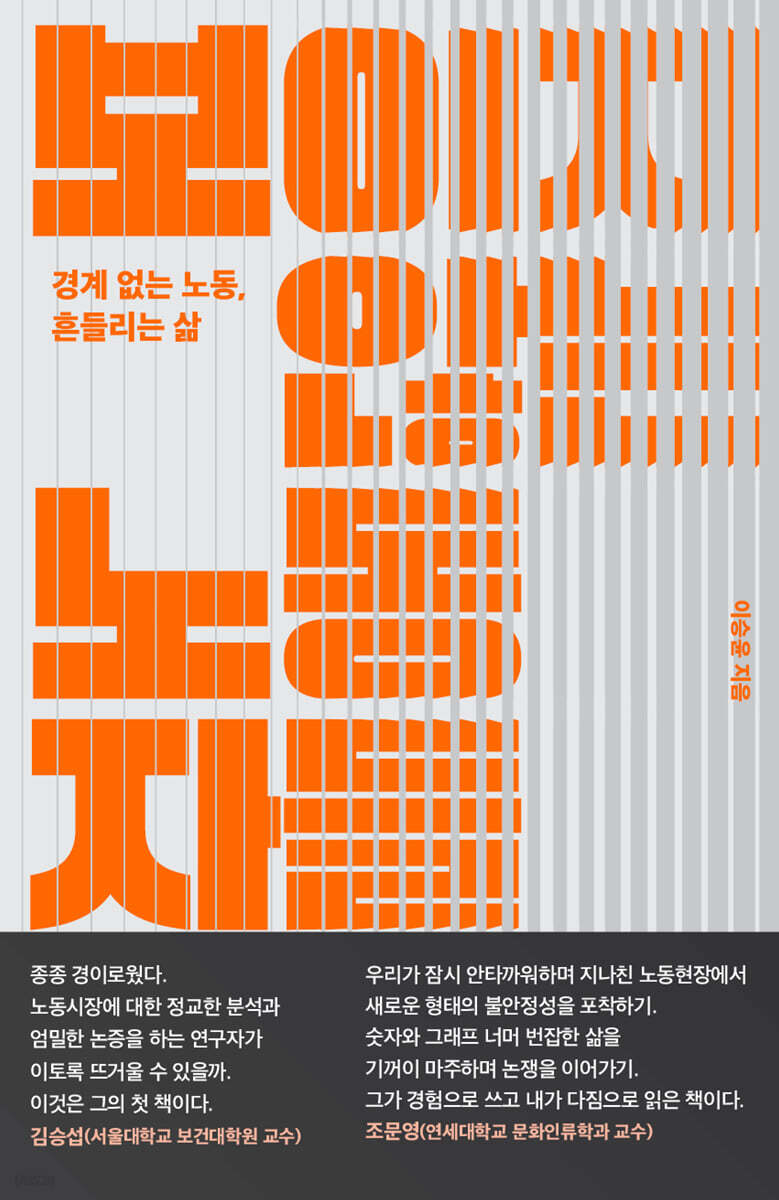
invisible workers
 |
Description
Book Introduction
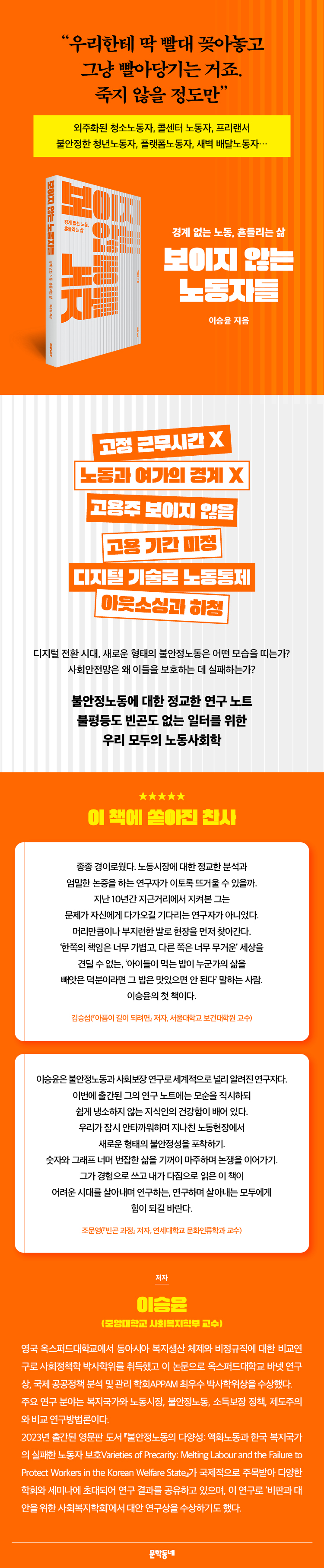
What will new forms of precarious work look like in the digital transformation era?
Why does the social safety net fail to protect them?
_Elaborate Research Notes on Precarious Work
As the form of work has changed over the past few decades, new forms of work have emerged that are difficult to explain with traditional categories such as “working class” or “proletariat.”
Examples include outsourced cleaning workers, call center workers, sick workers, laid-off workers, unstable young workers, subcontracted workers, freelancers, platform workers, early morning delivery workers, workers at small businesses, and fake self-employed people.
What is noteworthy is that unstable work is not simply a classification by occupation, gender, or age group, but a new classification based on the characteristics of the work.
The scope of unstable workers is expanding beyond regular workers, daily workers, and short-term contract workers to include new occupations such as YouTubers, creators, and platform workers.
On the surface, they appear to be independent self-employed or freelancers, working in a free and creative manner. However, in reality, they often work tirelessly, fearing an uncertain future and without a guaranteed adequate income.
Despite the changes brought about by technological advancements, such as the platform economy and the development of high-tech industries, why haven't workers' rights expanded in step? Why are our laborers treated as replaceable? "Invisible Workers" delves into the lives of not only traditionally unstable workers, including irregular workers, but also new forms of unstable workers. It conceptualizes the contradictory labor they experience in precise sociological terms and proposes a social security system to protect their right to live.
Professor Lee Seung-yoon of the Department of Social Welfare at Chung-Ang University, who has been recognized for his labor research both domestically and internationally, has published his first book, "Varieties of Precarity," which was first published in English-speaking countries. This book allows for the first time to examine the study of "liquefied labor."
As a labor researcher, his research and perspective, which combine academic integrity with ethical attitude, will contribute to understanding the 'reality' of labor in this society.
Why does the social safety net fail to protect them?
_Elaborate Research Notes on Precarious Work
As the form of work has changed over the past few decades, new forms of work have emerged that are difficult to explain with traditional categories such as “working class” or “proletariat.”
Examples include outsourced cleaning workers, call center workers, sick workers, laid-off workers, unstable young workers, subcontracted workers, freelancers, platform workers, early morning delivery workers, workers at small businesses, and fake self-employed people.
What is noteworthy is that unstable work is not simply a classification by occupation, gender, or age group, but a new classification based on the characteristics of the work.
The scope of unstable workers is expanding beyond regular workers, daily workers, and short-term contract workers to include new occupations such as YouTubers, creators, and platform workers.
On the surface, they appear to be independent self-employed or freelancers, working in a free and creative manner. However, in reality, they often work tirelessly, fearing an uncertain future and without a guaranteed adequate income.
Despite the changes brought about by technological advancements, such as the platform economy and the development of high-tech industries, why haven't workers' rights expanded in step? Why are our laborers treated as replaceable? "Invisible Workers" delves into the lives of not only traditionally unstable workers, including irregular workers, but also new forms of unstable workers. It conceptualizes the contradictory labor they experience in precise sociological terms and proposes a social security system to protect their right to live.
Professor Lee Seung-yoon of the Department of Social Welfare at Chung-Ang University, who has been recognized for his labor research both domestically and internationally, has published his first book, "Varieties of Precarity," which was first published in English-speaking countries. This book allows for the first time to examine the study of "liquefied labor."
As a labor researcher, his research and perspective, which combine academic integrity with ethical attitude, will contribute to understanding the 'reality' of labor in this society.
- You can preview some of the book's contents.
Preview
index
ㆍAt the beginning of the book
Following the Lives of Precarious Workers, Dissecting Their Fluid World
Part 1: Turbulent Workplaces and an Unprepared Society
1.
Double poor, lacking both time and money
2.
Dawn work, regressive innovation
3.
People left behind after industrial accidents
4.
The Cargo Truckers' Solidarity Strike and the "Fake Self-Employed"
Part 2: The worker collapses.
Yesterday, today and tomorrow
5.
It's poverty because it hurts
6.
To the industrial city of Ulsan
7.
Layoffs, the beginning of a downfall
8.
If the food children eat is collateral for someone's life
Part 3: Youth Labor: Who's Saying What?
9.
Between youth and 'MZ'
10.
A very unstable life vs.
A life without instability
11.
When 'class' is erased from youth discourse
12.
A spell called 'signature policy'
Part 4: Worries at the Boundary
13.
Why are scholars ignorant?
14.
Living as a female researcher in Korea
15.
The usefulness of researchers
16.
Belonging to the mainstream academic community
17.
Between research subjects and researchers
Research Note: The Diversity of Precarious Work and Liquid Labor
Americas
Following the Lives of Precarious Workers, Dissecting Their Fluid World
Part 1: Turbulent Workplaces and an Unprepared Society
1.
Double poor, lacking both time and money
2.
Dawn work, regressive innovation
3.
People left behind after industrial accidents
4.
The Cargo Truckers' Solidarity Strike and the "Fake Self-Employed"
Part 2: The worker collapses.
Yesterday, today and tomorrow
5.
It's poverty because it hurts
6.
To the industrial city of Ulsan
7.
Layoffs, the beginning of a downfall
8.
If the food children eat is collateral for someone's life
Part 3: Youth Labor: Who's Saying What?
9.
Between youth and 'MZ'
10.
A very unstable life vs.
A life without instability
11.
When 'class' is erased from youth discourse
12.
A spell called 'signature policy'
Part 4: Worries at the Boundary
13.
Why are scholars ignorant?
14.
Living as a female researcher in Korea
15.
The usefulness of researchers
16.
Belonging to the mainstream academic community
17.
Between research subjects and researchers
Research Note: The Diversity of Precarious Work and Liquid Labor
Americas
Detailed image
Into the book
The ultimate goal of "Invisible Workers" is not simply to repeat the familiar narrative that workers remain poor and precarious despite economic growth.
Rather, I want to share how new instabilities emerge as the form of work changes, where institutional efforts surrounding precarious workers fail, and, most importantly, how I research precarious work and social policy, and what I've learned.
At the same time, I wanted to reflect on how disconnected many researchers, policymakers, politicians, and administrators, including myself, are from this reality.
--- From "Introduction"
Despite the high rate of industrial accidents, numerous studies have shown that industrial accident insurance is not effectively implemented, leaving unstable workers without any protection.
(...) As of May 2020, only 16.84% of special employment workers are covered by industrial accident insurance.
Even if they are enrolled in industrial accident insurance, many of the unstable workers I met through my research either give up on filing for industrial accident compensation or end up with a compensation claim, such as receiving partial medical expenses privately from the factory owner or company.
This is because, during the difficult process of filing for industrial accident compensation, unstable workers who are more desperate for immediate income are more likely to give up filing.
--- From "People Left Behind After an Industrial Accident"
This is because in Korea, the safety net that prevents sick workers from falling into poverty is significantly weak.
For example, in the UK, where free medical care was introduced in the 1940s, there is a safety net called public medical care that prevents people from falling into poverty due to illness.
On the other hand, in Korea, the low coverage of health insurance is still a problem, making it difficult to prevent sick workers from becoming poor.
This means that even middle-class people fall into poverty when they become seriously ill, as health insurance benefits do not sufficiently cover patients' hospital bills.
Studies on the so-called "catastrophic medical expenses" in Korea have empirically demonstrated the situation in Korea where the middle class and above fall into poverty due to excessive medical expenses, or where the poor are unable to escape the shackles of poverty due to illness.
Moreover, unlike most OECD member countries, there is no government-supported 'sick leave allowance' in Korea.
--- From "Because I'm sick, I'm poor"
As unemployment benefits were not functioning properly, most respondents relied heavily on personal relationships during the job search process, and the utilization of job placement or employment services provided by government employment centers was found to be very low due to the short-term interruption of income-generating activities.
Ultimately, it was analyzed that these people were moving around the external labor market until they were on the verge of falling into the poverty class, receiving basic livelihood security.
--- "Dismissal, the Beginning of a Downfall," p. 104
It clearly shows how easily identity politics, which represent a specific generation, can erase class politics.
Although there are different interests depending on class within the group grouped under the single category of 'youth,' these differences are diluted within the frame of 'generational conflict.'
Moreover, the fragmentary representation of the youth generation revealed in the media had serious limitations in revealing reality.
As minority voices are amplified and reproduced as if they represent the opinions of all young people, the diversity and complexity within young people are ignored.
This has ultimately distorted social understanding of youth issues and hindered the establishment of effective policies.
--- From "Between Youth and 'MZ'"
Among young people in 2002, the largest group was classified as working in a 'somewhat unstable' state.
And although there were many middle-class youth, the proportion of very unstable youth was small, and the proportion of not at all unstable youth (stable) was small.
But in 2022, things changed.
The proportion of young people experiencing extremes of instability, such as those in the very unstable group and those in the not-at-all-unstable group, increased by nearly 1.5 and 2 times, respectively.
And the proportion of young people in the 'slightly unstable' group, which occupies an intermediate position, decreased by about 60%.
A serious polarization has emerged as the number of young people who are not very insecure increases simultaneously with the number of young people who are very insecure. --- "Very insecure life vs.
From “A Life Without Instability”
Scholars must understand their own class position and maintain a critical perspective on the risk of othering their research subjects.
Even in analyzing reality, we must be wary of unconditional trust in expertise guaranteed by theory or statistical figures, and explore reality beyond our own understanding and experience.
It seems that we live in an era where the concept of intellectuals' 'sense of responsibility for the times' is now distant and rarely used, and perhaps even seen as 'hypocrisy.'
However, blindly casting cynicism on the concept of a scholar's supposed 'sense of responsibility for the times' only accelerates the path to ignorance.
--- From "Living as a Female Researcher in Korea"
The phenomenon of labor changing from its existing standardized form can be explained by the concept of 'liquefied labor.'
This phenomenon of the various boundaries that traditionally constituted the concept of labor melting away was observed more clearly while studying the existing legal system.
Liquid labor encompasses non-standard and atypical forms of labor.
This includes irregular workers, subcontracted workers, freelancers whose status as workers has been formalized, platform workers, gig workers, SNS creators, and various forms of crowd work that ‘take on segmented tasks.’
Liquid labor generally deviates from the work methods, scope of the workplace, established working hours, and clear relationship between employer and worker stipulated in the Labor Standards Act.
Not only have the methods of job seeking, contracting, and acquiring skills changed, but even the methods of calculating wages, working hours, and control have changed.
In liquefied labor, there is a particularly invisible dependency.
Although self-employed individuals and workers in special employment relationships appear to have an independent contractual relationship with the person providing the work, in reality, they often have a one-sided dependency or are controlled by the contractor.
Rather, I want to share how new instabilities emerge as the form of work changes, where institutional efforts surrounding precarious workers fail, and, most importantly, how I research precarious work and social policy, and what I've learned.
At the same time, I wanted to reflect on how disconnected many researchers, policymakers, politicians, and administrators, including myself, are from this reality.
--- From "Introduction"
Despite the high rate of industrial accidents, numerous studies have shown that industrial accident insurance is not effectively implemented, leaving unstable workers without any protection.
(...) As of May 2020, only 16.84% of special employment workers are covered by industrial accident insurance.
Even if they are enrolled in industrial accident insurance, many of the unstable workers I met through my research either give up on filing for industrial accident compensation or end up with a compensation claim, such as receiving partial medical expenses privately from the factory owner or company.
This is because, during the difficult process of filing for industrial accident compensation, unstable workers who are more desperate for immediate income are more likely to give up filing.
--- From "People Left Behind After an Industrial Accident"
This is because in Korea, the safety net that prevents sick workers from falling into poverty is significantly weak.
For example, in the UK, where free medical care was introduced in the 1940s, there is a safety net called public medical care that prevents people from falling into poverty due to illness.
On the other hand, in Korea, the low coverage of health insurance is still a problem, making it difficult to prevent sick workers from becoming poor.
This means that even middle-class people fall into poverty when they become seriously ill, as health insurance benefits do not sufficiently cover patients' hospital bills.
Studies on the so-called "catastrophic medical expenses" in Korea have empirically demonstrated the situation in Korea where the middle class and above fall into poverty due to excessive medical expenses, or where the poor are unable to escape the shackles of poverty due to illness.
Moreover, unlike most OECD member countries, there is no government-supported 'sick leave allowance' in Korea.
--- From "Because I'm sick, I'm poor"
As unemployment benefits were not functioning properly, most respondents relied heavily on personal relationships during the job search process, and the utilization of job placement or employment services provided by government employment centers was found to be very low due to the short-term interruption of income-generating activities.
Ultimately, it was analyzed that these people were moving around the external labor market until they were on the verge of falling into the poverty class, receiving basic livelihood security.
--- "Dismissal, the Beginning of a Downfall," p. 104
It clearly shows how easily identity politics, which represent a specific generation, can erase class politics.
Although there are different interests depending on class within the group grouped under the single category of 'youth,' these differences are diluted within the frame of 'generational conflict.'
Moreover, the fragmentary representation of the youth generation revealed in the media had serious limitations in revealing reality.
As minority voices are amplified and reproduced as if they represent the opinions of all young people, the diversity and complexity within young people are ignored.
This has ultimately distorted social understanding of youth issues and hindered the establishment of effective policies.
--- From "Between Youth and 'MZ'"
Among young people in 2002, the largest group was classified as working in a 'somewhat unstable' state.
And although there were many middle-class youth, the proportion of very unstable youth was small, and the proportion of not at all unstable youth (stable) was small.
But in 2022, things changed.
The proportion of young people experiencing extremes of instability, such as those in the very unstable group and those in the not-at-all-unstable group, increased by nearly 1.5 and 2 times, respectively.
And the proportion of young people in the 'slightly unstable' group, which occupies an intermediate position, decreased by about 60%.
A serious polarization has emerged as the number of young people who are not very insecure increases simultaneously with the number of young people who are very insecure. --- "Very insecure life vs.
From “A Life Without Instability”
Scholars must understand their own class position and maintain a critical perspective on the risk of othering their research subjects.
Even in analyzing reality, we must be wary of unconditional trust in expertise guaranteed by theory or statistical figures, and explore reality beyond our own understanding and experience.
It seems that we live in an era where the concept of intellectuals' 'sense of responsibility for the times' is now distant and rarely used, and perhaps even seen as 'hypocrisy.'
However, blindly casting cynicism on the concept of a scholar's supposed 'sense of responsibility for the times' only accelerates the path to ignorance.
--- From "Living as a Female Researcher in Korea"
The phenomenon of labor changing from its existing standardized form can be explained by the concept of 'liquefied labor.'
This phenomenon of the various boundaries that traditionally constituted the concept of labor melting away was observed more clearly while studying the existing legal system.
Liquid labor encompasses non-standard and atypical forms of labor.
This includes irregular workers, subcontracted workers, freelancers whose status as workers has been formalized, platform workers, gig workers, SNS creators, and various forms of crowd work that ‘take on segmented tasks.’
Liquid labor generally deviates from the work methods, scope of the workplace, established working hours, and clear relationship between employer and worker stipulated in the Labor Standards Act.
Not only have the methods of job seeking, contracting, and acquiring skills changed, but even the methods of calculating wages, working hours, and control have changed.
In liquefied labor, there is a particularly invisible dependency.
Although self-employed individuals and workers in special employment relationships appear to have an independent contractual relationship with the person providing the work, in reality, they often have a one-sided dependency or are controlled by the contractor.
--- From "Research Note: Diversity and Liquid Labor in Precarious Work"
Publisher's Review
The average annual working hours of Koreans exceed the OECD average of 200 hours!
Korea ranks first in the 3050 Club countries for fatal industrial accidents per 100,000 workers.
The employment insurance subscription rate for purely self-employed workers is only 0.5%.
Why do we become more insecure the more we work?
Platform workers, call center workers, early morning delivery workers…
A Sophisticated Research Note on New Forms of Precarious Labor in the Digital Transformation Era
As the form of work has changed over the past few decades, new forms of work have emerged that are difficult to describe using traditional categories such as “working class” or “proletariat.”
Examples include call center workers, freelancers, early morning delivery workers, small business workers, and fake self-employed workers (dependent self-employed workers).
The scope of unstable workers is expanding beyond regular workers, daily workers, and short-term contract workers to include new occupations such as YouTubers, creators, and platform workers.
On the surface, they appear to be independent self-employed or freelancers, working in a free and creative way, but in reality, their employment is often more precarious, their wages lower, and their workplaces more dangerous.
Despite the changes brought about by technological advancements and the proliferation of the platform economy, why aren't workers' rights advancing in step? Why do we become more precarious as we work?
"Invisible Workers" is a research note that closely examines the lives of precarious workers, examining the theories that permeate their workplaces and the mechanisms through which the spread of precarious work can be explained.
At the same time, the author diagnoses how ineffective the current social safety net is in protecting the lives of precarious workers and proposes a better social security system that goes beyond it.
This is the first solo book by Professor Lee Seung-yoon of the Department of Social Welfare at Chung-Ang University, who has received attention for his research on labor both domestically and internationally. The book's greatest virtues are its rich data that concretely demonstrates the contradictions of labor practices and its introduction to overseas social security systems.
Above all, as a labor researcher, his research, which combines academic integrity with an ethical attitude, will be a valuable tool for understanding the 'reality' of labor in our society.
The ultimate goal of "Invisible Workers" is not simply to repeat the familiar narrative that workers remain poor and precarious despite economic growth.
Rather, I want to share how new instabilities emerge as the form of work changes, where institutional efforts surrounding precarious workers fail, and, most importantly, how I research precarious work and social policy, and what I've learned.
At the same time, I wanted to reflect on how disconnected many researchers, policymakers, politicians, and administrators, including myself, are from this reality.
_From "Preface," page 15
“They just stick a straw in us and suck it out.
“Just enough so that I don’t die.”
What is the theory that permeates the diverse faces of precarious labor?
Why is the social safety net so ineffective at protecting workers?
In an era where four out of ten workers are irregular workers, what is the reality of precarious work? The term "precariat" is sometimes used to refer to these precarious workers, who are often treated as a disposable workforce, easily disposed of.
Wage earners, who represented the working class in the past, also experienced employment and income instability, but after industrialization, they were able to enjoy a somewhat humane life through political efforts, the establishment of a social safety net, and improvements to the legal system.
However, non-standard forms of precarious workers, who fall outside of traditional categories such as the 'working class' or the 'proletariat', form a new class in the labor market, but remain exposed to vulnerable working conditions.
These include job insecurity, income irregularity, lack of control in the workplace, and limited access to social security.
Part 1 of this book, "Turbulent Labor Scenes, Unprepared Society," examines the diverse situations faced by unstable workers, particularly the reality of dawn delivery workers, industrial accident workers, and fake self-employed workers, which have rapidly increased in recent years.
The first chapter, "Double Poverty: Lacking Both Time and Money," presents the concept of "double poverty" as a common problem faced by unstable workers.
It may seem like everyone is given the same 24 hours, but as Veblen analyzed, the amount of time each person enjoys varies depending on social class, and those who work long hours but suffer from income poverty have a hard time escaping the swamp of 'double poverty.'
The author of the study on 'who suffers from what kind of poverty' points out that while regular workers are more likely to experience 'time poverty' than non-regular workers, the rate of experiencing both 'time poverty' and 'income poverty' is much higher for non-regular workers.
This is the true face of Korean society, where most necessities must be purchased with money due to low social welfare spending and where the guaranteed paid leave rate is low.
Now, let's look at the first site of unstable labor: the lives of dawn delivery workers.
What about the dawn labor scene, which is being praised as a "distribution innovation" and is growing rapidly, recording a market size of 11.9 trillion won (by 2023)?
The big data technologies that drive this market are also paired with electronic surveillance systems that control workers' movements and workloads.
In addition, although dawn work (night work) is a carcinogen designated by the International Agency for Research on Cancer (IARC) under the World Health Organization, delivery workers' long working hours are record-breaking (according to the "Delivery Workers' Union Survey" announced in September 2024 by the Delivery Workers' Overwork Death Countermeasures Committee and the Delivery Workers' Union, the average weekly working hours of Coupang delivery workers is 64.6 hours, which is far more than the 40 hours stipulated in the Labor Standards Act.
On May 28, 2023, a delivery worker in her 40s, Jeong Seol-gi, who was in charge of dawn delivery at Coupang CLS Namyangju Camp 2, died. According to the union, the deceased's working hours at the time of death were 77 hours, including night shifts.
The long working hours of dawn delivery workers are also linked to the risk of industrial accidents.
The risk of industrial accidents increases in subcontracted workplaces and small businesses with fewer than five employees to which the Serious Accident Punishment Act does not apply. However, delivery drivers for platform companies such as Coupang are not recognized as "workers" under the Labor Standards Act, making it difficult to handle industrial accidents.
Another group of people who are not recognized as ‘workers’ are the ‘fake self-employed.’
Transport drivers are a prime example. Could it be difficult to consider the truck drivers who went on a large-scale strike in 2022 demanding a safe fare system as workers, given that they own their vehicles?
They have a similar status to workers in that they follow the company's instructions, such as cargo dispatch and transportation schedules, and their income is affected accordingly, but whether they are recognized as workers is at the center of controversy.
However, the courts are tending to judge that special employment workers, such as delivery workers and tutors, who are in industries similar to transportation workers, should be guaranteed the three labor rights, and the international stance is to guarantee the three labor rights to individual self-employed workers.
The ILO core conventions, which South Korea ratified and entered into force in April 2022, also grant broad collective action rights to specially employed workers, regardless of whether they are in an employment relationship.
Part 2, "Workers Fall, Yesterday, Today, and Tomorrow," traces how the shadow of precarious labor permeates every corner of workers' lives and how fragile our social safety net is.
The first chapter of Part 2 delves into the vicious cycle of disease and poverty, examining how illness, a condition that can affect anyone, can lead to income loss and, for some, a catastrophe that plunges them into the abyss of poverty.
Next, it captures the ironic transformation of how Ulsan, once a symbol of prosperity and an industrial city, has formed a large-scale subcontracted labor market (approximately 80% of all Korean shipbuilding workers are subcontracted workers) and is producing a large number of unstable workers.
Next, the author examines the Ssangyong Motors mass layoffs to show that unstable labor is not a risk that only affects irregular workers, and examines how difficult it is for workers who have been pushed out of the "dual labor market" structure to re-enter the internal labor market, and what kind of lives workers in the external labor market lead - which the author describes as "sliding down a slide."
Meanwhile, we also turn our attention to schools with a high concentration of female workers and examine how the socialization of care services leads to women's unstable labor from a gender perspective.
As clearly revealed in parts 1 and 2, unstable labor encompasses a wide range of occupations and the main genders and age groups of workers, but they all have one thing in common: they lack the protection of a social insurance system.
For special-type workers such as Coupang drivers, the industrial accident insurance coverage rate is only 16.84% (2020), and the employment insurance subscription rate for temporary workers is only 51.2% (2022).
Furthermore, while unemployment insurance should function as a safety net when workers are laid off, Korea's unemployment benefits, due to their low income replacement rate and short payment period, do not provide substantial assistance in helping workers enter the internal market through job training.
However, the author does not stop at pointing out the problem; he proposes overseas systems to move towards a better society.
Examples include the European system that provides compensation without reporting by linking it to the national health insurance system rather than the industrial accident application system (where victims must complete all necessary procedures after filing an application to receive compensation); income-based insurance premiums for all income-earning individuals, whether self-employed or employed; and improvements to unemployment insurance that will enable real income replacement.
Fortunately, among these, there is a system that is being piloted in Korea: the sickness allowance for sick workers.
While this system has been in place for a long time in Western welfare states, in Korea, the first phase of the pilot project for the sick leave allowance was only implemented in July 2022, targeting six regions across the country, including Jongno-gu, Seoul and Bucheon-si, Gyeonggi-do.
The results of the Phase 1 and 2 pilot projects for the Sick Leave Allowance are very encouraging.
Many workers who received wages during the pilot project were able to fill the gap in income due to illness or injury with sickness benefits.
There were also cases introduced where patients were able to focus entirely on treatment without financial burden or return to work after recovering their health.
What's particularly noteworthy is that the pilot program was designed to include the self-employed and non-regular workers, allowing workers with precarious or vulnerable employment to focus on managing their health and lessen their anxiety about income loss.
_From "Because I'm sick, I'm poor," pp. 79-80
Young workers erased by generational theory,
Where did all those young people go?
Same youth, different lives… Polarized lives and precarious survival conditions
According to the latest Statistics Korea survey results (2024 Economically Active Population Survey by Employment Type Supplementary Survey), the proportion of non-regular workers among wage earners in their 20s reached an all-time high of 43.1%.
Also, according to one article ("What is the 'black hole' of jobs sucking in young people from non-metropolitan areas?", Reporter Jeon Hye-won, Sisa IN, October 2024, No. 892), the majority of jobs that many young people get when they move to Seoul are also irregular, dispatched jobs.
Professor Lee Seung-yoon also pays special attention to youth labor issues, and some of the author's experiences are reflected in this.
First, while conducting research on unstable workers, he confirmed that the main group flowing into the unstable labor market was young people. While serving as the first vice-chairman of the Youth Policy Coordination Committee under the Prime Minister's Office from 2020 to 2022, he witnessed the intersection of the "generation" of youth and the "class" of unstable workers.
As young people are a new entrant into the labor market and are at the forefront of change, their instability has prompted the consideration of generational variables in labor research.
This is also the background for Part 3, “Youth Labor, Who Says What?” being covered as one part.
What was the reality of young, unstable workers, as studied in depth?
The study found that young people were polarized into the “very insecure” and “not at all insecure” groups, and that the experience of insecure work was leading to new forms of class differentiation.
The polarization trend shown in the analysis results [Table 7] was surprising.
Among young people in 2002, the largest group was classified as working in a 'somewhat unstable' state.
And although there were many middle-class youth, the proportion of very unstable youth was small, and the proportion of not at all unstable youth (stable) was small.
But in 2022, things changed.
The proportion of young people experiencing extremes of instability, such as those in the very unstable group and those in the not-at-all-unstable group, increased by nearly 1.5 and 2 times, respectively.
And the proportion of young people in the 'slightly unstable' group, which occupies an intermediate position, decreased by about 60%.
A serious polarization has emerged as the number of young people who are not very stable increases simultaneously with the number of young people who are very unstable.
To understand these changes in more detail, we tracked and analyzed the labor market instability experienced by young people aged 19 to 34 over a 12-year period from 2008 to 2020.
Our analysis found that more than one in three young people at the start of 2008 remained unstable over the past 12 years.
On the other hand, one in four young people has lived a stable life for 12 years.
Although they were both young men, they lived different lives.
_「A very unstable life vs.
In "A Life Without Instability," pp. 138-140
In addition, noteworthy studies that closely examine intergenerational gaps amidst social change, such as those focusing on job entry by skill type in the digital transition and those considering the subjective satisfaction of young people with unstable employment, are also noteworthy.
These studies clearly point out the limitations of the MZ generation theory and fairness discourse that often follow when discussing the lives of young people, and how they erase the faces of those who face them.
We can imagine a better youth politics when we carefully consider what kind of youth faces a particular discourse represents and what analytical tools we can use to explain the differences between those faces.
The MZ generation theory, riddled with excessive generalizations, tends to underestimate diversity within the generation and view the entire generation as a homogeneous group.
This has resulted in ignoring the various social classes within the generation, regional differences, and inequalities that are of concern in the labor market and economic aspects.
_From "Between Youth and 'MZ,'" pp. 131-132
The era of 'liquefied labor'
The boundaries between working hours, employment terms, workplace, and employer are melting away.
Between the liquefaction of labor and the rigidity of the system
In the process of outlining the outlines of the newly emerging class of precarious workers, the author proposes the concept of 'melting labor.'
Liquefied labor refers to the phenomenon of the various boundaries that constitute the traditional concept of labor melting away.
As mentioned earlier, precarious work encompasses and is evolving to encompass forms of work that deviate from the work methods, workplace scope, established working hours, and clear relationships between employers and workers stipulated in the Labor Standards Act.
If labor is ‘liquefied’ in this way, but the system remains rigid, it will fail to guarantee workers’ rights.
This gap led the author to question where our social institutions fail to meet reality, and how workers become precarious at these missing points.
Thanks to this validity, the concept of 'liquefied labor' has received international attention, and Professor Seungyoon Lee has presented at many academic conferences, including the International Conference on East Asian Social Policy. Based on this discussion, an English book titled Varieties of Precarity: Melting Labour and the Failure to Protect Workers in the Korean Welfare State (Policy Press, 2023) was also published in the UK.
The detailed discussion has been included for the first time in a domestic edition of the book, making it available to domestic readers (see the last chapter of this book, “Research Note: Diversity of Precarious Labor and Liquid Labor”).
“Why are scholars ignorant?”
Workers and researchers meet at the border
The ethics of a researcher who is aware of his or her position as a scholar
The final section of the book, "Worries at the Border," contains the academic struggles I endured as a labor researcher in an era when labor was looked down upon.
In this chapter, he goes beyond listing the research findings on precarious work and candidly addresses the various ethical and methodological dilemmas he faced during the research process.
It contains various questions raised at the boundaries of academia, such as the ignorance of scholars, the unique experiences of female researchers, and the complex relationships between researchers and their subjects.
This article, which confesses the sense of disconnect and contradiction between the social position of a "professor" and the existential reality of unstable workers, and at times, questions and dissects himself, can serve as a model for writing that contains self-analysis as social analysis.
As a researcher, reflecting on how cognitive limitations distort the reality of workers prompts reflection on the limitations of intellectuals in an era that excessively grants authority to experts and scholars, and also sheds light on the erased role of field activists.
As Professor Cho Moon-young said in his recommendation, “I hope this book, written with his own experience and read with determination, will be a source of strength for all those who are living through difficult times, researching, and living while researching.”
It's highly likely that many of the professors around me have never earnt a strong desire for their children to start working and contribute to their families' finances immediately, rather than going to college.
When these researchers discuss the weakness of the younger generation, who only prefer good jobs, do they include their own children among the young people they target? Researchers who haven't overcome the humiliation of submitting various documents to the local government office to apply for livelihood benefits and prove their poverty are likely to argue that "payment of benefits based on thorough asset verification" is more efficient for the poor.
Researchers who have not experienced the various forms of exclusion and discrimination in their daily lives, such as those with disabilities or migrant workers, might argue that even the slightest violation of the law requires severe punishment for the struggles of those who collectively speak out.
The differences in existential class and positionality between the researcher and the research subject can refract the reality of the subject of analysis.
Scholars need to be constantly aware of the biases that arise from their social position, and awareness of this gap is important.
_From "Why Are Scholars Ignorant?", pp. 171-172
Korea ranks first in the 3050 Club countries for fatal industrial accidents per 100,000 workers.
The employment insurance subscription rate for purely self-employed workers is only 0.5%.
Why do we become more insecure the more we work?
Platform workers, call center workers, early morning delivery workers…
A Sophisticated Research Note on New Forms of Precarious Labor in the Digital Transformation Era
As the form of work has changed over the past few decades, new forms of work have emerged that are difficult to describe using traditional categories such as “working class” or “proletariat.”
Examples include call center workers, freelancers, early morning delivery workers, small business workers, and fake self-employed workers (dependent self-employed workers).
The scope of unstable workers is expanding beyond regular workers, daily workers, and short-term contract workers to include new occupations such as YouTubers, creators, and platform workers.
On the surface, they appear to be independent self-employed or freelancers, working in a free and creative way, but in reality, their employment is often more precarious, their wages lower, and their workplaces more dangerous.
Despite the changes brought about by technological advancements and the proliferation of the platform economy, why aren't workers' rights advancing in step? Why do we become more precarious as we work?
"Invisible Workers" is a research note that closely examines the lives of precarious workers, examining the theories that permeate their workplaces and the mechanisms through which the spread of precarious work can be explained.
At the same time, the author diagnoses how ineffective the current social safety net is in protecting the lives of precarious workers and proposes a better social security system that goes beyond it.
This is the first solo book by Professor Lee Seung-yoon of the Department of Social Welfare at Chung-Ang University, who has received attention for his research on labor both domestically and internationally. The book's greatest virtues are its rich data that concretely demonstrates the contradictions of labor practices and its introduction to overseas social security systems.
Above all, as a labor researcher, his research, which combines academic integrity with an ethical attitude, will be a valuable tool for understanding the 'reality' of labor in our society.
The ultimate goal of "Invisible Workers" is not simply to repeat the familiar narrative that workers remain poor and precarious despite economic growth.
Rather, I want to share how new instabilities emerge as the form of work changes, where institutional efforts surrounding precarious workers fail, and, most importantly, how I research precarious work and social policy, and what I've learned.
At the same time, I wanted to reflect on how disconnected many researchers, policymakers, politicians, and administrators, including myself, are from this reality.
_From "Preface," page 15
“They just stick a straw in us and suck it out.
“Just enough so that I don’t die.”
What is the theory that permeates the diverse faces of precarious labor?
Why is the social safety net so ineffective at protecting workers?
In an era where four out of ten workers are irregular workers, what is the reality of precarious work? The term "precariat" is sometimes used to refer to these precarious workers, who are often treated as a disposable workforce, easily disposed of.
Wage earners, who represented the working class in the past, also experienced employment and income instability, but after industrialization, they were able to enjoy a somewhat humane life through political efforts, the establishment of a social safety net, and improvements to the legal system.
However, non-standard forms of precarious workers, who fall outside of traditional categories such as the 'working class' or the 'proletariat', form a new class in the labor market, but remain exposed to vulnerable working conditions.
These include job insecurity, income irregularity, lack of control in the workplace, and limited access to social security.
Part 1 of this book, "Turbulent Labor Scenes, Unprepared Society," examines the diverse situations faced by unstable workers, particularly the reality of dawn delivery workers, industrial accident workers, and fake self-employed workers, which have rapidly increased in recent years.
The first chapter, "Double Poverty: Lacking Both Time and Money," presents the concept of "double poverty" as a common problem faced by unstable workers.
It may seem like everyone is given the same 24 hours, but as Veblen analyzed, the amount of time each person enjoys varies depending on social class, and those who work long hours but suffer from income poverty have a hard time escaping the swamp of 'double poverty.'
The author of the study on 'who suffers from what kind of poverty' points out that while regular workers are more likely to experience 'time poverty' than non-regular workers, the rate of experiencing both 'time poverty' and 'income poverty' is much higher for non-regular workers.
This is the true face of Korean society, where most necessities must be purchased with money due to low social welfare spending and where the guaranteed paid leave rate is low.
Now, let's look at the first site of unstable labor: the lives of dawn delivery workers.
What about the dawn labor scene, which is being praised as a "distribution innovation" and is growing rapidly, recording a market size of 11.9 trillion won (by 2023)?
The big data technologies that drive this market are also paired with electronic surveillance systems that control workers' movements and workloads.
In addition, although dawn work (night work) is a carcinogen designated by the International Agency for Research on Cancer (IARC) under the World Health Organization, delivery workers' long working hours are record-breaking (according to the "Delivery Workers' Union Survey" announced in September 2024 by the Delivery Workers' Overwork Death Countermeasures Committee and the Delivery Workers' Union, the average weekly working hours of Coupang delivery workers is 64.6 hours, which is far more than the 40 hours stipulated in the Labor Standards Act.
On May 28, 2023, a delivery worker in her 40s, Jeong Seol-gi, who was in charge of dawn delivery at Coupang CLS Namyangju Camp 2, died. According to the union, the deceased's working hours at the time of death were 77 hours, including night shifts.
The long working hours of dawn delivery workers are also linked to the risk of industrial accidents.
The risk of industrial accidents increases in subcontracted workplaces and small businesses with fewer than five employees to which the Serious Accident Punishment Act does not apply. However, delivery drivers for platform companies such as Coupang are not recognized as "workers" under the Labor Standards Act, making it difficult to handle industrial accidents.
Another group of people who are not recognized as ‘workers’ are the ‘fake self-employed.’
Transport drivers are a prime example. Could it be difficult to consider the truck drivers who went on a large-scale strike in 2022 demanding a safe fare system as workers, given that they own their vehicles?
They have a similar status to workers in that they follow the company's instructions, such as cargo dispatch and transportation schedules, and their income is affected accordingly, but whether they are recognized as workers is at the center of controversy.
However, the courts are tending to judge that special employment workers, such as delivery workers and tutors, who are in industries similar to transportation workers, should be guaranteed the three labor rights, and the international stance is to guarantee the three labor rights to individual self-employed workers.
The ILO core conventions, which South Korea ratified and entered into force in April 2022, also grant broad collective action rights to specially employed workers, regardless of whether they are in an employment relationship.
Part 2, "Workers Fall, Yesterday, Today, and Tomorrow," traces how the shadow of precarious labor permeates every corner of workers' lives and how fragile our social safety net is.
The first chapter of Part 2 delves into the vicious cycle of disease and poverty, examining how illness, a condition that can affect anyone, can lead to income loss and, for some, a catastrophe that plunges them into the abyss of poverty.
Next, it captures the ironic transformation of how Ulsan, once a symbol of prosperity and an industrial city, has formed a large-scale subcontracted labor market (approximately 80% of all Korean shipbuilding workers are subcontracted workers) and is producing a large number of unstable workers.
Next, the author examines the Ssangyong Motors mass layoffs to show that unstable labor is not a risk that only affects irregular workers, and examines how difficult it is for workers who have been pushed out of the "dual labor market" structure to re-enter the internal labor market, and what kind of lives workers in the external labor market lead - which the author describes as "sliding down a slide."
Meanwhile, we also turn our attention to schools with a high concentration of female workers and examine how the socialization of care services leads to women's unstable labor from a gender perspective.
As clearly revealed in parts 1 and 2, unstable labor encompasses a wide range of occupations and the main genders and age groups of workers, but they all have one thing in common: they lack the protection of a social insurance system.
For special-type workers such as Coupang drivers, the industrial accident insurance coverage rate is only 16.84% (2020), and the employment insurance subscription rate for temporary workers is only 51.2% (2022).
Furthermore, while unemployment insurance should function as a safety net when workers are laid off, Korea's unemployment benefits, due to their low income replacement rate and short payment period, do not provide substantial assistance in helping workers enter the internal market through job training.
However, the author does not stop at pointing out the problem; he proposes overseas systems to move towards a better society.
Examples include the European system that provides compensation without reporting by linking it to the national health insurance system rather than the industrial accident application system (where victims must complete all necessary procedures after filing an application to receive compensation); income-based insurance premiums for all income-earning individuals, whether self-employed or employed; and improvements to unemployment insurance that will enable real income replacement.
Fortunately, among these, there is a system that is being piloted in Korea: the sickness allowance for sick workers.
While this system has been in place for a long time in Western welfare states, in Korea, the first phase of the pilot project for the sick leave allowance was only implemented in July 2022, targeting six regions across the country, including Jongno-gu, Seoul and Bucheon-si, Gyeonggi-do.
The results of the Phase 1 and 2 pilot projects for the Sick Leave Allowance are very encouraging.
Many workers who received wages during the pilot project were able to fill the gap in income due to illness or injury with sickness benefits.
There were also cases introduced where patients were able to focus entirely on treatment without financial burden or return to work after recovering their health.
What's particularly noteworthy is that the pilot program was designed to include the self-employed and non-regular workers, allowing workers with precarious or vulnerable employment to focus on managing their health and lessen their anxiety about income loss.
_From "Because I'm sick, I'm poor," pp. 79-80
Young workers erased by generational theory,
Where did all those young people go?
Same youth, different lives… Polarized lives and precarious survival conditions
According to the latest Statistics Korea survey results (2024 Economically Active Population Survey by Employment Type Supplementary Survey), the proportion of non-regular workers among wage earners in their 20s reached an all-time high of 43.1%.
Also, according to one article ("What is the 'black hole' of jobs sucking in young people from non-metropolitan areas?", Reporter Jeon Hye-won, Sisa IN, October 2024, No. 892), the majority of jobs that many young people get when they move to Seoul are also irregular, dispatched jobs.
Professor Lee Seung-yoon also pays special attention to youth labor issues, and some of the author's experiences are reflected in this.
First, while conducting research on unstable workers, he confirmed that the main group flowing into the unstable labor market was young people. While serving as the first vice-chairman of the Youth Policy Coordination Committee under the Prime Minister's Office from 2020 to 2022, he witnessed the intersection of the "generation" of youth and the "class" of unstable workers.
As young people are a new entrant into the labor market and are at the forefront of change, their instability has prompted the consideration of generational variables in labor research.
This is also the background for Part 3, “Youth Labor, Who Says What?” being covered as one part.
What was the reality of young, unstable workers, as studied in depth?
The study found that young people were polarized into the “very insecure” and “not at all insecure” groups, and that the experience of insecure work was leading to new forms of class differentiation.
The polarization trend shown in the analysis results [Table 7] was surprising.
Among young people in 2002, the largest group was classified as working in a 'somewhat unstable' state.
And although there were many middle-class youth, the proportion of very unstable youth was small, and the proportion of not at all unstable youth (stable) was small.
But in 2022, things changed.
The proportion of young people experiencing extremes of instability, such as those in the very unstable group and those in the not-at-all-unstable group, increased by nearly 1.5 and 2 times, respectively.
And the proportion of young people in the 'slightly unstable' group, which occupies an intermediate position, decreased by about 60%.
A serious polarization has emerged as the number of young people who are not very stable increases simultaneously with the number of young people who are very unstable.
To understand these changes in more detail, we tracked and analyzed the labor market instability experienced by young people aged 19 to 34 over a 12-year period from 2008 to 2020.
Our analysis found that more than one in three young people at the start of 2008 remained unstable over the past 12 years.
On the other hand, one in four young people has lived a stable life for 12 years.
Although they were both young men, they lived different lives.
_「A very unstable life vs.
In "A Life Without Instability," pp. 138-140
In addition, noteworthy studies that closely examine intergenerational gaps amidst social change, such as those focusing on job entry by skill type in the digital transition and those considering the subjective satisfaction of young people with unstable employment, are also noteworthy.
These studies clearly point out the limitations of the MZ generation theory and fairness discourse that often follow when discussing the lives of young people, and how they erase the faces of those who face them.
We can imagine a better youth politics when we carefully consider what kind of youth faces a particular discourse represents and what analytical tools we can use to explain the differences between those faces.
The MZ generation theory, riddled with excessive generalizations, tends to underestimate diversity within the generation and view the entire generation as a homogeneous group.
This has resulted in ignoring the various social classes within the generation, regional differences, and inequalities that are of concern in the labor market and economic aspects.
_From "Between Youth and 'MZ,'" pp. 131-132
The era of 'liquefied labor'
The boundaries between working hours, employment terms, workplace, and employer are melting away.
Between the liquefaction of labor and the rigidity of the system
In the process of outlining the outlines of the newly emerging class of precarious workers, the author proposes the concept of 'melting labor.'
Liquefied labor refers to the phenomenon of the various boundaries that constitute the traditional concept of labor melting away.
As mentioned earlier, precarious work encompasses and is evolving to encompass forms of work that deviate from the work methods, workplace scope, established working hours, and clear relationships between employers and workers stipulated in the Labor Standards Act.
If labor is ‘liquefied’ in this way, but the system remains rigid, it will fail to guarantee workers’ rights.
This gap led the author to question where our social institutions fail to meet reality, and how workers become precarious at these missing points.
Thanks to this validity, the concept of 'liquefied labor' has received international attention, and Professor Seungyoon Lee has presented at many academic conferences, including the International Conference on East Asian Social Policy. Based on this discussion, an English book titled Varieties of Precarity: Melting Labour and the Failure to Protect Workers in the Korean Welfare State (Policy Press, 2023) was also published in the UK.
The detailed discussion has been included for the first time in a domestic edition of the book, making it available to domestic readers (see the last chapter of this book, “Research Note: Diversity of Precarious Labor and Liquid Labor”).
“Why are scholars ignorant?”
Workers and researchers meet at the border
The ethics of a researcher who is aware of his or her position as a scholar
The final section of the book, "Worries at the Border," contains the academic struggles I endured as a labor researcher in an era when labor was looked down upon.
In this chapter, he goes beyond listing the research findings on precarious work and candidly addresses the various ethical and methodological dilemmas he faced during the research process.
It contains various questions raised at the boundaries of academia, such as the ignorance of scholars, the unique experiences of female researchers, and the complex relationships between researchers and their subjects.
This article, which confesses the sense of disconnect and contradiction between the social position of a "professor" and the existential reality of unstable workers, and at times, questions and dissects himself, can serve as a model for writing that contains self-analysis as social analysis.
As a researcher, reflecting on how cognitive limitations distort the reality of workers prompts reflection on the limitations of intellectuals in an era that excessively grants authority to experts and scholars, and also sheds light on the erased role of field activists.
As Professor Cho Moon-young said in his recommendation, “I hope this book, written with his own experience and read with determination, will be a source of strength for all those who are living through difficult times, researching, and living while researching.”
It's highly likely that many of the professors around me have never earnt a strong desire for their children to start working and contribute to their families' finances immediately, rather than going to college.
When these researchers discuss the weakness of the younger generation, who only prefer good jobs, do they include their own children among the young people they target? Researchers who haven't overcome the humiliation of submitting various documents to the local government office to apply for livelihood benefits and prove their poverty are likely to argue that "payment of benefits based on thorough asset verification" is more efficient for the poor.
Researchers who have not experienced the various forms of exclusion and discrimination in their daily lives, such as those with disabilities or migrant workers, might argue that even the slightest violation of the law requires severe punishment for the struggles of those who collectively speak out.
The differences in existential class and positionality between the researcher and the research subject can refract the reality of the subject of analysis.
Scholars need to be constantly aware of the biases that arise from their social position, and awareness of this gap is important.
_From "Why Are Scholars Ignorant?", pp. 171-172
GOODS SPECIFICS
- Date of issue: October 30, 2024
- Page count, weight, size: 248 pages | 145*223*20mm
- ISBN13: 9791141607944
- ISBN10: 1141607948
You may also like
카테고리
korean


korean

![GQ KOREA Mark (Monthly): December [2025]](http://librairie.coreenne.fr/cdn/shop/files/8ef265dbbfbf186523ed75ba7319009d.jpg?v=1765340328&width=3840)


