

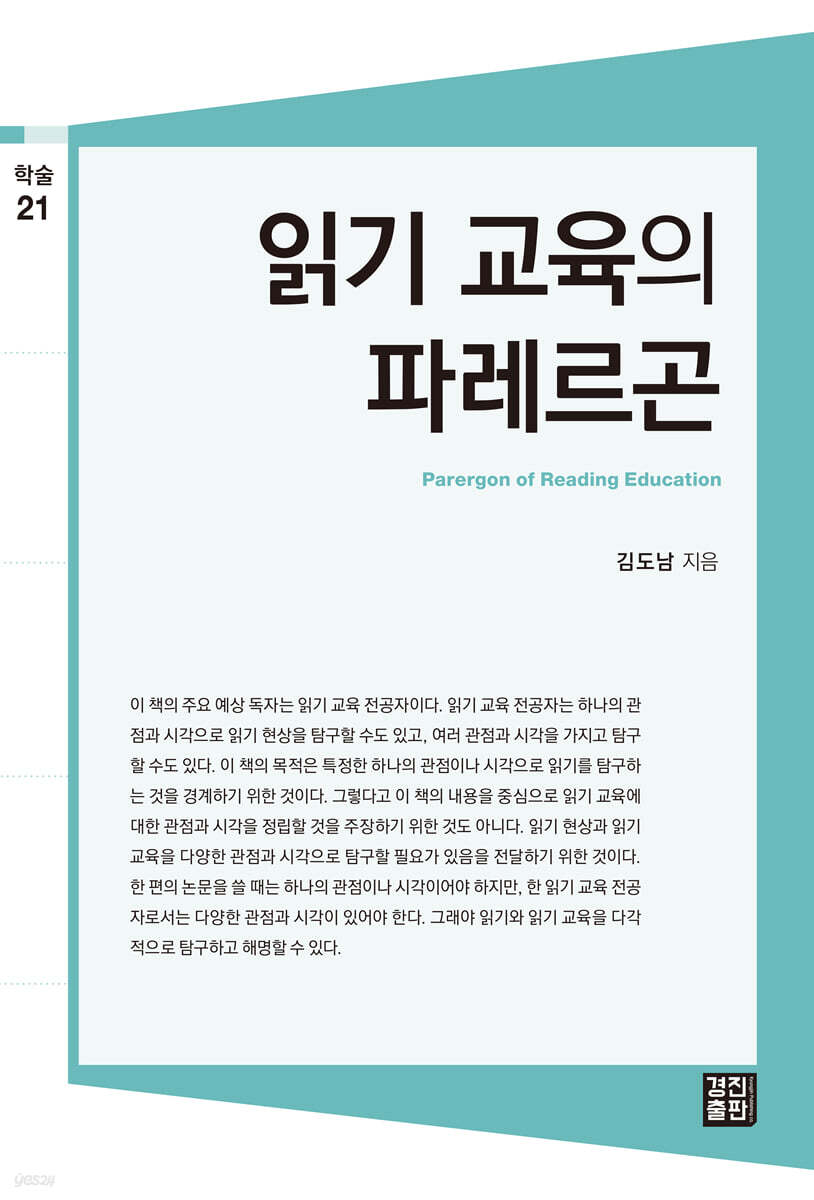
Parergon of Reading Education
 |
Description
Book Introduction
An outsider's perspective on the nature of reading phenomena and reading education.
This book defines the phenomenon of reading and the essence of reading education differently from the current educational perspective.
Current reading education defines reading from a cognitive perspective as the reader's construction of meaning.
This book looks at reading from several perspectives that differ from this definition.
These perspectives are broadly divided into Eastern and Western traditions.
In the Eastern tradition, the possibility of access to reading education was examined by exploring the phenomenon of reading based on the thoughts of Lao-tzu, Confucianism, and Buddhism.
In the Western tradition, reading phenomena were elucidated and the accessibility of reading education was explored based on Kierkegaard's theory of indirect communication, Husserl's concept of intentionality, Heidegger's theory of Dasein, Lacan's theory of desire, Levinas' philosophy of the other, Deleuze's semiotics, possible worlds theory, and difference generation theory.
Discussions based on these lead to different definitions of reading.
Therefore, the contents of this book allow us to look at reading from various perspectives.
This guides reading researchers and teachers to recognize reading from various perspectives.
This will expand the horizons of reading research and allow reading education to be approached from multiple perspectives.
This book defines the phenomenon of reading and the essence of reading education differently from the current educational perspective.
Current reading education defines reading from a cognitive perspective as the reader's construction of meaning.
This book looks at reading from several perspectives that differ from this definition.
These perspectives are broadly divided into Eastern and Western traditions.
In the Eastern tradition, the possibility of access to reading education was examined by exploring the phenomenon of reading based on the thoughts of Lao-tzu, Confucianism, and Buddhism.
In the Western tradition, reading phenomena were elucidated and the accessibility of reading education was explored based on Kierkegaard's theory of indirect communication, Husserl's concept of intentionality, Heidegger's theory of Dasein, Lacan's theory of desire, Levinas' philosophy of the other, Deleuze's semiotics, possible worlds theory, and difference generation theory.
Discussions based on these lead to different definitions of reading.
Therefore, the contents of this book allow us to look at reading from various perspectives.
This guides reading researchers and teachers to recognize reading from various perspectives.
This will expand the horizons of reading research and allow reading education to be approached from multiple perspectives.
- You can preview some of the book's contents.
Preview
index
preface
Part 1: Oriental Traditions
Chapter 1: Reading the Whole Life
1.
Reading the Tao Te Ching
2.
The Structure of Reading the Whole Life
3.
Education of reading throughout life
4.
The practice of reading throughout life
Chapter 2: Reading Self-Establishment
1.
University and Reading
2.
The structure of self-establishment reading
3.
Education of reading for self-establishment
4.
The practice of reading for self-establishment
Chapter 3: Reading Self-Realization
1.
The Doctrine of the Mean and Reading
2.
The Structure of Self-Actualization Reading
3.
Education of self-actualization reading
4.
The practice of reading for self-realization
Chapter 4: Actual Reading
1.
Construction and reading
2.
Structure of Actual Reading
3.
Teaching Actual Reading
4.
The practice of acting reading
Chapter 5: Reading with Consciousness
1.
Yogacara thought and reading
2.
Structure of literal reading
3.
Education of intellectual reading
4.
The practice of reading with wisdom
Chapter 6: Reading Awakening
1.
Reading the Tathagatagarbha
2.
Structure of Awakening Reading
3.
Education in Reading Awakening
4.
The practice of enlightened reading
Part 2 Western Tradition
Chapter 1: Independent Reading
1.
Indirect reading
2.
The structure of independent reading
3.
Teaching independent reading
4.
The practice of independent reading
Chapter 2: Transcendental Reading
1.
Orientation and Reading
2.
The Structure of Transcendental Reading
3.
Method of Transcendental Reading
4.
The practice of transcendental reading
Chapter 3: Existential Reading
1.
Dasein and the Reader
2.
The structure of existential reading
3.
Characteristics of existential reading
4.
The practice of existential reading
Chapter 4: Subjective Reading
1.
Desire and Reader
2.
Structure of subjective reading
3.
The function of subjective reading
4.
The task of independent education
5.
The practice of subjective reading
Chapter 5: Welcome Reading
1.
typist and reader
2.
The Structure of Hospitality Reading
3.
How to Read Welcomingly
4.
The practice of welcoming reading
Chapter 6: Learning Reading
1.
Symbols and Learning
2.
Deleuze's sign
3.
Reading Symbols and Learning
4.
The practice of learning reading
Chapter 7: Reading Possible Worlds
1.
Typing and Possible Worlds
2.
Structure of possible worlds
3.
How to Read Possible Worlds
4.
The practice of reading possible worlds
Chapter 8: Reading Difference Generation
1.
Difference repetition and reading
2.
Characteristics of differential reading
3.
How to read difference generation
4.
The practice of differential reading
References
Search
Part 1: Oriental Traditions
Chapter 1: Reading the Whole Life
1.
Reading the Tao Te Ching
2.
The Structure of Reading the Whole Life
3.
Education of reading throughout life
4.
The practice of reading throughout life
Chapter 2: Reading Self-Establishment
1.
University and Reading
2.
The structure of self-establishment reading
3.
Education of reading for self-establishment
4.
The practice of reading for self-establishment
Chapter 3: Reading Self-Realization
1.
The Doctrine of the Mean and Reading
2.
The Structure of Self-Actualization Reading
3.
Education of self-actualization reading
4.
The practice of reading for self-realization
Chapter 4: Actual Reading
1.
Construction and reading
2.
Structure of Actual Reading
3.
Teaching Actual Reading
4.
The practice of acting reading
Chapter 5: Reading with Consciousness
1.
Yogacara thought and reading
2.
Structure of literal reading
3.
Education of intellectual reading
4.
The practice of reading with wisdom
Chapter 6: Reading Awakening
1.
Reading the Tathagatagarbha
2.
Structure of Awakening Reading
3.
Education in Reading Awakening
4.
The practice of enlightened reading
Part 2 Western Tradition
Chapter 1: Independent Reading
1.
Indirect reading
2.
The structure of independent reading
3.
Teaching independent reading
4.
The practice of independent reading
Chapter 2: Transcendental Reading
1.
Orientation and Reading
2.
The Structure of Transcendental Reading
3.
Method of Transcendental Reading
4.
The practice of transcendental reading
Chapter 3: Existential Reading
1.
Dasein and the Reader
2.
The structure of existential reading
3.
Characteristics of existential reading
4.
The practice of existential reading
Chapter 4: Subjective Reading
1.
Desire and Reader
2.
Structure of subjective reading
3.
The function of subjective reading
4.
The task of independent education
5.
The practice of subjective reading
Chapter 5: Welcome Reading
1.
typist and reader
2.
The Structure of Hospitality Reading
3.
How to Read Welcomingly
4.
The practice of welcoming reading
Chapter 6: Learning Reading
1.
Symbols and Learning
2.
Deleuze's sign
3.
Reading Symbols and Learning
4.
The practice of learning reading
Chapter 7: Reading Possible Worlds
1.
Typing and Possible Worlds
2.
Structure of possible worlds
3.
How to Read Possible Worlds
4.
The practice of reading possible worlds
Chapter 8: Reading Difference Generation
1.
Difference repetition and reading
2.
Characteristics of differential reading
3.
How to read difference generation
4.
The practice of differential reading
References
Search
Publisher's Review
This book contains content that provides a new perspective on the phenomenon of reading and reading education.
To see things anew, we need different eyes than we have now.
This book utilizes Eastern past epistemology and Western present epistemology from different perspectives.
It is not something that should be discarded as an Eastern past epistemology, and it is not something that was created without a past as a Western present epistemology.
Past and present intersect to create something new.
Part 1 of this book is a discussion based on the Eastern epistemology of the past, and its contents can be briefly summarized as follows.
First, the perspective of Lao Tzu's 『Tao Te Ching』.
In the Tao Te Ching, Lao Tzu emphasizes that people should live their lives based on their knowledge of the world.
In this discussion, based on the cognitive logic of the Tao Te Ching, it was revealed that a reader's reading should be a composition of all concepts for the whole life, and an educational plan for reading for the whole life was discussed.
Second, the 『Great Learning』 perspective of Confucianism.
The Great Learning presents the study goals of a gentleman in eight articles, which can be interpreted in modern terms as self-establishment.
In this discussion, based on the eight articles of the Great Learning, we discussed that reading is an activity for self-establishment, and explored educational approaches for reading for self-establishment.
Third, the Confucian perspective of the Doctrine of the Mean.
The Doctrine of the Mean is a consciousness that seeks to achieve self-realization by understanding the essence of the world's principles and helping all things prosper.
In this discussion, from the perspective of the Doctrine of the Mean, it was revealed that reading should be an activity of self-realization, and the direction of education for reading for self-realization of readers was suggested.
Fourth, there is the Buddhist view of emptiness.
The idea of emptiness is that things do not have self-nature and are therefore empty.
So, it is seen that things exist and function in a dependent manner.
From this construction perspective, we identified the reading characteristics of readers and examined the possibility of education for readers' acting reading.
Fifth, it is the Buddhist viewpoint of consciousness-only.
Vijñāṇa ...
In this discussion, we utilized the cognitive logic of Vijñāna-kali studies to reveal the characteristics of readers' text comprehension and discussed methods of education for readers' Vijñāna-kali reading.
Sixth, the Buddhist perspective on the Tathagatagarbha idea.
The Tathagatagarbha idea is that everyone has Buddha-nature within their heart that can become a Buddha, and that if they manifest this Buddha-nature, they can become a Buddha.
In this discussion, we clarified the characteristics of enlightenment reading based on the logic of Tathagatagarbha thought and discussed education for readers to read enlightenment.
Part 2 of this book is a discussion based on current Western epistemology, and its contents can be briefly summarized as follows.
First, there is Kierkegaard's perspective on indirect communication.
Indirect communication is a method by which a sole individual encounters the Absolute and establishes subjective truth.
This discussion elucidates the process by which readers encounter the truth of a text and establish subjective truth through indirect communication, and discusses educational approaches for readers' indirect communication reading.
Second, there is the intentionality perspective of Husserl's phenomenology.
Directivity is defined as 'the conscious relationship of the self toward an object' and aims at transcending consciousness.
In this discussion, based on the concept of intentionality, we examined the process of readers transcending consciousness through the 'conscious relationship of the reader's ego toward the text' and examined the educational possibilities for transcendental reading.
Third, Heidegger's ontological perspective.
The present existence exists as it is by possessing beings and beings, and understanding the possibility of being through the question of being.
In this discussion, we explored the logic of the reader's existential reading by understanding the text and its existence and by examining educational methods for the reader's existential reading.
Fourth, Lacan's theory of desire.
Lacan explains the formation of the subject through the creation and activity of desire in the imaginary, symbolic, and real worlds.
In this discussion, we examined the formation of the reading subject and subjective reading activities based on the theory of desire, and explored educational approaches for readers' subjective reading.
Fifth, Levinas' theory of the other.
The other is a being that must be communicated with and welcomed to bring the self into consciousness and awaken it.
This paper discusses how to awaken the self by welcoming the other that readers encounter in the process of reading, and discusses approaches to welcoming reading education for readers.
Sixth, Deleuze's theory of signs, possible worlds, and difference production.
Deleuze's sign is something that beings emit to us, that we sense, and that allows us to think and learn from.
A possible world is a world that we perceive as the representation of others.
Difference creation is recognizing difference by paying attention to the difference itself in the object.
These are the ways of perceiving objects that Deleuze explains.
In this discussion, we concretized the methods of learning reading, possible world reading, and difference-generating reading based on symbols, possible worlds, and dental generativity, and explored approaches to reading education.
To see things anew, we need different eyes than we have now.
This book utilizes Eastern past epistemology and Western present epistemology from different perspectives.
It is not something that should be discarded as an Eastern past epistemology, and it is not something that was created without a past as a Western present epistemology.
Past and present intersect to create something new.
Part 1 of this book is a discussion based on the Eastern epistemology of the past, and its contents can be briefly summarized as follows.
First, the perspective of Lao Tzu's 『Tao Te Ching』.
In the Tao Te Ching, Lao Tzu emphasizes that people should live their lives based on their knowledge of the world.
In this discussion, based on the cognitive logic of the Tao Te Ching, it was revealed that a reader's reading should be a composition of all concepts for the whole life, and an educational plan for reading for the whole life was discussed.
Second, the 『Great Learning』 perspective of Confucianism.
The Great Learning presents the study goals of a gentleman in eight articles, which can be interpreted in modern terms as self-establishment.
In this discussion, based on the eight articles of the Great Learning, we discussed that reading is an activity for self-establishment, and explored educational approaches for reading for self-establishment.
Third, the Confucian perspective of the Doctrine of the Mean.
The Doctrine of the Mean is a consciousness that seeks to achieve self-realization by understanding the essence of the world's principles and helping all things prosper.
In this discussion, from the perspective of the Doctrine of the Mean, it was revealed that reading should be an activity of self-realization, and the direction of education for reading for self-realization of readers was suggested.
Fourth, there is the Buddhist view of emptiness.
The idea of emptiness is that things do not have self-nature and are therefore empty.
So, it is seen that things exist and function in a dependent manner.
From this construction perspective, we identified the reading characteristics of readers and examined the possibility of education for readers' acting reading.
Fifth, it is the Buddhist viewpoint of consciousness-only.
Vijñāṇa ...
In this discussion, we utilized the cognitive logic of Vijñāna-kali studies to reveal the characteristics of readers' text comprehension and discussed methods of education for readers' Vijñāna-kali reading.
Sixth, the Buddhist perspective on the Tathagatagarbha idea.
The Tathagatagarbha idea is that everyone has Buddha-nature within their heart that can become a Buddha, and that if they manifest this Buddha-nature, they can become a Buddha.
In this discussion, we clarified the characteristics of enlightenment reading based on the logic of Tathagatagarbha thought and discussed education for readers to read enlightenment.
Part 2 of this book is a discussion based on current Western epistemology, and its contents can be briefly summarized as follows.
First, there is Kierkegaard's perspective on indirect communication.
Indirect communication is a method by which a sole individual encounters the Absolute and establishes subjective truth.
This discussion elucidates the process by which readers encounter the truth of a text and establish subjective truth through indirect communication, and discusses educational approaches for readers' indirect communication reading.
Second, there is the intentionality perspective of Husserl's phenomenology.
Directivity is defined as 'the conscious relationship of the self toward an object' and aims at transcending consciousness.
In this discussion, based on the concept of intentionality, we examined the process of readers transcending consciousness through the 'conscious relationship of the reader's ego toward the text' and examined the educational possibilities for transcendental reading.
Third, Heidegger's ontological perspective.
The present existence exists as it is by possessing beings and beings, and understanding the possibility of being through the question of being.
In this discussion, we explored the logic of the reader's existential reading by understanding the text and its existence and by examining educational methods for the reader's existential reading.
Fourth, Lacan's theory of desire.
Lacan explains the formation of the subject through the creation and activity of desire in the imaginary, symbolic, and real worlds.
In this discussion, we examined the formation of the reading subject and subjective reading activities based on the theory of desire, and explored educational approaches for readers' subjective reading.
Fifth, Levinas' theory of the other.
The other is a being that must be communicated with and welcomed to bring the self into consciousness and awaken it.
This paper discusses how to awaken the self by welcoming the other that readers encounter in the process of reading, and discusses approaches to welcoming reading education for readers.
Sixth, Deleuze's theory of signs, possible worlds, and difference production.
Deleuze's sign is something that beings emit to us, that we sense, and that allows us to think and learn from.
A possible world is a world that we perceive as the representation of others.
Difference creation is recognizing difference by paying attention to the difference itself in the object.
These are the ways of perceiving objects that Deleuze explains.
In this discussion, we concretized the methods of learning reading, possible world reading, and difference-generating reading based on symbols, possible worlds, and dental generativity, and explored approaches to reading education.
GOODS SPECIFICS
- Date of issue: August 25, 2024
- Page count, weight, size: 528 pages | 152*224*35mm
- ISBN13: 9791193985335
- ISBN10: 1193985331
You may also like
카테고리
korean


korean

![GQ KOREA Mark (Monthly): December [2025]](http://librairie.coreenne.fr/cdn/shop/files/8ef265dbbfbf186523ed75ba7319009d.jpg?v=1765340328&width=3840)


