

How Wildfires Changed a Village
 |
Description
Book Introduction
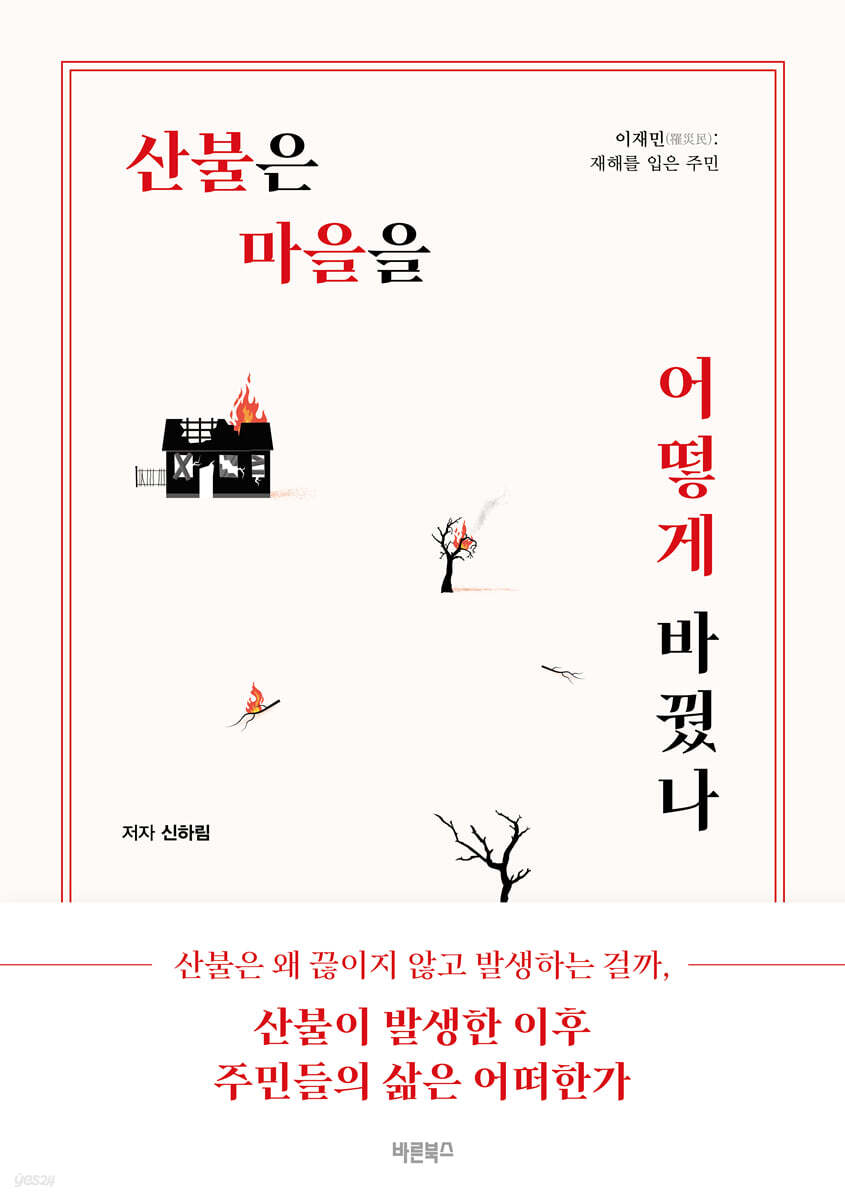
Due to climate change, large-scale forest fires are becoming more frequent and nationwide!
Are the lives of the displaced people recovering after the wildfires?
Is the domestic disaster recovery system fit for an era of $30,000 per capita income?
'7,006 soccer fields (5,002 hectares)'
This is the area burned by large and small forest fires that occurred in the Gangwon region over the past 10 years.
In the past five years, there have been three forest fires that the government has declared special disaster areas due to the extensive damage.
The total number of people displaced by the 2019 Goseong wildfire, the 2022 East Coast wildfire, and the 2023 Gangneung Gyeongpo wildfire is 1,958.
How have the lives of displaced people who lost their homes and jobs overnight, and the villages where they live, changed?
The author, a reporter for a local daily newspaper in Gangwon Province, analyzed economic, social, and psychological changes through interviews with displaced persons and continuous on-site reporting.
We analyze vulnerabilities in the recovery phase of the domestic disaster management system, which consists of prevention, preparation, response, and recovery.
This book presents why the domestic disaster recovery system must change beyond physical recovery, such as rebuilding buildings, to aim for restoring the daily lives of disaster victims.
Are the lives of the displaced people recovering after the wildfires?
Is the domestic disaster recovery system fit for an era of $30,000 per capita income?
'7,006 soccer fields (5,002 hectares)'
This is the area burned by large and small forest fires that occurred in the Gangwon region over the past 10 years.
In the past five years, there have been three forest fires that the government has declared special disaster areas due to the extensive damage.
The total number of people displaced by the 2019 Goseong wildfire, the 2022 East Coast wildfire, and the 2023 Gangneung Gyeongpo wildfire is 1,958.
How have the lives of displaced people who lost their homes and jobs overnight, and the villages where they live, changed?
The author, a reporter for a local daily newspaper in Gangwon Province, analyzed economic, social, and psychological changes through interviews with displaced persons and continuous on-site reporting.
We analyze vulnerabilities in the recovery phase of the domestic disaster management system, which consists of prevention, preparation, response, and recovery.
This book presents why the domestic disaster recovery system must change beyond physical recovery, such as rebuilding buildings, to aim for restoring the daily lives of disaster victims.
- You can preview some of the book's contents.
Preview
index
Prologue: The Repeated Disaster
Preface: Weak Links, Short Attention
Chapter 1.
My longed-for home
Why new homes are uncomfortable
Anxiety in the dusk
An old house on a narrow road
separated families
unstoppable cold
Chapter 2.
The shackles of debt
empty land
All or nothing
There's frost on the snow again
Three injustices
Burned pine tree
Chapter 3.
A village that lost its forest workplace
Bare mountains, dry valleys
Old people picking up trash
Songi's empty seat
Chapter 4.
A village divided into four parts
Two interviews
The reason they split up
Hot refugees, cold government
Chapter 5.
marginalized people
radio waves, half waves, sofa
Tears of a young entrepreneur
A knife in the chest
We didn't even say hello
Chapter 6.
Disaster after disaster
A handful of medicine
Lost History
“Because I don’t have a basketball.”
Recovery without communication
Fall down again
The pain of enduring alone
Chapter 7.
Wildfires and Inequality
Chapter 8.
The power to get back up again
Epilogue
References
Preface: Weak Links, Short Attention
Chapter 1.
My longed-for home
Why new homes are uncomfortable
Anxiety in the dusk
An old house on a narrow road
separated families
unstoppable cold
Chapter 2.
The shackles of debt
empty land
All or nothing
There's frost on the snow again
Three injustices
Burned pine tree
Chapter 3.
A village that lost its forest workplace
Bare mountains, dry valleys
Old people picking up trash
Songi's empty seat
Chapter 4.
A village divided into four parts
Two interviews
The reason they split up
Hot refugees, cold government
Chapter 5.
marginalized people
radio waves, half waves, sofa
Tears of a young entrepreneur
A knife in the chest
We didn't even say hello
Chapter 6.
Disaster after disaster
A handful of medicine
Lost History
“Because I don’t have a basketball.”
Recovery without communication
Fall down again
The pain of enduring alone
Chapter 7.
Wildfires and Inequality
Chapter 8.
The power to get back up again
Epilogue
References
Publisher's Review
Debt, conflict, and anxiety left behind by wildfire victims
“Our house was like a fairy tale.
“Before the forest fire broke out…”
This is the text on a banner hung after a forest fire broke out in the Gyeongpo area of Gangneung on April 11, 2023.
People who never imagined that their homes, businesses, and villages would be reduced to ashes by wildfires suddenly become 'displaced persons'.
The media briefly reported on the disaster site, and the government and local governments announced plans to invest a huge budget in recovery.
And the displaced people were forgotten in people's memories.
Will their daily lives ever be restored?
To find the answer, the author interviewed the displaced people about their ‘daily lives after the disaster.’
Chapter 1 addresses the issue of housing instability.
Displaced people receive disaster relief funds and public donations from the government and local governments, but this is not enough to cover recovery costs.
I have no choice but to take out a loan.
Elderly displaced people sometimes give up on rebuilding their homes.
Temporary prefabricated housing provided to displaced people is vulnerable to heat waves and cold waves.
The rule that a maximum of three people must live in a space of about 7 pyeong creates 'separated families.'
They cannot live together in cramped spaces and are often scattered.
Chapter 2 is about the recovery of businesses that are worse off than housing.
Urban wildfires take out not only forests but also businesses.
The damage is greater than the housing and is fatal in terms of loss of income, but there is no direct support, only indirect support in the form of loans.
In the end, you may have no choice but to take on hundreds of millions or billions of won in debt to recover.
Small business owners who were already in debt before the wildfires broke out are having a difficult time with their debts rapidly increasing due to the wildfires.
In particular, victims of the 2019 Goseong wildfire experienced a national disaster called COVID-19 immediately after completing recovery, weakening their ability to repay debt and leaving them feeling deeply frustrated.
Chapter 3 deals with the economic problems caused by the disappearance of pine forests.
The reality of today's rural areas is that it is difficult to make a living through farming alone.
Picking mushrooms in the fall is a valuable source of income for older people.
But forest fires take away the forest as a workplace.
The government and local governments are supporting public works projects and alternative crop production projects to provide sources of income, but this is not enough to return to the 'pre-wildfire' state.
Chapter 4 is a story about relationships torn apart by a forest fire.
The displaced are divided based on the extent of the damage, and those who lived as family in one village experience 'subtle changes'.
In the 2019 Goseong wildfire, the cause (Korea Electric Power Corporation) was clear, but there was intense conflict of opinion among the victims over compensation.
This led to civil litigation and the conflict lasted for years.
The government's lawsuit for damages brought against the cause provider in accordance with the law and principles is also another spark of conflict.
The author explores how a forest fire can destroy a village's precious social capital.
Chapter 5 deals with the issue of alienation caused by forest fires and the alienation that causes forest fires.
There are people who are not recognized for their damages and are excluded from recovery measures.
We also examine the origins of the 2022 East Coast wildfires, which were caused by arson by residents who had previously had strained relationships with their neighbors.
The key to reviving the lives of displaced people is restoring income and communication.
When the wildfires are extinguished, does that mean the disaster is over? Rather, it marks the beginning of secondary and tertiary disasters.
As forests and trees disappear, displaced people are left with anxieties about landslides and mudslides.
Even in places where landslides have been completed, landslides can actually occur in disasters such as extreme rainfall.
The hearts of the displaced people also suffer from disaster.
I feel a sense of loss and depression due to the loss of not only private facilities but also meaningful items containing the history and memories of the house, such as photo albums.
Anger and frustration can weaken even a healthy body.
In Chapter 6, the author addresses the limitations of the current recovery system, which is passive in caring for the emotional well-being of the victims and the "post-disaster" period.
Disasters afflict the weak and make them weaker.
Chapter 7 is about the inequality surrounding wildfires.
The 2019 Goseong wildfire was caused by an electrical factor (a spark from an arc on a high-voltage power line).
However, in 2004, a forest fire of similar cause broke out in nearby Sokcho, causing great damage to residents.
The east coast is plagued by large-scale forest fires caused by electrical factors, yet its underground power line project is the most underdeveloped in the country.
It's because of the poor financial conditions.
Displaced people also experience ‘information inequality’ during the recovery process.
While specific information is needed for individual recovery, the administration has neither interest nor obligation to provide ongoing information.
Displaced people who are not informed feel anxious, distrustful, and alienated.
The author makes it clear that the domestic disaster recovery system, such as 'each for himself', has limitations and presents an alternative in Chapter 8.
It focuses on the process of "learning" to more objectively review the disaster recovery process and pass on the lessons of the disaster to future generations, a more long-term system that aims to "recover income sources" beyond short-term tasks, and above all, the importance of "communication" to listen to and respond to the needs of the displaced to improve the quality of recovery.
"The Wildfire Disaster and What Happened Aftermath," a five-year report from a working reporter.
“It’s sad that our sacrifices are being forgotten without meaning.”
This is a common comment from the victims the author met after the 2019 Goseong wildfire.
The scene of a terrible disaster completely disappears from people's memories at some point.
The displaced people just live with their 'personal pain'.
This book began with the awareness that the suffering of forest fire victims should not be limited to personal pain.
While forest fire prevention measures such as increasing the number of large helicopters and creating fire-resistant forest belts are important, it is also important to have a robust recovery plan that will allow the displaced people to quickly return to their daily lives.
In today's world, where disasters are a constant risk, this book raises the question of "restoring daily life after a disaster."
“I have memories of the Vietnam War when I was young, but I have no memories of the forest fires.
Instead, they took everything away.”
- A 70-year-old evacuee from the 2019 Goseong wildfire
“When there is a forest fire and I am home alone, all I can do is cry.
I'm out of the house.
“I can’t sleep because I’m scared.”
- A 90-year-old evacuee from the 2022 East Coast wildfires
“It’s a debt that wouldn’t have had to be repaid if the forest fire hadn’t occurred, but it’s frustrating to have to pay interest every time.”
- A self-employed person in his 60s who suffered damage from the 2019 Goseong wildfire
“Because of the forest fires, I’m running a food business that I never thought I’d be able to afford.”
- Self-employed person in his 50s affected by the 2019 Goseong wildfire
“I developed social phobia after experiencing the forest fire and being disappointed in people.
Even if we meet, there is nothing good to talk about… .
Now, the people I meet are narrowed down to fellow refugees.”
- Self-employed person in his 50s affected by the 2019 Goseong wildfire
“When I hear people say that forest fires are natural disasters, my blood boils.
“How can it be a natural disaster when there is a cause?”
- A person in his 60s displaced by the 2019 Goseong wildfire
“Sometimes I get confused as to whether this is a dream or reality.
“It wasn’t until I saw the vast expanse of wasteland, with nowhere to urinate, during the full-scale recovery effort that I realized, ‘Wow! I’ve been through a forest fire.’”
- A person in his 70s displaced by the 2022 East Coast wildfires.
“My husband’s dowager robe, which he brought as a dowry when he got married, was burned in the forest fire, and a photo album containing our family’s history was lost.”
- A person in his 60s displaced by the 2019 Goseong wildfire
“There are no trees on the mountain like before, so when it rains, muddy water comes down from the mountain.
I'm so anxious that I can't sleep.
“I was worried that a landslide might occur…”
- A person in his 70s displaced by the 2022 East Coast wildfires.
“I vividly remember the smoke spreading through the city.
“The whole city has turned gray, and every spring, I remember the situation back then and it’s scary.”
- Residents of the East Coast wildfire-affected areas in 2022
“Our house was like a fairy tale.
“Before the forest fire broke out…”
This is the text on a banner hung after a forest fire broke out in the Gyeongpo area of Gangneung on April 11, 2023.
People who never imagined that their homes, businesses, and villages would be reduced to ashes by wildfires suddenly become 'displaced persons'.
The media briefly reported on the disaster site, and the government and local governments announced plans to invest a huge budget in recovery.
And the displaced people were forgotten in people's memories.
Will their daily lives ever be restored?
To find the answer, the author interviewed the displaced people about their ‘daily lives after the disaster.’
Chapter 1 addresses the issue of housing instability.
Displaced people receive disaster relief funds and public donations from the government and local governments, but this is not enough to cover recovery costs.
I have no choice but to take out a loan.
Elderly displaced people sometimes give up on rebuilding their homes.
Temporary prefabricated housing provided to displaced people is vulnerable to heat waves and cold waves.
The rule that a maximum of three people must live in a space of about 7 pyeong creates 'separated families.'
They cannot live together in cramped spaces and are often scattered.
Chapter 2 is about the recovery of businesses that are worse off than housing.
Urban wildfires take out not only forests but also businesses.
The damage is greater than the housing and is fatal in terms of loss of income, but there is no direct support, only indirect support in the form of loans.
In the end, you may have no choice but to take on hundreds of millions or billions of won in debt to recover.
Small business owners who were already in debt before the wildfires broke out are having a difficult time with their debts rapidly increasing due to the wildfires.
In particular, victims of the 2019 Goseong wildfire experienced a national disaster called COVID-19 immediately after completing recovery, weakening their ability to repay debt and leaving them feeling deeply frustrated.
Chapter 3 deals with the economic problems caused by the disappearance of pine forests.
The reality of today's rural areas is that it is difficult to make a living through farming alone.
Picking mushrooms in the fall is a valuable source of income for older people.
But forest fires take away the forest as a workplace.
The government and local governments are supporting public works projects and alternative crop production projects to provide sources of income, but this is not enough to return to the 'pre-wildfire' state.
Chapter 4 is a story about relationships torn apart by a forest fire.
The displaced are divided based on the extent of the damage, and those who lived as family in one village experience 'subtle changes'.
In the 2019 Goseong wildfire, the cause (Korea Electric Power Corporation) was clear, but there was intense conflict of opinion among the victims over compensation.
This led to civil litigation and the conflict lasted for years.
The government's lawsuit for damages brought against the cause provider in accordance with the law and principles is also another spark of conflict.
The author explores how a forest fire can destroy a village's precious social capital.
Chapter 5 deals with the issue of alienation caused by forest fires and the alienation that causes forest fires.
There are people who are not recognized for their damages and are excluded from recovery measures.
We also examine the origins of the 2022 East Coast wildfires, which were caused by arson by residents who had previously had strained relationships with their neighbors.
The key to reviving the lives of displaced people is restoring income and communication.
When the wildfires are extinguished, does that mean the disaster is over? Rather, it marks the beginning of secondary and tertiary disasters.
As forests and trees disappear, displaced people are left with anxieties about landslides and mudslides.
Even in places where landslides have been completed, landslides can actually occur in disasters such as extreme rainfall.
The hearts of the displaced people also suffer from disaster.
I feel a sense of loss and depression due to the loss of not only private facilities but also meaningful items containing the history and memories of the house, such as photo albums.
Anger and frustration can weaken even a healthy body.
In Chapter 6, the author addresses the limitations of the current recovery system, which is passive in caring for the emotional well-being of the victims and the "post-disaster" period.
Disasters afflict the weak and make them weaker.
Chapter 7 is about the inequality surrounding wildfires.
The 2019 Goseong wildfire was caused by an electrical factor (a spark from an arc on a high-voltage power line).
However, in 2004, a forest fire of similar cause broke out in nearby Sokcho, causing great damage to residents.
The east coast is plagued by large-scale forest fires caused by electrical factors, yet its underground power line project is the most underdeveloped in the country.
It's because of the poor financial conditions.
Displaced people also experience ‘information inequality’ during the recovery process.
While specific information is needed for individual recovery, the administration has neither interest nor obligation to provide ongoing information.
Displaced people who are not informed feel anxious, distrustful, and alienated.
The author makes it clear that the domestic disaster recovery system, such as 'each for himself', has limitations and presents an alternative in Chapter 8.
It focuses on the process of "learning" to more objectively review the disaster recovery process and pass on the lessons of the disaster to future generations, a more long-term system that aims to "recover income sources" beyond short-term tasks, and above all, the importance of "communication" to listen to and respond to the needs of the displaced to improve the quality of recovery.
"The Wildfire Disaster and What Happened Aftermath," a five-year report from a working reporter.
“It’s sad that our sacrifices are being forgotten without meaning.”
This is a common comment from the victims the author met after the 2019 Goseong wildfire.
The scene of a terrible disaster completely disappears from people's memories at some point.
The displaced people just live with their 'personal pain'.
This book began with the awareness that the suffering of forest fire victims should not be limited to personal pain.
While forest fire prevention measures such as increasing the number of large helicopters and creating fire-resistant forest belts are important, it is also important to have a robust recovery plan that will allow the displaced people to quickly return to their daily lives.
In today's world, where disasters are a constant risk, this book raises the question of "restoring daily life after a disaster."
“I have memories of the Vietnam War when I was young, but I have no memories of the forest fires.
Instead, they took everything away.”
- A 70-year-old evacuee from the 2019 Goseong wildfire
“When there is a forest fire and I am home alone, all I can do is cry.
I'm out of the house.
“I can’t sleep because I’m scared.”
- A 90-year-old evacuee from the 2022 East Coast wildfires
“It’s a debt that wouldn’t have had to be repaid if the forest fire hadn’t occurred, but it’s frustrating to have to pay interest every time.”
- A self-employed person in his 60s who suffered damage from the 2019 Goseong wildfire
“Because of the forest fires, I’m running a food business that I never thought I’d be able to afford.”
- Self-employed person in his 50s affected by the 2019 Goseong wildfire
“I developed social phobia after experiencing the forest fire and being disappointed in people.
Even if we meet, there is nothing good to talk about… .
Now, the people I meet are narrowed down to fellow refugees.”
- Self-employed person in his 50s affected by the 2019 Goseong wildfire
“When I hear people say that forest fires are natural disasters, my blood boils.
“How can it be a natural disaster when there is a cause?”
- A person in his 60s displaced by the 2019 Goseong wildfire
“Sometimes I get confused as to whether this is a dream or reality.
“It wasn’t until I saw the vast expanse of wasteland, with nowhere to urinate, during the full-scale recovery effort that I realized, ‘Wow! I’ve been through a forest fire.’”
- A person in his 70s displaced by the 2022 East Coast wildfires.
“My husband’s dowager robe, which he brought as a dowry when he got married, was burned in the forest fire, and a photo album containing our family’s history was lost.”
- A person in his 60s displaced by the 2019 Goseong wildfire
“There are no trees on the mountain like before, so when it rains, muddy water comes down from the mountain.
I'm so anxious that I can't sleep.
“I was worried that a landslide might occur…”
- A person in his 70s displaced by the 2022 East Coast wildfires.
“I vividly remember the smoke spreading through the city.
“The whole city has turned gray, and every spring, I remember the situation back then and it’s scary.”
- Residents of the East Coast wildfire-affected areas in 2022
GOODS SPECIFICS
- Date of issue: May 23, 2024
- Page count, weight, size: 256 pages | 148*210*20mm
- ISBN13: 9791193879993
- ISBN10: 119387999X
You may also like
카테고리
korean


korean

![GQ KOREA Mark (Monthly): December [2025]](http://librairie.coreenne.fr/cdn/shop/files/8ef265dbbfbf186523ed75ba7319009d.jpg?v=1765340328&width=3840)


