

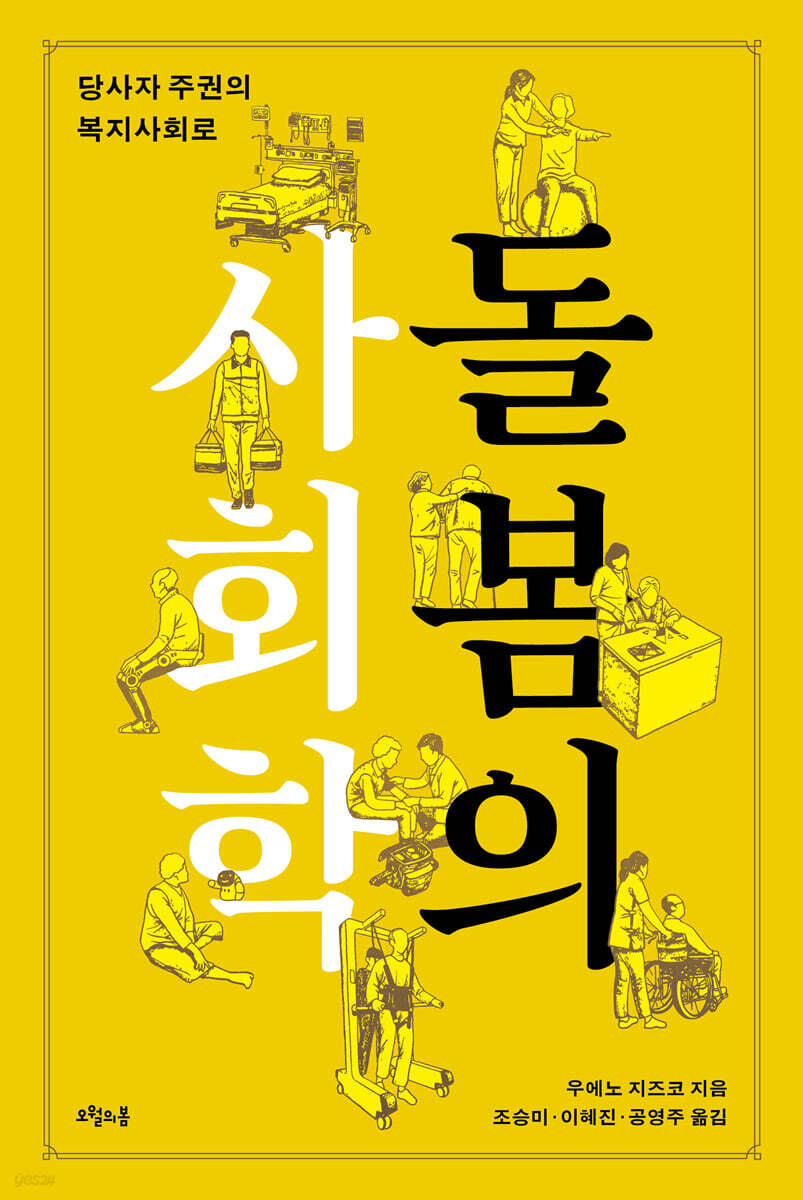
Sociology of Care
 |
Description
Book Introduction
- A word from MD
- The hot topic in the world today is care.
As the aging population progresses, care work will become more of a problem.
In the era of neoliberalism, care is left to the realm of the market and the family.
It is unsustainable.
Sociologist Chizuko Ueno has been researching and contemplating the issue of care for ten years.
- Son Min-gyu, Social and Political PD
“As expected, it’s Ueno Chizuko.
amazing."
An essential task for everyone living in an aging society
What is good care? Who should practice it, and how?
10 years of research, extensive fieldwork, and sophisticated theory
Ueno Chizuko: A culmination of sociology and a new horizon!
The Sociology of Care: A Key Issue Ahead of Us
Korea entered an aging society (a society in which the elderly population accounts for more than 14% of the total population) in 2017.
Everyone ages, whether quickly or slowly, and no one can control this.
In other words, one day everyone will become socially disadvantaged.
But are we adequately prepared for this? Therefore, it's worth examining the case of Japan, which experienced an aging society before Korea in 1994.
The book “Sociology of Care” by Chizuko Ueno, a leading Japanese sociologist and feminist, has significant implications for Korean society.
As can be seen in works such as 『Advising People to Die Alone at Home』, 『Death in an Age of Aloneness』, and 『A Single Afternoon』, which have been introduced in Korea, the author has been contemplating the issue of ‘care’, or the ‘sociology of care’, from early on.
In this book, the author comprehensively addresses the issue of ‘elderly care.’
The starting point of this book is the long-term care insurance system implemented in Japan in April 2000.
Nursing care insurance is Japan's long-term care insurance for the elderly, and the author calls it the "family revolution."
This system dramatically changed welfare for the elderly from “paternalism” to “contractualism” and from “charity” to “right.”
Because it shifts the responsibility for caring for the elderly from the family to the public sector.
The author traces the changes that have occurred in Japanese society over the past decade since the introduction of long-term care insurance.
The book addresses three main questions.
1) What is care? 2) What constitutes good senior care? 3) How can we achieve good senior care?
amazing."
An essential task for everyone living in an aging society
What is good care? Who should practice it, and how?
10 years of research, extensive fieldwork, and sophisticated theory
Ueno Chizuko: A culmination of sociology and a new horizon!
The Sociology of Care: A Key Issue Ahead of Us
Korea entered an aging society (a society in which the elderly population accounts for more than 14% of the total population) in 2017.
Everyone ages, whether quickly or slowly, and no one can control this.
In other words, one day everyone will become socially disadvantaged.
But are we adequately prepared for this? Therefore, it's worth examining the case of Japan, which experienced an aging society before Korea in 1994.
The book “Sociology of Care” by Chizuko Ueno, a leading Japanese sociologist and feminist, has significant implications for Korean society.
As can be seen in works such as 『Advising People to Die Alone at Home』, 『Death in an Age of Aloneness』, and 『A Single Afternoon』, which have been introduced in Korea, the author has been contemplating the issue of ‘care’, or the ‘sociology of care’, from early on.
In this book, the author comprehensively addresses the issue of ‘elderly care.’
The starting point of this book is the long-term care insurance system implemented in Japan in April 2000.
Nursing care insurance is Japan's long-term care insurance for the elderly, and the author calls it the "family revolution."
This system dramatically changed welfare for the elderly from “paternalism” to “contractualism” and from “charity” to “right.”
Because it shifts the responsibility for caring for the elderly from the family to the public sector.
The author traces the changes that have occurred in Japanese society over the past decade since the introduction of long-term care insurance.
The book addresses three main questions.
1) What is care? 2) What constitutes good senior care? 3) How can we achieve good senior care?
- You can preview some of the book's contents.
Preview
index
Preface to the Korean edition
Notes and Glossary
Preface: The Idea and Practice of Care and Cooperation
After the Great Earthquake│Care as a Topic (Part 1)│What is Good Care? (Part 2)│The Role of the Cooperative Sector (Part 3)│The Future of Care (Part 4)│In Conclusion: There is Hope
Part 1│Theme of Care
Chapter 1.
What is care?
Why Discuss Care? What Is Care? Defining Care? What Is Care Work? Conceptualizing Care
Chapter 2.
What Care Should Be: A Normative Theory of Care
Normative Approach to Care│Normative Science of Care│The Essence of Care│Gilligan's 'Ethics of Care'│The Post-Gilligan Debate on the 'Ethics of Care'│Care Theory in Clinical Philosophy│Examining 'Caring'│Examining the Context of Care│Human Rights Approach to Care
Chapter 3.
Who Are the Parties?: Needs and Party Sovereignty
Who is a party? │ Subjects that attribute needs │ The proliferation of party concepts │ The competency approach │ Primary needs and derivative needs │ Being a party and becoming a party │ In conclusion: The needs of the party are important
Part 2: What is Good Care?
Chapter 4: Is there a basis for care?
Why Care for the Elderly? Is Care Reproductive Labor? Elderly Care Seen Through the Eyes of Class? What Is Family Care? Rethinking the Distribution of Reproductive Costs. Is Social Support Justifiable? Does the Family Have Responsibility for Elderly Care? Is Family Care Always a Good Thing?
Chapter 5: Is Family Care a Given Thing?
Is family care natural? What is family care? When did family care become a problem? Who are family caregivers? Is family care a social welfare asset? A study on the stress of family caregivers? Family care and gender? Is family care really a good thing? Is family care desirable?
Chapter 6: What Kind of Work Is Care?
Exchange of Needs and Services│Conceptualizing Care Labor│Is Care Labor Labor?│Comparing Care Labor and Housework│Service Products and Labor Products│The Price of Care│What Kind of Product is Care Labor?│Care Labor and Emotional Labor│Why Is Care Labor Cheap?
Chapter 7: What is the experience of being cared for?
Receiving care│The experience of receiving care│The birth of a caregiver│Learning from the disability movement about both ‘problems (problematization)’ and ‘needs’│Is there a senior citizen movement│History of the disability movement│What is user satisfaction│Comparison of the elderly and the disabled│Comparison of the parties involved and their families│Service evaluation by users│Experiences of the elderly with dementia│Learning from the experiences of the disabled│How to receive good care
Chapter 8: What is Good Care?: From Group Care to Individual Care
What is good care? │ Unit care │ Hotel cost │ The origins of unit care │ Unit care based on private rooms │ Unit care and labor reinforcement │ The reality of unit care as seen through data │ Unit care and emotional labor │ Does unit care provide care 'like family' │ From facilities to housing: The residentialization of facilities │ New trends │ Good care is individual care
Part 3: The Role of Civil Society
Chapter 9 Who Provides Care: For Optimal Cost-Effectiveness
If not family, who will care? │ Public-private-cooperative-private, welfare pluralism │ Limitations of the dual model │ Critical review of welfare mix theory │ Critical review of comparative welfare system theory │ De-familialization and de-commodification of care │ Public-private-cooperative-private, employee model │ Socialization of care and the role of the cooperative sector
Chapter 10: Civic Enterprises and Participatory Welfare
Field Studies on the Practice of Care│Participatory Welfare│Citizens or Residents│What is a Region│Strange Paid Volunteerism│Nursing Care Insurance and NPOs│The Superiority of NPOs│A Critical Review of NPO Research│Welfare Management from the Perspective of the Needs of the Parties│Why Is There No Research on Welfare Management?
Chapter 11 Cooperative Welfare
Cooperative Welfare and the Workers' Collective │ Long-Term Care Insurance and Cooperative Welfare Projects │ Expectations and Pride in Cooperative Welfare │ How the Workers' Collective Came to Be Established │ Three Types of Cooperative Welfare │ History Before the Workers' Collective │ The Growth of the Workers' Collective │ The Workers' Collective Just Before the Implementation of Long-Term Care Insurance
Chapter 12: Greencorp's Welfare Workers Collective
Introduction: Reasons for research on cooperative welfare│Activity subjects participating in the research│Four types of activity subjects of Workers’ Collective│Motivation for participation│Workers’ Collective’s labor and compensation│Workers’ Collective’s users and usage fees│Workers’ Collective’s management costs│Management costs and time costs│Comparison of management costs│Workers’ Collective’s care service quality│Workers’ Collective’s startup support system│Development of cooperative’s welfare business after implementation of long-term care insurance│Value given to pride
Chapter 13: Gender Organization of Co-ops
Cooperatives and Feminism│Gender Awareness in Cooperatives│Gender Equality in Cooperatives│Dual Structure of Activities and Labor│History of Cooperative Organizations: From Dual to Triple Structure│Delivery is 'Men's Work'│Cooperatives Introduce Part-Time Work│Flexibility of Labor in Cooperatives│Establishment of Workers' Collective│Flexibility of Labor and Reorganization│Back to Cooperatives and Feminism
Chapter 14: Advanced Care Practices in the Collaborative Sector: A Case Study of a Small-Scale, Multifunctional Home Care
Small-scale multifunctional home care operated by an NPO│Nursing care insurance revision and small-scale multifunctional home care business│The positioning of social welfare corporations in the cooperative sector│Toyama type, a new form of nursing care service│Overview and history of Kono Yubidomare│Startup funds│Practice of small-scale multifunctional symbiotic care│Effects of the symbiotic model│Users and families│Workers and volunteers│What is 'family care'│'Toyama type' from a welfare management perspective
Chapter 15: Successes and Frustration in the Public Sector: The Case of Care Town Takanos
The boundary between the public and cooperative sectors│A village aiming for the best welfare in Japan│The background and history of the establishment of Care Town Takanos│Care Town Takanos' care practices: the hard side│Care Town Takanos' care practices: the soft side│Users of Care Town Takanos│Employees of Care Town Takanos│Conditions for improving the quality of care│Report of the 'Business Improvement Committee'│Examining the circumstances under which village welfare was frustrated│Village welfare played by neoliberal reform│What can we learn from the failure of Takanos?
Chapter 16: Advantages of the Cooperation Sector
Competitive Advantages of the Cooperative Sector│Working Conditions and Staffing│What Are Cooperative-Like Welfare Benefits?│Cooperative Identity and Workers' Collectives│The Paradox of Labor Self-Determination│Regional Characteristics│Conclusion: Reasons for Expectations from the Cooperative Sector
Part 4: The Future of Care
Chapter 17: Revisiting Care Work: Globalization and Care
The Collapse of the Care Workforce│Why Are Care Workers' Wages So Low│Commodification and Decommodification of Labor and Services│Labor and the Labor Force│An Incompletely Commodified Labor Force│Globalization and Care Labor│The Impact of Globalization│Globalization of the Reproductive Sector and the International Transfer of Care Labor│Revisiting the Value of Care
Chapter 18: Planning a Next-Generation Welfare Society
Market Failure, Family Failure, State Failure│Sharing Responsibilities and Burdens in a Welfare Pluralistic Society│Solidarity and Redistribution│Towards a Needs-Centered Welfare Society: Designing Social Service Law│Integrating Care for the Elderly, the Disabled, and Infants│With Whom Should We Stand in Solidarity│Towards a Stakeholder Movement
Conclusion_ In lieu of expressing gratitude
Translator's Note: A book for those who dream of a better society.
Release_The Path to a Care Society (Yang Nan-ju, Professor of Social Welfare, Daegu University)
Care-related timeline
References
Search
Notes and Glossary
Preface: The Idea and Practice of Care and Cooperation
After the Great Earthquake│Care as a Topic (Part 1)│What is Good Care? (Part 2)│The Role of the Cooperative Sector (Part 3)│The Future of Care (Part 4)│In Conclusion: There is Hope
Part 1│Theme of Care
Chapter 1.
What is care?
Why Discuss Care? What Is Care? Defining Care? What Is Care Work? Conceptualizing Care
Chapter 2.
What Care Should Be: A Normative Theory of Care
Normative Approach to Care│Normative Science of Care│The Essence of Care│Gilligan's 'Ethics of Care'│The Post-Gilligan Debate on the 'Ethics of Care'│Care Theory in Clinical Philosophy│Examining 'Caring'│Examining the Context of Care│Human Rights Approach to Care
Chapter 3.
Who Are the Parties?: Needs and Party Sovereignty
Who is a party? │ Subjects that attribute needs │ The proliferation of party concepts │ The competency approach │ Primary needs and derivative needs │ Being a party and becoming a party │ In conclusion: The needs of the party are important
Part 2: What is Good Care?
Chapter 4: Is there a basis for care?
Why Care for the Elderly? Is Care Reproductive Labor? Elderly Care Seen Through the Eyes of Class? What Is Family Care? Rethinking the Distribution of Reproductive Costs. Is Social Support Justifiable? Does the Family Have Responsibility for Elderly Care? Is Family Care Always a Good Thing?
Chapter 5: Is Family Care a Given Thing?
Is family care natural? What is family care? When did family care become a problem? Who are family caregivers? Is family care a social welfare asset? A study on the stress of family caregivers? Family care and gender? Is family care really a good thing? Is family care desirable?
Chapter 6: What Kind of Work Is Care?
Exchange of Needs and Services│Conceptualizing Care Labor│Is Care Labor Labor?│Comparing Care Labor and Housework│Service Products and Labor Products│The Price of Care│What Kind of Product is Care Labor?│Care Labor and Emotional Labor│Why Is Care Labor Cheap?
Chapter 7: What is the experience of being cared for?
Receiving care│The experience of receiving care│The birth of a caregiver│Learning from the disability movement about both ‘problems (problematization)’ and ‘needs’│Is there a senior citizen movement│History of the disability movement│What is user satisfaction│Comparison of the elderly and the disabled│Comparison of the parties involved and their families│Service evaluation by users│Experiences of the elderly with dementia│Learning from the experiences of the disabled│How to receive good care
Chapter 8: What is Good Care?: From Group Care to Individual Care
What is good care? │ Unit care │ Hotel cost │ The origins of unit care │ Unit care based on private rooms │ Unit care and labor reinforcement │ The reality of unit care as seen through data │ Unit care and emotional labor │ Does unit care provide care 'like family' │ From facilities to housing: The residentialization of facilities │ New trends │ Good care is individual care
Part 3: The Role of Civil Society
Chapter 9 Who Provides Care: For Optimal Cost-Effectiveness
If not family, who will care? │ Public-private-cooperative-private, welfare pluralism │ Limitations of the dual model │ Critical review of welfare mix theory │ Critical review of comparative welfare system theory │ De-familialization and de-commodification of care │ Public-private-cooperative-private, employee model │ Socialization of care and the role of the cooperative sector
Chapter 10: Civic Enterprises and Participatory Welfare
Field Studies on the Practice of Care│Participatory Welfare│Citizens or Residents│What is a Region│Strange Paid Volunteerism│Nursing Care Insurance and NPOs│The Superiority of NPOs│A Critical Review of NPO Research│Welfare Management from the Perspective of the Needs of the Parties│Why Is There No Research on Welfare Management?
Chapter 11 Cooperative Welfare
Cooperative Welfare and the Workers' Collective │ Long-Term Care Insurance and Cooperative Welfare Projects │ Expectations and Pride in Cooperative Welfare │ How the Workers' Collective Came to Be Established │ Three Types of Cooperative Welfare │ History Before the Workers' Collective │ The Growth of the Workers' Collective │ The Workers' Collective Just Before the Implementation of Long-Term Care Insurance
Chapter 12: Greencorp's Welfare Workers Collective
Introduction: Reasons for research on cooperative welfare│Activity subjects participating in the research│Four types of activity subjects of Workers’ Collective│Motivation for participation│Workers’ Collective’s labor and compensation│Workers’ Collective’s users and usage fees│Workers’ Collective’s management costs│Management costs and time costs│Comparison of management costs│Workers’ Collective’s care service quality│Workers’ Collective’s startup support system│Development of cooperative’s welfare business after implementation of long-term care insurance│Value given to pride
Chapter 13: Gender Organization of Co-ops
Cooperatives and Feminism│Gender Awareness in Cooperatives│Gender Equality in Cooperatives│Dual Structure of Activities and Labor│History of Cooperative Organizations: From Dual to Triple Structure│Delivery is 'Men's Work'│Cooperatives Introduce Part-Time Work│Flexibility of Labor in Cooperatives│Establishment of Workers' Collective│Flexibility of Labor and Reorganization│Back to Cooperatives and Feminism
Chapter 14: Advanced Care Practices in the Collaborative Sector: A Case Study of a Small-Scale, Multifunctional Home Care
Small-scale multifunctional home care operated by an NPO│Nursing care insurance revision and small-scale multifunctional home care business│The positioning of social welfare corporations in the cooperative sector│Toyama type, a new form of nursing care service│Overview and history of Kono Yubidomare│Startup funds│Practice of small-scale multifunctional symbiotic care│Effects of the symbiotic model│Users and families│Workers and volunteers│What is 'family care'│'Toyama type' from a welfare management perspective
Chapter 15: Successes and Frustration in the Public Sector: The Case of Care Town Takanos
The boundary between the public and cooperative sectors│A village aiming for the best welfare in Japan│The background and history of the establishment of Care Town Takanos│Care Town Takanos' care practices: the hard side│Care Town Takanos' care practices: the soft side│Users of Care Town Takanos│Employees of Care Town Takanos│Conditions for improving the quality of care│Report of the 'Business Improvement Committee'│Examining the circumstances under which village welfare was frustrated│Village welfare played by neoliberal reform│What can we learn from the failure of Takanos?
Chapter 16: Advantages of the Cooperation Sector
Competitive Advantages of the Cooperative Sector│Working Conditions and Staffing│What Are Cooperative-Like Welfare Benefits?│Cooperative Identity and Workers' Collectives│The Paradox of Labor Self-Determination│Regional Characteristics│Conclusion: Reasons for Expectations from the Cooperative Sector
Part 4: The Future of Care
Chapter 17: Revisiting Care Work: Globalization and Care
The Collapse of the Care Workforce│Why Are Care Workers' Wages So Low│Commodification and Decommodification of Labor and Services│Labor and the Labor Force│An Incompletely Commodified Labor Force│Globalization and Care Labor│The Impact of Globalization│Globalization of the Reproductive Sector and the International Transfer of Care Labor│Revisiting the Value of Care
Chapter 18: Planning a Next-Generation Welfare Society
Market Failure, Family Failure, State Failure│Sharing Responsibilities and Burdens in a Welfare Pluralistic Society│Solidarity and Redistribution│Towards a Needs-Centered Welfare Society: Designing Social Service Law│Integrating Care for the Elderly, the Disabled, and Infants│With Whom Should We Stand in Solidarity│Towards a Stakeholder Movement
Conclusion_ In lieu of expressing gratitude
Translator's Note: A book for those who dream of a better society.
Release_The Path to a Care Society (Yang Nan-ju, Professor of Social Welfare, Daegu University)
Care-related timeline
References
Search
Into the book
The relationship between the caregiver and the care recipient is asymmetrical.
If we look at care as a reciprocal act, the one giving care may or may not give care, but the one receiving care may not.
This asymmetrical relationship can easily turn into a power relationship.
--- p.25
Because the price of care work is cheap.
Because we don't want to raise prices again.
Why is care work so cheap? Why aren't they trying to raise its price?
--- p.43
In the past, childcare and elderly care were considered private matters, so no one recognized them as social issues.
However, gender studies have shown that the private sphere has simply become invisible because it is excluded from the public sphere, and furthermore, that the private sphere is a sphere that has been created publicly.
Gender studies, which originated from feminism with the slogan “the personal is political,” politicized the private sphere.
Afterwards, care, which had been considered a private act, became a visible social problem.
--- p.50
Family care is mostly forced labor.
For example, when we see daughters-in-law caring for the elderly, we can realize that caregiving is often forced labor in reality.
Forced labor isn't limited to concentration camps.
For those who cannot leave their homes, their families can become another concentration camp.
As with concentration camps, it is historically proven that abuse and forced labor exist within families.
--- p.96
I got this idea from Shane Ferran.
Quoting Foucault, who did not hide the fact that he was gay, as saying, “I try to be gay,” Ferran said that the “coming out” of being gay/lesbian is always “becoming out.”
'Being gay/lesbian' is not something that can be objectively defined, but rather a strategy and process of sexual subjectification of the subject who has accepted 'being gay/lesbian'.
Every time one comes out, one chooses a sexual subjectivity that makes one gay/lesbian.
--- p.130
Why care for the elderly? This is a truly frightening question.
Because there is no real basis to justify care for the elderly.
Historically, there is a reality where elderly people in need of care have not been cared for.
Since care for the elderly is a newly emerging demand, both theoretically and practically, it cannot be taken for granted.
--- p.141
Here, let us look back at what the problem of housework was.
The problem with housework was that ① the cost of reproduction, which is essential labor for the survival of society, was allocated outside the market, that is, to the family, ② unfairly as labor that did not pay wages (did not have a price), and ③ was allocated only to women under gender segregation.
Only through this problem setting was it possible to finally find the answer to the question, “Why is it unfair that only women do housework?”
And in reality, the market has been secretly dependent on external sources for reproduction costs, thus clearly revealing that the 'self-sufficiency of the market' is nothing more than a fiction.
--- p.158~159
But when and how did family care become taken for granted? And is family care truly desirable? Aren't the various options outside the family, resulting from the "socialization of care," merely supplementary alternatives to the supposedly desirable family care? Are they merely inadequate, second-rate alternatives? Asking these questions can lead us to a more fundamental question.
Is family care the best?
--- p.170
Gendered work entails the irregularization of the workforce.
Care work, which is considered suitable for women, is marginalized, and this creates a vicious cycle in which women's participation increases.
--- p.252
Actually, the solution to the labor shortage problem is simple.
As long as working conditions are improved and wages are raised, labor mobility will occur.
No matter how harsh the working conditions of doctors are, the reason there is a constant stream of new entrants is because doctors' social status and compensation are that high.
--- p.253
Why is the price of care so cheap? Explaining this in terms of gender makes the answer clear.
Why? Because I thought it was something women did.
British feminist sociologist Veronica Beach argued that marginalized part-time work is low-wage not because it is “low-wage work that women do,” but because it is “women’s work.”
--- p.269
In reality, many older adults hope to remain at home until the end of their lives, but their families tend to want them to leave home if possible.
--- p.294
But once we experience illness, disability, or aging, this fundamental question immediately comes back to us.
Aging is similar to an acquired disability, as it is the experience of not being able to do today what you could do yesterday, and not being able to do tomorrow what you can do today.
Elderly people who have suffered hemiplegia due to cerebral infarction may have felt the painful physical sensation of their own body becoming someone else's.
--- p.315
Aging is similar to becoming disabled later in life for everyone.
If you become disabled due to paralysis of the limbs or speech impediment caused by old age or cerebrovascular disease, you become disabled.
People with acquired disabilities are experiencing paralysis or disability for the first time in their lives and are in an amateur state of having to figure out how to receive care.
--- p.317
For families, avoiding care—that is, not sending the elderly person home from the facility—may be the greatest service they can provide.
Because businesses are more concerned with the needs of their families than with the elderly users themselves, care services can easily become services for the elderly's family members who make decisions.
--- p.415
It's not that women do [part-time work].
Let us paraphrase Beechey's statement that "part-time work was created as 'women's work'" (Beechey 1987).
“It’s not because we’re an NPO that we pay cheap rates.
“Because only low prices are set, only NPOs participate.” This is a statement that fits the reality.
Let's also add gender as a variable here.
If the people working at the nursing NPO were men, would the above claims have been made? I doubt it.
If we look at care as a reciprocal act, the one giving care may or may not give care, but the one receiving care may not.
This asymmetrical relationship can easily turn into a power relationship.
--- p.25
Because the price of care work is cheap.
Because we don't want to raise prices again.
Why is care work so cheap? Why aren't they trying to raise its price?
--- p.43
In the past, childcare and elderly care were considered private matters, so no one recognized them as social issues.
However, gender studies have shown that the private sphere has simply become invisible because it is excluded from the public sphere, and furthermore, that the private sphere is a sphere that has been created publicly.
Gender studies, which originated from feminism with the slogan “the personal is political,” politicized the private sphere.
Afterwards, care, which had been considered a private act, became a visible social problem.
--- p.50
Family care is mostly forced labor.
For example, when we see daughters-in-law caring for the elderly, we can realize that caregiving is often forced labor in reality.
Forced labor isn't limited to concentration camps.
For those who cannot leave their homes, their families can become another concentration camp.
As with concentration camps, it is historically proven that abuse and forced labor exist within families.
--- p.96
I got this idea from Shane Ferran.
Quoting Foucault, who did not hide the fact that he was gay, as saying, “I try to be gay,” Ferran said that the “coming out” of being gay/lesbian is always “becoming out.”
'Being gay/lesbian' is not something that can be objectively defined, but rather a strategy and process of sexual subjectification of the subject who has accepted 'being gay/lesbian'.
Every time one comes out, one chooses a sexual subjectivity that makes one gay/lesbian.
--- p.130
Why care for the elderly? This is a truly frightening question.
Because there is no real basis to justify care for the elderly.
Historically, there is a reality where elderly people in need of care have not been cared for.
Since care for the elderly is a newly emerging demand, both theoretically and practically, it cannot be taken for granted.
--- p.141
Here, let us look back at what the problem of housework was.
The problem with housework was that ① the cost of reproduction, which is essential labor for the survival of society, was allocated outside the market, that is, to the family, ② unfairly as labor that did not pay wages (did not have a price), and ③ was allocated only to women under gender segregation.
Only through this problem setting was it possible to finally find the answer to the question, “Why is it unfair that only women do housework?”
And in reality, the market has been secretly dependent on external sources for reproduction costs, thus clearly revealing that the 'self-sufficiency of the market' is nothing more than a fiction.
--- p.158~159
But when and how did family care become taken for granted? And is family care truly desirable? Aren't the various options outside the family, resulting from the "socialization of care," merely supplementary alternatives to the supposedly desirable family care? Are they merely inadequate, second-rate alternatives? Asking these questions can lead us to a more fundamental question.
Is family care the best?
--- p.170
Gendered work entails the irregularization of the workforce.
Care work, which is considered suitable for women, is marginalized, and this creates a vicious cycle in which women's participation increases.
--- p.252
Actually, the solution to the labor shortage problem is simple.
As long as working conditions are improved and wages are raised, labor mobility will occur.
No matter how harsh the working conditions of doctors are, the reason there is a constant stream of new entrants is because doctors' social status and compensation are that high.
--- p.253
Why is the price of care so cheap? Explaining this in terms of gender makes the answer clear.
Why? Because I thought it was something women did.
British feminist sociologist Veronica Beach argued that marginalized part-time work is low-wage not because it is “low-wage work that women do,” but because it is “women’s work.”
--- p.269
In reality, many older adults hope to remain at home until the end of their lives, but their families tend to want them to leave home if possible.
--- p.294
But once we experience illness, disability, or aging, this fundamental question immediately comes back to us.
Aging is similar to an acquired disability, as it is the experience of not being able to do today what you could do yesterday, and not being able to do tomorrow what you can do today.
Elderly people who have suffered hemiplegia due to cerebral infarction may have felt the painful physical sensation of their own body becoming someone else's.
--- p.315
Aging is similar to becoming disabled later in life for everyone.
If you become disabled due to paralysis of the limbs or speech impediment caused by old age or cerebrovascular disease, you become disabled.
People with acquired disabilities are experiencing paralysis or disability for the first time in their lives and are in an amateur state of having to figure out how to receive care.
--- p.317
For families, avoiding care—that is, not sending the elderly person home from the facility—may be the greatest service they can provide.
Because businesses are more concerned with the needs of their families than with the elderly users themselves, care services can easily become services for the elderly's family members who make decisions.
--- p.415
It's not that women do [part-time work].
Let us paraphrase Beechey's statement that "part-time work was created as 'women's work'" (Beechey 1987).
“It’s not because we’re an NPO that we pay cheap rates.
“Because only low prices are set, only NPOs participate.” This is a statement that fits the reality.
Let's also add gender as a variable here.
If the people working at the nursing NPO were men, would the above claims have been made? I doubt it.
--- p.451
Publisher's Review
What is good care?
The greatest strength of this book is that it excels in both theory and practice of 'care.'
This can truly be said to be the culmination of Ueno Chizuko's sociology.
The author criticizes the repeated "gender bias" in the "care theory" developed so far, and develops a sophisticated theoretical development that incorporates human rights and feminism.
In other words, there has been a lot of discussion regarding care as a task that should primarily be done by women, and the ‘women’s perspective’ has been left out.
The author critiques these theoretical discussions from a feminist perspective and reexamines the questions, “What is care?” and “What is care work?”
“The theory of unpaid labor originally began with the existing economics’ ‘gender-ignorant’ perspective (non-recognition of gender) on the work women do at home, such as housework, childcare, and eldercare.
“Care is an invisible labor primarily performed by women. However, excluding gender from discussions about care, as if women are not involved in care, should also be criticized as a position that does not understand gender.” (p. 24)
Another strength of this book is the field research conducted over the past 10 years.
The author toured various on-site facilities and met with many stakeholders, exploring the questions, "What constitutes good senior care?" and "How can we solve and implement senior care issues?"
Particularly noteworthy are "unit care" facilities, where everyone can live in a private room, and "coexistence care" facilities, where people with disabilities, infants, and the elderly live together.
While Korean nursing homes are typically four-person rooms and primarily provide 'group care,' these facilities are user-centered and provide 'individual care.'
“Therefore, the criteria for ‘good care’ are as follows:
It is individual care rather than group care, home care rather than facility care, and private room care rather than multi-person room care within a facility.
“In general, good care is care that responds to the individuality of the person involved and values the person’s needs.” (p. 30)
Why is care work cheap?
But Japan's innovative facilities also have their drawbacks.
This is because these facilities are supported by the low wages of care workers.
"Why is care work so cheap? Why aren't we trying to raise its price?" The author repeatedly poses this question, ultimately asserting that if we fail to address it, the future of care will be bleak.
And this question is also answered from a feminist perspective.
“If we explain this in terms of gender, the answer is clear.
Why? Because I thought it was something women did.
British feminist sociologist Veronica Beach argued that marginalized part-time work is low-wage not because it is ‘low-wage work that women do,’ but because it is ‘women’s work.’ (p. 269) This question also applies to Korea.
The low wages and unstable employment of nursing assistants remain issues that need to be addressed.
So who will practice care? The author argues that the family ("family failure"), the state or local government ("state failure"), and the market ("market failure") all have limitations, and he urges the cooperative sector, which includes civil society, to take center stage.
In reality, Japan's "good care" is mainly practiced by non-profit organizations and civic businesses with a new public nature, such as worker collectives and cooperatives, where everyone is both a manager and a worker.
However, this cooperation also has its limitations.
Ultimately, we conclude that good care has its limitations in the government (public), market (people), civil society (cooperative), and family (private) sectors, and therefore a welfare pluralistic society in which all sectors complement each other must be realized.
In other words, the theory the author is based on is the theory of a welfare pluralistic society that replaces the existing welfare state theory.
What is care?
Parties' sovereignty and human rights approach
So what does Ueno Chizuko mean by care? Care is 1) a reciprocal act and relationship between a giver and a receiver, 2) the needs of the care recipient are paramount, and 3) labor that can be transferred to a third party.
And the relationship between the caregiver and the care recipient is asymmetrical.
If we look at care as a reciprocal act, the one giving care may or may not give care, but the one receiving care may not.
This asymmetrical relationship can easily degenerate into a power relationship.
In this book, the author presents the following two positions on the normative theory of care, symbolized by the 'ethics of care.'
First, care is not always a 'good thing'; it can also be 'a burden, a heavy load, a nuisance to be avoided'.
Second, we will approach it from a human rights perspective through the following four rights:
The four rights are:
1) Right to care.
2) Right to care.
3) The right not to be forced to provide care.
4) The right not to be forced to receive (inappropriate) care.
A central and somewhat normative position in this book is 'sovereignty of the parties.'
The party the author is talking about is not simply a socially disadvantaged person, but a socially disadvantaged person who has become a subject.
In other words, the socially disadvantaged must take steps to reveal their identity and assert their rights before they can become parties.
“Being a ‘care recipient’ who needs care and having the identity of a ‘care recipient’ and becoming a party to the matter are two different matters.
“To become a caregiver, there must be an opportunity to reveal and identify one’s needs.” (p. 130) In other words, the sovereignty of the care recipients is for them to assert their needs and rights without relying on the paternalistic judgment of experts or third parties.
In this respect, it is said that Japan's elderly people requiring nursing care have not yet become the parties concerned.
The author argues that we must strengthen welfare for the elderly through a movement of individuals who assert their needs and rights.
Is family care a given?
Who should take care of them? Most people think of their family first.
It also mostly brings to mind the women in the household (wife, daughter-in-law, daughter).
Both the state and society take family care for granted.
However, the author logically criticizes this 'family care' one by one.
'Family care' is a kind of 'myth' and 'unfounded'.
He also notes that saying things like, "Things were better in the old days" or "Families used to take care of each other" are nothing more than nostalgia and not true.
The author's conclusion is unequivocal.
Family care is neither expected, nor natural, nor desirable.
It is sometimes mentioned that family care can be forced labor.
“For example, when you see a daughter-in-law taking care of an elderly person, you realize that caregiving is often forced labor in reality.
Forced labor isn't limited to concentration camps.
“For someone who cannot leave home, the family can become another concentration camp.” (p. 96)
A welfare-based society where everyone complements each other
After a lengthy discussion of the contradictions of family care, the author asks, "So who should be responsible for providing care?"
The author's theoretical foundation is the theory of a welfare pluralistic society.
The theory of a pluralistic welfare society states that the government (state/local government), private sector (market), cooperative society, and private sector (family) all have limitations and therefore complement each other.
In particular, the author is looking forward to the cooperative sector, a new framework of commonality, at a time when the three-part set of modern family, market, and state, which was believed to function omnipotently, has revealed its limitations.
Welfare has been established and operated based on the principle of complementarity, which means that the state compensates for market failures and civil society compensates for state failures.
However, this complementarity principle presupposes ‘family failure.’
Here, 'family failure' refers to a failed family, that is, family members who have been separated or broken up due to bereavement, separation, divorce, etc.
Therefore, welfare recipients have been limited to elderly people living alone, single-parent women, etc.
Conversely, it has been thought that there is no problem if all family members are present.
This is a conservative welfare system that relies on the family.
The family has long since lost its function and become meaningless.
Furthermore, previous research on the modern family has revealed that even families that appear to be functioning properly on the outside carry a heavy burden of caregiving within them, and that they are in fact "arks loaded with too much baggage."
Historically, the 'failure of the family' was already expected, but the state and researchers simply did not acknowledge it.
From "family failure," "market failure," and "state failure," we can see that any sector has limitations in providing welfare. Even cooperative sectors (civil society), such as NPOs (non-profit organizations), have limitations. It's impossible for NPOs alone to fully address the failures of the family, the market, and the state.
The theory that replaces the existing welfare state theory is the 'welfare pluralism theory', which originated from the idea that every sector has its limitations and therefore each sector needs to complement each other to fulfill its role.
Unit care and symbiotic care: Japan's leading examples
The various activities undertaken by Japan's cooperatives and local governments to achieve better care for the elderly are noteworthy.
It is particularly interesting that unit care based on single rooms was pioneered by the local government in Care Town Takanosu and later institutionally accepted by the Ministry of Health, Labor and Welfare.
The 'small-scale multi-functional home care' model, which provides various types of services needed by users in one institution rather than a specific type of service institution, and the 'coexistence model', in which children, the elderly, and the disabled use day services together, are care models created by civic businesses such as consumer cooperatives before the introduction of Japan's long-term care insurance, and the Ministry of Health, Labor and Welfare later adopted this model into the system.
The author suggests that the conditions for advanced care found in civic businesses are “① when managers with high ideals and leadership ② hire care workers with high moral standards and capabilities ③ under low working conditions.”
The spontaneity of civil society serves as the foundation, and the participation of highly educated, full-time housewives in cooperative activities is a particularly important resource.
The author criticizes Japan's "housewife preference policy" for confining women to the home as caregivers for an aging society. It is a striking irony that the cooperative's advanced care practices are made possible by the low-wage labor of housewives, a policy that maintains this gender-discriminatory structure.
The greatest strength of this book is that it excels in both theory and practice of 'care.'
This can truly be said to be the culmination of Ueno Chizuko's sociology.
The author criticizes the repeated "gender bias" in the "care theory" developed so far, and develops a sophisticated theoretical development that incorporates human rights and feminism.
In other words, there has been a lot of discussion regarding care as a task that should primarily be done by women, and the ‘women’s perspective’ has been left out.
The author critiques these theoretical discussions from a feminist perspective and reexamines the questions, “What is care?” and “What is care work?”
“The theory of unpaid labor originally began with the existing economics’ ‘gender-ignorant’ perspective (non-recognition of gender) on the work women do at home, such as housework, childcare, and eldercare.
“Care is an invisible labor primarily performed by women. However, excluding gender from discussions about care, as if women are not involved in care, should also be criticized as a position that does not understand gender.” (p. 24)
Another strength of this book is the field research conducted over the past 10 years.
The author toured various on-site facilities and met with many stakeholders, exploring the questions, "What constitutes good senior care?" and "How can we solve and implement senior care issues?"
Particularly noteworthy are "unit care" facilities, where everyone can live in a private room, and "coexistence care" facilities, where people with disabilities, infants, and the elderly live together.
While Korean nursing homes are typically four-person rooms and primarily provide 'group care,' these facilities are user-centered and provide 'individual care.'
“Therefore, the criteria for ‘good care’ are as follows:
It is individual care rather than group care, home care rather than facility care, and private room care rather than multi-person room care within a facility.
“In general, good care is care that responds to the individuality of the person involved and values the person’s needs.” (p. 30)
Why is care work cheap?
But Japan's innovative facilities also have their drawbacks.
This is because these facilities are supported by the low wages of care workers.
"Why is care work so cheap? Why aren't we trying to raise its price?" The author repeatedly poses this question, ultimately asserting that if we fail to address it, the future of care will be bleak.
And this question is also answered from a feminist perspective.
“If we explain this in terms of gender, the answer is clear.
Why? Because I thought it was something women did.
British feminist sociologist Veronica Beach argued that marginalized part-time work is low-wage not because it is ‘low-wage work that women do,’ but because it is ‘women’s work.’ (p. 269) This question also applies to Korea.
The low wages and unstable employment of nursing assistants remain issues that need to be addressed.
So who will practice care? The author argues that the family ("family failure"), the state or local government ("state failure"), and the market ("market failure") all have limitations, and he urges the cooperative sector, which includes civil society, to take center stage.
In reality, Japan's "good care" is mainly practiced by non-profit organizations and civic businesses with a new public nature, such as worker collectives and cooperatives, where everyone is both a manager and a worker.
However, this cooperation also has its limitations.
Ultimately, we conclude that good care has its limitations in the government (public), market (people), civil society (cooperative), and family (private) sectors, and therefore a welfare pluralistic society in which all sectors complement each other must be realized.
In other words, the theory the author is based on is the theory of a welfare pluralistic society that replaces the existing welfare state theory.
What is care?
Parties' sovereignty and human rights approach
So what does Ueno Chizuko mean by care? Care is 1) a reciprocal act and relationship between a giver and a receiver, 2) the needs of the care recipient are paramount, and 3) labor that can be transferred to a third party.
And the relationship between the caregiver and the care recipient is asymmetrical.
If we look at care as a reciprocal act, the one giving care may or may not give care, but the one receiving care may not.
This asymmetrical relationship can easily degenerate into a power relationship.
In this book, the author presents the following two positions on the normative theory of care, symbolized by the 'ethics of care.'
First, care is not always a 'good thing'; it can also be 'a burden, a heavy load, a nuisance to be avoided'.
Second, we will approach it from a human rights perspective through the following four rights:
The four rights are:
1) Right to care.
2) Right to care.
3) The right not to be forced to provide care.
4) The right not to be forced to receive (inappropriate) care.
A central and somewhat normative position in this book is 'sovereignty of the parties.'
The party the author is talking about is not simply a socially disadvantaged person, but a socially disadvantaged person who has become a subject.
In other words, the socially disadvantaged must take steps to reveal their identity and assert their rights before they can become parties.
“Being a ‘care recipient’ who needs care and having the identity of a ‘care recipient’ and becoming a party to the matter are two different matters.
“To become a caregiver, there must be an opportunity to reveal and identify one’s needs.” (p. 130) In other words, the sovereignty of the care recipients is for them to assert their needs and rights without relying on the paternalistic judgment of experts or third parties.
In this respect, it is said that Japan's elderly people requiring nursing care have not yet become the parties concerned.
The author argues that we must strengthen welfare for the elderly through a movement of individuals who assert their needs and rights.
Is family care a given?
Who should take care of them? Most people think of their family first.
It also mostly brings to mind the women in the household (wife, daughter-in-law, daughter).
Both the state and society take family care for granted.
However, the author logically criticizes this 'family care' one by one.
'Family care' is a kind of 'myth' and 'unfounded'.
He also notes that saying things like, "Things were better in the old days" or "Families used to take care of each other" are nothing more than nostalgia and not true.
The author's conclusion is unequivocal.
Family care is neither expected, nor natural, nor desirable.
It is sometimes mentioned that family care can be forced labor.
“For example, when you see a daughter-in-law taking care of an elderly person, you realize that caregiving is often forced labor in reality.
Forced labor isn't limited to concentration camps.
“For someone who cannot leave home, the family can become another concentration camp.” (p. 96)
A welfare-based society where everyone complements each other
After a lengthy discussion of the contradictions of family care, the author asks, "So who should be responsible for providing care?"
The author's theoretical foundation is the theory of a welfare pluralistic society.
The theory of a pluralistic welfare society states that the government (state/local government), private sector (market), cooperative society, and private sector (family) all have limitations and therefore complement each other.
In particular, the author is looking forward to the cooperative sector, a new framework of commonality, at a time when the three-part set of modern family, market, and state, which was believed to function omnipotently, has revealed its limitations.
Welfare has been established and operated based on the principle of complementarity, which means that the state compensates for market failures and civil society compensates for state failures.
However, this complementarity principle presupposes ‘family failure.’
Here, 'family failure' refers to a failed family, that is, family members who have been separated or broken up due to bereavement, separation, divorce, etc.
Therefore, welfare recipients have been limited to elderly people living alone, single-parent women, etc.
Conversely, it has been thought that there is no problem if all family members are present.
This is a conservative welfare system that relies on the family.
The family has long since lost its function and become meaningless.
Furthermore, previous research on the modern family has revealed that even families that appear to be functioning properly on the outside carry a heavy burden of caregiving within them, and that they are in fact "arks loaded with too much baggage."
Historically, the 'failure of the family' was already expected, but the state and researchers simply did not acknowledge it.
From "family failure," "market failure," and "state failure," we can see that any sector has limitations in providing welfare. Even cooperative sectors (civil society), such as NPOs (non-profit organizations), have limitations. It's impossible for NPOs alone to fully address the failures of the family, the market, and the state.
The theory that replaces the existing welfare state theory is the 'welfare pluralism theory', which originated from the idea that every sector has its limitations and therefore each sector needs to complement each other to fulfill its role.
Unit care and symbiotic care: Japan's leading examples
The various activities undertaken by Japan's cooperatives and local governments to achieve better care for the elderly are noteworthy.
It is particularly interesting that unit care based on single rooms was pioneered by the local government in Care Town Takanosu and later institutionally accepted by the Ministry of Health, Labor and Welfare.
The 'small-scale multi-functional home care' model, which provides various types of services needed by users in one institution rather than a specific type of service institution, and the 'coexistence model', in which children, the elderly, and the disabled use day services together, are care models created by civic businesses such as consumer cooperatives before the introduction of Japan's long-term care insurance, and the Ministry of Health, Labor and Welfare later adopted this model into the system.
The author suggests that the conditions for advanced care found in civic businesses are “① when managers with high ideals and leadership ② hire care workers with high moral standards and capabilities ③ under low working conditions.”
The spontaneity of civil society serves as the foundation, and the participation of highly educated, full-time housewives in cooperative activities is a particularly important resource.
The author criticizes Japan's "housewife preference policy" for confining women to the home as caregivers for an aging society. It is a striking irony that the cooperative's advanced care practices are made possible by the low-wage labor of housewives, a policy that maintains this gender-discriminatory structure.
GOODS SPECIFICS
- Date of issue: May 27, 2024
- Format: Hardcover book binding method guide
- Page count, weight, size: 944 pages | 1,368g | 148*218*49mm
- ISBN13: 9791168731035
- ISBN10: 1168731038
You may also like
카테고리
korean


korean

![GQ KOREA Mark (Monthly): December [2025]](http://librairie.coreenne.fr/cdn/shop/files/8ef265dbbfbf186523ed75ba7319009d.jpg?v=1765340328&width=3840)


