

Working mind
 |
Description
Book Introduction
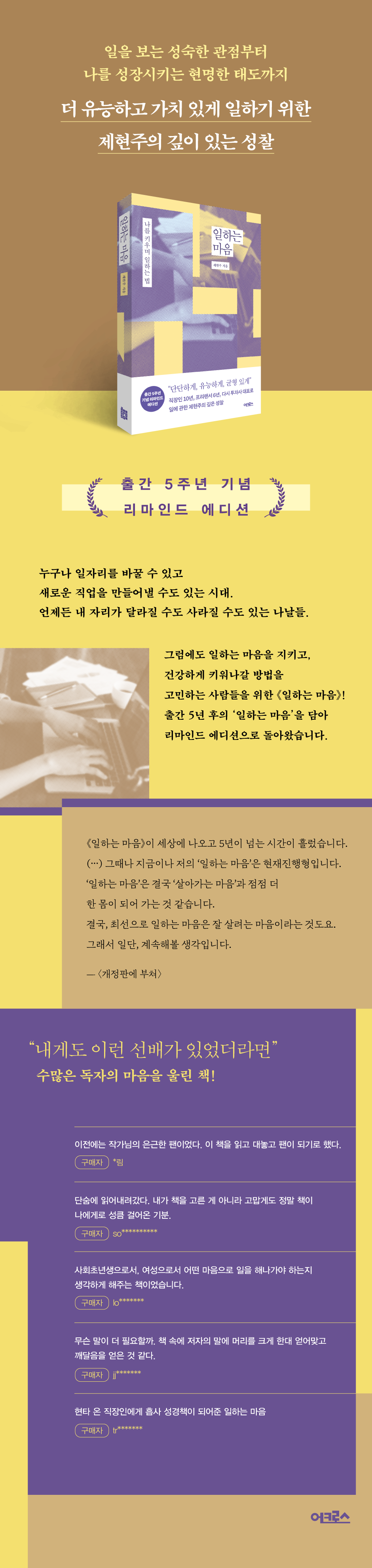
Since its publication, "The Mind of Work," which has been loved by countless readers as a "must-read for successful workers," has returned with a reminder edition to commemorate its 5th anniversary.
A new manuscript has been added in which the author reflects on his working mindset from five years ago and organizes his current working mindset.
In an age where my job can change at any time and my work history can change.
This book, which discusses the philosophy of work that will not be swept away by the waves of change, will be a strong and affectionate encouragement to all of us who work and live.
A new manuscript has been added in which the author reflects on his working mindset from five years ago and organizes his current working mindset.
In an age where my job can change at any time and my work history can change.
This book, which discusses the philosophy of work that will not be swept away by the waves of change, will be a strong and affectionate encouragement to all of us who work and live.
- You can preview some of the book's contents.
Preview
index
prolog
On the publication of the revised edition: Still, with a working mind
1.
Again, look at the work
How to run 3 kilometers
The freedom that distance allows
Good and bad come together
Learn how to learn
The liberation that comes with limitations
Crossing the border is
2.
Choose either
A perfectly mediocre taste
Any choice is fine
Tetris of everyday life
When to rewrite the story
The power to imagine a different future
It starts with a declaration
The power of storytelling
3.
From a strong body to a strong mind
Knowing, not believing
A sense of accomplishment beneath my feet
Get in shape
If you keep doing it,
If there is no open space, at least in the square
Training can always be fun
4.
A very personal motivation
Discovery of resignation
"What do you do for a living?"
n-job skills
The ego is originally fragmented
Conditions of contingency and autonomy
Excellence, not expertise
5.
A good person who does good things
The loneliness of working alone
Things that make you a good person
I heard you
Maintaining one's dignity
What people do
6.
Things that are possible because we can think of 'us'
I understand you
Leave your pain here
Capacity of responsibility
A place to share discomfort
A person who becomes a teacher
Diet Edge Letter
7.
I will continue
I'm the same
The remaining at-bats are finite.
Still, anyway, ski
Epilogue
On the publication of the revised edition: Still, with a working mind
1.
Again, look at the work
How to run 3 kilometers
The freedom that distance allows
Good and bad come together
Learn how to learn
The liberation that comes with limitations
Crossing the border is
2.
Choose either
A perfectly mediocre taste
Any choice is fine
Tetris of everyday life
When to rewrite the story
The power to imagine a different future
It starts with a declaration
The power of storytelling
3.
From a strong body to a strong mind
Knowing, not believing
A sense of accomplishment beneath my feet
Get in shape
If you keep doing it,
If there is no open space, at least in the square
Training can always be fun
4.
A very personal motivation
Discovery of resignation
"What do you do for a living?"
n-job skills
The ego is originally fragmented
Conditions of contingency and autonomy
Excellence, not expertise
5.
A good person who does good things
The loneliness of working alone
Things that make you a good person
I heard you
Maintaining one's dignity
What people do
6.
Things that are possible because we can think of 'us'
I understand you
Leave your pain here
Capacity of responsibility
A place to share discomfort
A person who becomes a teacher
Diet Edge Letter
7.
I will continue
I'm the same
The remaining at-bats are finite.
Still, anyway, ski
Epilogue
Detailed image
Into the book
“Let’s live less cautiously.” This was the resolution I engraved in my heart during my long trip at the beginning of the winter of 2016.
I've been living my life being overly cautious, and now it's time (or rather, it's already past) for me to stop being so cautious. I feel like I won't be able to get as far as I want if I keep being so cautious.
---「Chapter 1.
From "Crossing the Boundary"
When the stories that worked in the past no longer work, we need new stories.
If you have a better story, if you can keep rewriting the story, you can start over at any time.
---「Chapter 2.
From "When You Need to Rewrite the Story"
I 'know' that there are multi-layered universes open only to those who love them. I don't believe it, I just know it.
And I feel a deep sense of security within that universe of mine.
---「Chapter 3.
From “Knowing, Not Believing”
While putting in excessive effort may be like offering more labor than is necessary to your employer, it also creates a gradient for personal fulfillment in your life.
Those who have experienced the thrill of a steep slope seek that same slope when faced with other experiences.
A steeper slope increases the total amount of enjoyment.
Pleasure is another name for excellence.
Only I can decide what is enjoyable, and what is excellence.
---「Chapter 4.
From “Excellence, Not Expertise”
The reason so many people today suffer from the anxiety and helplessness that comes from a precarious right to vote may be because our right to vote was initially subject to numerous qualifications.
In too many places, not to mention the workplace, our membership is conditional.
It is only when the condition is no longer taken for granted that it finally reveals itself to us.
---「Chapter 5.
From "I heard what you said"
Ten years ago, the phrase ‘female juniors who will come after me’ was an abstract term to me.
(…) But now, when I hear the words “You have to do that,” there are faces that come to mind.
This is because I get to meet a lot more female colleagues than before.
It might be an exaggeration to say 'for those faces', but I don't want to be ashamed of those faces.
Even though it may not be of much help, I don't want to set a bad precedent for them to overcome.
---「Chapter 6.
From “The Person Who Becomes a Teacher”
For a long time, I've thought that the key question was what you want, but now I think the real question to answer is what you decide to want.
I decide to do it, and I do it.
Living this cycle, tying it up once in a while, might be a career, and perhaps life.
I've been living my life being overly cautious, and now it's time (or rather, it's already past) for me to stop being so cautious. I feel like I won't be able to get as far as I want if I keep being so cautious.
---「Chapter 1.
From "Crossing the Boundary"
When the stories that worked in the past no longer work, we need new stories.
If you have a better story, if you can keep rewriting the story, you can start over at any time.
---「Chapter 2.
From "When You Need to Rewrite the Story"
I 'know' that there are multi-layered universes open only to those who love them. I don't believe it, I just know it.
And I feel a deep sense of security within that universe of mine.
---「Chapter 3.
From “Knowing, Not Believing”
While putting in excessive effort may be like offering more labor than is necessary to your employer, it also creates a gradient for personal fulfillment in your life.
Those who have experienced the thrill of a steep slope seek that same slope when faced with other experiences.
A steeper slope increases the total amount of enjoyment.
Pleasure is another name for excellence.
Only I can decide what is enjoyable, and what is excellence.
---「Chapter 4.
From “Excellence, Not Expertise”
The reason so many people today suffer from the anxiety and helplessness that comes from a precarious right to vote may be because our right to vote was initially subject to numerous qualifications.
In too many places, not to mention the workplace, our membership is conditional.
It is only when the condition is no longer taken for granted that it finally reveals itself to us.
---「Chapter 5.
From "I heard what you said"
Ten years ago, the phrase ‘female juniors who will come after me’ was an abstract term to me.
(…) But now, when I hear the words “You have to do that,” there are faces that come to mind.
This is because I get to meet a lot more female colleagues than before.
It might be an exaggeration to say 'for those faces', but I don't want to be ashamed of those faces.
Even though it may not be of much help, I don't want to set a bad precedent for them to overcome.
---「Chapter 6.
From “The Person Who Becomes a Teacher”
For a long time, I've thought that the key question was what you want, but now I think the real question to answer is what you decide to want.
I decide to do it, and I do it.
Living this cycle, tying it up once in a while, might be a career, and perhaps life.
---「Chapter 7.
From "The remaining at-bats are finite"
From "The remaining at-bats are finite"
Publisher's Review
In an era where anyone's job can disappear or their career can change
For those who are still thinking about how to develop a healthy working mindset
★ 《Working Mind》 returns in a reminder edition, containing the ‘working mind’ five years after its publication!
In an era where jobs can disappear and careers can change overnight.
Days when my position can change at any time.
However, there are still people who are concerned about how to maintain a healthy working mind.
《The Mind at Work》 has been loved for a long time since its publication, reminding people how to work without losing themselves.
Today, as society surrounding work changes rapidly, the questions raised by the author in "The Mind at Work" remain relevant even though quite some time has passed since its publication.
This is why it has returned with a revised edition after five years.
How can we broaden our perspective on work? How can we achieve a satisfying sense of accomplishment, one that doesn't require anyone's approval? When the challenges ahead feel daunting and overwhelming, what motivates me to face them? And how can we find colleagues with whom we can build a mutually supportive relationship? This book is filled with passages that anyone who loves their work, or wants to love their work, or who aspires to excel at their job without wanting to hurt others, will find helpful reading.
“Yes, I want to become a competent person.
“It’s a bit different from the desire for greater success, but it’s the desire to have less and less fearful situations and to be able to comfortably produce satisfactory results no matter what situation is given.” - From the Prologue
If companies could discover their own competencies rather than those dictated by their superiors, if they had standards for performance that satisfied themselves rather than those praised by others, the way we work would be very different from what we have now.
If you want to reflect on your work in a different way than before, now is the time.
This revised edition has been enriched with a chapter containing reflections on work felt since the publication of "The Mind at Work."
It was named 'Remind Edition' because it was written with the intention of starting over again while looking back on the past five years.
Whether you're a new reader or someone who encountered it five years ago, the revised edition of "The Mind at Work" will offer comfort and enlightenment you've never felt before.
There are times when I want to run away, but I still want to do better
About our working mind
Even if you're someone who only thinks about leaving work from the moment you get to work, deep down, everyone has a desire to work better.
From a salary that doesn't seem to match the effort you put in to a boss who doesn't expect you to learn, several obstacles only serve to dampen your desire to do better.
This book doesn't ignore such difficult realities, but it gives us the strength to move forward, even though we want to do better.
People who find it difficult to expect vertical learning from their company or seniors are always plagued by self-doubt and anxiety.
Because it is difficult to measure and sense one's own growth or achievements.
In this book, the author candidly shares his experiences and struggles, sharing insights and insights that have been useful to him, from how to establish a distance between work and self to how to increase his capacity for responsibility.
These are practical tips to help you set your own standards for 'growth'.
As you read, vague anxieties like, "Am I doing well? How can I do better?" are replaced by a firm resolution to "Let's do this next time."
“Growth is a result that cannot be achieved without going through a process, and a well-executed process may not guarantee the result that the world defines as success, but it will bring growth.
No, to be precise, those who make an effort to intellectually focus on the process of practice and to be conscious of what they are doing and how they are doing it will discover what they have improved in.
“The person who discovered it gave it the name ‘growth.’” - Chapter 1: Again, looking at the work, from “Learning How to Learn”
Ambition over planning, excellence over expertise
New names for competence
Unlike the past, when obtaining a single qualification secured a fixed position and recognition of expertise based on experience was the only path, today's careers are fluid.
Now we need a new path fit for this era.
Having experienced transitions in various professions, including as an office worker, writer, translator, planner, and independent consultant, the author discusses the new competencies needed in our times.
It involves opening yourself up to the possibility of 'accidentally' discovering the next step through repeated attempts, big and small; 'on your own' judging and finding what suits you in the process; and 'naming' and speaking about fragmented experiences that cannot be contained in traditional names.
The author names this competence "excellence" and persuasively conveys why excellence, rather than expertise, should be the standard for work.
“Even if we do the same thing, the stories we can write about through our experiences are different for each person.
A person who can write a consistent and meaningful story even from seemingly fragmented and discontinuous experiences has his or her own standards and can interpret his or her work experiences according to those standards.
“The excellence that such a person creates becomes a solid stepping stone even if it is not replaced by expertise.” - Chapter 4: Very Personal Motivation, from “Excellence, Not Expertise”
The desire to work, especially the desire to do a good job, is always accompanied by fear.
There are times when I feel discouraged, wondering, 'Is this really possible? Is this beyond my capabilities?'
There may not be a cool, clear answer that will get us through these moments, but the author suggests we start 'for now' and talk more about our goals and ambitions.
It takes practice to overcome hesitation.
But the more courage you have, the further you can go, and the more likely you are to find companions there, the more support you need.
So, even if you are afraid, taking the first step is never a bad thing.
For those who are still thinking about how to develop a healthy working mindset
★ 《Working Mind》 returns in a reminder edition, containing the ‘working mind’ five years after its publication!
In an era where jobs can disappear and careers can change overnight.
Days when my position can change at any time.
However, there are still people who are concerned about how to maintain a healthy working mind.
《The Mind at Work》 has been loved for a long time since its publication, reminding people how to work without losing themselves.
Today, as society surrounding work changes rapidly, the questions raised by the author in "The Mind at Work" remain relevant even though quite some time has passed since its publication.
This is why it has returned with a revised edition after five years.
How can we broaden our perspective on work? How can we achieve a satisfying sense of accomplishment, one that doesn't require anyone's approval? When the challenges ahead feel daunting and overwhelming, what motivates me to face them? And how can we find colleagues with whom we can build a mutually supportive relationship? This book is filled with passages that anyone who loves their work, or wants to love their work, or who aspires to excel at their job without wanting to hurt others, will find helpful reading.
“Yes, I want to become a competent person.
“It’s a bit different from the desire for greater success, but it’s the desire to have less and less fearful situations and to be able to comfortably produce satisfactory results no matter what situation is given.” - From the Prologue
If companies could discover their own competencies rather than those dictated by their superiors, if they had standards for performance that satisfied themselves rather than those praised by others, the way we work would be very different from what we have now.
If you want to reflect on your work in a different way than before, now is the time.
This revised edition has been enriched with a chapter containing reflections on work felt since the publication of "The Mind at Work."
It was named 'Remind Edition' because it was written with the intention of starting over again while looking back on the past five years.
Whether you're a new reader or someone who encountered it five years ago, the revised edition of "The Mind at Work" will offer comfort and enlightenment you've never felt before.
There are times when I want to run away, but I still want to do better
About our working mind
Even if you're someone who only thinks about leaving work from the moment you get to work, deep down, everyone has a desire to work better.
From a salary that doesn't seem to match the effort you put in to a boss who doesn't expect you to learn, several obstacles only serve to dampen your desire to do better.
This book doesn't ignore such difficult realities, but it gives us the strength to move forward, even though we want to do better.
People who find it difficult to expect vertical learning from their company or seniors are always plagued by self-doubt and anxiety.
Because it is difficult to measure and sense one's own growth or achievements.
In this book, the author candidly shares his experiences and struggles, sharing insights and insights that have been useful to him, from how to establish a distance between work and self to how to increase his capacity for responsibility.
These are practical tips to help you set your own standards for 'growth'.
As you read, vague anxieties like, "Am I doing well? How can I do better?" are replaced by a firm resolution to "Let's do this next time."
“Growth is a result that cannot be achieved without going through a process, and a well-executed process may not guarantee the result that the world defines as success, but it will bring growth.
No, to be precise, those who make an effort to intellectually focus on the process of practice and to be conscious of what they are doing and how they are doing it will discover what they have improved in.
“The person who discovered it gave it the name ‘growth.’” - Chapter 1: Again, looking at the work, from “Learning How to Learn”
Ambition over planning, excellence over expertise
New names for competence
Unlike the past, when obtaining a single qualification secured a fixed position and recognition of expertise based on experience was the only path, today's careers are fluid.
Now we need a new path fit for this era.
Having experienced transitions in various professions, including as an office worker, writer, translator, planner, and independent consultant, the author discusses the new competencies needed in our times.
It involves opening yourself up to the possibility of 'accidentally' discovering the next step through repeated attempts, big and small; 'on your own' judging and finding what suits you in the process; and 'naming' and speaking about fragmented experiences that cannot be contained in traditional names.
The author names this competence "excellence" and persuasively conveys why excellence, rather than expertise, should be the standard for work.
“Even if we do the same thing, the stories we can write about through our experiences are different for each person.
A person who can write a consistent and meaningful story even from seemingly fragmented and discontinuous experiences has his or her own standards and can interpret his or her work experiences according to those standards.
“The excellence that such a person creates becomes a solid stepping stone even if it is not replaced by expertise.” - Chapter 4: Very Personal Motivation, from “Excellence, Not Expertise”
The desire to work, especially the desire to do a good job, is always accompanied by fear.
There are times when I feel discouraged, wondering, 'Is this really possible? Is this beyond my capabilities?'
There may not be a cool, clear answer that will get us through these moments, but the author suggests we start 'for now' and talk more about our goals and ambitions.
It takes practice to overcome hesitation.
But the more courage you have, the further you can go, and the more likely you are to find companions there, the more support you need.
So, even if you are afraid, taking the first step is never a bad thing.
GOODS SPECIFICS
- Date of issue: April 15, 2024
- Page count, weight, size: 268 pages | 356g | 140*210*15mm
- ISBN13: 9791167741462
- ISBN10: 1167741463
You may also like
카테고리
korean


korean

![GQ KOREA Mark (Monthly): December [2025]](http://librairie.coreenne.fr/cdn/shop/files/8ef265dbbfbf186523ed75ba7319009d.jpg?v=1765340328&width=3840)


