

ducks
 |
Description
Book Introduction
Recommended by former President Obama, Professor Cho Moon-young, and translator Kim Myeong-nam!
"A stunningly beautiful book about loneliness, work, and survival."
2022 Barack Obama's Books of the Year
2022 Guardian and Forbes Graphic Novels of the Year
2022 New Yorker, Time, Washington Post, and NPR Books of the Year
2023 Winner of Canada Reads
2023 Eisner Awards for Best Graphic Memoir and Best Author
Contains labor, environment, gender, and human absurdity
Masterpiece graphic novel
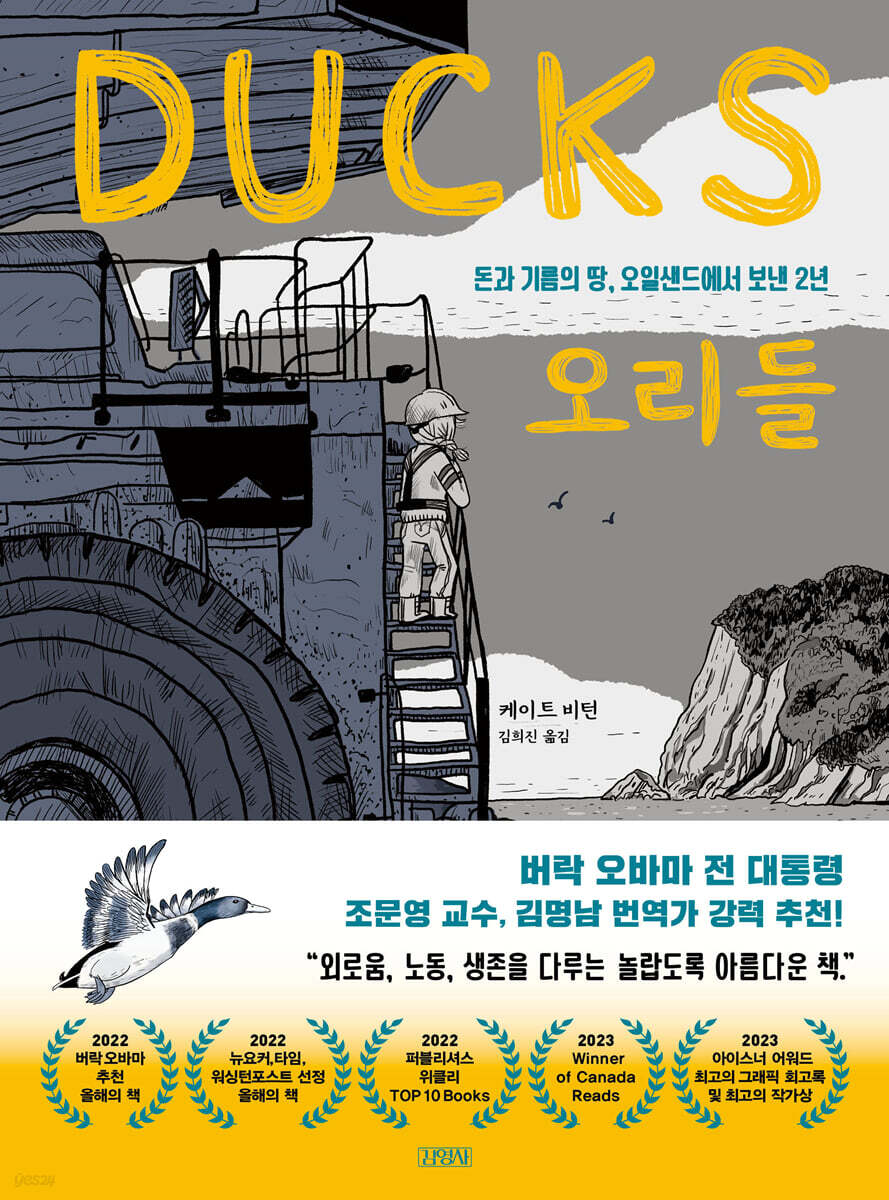
Kate Beaton's first full-length graphic novel, a memoir detailing her two years spent mining in Alberta's oil sands just before she rose to fame as a cartoonist.
Published in 2022, it was named to the Best Books of the Year lists by The New York Times, The New Yorker, Time, NPR, and others, and won the Best Graphic Memoir and Author Award at the Iners Awards, often referred to as the Academy Awards of the American comics industry, receiving acclaim from the press and critics.
In particular, it garnered attention as the first graphic novel to be included on former President Barack Obama's list of books of the year, and it won the grand prize at Canada Reads (a contest to select the book that all Canadians should read that year) hosted by the Canadian public broadcaster CBC, becoming a Canadian national book.
Kate, a liberal arts student who grew up in a coastal town in eastern Canada, is unable to find work in her hometown, so she heads west to the Alberta oil sands, a place rumored to be "where the money is flowing."
There was only one goal.
To pay off the student loans that are squeezing your neck in a short period of time and live the life you want.
He gets a job in a high-paying camp tool shed owned and operated by a major oil company, but it's the worst workplace he's ever been in, with discrimination, isolation, and environmental degradation all too commonplace.
Katie moves to a more isolated workplace with long hours for higher wages, but what she experiences and witnesses later leaves a deep trauma in her life.
Set against the majestic backdrop of Alberta's natural beauty—wildlife, the Northern Lights, the Rocky Mountains—this masterpiece graphic novel strikingly depicts the vast machinery of the oil industry and the delicate emotions of the people who endure day to day within it.
"A stunningly beautiful book about loneliness, work, and survival."
2022 Barack Obama's Books of the Year
2022 Guardian and Forbes Graphic Novels of the Year
2022 New Yorker, Time, Washington Post, and NPR Books of the Year
2023 Winner of Canada Reads
2023 Eisner Awards for Best Graphic Memoir and Best Author
Contains labor, environment, gender, and human absurdity
Masterpiece graphic novel
Kate Beaton's first full-length graphic novel, a memoir detailing her two years spent mining in Alberta's oil sands just before she rose to fame as a cartoonist.
Published in 2022, it was named to the Best Books of the Year lists by The New York Times, The New Yorker, Time, NPR, and others, and won the Best Graphic Memoir and Author Award at the Iners Awards, often referred to as the Academy Awards of the American comics industry, receiving acclaim from the press and critics.
In particular, it garnered attention as the first graphic novel to be included on former President Barack Obama's list of books of the year, and it won the grand prize at Canada Reads (a contest to select the book that all Canadians should read that year) hosted by the Canadian public broadcaster CBC, becoming a Canadian national book.
Kate, a liberal arts student who grew up in a coastal town in eastern Canada, is unable to find work in her hometown, so she heads west to the Alberta oil sands, a place rumored to be "where the money is flowing."
There was only one goal.
To pay off the student loans that are squeezing your neck in a short period of time and live the life you want.
He gets a job in a high-paying camp tool shed owned and operated by a major oil company, but it's the worst workplace he's ever been in, with discrimination, isolation, and environmental degradation all too commonplace.
Katie moves to a more isolated workplace with long hours for higher wages, but what she experiences and witnesses later leaves a deep trauma in her life.
Set against the majestic backdrop of Alberta's natural beauty—wildlife, the Northern Lights, the Rocky Mountains—this masterpiece graphic novel strikingly depicts the vast machinery of the oil industry and the delicate emotions of the people who endure day to day within it.
- You can preview some of the book's contents.
Preview
index
prolog
Cape Breton
Syncrud Mildred Lake
Synchronized Aurora
Long Lake
A year in Victoria
Shell
Epilogue
Author's Note
Recommendation
Cape Breton
Syncrud Mildred Lake
Synchronized Aurora
Long Lake
A year in Victoria
Shell
Epilogue
Author's Note
Recommendation
Detailed image

Publisher's Review
Contains labor, environment, gender, and human absurdity
Masterpiece graphic novel
“I found out around the age of twenty-one.
Any job is a good job, and even a crappy job is a good job.
… In 2005, the place to go for good jobs, good money, and a better life was the oil sands of northern Alberta.”
Kate Beaton's first full-length graphic novel, a memoir detailing her two years spent mining in Alberta's oil sands just before she rose to fame as a cartoonist.
Published in 2022, it was named to the Best Books of the Year lists by The New York Times, The New Yorker, Time, NPR, and others, and won the Best Graphic Memoir and Author Award at the Iners Awards, often referred to as the Academy Awards of the American comics industry, receiving acclaim from the press and critics.
In particular, it garnered attention as the first graphic novel to be included on former President Barack Obama's list of books of the year, and it won the grand prize at Canada Reads (a contest to select the book that all Canadians should read that year) hosted by the Canadian public broadcaster CBC, becoming a Canadian national book.
Kate (usually referred to as "Katie" in the novel), a liberal arts student who grew up in a coastal town in eastern Canada, leaves for the Alberta oil sands mines in the west, a place rumored to be "where the money is flowing", when she can't find work in her hometown.
There was only one goal.
To pay off the student loans that are squeezing your neck in a short period of time and live the life you want.
He gets a job in a high-paying camp tool shed owned and operated by a major oil company, but it's the worst workplace he's ever been in, with discrimination, isolation, and environmental degradation all too commonplace.
Katie moves to a more isolated workplace with long hours for higher wages, but what she experiences and witnesses later leaves a deep trauma in her life.
Harsh workplaces and the world of men
Katie's first job was at Syncrude, Canada's largest oil sands mining project at the time.
The main job is to rent out necessary equipment to field workers in the tool room.
Although it seemed like a simple task on the surface, the working conditions and on-site conditions were poor.
In winter, there was little sunlight and temperatures dropped below -40°C.
Because I worked many night shifts, I was often exhausted the next day, and I had to swallow my tears as I carried dirty equipment with my hands stiff from the cold.
The polluted air left me with a constant cough and phlegm, and I developed hives on my skin.
But what bothered him more than the harsh conditions was the camp's abnormal culture, which stemmed from the overwhelming male-dominated ratio (50 men to 1 woman).
Men would immediately call her "cutie" and make casual sexual jokes upon first meeting her, and they would often gossip about or spread rumors about the female employees' private lives.
Things got worse when I moved to a camp in Long Lake, which provided lodging.
Often, male employees would pretend to be mistaken and open his dormitory door and come in, and even men would form a long line around the tool room building to 'look' at the new female employee and comment on her appearance.
Katie complained to her manager about the situation, but her manager advised her, “Don’t expect special treatment.”
“I knew from the moment I set foot here that this was a man’s world.”
Katie is shocked by the deviance of people like her father, who would have been perfectly normal and sane if not for the camp environment, but she learns the harsh lesson that to survive in this world, you have to suppress your discontent, and to bring issues to light, you have to be prepared to be labeled a "crazy girl."
Life vs.
money
Katie, who was suffering from trauma, decided to leave the camp for a while.
She got a job at the Maritime Museum on Victoria Island, a town for wealthy retirees, but even with part-time jobs (housekeeper, grocery store cashier), she couldn't make enough money to cover the camp expenses.
After receiving a call from his bank urging him to repay his student loans, he returned to Alberta, leaving behind dreamlike memories (museums, opera, people calling him "lady").
Katie lands a warehouse management job at Shell, a major oil company, but remains ignorant of the oil sands companies' prioritization of profits over worker safety.
On one hand, there are grim rumors about a contract worker being crushed to death by heavy equipment and an employee fired after defecating in a parking lot after taking cocaine, while on the other, the company sends employees an email celebrating “achieving 3 million man-hours without a lost-time injury.”
Katie is perplexed, saying, “There was never a single safety meeting about drugs,” but her colleagues say there’s a company culture of silence about employees’ mental health issues.
Meanwhile, Katie, reading a newspaper article about hundreds of ducks dying in the tailings ponds of the sinkholes (polluted water left over from mining operations), realized that the dangers of the oil sands weren't limited to the people who worked there.
A YouTube broadcast featuring Celina Harp, an elder from the Cree Aboriginal community in Fort Mackay, was particularly crucial.
The elder complained that the local indigenous people have long suffered from serious illnesses and their lives are threatened by the pollutants emitted from the mine.
“It was all destroyed.
Our lives were destroyed, our water, our air, everything.
“They don’t care how many of us die, as long as they make money at the expense of our lives.” Katie is deeply disturbed when she realizes that she, who had always considered herself to be on the receiving end of violence and trauma, is now complicit in the oil industry, destroying the environment, and dispossessing indigenous peoples of their homes through her labor.
A story that cannot be divided into good and evil
This work, which impressively depicts the massive machinery of the oil industry and the delicate emotions of the people who endure day to day within it, against the backdrop of Alberta's majestic nature, including wildlife, the Northern Lights, and the Rocky Mountains, is considered to be the pinnacle of his artistic talent.
A particular virtue of this book is that it resists the conventional wisdom that characterizes the oil sands as “purely bad.”
In his eyes, the oil sands were a place that “did not fit into any simple rules.”
The camp wasn't just full of "badass" guys, there were more ordinary people.
There were also many men who cared for him and treated him warmly (Norman, the mechanic who gave him a parting gift of a photo of the aurora and a beautiful rainbow; Joe, the equipment manager who suggested a drive to cheer him up when he was feeling down; Uncle Davey, a fellow hometown friend who came all the way to check on him).
In the end, Katie is unable to open up to a reporter from the Globe and Mail who asks her about the sordid happenings in the oil sands.
“Even at their worst, they look more like me than that reporter.” She was a woman discriminated against in a man’s world, but her class identity was closer to that of a group of colleagues from a poor rural area, trying to make money, than to a female reporter making phone calls from a comfortable office in Toronto.
“The hardest thing for me while being harassed here isn’t that people say unpleasant things.
When they say things like that, their tone is exactly like mine, and they use that accent I lost when I went to college.
“They look like my cousins and uncles,” Katie said, unsure if she could explain such a complex truth to a reporter who had already decided the oil sands were a horrible place and was only interested in collecting examples.
Perhaps this book is the answer he was hesitant to give to the reporter who requested an interview at the time, and it was released 18 years later.
The 'Oil Sands' Within Us
The book's title, "Ducks," first appears in an article about a flock of ducks that died in a tailing pond.
It reads as a metaphor for oil sands workers: like ducks that erroneously fly into polluted habitats in search of food, Katie and her colleagues, who come here to make money, suffer both physically and mentally in the toxic environment.
It is also quite fun to read the cultural symbols and allusions the author places throughout the book.
Canada is a large country, but its ethnic composition, culture, and economic power vary greatly depending on the region.
Cape Breton Island in eastern Canada, the author's home, is a poor provincial town where descendants of Scottish immigrants have lived for generations, has beautiful beaches, and lobster is a specialty, but now, with the decline of the coal and steel industries, every household has an "empty chair" filled with families moving in.
Meanwhile, the Alberta oil sands camp in the east, where he got a job, is a boomtown filled with entertainment establishments as well as easy money, restaurants named after places from all over the country, and Baptist and Muslim buildings all mixed together.
The book is filled with descriptions that hint at regional and cultural characteristics. Even signs, lyrics, and book covers carry meaning. Keeping this in mind while reading will allow you to savor the work more deeply.
Twenty-two-year-old Katie is portrayed as a strong family man, quick to grasp reality, and confident.
Even in difficult situations, he perseveres day by day towards his goal.
Readers will root for his happy ending until the very end.
Now, the 'Sunflower' tool room staff member is over forty and has earned the reputation of being a best-selling author.
But this story, which he confesses heartbreakingly after a long time, and which he is ultimately forced to confess, will go beyond his personal experience.
“Everyone has had their own experience with the oil sands.
“This is the oil sands I experienced.” This is the first sentence of the author’s note.
The themes in this book—labor, loneliness, capitalism, gender, environmental destruction—resonate deeply with the realities facing our society.
Perhaps, many Korean readers will recall the 'oil sands' within us while reading this book.
Great stories transcend borders and cultures.
Masterpiece graphic novel
“I found out around the age of twenty-one.
Any job is a good job, and even a crappy job is a good job.
… In 2005, the place to go for good jobs, good money, and a better life was the oil sands of northern Alberta.”
Kate Beaton's first full-length graphic novel, a memoir detailing her two years spent mining in Alberta's oil sands just before she rose to fame as a cartoonist.
Published in 2022, it was named to the Best Books of the Year lists by The New York Times, The New Yorker, Time, NPR, and others, and won the Best Graphic Memoir and Author Award at the Iners Awards, often referred to as the Academy Awards of the American comics industry, receiving acclaim from the press and critics.
In particular, it garnered attention as the first graphic novel to be included on former President Barack Obama's list of books of the year, and it won the grand prize at Canada Reads (a contest to select the book that all Canadians should read that year) hosted by the Canadian public broadcaster CBC, becoming a Canadian national book.
Kate (usually referred to as "Katie" in the novel), a liberal arts student who grew up in a coastal town in eastern Canada, leaves for the Alberta oil sands mines in the west, a place rumored to be "where the money is flowing", when she can't find work in her hometown.
There was only one goal.
To pay off the student loans that are squeezing your neck in a short period of time and live the life you want.
He gets a job in a high-paying camp tool shed owned and operated by a major oil company, but it's the worst workplace he's ever been in, with discrimination, isolation, and environmental degradation all too commonplace.
Katie moves to a more isolated workplace with long hours for higher wages, but what she experiences and witnesses later leaves a deep trauma in her life.
Harsh workplaces and the world of men
Katie's first job was at Syncrude, Canada's largest oil sands mining project at the time.
The main job is to rent out necessary equipment to field workers in the tool room.
Although it seemed like a simple task on the surface, the working conditions and on-site conditions were poor.
In winter, there was little sunlight and temperatures dropped below -40°C.
Because I worked many night shifts, I was often exhausted the next day, and I had to swallow my tears as I carried dirty equipment with my hands stiff from the cold.
The polluted air left me with a constant cough and phlegm, and I developed hives on my skin.
But what bothered him more than the harsh conditions was the camp's abnormal culture, which stemmed from the overwhelming male-dominated ratio (50 men to 1 woman).
Men would immediately call her "cutie" and make casual sexual jokes upon first meeting her, and they would often gossip about or spread rumors about the female employees' private lives.
Things got worse when I moved to a camp in Long Lake, which provided lodging.
Often, male employees would pretend to be mistaken and open his dormitory door and come in, and even men would form a long line around the tool room building to 'look' at the new female employee and comment on her appearance.
Katie complained to her manager about the situation, but her manager advised her, “Don’t expect special treatment.”
“I knew from the moment I set foot here that this was a man’s world.”
Katie is shocked by the deviance of people like her father, who would have been perfectly normal and sane if not for the camp environment, but she learns the harsh lesson that to survive in this world, you have to suppress your discontent, and to bring issues to light, you have to be prepared to be labeled a "crazy girl."
Life vs.
money
Katie, who was suffering from trauma, decided to leave the camp for a while.
She got a job at the Maritime Museum on Victoria Island, a town for wealthy retirees, but even with part-time jobs (housekeeper, grocery store cashier), she couldn't make enough money to cover the camp expenses.
After receiving a call from his bank urging him to repay his student loans, he returned to Alberta, leaving behind dreamlike memories (museums, opera, people calling him "lady").
Katie lands a warehouse management job at Shell, a major oil company, but remains ignorant of the oil sands companies' prioritization of profits over worker safety.
On one hand, there are grim rumors about a contract worker being crushed to death by heavy equipment and an employee fired after defecating in a parking lot after taking cocaine, while on the other, the company sends employees an email celebrating “achieving 3 million man-hours without a lost-time injury.”
Katie is perplexed, saying, “There was never a single safety meeting about drugs,” but her colleagues say there’s a company culture of silence about employees’ mental health issues.
Meanwhile, Katie, reading a newspaper article about hundreds of ducks dying in the tailings ponds of the sinkholes (polluted water left over from mining operations), realized that the dangers of the oil sands weren't limited to the people who worked there.
A YouTube broadcast featuring Celina Harp, an elder from the Cree Aboriginal community in Fort Mackay, was particularly crucial.
The elder complained that the local indigenous people have long suffered from serious illnesses and their lives are threatened by the pollutants emitted from the mine.
“It was all destroyed.
Our lives were destroyed, our water, our air, everything.
“They don’t care how many of us die, as long as they make money at the expense of our lives.” Katie is deeply disturbed when she realizes that she, who had always considered herself to be on the receiving end of violence and trauma, is now complicit in the oil industry, destroying the environment, and dispossessing indigenous peoples of their homes through her labor.
A story that cannot be divided into good and evil
This work, which impressively depicts the massive machinery of the oil industry and the delicate emotions of the people who endure day to day within it, against the backdrop of Alberta's majestic nature, including wildlife, the Northern Lights, and the Rocky Mountains, is considered to be the pinnacle of his artistic talent.
A particular virtue of this book is that it resists the conventional wisdom that characterizes the oil sands as “purely bad.”
In his eyes, the oil sands were a place that “did not fit into any simple rules.”
The camp wasn't just full of "badass" guys, there were more ordinary people.
There were also many men who cared for him and treated him warmly (Norman, the mechanic who gave him a parting gift of a photo of the aurora and a beautiful rainbow; Joe, the equipment manager who suggested a drive to cheer him up when he was feeling down; Uncle Davey, a fellow hometown friend who came all the way to check on him).
In the end, Katie is unable to open up to a reporter from the Globe and Mail who asks her about the sordid happenings in the oil sands.
“Even at their worst, they look more like me than that reporter.” She was a woman discriminated against in a man’s world, but her class identity was closer to that of a group of colleagues from a poor rural area, trying to make money, than to a female reporter making phone calls from a comfortable office in Toronto.
“The hardest thing for me while being harassed here isn’t that people say unpleasant things.
When they say things like that, their tone is exactly like mine, and they use that accent I lost when I went to college.
“They look like my cousins and uncles,” Katie said, unsure if she could explain such a complex truth to a reporter who had already decided the oil sands were a horrible place and was only interested in collecting examples.
Perhaps this book is the answer he was hesitant to give to the reporter who requested an interview at the time, and it was released 18 years later.
The 'Oil Sands' Within Us
The book's title, "Ducks," first appears in an article about a flock of ducks that died in a tailing pond.
It reads as a metaphor for oil sands workers: like ducks that erroneously fly into polluted habitats in search of food, Katie and her colleagues, who come here to make money, suffer both physically and mentally in the toxic environment.
It is also quite fun to read the cultural symbols and allusions the author places throughout the book.
Canada is a large country, but its ethnic composition, culture, and economic power vary greatly depending on the region.
Cape Breton Island in eastern Canada, the author's home, is a poor provincial town where descendants of Scottish immigrants have lived for generations, has beautiful beaches, and lobster is a specialty, but now, with the decline of the coal and steel industries, every household has an "empty chair" filled with families moving in.
Meanwhile, the Alberta oil sands camp in the east, where he got a job, is a boomtown filled with entertainment establishments as well as easy money, restaurants named after places from all over the country, and Baptist and Muslim buildings all mixed together.
The book is filled with descriptions that hint at regional and cultural characteristics. Even signs, lyrics, and book covers carry meaning. Keeping this in mind while reading will allow you to savor the work more deeply.
Twenty-two-year-old Katie is portrayed as a strong family man, quick to grasp reality, and confident.
Even in difficult situations, he perseveres day by day towards his goal.
Readers will root for his happy ending until the very end.
Now, the 'Sunflower' tool room staff member is over forty and has earned the reputation of being a best-selling author.
But this story, which he confesses heartbreakingly after a long time, and which he is ultimately forced to confess, will go beyond his personal experience.
“Everyone has had their own experience with the oil sands.
“This is the oil sands I experienced.” This is the first sentence of the author’s note.
The themes in this book—labor, loneliness, capitalism, gender, environmental destruction—resonate deeply with the realities facing our society.
Perhaps, many Korean readers will recall the 'oil sands' within us while reading this book.
Great stories transcend borders and cultures.
GOODS SPECIFICS
- Date of issue: March 15, 2024
- Format: Hardcover book binding method guide
- Page count, weight, size: 436 pages | 171*230*20mm
- ISBN13: 9788934941507
- ISBN10: 8934941502
You may also like
카테고리
korean


korean

![GQ KOREA Mark (Monthly): December [2025]](http://librairie.coreenne.fr/cdn/shop/files/8ef265dbbfbf186523ed75ba7319009d.jpg?v=1765340328&width=3840)


