

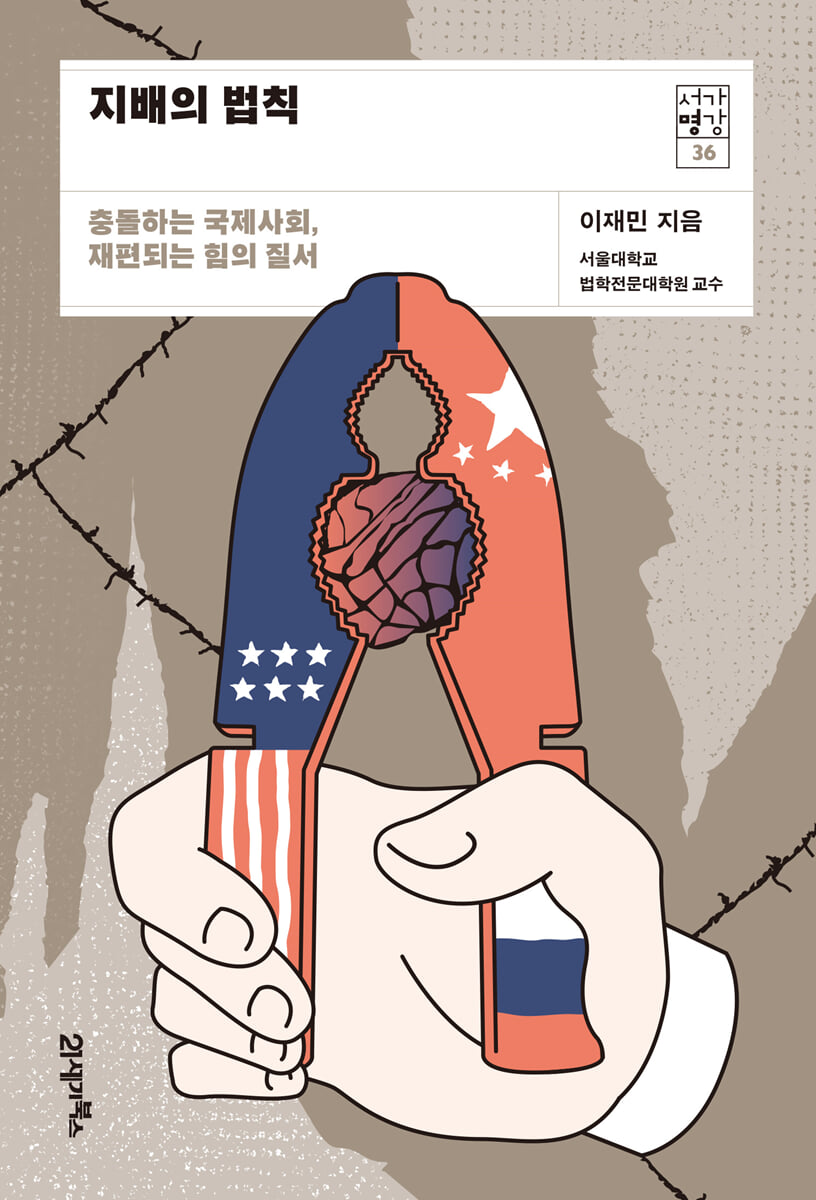
Law of Domination
 |
Description
Book Introduction
"Seogamyeonggang": A famous lecture you can attend without going to Seoul National University.
The world is now in an era of ‘paradigm shift in the international order’. Pay attention to the turbulent international community and the reorganization of the power order! Discover Korea's finest lectures in book form! The thirty-sixth volume in the "Seogamyeonggang" series, featuring carefully curated lectures by current Seoul National University faculty, has been published. The Seoga Myunggang series, which transcribes the lectures of Seoul National University's top professors in various fields, including history, philosophy, science, medicine, and art, into books, provides readers with the expansion of knowledge and the joy of learning. 『The Law of Domination』, written by Professor Jaemin Lee of Seoul National University Law School, Korea's leading international dispute expert and international law scholar, examines the current state of the international society in chaos through four mega keywords: 'New Cold War', 'Economy in the Digital Age', 'Polar Regions and Space Development', and 'Global Crisis', and forecasts the future and seeks growth opportunities. Professor Lee Jae-min, who has a keen insight into the order of power that dominates the world, passed the Foreign Service Higher Civil Service Examination and worked at the Ministry of Foreign Affairs and Trade. Afterwards, he turned his attention to the world and worked as a lawyer at an American law firm specializing in international disputes, playing a leading role in international disputes. He also worked at the United Nations, the World Trade Organization, and other organizations. This book vividly illustrates the vivid reality and profound insights of the great transformation of the 21st-century international order experienced during this process through the tools of 'international law' and 'international norms.' Today, the world is fragmented by international norms and riven by geopolitical conflicts, as evidenced by the US-China conflict, the Russia-Ukraine war, and the Israel-Hamas conflict. We also face challenges threatening humanity, such as the climate crisis, pandemics like COVID-19, and the disintegration of global supply chains, as well as civilization-changing challenges like the Fourth Industrial Revolution and the emergence of AI. The international outlook we face today is by no means optimistic, but therefore, a breakthrough strategy that turns this crisis into an opportunity is urgently needed. This book is highly recommended for readers who wish to clearly understand the increasingly sharp and complex international issues from an expert's perspective, while also seeking to discover new opportunities amidst the currents of international crisis. |
- You can preview some of the book's contents.
Preview
index
Before reading this book
Classification of academic disciplines
Main keywords
Introduction: Understanding the world order opens the door to the future.
Part 1: The Prelude to a New Cold War That Will Change the World
A Dividing World: The New Cold War 2.0
A battle of norms more powerful than weapons: a legal war
An era in which a new order is needed
Q/A Ask and Answer
The digital age is coming, crossing the line of the second part.
An international order expanding into a world of 0s and 1s
A digital society that develops faster than the law
Digital: Questioning the Definition of Borders
Q/A Ask and Answer
Part 3: Now the world goes to the poles, to space.
New world, new hegemony
The space race has begun again
Another opportunity hidden in the ice
Q/A Ask and Answer
Part 4: A Great Transformation: Turning Crisis into Opportunity
The international community sinking into crisis
How to survive in an era of each-for-himself
Rewriting the Future of Humanity with a New Order
Q/A Ask and Answer
The New Weapon of the Winner : International Law
annotation
References
Classification of academic disciplines
Main keywords
Introduction: Understanding the world order opens the door to the future.
Part 1: The Prelude to a New Cold War That Will Change the World
A Dividing World: The New Cold War 2.0
A battle of norms more powerful than weapons: a legal war
An era in which a new order is needed
Q/A Ask and Answer
The digital age is coming, crossing the line of the second part.
An international order expanding into a world of 0s and 1s
A digital society that develops faster than the law
Digital: Questioning the Definition of Borders
Q/A Ask and Answer
Part 3: Now the world goes to the poles, to space.
New world, new hegemony
The space race has begun again
Another opportunity hidden in the ice
Q/A Ask and Answer
Part 4: A Great Transformation: Turning Crisis into Opportunity
The international community sinking into crisis
How to survive in an era of each-for-himself
Rewriting the Future of Humanity with a New Order
Q/A Ask and Answer
The New Weapon of the Winner : International Law
annotation
References
Detailed image

Into the book
This situation, where groups are closely aligned on one side and countries are competing on the other, is unfolding all over the world.
As mentioned earlier, this phenomenon can be seen as the advent of a new Cold War era.
If the previous Cold War era saw ideological confrontation reaching extremes, now it is not a matter of ideology, but of unity and separation centered on national interests.
Countries are weighing their interests against each other in various areas under the banner of national interests.
--- p.37 From “Part 1│The Prelude to a New Cold War That Will Change the World”
The new Cold War system is an undeniable trend of the times.
What should we prepare for and how should we behave in times like these? (Omitted) Looking at the bigger picture, we must consider what we should do in this new Cold War era, where many nations are engaging in new levels of international activity and decision-making.
(Omitted) In the process of finding these answers, the foundation that must be established is understanding the norms that drive this flow.
--- pp.62-63 From "Part 1│The Prelude to a New Cold War That Will Change the World"
In the information age, digital issues are directly linked to the core national interests of every country.
Someone has said that information in modern society is itself oil, rice, and semiconductors.
Today, information is at the heart of national interests, national security, and economic activity.
--- p.88 From “Part 2│The Digital Age Crossing the Line is Coming”
In this way, we are now living in both the territorial age and the cyber age.
At a time when the boundaries between my land and someone else's land are becoming blurred, a new, interesting, yet confusing, story is being written about the need to protect my land.
We live in a world where two things strangely coexist, even though they are difficult to reconcile.
--- p.109 From “Part 2│The Digital Age Crossing the Line is Coming”
Historically, we have always lived within the constraints of space.
It's because of the small land area.
But now the opportunity to escape this fate has arrived.
This is the digital age that uses cyberspace as a medium, and the age of the space industry that is advancing into new spaces.
These are new areas where territorial restrictions have disappeared.
Now that two eras are approaching simultaneously, a new opportunity for a leap forward lies before us.
--- p.155 From “Part 3│Now the world goes to the pole, to space”
What do these recent developments tell us? We are facing a global crisis.
These crises have no borders.
Every nation is affected, and a collective effort by all of humanity is needed to address this.
But these joint efforts are not very visible now.
(Omitted) They are participating in a closed group centered around major powers, selecting issues and strategically cooperating.
Rather than a collective response from all of humanity, it is limited to individual groups responding based on vested interests.
This is not a proper response.
--- p.185 From “Part 4│A Great Transformation that Turns Crisis into Opportunity”
You should now understand that our future depends on how we understand the various international norms and how we participate in this system, actively shaping new norms by incorporating our ideas.
As in all things, a crisis is also a new opportunity.
I hope everyone will take a keen interest in turning crises into opportunities through a strategic approach that understands and utilizes international norms.
As mentioned earlier, this phenomenon can be seen as the advent of a new Cold War era.
If the previous Cold War era saw ideological confrontation reaching extremes, now it is not a matter of ideology, but of unity and separation centered on national interests.
Countries are weighing their interests against each other in various areas under the banner of national interests.
--- p.37 From “Part 1│The Prelude to a New Cold War That Will Change the World”
The new Cold War system is an undeniable trend of the times.
What should we prepare for and how should we behave in times like these? (Omitted) Looking at the bigger picture, we must consider what we should do in this new Cold War era, where many nations are engaging in new levels of international activity and decision-making.
(Omitted) In the process of finding these answers, the foundation that must be established is understanding the norms that drive this flow.
--- pp.62-63 From "Part 1│The Prelude to a New Cold War That Will Change the World"
In the information age, digital issues are directly linked to the core national interests of every country.
Someone has said that information in modern society is itself oil, rice, and semiconductors.
Today, information is at the heart of national interests, national security, and economic activity.
--- p.88 From “Part 2│The Digital Age Crossing the Line is Coming”
In this way, we are now living in both the territorial age and the cyber age.
At a time when the boundaries between my land and someone else's land are becoming blurred, a new, interesting, yet confusing, story is being written about the need to protect my land.
We live in a world where two things strangely coexist, even though they are difficult to reconcile.
--- p.109 From “Part 2│The Digital Age Crossing the Line is Coming”
Historically, we have always lived within the constraints of space.
It's because of the small land area.
But now the opportunity to escape this fate has arrived.
This is the digital age that uses cyberspace as a medium, and the age of the space industry that is advancing into new spaces.
These are new areas where territorial restrictions have disappeared.
Now that two eras are approaching simultaneously, a new opportunity for a leap forward lies before us.
--- p.155 From “Part 3│Now the world goes to the pole, to space”
What do these recent developments tell us? We are facing a global crisis.
These crises have no borders.
Every nation is affected, and a collective effort by all of humanity is needed to address this.
But these joint efforts are not very visible now.
(Omitted) They are participating in a closed group centered around major powers, selecting issues and strategically cooperating.
Rather than a collective response from all of humanity, it is limited to individual groups responding based on vested interests.
This is not a proper response.
--- p.185 From “Part 4│A Great Transformation that Turns Crisis into Opportunity”
You should now understand that our future depends on how we understand the various international norms and how we participate in this system, actively shaping new norms by incorporating our ideas.
As in all things, a crisis is also a new opportunity.
I hope everyone will take a keen interest in turning crises into opportunities through a strategic approach that understands and utilizes international norms.
--- p.214 From “Part 4│A Great Transformation that Turns Crisis into Opportunity”
Publisher's Review
Forget all the rules so far!
The norms that supported the international community after World War II have collapsed!
Let's take a look at the daily lives of Korean office workers in the 21st century.
I drink Americano on my way to work and discuss contract terms with overseas business partners via video conference.
I listen to music on YouTube on the subway home from work, buy stuff on Amazon, and then watch new content on Netflix while eating dinner back home.
This routine is primarily due to technological advancements, but behind it are already the many 'norms' promised to operate it.
These norms have an impact not only on individuals and businesses, but also between countries, and are collectively called 'international law' or 'international norms.'
As the international community becomes more interconnected, as it is today, the significance of international law becomes increasingly important.
Especially in the case of our country, which survives on trade, the influence of international law is greater.
But international norms are now undergoing significant change.
With the advent of the US-China conflict and the new Cold War 2.0, the rift between nations is deepening day by day, and following the Russia-Ukraine War and the Israel-Hamas War, the issue of a military conflict between China and Taiwan is becoming a reality.
Moreover, the multilateral system, which had been virtually the only order that supported the international community for about 80 years since World War II, has completely collapsed.
Each nation is abandoning the old rules that have become meaningless, and is fiercely opposing each other based on their own interests, fighting to establish new rules for a world that is becoming increasingly divided.
"The New Cold War," "The Digital Economy," "Polar Regions and Space Exploration," and "The Global Crisis"
4 mega keywords to survive in the global jungle!
In this book, the author identifies the 'new Cold War,' 'the economy in the digital age,' 'polar regions and space development,' and 'the global crisis' as areas where the great transformation of the international order is clearly revealed.
What these four areas have in common is that nothing can be defined by the rules of the past.
In other words, the key to achieving future hegemony lies in becoming the master of new norms in this area.
Part 1 explains how the Cold War system, which was dismantled after the collapse of the Soviet Union in 1991, has returned under the name of 'New Cold War 2.0', what its characteristics are, and how it disrupts the international situation.
By interpreting and analyzing the Russia-Ukraine war, which still commands global attention, from the perspective of a legal war, we deepen our perspective on the international order.
Part 2 addresses the issue of conflicting interests between nations in a situation where the territorial era and the cyber era coexist.
Using tax issues of giant IT companies such as Apple, Google, Meta, and Netflix as examples, it reminds us that fierce competition is taking place in our daily lives as well.
Furthermore, by discussing 'transnational borders,' one of the key issues of the digital age, in relation to international law, it makes us reconsider the definition of borders and territories today.
The following third part brings space and the polar regions, areas of curiosity and exploration, back to reality.
As this area emerges as a gold mine for new economic value creation, the fierce legal battles surrounding its development are demonstrated through various discourses.
It is highly likely that the future international order and the winners of the global economy will be determined in this area.
The final part, Part 4, analyzes the impact of global warming and the COVID-19 pandemic on international politics and warns that the past order can no longer overcome the current crisis.
At the same time, he emphasizes that to overcome this, a collective effort by humanity is urgently needed under the framework of inter-national solidarity and connectivity norms that will unite the world once again.
How to turn a crisis into an opportunity and become the master of a new era.
Capture South Korea's survival strategy in international law!
The Fourth Industrial Revolution, brought about by science and technology, has completely changed the international landscape.
The order we once believed to be true has now lost its power.
Great powers act only for the benefit of their own countries and their allies.
Taking a route and riding on the powerful forces that are already in conflict is still a valid survival strategy.
But the questions this book asks and the strategies it suggests go beyond that.
If we are to avoid repeating the history of suffering under pressure from foreign powers, such as the Japanese invasion or the British occupation of Geomundo Island, which they named "Hamilton Port," we must not focus solely on survival in this era of great change.
Beyond being an industrial powerhouse in semiconductors and shipbuilding, South Korea is now a global cultural leader with K-pop, led by BTS and Blackpink. Is South Korea content with simply navigating this chaotic period? Doesn't it aspire to emerge as a new player, seizing the opportunity to win the global legal battle? Professor Lee Jae-min addresses this question, stating, "In this uncharted territory where no one has yet established norms, the first to plant the flag of norms will be reborn as the future winner." He emphasizes that "international law cannot be governed solely by government-level efforts, including those at the Ministry of Foreign Affairs. It requires the interest of ordinary citizens, their consistent collective voice, and their advancement into the global stage, including through international organizations."
As the author says, international law is never separate from our lives.
Through this book, I encourage you to solidify the foundation of the international norms that sustain our world today and to develop an eye for opportunities in areas where new winners are emerging.
Meet 'Seo Ga-myeong-gang' on YouTube, lectures, and podcasts!
▶ Lecture book21.com/lecture
▶ YouTube youtube.com/서가명강
▶ Audio clip audioclip.naver.com/channels/345
▶ Podbbang podbbang.com/ch/14808
▶ Post post.naver.com/21c_sgmk?
The norms that supported the international community after World War II have collapsed!
Let's take a look at the daily lives of Korean office workers in the 21st century.
I drink Americano on my way to work and discuss contract terms with overseas business partners via video conference.
I listen to music on YouTube on the subway home from work, buy stuff on Amazon, and then watch new content on Netflix while eating dinner back home.
This routine is primarily due to technological advancements, but behind it are already the many 'norms' promised to operate it.
These norms have an impact not only on individuals and businesses, but also between countries, and are collectively called 'international law' or 'international norms.'
As the international community becomes more interconnected, as it is today, the significance of international law becomes increasingly important.
Especially in the case of our country, which survives on trade, the influence of international law is greater.
But international norms are now undergoing significant change.
With the advent of the US-China conflict and the new Cold War 2.0, the rift between nations is deepening day by day, and following the Russia-Ukraine War and the Israel-Hamas War, the issue of a military conflict between China and Taiwan is becoming a reality.
Moreover, the multilateral system, which had been virtually the only order that supported the international community for about 80 years since World War II, has completely collapsed.
Each nation is abandoning the old rules that have become meaningless, and is fiercely opposing each other based on their own interests, fighting to establish new rules for a world that is becoming increasingly divided.
"The New Cold War," "The Digital Economy," "Polar Regions and Space Exploration," and "The Global Crisis"
4 mega keywords to survive in the global jungle!
In this book, the author identifies the 'new Cold War,' 'the economy in the digital age,' 'polar regions and space development,' and 'the global crisis' as areas where the great transformation of the international order is clearly revealed.
What these four areas have in common is that nothing can be defined by the rules of the past.
In other words, the key to achieving future hegemony lies in becoming the master of new norms in this area.
Part 1 explains how the Cold War system, which was dismantled after the collapse of the Soviet Union in 1991, has returned under the name of 'New Cold War 2.0', what its characteristics are, and how it disrupts the international situation.
By interpreting and analyzing the Russia-Ukraine war, which still commands global attention, from the perspective of a legal war, we deepen our perspective on the international order.
Part 2 addresses the issue of conflicting interests between nations in a situation where the territorial era and the cyber era coexist.
Using tax issues of giant IT companies such as Apple, Google, Meta, and Netflix as examples, it reminds us that fierce competition is taking place in our daily lives as well.
Furthermore, by discussing 'transnational borders,' one of the key issues of the digital age, in relation to international law, it makes us reconsider the definition of borders and territories today.
The following third part brings space and the polar regions, areas of curiosity and exploration, back to reality.
As this area emerges as a gold mine for new economic value creation, the fierce legal battles surrounding its development are demonstrated through various discourses.
It is highly likely that the future international order and the winners of the global economy will be determined in this area.
The final part, Part 4, analyzes the impact of global warming and the COVID-19 pandemic on international politics and warns that the past order can no longer overcome the current crisis.
At the same time, he emphasizes that to overcome this, a collective effort by humanity is urgently needed under the framework of inter-national solidarity and connectivity norms that will unite the world once again.
How to turn a crisis into an opportunity and become the master of a new era.
Capture South Korea's survival strategy in international law!
The Fourth Industrial Revolution, brought about by science and technology, has completely changed the international landscape.
The order we once believed to be true has now lost its power.
Great powers act only for the benefit of their own countries and their allies.
Taking a route and riding on the powerful forces that are already in conflict is still a valid survival strategy.
But the questions this book asks and the strategies it suggests go beyond that.
If we are to avoid repeating the history of suffering under pressure from foreign powers, such as the Japanese invasion or the British occupation of Geomundo Island, which they named "Hamilton Port," we must not focus solely on survival in this era of great change.
Beyond being an industrial powerhouse in semiconductors and shipbuilding, South Korea is now a global cultural leader with K-pop, led by BTS and Blackpink. Is South Korea content with simply navigating this chaotic period? Doesn't it aspire to emerge as a new player, seizing the opportunity to win the global legal battle? Professor Lee Jae-min addresses this question, stating, "In this uncharted territory where no one has yet established norms, the first to plant the flag of norms will be reborn as the future winner." He emphasizes that "international law cannot be governed solely by government-level efforts, including those at the Ministry of Foreign Affairs. It requires the interest of ordinary citizens, their consistent collective voice, and their advancement into the global stage, including through international organizations."
As the author says, international law is never separate from our lives.
Through this book, I encourage you to solidify the foundation of the international norms that sustain our world today and to develop an eye for opportunities in areas where new winners are emerging.
Meet 'Seo Ga-myeong-gang' on YouTube, lectures, and podcasts!
▶ Lecture book21.com/lecture
▶ YouTube youtube.com/서가명강
▶ Audio clip audioclip.naver.com/channels/345
▶ Podbbang podbbang.com/ch/14808
▶ Post post.naver.com/21c_sgmk?
GOODS SPECIFICS
- Date of issue: March 11, 2024
- Page count, weight, size: 240 pages | 128*188*20mm
- ISBN13: 9791171174904
- ISBN10: 117117490X
You may also like
카테고리
korean


korean

![GQ KOREA Mark (Monthly): December [2025]](http://librairie.coreenne.fr/cdn/shop/files/8ef265dbbfbf186523ed75ba7319009d.jpg?v=1765340328&width=3840)


