

The era of edtech
 |
Description
Book Introduction
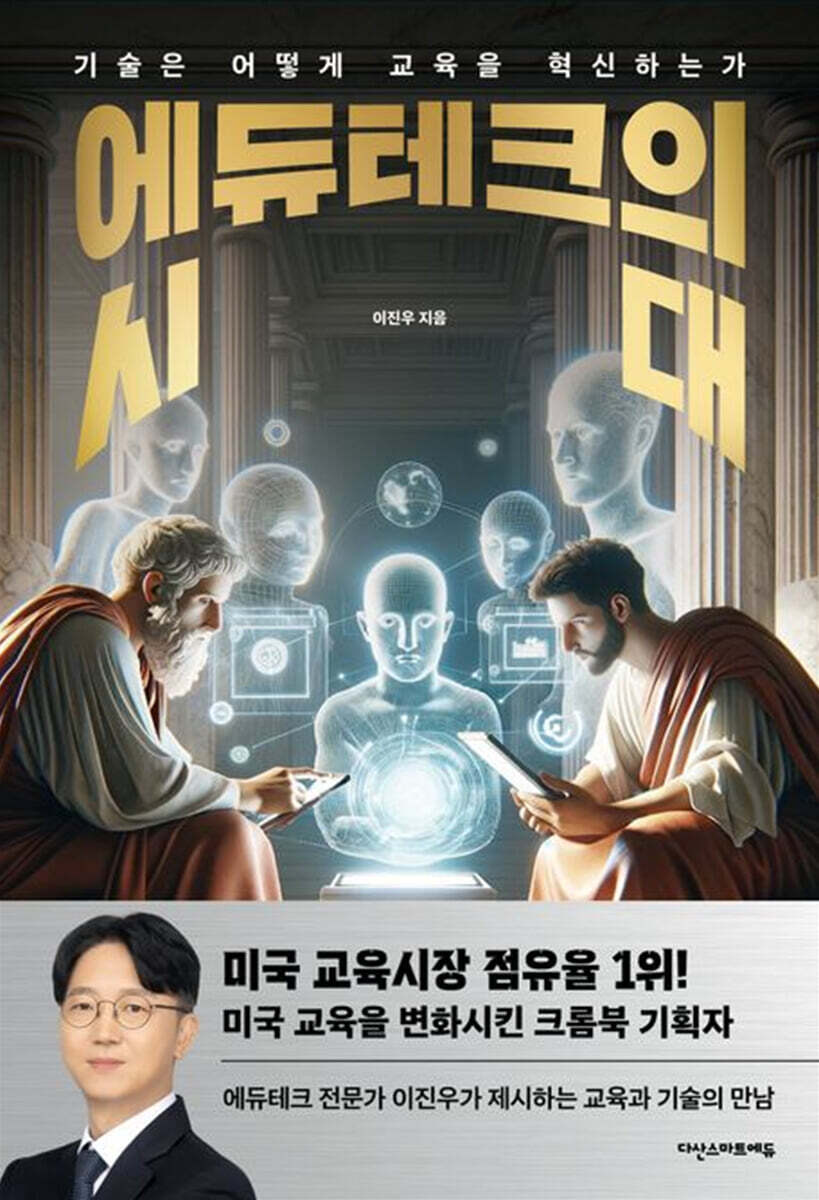
#1 in US education market share! The Chromebook Designer Who Transformed American Education The intersection of education and technology presented by edtech expert Jinwoo Lee. "South Korea, a nation that thrived on education, is now collapsing with the collapse of public education." "I hope this book will reach those who seek to build a new educational bridge for future generations." Highly recommended by Professor Jae-Cheon Choi of Ewha Womans University! Highly recommended by Professor Sang-gyun Kim, author of "Metaverse"! Why should we use technology in education? Without answers to these questions, no matter how much money you spend, you'll end up with hundreds of smart devices sitting in empty classrooms, gathering dust. The term 'edutech' is now so natural. No one disputes the necessity of integrating education and technology. AI technology is sweeping the globe, and public education, which emerged during the Industrial Revolution, is also facing significant changes with the Fourth Industrial Revolution. As we navigate the COVID-19 era, our educational landscape has embraced unprecedented change. It is the introduction of technology. The author has fully incorporated the insights he gained from working in public education in the United States and Korea for over ten years into this book. We look back at the development of education and technology from its birth to the present and explain 'why' and 'how' to apply technology to education. It introduces the use of technology in education, operational principles, and required capabilities, along with various examples and abundant statistical data. "The Age of EdTech" will inform those who are unfamiliar with edtech or have viewed it with suspicion why they should adopt it. It will also serve as a clear guide to those who know the need for edtech but haven't fully grasped its purpose. I hope that this book will open the door to a new era called "EduTech" for all of us, including teachers, parents, educational institutions, and EdTech companies, as well as all of us living as members of our constantly evolving modern society. |
- You can preview some of the book's contents.
Preview
index
Preface: For a Better Future of Education
Chapter 1: Rethinking Education
1.
From the birth of public education to the present
2.
What is the task at hand?
3.
Which direction should we go?
4.
What is the purpose?
Chapter 2: This is the Age of Technology
1.
What is technology?
2.
The nature of technology
3.
The current state of edtech
Chapter 3: Why Use Technology in Education?
1.
Ensuring stability in education
2.
Expanding the space and time of education
3.
Fast speed implementation
4.
Introducing fun elements
5.
Data acquisition and utilization
6.
Strengthening cooperation
7.
Strengthening communication between educational stakeholders
Chapter 4: Development and Application of Technology for Education
1.
What skills are needed for education?
2.
Technology application process
Chapter 5: Choosing a Technology
1.
Technology application process
2.
What to choose and how to choose
3.
What criteria should you use to choose?
Chapter 6: Operation of Technology
1.
Principles of Technology Operation
2.
The reality of technology operation
Chapter 7: Is Technology Always Right?
1.
Screen reading vs.
Reading paper books
2.
The moment in education when technology should be minimized
3.
How far should technology be used in education?
4.
How to use artificial intelligence
5.
Control of technology applied in education
Chapter 8: How Technology Can Be Effectively Applied to Education
1.
Establishing educational objectives
2.
The need for institutional reform
3.
Activating professional learning communities
4.
Strengthening teachers' technical capabilities
5.
The role of the family
Chapter 1: Rethinking Education
1.
From the birth of public education to the present
2.
What is the task at hand?
3.
Which direction should we go?
4.
What is the purpose?
Chapter 2: This is the Age of Technology
1.
What is technology?
2.
The nature of technology
3.
The current state of edtech
Chapter 3: Why Use Technology in Education?
1.
Ensuring stability in education
2.
Expanding the space and time of education
3.
Fast speed implementation
4.
Introducing fun elements
5.
Data acquisition and utilization
6.
Strengthening cooperation
7.
Strengthening communication between educational stakeholders
Chapter 4: Development and Application of Technology for Education
1.
What skills are needed for education?
2.
Technology application process
Chapter 5: Choosing a Technology
1.
Technology application process
2.
What to choose and how to choose
3.
What criteria should you use to choose?
Chapter 6: Operation of Technology
1.
Principles of Technology Operation
2.
The reality of technology operation
Chapter 7: Is Technology Always Right?
1.
Screen reading vs.
Reading paper books
2.
The moment in education when technology should be minimized
3.
How far should technology be used in education?
4.
How to use artificial intelligence
5.
Control of technology applied in education
Chapter 8: How Technology Can Be Effectively Applied to Education
1.
Establishing educational objectives
2.
The need for institutional reform
3.
Activating professional learning communities
4.
Strengthening teachers' technical capabilities
5.
The role of the family
Detailed image

Into the book
Introducing technology to schools, including smart devices, should not be an end in itself.
Only when teachers, students, parents, and educational authorities agree on and share the answers to the questions, "What are we trying to do?" and "What are we trying to solve?" can we move beyond dissemination projects to the stage of application and utilization.
To do that, we need to look at what problems lie ahead of us waiting to be solved.
--- p.26
A word that frequently appears when discussing the future of education is ‘personalization.’
Until now, education has been designed and implemented based on the premise of ‘groups.’
There was only a distinction based on grade, such as 1st and 2nd grade in elementary school or 1st and 2nd grade in middle school.
The individual was invisible in the curriculum.
By completing a curriculum that did not take individuals into account, students learned to 'become one another'.
We lost the opportunity to learn the value of 'difference' rather than 'mistake'.
--- p.47
How will we use technology? Can we uphold the fundamental principle of "technology for humanity"? Technology may even change its very nature.
One thing is certain: the technology that humans create must be for humans, and humans must also play a role in ensuring that technology becomes for humans.
Humans create and use technology.
We expect this proposition to always be true.
--- p.73
Students need comprehensive guidance on how to utilize smart devices at school, not just how to use them.
For students, computers can be both tools for learning and tools for playing games.
We must develop the ability to decide for ourselves what purpose it should be used for depending on the situation.
Students also need education that enables them to understand technology and develop a proactive attitude toward 'using technology.'
--- p.113
Now, schools must overcome the limitations of their location through technology.
Now that the coronavirus lockdown has been lifted and students are returning to school every day, some teachers are asking why they should use smart devices.
When we first launched Chromebooks in Korea in 2016, our dream wasn't for students to use smart devices for remote learning due to a pandemic.
It depicts how it can be used in various types of classes regardless of location.
Schools must now be able to conduct classes both online and offline depending on the situation.
Schools should no longer be 'places' but rather 'systems' that teach and develop students.
--- p.147
“Since we started using smart devices, no students have fallen asleep in class.” Perhaps this is an obvious result.
This is the result of creating a time for students who would otherwise just sit quietly and listen to become the main characters of the class.
The mere fact that a smart device was placed in front of me during class might have already made me lose sleep.
When we provided an environment where students could create their own classes, they responded with enjoyable classes.
--- p.165
Collecting, managing, and effectively utilizing student data is essential to realizing the future of education.
In particular, individualized curriculum design, career guidance, and life guidance are key elements of personalization, so student-related data must be utilized as the basis for these efforts.
We must now move into a new era of education, one where technology is actively utilized to collect, store, manage, and use data.
---- p.181
Technology is value-neutral.
Technology itself does not favor anything or pursue a particular direction.
But humans who create and use technology are not like that.
It is very important what kind of thoughts and values we have when using technology in education.
Because technology applied in education is likely to be uncritically accepted and used by students, we must carefully examine the direction in which technology is taking.
--- p.205
Technology is like a living organism.
Competitive technologies find a way to survive on their own.
As technology opens up avenues for education, we will see a much wider range of technologies entering schools in the future.
While there is no doubt that easy technology is important, technology should not be applied to education simply because it is convenient or because it has superior functionality.
It must be a technology that thoroughly contributes to the ‘purpose of education.’
--- p.217
Companies value efficiency and productivity above all else.
So, we actively introduced and accepted technologies that increase efficiency and productivity.
The educational field should be different.
We need to think more carefully and be more selective to find and apply the technologies that are absolutely necessary.
Because it is a technology used for ‘raising people’ rather than for efficiency and productivity.
--- p.218
Technologies developed and applied for education must also clearly recognize the direction in which current education is headed.
Since technology is used as a tool for education, its first goal should be to contribute to the ultimate direction of education.
Whatever the technical tool, it should not exist independently.
--- p.226
The same goes for choosing a technology.
Teachers must first determine the direction in which their classes will move and the goals for change.
And we must proactively choose technology as a means to achieve that goal.
The need for specific apps or hardware arises as a result of the question, "How can I personalize my classes?"
At that time, teachers should ask the school and the education office to support the necessary technical elements.
--- p.262
It is clearly wrong to use technology to replace the role of teachers.
While technology may change the role of teachers, we must remember that it is humans who develop human beings.
Voices of encouragement are heard everywhere, calling for everyone to run together as we apply technology to education.
Now is the time to clearly define the boundaries and direction of how far we should run and in what direction we should run.
Too much is worse than too little.
This is the technology applied to education.
Only when teachers, students, parents, and educational authorities agree on and share the answers to the questions, "What are we trying to do?" and "What are we trying to solve?" can we move beyond dissemination projects to the stage of application and utilization.
To do that, we need to look at what problems lie ahead of us waiting to be solved.
--- p.26
A word that frequently appears when discussing the future of education is ‘personalization.’
Until now, education has been designed and implemented based on the premise of ‘groups.’
There was only a distinction based on grade, such as 1st and 2nd grade in elementary school or 1st and 2nd grade in middle school.
The individual was invisible in the curriculum.
By completing a curriculum that did not take individuals into account, students learned to 'become one another'.
We lost the opportunity to learn the value of 'difference' rather than 'mistake'.
--- p.47
How will we use technology? Can we uphold the fundamental principle of "technology for humanity"? Technology may even change its very nature.
One thing is certain: the technology that humans create must be for humans, and humans must also play a role in ensuring that technology becomes for humans.
Humans create and use technology.
We expect this proposition to always be true.
--- p.73
Students need comprehensive guidance on how to utilize smart devices at school, not just how to use them.
For students, computers can be both tools for learning and tools for playing games.
We must develop the ability to decide for ourselves what purpose it should be used for depending on the situation.
Students also need education that enables them to understand technology and develop a proactive attitude toward 'using technology.'
--- p.113
Now, schools must overcome the limitations of their location through technology.
Now that the coronavirus lockdown has been lifted and students are returning to school every day, some teachers are asking why they should use smart devices.
When we first launched Chromebooks in Korea in 2016, our dream wasn't for students to use smart devices for remote learning due to a pandemic.
It depicts how it can be used in various types of classes regardless of location.
Schools must now be able to conduct classes both online and offline depending on the situation.
Schools should no longer be 'places' but rather 'systems' that teach and develop students.
--- p.147
“Since we started using smart devices, no students have fallen asleep in class.” Perhaps this is an obvious result.
This is the result of creating a time for students who would otherwise just sit quietly and listen to become the main characters of the class.
The mere fact that a smart device was placed in front of me during class might have already made me lose sleep.
When we provided an environment where students could create their own classes, they responded with enjoyable classes.
--- p.165
Collecting, managing, and effectively utilizing student data is essential to realizing the future of education.
In particular, individualized curriculum design, career guidance, and life guidance are key elements of personalization, so student-related data must be utilized as the basis for these efforts.
We must now move into a new era of education, one where technology is actively utilized to collect, store, manage, and use data.
---- p.181
Technology is value-neutral.
Technology itself does not favor anything or pursue a particular direction.
But humans who create and use technology are not like that.
It is very important what kind of thoughts and values we have when using technology in education.
Because technology applied in education is likely to be uncritically accepted and used by students, we must carefully examine the direction in which technology is taking.
--- p.205
Technology is like a living organism.
Competitive technologies find a way to survive on their own.
As technology opens up avenues for education, we will see a much wider range of technologies entering schools in the future.
While there is no doubt that easy technology is important, technology should not be applied to education simply because it is convenient or because it has superior functionality.
It must be a technology that thoroughly contributes to the ‘purpose of education.’
--- p.217
Companies value efficiency and productivity above all else.
So, we actively introduced and accepted technologies that increase efficiency and productivity.
The educational field should be different.
We need to think more carefully and be more selective to find and apply the technologies that are absolutely necessary.
Because it is a technology used for ‘raising people’ rather than for efficiency and productivity.
--- p.218
Technologies developed and applied for education must also clearly recognize the direction in which current education is headed.
Since technology is used as a tool for education, its first goal should be to contribute to the ultimate direction of education.
Whatever the technical tool, it should not exist independently.
--- p.226
The same goes for choosing a technology.
Teachers must first determine the direction in which their classes will move and the goals for change.
And we must proactively choose technology as a means to achieve that goal.
The need for specific apps or hardware arises as a result of the question, "How can I personalize my classes?"
At that time, teachers should ask the school and the education office to support the necessary technical elements.
--- p.262
It is clearly wrong to use technology to replace the role of teachers.
While technology may change the role of teachers, we must remember that it is humans who develop human beings.
Voices of encouragement are heard everywhere, calling for everyone to run together as we apply technology to education.
Now is the time to clearly define the boundaries and direction of how far we should run and in what direction we should run.
Too much is worse than too little.
This is the technology applied to education.
--- p.386
Publisher's Review
How to Apply Technology to Education
Technology that took over the classroom without warning
The one and only guide to saving teachers and children from confusion.
A public education system stuck in the 20th century
The environment surrounding education is changing faster than ever.
The public education system, created during the 20th century when industrial growth was at its peak, is widely acknowledged to lack consideration for the unique characteristics of individuals.
This is because the focus is on cultivating the talents society needs through standardized education.
But now, humanity is moving beyond the industrial age and into the era of the Fourth Industrial Revolution, represented by artificial intelligence.
The wave of automation using artificial intelligence has become an irreversible trend.
Therefore, the core task of education should be to discover and develop individual characteristics for the next generation.
Reforming the individual-centered education system and applying technology
To move from standardized education to education that considers and cares for the individual, a change in the entire education system is inevitable.
New tools are also needed to transform education into one that takes individual characteristics into account.
Because it is physically impossible for one teacher to individually instruct each student.
In these troubles, technology emerged as a savior.
The proliferation of smart devices and the resulting confusion in education.
Smart devices have been widely used in classrooms for several years now.
New tools such as digital textbooks and electronic whiteboards are being applied one after another in the educational field.
The application of technology in education has accelerated in the COVID-19 era.
However, the general reaction felt in the educational field was 'confusion'.
How can we apply technology to education?
Before discussing how to use smart devices or teach AI, we need to answer this question.
To do this, we must first understand what technology is and clearly define why we want to apply technology to education.
As the purpose of education has clearly changed, future education can move in the right direction only when we accurately recognize technology as a means to achieve that purpose.
Technology is a means to achieve the purpose of education.
This book provides a broad overview of the entire process of applying technology to education.
The term 'technological tools' is used to collectively refer to technological elements that can be used in education, such as smart devices, electronic whiteboards, and various software.
It emphasizes that technology is a means to achieve the purpose of education and expresses that it is a tool that teachers and students should use proactively.
Above all, I hope that it accurately reflects the reality of school, so that we can stand on the ground and look as far ahead as possible.
Technology that took over the classroom without warning
The one and only guide to saving teachers and children from confusion.
A public education system stuck in the 20th century
The environment surrounding education is changing faster than ever.
The public education system, created during the 20th century when industrial growth was at its peak, is widely acknowledged to lack consideration for the unique characteristics of individuals.
This is because the focus is on cultivating the talents society needs through standardized education.
But now, humanity is moving beyond the industrial age and into the era of the Fourth Industrial Revolution, represented by artificial intelligence.
The wave of automation using artificial intelligence has become an irreversible trend.
Therefore, the core task of education should be to discover and develop individual characteristics for the next generation.
Reforming the individual-centered education system and applying technology
To move from standardized education to education that considers and cares for the individual, a change in the entire education system is inevitable.
New tools are also needed to transform education into one that takes individual characteristics into account.
Because it is physically impossible for one teacher to individually instruct each student.
In these troubles, technology emerged as a savior.
The proliferation of smart devices and the resulting confusion in education.
Smart devices have been widely used in classrooms for several years now.
New tools such as digital textbooks and electronic whiteboards are being applied one after another in the educational field.
The application of technology in education has accelerated in the COVID-19 era.
However, the general reaction felt in the educational field was 'confusion'.
How can we apply technology to education?
Before discussing how to use smart devices or teach AI, we need to answer this question.
To do this, we must first understand what technology is and clearly define why we want to apply technology to education.
As the purpose of education has clearly changed, future education can move in the right direction only when we accurately recognize technology as a means to achieve that purpose.
Technology is a means to achieve the purpose of education.
This book provides a broad overview of the entire process of applying technology to education.
The term 'technological tools' is used to collectively refer to technological elements that can be used in education, such as smart devices, electronic whiteboards, and various software.
It emphasizes that technology is a means to achieve the purpose of education and expresses that it is a tool that teachers and students should use proactively.
Above all, I hope that it accurately reflects the reality of school, so that we can stand on the ground and look as far ahead as possible.
GOODS SPECIFICS
- Date of issue: March 20, 2024
- Page count, weight, size: 431 pages | 810g | 152*225*30mm
- ISBN13: 9791130650661
- ISBN10: 1130650669
You may also like
카테고리
korean


korean

![GQ KOREA Mark (Monthly): December [2025]](http://librairie.coreenne.fr/cdn/shop/files/8ef265dbbfbf186523ed75ba7319009d.jpg?v=1765340328&width=3840)


