

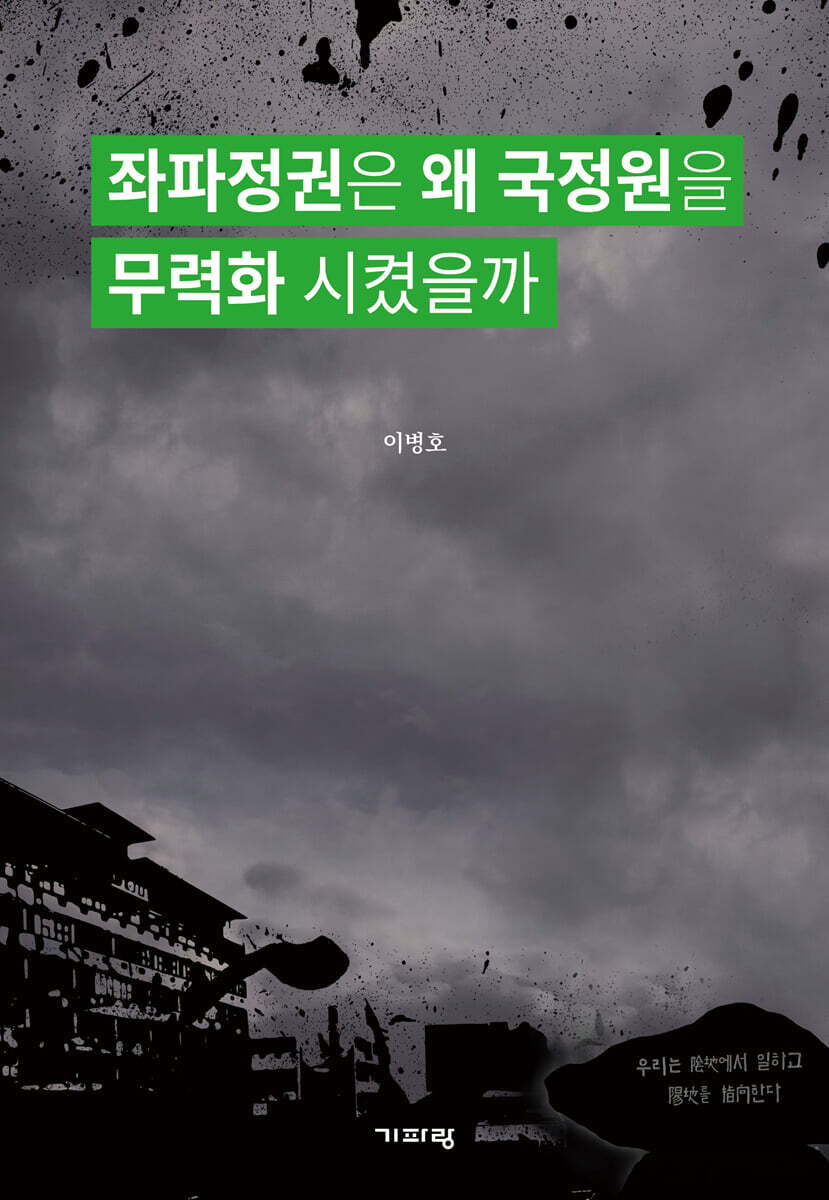
Why did the leftist government neutralize the National Intelligence Service?
 |
Description
Book Introduction
A record of silent devotion and pain
The Story of the National Intelligence Service (NIS) by Former Director Lee Byung-ho
The true story of the NIS's weakening, as revealed by the director of the National Intelligence Service under the Park Geun-hye administration.
During the five years of the Moon Jae-in administration, the National Intelligence Service (NIS) was a hunting ground for "eradicating deep-rooted evils." Why were they so intent on demonizing and neutralizing the NIS?
Information work is a profession where people keep their mouths shut and carry the information they learn on the job to their grave.
Breaking the ethics of silence, he asked endless questions in prison.
“Who benefits most from the weakening of the National Intelligence Service?”
The Story of the National Intelligence Service (NIS) by Former Director Lee Byung-ho
The true story of the NIS's weakening, as revealed by the director of the National Intelligence Service under the Park Geun-hye administration.
During the five years of the Moon Jae-in administration, the National Intelligence Service (NIS) was a hunting ground for "eradicating deep-rooted evils." Why were they so intent on demonizing and neutralizing the NIS?
Information work is a profession where people keep their mouths shut and carry the information they learn on the job to their grave.
Breaking the ethics of silence, he asked endless questions in prison.
“Who benefits most from the weakening of the National Intelligence Service?”
- You can preview some of the book's contents.
Preview
index
preface
I.
The Mission and History of the National Intelligence Service
When morning dawns at the National Intelligence Service / Standing on the front lines of a silent war / Efforts to gather information on North Korea disappear like bubbles / Not an ordinary workplace, but a place to realize a noble calling / Driven into a fatal crisis / The Central Intelligence Agency, launched as a governing body rather than an intelligence agency / Dictatorship is fundamentally bad.
But doing nothing under the pretext of principle is worse / A troublesome but essential agency / The Central Intelligence Agency's humble beginnings / The early Central Intelligence Agency takes a gamble
II.
Understanding national intelligence
Intelligence work / The National Intelligence Service is incapable of conducting covert operations / The national intelligence agency, along with the military command authority, is a national security device utilized by the president / The Supreme Court's unconstitutional ruling / The national intelligence agency does not collect any information / The leftist government's attempt to dismantle the National Intelligence Service
III.
A 30-Year Journey in Information Management
Becoming a KCIA agent / Dispatched to Washington / President Park Chung-hee's funeral / Chun Doo-hwan-Reagan summit, a fortuitous beginning / Historical assessment of the Fifth Republic / Aung San bombing: The Agency for National Security Planning's biggest intelligence failure / Virtual act of war: Assassination of the head of state / Promotion to director of overseas affairs / 1988 Seoul Olympics / Beginning of the Northern Policy / Global expansion of the Agency for National Security Planning's intelligence cooperation network / Back to Washington / Private dinner with CIA Director Robert Gates / Promotion to second deputy director of overseas affairs / Fluctuating situation on the Korean Peninsula / Former President Carter's visit to North Korea / Sudden death of Kim Il-sung / Discussion of North Korean situation after Kim Il-sung's death with Russian Foreign Intelligence Agency Director Primakov / Full-scale diplomatic efforts to prevent North Korea's nuclear development / Playing a behind-the-scenes role in establishing diplomatic relations between Korea and Egypt / Visit to Saudi Arabia to host the 2002 World Cup / Consul Choi Deok-geun, dispatched to the Agency for National Security Planning, becomes a star on the Agency's National Security Tower / Secretary Hwang Jang-yop reaches out to the Agency first / Hwang Jang-yop's defection to North Korea Missing a historical opportunity
IV.
Responsibilities of the Director of the National Intelligence Service
Becoming the Director of the National Intelligence Service / The NIS's Mission: The Last Battle with North Korea / The Director of the Cabinet Intelligence and Research Office of Japan Visits Immediately After Taking Office / CIA Director John Brennan Pays a Courtesy Visit / Connection with US Director of National Intelligence James Clapper / CIA Director Mike Pompeo's Special Proposal / Experiencing China's Intelligence Capabilities on North Korea / The True Face of China's Hegemonic Great Powerism / Intelligence Cooperation with Russia / North Korea Shows Interest in the Inter-Korean Summit / An Elite Intelligence Agent's Extreme Choice / The Democratic Party of Korea Fiercely Opposes the Enactment of the Anti-Terrorism Act / The Mass Exodus of Female Waitresses at the Yugyong Restaurant in China / Kim Jong-un's Poisoning of Kim Jong-nam, Even Betraying Family Law / Candlelight Protests: A Tsunami of Madness That Hits Our Society / Stepping Down as the NIS Director / The NIS Becomes a Hunting Ground for Eradicating Corruption / Eradicating Corruption, Its Cruel Heavenly Punishment / Three NIS Directors Imprisoned for Violating the Rule of Law / Appeals Court Ruling Overturned by the Supreme Court
V.
The Crisis on the Korean Peninsula and the Nature of the North Korean Regime
Nuclear development is the unchanging faith of Kim Il-sung's theocratic regime / A warning from half a century ago by American diplomat George Kennan / "There is no Earth without Joseon": The dangerous genetic elements of the Kim Il-sung dynasty / The fable of the scorpion and the frog, not sunlight / Poverty is the secret to the durability of the North Korean regime / Why we cannot live with North Korean nuclear weapons on our heads / President Park Geun-hye decides to lead with strong sanctions against North Korea / The mission of the National Intelligence Service to create peaceful unification / The National Intelligence Service of the Republic of Korea, not the CIA or Mossad / The triangle that systematically handles North Korean information from around the world
VI.
The National Intelligence Service's ordeal
The National Intelligence Service's (NIS) Core Intelligence Functions Are Broken / The NIS's Counterespionage Investigation Authority Abolished and Transferred to the Police: North Korea's 70-Year-Old Wish Fulfilled / The Collapse of Domestic Security Intelligence: A Strange Country Without Domestic Intelligence / The World's Strongest Intelligence Agency: The U.S. Intelligence Community / Israel's Battle-Toughened Intelligence Agency
VII.
Suggestions for the future
We anticipate extraordinary measures to strengthen the National Intelligence Service's intelligence capabilities, restore its status as a central national security agency, systematize imagination for policy formulation, and strive for a new leap forward, overcoming adversity and trials.
Conclusion
I.
The Mission and History of the National Intelligence Service
When morning dawns at the National Intelligence Service / Standing on the front lines of a silent war / Efforts to gather information on North Korea disappear like bubbles / Not an ordinary workplace, but a place to realize a noble calling / Driven into a fatal crisis / The Central Intelligence Agency, launched as a governing body rather than an intelligence agency / Dictatorship is fundamentally bad.
But doing nothing under the pretext of principle is worse / A troublesome but essential agency / The Central Intelligence Agency's humble beginnings / The early Central Intelligence Agency takes a gamble
II.
Understanding national intelligence
Intelligence work / The National Intelligence Service is incapable of conducting covert operations / The national intelligence agency, along with the military command authority, is a national security device utilized by the president / The Supreme Court's unconstitutional ruling / The national intelligence agency does not collect any information / The leftist government's attempt to dismantle the National Intelligence Service
III.
A 30-Year Journey in Information Management
Becoming a KCIA agent / Dispatched to Washington / President Park Chung-hee's funeral / Chun Doo-hwan-Reagan summit, a fortuitous beginning / Historical assessment of the Fifth Republic / Aung San bombing: The Agency for National Security Planning's biggest intelligence failure / Virtual act of war: Assassination of the head of state / Promotion to director of overseas affairs / 1988 Seoul Olympics / Beginning of the Northern Policy / Global expansion of the Agency for National Security Planning's intelligence cooperation network / Back to Washington / Private dinner with CIA Director Robert Gates / Promotion to second deputy director of overseas affairs / Fluctuating situation on the Korean Peninsula / Former President Carter's visit to North Korea / Sudden death of Kim Il-sung / Discussion of North Korean situation after Kim Il-sung's death with Russian Foreign Intelligence Agency Director Primakov / Full-scale diplomatic efforts to prevent North Korea's nuclear development / Playing a behind-the-scenes role in establishing diplomatic relations between Korea and Egypt / Visit to Saudi Arabia to host the 2002 World Cup / Consul Choi Deok-geun, dispatched to the Agency for National Security Planning, becomes a star on the Agency's National Security Tower / Secretary Hwang Jang-yop reaches out to the Agency first / Hwang Jang-yop's defection to North Korea Missing a historical opportunity
IV.
Responsibilities of the Director of the National Intelligence Service
Becoming the Director of the National Intelligence Service / The NIS's Mission: The Last Battle with North Korea / The Director of the Cabinet Intelligence and Research Office of Japan Visits Immediately After Taking Office / CIA Director John Brennan Pays a Courtesy Visit / Connection with US Director of National Intelligence James Clapper / CIA Director Mike Pompeo's Special Proposal / Experiencing China's Intelligence Capabilities on North Korea / The True Face of China's Hegemonic Great Powerism / Intelligence Cooperation with Russia / North Korea Shows Interest in the Inter-Korean Summit / An Elite Intelligence Agent's Extreme Choice / The Democratic Party of Korea Fiercely Opposes the Enactment of the Anti-Terrorism Act / The Mass Exodus of Female Waitresses at the Yugyong Restaurant in China / Kim Jong-un's Poisoning of Kim Jong-nam, Even Betraying Family Law / Candlelight Protests: A Tsunami of Madness That Hits Our Society / Stepping Down as the NIS Director / The NIS Becomes a Hunting Ground for Eradicating Corruption / Eradicating Corruption, Its Cruel Heavenly Punishment / Three NIS Directors Imprisoned for Violating the Rule of Law / Appeals Court Ruling Overturned by the Supreme Court
V.
The Crisis on the Korean Peninsula and the Nature of the North Korean Regime
Nuclear development is the unchanging faith of Kim Il-sung's theocratic regime / A warning from half a century ago by American diplomat George Kennan / "There is no Earth without Joseon": The dangerous genetic elements of the Kim Il-sung dynasty / The fable of the scorpion and the frog, not sunlight / Poverty is the secret to the durability of the North Korean regime / Why we cannot live with North Korean nuclear weapons on our heads / President Park Geun-hye decides to lead with strong sanctions against North Korea / The mission of the National Intelligence Service to create peaceful unification / The National Intelligence Service of the Republic of Korea, not the CIA or Mossad / The triangle that systematically handles North Korean information from around the world
VI.
The National Intelligence Service's ordeal
The National Intelligence Service's (NIS) Core Intelligence Functions Are Broken / The NIS's Counterespionage Investigation Authority Abolished and Transferred to the Police: North Korea's 70-Year-Old Wish Fulfilled / The Collapse of Domestic Security Intelligence: A Strange Country Without Domestic Intelligence / The World's Strongest Intelligence Agency: The U.S. Intelligence Community / Israel's Battle-Toughened Intelligence Agency
VII.
Suggestions for the future
We anticipate extraordinary measures to strengthen the National Intelligence Service's intelligence capabilities, restore its status as a central national security agency, systematize imagination for policy formulation, and strive for a new leap forward, overcoming adversity and trials.
Conclusion
Into the book
The National Intelligence Service was the ultimate hunting ground for eradicating corruption.
More than 350 current and former employees were investigated by prosecutors, and 46 employees, including three heads of the National Intelligence Service, were sent to prison.
The National Intelligence Service suffered a wound beyond imagination from the eradication of corruption.
The spirit of the intelligence agency was injured.
Through this book, I pointed out the difficult reality facing the National Intelligence Service and suggested that President Yoon Seok-yeol exercise extraordinary leadership to strengthen the agency's intelligence capabilities.
I sincerely hope that this book will contribute, even if only slightly, to the National Intelligence Service's advancement into a better intelligence agency.
---From the "Preface"
When I took office as director of the National Intelligence Service in March 2015, a new and urgent task was emerging in the silent war between North and South Korea.
It was a slush fund that was used to strengthen North Korea's nuclear and missile capabilities, which was used to suffocate Kim Jong-un.
On January 6, 2016, the third year of President Park Geun-hye's term, North Korea conducted a nuclear test.
It was the fourth time since 2009.
UN Security Council sanctions against North Korea have been fully implemented.
Information is key to the policy of pressuring North Korea through tightening the financial system.
North Korea has used every means of evasion to avoid international scrutiny.
The National Intelligence Service's efforts to find this out were fierce.
A fierce game of hide-and-seek unfolded between those trying to hide and those trying to find.
Then, the world of the Moon Jae-in administration became something we had never experienced before.
The National Intelligence Service's efforts to gather information on North Korea, which had been pursuing North Korea, were blocked by a large rock wall.
---「I.
From “The Mission and History of the National Intelligence Service”
Intelligence agencies in every country in the world perform special functions.
This special function is called covert action in the United States and active measures in Russia.
It refers to the work of actively and secretly targeting information targets to achieve national policy goals.
Most of the secret contacts between North and South Korea throughout our history were the work of the National Intelligence Service.
All secret negotiations with North Korea that have taken place so far, including the July 4th North-South Joint Statement by former KCIA Director Lee Hu-rak, the Kim Dae-jung administration's remittance of $450 million to North Korea, and the first North-South summit, were carried out by intelligence agencies.
All of this falls under the category of covert operations.
The Moon Jae-in administration has comprehensively revised the National Intelligence Service Act.
All special activities against North Korea carried out by the National Intelligence Service are activities without legal basis.
Furthermore, behind-the-scenes contact with North Korea is a task that has no legal basis and should not be done.
---「II.
From “Understanding National Intelligence”
The Moon Jae-in administration suddenly sent former President Park Geun-hye and three National Intelligence Service directors to prison on charges of embezzlement of national funds, under the pretext of eradicating deep-rooted evils.
It ruled that the president's command of the National Intelligence Service budget was illegal.
I testified in court to the following effect:
“The President’s authority to command the National Intelligence Service is guaranteed by the Constitution and the law.
The president's first responsibility is national security.
The President must be able to mobilize all the nation's resources to ensure national security.
Former President Park Geun-hye neither embezzled money nor used National Intelligence Service support funds for personal gain.
“And yet, the president misused the National Intelligence Service budget, causing a loss to the national treasury. This is an absurd criminal charge that could not be committed in any civilized country.”
I believe that the ruling to liquidate corruption will be recorded in history as the biggest blemish on the Kim Myung-soo judicial system.
A constitutional petition has been filed regarding this Supreme Court ruling.
---「II.
From “Understanding National Intelligence”
South Korea must not neglect the suffering of the North Korean people, both from the perspective of human rights, a universal value of humanity, and from the historical imperative of unification of the Korean Peninsula.
We must quietly work to create conditions for peaceful unification.
That job is obviously the responsibility of the National Intelligence Service.
The National Intelligence Service's 'Creating Peaceful Unification' projects and programs are diverse.
The project's theme is to ensure that all North Koreans share the belief that "the future of the Korean people lies in South Korea."
There are also efforts to awaken the consciousness of North Korean citizens by exploiting the regime's vulnerabilities, such as human rights issues.
There are also programs designed to undermine the cohesion of North Korean elites by spreading the message that if they engage in friendly activities with us, they will have nothing to fear when unification occurs.
The National Intelligence Service's various projects toward North Korea have received considerable response within North Korea.
The increase in defectors, especially elite defectors, attests to this.
During my tenure as the Director of the National Intelligence Service, there was a continuous stream of defectors, including the group defection of 13 employees from Yukyung Restaurant.
There have been defections by a double-digit number of high-ranking North Korean elites, including Ambassador Thae Yong-ho.
A mood of admiration for South Korea was gradually spreading among North Korean residents.
But then the Moon Jae-in government suddenly appeared.
The effort to instill hope in North Korean citizens has been dealt a crushing blow.
The Moon Jae-in administration has neglected North Korean defectors who risked their lives to escape.
Even elite defectors were kicked out.
A North Korean fisherman was forcibly repatriated through Panmunjom while blindfolded.
Even in the eyes of North Korean citizens, the Moon Jae-in administration must have been seen as a regime that only deals with and courts the brutal dictator Kim Jong-un.
In this way, North Korean people lost hope in South Korea.
---「V.
From “The Crisis on the Korean Peninsula and the Nature of the North Korean Regime”
National intelligence work is largely divided into two areas.
The fields are Internal Security & Intelligence and Foreign Intelligence.
Of these two major national intelligence functions, the Moon Jae-in administration has effectively dismantled the domestic security intelligence sector.
The Moon Jae-in administration pushed to abolish the National Intelligence Service's counterintelligence investigation authority and transfer it to the police.
And the domestic intelligence division of the National Intelligence Service was effectively abolished.
The National Intelligence Service's function of protecting the country has been completely weakened.
This is a development that North Korea is very pleased with.
It is well known that North Korea has consistently demanded the abolition of the National Security Law and the disbandment of the National Intelligence Service for the past 70 years.
This is because the National Security Act and the National Intelligence Service are the biggest obstacles to what they want to do, namely, the operation of the South Korean communist project.
The Moon Jae-in administration has effectively dismantled the obstacles that North Korea's intelligence agencies had hoped for, thereby offering them to North Korea.
---「VI.
From “The Ordeal of the National Intelligence Service”
Currently, routine work at the National Intelligence Service that does not involve risk is going well.
However, the impetus to pursue more breakthrough information work has been lost.
With this kind of attitude, will the National Intelligence Service be able to properly fulfill its role as an intelligence agency that will overcome the national security crisis we face in the future?
That is why the National Intelligence Service must quickly become a proper intelligence agency.
It is absolutely necessary for national security.
There is only one way.
It is about returning to the basics of information management, applying it to the operation of the National Intelligence Service, and waiting for the time to accumulate and establish it.
More than 350 current and former employees were investigated by prosecutors, and 46 employees, including three heads of the National Intelligence Service, were sent to prison.
The National Intelligence Service suffered a wound beyond imagination from the eradication of corruption.
The spirit of the intelligence agency was injured.
Through this book, I pointed out the difficult reality facing the National Intelligence Service and suggested that President Yoon Seok-yeol exercise extraordinary leadership to strengthen the agency's intelligence capabilities.
I sincerely hope that this book will contribute, even if only slightly, to the National Intelligence Service's advancement into a better intelligence agency.
---From the "Preface"
When I took office as director of the National Intelligence Service in March 2015, a new and urgent task was emerging in the silent war between North and South Korea.
It was a slush fund that was used to strengthen North Korea's nuclear and missile capabilities, which was used to suffocate Kim Jong-un.
On January 6, 2016, the third year of President Park Geun-hye's term, North Korea conducted a nuclear test.
It was the fourth time since 2009.
UN Security Council sanctions against North Korea have been fully implemented.
Information is key to the policy of pressuring North Korea through tightening the financial system.
North Korea has used every means of evasion to avoid international scrutiny.
The National Intelligence Service's efforts to find this out were fierce.
A fierce game of hide-and-seek unfolded between those trying to hide and those trying to find.
Then, the world of the Moon Jae-in administration became something we had never experienced before.
The National Intelligence Service's efforts to gather information on North Korea, which had been pursuing North Korea, were blocked by a large rock wall.
---「I.
From “The Mission and History of the National Intelligence Service”
Intelligence agencies in every country in the world perform special functions.
This special function is called covert action in the United States and active measures in Russia.
It refers to the work of actively and secretly targeting information targets to achieve national policy goals.
Most of the secret contacts between North and South Korea throughout our history were the work of the National Intelligence Service.
All secret negotiations with North Korea that have taken place so far, including the July 4th North-South Joint Statement by former KCIA Director Lee Hu-rak, the Kim Dae-jung administration's remittance of $450 million to North Korea, and the first North-South summit, were carried out by intelligence agencies.
All of this falls under the category of covert operations.
The Moon Jae-in administration has comprehensively revised the National Intelligence Service Act.
All special activities against North Korea carried out by the National Intelligence Service are activities without legal basis.
Furthermore, behind-the-scenes contact with North Korea is a task that has no legal basis and should not be done.
---「II.
From “Understanding National Intelligence”
The Moon Jae-in administration suddenly sent former President Park Geun-hye and three National Intelligence Service directors to prison on charges of embezzlement of national funds, under the pretext of eradicating deep-rooted evils.
It ruled that the president's command of the National Intelligence Service budget was illegal.
I testified in court to the following effect:
“The President’s authority to command the National Intelligence Service is guaranteed by the Constitution and the law.
The president's first responsibility is national security.
The President must be able to mobilize all the nation's resources to ensure national security.
Former President Park Geun-hye neither embezzled money nor used National Intelligence Service support funds for personal gain.
“And yet, the president misused the National Intelligence Service budget, causing a loss to the national treasury. This is an absurd criminal charge that could not be committed in any civilized country.”
I believe that the ruling to liquidate corruption will be recorded in history as the biggest blemish on the Kim Myung-soo judicial system.
A constitutional petition has been filed regarding this Supreme Court ruling.
---「II.
From “Understanding National Intelligence”
South Korea must not neglect the suffering of the North Korean people, both from the perspective of human rights, a universal value of humanity, and from the historical imperative of unification of the Korean Peninsula.
We must quietly work to create conditions for peaceful unification.
That job is obviously the responsibility of the National Intelligence Service.
The National Intelligence Service's 'Creating Peaceful Unification' projects and programs are diverse.
The project's theme is to ensure that all North Koreans share the belief that "the future of the Korean people lies in South Korea."
There are also efforts to awaken the consciousness of North Korean citizens by exploiting the regime's vulnerabilities, such as human rights issues.
There are also programs designed to undermine the cohesion of North Korean elites by spreading the message that if they engage in friendly activities with us, they will have nothing to fear when unification occurs.
The National Intelligence Service's various projects toward North Korea have received considerable response within North Korea.
The increase in defectors, especially elite defectors, attests to this.
During my tenure as the Director of the National Intelligence Service, there was a continuous stream of defectors, including the group defection of 13 employees from Yukyung Restaurant.
There have been defections by a double-digit number of high-ranking North Korean elites, including Ambassador Thae Yong-ho.
A mood of admiration for South Korea was gradually spreading among North Korean residents.
But then the Moon Jae-in government suddenly appeared.
The effort to instill hope in North Korean citizens has been dealt a crushing blow.
The Moon Jae-in administration has neglected North Korean defectors who risked their lives to escape.
Even elite defectors were kicked out.
A North Korean fisherman was forcibly repatriated through Panmunjom while blindfolded.
Even in the eyes of North Korean citizens, the Moon Jae-in administration must have been seen as a regime that only deals with and courts the brutal dictator Kim Jong-un.
In this way, North Korean people lost hope in South Korea.
---「V.
From “The Crisis on the Korean Peninsula and the Nature of the North Korean Regime”
National intelligence work is largely divided into two areas.
The fields are Internal Security & Intelligence and Foreign Intelligence.
Of these two major national intelligence functions, the Moon Jae-in administration has effectively dismantled the domestic security intelligence sector.
The Moon Jae-in administration pushed to abolish the National Intelligence Service's counterintelligence investigation authority and transfer it to the police.
And the domestic intelligence division of the National Intelligence Service was effectively abolished.
The National Intelligence Service's function of protecting the country has been completely weakened.
This is a development that North Korea is very pleased with.
It is well known that North Korea has consistently demanded the abolition of the National Security Law and the disbandment of the National Intelligence Service for the past 70 years.
This is because the National Security Act and the National Intelligence Service are the biggest obstacles to what they want to do, namely, the operation of the South Korean communist project.
The Moon Jae-in administration has effectively dismantled the obstacles that North Korea's intelligence agencies had hoped for, thereby offering them to North Korea.
---「VI.
From “The Ordeal of the National Intelligence Service”
Currently, routine work at the National Intelligence Service that does not involve risk is going well.
However, the impetus to pursue more breakthrough information work has been lost.
With this kind of attitude, will the National Intelligence Service be able to properly fulfill its role as an intelligence agency that will overcome the national security crisis we face in the future?
That is why the National Intelligence Service must quickly become a proper intelligence agency.
It is absolutely necessary for national security.
There is only one way.
It is about returning to the basics of information management, applying it to the operation of the National Intelligence Service, and waiting for the time to accumulate and establish it.
---「VII.
From “Suggestions for the Future”
From “Suggestions for the Future”
Publisher's Review
Who Benefits from the NIS's Downfall?
350 current and former officials investigated by prosecutors, 46 sentenced to prison, including three former heads. If true, is there any organization more vicious than this? This is the ordeal the National Intelligence Service (NIS) of the Republic of Korea endured during the five years of the Moon Jae-in administration in the name of "eliminating deep-rooted corruption."
One of the three former directors (Lee Byeong-gi, Nam Jae-jun, and Lee Byeong-ho) who suffered imprisonment has broken the taboo of the 'ethics of silence' and spoken out.
“Why Did the Left-Wing Government Neutralize the National Intelligence Service?” (by Lee Byeong-ho) is a true account of the National Intelligence Service’s ordeals during the five years of the Moon Jae-in administration.
National Intelligence Service employees have a silent professional ethics of keeping their work experience secret for the rest of their lives.
While I was in prison, I felt compelled to break this silence and protest against the unjust persecution of the National Intelligence Service.
I wrote this book under the strict self-censorship of a security consciousness.
No matter how old the anecdote is, what happened at the National Intelligence Service has current significance.
So, to help readers understand, I have limited the anecdotes I can provide to the information work being carried out by the National Intelligence Service.
(Preface, pp. 5-6)
The National Intelligence Service's tribulations under the Moon Jae-in administration were not limited to the trials of its members.
The revision of the National Intelligence Service Act transferred most of the domestic intelligence functions of the NIS, which are the two main pillars of its work—domestic information security and overseas intelligence—to the police, and eliminated the legal basis for the “covert operations” that national intelligence agencies around the world carry out as if it were an unwritten rule.
Domestic intelligence includes not only information on North Korea but also the identification of domestic security threats, and many activities are conducted secretly. Therefore, the National Intelligence Service, which lacks domestic intelligence and covert operations functions, cannot achieve its original purpose as an intelligence agency, which is national security.
Who has benefited most from this reduction in the functions and demotion of national intelligence agencies? This is precisely why the book so bluntly labels "left-wing" in its title.
It is well known that North Korea has consistently demanded the abolition of the National Security Law and the disbandment of the National Intelligence Service for the past 70 years.
The Moon Jae-in administration has effectively dismantled the obstacles that North Korea's intelligence agencies had hoped for, thereby offering them to North Korea.
(VI.
The National Intelligence Service's Trials, p. 281)
Work in the shade and aim for the sun
"We work in the shade and aim for the sun." This was the motto of the Central Intelligence Agency (CIA) and the Agency for National Security Planning (ANSP), the predecessors of the National Intelligence Service (NIS), which was first established in 1961 and lasted for 38 years until the early years of the Kim Dae-jung administration.
In 1999, the name was changed to the current National Intelligence Service, and after going through several changes in government and four changes in the institute's motto, the Yoon Seok-yeol administration restored the original motto of "working in the shadows and aiming for the sun."
The author graduated from the 19th class of the Korea Military Academy in 1963, served in the Vietnam War as a reconnaissance platoon leader, and upon returning, was dispatched as an interpreter to the U.S. Army Okinawa Intelligence School, where he began working in overseas intelligence work.
He left the National Intelligence Service (NIS) after serving as the Second Deputy Director in charge of overseas affairs, but returned as the third NIS director under the Park Geun-hye administration after 18 years.
The book is also an introductory guide to the inner workings of national intelligence work, which must constantly walk a tightrope between legality and illegality, publicity and secrecy.
The book is filled with vivid stories from the field, including the shock he felt when he learned of the assassination of the president by the current director of the Korean Central Intelligence Agency while working at the U.S. Embassy in Washington, the Chun Doo-hwan-Reagan summit that came to fruition by chance, the Aung San terror attack, the behind-the-scenes coordination of Roh Tae-woo's Northern Policy, the defection of former Ambassador Tae Yong-ho, and the mass defection of 13 people from Yugyong Restaurant.
It helps to understand intelligence work by comparing the activities of world-class national intelligence agencies, such as the CIA in the United States, MI6 in the United Kingdom, and Mossad in Israel, with those of the National Intelligence Service.
In particular, the Entebbe Rescue Operation (1976), a notable success story in the execution of intelligence agency missions, and the Hamas invasion of Israel in 2023, a case of great failure, make us nod our heads as to why 'silent dedication' behind the scenes is necessary for a safe society.
Let the intelligence agency be an intelligence agency
The author was convicted of the 'National Intelligence Service Director Special Activities Fund Bribery Case' after the change of government and was pardoned by the Yoon Seok-yeol government while serving his sentence.
The book presents four specific innovation tasks to restore the status and national security functions of the National Intelligence Service of the Republic of Korea, and strongly urges the creation of a so-called "National Intelligence Service Innovation Task Force" to implement these tasks.
· Re-revision of the National Intelligence Service Act
· Restoration of domestic security information functions
· Advancing information capabilities using cutting-edge science and technology
· Establishment of personnel system to cultivate veterans in each field (VII.
Suggestions for the future)
You can't jump with broken wings and festering wounds.
‘Normalization of the abnormal’ comes first.
350 current and former officials investigated by prosecutors, 46 sentenced to prison, including three former heads. If true, is there any organization more vicious than this? This is the ordeal the National Intelligence Service (NIS) of the Republic of Korea endured during the five years of the Moon Jae-in administration in the name of "eliminating deep-rooted corruption."
One of the three former directors (Lee Byeong-gi, Nam Jae-jun, and Lee Byeong-ho) who suffered imprisonment has broken the taboo of the 'ethics of silence' and spoken out.
“Why Did the Left-Wing Government Neutralize the National Intelligence Service?” (by Lee Byeong-ho) is a true account of the National Intelligence Service’s ordeals during the five years of the Moon Jae-in administration.
National Intelligence Service employees have a silent professional ethics of keeping their work experience secret for the rest of their lives.
While I was in prison, I felt compelled to break this silence and protest against the unjust persecution of the National Intelligence Service.
I wrote this book under the strict self-censorship of a security consciousness.
No matter how old the anecdote is, what happened at the National Intelligence Service has current significance.
So, to help readers understand, I have limited the anecdotes I can provide to the information work being carried out by the National Intelligence Service.
(Preface, pp. 5-6)
The National Intelligence Service's tribulations under the Moon Jae-in administration were not limited to the trials of its members.
The revision of the National Intelligence Service Act transferred most of the domestic intelligence functions of the NIS, which are the two main pillars of its work—domestic information security and overseas intelligence—to the police, and eliminated the legal basis for the “covert operations” that national intelligence agencies around the world carry out as if it were an unwritten rule.
Domestic intelligence includes not only information on North Korea but also the identification of domestic security threats, and many activities are conducted secretly. Therefore, the National Intelligence Service, which lacks domestic intelligence and covert operations functions, cannot achieve its original purpose as an intelligence agency, which is national security.
Who has benefited most from this reduction in the functions and demotion of national intelligence agencies? This is precisely why the book so bluntly labels "left-wing" in its title.
It is well known that North Korea has consistently demanded the abolition of the National Security Law and the disbandment of the National Intelligence Service for the past 70 years.
The Moon Jae-in administration has effectively dismantled the obstacles that North Korea's intelligence agencies had hoped for, thereby offering them to North Korea.
(VI.
The National Intelligence Service's Trials, p. 281)
Work in the shade and aim for the sun
"We work in the shade and aim for the sun." This was the motto of the Central Intelligence Agency (CIA) and the Agency for National Security Planning (ANSP), the predecessors of the National Intelligence Service (NIS), which was first established in 1961 and lasted for 38 years until the early years of the Kim Dae-jung administration.
In 1999, the name was changed to the current National Intelligence Service, and after going through several changes in government and four changes in the institute's motto, the Yoon Seok-yeol administration restored the original motto of "working in the shadows and aiming for the sun."
The author graduated from the 19th class of the Korea Military Academy in 1963, served in the Vietnam War as a reconnaissance platoon leader, and upon returning, was dispatched as an interpreter to the U.S. Army Okinawa Intelligence School, where he began working in overseas intelligence work.
He left the National Intelligence Service (NIS) after serving as the Second Deputy Director in charge of overseas affairs, but returned as the third NIS director under the Park Geun-hye administration after 18 years.
The book is also an introductory guide to the inner workings of national intelligence work, which must constantly walk a tightrope between legality and illegality, publicity and secrecy.
The book is filled with vivid stories from the field, including the shock he felt when he learned of the assassination of the president by the current director of the Korean Central Intelligence Agency while working at the U.S. Embassy in Washington, the Chun Doo-hwan-Reagan summit that came to fruition by chance, the Aung San terror attack, the behind-the-scenes coordination of Roh Tae-woo's Northern Policy, the defection of former Ambassador Tae Yong-ho, and the mass defection of 13 people from Yugyong Restaurant.
It helps to understand intelligence work by comparing the activities of world-class national intelligence agencies, such as the CIA in the United States, MI6 in the United Kingdom, and Mossad in Israel, with those of the National Intelligence Service.
In particular, the Entebbe Rescue Operation (1976), a notable success story in the execution of intelligence agency missions, and the Hamas invasion of Israel in 2023, a case of great failure, make us nod our heads as to why 'silent dedication' behind the scenes is necessary for a safe society.
Let the intelligence agency be an intelligence agency
The author was convicted of the 'National Intelligence Service Director Special Activities Fund Bribery Case' after the change of government and was pardoned by the Yoon Seok-yeol government while serving his sentence.
The book presents four specific innovation tasks to restore the status and national security functions of the National Intelligence Service of the Republic of Korea, and strongly urges the creation of a so-called "National Intelligence Service Innovation Task Force" to implement these tasks.
· Re-revision of the National Intelligence Service Act
· Restoration of domestic security information functions
· Advancing information capabilities using cutting-edge science and technology
· Establishment of personnel system to cultivate veterans in each field (VII.
Suggestions for the future)
You can't jump with broken wings and festering wounds.
‘Normalization of the abnormal’ comes first.
GOODS SPECIFICS
- Date of issue: March 4, 2024
- Page count, weight, size: 368 pages | 530g | 150*220*18mm
- ISBN13: 9788965235002
- ISBN10: 8965235006
You may also like
카테고리
korean


korean

![GQ KOREA Mark (Monthly): December [2025]](http://librairie.coreenne.fr/cdn/shop/files/8ef265dbbfbf186523ed75ba7319009d.jpg?v=1765340328&width=3840)


