

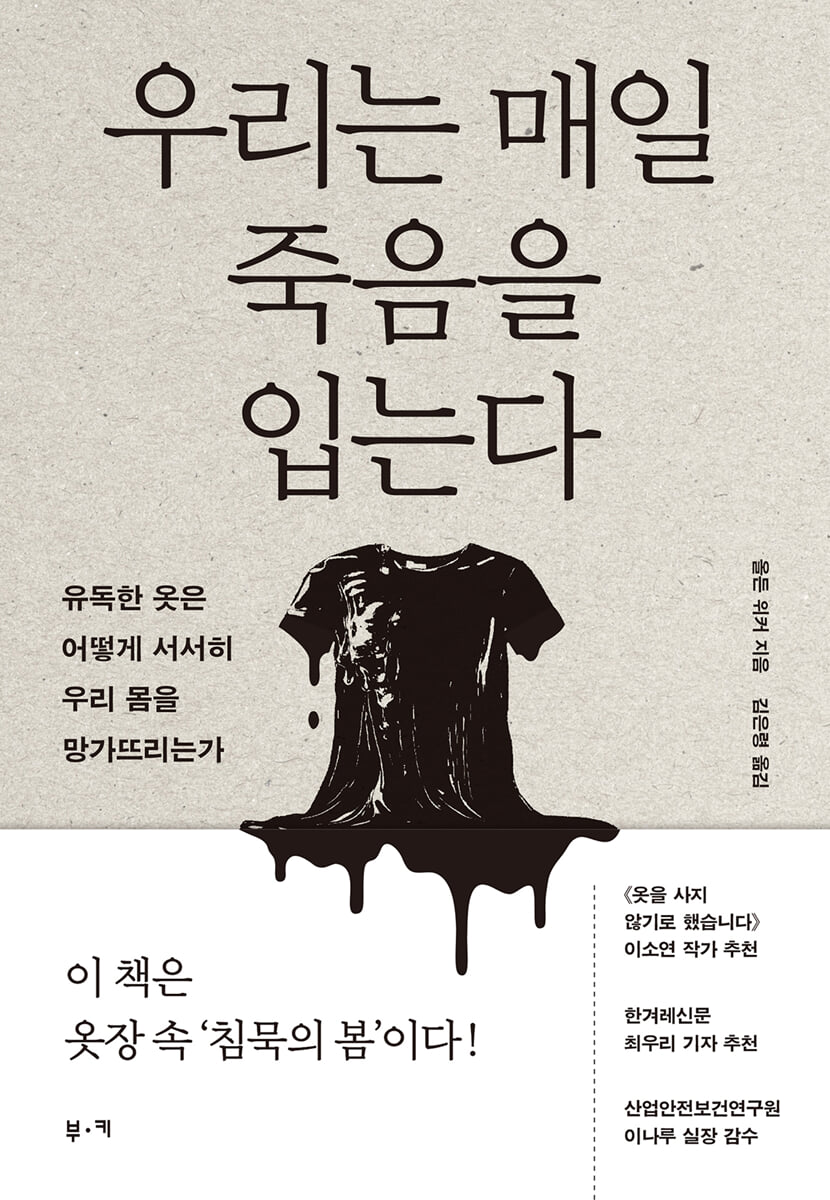
We wear death every day
 |
Description
Book Introduction
“This book is the ‘Silent Spring’ in the closet!” The truth hidden in the clothes that cover our bodies 24 hours a day. More and more people are sensitive to what they eat and apply on their skin than ever before. We eat bread made with organic flour, use natural cosmetics and detergents, and meticulously check the origin and ingredients of various household goods. It goes without saying that this is especially true for homes with children. Whenever I come across news about humidifier disinfectants or radon beds, I check my shopping cart with a more critical eye. But there are some items that don't quite catch our eye. It's clothes. How much do we know about the ingredients in the clothes that cover our bodies 24 hours a day, whether we're awake or asleep? Are clothes really safe? Did you check the label on your clothes? It says they're made in China and are 50 percent cotton, 30 percent polyester, and 20 percent nylon? Unfortunately, that label is lying. Fashion products have some of the most complex and multilayered chemical profiles of any consumer product we can purchase without a handling license. A single garment can contain sometimes more than 50 chemicals, which can enter our bodies and cause endocrine disruption, pain, allergies, infertility, and even cancer. Pants splattered with microplastics, baby shoes laced with heavy metals, cozy sweaters laced with carcinogenic azo dyes, flashy slippers slathered in phthalates… If you've ever felt itchy or tired after wearing new clothes, it might not be your sensitivity, but the clothes that are to blame. This book exposes the terrible truth hidden in the clothes we wear every day, and suggests what we can do about it. What to buy, what not to buy, and how we can work together to change this toxic system. |
- You can preview some of the book's contents.
Preview
index
Recommendation | Translator's Note | Author's Note
prolog
Part 1: The Canary in the Coal Mine
Chapter 1: Emergency: Toxic Alarms from the Sky
Not Coincidence, but Inevitability | The Secret Hidden in Clothes | The "Safe Capacity" Trick | Problems Happen on Earth, Too
Chapter 2: The Killer in the Closet: Can Scientists Catch the Culprit?
Cheap clothes, expensive prices | The dark side of flashy colors | The clear evidence | If clothes are making my child sick | The hidden culprit: dyes | Clothing needs full ingredient labels, too.
Part 2: The Toxic History of Fashion
Chapter 3: The Betrayal of Cool and Convenient Things: Trends are short-lived, but side effects are long.
Poisoned Perfume Gloves | The Age of the Mad Hatter | Oil Rainbows on the River | Designers Fascinated by Plastic | Even Pure Cotton Can't Be Safe | The Trap of Functional Materials | A Material That Will Never Disappear from the Earth | An Unexpected Helper
Chapter 4: Deadly Colors: From Heavy Metal Green to Tar Dyes
Green Addiction | A Color Born from a Coal Bin | Exciting or Fearful | Black That Calls Death | The Hidden Truth
Part 3: The Price Our Body Pays
Chapter 5: Stolen Fertility: The Effects of Endocrine Disruptors on the Human Body
Who's Stealing Our Eggs and Sperm? | Every Drop Can Be Dangerous | Detoxing for Pregnancy
Chapter 6: You're Too Sensitive: The Mystery of Chemical Sensitivity
Controversy and misconceptions surrounding the condition | People who can't adapt to the chemical world | It all happened in my head
Chapter 7: My Body Attacks Me: The Autoimmune Disease Epidemic
A Life Disintegrated by a Single Piece of Clothing | Your Body Revolts | Immune Cells Remember What You're Wearing
Part 4 Field Verification
Chapter 8: A Very Dangerous Place: The Reality of Overseas Textile Factories
Tragedy Seeps In Like Contaminated Groundwater | Steps Toward Change | Best Practices and Gaps | The Darkness Deepens the Lower You Go | We Are All Connected
Chapter 9: Trust, but Verify: How Reliable Are Eco-Friendly Certifications?
A flood of shipping boxes | Where is the regulation? | Amazon and Instagram are not responsible | Oeko-Tex, the eco-friendly guarantee | The test I paid for | Which side should I trust? | Lies of omission
Part 5: How to Protect Yourself
Chapter 10: Detox Time: What We Can Do for a Cleaner Closet and World
How to Choose and Care for Non-Toxic Clothing | Tips for Safe Fashion for Everyone
Epilogue
Acknowledgments | Reviewer's Note | Glossary | Note
prolog
Part 1: The Canary in the Coal Mine
Chapter 1: Emergency: Toxic Alarms from the Sky
Not Coincidence, but Inevitability | The Secret Hidden in Clothes | The "Safe Capacity" Trick | Problems Happen on Earth, Too
Chapter 2: The Killer in the Closet: Can Scientists Catch the Culprit?
Cheap clothes, expensive prices | The dark side of flashy colors | The clear evidence | If clothes are making my child sick | The hidden culprit: dyes | Clothing needs full ingredient labels, too.
Part 2: The Toxic History of Fashion
Chapter 3: The Betrayal of Cool and Convenient Things: Trends are short-lived, but side effects are long.
Poisoned Perfume Gloves | The Age of the Mad Hatter | Oil Rainbows on the River | Designers Fascinated by Plastic | Even Pure Cotton Can't Be Safe | The Trap of Functional Materials | A Material That Will Never Disappear from the Earth | An Unexpected Helper
Chapter 4: Deadly Colors: From Heavy Metal Green to Tar Dyes
Green Addiction | A Color Born from a Coal Bin | Exciting or Fearful | Black That Calls Death | The Hidden Truth
Part 3: The Price Our Body Pays
Chapter 5: Stolen Fertility: The Effects of Endocrine Disruptors on the Human Body
Who's Stealing Our Eggs and Sperm? | Every Drop Can Be Dangerous | Detoxing for Pregnancy
Chapter 6: You're Too Sensitive: The Mystery of Chemical Sensitivity
Controversy and misconceptions surrounding the condition | People who can't adapt to the chemical world | It all happened in my head
Chapter 7: My Body Attacks Me: The Autoimmune Disease Epidemic
A Life Disintegrated by a Single Piece of Clothing | Your Body Revolts | Immune Cells Remember What You're Wearing
Part 4 Field Verification
Chapter 8: A Very Dangerous Place: The Reality of Overseas Textile Factories
Tragedy Seeps In Like Contaminated Groundwater | Steps Toward Change | Best Practices and Gaps | The Darkness Deepens the Lower You Go | We Are All Connected
Chapter 9: Trust, but Verify: How Reliable Are Eco-Friendly Certifications?
A flood of shipping boxes | Where is the regulation? | Amazon and Instagram are not responsible | Oeko-Tex, the eco-friendly guarantee | The test I paid for | Which side should I trust? | Lies of omission
Part 5: How to Protect Yourself
Chapter 10: Detox Time: What We Can Do for a Cleaner Closet and World
How to Choose and Care for Non-Toxic Clothing | Tips for Safe Fashion for Everyone
Epilogue
Acknowledgments | Reviewer's Note | Glossary | Note
Detailed image

Into the book
Chapter 1: Emergency: Toxic Alarms from the Sky
The textile industry has set limits on the use of each chemical substance.
If an individual substance is present at a level below the recommended limit, then mixing multiple substances together may not be a problem for them even if the hazard exceeds that limit.
The industry consensus is that toxicity is determined by the amount used.
As a result, tricks to check the safety limits of each chemical and keep the amount used below the limit have emerged.
Following these guidelines, the uniforms appear perfectly fine, at least with respect to the chemicals tested.
--- p.50
Chapter 2: The Killer in the Closet: Can Scientists Catch the Culprit?
For years, flight attendants, mothers, and countless women suffering from chemical sensitivities have reported that wearing synthetic fiber clothing makes them feel sick.
However, no evidence was found to suggest that polyester or nylon are toxic.
What if they were right? What if it wasn't the polyester, nylon, or polyurethane fabric itself that was causing the side effects? What if the dyes on the fabric were the problem?
--- p.86
Chapter 3: The Betrayal of Cool and Convenient Things: Trends are short-lived, but side effects are long.
The chemicals used in fabrics may not be hazardous in themselves, but they can release toxic substances over time.
Formaldehyde in un-ironed trousers and amines in dyed shirts cause toxic substance poisoning in garment workers and pollute the community.
Then, it stays on our clothes for a while as a harmless functional substance, and then it is absorbed into the human body little by little through breathing and skin every day, revealing its true form.
--- p.124
Chapter 4: Deadly Colors: From Heavy Metal Green to Tar Dyes
Who would have guessed that the central role of chemicals in fashion could be so deliberately and completely concealed from consumers? Would the average person really believe that dozens of man-made petrochemicals are lurking beneath the surface of a sweater, jeans, socks, or underwear? A cotton T-shirt containing a substance made from fossil fuels through a chemical process? That's ridiculous! It makes sense.
Fossil fuel-based chemistry wasn't just used in fashion; as we've seen, it came into existence because of fashion.
Chemistry is fashion, and fashion is chemistry.
--- p.163
Chapter 5: Stolen Fertility: The Effects of Endocrine Disruptors on the Human Body
“The representative substances we have talked about, such as phthalates, BPA, lead, and heavy metals, continue to accumulate in the body over time.
What if you absorb a little from food, a little from clothing, and a little from hygiene products? All of this combined is enough to cause symptoms and problems caused by the commercial effect, I guarantee.
In fact, we already experience its effects on a daily basis.
Don't you take fatigue for granted? What about dry, itchy skin or an asthmatic reaction to something? Don't you just say, "Oh, I sometimes have shortness of breath," without even looking into it?
--- p.182
Chapter 6: You're Too Sensitive: The Mystery of Chemical Sensitivity
“Some people are so worn out that they can no longer wear clothes and are naked at home.
People with really severe symptoms only wear white or beige clothes.
“Because the clothes in the bright colors might have too much dye in them.” One customer with eczema said she couldn’t tolerate even 2 percent spandex in her clothes.
He reported that some people buy new clothes and hang them out in the sun and rain for months, put them in a pressure cooker, or soak them in a mixture of powdered milk and vinegar.
Some people have said that they buy sneakers and leave them outside for three years, hoping that they will be able to wear them someday.
--- p.202~203
Chapter 7: My Body Attacks Me: The Autoimmune Disease Epidemic
Talking to Fairweather, I finally understood why the horror stories of someone's life being ruined because of their clothes always started with a rash or hives.
A rash or hives was a kind of warning light, a distress signal, a cry for help.
“I tell everyone who comes to me with food allergies that if they don’t address this issue, it will eventually become a chronic condition in their lifetime,” he said.
--- p.223
Our grandparents and parents probably heard stories about how chemical technology could make our lives better.
But if we could say no to such chemistry, especially the chemistry that is applied to the clothes we wear without our consent or full knowledge, we could live our best lives.
--- p.224
Chapter 8: A Very Dangerous Place: The Reality of Overseas Textile Factories
Should we focus solely on production and address the problem, or should we focus our attention on the privileged Western consumer? It wasn't a one-or-nothing situation.
That couldn't be possible.
Especially when it comes to chemicals, I realized that we are all connected.
(…) The garment workers of Tirupur and the consumers of America, though separated by thousands of kilometers, are blood sisters.
Because we share the same toxic chemicals from the same clothes in our blood.
--- p.254~255
Chapter 9: Trust, but Verify: How Reliable Are Eco-Friendly Certifications?
It occurred to me that the more stringent the Oeko-Tex certification, the more ultimately beneficial it would be for the brand.
These brands spend hundreds of thousands of dollars on certification.
So, we have to get some value from it.
You want to create an image as an honest and environmentally friendly company, or you want to protect yourself from financial and legal liability for toxic chemicals in your products.
Probably both.
If someone were to have a problem with their clothing or find a toxic substance in it, they would point to the Oeko-Tex certification and say things like the CEO of Things, Delta Air Lines and Land's End did.
The issue is personal sensitivity.
Our products have passed the most rigorous testing in the industry.
--- p.293~294
Chapter 10: Detox Time: What We Can Do for a Cleaner Closet and World
Many consumers believe that if they buy products made from natural ingredients, they will be safe.
But that's not necessarily the case.
When making a white cotton blouse, a lot of chemicals are used, including perfluorinated compounds for stain prevention and wrinkle prevention finishes.
If you bury this blouse in your backyard, you'll be poisoning your organic garden.
The textile industry has set limits on the use of each chemical substance.
If an individual substance is present at a level below the recommended limit, then mixing multiple substances together may not be a problem for them even if the hazard exceeds that limit.
The industry consensus is that toxicity is determined by the amount used.
As a result, tricks to check the safety limits of each chemical and keep the amount used below the limit have emerged.
Following these guidelines, the uniforms appear perfectly fine, at least with respect to the chemicals tested.
--- p.50
Chapter 2: The Killer in the Closet: Can Scientists Catch the Culprit?
For years, flight attendants, mothers, and countless women suffering from chemical sensitivities have reported that wearing synthetic fiber clothing makes them feel sick.
However, no evidence was found to suggest that polyester or nylon are toxic.
What if they were right? What if it wasn't the polyester, nylon, or polyurethane fabric itself that was causing the side effects? What if the dyes on the fabric were the problem?
--- p.86
Chapter 3: The Betrayal of Cool and Convenient Things: Trends are short-lived, but side effects are long.
The chemicals used in fabrics may not be hazardous in themselves, but they can release toxic substances over time.
Formaldehyde in un-ironed trousers and amines in dyed shirts cause toxic substance poisoning in garment workers and pollute the community.
Then, it stays on our clothes for a while as a harmless functional substance, and then it is absorbed into the human body little by little through breathing and skin every day, revealing its true form.
--- p.124
Chapter 4: Deadly Colors: From Heavy Metal Green to Tar Dyes
Who would have guessed that the central role of chemicals in fashion could be so deliberately and completely concealed from consumers? Would the average person really believe that dozens of man-made petrochemicals are lurking beneath the surface of a sweater, jeans, socks, or underwear? A cotton T-shirt containing a substance made from fossil fuels through a chemical process? That's ridiculous! It makes sense.
Fossil fuel-based chemistry wasn't just used in fashion; as we've seen, it came into existence because of fashion.
Chemistry is fashion, and fashion is chemistry.
--- p.163
Chapter 5: Stolen Fertility: The Effects of Endocrine Disruptors on the Human Body
“The representative substances we have talked about, such as phthalates, BPA, lead, and heavy metals, continue to accumulate in the body over time.
What if you absorb a little from food, a little from clothing, and a little from hygiene products? All of this combined is enough to cause symptoms and problems caused by the commercial effect, I guarantee.
In fact, we already experience its effects on a daily basis.
Don't you take fatigue for granted? What about dry, itchy skin or an asthmatic reaction to something? Don't you just say, "Oh, I sometimes have shortness of breath," without even looking into it?
--- p.182
Chapter 6: You're Too Sensitive: The Mystery of Chemical Sensitivity
“Some people are so worn out that they can no longer wear clothes and are naked at home.
People with really severe symptoms only wear white or beige clothes.
“Because the clothes in the bright colors might have too much dye in them.” One customer with eczema said she couldn’t tolerate even 2 percent spandex in her clothes.
He reported that some people buy new clothes and hang them out in the sun and rain for months, put them in a pressure cooker, or soak them in a mixture of powdered milk and vinegar.
Some people have said that they buy sneakers and leave them outside for three years, hoping that they will be able to wear them someday.
--- p.202~203
Chapter 7: My Body Attacks Me: The Autoimmune Disease Epidemic
Talking to Fairweather, I finally understood why the horror stories of someone's life being ruined because of their clothes always started with a rash or hives.
A rash or hives was a kind of warning light, a distress signal, a cry for help.
“I tell everyone who comes to me with food allergies that if they don’t address this issue, it will eventually become a chronic condition in their lifetime,” he said.
--- p.223
Our grandparents and parents probably heard stories about how chemical technology could make our lives better.
But if we could say no to such chemistry, especially the chemistry that is applied to the clothes we wear without our consent or full knowledge, we could live our best lives.
--- p.224
Chapter 8: A Very Dangerous Place: The Reality of Overseas Textile Factories
Should we focus solely on production and address the problem, or should we focus our attention on the privileged Western consumer? It wasn't a one-or-nothing situation.
That couldn't be possible.
Especially when it comes to chemicals, I realized that we are all connected.
(…) The garment workers of Tirupur and the consumers of America, though separated by thousands of kilometers, are blood sisters.
Because we share the same toxic chemicals from the same clothes in our blood.
--- p.254~255
Chapter 9: Trust, but Verify: How Reliable Are Eco-Friendly Certifications?
It occurred to me that the more stringent the Oeko-Tex certification, the more ultimately beneficial it would be for the brand.
These brands spend hundreds of thousands of dollars on certification.
So, we have to get some value from it.
You want to create an image as an honest and environmentally friendly company, or you want to protect yourself from financial and legal liability for toxic chemicals in your products.
Probably both.
If someone were to have a problem with their clothing or find a toxic substance in it, they would point to the Oeko-Tex certification and say things like the CEO of Things, Delta Air Lines and Land's End did.
The issue is personal sensitivity.
Our products have passed the most rigorous testing in the industry.
--- p.293~294
Chapter 10: Detox Time: What We Can Do for a Cleaner Closet and World
Many consumers believe that if they buy products made from natural ingredients, they will be safe.
But that's not necessarily the case.
When making a white cotton blouse, a lot of chemicals are used, including perfluorinated compounds for stain prevention and wrinkle prevention finishes.
If you bury this blouse in your backyard, you'll be poisoning your organic garden.
--- p.301
Publisher's Review
Are the clothes that cover our bodies 24 hours a day really safe?
What Fashion Brands and Chemical Companies Don't Tell You
The author first became interested in the harmful effects of fashion after a class action lawsuit was filed by airline flight attendants who suffered hives, rashes, asthma, and hair loss after wearing new uniforms.
Some crew members had difficulty breathing and ended up in the emergency room within days, while others were so sick that they lost their jobs and their lives were shattered.
The uniforms in question had in common the fact that they had various functions such as waterproofing, contamination prevention, wrinkle prevention, and odor prevention, and had highly saturated colors.
That is, almost all the latest chemical processes were layered on the clothes.
Because flight attendants wear the same clothes over and over again in a relatively controlled environment, it is relatively easy to identify symptoms caused by them.
If the average person were experiencing problems like fatigue, anxiety, or infertility due to the toxicity of their clothing, it would be harder than you might imagine to detect and prove.
There are between 40,000 and 60,000 industrial chemicals in the United States alone, the effects of which are unknown, and none of them are even listed on clothing labels.
In fact, not only consumers, but even the manufacturers who make the clothes and the brands that sell them do not know properly.
Because chemical companies treat this as a kind of trade secret.
The illusion that clothes are okay because you don't eat them
Given this situation, even if consumers complain about damages, manufacturers do not readily acknowledge them.
Recalls are only rarely taken.
Hundreds of parents have reported that the baby clothes caused rashes in their babies, but Carter's has dismissed the claims, saying tests showed no problems with the product and that it was just a problem for sensitive babies. Victoria's Secret has won lawsuits against the affected women, arguing that the formaldehyde in the bras was too low to cause health problems.
If there's a problem, you might think the government or regulatory agencies would take care of it, but in the US, there are virtually no regulations, and even in the EU, which is relatively strict about the use of chemicals, there are many cases where regulations are ignored.
Above all, much remains unknown about the effects of chemicals in fashion products on the human body, a gap the industry exploits.
“You’re not eating your clothes, are you?” said one industry expert.
However, when a Duke University research team analyzed the dust in the homes of 124 households with young children, they found azo-disperse dyes in every home.
Azo disperse dyes, used to dye synthetic fibers, release compounds called amines when they come into contact with skin bacteria, which can cause cancer and genetic changes in human cells.
If dyes are present in house dust, we may as well be eating our clothes.
We breathe in and swallow these toxic substances every day, they fall off our clothes and are everywhere in our homes.
Young children, in particular, inhale up to 20 times more dust than adults by crawling on the floor and putting their hands in their mouths.
A toxic substance that flows through the blood of 99.7% of Americans and even Antarctic animals.
It may be hard to believe that life-threatening chemical hazards could lurk in a mere T-shirt or underwear, let alone a car or an appliance, but fashion and chemistry have been working together to create terrible things for a long time.
Part II of this book traces the toxic history of the Renaissance, from the poisoned perfumed gloves of the Renaissance to the mercury poisoning that plagued the 19th-century hat industry, to the synthetic dyes that brought both fashion and death to European fashion, to the rise and fall of the leather industry that polluted entire cities and sickened its inhabitants.
One of the main villains in this story, which borders on murder mystery, is a perfluorinated compound that is actually very familiar to us all.
PFOA (perfluorooctanoic acid), invented by 3M in the 1940s and sold to DuPont, was used in a variety of household products, including Teflon-coated frying pans.
As the film "Dark Waters" starkly exposed, both companies knew for over half a century that exposure to PFOA causes various cancers, birth defects, and DNA damage, yet they kept this information a secret in pursuit of profit.
It wasn't until 2000 that 3M announced it would phase out PFOA production, but the fashion industry was already hooked.
Fabrics treated with perfluorinated compounds have excellent waterproof and stain-repellent properties, and are used in everything from hiking boots to ski suits and swimwear.
As a result, PFOA, which is called a "forever chemical" because it does not completely break down, is flowing today not only in the blood of 99.7 percent of Americans and animals in Antarctica, but also in rainwater.
People who visit infertility clinics with chemicals all over their bodies
"A Better Life with Chemistry." Just as DuPont's slogan of the last century suggests, chemistry has improved our lives in many ways.
But there was a price to pay.
In Part 3 of this book, three representative health problems caused by everyday exposure to synthetic chemicals in modern people are infertility, autoimmune diseases, and chemical sensitivity.
Men's sperm counts have plummeted by more than 50 percent over the past 40 years, and 51 percent of men are projected to experience infertility by 2050.
I'm smoking and drinking less than before, and I'm exercising more.
Shanna H.
Dr. Swan points to “chemicals that are insidiously spread throughout modern society” as the cause, which “interfere with our bodies’ natural hormonal activity.”
These are endocrine disruptors, commonly known as environmental hormones.
This includes perfluorinated compounds, phthalates, and bisphenols, which are ingredients frequently used in the fashion industry.
Endocrine disruptors aren't just a problem for couples trying to have children.
Girls are starting their periods earlier than before, conditions like breast cancer and endometriosis are becoming more common, and countless people are suffering from various autoimmune diseases, where the immune system attacks itself.
The common characteristic of over 80 autoimmune diseases, including type 1 diabetes, Crohn's disease, and autoimmune thyroiditis, is that the immune system, triggered by something, attacks the body itself.
Over the past decade, scientists have come to agree that something is a virus or toxin in our environment.
Of course, not everyone who is exposed to chemicals gets sick.
It might be tempting to dismiss this as simply a problem for a "few overly sensitive people."
However, a test of 10,000 Americans found that more than 20 percent of respondents had chemical sensitivities.
According to immunologist Dr. Claudia Miller, this is because our bodies have not yet evolved to cope with chemicals made from fossil fuels.
From on-site verification to testing of domestically produced ingredients
Part 4 of this book, which tracks down the killer in the closet, is literally a 'field investigation.'
The author visits a factory in Tirupur, India, to investigate the dyeing and finishing process for fabrics, and visits a U.S. Customs and Border Protection inspection station to see how international fashion shipments are screened for hazardous materials.
I even use the advance royalties from this book to commission Oeko-Tex, a global eco-friendly certification agency, to test the ingredients of the products I purchase directly.
I hope you can check out the results of the test, which were unusual from the preparation stage onwards, directly in the book.
Part 5 is the author's answer to the question he's heard countless times: "So what should I buy?"
In addition to providing advice on how to select and care for non-toxic clothing, it also includes suggestions for creating a system that allows everyone to enjoy safe fashion.
Towards a world where we make and wear clothes that are safe for both humans and the planet.
The author's primary interest was how toxic fashion affects people's health.
If Western or Korean consumers are at one end of this problem, then garment workers in India or China are at the other.
We like to console ourselves with the thought that the unfortunate events that occur in the textile factories of India and China, while unfortunate, are far from our own.
But the story of chemicals in clothing doesn't end with the waste heaps in the backyards of dye factories; it extends to our wardrobes, our skin, and even the washing machines we use.
Faced with this vast network of chemicals, some readers will feel worried, angry, and perhaps even helpless, as they would with any environmental issue.
But the author, who experienced even greater shock and discouragement during the process of writing the book, still lifts readers up with the words, “I believe in our power to demand change.”
Although the book contains many shocking and gloomy contents, there are also hints of hope among them.
Recently, in Korea, the CEO of a company that manufactured and sold humidifier disinfectants containing harmful ingredients was found guilty in the second trial after being acquitted in the first trial.
It has been 13 years since this incident came to light.
So let's not forget that the small changes we make today will make a difference tomorrow, the day after, and the day after that.
Rachel Carson, who first raised awareness of the dangers of DDT pesticide by publishing "Silent Spring," faced a great deal of opposition and resistance at the time.
But now his claims are universally acknowledged, and his book has become a classic.
Author Alden Wicker tells a similar story about the clothes we wear every day.
I hope that the message of this book will spread widely and contribute to a world where people wear and make clothes that are safe for both people and the planet.
What Fashion Brands and Chemical Companies Don't Tell You
The author first became interested in the harmful effects of fashion after a class action lawsuit was filed by airline flight attendants who suffered hives, rashes, asthma, and hair loss after wearing new uniforms.
Some crew members had difficulty breathing and ended up in the emergency room within days, while others were so sick that they lost their jobs and their lives were shattered.
The uniforms in question had in common the fact that they had various functions such as waterproofing, contamination prevention, wrinkle prevention, and odor prevention, and had highly saturated colors.
That is, almost all the latest chemical processes were layered on the clothes.
Because flight attendants wear the same clothes over and over again in a relatively controlled environment, it is relatively easy to identify symptoms caused by them.
If the average person were experiencing problems like fatigue, anxiety, or infertility due to the toxicity of their clothing, it would be harder than you might imagine to detect and prove.
There are between 40,000 and 60,000 industrial chemicals in the United States alone, the effects of which are unknown, and none of them are even listed on clothing labels.
In fact, not only consumers, but even the manufacturers who make the clothes and the brands that sell them do not know properly.
Because chemical companies treat this as a kind of trade secret.
The illusion that clothes are okay because you don't eat them
Given this situation, even if consumers complain about damages, manufacturers do not readily acknowledge them.
Recalls are only rarely taken.
Hundreds of parents have reported that the baby clothes caused rashes in their babies, but Carter's has dismissed the claims, saying tests showed no problems with the product and that it was just a problem for sensitive babies. Victoria's Secret has won lawsuits against the affected women, arguing that the formaldehyde in the bras was too low to cause health problems.
If there's a problem, you might think the government or regulatory agencies would take care of it, but in the US, there are virtually no regulations, and even in the EU, which is relatively strict about the use of chemicals, there are many cases where regulations are ignored.
Above all, much remains unknown about the effects of chemicals in fashion products on the human body, a gap the industry exploits.
“You’re not eating your clothes, are you?” said one industry expert.
However, when a Duke University research team analyzed the dust in the homes of 124 households with young children, they found azo-disperse dyes in every home.
Azo disperse dyes, used to dye synthetic fibers, release compounds called amines when they come into contact with skin bacteria, which can cause cancer and genetic changes in human cells.
If dyes are present in house dust, we may as well be eating our clothes.
We breathe in and swallow these toxic substances every day, they fall off our clothes and are everywhere in our homes.
Young children, in particular, inhale up to 20 times more dust than adults by crawling on the floor and putting their hands in their mouths.
A toxic substance that flows through the blood of 99.7% of Americans and even Antarctic animals.
It may be hard to believe that life-threatening chemical hazards could lurk in a mere T-shirt or underwear, let alone a car or an appliance, but fashion and chemistry have been working together to create terrible things for a long time.
Part II of this book traces the toxic history of the Renaissance, from the poisoned perfumed gloves of the Renaissance to the mercury poisoning that plagued the 19th-century hat industry, to the synthetic dyes that brought both fashion and death to European fashion, to the rise and fall of the leather industry that polluted entire cities and sickened its inhabitants.
One of the main villains in this story, which borders on murder mystery, is a perfluorinated compound that is actually very familiar to us all.
PFOA (perfluorooctanoic acid), invented by 3M in the 1940s and sold to DuPont, was used in a variety of household products, including Teflon-coated frying pans.
As the film "Dark Waters" starkly exposed, both companies knew for over half a century that exposure to PFOA causes various cancers, birth defects, and DNA damage, yet they kept this information a secret in pursuit of profit.
It wasn't until 2000 that 3M announced it would phase out PFOA production, but the fashion industry was already hooked.
Fabrics treated with perfluorinated compounds have excellent waterproof and stain-repellent properties, and are used in everything from hiking boots to ski suits and swimwear.
As a result, PFOA, which is called a "forever chemical" because it does not completely break down, is flowing today not only in the blood of 99.7 percent of Americans and animals in Antarctica, but also in rainwater.
People who visit infertility clinics with chemicals all over their bodies
"A Better Life with Chemistry." Just as DuPont's slogan of the last century suggests, chemistry has improved our lives in many ways.
But there was a price to pay.
In Part 3 of this book, three representative health problems caused by everyday exposure to synthetic chemicals in modern people are infertility, autoimmune diseases, and chemical sensitivity.
Men's sperm counts have plummeted by more than 50 percent over the past 40 years, and 51 percent of men are projected to experience infertility by 2050.
I'm smoking and drinking less than before, and I'm exercising more.
Shanna H.
Dr. Swan points to “chemicals that are insidiously spread throughout modern society” as the cause, which “interfere with our bodies’ natural hormonal activity.”
These are endocrine disruptors, commonly known as environmental hormones.
This includes perfluorinated compounds, phthalates, and bisphenols, which are ingredients frequently used in the fashion industry.
Endocrine disruptors aren't just a problem for couples trying to have children.
Girls are starting their periods earlier than before, conditions like breast cancer and endometriosis are becoming more common, and countless people are suffering from various autoimmune diseases, where the immune system attacks itself.
The common characteristic of over 80 autoimmune diseases, including type 1 diabetes, Crohn's disease, and autoimmune thyroiditis, is that the immune system, triggered by something, attacks the body itself.
Over the past decade, scientists have come to agree that something is a virus or toxin in our environment.
Of course, not everyone who is exposed to chemicals gets sick.
It might be tempting to dismiss this as simply a problem for a "few overly sensitive people."
However, a test of 10,000 Americans found that more than 20 percent of respondents had chemical sensitivities.
According to immunologist Dr. Claudia Miller, this is because our bodies have not yet evolved to cope with chemicals made from fossil fuels.
From on-site verification to testing of domestically produced ingredients
Part 4 of this book, which tracks down the killer in the closet, is literally a 'field investigation.'
The author visits a factory in Tirupur, India, to investigate the dyeing and finishing process for fabrics, and visits a U.S. Customs and Border Protection inspection station to see how international fashion shipments are screened for hazardous materials.
I even use the advance royalties from this book to commission Oeko-Tex, a global eco-friendly certification agency, to test the ingredients of the products I purchase directly.
I hope you can check out the results of the test, which were unusual from the preparation stage onwards, directly in the book.
Part 5 is the author's answer to the question he's heard countless times: "So what should I buy?"
In addition to providing advice on how to select and care for non-toxic clothing, it also includes suggestions for creating a system that allows everyone to enjoy safe fashion.
Towards a world where we make and wear clothes that are safe for both humans and the planet.
The author's primary interest was how toxic fashion affects people's health.
If Western or Korean consumers are at one end of this problem, then garment workers in India or China are at the other.
We like to console ourselves with the thought that the unfortunate events that occur in the textile factories of India and China, while unfortunate, are far from our own.
But the story of chemicals in clothing doesn't end with the waste heaps in the backyards of dye factories; it extends to our wardrobes, our skin, and even the washing machines we use.
Faced with this vast network of chemicals, some readers will feel worried, angry, and perhaps even helpless, as they would with any environmental issue.
But the author, who experienced even greater shock and discouragement during the process of writing the book, still lifts readers up with the words, “I believe in our power to demand change.”
Although the book contains many shocking and gloomy contents, there are also hints of hope among them.
Recently, in Korea, the CEO of a company that manufactured and sold humidifier disinfectants containing harmful ingredients was found guilty in the second trial after being acquitted in the first trial.
It has been 13 years since this incident came to light.
So let's not forget that the small changes we make today will make a difference tomorrow, the day after, and the day after that.
Rachel Carson, who first raised awareness of the dangers of DDT pesticide by publishing "Silent Spring," faced a great deal of opposition and resistance at the time.
But now his claims are universally acknowledged, and his book has become a classic.
Author Alden Wicker tells a similar story about the clothes we wear every day.
I hope that the message of this book will spread widely and contribute to a world where people wear and make clothes that are safe for both people and the planet.
GOODS SPECIFICS
- Date of issue: February 29, 2024
- Page count, weight, size: 404 pages | 482g | 146*210*22mm
- ISBN13: 9791193528044
- ISBN10: 1193528046
You may also like
카테고리
korean


korean

![GQ KOREA Mark (Monthly): December [2025]](http://librairie.coreenne.fr/cdn/shop/files/8ef265dbbfbf186523ed75ba7319009d.jpg?v=1765340328&width=3840)


