

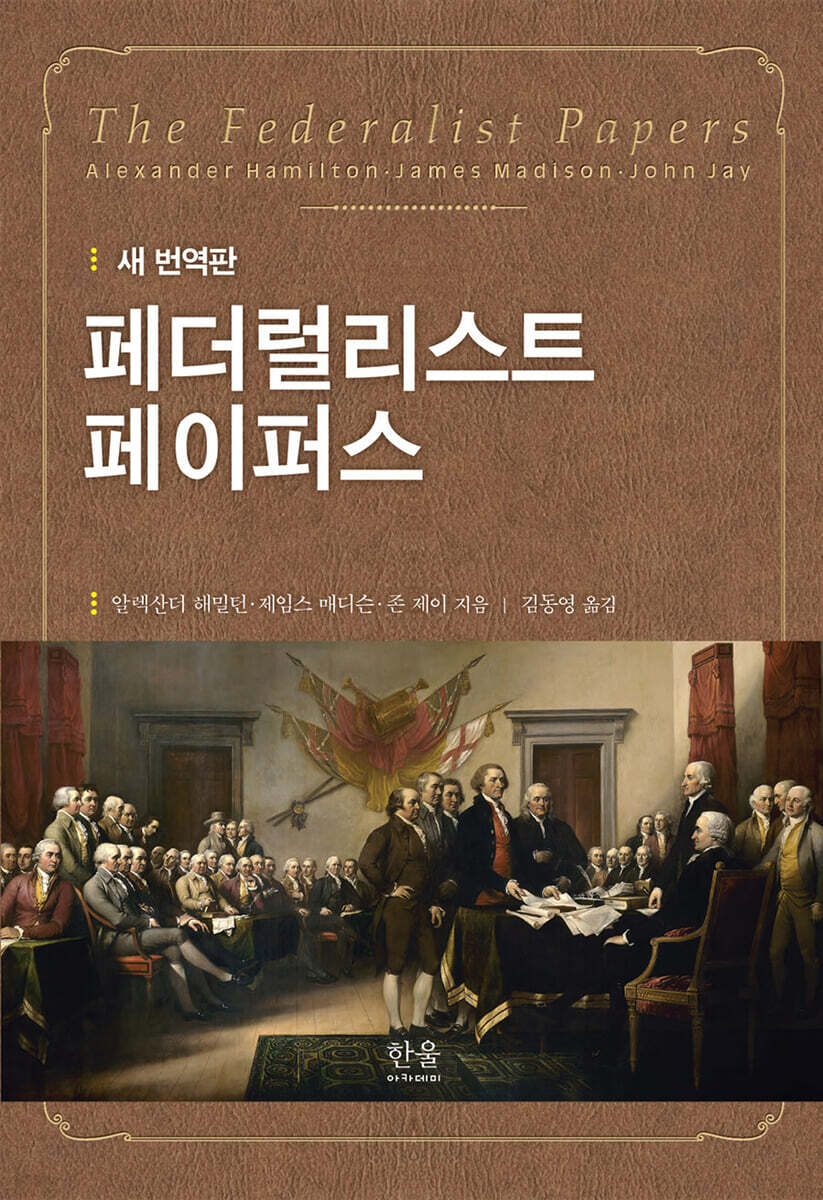
New Translation of the Federalist Papers
 |
Description
Book Introduction
“Along with the American Declaration of Independence and the Constitution
“The most authoritative document in American history”
The Federalist Papers is a collection of articles anonymously contributed to newspapers by Alexander Hamilton, James Madison, and John Jay, who attended the Philadelphia Constitutional Convention and led the drafting of the Constitution, and who served as President of the Continental Congress, in order to explain the new Constitution to the citizens of New York, who were most opposed to its ratification, and to refute the opponents' far-fetched arguments.
At the time of publication, the pen name Publius was used.
Each of these essays clearly explains the philosophy and motivation behind the government structure proposed in the Constitution and refutes the irrationality of the arguments put forward by opponents of the Constitution (anti-federalists).
The U.S. Supreme Court still cites this text when interpreting the Constitution because it explains the Constitution through persuasive sentences and rigorous logical structure.
The Federalist Papers were published at a crucial moment in American history and provide readers with a useful intellectual guide to the crucial issues that democracy must address.
“The most authoritative document in American history”
The Federalist Papers is a collection of articles anonymously contributed to newspapers by Alexander Hamilton, James Madison, and John Jay, who attended the Philadelphia Constitutional Convention and led the drafting of the Constitution, and who served as President of the Continental Congress, in order to explain the new Constitution to the citizens of New York, who were most opposed to its ratification, and to refute the opponents' far-fetched arguments.
At the time of publication, the pen name Publius was used.
Each of these essays clearly explains the philosophy and motivation behind the government structure proposed in the Constitution and refutes the irrationality of the arguments put forward by opponents of the Constitution (anti-federalists).
The U.S. Supreme Court still cites this text when interpreting the Constitution because it explains the Constitution through persuasive sentences and rigorous logical structure.
The Federalist Papers were published at a crucial moment in American history and provide readers with a useful intellectual guide to the crucial issues that democracy must address.
- You can preview some of the book's contents.
Preview
index
Translator's Preface ...4
Definitions and explanations of terms in the original text...14
Topics by Paper Number
No. 1 Purpose and Structure of Paper Publication...23
No.2 Background of the Constitutional Convention and the Proposal of a New Constitution...29
No. 3 Risks from foreign powers and influences...35
No. 4 Risks from Foreign Powers and Influences...41
No. 5 Situation in the event of a division of the United States...47
No.6 Situation in the event of a division of the United States...52
No.7 Situation in the event of a division of the United States...62
No. 8 Situation in the event of a division of the United States...70
No. 9 The Usefulness of the Federation in Preventing Civil Strife and Rebellion...76
No. 10 The Usefulness of the Federation in Preventing Civil Strife and Rebellion...83
No. 11 The utility of the Federation in commerce and naval affairs...93
No. 12 The Usefulness of the Federation in Revenue ...101
No. 13 The Usefulness of the Federation from an Economic Perspective...108
No. 14 The Impact of National Territory Size on Republican Government...111
No. 15 Flaws in the Existing Alliance...118
No. 16 Flaws in the Existing Alliance...128
No. 17 Flaws in the Existing Alliance...135
No. 18 Another example of a union: Ancient Greece...141
No. 19 Examples of Other Unions: Germany, Poland, Switzerland...152
No. 20 Another example of a coalition: the Netherlands...161
No. 21 Other Problems with the Existing Coalition...168
No. 22 Other Problems with the Existing Coalition...175
No. 23 The Need for a Strong Central Government (Federal Government) ...186
No. 24 Authority to Create a Federal Standing Army...192
No. 25 Authority to Create a Federal Standing Army...199
No. 26 Response to Opposition to the Creation of a Federal Standing Army...206
No. 27 Response to Objections to the Creation of a Federal Standing Army...214
No. 28 Response to Opposition to the Creation of a Federal Standing Army...219
No. 29 Comments on the Militia...224
No. 30 Discussion on Taxation Rights...232
No. 31 Discussion on Taxation Rights...238
No. 32 Discussion on Taxation Rights...243
No. 33 Discussion on Taxation Rights...249
No. 34 Discussion on Taxation Rights...254
No. 35 Discussion on Taxation Rights...261
No. 36 Discussion on Taxation Rights...268
No. 37 The Constitutional Convention's Difficulties in Devising an Appropriate Constitution...277
No. 38 Contradiction in Opposition to the New Constitution...286
No. 39 Characteristics of the political system to be established by the new constitution...298
No. 40 Legitimacy of the Constitutional Convention's Abuse of Power...307
No. 41 Powers Granted to the Federal Government ...318
No. 42 Powers Granted to the Federal Government ...329
No. 43 Powers Granted to the Federal Government ...338
No. 44 Powers Granted to the Federal Government ...350
No. 45 The Federal Government's Potential Risks to State Governments...360
No. 46 Mutual Checks and Balances Between Federal and State Governments...367
No. 47 Separation of Powers, Checks and Balances...375
No. 48 Separation of Powers, Checks and Balances...384
No. 49 Separation of Powers, Checks and Balances...391
No. 50 Separation of Powers, Checks and Balances...397
No. 51 Separation of Powers, Checks and Balances...401
No. 52 Qualifications of the House of Representatives and Members of the House of Representatives...408
No. 53 House of Representatives' Term of Office...414
No. 54 House of Representatives Seat Distribution by State...421
No. 55 Size of the House of Representatives...428
No. 56 Size of the House of Representatives...435
No. 57 Size of the House of Representatives...440
No. 58 Size of the House of Representatives...447
No. 59 Regulation of House of Representatives Elections...454
No. 60 Regulation of House of Representatives Elections...460
No. 61 Regulation of House of Representatives Elections...467
No. 62 Composition of the Senate, Qualifications of Senators, Method of Election...472
No. 63 Number and Term of Office of the Senate...480
No. 64 Senate and Treaty-Making Power...490
No. 65 The Senate's Role as an Impeachment Court...497
No. 66 The Senate's Role as an Impeachment Court...504
No. 67 False Claims About the President's Powers...512
No. 68 Presidential Election Method...518
No. 69 Comparison of the President, the King of England, and the Governor of New York...524
No. 70 Unity of the Chief Executive (President) ...534
No. 71 President's term of office...545
No. 72 President's re-election...550
No. 73 Presidential Veto...556
No. 74 The President's Command-in-Chief and Pardon Powers...564
No. 75 The President's Treaty-Making Power...568
No. 76 President's power to appoint officials...574
No. 77 Conclusion on the Presidency...580
No. 78 Composition of the Judiciary ...587
No. 79 Independence and Responsibility of Judges...597
No. 80 Powers of the Federal Judiciary ...601
No. 81 Distribution of Judicial Powers...609
No. 82 Relationship between Federal and State Courts...622
No. 83 Judiciary and Jury Trials...628
No. 84 Objection to the Omission of the Bill of Rights...646
No. 85: The Urgency of Constitutional Ratification and Conclusion...659
supplement
Constitution of the United States of America ...668
Amendment 685 of the United States Constitution
Definitions and explanations of terms in the original text...14
Topics by Paper Number
No. 1 Purpose and Structure of Paper Publication...23
No.2 Background of the Constitutional Convention and the Proposal of a New Constitution...29
No. 3 Risks from foreign powers and influences...35
No. 4 Risks from Foreign Powers and Influences...41
No. 5 Situation in the event of a division of the United States...47
No.6 Situation in the event of a division of the United States...52
No.7 Situation in the event of a division of the United States...62
No. 8 Situation in the event of a division of the United States...70
No. 9 The Usefulness of the Federation in Preventing Civil Strife and Rebellion...76
No. 10 The Usefulness of the Federation in Preventing Civil Strife and Rebellion...83
No. 11 The utility of the Federation in commerce and naval affairs...93
No. 12 The Usefulness of the Federation in Revenue ...101
No. 13 The Usefulness of the Federation from an Economic Perspective...108
No. 14 The Impact of National Territory Size on Republican Government...111
No. 15 Flaws in the Existing Alliance...118
No. 16 Flaws in the Existing Alliance...128
No. 17 Flaws in the Existing Alliance...135
No. 18 Another example of a union: Ancient Greece...141
No. 19 Examples of Other Unions: Germany, Poland, Switzerland...152
No. 20 Another example of a coalition: the Netherlands...161
No. 21 Other Problems with the Existing Coalition...168
No. 22 Other Problems with the Existing Coalition...175
No. 23 The Need for a Strong Central Government (Federal Government) ...186
No. 24 Authority to Create a Federal Standing Army...192
No. 25 Authority to Create a Federal Standing Army...199
No. 26 Response to Opposition to the Creation of a Federal Standing Army...206
No. 27 Response to Objections to the Creation of a Federal Standing Army...214
No. 28 Response to Opposition to the Creation of a Federal Standing Army...219
No. 29 Comments on the Militia...224
No. 30 Discussion on Taxation Rights...232
No. 31 Discussion on Taxation Rights...238
No. 32 Discussion on Taxation Rights...243
No. 33 Discussion on Taxation Rights...249
No. 34 Discussion on Taxation Rights...254
No. 35 Discussion on Taxation Rights...261
No. 36 Discussion on Taxation Rights...268
No. 37 The Constitutional Convention's Difficulties in Devising an Appropriate Constitution...277
No. 38 Contradiction in Opposition to the New Constitution...286
No. 39 Characteristics of the political system to be established by the new constitution...298
No. 40 Legitimacy of the Constitutional Convention's Abuse of Power...307
No. 41 Powers Granted to the Federal Government ...318
No. 42 Powers Granted to the Federal Government ...329
No. 43 Powers Granted to the Federal Government ...338
No. 44 Powers Granted to the Federal Government ...350
No. 45 The Federal Government's Potential Risks to State Governments...360
No. 46 Mutual Checks and Balances Between Federal and State Governments...367
No. 47 Separation of Powers, Checks and Balances...375
No. 48 Separation of Powers, Checks and Balances...384
No. 49 Separation of Powers, Checks and Balances...391
No. 50 Separation of Powers, Checks and Balances...397
No. 51 Separation of Powers, Checks and Balances...401
No. 52 Qualifications of the House of Representatives and Members of the House of Representatives...408
No. 53 House of Representatives' Term of Office...414
No. 54 House of Representatives Seat Distribution by State...421
No. 55 Size of the House of Representatives...428
No. 56 Size of the House of Representatives...435
No. 57 Size of the House of Representatives...440
No. 58 Size of the House of Representatives...447
No. 59 Regulation of House of Representatives Elections...454
No. 60 Regulation of House of Representatives Elections...460
No. 61 Regulation of House of Representatives Elections...467
No. 62 Composition of the Senate, Qualifications of Senators, Method of Election...472
No. 63 Number and Term of Office of the Senate...480
No. 64 Senate and Treaty-Making Power...490
No. 65 The Senate's Role as an Impeachment Court...497
No. 66 The Senate's Role as an Impeachment Court...504
No. 67 False Claims About the President's Powers...512
No. 68 Presidential Election Method...518
No. 69 Comparison of the President, the King of England, and the Governor of New York...524
No. 70 Unity of the Chief Executive (President) ...534
No. 71 President's term of office...545
No. 72 President's re-election...550
No. 73 Presidential Veto...556
No. 74 The President's Command-in-Chief and Pardon Powers...564
No. 75 The President's Treaty-Making Power...568
No. 76 President's power to appoint officials...574
No. 77 Conclusion on the Presidency...580
No. 78 Composition of the Judiciary ...587
No. 79 Independence and Responsibility of Judges...597
No. 80 Powers of the Federal Judiciary ...601
No. 81 Distribution of Judicial Powers...609
No. 82 Relationship between Federal and State Courts...622
No. 83 Judiciary and Jury Trials...628
No. 84 Objection to the Omission of the Bill of Rights...646
No. 85: The Urgency of Constitutional Ratification and Conclusion...659
supplement
Constitution of the United States of America ...668
Amendment 685 of the United States Constitution
Detailed image
.jpg)
Into the book
Under a vibrant central government, we could use the power and resources we receive from nature for the common good, thereby thwarting any concerted action by European nations to impede our growth.
A single central government under a new constitution would discourage joint action among European nations, removing even the incentive for their unity.
Brisk trade, expansion of maritime traffic, and a thriving shipping industry will naturally arise from America's spiritual and material needs.
Moreover, under a strong central government, we can resist the schemes of petty politicians who seek to defy or alter the inevitable and unchangeable natural order.
--- p.96, from 「No.11 Alexander Hamilton」
The doctrine of the opponents is that, as if the power of the federal government proposed by the new Constitution were too strong or too rigid, they deliberately lead us to weaken or soften it by resorting to expedients already condemned or prohibited in other cases.
If the various principles they advocate on various points were to become so widely accepted as to become general creeds, it could be said with certainty that they would render the citizens of this country utterly unfit for any kind of government.
However, there is no need to worry about this type of risk.
Because American citizens are sufficiently discerning to be persuaded into anarchy.
If our experience has not instilled in the public mind a profound and serious conviction that a more vigorous government is essential to the welfare and prosperity of society, I am seriously mistaken.
--- p.207, 「no.
26 From Alexander Hamilton
On the one hand, the spirit of republican liberty requires that all powers emanate from the people, and that those entrusted with that power be limited to short terms, thus ensuring their constant dependence on the people. Madison explains why he set the term of office for the House of Representatives at two years.
Moreover, even for this short period, the delegation of power must be placed in the hands of the many, not the few.
On the other hand, from the perspective of the stability of the political system, those entrusted with power must maintain their positions for a considerable period of time without frequent change. This explains why, in contrast to the short two-year term of office of the House of Representatives, the term of office of the Senate is set at six years, and furthermore, only one-third of the seats in the Senate are subject to election every two years, to ensure government stability and continuity of state affairs.
Frequent elections will lead to frequent changes in representatives, and frequent changes in representatives will lead to frequent changes in the system.
However, from the perspective of the vitality of the political system, power must not only last for a certain period of time, but also be exercised by a single person. Here, Madison is alluding to the President, the head of the executive branch envisioned by the new Constitution.
The president, the head of the executive branch proposed by the new constitution, is a unique product of American politics.
The Constitutional Convention also proposed appointing two leaders of the executive branch, each responsible for a different area of work, or a committee composed of several members.
However, in the end, the final decision was made to have a single person as the head of the executive branch and to call him the President.
See footnote 5 of paper 4) and footnote 7 of paper 16).
--- p.280, from 「No.37 James Madison」
The federal government's ambitious encroachment on the powers of the states will not merely excite opposition from one or several states, but will serve as a general warning signal, uniting all the states in common purpose.
Communication networks will be opened and cooperation for resistance will be achieved.
A unified spirit will inspire and direct the whole.
In short, just as the Confederacy was formed out of fear of foreign enslavement, so the states will eventually resort to force if the federal government does not voluntarily abandon its ambitious plans.
But what level of madness could drive the federal government to such extremes? During the war with Britain, parts of our American empire encroached upon other parts.
The numerically larger side was infringing on the rights of the smaller side. Immediately after the war with Britain began, the 13 American colonies were divided between the northern and central states, which wanted independence from Britain, and the southern states, which wanted to remain colonies as long as their colonial rights were guaranteed.
However, in drafting and adopting the Declaration of Independence at the Second Continental Congress in 1776, the majority of northern and central states ignored the opinions of the southern states that opposed independence and pushed ahead with the adoption of the Declaration of Independence.
It was unfair and unwise, but not entirely unthinkable.
But what would the fight be like in the scenario we're assuming, and who would be involved? Perhaps a small group of national representatives would be fighting against the people themselves.
Or the representatives of the Federal Congress will face off against the representatives of the thirteen state legislatures, and the people of both will side with the latter.
--- p.371~372, from 「No.46 James Madison」
If the majority unites for their common interest, the rights of the minority are endangered.
However, there are only two ways to prevent this harm.
One is the power that does not depend on the majority, that is, is not subject to the constraints of society itself. In the original text, it is 'a will', and Madison uses this word to mean 'agency' or 'agencies', which are the power, force, or means to ensure the safety of the minority.
For example, it refers to laws, institutions, or binding powers that have absolute power.
Madison argues that in a republic, the use of this kind of power or means should be as restrained as possible.
See this paper, footnote 4).
One is to create a society of very different kinds of citizens, and the other is to make it difficult, if not impossible, for many unjust combinations to occur.
--- p.404~405, from 「No.51 James Madison」
The President of the United States is a public official elected by the people for a four-year term, but the British monarch is a hereditary monarch for life.
The President may be personally punished and disgraced, but the British monarch is sacred and inviolable.
The President has limited veto power over bills passed by the legislature, but the British monarch has absolute veto power.
The President has command of the Army and Navy of the United States, but the British monarch has, in addition to these powers, the power to declare war and to raise and control fleets and armies on her own authority.
Also, the former, the President, shares the power to conclude treaties with the House of Lords, a legislative body, while the latter, the British monarch, is the sole holder of the power to conclude treaties.
The former also has joint authority over the appointment of managers, but the latter has all appointment authority alone.
The former cannot grant any privileges, but the latter can grant citizenship to foreigners, make commoners nobles, and establish corporations with all the rights incidental to corporate bodies.
The President shall make no rules respecting the commerce or currency of the United States; but the Crown is in various respects the regulator of commerce, and in that capacity may open markets, large and small, for commerce, regulate weights and measures, impose embargoes for specified periods, coin money, and permit or prohibit the circulation of foreign coins.
Although the President has no jurisdiction over religion, the British monarch is the supreme head and administrator of the Church of England.
What answer can we give to those who insist that such different things are similar? We can only say the same thing to those who insist that a government in which all power is vested in the hands of persons periodically elected by the people is an aristocracy, a monarchy, or a despotism.
A single central government under a new constitution would discourage joint action among European nations, removing even the incentive for their unity.
Brisk trade, expansion of maritime traffic, and a thriving shipping industry will naturally arise from America's spiritual and material needs.
Moreover, under a strong central government, we can resist the schemes of petty politicians who seek to defy or alter the inevitable and unchangeable natural order.
--- p.96, from 「No.11 Alexander Hamilton」
The doctrine of the opponents is that, as if the power of the federal government proposed by the new Constitution were too strong or too rigid, they deliberately lead us to weaken or soften it by resorting to expedients already condemned or prohibited in other cases.
If the various principles they advocate on various points were to become so widely accepted as to become general creeds, it could be said with certainty that they would render the citizens of this country utterly unfit for any kind of government.
However, there is no need to worry about this type of risk.
Because American citizens are sufficiently discerning to be persuaded into anarchy.
If our experience has not instilled in the public mind a profound and serious conviction that a more vigorous government is essential to the welfare and prosperity of society, I am seriously mistaken.
--- p.207, 「no.
26 From Alexander Hamilton
On the one hand, the spirit of republican liberty requires that all powers emanate from the people, and that those entrusted with that power be limited to short terms, thus ensuring their constant dependence on the people. Madison explains why he set the term of office for the House of Representatives at two years.
Moreover, even for this short period, the delegation of power must be placed in the hands of the many, not the few.
On the other hand, from the perspective of the stability of the political system, those entrusted with power must maintain their positions for a considerable period of time without frequent change. This explains why, in contrast to the short two-year term of office of the House of Representatives, the term of office of the Senate is set at six years, and furthermore, only one-third of the seats in the Senate are subject to election every two years, to ensure government stability and continuity of state affairs.
Frequent elections will lead to frequent changes in representatives, and frequent changes in representatives will lead to frequent changes in the system.
However, from the perspective of the vitality of the political system, power must not only last for a certain period of time, but also be exercised by a single person. Here, Madison is alluding to the President, the head of the executive branch envisioned by the new Constitution.
The president, the head of the executive branch proposed by the new constitution, is a unique product of American politics.
The Constitutional Convention also proposed appointing two leaders of the executive branch, each responsible for a different area of work, or a committee composed of several members.
However, in the end, the final decision was made to have a single person as the head of the executive branch and to call him the President.
See footnote 5 of paper 4) and footnote 7 of paper 16).
--- p.280, from 「No.37 James Madison」
The federal government's ambitious encroachment on the powers of the states will not merely excite opposition from one or several states, but will serve as a general warning signal, uniting all the states in common purpose.
Communication networks will be opened and cooperation for resistance will be achieved.
A unified spirit will inspire and direct the whole.
In short, just as the Confederacy was formed out of fear of foreign enslavement, so the states will eventually resort to force if the federal government does not voluntarily abandon its ambitious plans.
But what level of madness could drive the federal government to such extremes? During the war with Britain, parts of our American empire encroached upon other parts.
The numerically larger side was infringing on the rights of the smaller side. Immediately after the war with Britain began, the 13 American colonies were divided between the northern and central states, which wanted independence from Britain, and the southern states, which wanted to remain colonies as long as their colonial rights were guaranteed.
However, in drafting and adopting the Declaration of Independence at the Second Continental Congress in 1776, the majority of northern and central states ignored the opinions of the southern states that opposed independence and pushed ahead with the adoption of the Declaration of Independence.
It was unfair and unwise, but not entirely unthinkable.
But what would the fight be like in the scenario we're assuming, and who would be involved? Perhaps a small group of national representatives would be fighting against the people themselves.
Or the representatives of the Federal Congress will face off against the representatives of the thirteen state legislatures, and the people of both will side with the latter.
--- p.371~372, from 「No.46 James Madison」
If the majority unites for their common interest, the rights of the minority are endangered.
However, there are only two ways to prevent this harm.
One is the power that does not depend on the majority, that is, is not subject to the constraints of society itself. In the original text, it is 'a will', and Madison uses this word to mean 'agency' or 'agencies', which are the power, force, or means to ensure the safety of the minority.
For example, it refers to laws, institutions, or binding powers that have absolute power.
Madison argues that in a republic, the use of this kind of power or means should be as restrained as possible.
See this paper, footnote 4).
One is to create a society of very different kinds of citizens, and the other is to make it difficult, if not impossible, for many unjust combinations to occur.
--- p.404~405, from 「No.51 James Madison」
The President of the United States is a public official elected by the people for a four-year term, but the British monarch is a hereditary monarch for life.
The President may be personally punished and disgraced, but the British monarch is sacred and inviolable.
The President has limited veto power over bills passed by the legislature, but the British monarch has absolute veto power.
The President has command of the Army and Navy of the United States, but the British monarch has, in addition to these powers, the power to declare war and to raise and control fleets and armies on her own authority.
Also, the former, the President, shares the power to conclude treaties with the House of Lords, a legislative body, while the latter, the British monarch, is the sole holder of the power to conclude treaties.
The former also has joint authority over the appointment of managers, but the latter has all appointment authority alone.
The former cannot grant any privileges, but the latter can grant citizenship to foreigners, make commoners nobles, and establish corporations with all the rights incidental to corporate bodies.
The President shall make no rules respecting the commerce or currency of the United States; but the Crown is in various respects the regulator of commerce, and in that capacity may open markets, large and small, for commerce, regulate weights and measures, impose embargoes for specified periods, coin money, and permit or prohibit the circulation of foreign coins.
Although the President has no jurisdiction over religion, the British monarch is the supreme head and administrator of the Church of England.
What answer can we give to those who insist that such different things are similar? We can only say the same thing to those who insist that a government in which all power is vested in the hands of persons periodically elected by the people is an aristocracy, a monarchy, or a despotism.
--- p.531~532, 「no.
From "69 Alexander Hamilton"
From "69 Alexander Hamilton"
Publisher's Review
Until the 13 American colonies gained independence from Britain and became the United States of America.
Background of the Federalist Papers
In 1787, Hamilton, Madison, and Jay were explaining the newly proposed Constitution of the United States to the citizens of New York and persuading them of its ratification.
The new constitution, which was created by gathering the wisdom of representatives from each state who participated in the Constitutional Convention, would complement the shortcomings of numerous forms of government that have existed throughout human history, guarantee the freedom, happiness, and safety of the people, and if the American continent united to respond to foreign military and trade pressure, it would become a powerful nation that the great powers of Europe would not easily overlook, and it would protect citizens by establishing a sophisticated system of surveillance and checks to prevent the tyranny of those in power.
The Federalist Papers is a collection of 85 articles published by Alexander Hamilton, James Madison, and John Jay under the pseudonym Publius in New York City newspapers, including the Independent Journal, between October 1787 and August 1788.
The Federalist Papers were published at a crucial moment in American history, explaining to the people of New York State at large and to the entire United States at large why a powerful central government system was needed to represent and govern the entire nation, encompassing foreign affairs, administration, judiciary, and legislation.
Because it was written for debate and persuasion from the beginning and was published in a newspaper serial format, there is a lot of duplicate content and there are cases where the contents of the Constitution are explained ambiguously or even misleadingly.
In such cases, this book has added translator's notes to these parts to help readers understand accurately.
A democratic government requires not only sufficient delegation of authority but also sober checks and balances.
What is government in the first place? What else could it be but the greatest expression of distrust in humanity? If humans were angels, there would be no need for any government.
Also, if angels ruled over humans, there would be no need for external or internal control over government.
This is precisely the greatest difficulty in forming a government for human beings to govern human beings.
First, the government must be able to control the subjects, and second, the government must be able to control itself.
The most fundamental control over government is undoubtedly to make it subordinate and dependent on the people, but experience has taught mankind that auxiliary precautions are necessary.
_From James Madison Paper 51
As Madison said, if men were angels, there would be no need for government, and if angels ruled, there would be no need for surveillance.
It leaps forward some 240 years and forces us to reconsider the fundamental questions of modern democracy, representative democracy, and the separation of powers.
The Constitution that was announced at that time was a collection of wisdom that drew lessons from the history of countless governments, unions, confederations, and republics that had existed in human history up to that time, supplemented their shortcomings, and created a strong United States that could stand strong against foreign powers and rebellion while guaranteeing the freedom of the people and governing according to the will of the people.
The first professional translation was published in 1995, and 28 years later,
Republished with a new translation and significantly improved annotations
Professor Kim Dong-young, the translator, was the first in Korea to translate and publish the full text of the Federalist Papers in 1995.
Since then, I have published a new translation that complements the shortcomings of the first translation and adds background knowledge and expert expertise in the form of footnotes to help readers, drawing on my experience studying American politics and lecturing on it.
For the reader's convenience, a glossary of terms is included at the beginning of the book, and the Federal Constitution and its amendments are included as an appendix at the back.
When explaining the contents of the new constitution in a paper or referring to the contents of another paper, the location can be noted in a footnote for immediate reference.
Additionally, detailed background information and the meanings of English words at the time, which were different from today, were added as footnotes, so that it can serve as a reference book for the Federalist Papers.
The translator points out that it is wrong to translate federalist as federalist.
Federalist was simply a term for those who advocated for the newly proposed Constitution and the new form of government that would be established by it, and although the concept of the federal government had been introduced at the time, neither the concept nor the term federalism itself existed.
The translator explains the term 'federal' as follows:
At the time the "Federalist Papers" were written, the term "federal" was used interchangeably with the term "confederal," which means union, as well as the current federation, without a clear distinction between them, and the authors often used the word "federal" in the original text to mean "confederal."
This is an example of how 'flammabale' and 'inflammable' are used interchangeably in modern English.
In the term 'federal government', when the authors used federal to mean confederal, it was translated as a union government, and when it meant a government system starting anew under a new constitution, it was translated as a federal government.
Page 14 “Definitions and Explanations of Terms in the Original Text”
“Along with the Declaration of Independence and the Constitution, it is the most authoritative document in American history.” _Library of Congress
“In his most frequently cited paper, Paper 10, Madison rejected the prevailing notion that a republic was only possible over a small territory, arguing that safety, liberty, and justice were more likely to be achieved over a large, heterogeneous population.
This article advocates for social, economic, and cultural pluralism and a complex majoritarianism formed through compromise and reconciliation, and argues that decisions by such a majority are more likely to serve the right purpose of government than decisions by a unified majority.” _From the Encyclopedia Britannica
Background of the Federalist Papers
In 1787, Hamilton, Madison, and Jay were explaining the newly proposed Constitution of the United States to the citizens of New York and persuading them of its ratification.
The new constitution, which was created by gathering the wisdom of representatives from each state who participated in the Constitutional Convention, would complement the shortcomings of numerous forms of government that have existed throughout human history, guarantee the freedom, happiness, and safety of the people, and if the American continent united to respond to foreign military and trade pressure, it would become a powerful nation that the great powers of Europe would not easily overlook, and it would protect citizens by establishing a sophisticated system of surveillance and checks to prevent the tyranny of those in power.
The Federalist Papers is a collection of 85 articles published by Alexander Hamilton, James Madison, and John Jay under the pseudonym Publius in New York City newspapers, including the Independent Journal, between October 1787 and August 1788.
The Federalist Papers were published at a crucial moment in American history, explaining to the people of New York State at large and to the entire United States at large why a powerful central government system was needed to represent and govern the entire nation, encompassing foreign affairs, administration, judiciary, and legislation.
Because it was written for debate and persuasion from the beginning and was published in a newspaper serial format, there is a lot of duplicate content and there are cases where the contents of the Constitution are explained ambiguously or even misleadingly.
In such cases, this book has added translator's notes to these parts to help readers understand accurately.
A democratic government requires not only sufficient delegation of authority but also sober checks and balances.
What is government in the first place? What else could it be but the greatest expression of distrust in humanity? If humans were angels, there would be no need for any government.
Also, if angels ruled over humans, there would be no need for external or internal control over government.
This is precisely the greatest difficulty in forming a government for human beings to govern human beings.
First, the government must be able to control the subjects, and second, the government must be able to control itself.
The most fundamental control over government is undoubtedly to make it subordinate and dependent on the people, but experience has taught mankind that auxiliary precautions are necessary.
_From James Madison Paper 51
As Madison said, if men were angels, there would be no need for government, and if angels ruled, there would be no need for surveillance.
It leaps forward some 240 years and forces us to reconsider the fundamental questions of modern democracy, representative democracy, and the separation of powers.
The Constitution that was announced at that time was a collection of wisdom that drew lessons from the history of countless governments, unions, confederations, and republics that had existed in human history up to that time, supplemented their shortcomings, and created a strong United States that could stand strong against foreign powers and rebellion while guaranteeing the freedom of the people and governing according to the will of the people.
The first professional translation was published in 1995, and 28 years later,
Republished with a new translation and significantly improved annotations
Professor Kim Dong-young, the translator, was the first in Korea to translate and publish the full text of the Federalist Papers in 1995.
Since then, I have published a new translation that complements the shortcomings of the first translation and adds background knowledge and expert expertise in the form of footnotes to help readers, drawing on my experience studying American politics and lecturing on it.
For the reader's convenience, a glossary of terms is included at the beginning of the book, and the Federal Constitution and its amendments are included as an appendix at the back.
When explaining the contents of the new constitution in a paper or referring to the contents of another paper, the location can be noted in a footnote for immediate reference.
Additionally, detailed background information and the meanings of English words at the time, which were different from today, were added as footnotes, so that it can serve as a reference book for the Federalist Papers.
The translator points out that it is wrong to translate federalist as federalist.
Federalist was simply a term for those who advocated for the newly proposed Constitution and the new form of government that would be established by it, and although the concept of the federal government had been introduced at the time, neither the concept nor the term federalism itself existed.
The translator explains the term 'federal' as follows:
At the time the "Federalist Papers" were written, the term "federal" was used interchangeably with the term "confederal," which means union, as well as the current federation, without a clear distinction between them, and the authors often used the word "federal" in the original text to mean "confederal."
This is an example of how 'flammabale' and 'inflammable' are used interchangeably in modern English.
In the term 'federal government', when the authors used federal to mean confederal, it was translated as a union government, and when it meant a government system starting anew under a new constitution, it was translated as a federal government.
Page 14 “Definitions and Explanations of Terms in the Original Text”
“Along with the Declaration of Independence and the Constitution, it is the most authoritative document in American history.” _Library of Congress
“In his most frequently cited paper, Paper 10, Madison rejected the prevailing notion that a republic was only possible over a small territory, arguing that safety, liberty, and justice were more likely to be achieved over a large, heterogeneous population.
This article advocates for social, economic, and cultural pluralism and a complex majoritarianism formed through compromise and reconciliation, and argues that decisions by such a majority are more likely to serve the right purpose of government than decisions by a unified majority.” _From the Encyclopedia Britannica
GOODS SPECIFICS
- Date of issue: January 22, 2024
- Format: Hardcover book binding method guide
- Page count, weight, size: 720 pages | 1,162g | 153*224*42mm
- ISBN13: 9788946074927
You may also like
카테고리
korean


korean

![GQ KOREA Mark (Monthly): December [2025]](http://librairie.coreenne.fr/cdn/shop/files/8ef265dbbfbf186523ed75ba7319009d.jpg?v=1765340328&width=3840)


