

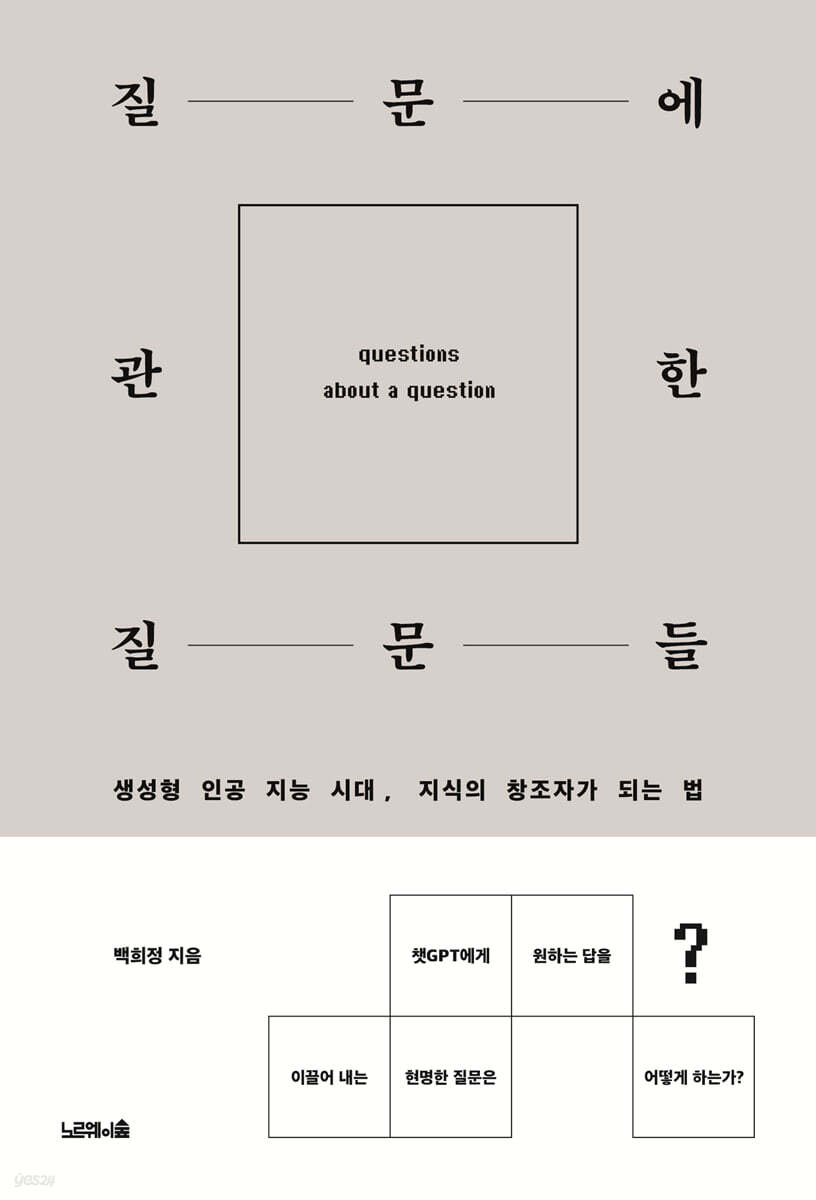
Questions about questions
 |
Description
Book Introduction
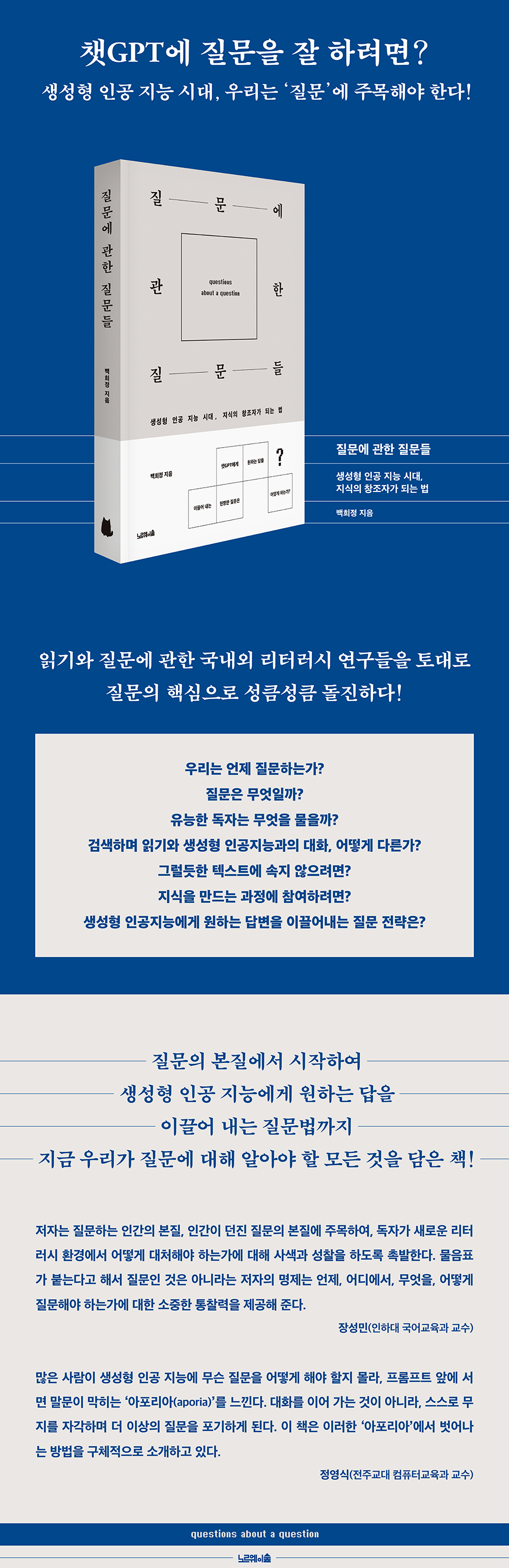
How to ask good questions in ChatGPT?
In the era of generative artificial intelligence, we must focus on 'questions'!
Based on domestic and international literacy research on reading and questioning
A book that boldly dives into the heart of the matter!
Public interest in artificial intelligence technology is hotter than ever, with OpenAI launching ChatGPT, a conversational AI service based on GPT-3.5 and GPT-4.
Recently, research in various fields including artificial intelligence technology has focused on the fact that the process of humans communicating with symbols and managing resources in an AI-based literacy environment is done through 'questions'. Accordingly, a new word, 'homo prompt', was created to refer to a person who uses AI services appropriately through a process of continuous questioning and answering with various AIs.
Questions are a type of speech that occurs naturally in everyday life, but in reading research, they have been primarily treated as a teaching and learning strategy to support learners' reading comprehension.
The author, a young Korean language educator and elementary school teacher with nine years of experience, explores various aspects of questioning based on domestic and international literacy research results in this book and proposes a method for pursuing knowledge exploration and creative thinking through communication with artificial intelligence through questioning.
It also provides various examples and guidelines to help readers develop their own effective questioning habits, helping them become proactive knowledge constructors in a changing literacy environment.
In the era of generative artificial intelligence, we must focus on 'questions'!
Based on domestic and international literacy research on reading and questioning
A book that boldly dives into the heart of the matter!
Public interest in artificial intelligence technology is hotter than ever, with OpenAI launching ChatGPT, a conversational AI service based on GPT-3.5 and GPT-4.
Recently, research in various fields including artificial intelligence technology has focused on the fact that the process of humans communicating with symbols and managing resources in an AI-based literacy environment is done through 'questions'. Accordingly, a new word, 'homo prompt', was created to refer to a person who uses AI services appropriately through a process of continuous questioning and answering with various AIs.
Questions are a type of speech that occurs naturally in everyday life, but in reading research, they have been primarily treated as a teaching and learning strategy to support learners' reading comprehension.
The author, a young Korean language educator and elementary school teacher with nine years of experience, explores various aspects of questioning based on domestic and international literacy research results in this book and proposes a method for pursuing knowledge exploration and creative thinking through communication with artificial intelligence through questioning.
It also provides various examples and guidelines to help readers develop their own effective questioning habits, helping them become proactive knowledge constructors in a changing literacy environment.
- You can preview some of the book's contents.
Preview
index
Entering the Age of Generative Artificial Intelligence: Why the Question?
01.
When, where, and what to ask
1_When do we ask questions?
Factual questions, read carefully
Inferential questions, bridging meanings
Critical Questions, Getting to the Essence
Biased Reader
What do competent readers ask?
2_Is it a question if there is only a question mark?
What is the question?
The question begins with an empty space.
3_From 'Search' to 'Prompt'
Readers in an online literacy environment
Search and read and the emergence of prompts
I asked the chatbot a question directly.
Prompt-Response Exchange
02.
How to ask a question
4_Don't be fooled by plausible text
Don't be fooled by 'text'
Don't be fooled by yourself
5_The Real Meaning of Asking AI Questions
Limitations of Chatbots
Strategies for Questioning Artificial Intelligence
If you get the wrong answer
Select and use only nouns
When efficiency is not everything
6_Becoming a knowledge constructor
The illusion of knowing
Readers with sophisticated beliefs
Hypertext reading
When the reader loses subjectivity
cognitive misers
To participate in the process of creating knowledge
7_Ask one more question
AI that suggests questions
What AI Can't Infer
Exploratory Questions and the Question Continuum
Collaborating with AI
Going Out_ The Age of Smart Questions and Smart Answers
Acknowledgements
References
01.
When, where, and what to ask
1_When do we ask questions?
Factual questions, read carefully
Inferential questions, bridging meanings
Critical Questions, Getting to the Essence
Biased Reader
What do competent readers ask?
2_Is it a question if there is only a question mark?
What is the question?
The question begins with an empty space.
3_From 'Search' to 'Prompt'
Readers in an online literacy environment
Search and read and the emergence of prompts
I asked the chatbot a question directly.
Prompt-Response Exchange
02.
How to ask a question
4_Don't be fooled by plausible text
Don't be fooled by 'text'
Don't be fooled by yourself
5_The Real Meaning of Asking AI Questions
Limitations of Chatbots
Strategies for Questioning Artificial Intelligence
If you get the wrong answer
Select and use only nouns
When efficiency is not everything
6_Becoming a knowledge constructor
The illusion of knowing
Readers with sophisticated beliefs
Hypertext reading
When the reader loses subjectivity
cognitive misers
To participate in the process of creating knowledge
7_Ask one more question
AI that suggests questions
What AI Can't Infer
Exploratory Questions and the Question Continuum
Collaborating with AI
Going Out_ The Age of Smart Questions and Smart Answers
Acknowledgements
References
Detailed image
Into the book
In fact, the question is one we have always emphasized.
At the end of class, the teacher habitually asks students if they have any questions.
Even when we are not in a classroom or interacting with others, we ask ourselves questions.
Think back to a time when you were reading a book.
As we silently ask ourselves, 'What is this person trying to say?', we are asking ourselves this question.
As we will see in more detail later, questions are speech acts that arise from human curiosity to fill in gaps in knowledge, and in educational terms, they are a barometer for predicting the learner's level of understanding.
--- p.8, from “Introduction”
We don't read words and phrases, sentences and sentences, as carefully as we think.
I only diligently read the first one or two paragraphs of the entire text, and then quickly skim the paragraphs that follow.
When you read an article on your smartphone, think about yourself.
Don't you usually read a sentence or two in the first paragraph after reading the title and then scroll down to check the comments?
--- p.23
But sometimes we don't ask questions.
Perhaps the expression 'can't' would be more accurate.
Even when you absolutely must ask, such as when you are learning something new or challenging someone's opinion.
At the end of a class or lecture, the professor asks the audience if they have any questions, as if it were a rite of passage.
At this moment, I have never raised my hand either.
I just hoped that someone would raise their hand to break the silence for me, or that no one would raise their hand so the class would end quickly.
Why is it that questions that are easily asked in everyday life are not easily asked in situations like this?
--- p.35
People who passively perceive their role in the process of knowing are unlikely to 'necessarily' ask questions.
Such a person may have naive epistemological beliefs.
They take knowledge as absolute and believe that there is no room for their intervention.
Unfortunately, I think this is why students in our country don't ask questions in the classroom.
Under a rigid, competition-oriented college entrance exam system, students can only get good grades if they simply accept the knowledge given to them.
There are changes, both big and small, such as the expansion of essay evaluations and the reform of the high school credit system, but even so, to advance to university, you must memorize and re-memorize the knowledge of major subjects.
The belief that you can get into a good university if you memorize well and do well on the CSAT still remains.
--- p.66
The process of asking and answering questions to artificial intelligence replaces the time-consuming exploration, evaluation, and synthesis processes of online reading.
Because AI has learned from large data sets of texts that readers can review, readers can simply ask questions and quickly generate responses to potential texts that previously had to be explored and synthesized on their own.
Artificial intelligence is optimized to produce complete essays.
--- p.90
Asking questions is an instinctive act.
Because humans are learning beings.
We have constantly acquired new knowledge, pioneered the given situation, and created the modern civilization we have today.
When the subject of inquiry is a natural phenomenon, 'science' is established, and when the essence of the world and human life is explored, 'philosophy' is established.
The law of universal gravitation was created from the question, 'Why do apples fall from trees?'
Even looking at the same apple, Kant asks, “Can we really say that an apple is red just because it ‘looks’ red?”
This question became the basis for explaining how human reason perceives the working structure of the world.
Isn't that amazing? Asking questions is a proactive and passionate thing that humans can do.
Even if the medium changes, its essence remains the same.
Questions allow us to live a life that does not settle but takes us one step further toward ‘knowledge.’
--- p.93
This is made possible by systematic doubt and reservation of judgment.
Systematic skepticism does not imply unconditional skepticism about literacy skills or behaviors.
Systematic skepticism is a process of ‘tripartite observation’, which means controlling the impact of one’s own interpretations (Lee Jun-woong, 2009: 24).
It can be said to be a process of reflection in which we rationally look back on the unrefined, raw feelings that arise from our self-centered, unknowing interpretation of the situation.
You could say it's a kind of meta feeling.
When humans perceive an object, they have a 'feeling' as a result of perception, and the feeling formed at this time has a great influence on the process of thinking.
We can critically read a text by quickly recognizing the initial feelings that come to mind and transforming them into refined 'thoughts'.
--- p.120
In generative AI technology, the way data is processed often becomes a constraint on generating ‘good text’.
Generative AI uses large-scale language data it has learned to explore materials relevant to the information the user wants.
The standard for selecting data at this time is ‘quantity’ rather than ‘quality’.
We gather and analyze as much information as possible without considering the quality of the information.
Therefore, if a lot of the learning data is 'contaminated', the results are bound to be inaccurate and distorted.
--- p.137
Interrogating large-scale language data is a reminder that we must be critical of the information we are answering.
This also means that we need to evaluate the source of the responses generated by AI.
When the teacher is the object of the question, the learner reader can trust and consider the information the teacher has as valid.
In multi-text reading, evaluating an author's authority is tantamount to not questioning the quality of the information.
--- p.138
In reading contexts that utilize artificial intelligence, ‘questions’ serve as a catalyst for initiating and sustaining reading.
To receive text from AI, readers must ask questions.
You should structure your questions around what you want and why it is needed, focusing on your reading purpose and task.
If the text to be read had already been given, we wouldn't have asked, but reading using AI has a problem-solving nature from the start.
--- p.170
American educational researchers Marzano and Simms (2014), who proposed the question continuum concept, suggest 'details', 'categories', 'elaboration', and 'evidence' as elements of an effective question continuum.
Accordingly, learners can deeply understand the content by recognizing similarities and differences from specific facts (details), deriving general properties (categories), recalling the reasons for them (elaboration), and establishing grounds (evidence).
--- p.187
Compared to the previous responses, applying the question continuum yields significantly more specific information and information closer to what the reader was looking for.
Of course, the process of applying the question continuum and its results also have limitations.
When I asked the question, I was hoping to get the perspective of someone who was "against" the infectious disease management system, but Ian kept giving me positively biased answers.
Still, some degree of improvement was possible.
We just have to hang on a little more persistently.
--- p.206
There is an old saying, 'A foolish question gives a wise answer.'
It means giving a wise answer even if you ask a foolish question.
In the age of artificial intelligence, you need to ask smart questions first to get the answers you want.
Now is the time when we need 'wise questions and wise answers' from humans.
At the end of class, the teacher habitually asks students if they have any questions.
Even when we are not in a classroom or interacting with others, we ask ourselves questions.
Think back to a time when you were reading a book.
As we silently ask ourselves, 'What is this person trying to say?', we are asking ourselves this question.
As we will see in more detail later, questions are speech acts that arise from human curiosity to fill in gaps in knowledge, and in educational terms, they are a barometer for predicting the learner's level of understanding.
--- p.8, from “Introduction”
We don't read words and phrases, sentences and sentences, as carefully as we think.
I only diligently read the first one or two paragraphs of the entire text, and then quickly skim the paragraphs that follow.
When you read an article on your smartphone, think about yourself.
Don't you usually read a sentence or two in the first paragraph after reading the title and then scroll down to check the comments?
--- p.23
But sometimes we don't ask questions.
Perhaps the expression 'can't' would be more accurate.
Even when you absolutely must ask, such as when you are learning something new or challenging someone's opinion.
At the end of a class or lecture, the professor asks the audience if they have any questions, as if it were a rite of passage.
At this moment, I have never raised my hand either.
I just hoped that someone would raise their hand to break the silence for me, or that no one would raise their hand so the class would end quickly.
Why is it that questions that are easily asked in everyday life are not easily asked in situations like this?
--- p.35
People who passively perceive their role in the process of knowing are unlikely to 'necessarily' ask questions.
Such a person may have naive epistemological beliefs.
They take knowledge as absolute and believe that there is no room for their intervention.
Unfortunately, I think this is why students in our country don't ask questions in the classroom.
Under a rigid, competition-oriented college entrance exam system, students can only get good grades if they simply accept the knowledge given to them.
There are changes, both big and small, such as the expansion of essay evaluations and the reform of the high school credit system, but even so, to advance to university, you must memorize and re-memorize the knowledge of major subjects.
The belief that you can get into a good university if you memorize well and do well on the CSAT still remains.
--- p.66
The process of asking and answering questions to artificial intelligence replaces the time-consuming exploration, evaluation, and synthesis processes of online reading.
Because AI has learned from large data sets of texts that readers can review, readers can simply ask questions and quickly generate responses to potential texts that previously had to be explored and synthesized on their own.
Artificial intelligence is optimized to produce complete essays.
--- p.90
Asking questions is an instinctive act.
Because humans are learning beings.
We have constantly acquired new knowledge, pioneered the given situation, and created the modern civilization we have today.
When the subject of inquiry is a natural phenomenon, 'science' is established, and when the essence of the world and human life is explored, 'philosophy' is established.
The law of universal gravitation was created from the question, 'Why do apples fall from trees?'
Even looking at the same apple, Kant asks, “Can we really say that an apple is red just because it ‘looks’ red?”
This question became the basis for explaining how human reason perceives the working structure of the world.
Isn't that amazing? Asking questions is a proactive and passionate thing that humans can do.
Even if the medium changes, its essence remains the same.
Questions allow us to live a life that does not settle but takes us one step further toward ‘knowledge.’
--- p.93
This is made possible by systematic doubt and reservation of judgment.
Systematic skepticism does not imply unconditional skepticism about literacy skills or behaviors.
Systematic skepticism is a process of ‘tripartite observation’, which means controlling the impact of one’s own interpretations (Lee Jun-woong, 2009: 24).
It can be said to be a process of reflection in which we rationally look back on the unrefined, raw feelings that arise from our self-centered, unknowing interpretation of the situation.
You could say it's a kind of meta feeling.
When humans perceive an object, they have a 'feeling' as a result of perception, and the feeling formed at this time has a great influence on the process of thinking.
We can critically read a text by quickly recognizing the initial feelings that come to mind and transforming them into refined 'thoughts'.
--- p.120
In generative AI technology, the way data is processed often becomes a constraint on generating ‘good text’.
Generative AI uses large-scale language data it has learned to explore materials relevant to the information the user wants.
The standard for selecting data at this time is ‘quantity’ rather than ‘quality’.
We gather and analyze as much information as possible without considering the quality of the information.
Therefore, if a lot of the learning data is 'contaminated', the results are bound to be inaccurate and distorted.
--- p.137
Interrogating large-scale language data is a reminder that we must be critical of the information we are answering.
This also means that we need to evaluate the source of the responses generated by AI.
When the teacher is the object of the question, the learner reader can trust and consider the information the teacher has as valid.
In multi-text reading, evaluating an author's authority is tantamount to not questioning the quality of the information.
--- p.138
In reading contexts that utilize artificial intelligence, ‘questions’ serve as a catalyst for initiating and sustaining reading.
To receive text from AI, readers must ask questions.
You should structure your questions around what you want and why it is needed, focusing on your reading purpose and task.
If the text to be read had already been given, we wouldn't have asked, but reading using AI has a problem-solving nature from the start.
--- p.170
American educational researchers Marzano and Simms (2014), who proposed the question continuum concept, suggest 'details', 'categories', 'elaboration', and 'evidence' as elements of an effective question continuum.
Accordingly, learners can deeply understand the content by recognizing similarities and differences from specific facts (details), deriving general properties (categories), recalling the reasons for them (elaboration), and establishing grounds (evidence).
--- p.187
Compared to the previous responses, applying the question continuum yields significantly more specific information and information closer to what the reader was looking for.
Of course, the process of applying the question continuum and its results also have limitations.
When I asked the question, I was hoping to get the perspective of someone who was "against" the infectious disease management system, but Ian kept giving me positively biased answers.
Still, some degree of improvement was possible.
We just have to hang on a little more persistently.
--- p.206
There is an old saying, 'A foolish question gives a wise answer.'
It means giving a wise answer even if you ask a foolish question.
In the age of artificial intelligence, you need to ask smart questions first to get the answers you want.
Now is the time when we need 'wise questions and wise answers' from humans.
--- p.216
Publisher's Review
How to ask good questions in ChatGPT?
In the era of generative artificial intelligence, we must focus on 'questions'!
Public interest in artificial intelligence technology is hotter than ever, with OpenAI launching ChatGPT, a conversational AI service based on GPT-3.5 and GPT-4.
Recently, research in various fields including artificial intelligence technology has focused on the fact that the process of humans communicating with symbols and managing resources in an AI-based literacy environment is done through 'questions'. Accordingly, a new word, 'homo prompt', was created to refer to a person who uses AI services appropriately through a process of continuous questioning and answering with various AIs.
Questions are a type of speech that occurs naturally in everyday life, but in reading research, they have been primarily treated as a teaching and learning strategy to support learners' reading comprehension.
The author, a young Korean language educator and elementary school teacher with nine years of experience, explores various aspects of questioning based on domestic and international literacy research results in this book and proposes a method for pursuing knowledge exploration and creative thinking through communication with artificial intelligence through questioning.
It also provides various examples and guidelines to help readers develop their own effective questioning habits, helping them become proactive knowledge constructors in a changing literacy environment.
How do you ask ChatGPT smart questions that elicit the answers you want?
In reading contexts that utilize artificial intelligence, ‘questions’ play a role in starting and continuing reading.
To obtain more accurate and valid knowledge, the author points out that users need to recognize that there are unresolved questions in the text generated by AI and ask questions to obtain additional information. However, if users do not ask follow-up questions after the first question, they will not be able to elicit the desired answers from AI.
The strategy the author proposes to overcome the 'aporia' of not knowing what questions to ask generative AI and being speechless when standing in front of a prompt is 'Questioning Sequences'.
The 'Question Continuum' is a strategy proposed by American educational researchers Marzano and Simms, and is a question system originally designed by teachers to promote students' inquiry.
The theory is that by asking questions in the order of 'details', 'categories', 'refinements', and 'evidence', you can build and refine the knowledge you want to obtain. Applying this to chatbots can elicit more sophisticated answers from them.
In the book, the author demonstrates the process of eliciting satisfactory answers from a chatbot by asking questions about Korea's COVID-19 infectious disease management system in the order of 'details,' 'categories,' 'refinements,' and 'evidence.'
Based on domestic and international literacy research on reading and questioning
A book that boldly dives into the heart of the matter!
Another fun aspect of reading "Questions About Questions" is seeing the process of boldly rushing into the core of questions based on domestic and international literacy research on reading and questions.
Part 1, which consists of three chapters, unfolds the story on the topic of 'when, where, and how to ask questions.'
Chapter 1 examines various examples of how and what types of questions we ask and receive in our daily lives, and Chapter 2 reveals the essence of 'questions'.
Dylan (J.
T. Dillon), Karabenick, S.
A) Based on the research results on the question-making process of scholars such as Sharma (R.) and Hans van der Meij, the properties of questions are identified.
Chapter 3 examines how the form of questions is changing in a changing literacy environment.
Part 2 explores 'how to ask questions' to become a questioning human in the age of artificial intelligence.
Chapters 4, 5, and 6 discuss how to accept plausible texts generated by artificial intelligence, what it truly means to question artificial intelligence as the "object" of the question, and what attitude humans should have as the "subject" of the question.
Chapter 7 explains what truly powerful questions look like, highlighting their exploratory nature and their ongoing conversational nature.
The author says that what is most important is the epistemological belief that one does not give up one's authority as a subject who constructs knowledge.
For us, who will live alongside artificial intelligence, it is even more important to have a mindset of questioning and learning, believing that knowledge is not something given by authority but rather something created through rational inquiry.
"Questions About Questions" is a timely book for anyone who wants to ask good questions in the age of generative artificial intelligence.
This book will provide profound insights for teachers and other professionals contemplating how to teach questioning, and it will also serve as a practical guide for those seeking to utilize generative AI in their academic and professional lives.
Above all, the true value of this book lies in pointing out how the literacy environment has changed and in allowing us to reflect on what true humanity means to coexist with artificial intelligence in this changing environment.
In the era of generative artificial intelligence, we must focus on 'questions'!
Public interest in artificial intelligence technology is hotter than ever, with OpenAI launching ChatGPT, a conversational AI service based on GPT-3.5 and GPT-4.
Recently, research in various fields including artificial intelligence technology has focused on the fact that the process of humans communicating with symbols and managing resources in an AI-based literacy environment is done through 'questions'. Accordingly, a new word, 'homo prompt', was created to refer to a person who uses AI services appropriately through a process of continuous questioning and answering with various AIs.
Questions are a type of speech that occurs naturally in everyday life, but in reading research, they have been primarily treated as a teaching and learning strategy to support learners' reading comprehension.
The author, a young Korean language educator and elementary school teacher with nine years of experience, explores various aspects of questioning based on domestic and international literacy research results in this book and proposes a method for pursuing knowledge exploration and creative thinking through communication with artificial intelligence through questioning.
It also provides various examples and guidelines to help readers develop their own effective questioning habits, helping them become proactive knowledge constructors in a changing literacy environment.
How do you ask ChatGPT smart questions that elicit the answers you want?
In reading contexts that utilize artificial intelligence, ‘questions’ play a role in starting and continuing reading.
To obtain more accurate and valid knowledge, the author points out that users need to recognize that there are unresolved questions in the text generated by AI and ask questions to obtain additional information. However, if users do not ask follow-up questions after the first question, they will not be able to elicit the desired answers from AI.
The strategy the author proposes to overcome the 'aporia' of not knowing what questions to ask generative AI and being speechless when standing in front of a prompt is 'Questioning Sequences'.
The 'Question Continuum' is a strategy proposed by American educational researchers Marzano and Simms, and is a question system originally designed by teachers to promote students' inquiry.
The theory is that by asking questions in the order of 'details', 'categories', 'refinements', and 'evidence', you can build and refine the knowledge you want to obtain. Applying this to chatbots can elicit more sophisticated answers from them.
In the book, the author demonstrates the process of eliciting satisfactory answers from a chatbot by asking questions about Korea's COVID-19 infectious disease management system in the order of 'details,' 'categories,' 'refinements,' and 'evidence.'
Based on domestic and international literacy research on reading and questioning
A book that boldly dives into the heart of the matter!
Another fun aspect of reading "Questions About Questions" is seeing the process of boldly rushing into the core of questions based on domestic and international literacy research on reading and questions.
Part 1, which consists of three chapters, unfolds the story on the topic of 'when, where, and how to ask questions.'
Chapter 1 examines various examples of how and what types of questions we ask and receive in our daily lives, and Chapter 2 reveals the essence of 'questions'.
Dylan (J.
T. Dillon), Karabenick, S.
A) Based on the research results on the question-making process of scholars such as Sharma (R.) and Hans van der Meij, the properties of questions are identified.
Chapter 3 examines how the form of questions is changing in a changing literacy environment.
Part 2 explores 'how to ask questions' to become a questioning human in the age of artificial intelligence.
Chapters 4, 5, and 6 discuss how to accept plausible texts generated by artificial intelligence, what it truly means to question artificial intelligence as the "object" of the question, and what attitude humans should have as the "subject" of the question.
Chapter 7 explains what truly powerful questions look like, highlighting their exploratory nature and their ongoing conversational nature.
The author says that what is most important is the epistemological belief that one does not give up one's authority as a subject who constructs knowledge.
For us, who will live alongside artificial intelligence, it is even more important to have a mindset of questioning and learning, believing that knowledge is not something given by authority but rather something created through rational inquiry.
"Questions About Questions" is a timely book for anyone who wants to ask good questions in the age of generative artificial intelligence.
This book will provide profound insights for teachers and other professionals contemplating how to teach questioning, and it will also serve as a practical guide for those seeking to utilize generative AI in their academic and professional lives.
Above all, the true value of this book lies in pointing out how the literacy environment has changed and in allowing us to reflect on what true humanity means to coexist with artificial intelligence in this changing environment.
GOODS SPECIFICS
- Date of issue: December 20, 2023
- Page count, weight, size: 228 pages | 258g | 128*188*15mm
- ISBN13: 9791197791765
- ISBN10: 1197791760
You may also like
카테고리
korean


korean

![GQ KOREA Mark (Monthly): December [2025]](http://librairie.coreenne.fr/cdn/shop/files/8ef265dbbfbf186523ed75ba7319009d.jpg?v=1765340328&width=3840)


