

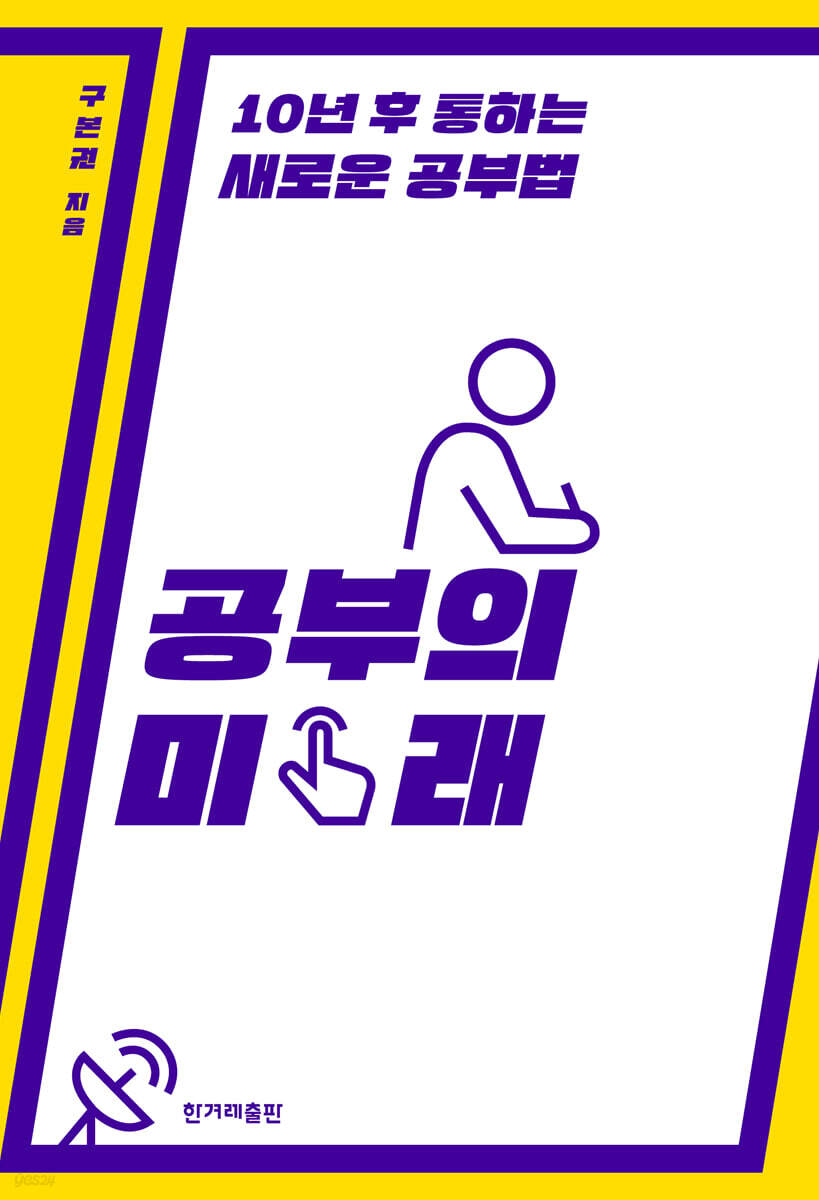
The future of studying
 |
Description
Book Introduction
Highly recommended by Professor Jaeseung Jeong of KAIST
A Future Study Roadmap Designing for 2030
A future transformed by robots and artificial intelligence: What should we learn and what should we teach?
Koo Bon-kwon, an IT journalist and digital humanist who has been rapidly tracking the various phenomena brought about by technological advancements, delves into the issues of future education.
Amidst the global and macroeconomic changes surrounding the educational environment, is South Korea's education system currently competitive?
How should we respond immediately to the rapidly changing educational environment, including automatic machine translation, digital textbooks, and coding education?
How can we develop unique skills that machines can't replace, such as creativity, critical thinking, and collaboration?
If you understand the 'essence of study' that does not change with the times, any crisis becomes an opportunity.
We answer the most pressing and pressing questions in the Korean educational landscape today and explore new study methods that look ahead to the next decade.
A Future Study Roadmap Designing for 2030
A future transformed by robots and artificial intelligence: What should we learn and what should we teach?
Koo Bon-kwon, an IT journalist and digital humanist who has been rapidly tracking the various phenomena brought about by technological advancements, delves into the issues of future education.
Amidst the global and macroeconomic changes surrounding the educational environment, is South Korea's education system currently competitive?
How should we respond immediately to the rapidly changing educational environment, including automatic machine translation, digital textbooks, and coding education?
How can we develop unique skills that machines can't replace, such as creativity, critical thinking, and collaboration?
If you understand the 'essence of study' that does not change with the times, any crisis becomes an opportunity.
We answer the most pressing and pressing questions in the Korean educational landscape today and explore new study methods that look ahead to the next decade.
- You can preview some of the book's contents.
Preview
index
Introduction | How is the 'Future of Learning' Changing?
Part 1: The Meaning of Studying Changes
01 The Future of Learning Tools
In the age of automatic machine translation, should you still learn a foreign language? | Why you should still learn a foreign language | Pros and Cons of Coding Education | The Real Reason to Learn Code | Understand the Pros and Cons of Digital Textbooks | Why Open Online Lectures Fail | Why They Banned PowerPoint
02 The Future of Universities
The College Entrance Exam Competition Will Change in a Low Birthrate Society | The Distinction Between Liberal Arts and Sciences Disappears | The Secrets of Professor Choi Jae-cheon, a Writing Scientist | Universities in Crisis | The Way We Recruit Talent Is Changing | New Universities Are Coming | We Must Learn How to Learn
03 The Future of Jobs
What's the shelf life of my job? | Emerging and declining jobs in Korea | The paradox of jobs that are currently booming | The generation that lives the longest but has the most job insecurity | The concept of work is changing | What is the future of doctors, pharmacists, and lawyers? The paradox of professional occupations | Is the future of professional occupations truly bleak? | "I've already decided on my career path" | What kind of education should I pursue?
Part 2 Future Abilities
04 Creativity
The Demand for Creativity | Misconceptions About Creativity | Creativity is 'Connection' | How to Make Creative Connections | Creativity is 'Curiosity' | 'Safe Base' for Fostering Curiosity | Fixed Mindset vs. Growth Mindset | Creativity is a 'Square Peg'
05 Critical Thinking
The Ultimate Goal of Education | Why Do We Struggle with Critical Thinking? | Why Teaching Critical Thinking Is Difficult | The 'Four Idols' That Obsess Human Cognition | Understanding Cognitive Instincts and Error Propensities | Traps Targeting 'Cognitive Misers' | Why Fake News is So Dangerous in Developed Countries | The Fool with the One Ring | Four Tools for Critical Thinking | Reading: The Beginning of Critical Thinking | Critical Thinking is an 'Attitude to Life'
06 Self-control
The Truth and Misconceptions about the Marshmallow Test | The Marshmallow Test's Reversal | An Environment That Develops Patience | 'Small Happiness' and 'YOLO': A Generation That Can't Delay Gratification | Being Patient in the Digital World | How to Use Your Mind as You Will | The 'Power of Habit' Strategy | The 'Power of Mind' Strategy | How to Avoid Being a Slave to Desire | The Seven Elements of Happiness | Secrets of Life from a Death Camp Survivor
07 Collaborative skills
What Google Discovered Through Human Resources Data Analysis | People Are Stronger Together | 'Complex Problems' Can't Be Solved Alone | Why Did Apple Build Its Donut-Shaped Headquarters? | We Must Learn to Learn Together | Centaur's Guide to the Future of Collaboration | Empathy, a Rarity in the Digital Environment | Communication Begins with Empathy
Part 3: How to Determine Your Own Future
08 People who discovered their inner motivation
What Motivates You | The Paradox of Compensation | Entering Your Dream College, But Facing "College Sophomore Syndrome" | Inner Motivation is Created | The Power to Endure 10,000 Hours | Unchanging Preferred Career Rankings and Korean Society | "Self-Awareness" is the Most Practical Knowledge | The Path to Self-Discovery: "Sudden Change" | "Endureable Trials" and "Learned Helplessness" | The Secrets of "Masters of Life"
09 Starting Point and Ultimate Goal of Learning
Where do I stand in "Navigating the Fog"? | The Secret of the Top 0.1% of Students | Ability that Children Have but Computers Don't | Metacognition: The Control Panel and Steering Wheel of Learning | "Discovering Ignorance" That Enables Learning | Why It's Difficult to Develop Metacognitive Abilities | Self-Objectification: Boosting Metacognition | Metacognition: The "Licorice of Pharmacy"
Part 1: The Meaning of Studying Changes
01 The Future of Learning Tools
In the age of automatic machine translation, should you still learn a foreign language? | Why you should still learn a foreign language | Pros and Cons of Coding Education | The Real Reason to Learn Code | Understand the Pros and Cons of Digital Textbooks | Why Open Online Lectures Fail | Why They Banned PowerPoint
02 The Future of Universities
The College Entrance Exam Competition Will Change in a Low Birthrate Society | The Distinction Between Liberal Arts and Sciences Disappears | The Secrets of Professor Choi Jae-cheon, a Writing Scientist | Universities in Crisis | The Way We Recruit Talent Is Changing | New Universities Are Coming | We Must Learn How to Learn
03 The Future of Jobs
What's the shelf life of my job? | Emerging and declining jobs in Korea | The paradox of jobs that are currently booming | The generation that lives the longest but has the most job insecurity | The concept of work is changing | What is the future of doctors, pharmacists, and lawyers? The paradox of professional occupations | Is the future of professional occupations truly bleak? | "I've already decided on my career path" | What kind of education should I pursue?
Part 2 Future Abilities
04 Creativity
The Demand for Creativity | Misconceptions About Creativity | Creativity is 'Connection' | How to Make Creative Connections | Creativity is 'Curiosity' | 'Safe Base' for Fostering Curiosity | Fixed Mindset vs. Growth Mindset | Creativity is a 'Square Peg'
05 Critical Thinking
The Ultimate Goal of Education | Why Do We Struggle with Critical Thinking? | Why Teaching Critical Thinking Is Difficult | The 'Four Idols' That Obsess Human Cognition | Understanding Cognitive Instincts and Error Propensities | Traps Targeting 'Cognitive Misers' | Why Fake News is So Dangerous in Developed Countries | The Fool with the One Ring | Four Tools for Critical Thinking | Reading: The Beginning of Critical Thinking | Critical Thinking is an 'Attitude to Life'
06 Self-control
The Truth and Misconceptions about the Marshmallow Test | The Marshmallow Test's Reversal | An Environment That Develops Patience | 'Small Happiness' and 'YOLO': A Generation That Can't Delay Gratification | Being Patient in the Digital World | How to Use Your Mind as You Will | The 'Power of Habit' Strategy | The 'Power of Mind' Strategy | How to Avoid Being a Slave to Desire | The Seven Elements of Happiness | Secrets of Life from a Death Camp Survivor
07 Collaborative skills
What Google Discovered Through Human Resources Data Analysis | People Are Stronger Together | 'Complex Problems' Can't Be Solved Alone | Why Did Apple Build Its Donut-Shaped Headquarters? | We Must Learn to Learn Together | Centaur's Guide to the Future of Collaboration | Empathy, a Rarity in the Digital Environment | Communication Begins with Empathy
Part 3: How to Determine Your Own Future
08 People who discovered their inner motivation
What Motivates You | The Paradox of Compensation | Entering Your Dream College, But Facing "College Sophomore Syndrome" | Inner Motivation is Created | The Power to Endure 10,000 Hours | Unchanging Preferred Career Rankings and Korean Society | "Self-Awareness" is the Most Practical Knowledge | The Path to Self-Discovery: "Sudden Change" | "Endureable Trials" and "Learned Helplessness" | The Secrets of "Masters of Life"
09 Starting Point and Ultimate Goal of Learning
Where do I stand in "Navigating the Fog"? | The Secret of the Top 0.1% of Students | Ability that Children Have but Computers Don't | Metacognition: The Control Panel and Steering Wheel of Learning | "Discovering Ignorance" That Enables Learning | Why It's Difficult to Develop Metacognitive Abilities | Self-Objectification: Boosting Metacognition | Metacognition: The "Licorice of Pharmacy"
Into the book
Even in the age of machine translation, foreign language skills are still crucial for evaluating translation results.
No matter how advanced the tools become, machines cannot translate the subtle differences in nuance between English and Korean, the speaker's intentions, or the atmosphere of the situation.
For example, if you type 'Piribu is a man' into Google Translate, it will be translated as 'Piribu is a man'.
When words with ambiguous meanings are used in different contexts, machine translation presents multiple translations, and it's ultimately up to us to decide which one to choose.
The gap between those who know that 'Piribu is a man' is not the desired outcome and those who do not will never disappear in the future.
--- p.22, from “Why You Should Still Learn a Foreign Language”
The purpose of including coding in the revised curriculum is not to teach the 'skills' of computer languages and programming.
Programming languages are constantly being upgraded, and it is certain that artificial intelligence will be able to create programs more efficiently than humans.
The real purpose of teaching coding to students is to develop logical thinking and problem-solving skills through coding.
Coding education is a great learning method that allows students to create something on their own, issue commands to operate it, and immediately see the results, upgrading their skills beyond the textbook- and theory-centric educational reality.
In other words, coding education is important because it is an experiential learning method that allows you to freely use convenient digital tools in the way you want.
--- p.33, from “The Real Reason to Learn Coding”
To lead and control yourself in the direction you want, you must first know yourself.
Like the haenyeo, you must know your breath length, that is, your limits.
Everyone has a different breath length. What if we taught them that success requires unconditional endurance and perseverance, saying, "The fruit of patience is sweet"? The result of unconditional perseverance without understanding one's own limitations is not success, but misfortune or tragedy.
--- p.164, from “Strategy of the ‘Power of the Mind’”
In 2016, Google launched Project Aristotle, an internal study that analyzed the most creative and productive teams within the company.
We compared Team A, comprised of top scientists, with Team B, comprised of less-than-top team members, and again, we got unexpected results.
Team B produced much more important and productive ideas than Team A.
The most effective teams were found to have a common thread: equality, generosity, curiosity about fellow team members' ideas, empathy, and, most importantly, emotional stability and a lack of a "bullying" culture.
--- p.173~174, from “People Who Become Stronger Together”
Education is not something that can be achieved in a short period of time, as the saying goes, “a century-long plan.”
The future is full of uncertainty and volatility, so studying for short-term goals and visible results is very likely to fail.
The wisest way to prepare for the unknown changes in the external world is not to constantly aim for a constantly shifting target, but to discover values that remain unwavering even as time and circumstances change.
That is self-objectification, or metacognition, which begins with reflecting on oneself.
Ultimately, what we can control is neither social change nor the abilities and thoughts of others.
This is why objective reflection on one's own body and mind is the starting point of true study and the future of study.
No matter how advanced the tools become, machines cannot translate the subtle differences in nuance between English and Korean, the speaker's intentions, or the atmosphere of the situation.
For example, if you type 'Piribu is a man' into Google Translate, it will be translated as 'Piribu is a man'.
When words with ambiguous meanings are used in different contexts, machine translation presents multiple translations, and it's ultimately up to us to decide which one to choose.
The gap between those who know that 'Piribu is a man' is not the desired outcome and those who do not will never disappear in the future.
--- p.22, from “Why You Should Still Learn a Foreign Language”
The purpose of including coding in the revised curriculum is not to teach the 'skills' of computer languages and programming.
Programming languages are constantly being upgraded, and it is certain that artificial intelligence will be able to create programs more efficiently than humans.
The real purpose of teaching coding to students is to develop logical thinking and problem-solving skills through coding.
Coding education is a great learning method that allows students to create something on their own, issue commands to operate it, and immediately see the results, upgrading their skills beyond the textbook- and theory-centric educational reality.
In other words, coding education is important because it is an experiential learning method that allows you to freely use convenient digital tools in the way you want.
--- p.33, from “The Real Reason to Learn Coding”
To lead and control yourself in the direction you want, you must first know yourself.
Like the haenyeo, you must know your breath length, that is, your limits.
Everyone has a different breath length. What if we taught them that success requires unconditional endurance and perseverance, saying, "The fruit of patience is sweet"? The result of unconditional perseverance without understanding one's own limitations is not success, but misfortune or tragedy.
--- p.164, from “Strategy of the ‘Power of the Mind’”
In 2016, Google launched Project Aristotle, an internal study that analyzed the most creative and productive teams within the company.
We compared Team A, comprised of top scientists, with Team B, comprised of less-than-top team members, and again, we got unexpected results.
Team B produced much more important and productive ideas than Team A.
The most effective teams were found to have a common thread: equality, generosity, curiosity about fellow team members' ideas, empathy, and, most importantly, emotional stability and a lack of a "bullying" culture.
--- p.173~174, from “People Who Become Stronger Together”
Education is not something that can be achieved in a short period of time, as the saying goes, “a century-long plan.”
The future is full of uncertainty and volatility, so studying for short-term goals and visible results is very likely to fail.
The wisest way to prepare for the unknown changes in the external world is not to constantly aim for a constantly shifting target, but to discover values that remain unwavering even as time and circumstances change.
That is self-objectification, or metacognition, which begins with reflecting on oneself.
Ultimately, what we can control is neither social change nor the abilities and thoughts of others.
This is why objective reflection on one's own body and mind is the starting point of true study and the future of study.
--- p.246, from “The Virtuous Cycle of Learning and Knowledge, Self-Discovery and Happiness”
Publisher's Review
The Future Changed by Robots and Artificial Intelligence
What to learn and what to teach
“Korean students waste more than 10 hours a day at school and academies, studying for knowledge that will not be needed in the future and for jobs that will not exist.” World-renowned futurist Alvin Toffler expressed concern about Korea’s entrance exam-oriented education system and emphasized educational reform suitable for the 21st century.
Since the shock of AlphaGo shook Korean society in March 2016, attempts at reform have been made in the Korean education sector, which was late to recognize the crisis.
In preparation for the Fourth Industrial Revolution, the Ministry of Education has made coding education, which covers the language of digital and artificial intelligence, mandatory starting in the 2018 school year.
In the private education market, coding academies are rapidly increasing, fanning anxiety with aggressive marketing.
Conversely, there is also a strong argument that there is no need to learn coding.
Andreas Schleicher, OECD Education Director, criticized coding education as a waste of time, saying, “We’re teaching coding to three-year-olds now, and by the time they graduate from college, they won’t even remember what coding is.”
What choices should students and parents make as they face the prospect of college and career advancement? Should they learn coding, or should they forgo it?
Currently, the hottest questions in the Korean education field
Realistic answers and concrete advice
Having personally met countless parents, teachers, and students who are feeling a sense of crisis about the changes brought about by artificial intelligence and robots, the author examines the numerous pressing questions raised in the educational field one by one and presents practical alternatives.
In an age where Google's real-time translation earphones, "Pixel Buds," Naver's translation app, "Papago," and high-quality translation apps that instantly translate menus by pointing the camera at them, is it really necessary to learn a foreign language? Why should we learn a foreign language, and how can we motivate students? Is it right to immediately introduce online video lectures (online lectures), digital textbooks, and various educational apps to the classroom? If so, have these smart devices actually helped enhance learning in the classroom? While the fundamental assumptions of traditional education and learning are being shaken, we still tend to view the future and make choices based on methods and standards that were prevalent in the past.
This book focuses on the most pressing questions in the current Korean education landscape, guiding those struggling with anxiety and a sense of crisis to make wise choices.
Creativity, critical thinking, self-control, collaboration…
How to Develop "Soft Skills"—The Future's Abilities
Is Korean education competitive amidst global and macroeconomic changes surrounding the educational environment?
Our country's entrance exam-oriented education system has long ranked students based on their ability to guess the correct answer, but this is bound to change in the future.
"Hard skills" that can be replaced by machines, such as reading comprehension, typing and programming skills, math skills, and machine operation skills, are not included in the competencies for the future.
Future education must be directed toward fostering an attitude and ability to embrace complexity and unpredictability without fear.
It's about developing 'soft skills' such as creativity, critical thinking, self-control, and collaboration.
This book examines the roots of South Korea's education system, which has neglected "soft skills," which are more difficult to specifically assess, compared to "hard skills," and meticulously examines what kind of educational environment must be created at home and at school to foster these abilities in students.
Furthermore, we explore ways to discover and develop soft skills, uniquely human abilities, across fields such as humanities, philosophy, psychology, and science.
The essence of study that does not change even as times change,
We must learn 'metacognition'
The author views 'metacognition', the ability to understand what one knows and what one does not know, as the core and most powerful tool for studying.
People with developed metacognition have excellent learning abilities.
Because you can objectively assess your own condition, you can know what to study within a limited time, reflect on the meaning of what you are doing, receive feedback, and continuously grow.
If you have the metacognitive ability to step back and look at a problem and find its essence, you can find solutions no matter how unfamiliar the environment or new problem you encounter.
However, metacognition is the most advanced cognitive ability that humans possess, and not many people are able to use it freely.
This book presents specific methods for fostering metacognitive abilities through education and learning, based on various statistics, experiments, and research.
The future is full of uncertainty and volatility, so studying with short-term goals and visible results is very likely to fail.
Only those who understand the fundamental values that remain unchanged even in an uncertain future and constantly study toward them can achieve fruition and happiness.
Cutting-edge technology and an uncertain future once again call into question the essence of learning.
We need to learn a new way of studying that looks beyond immediate test scores and college admissions to a future 10 years in the future.
This book will provide the answer.
What to learn and what to teach
“Korean students waste more than 10 hours a day at school and academies, studying for knowledge that will not be needed in the future and for jobs that will not exist.” World-renowned futurist Alvin Toffler expressed concern about Korea’s entrance exam-oriented education system and emphasized educational reform suitable for the 21st century.
Since the shock of AlphaGo shook Korean society in March 2016, attempts at reform have been made in the Korean education sector, which was late to recognize the crisis.
In preparation for the Fourth Industrial Revolution, the Ministry of Education has made coding education, which covers the language of digital and artificial intelligence, mandatory starting in the 2018 school year.
In the private education market, coding academies are rapidly increasing, fanning anxiety with aggressive marketing.
Conversely, there is also a strong argument that there is no need to learn coding.
Andreas Schleicher, OECD Education Director, criticized coding education as a waste of time, saying, “We’re teaching coding to three-year-olds now, and by the time they graduate from college, they won’t even remember what coding is.”
What choices should students and parents make as they face the prospect of college and career advancement? Should they learn coding, or should they forgo it?
Currently, the hottest questions in the Korean education field
Realistic answers and concrete advice
Having personally met countless parents, teachers, and students who are feeling a sense of crisis about the changes brought about by artificial intelligence and robots, the author examines the numerous pressing questions raised in the educational field one by one and presents practical alternatives.
In an age where Google's real-time translation earphones, "Pixel Buds," Naver's translation app, "Papago," and high-quality translation apps that instantly translate menus by pointing the camera at them, is it really necessary to learn a foreign language? Why should we learn a foreign language, and how can we motivate students? Is it right to immediately introduce online video lectures (online lectures), digital textbooks, and various educational apps to the classroom? If so, have these smart devices actually helped enhance learning in the classroom? While the fundamental assumptions of traditional education and learning are being shaken, we still tend to view the future and make choices based on methods and standards that were prevalent in the past.
This book focuses on the most pressing questions in the current Korean education landscape, guiding those struggling with anxiety and a sense of crisis to make wise choices.
Creativity, critical thinking, self-control, collaboration…
How to Develop "Soft Skills"—The Future's Abilities
Is Korean education competitive amidst global and macroeconomic changes surrounding the educational environment?
Our country's entrance exam-oriented education system has long ranked students based on their ability to guess the correct answer, but this is bound to change in the future.
"Hard skills" that can be replaced by machines, such as reading comprehension, typing and programming skills, math skills, and machine operation skills, are not included in the competencies for the future.
Future education must be directed toward fostering an attitude and ability to embrace complexity and unpredictability without fear.
It's about developing 'soft skills' such as creativity, critical thinking, self-control, and collaboration.
This book examines the roots of South Korea's education system, which has neglected "soft skills," which are more difficult to specifically assess, compared to "hard skills," and meticulously examines what kind of educational environment must be created at home and at school to foster these abilities in students.
Furthermore, we explore ways to discover and develop soft skills, uniquely human abilities, across fields such as humanities, philosophy, psychology, and science.
The essence of study that does not change even as times change,
We must learn 'metacognition'
The author views 'metacognition', the ability to understand what one knows and what one does not know, as the core and most powerful tool for studying.
People with developed metacognition have excellent learning abilities.
Because you can objectively assess your own condition, you can know what to study within a limited time, reflect on the meaning of what you are doing, receive feedback, and continuously grow.
If you have the metacognitive ability to step back and look at a problem and find its essence, you can find solutions no matter how unfamiliar the environment or new problem you encounter.
However, metacognition is the most advanced cognitive ability that humans possess, and not many people are able to use it freely.
This book presents specific methods for fostering metacognitive abilities through education and learning, based on various statistics, experiments, and research.
The future is full of uncertainty and volatility, so studying with short-term goals and visible results is very likely to fail.
Only those who understand the fundamental values that remain unchanged even in an uncertain future and constantly study toward them can achieve fruition and happiness.
Cutting-edge technology and an uncertain future once again call into question the essence of learning.
We need to learn a new way of studying that looks beyond immediate test scores and college admissions to a future 10 years in the future.
This book will provide the answer.
GOODS SPECIFICS
- Date of issue: November 8, 2023
- Page count, weight, size: 252 pages | 140*205*20mm
- ISBN13: 9791160407112
- ISBN10: 1160407118
You may also like
카테고리
korean


korean

![GQ KOREA Mark (Monthly): December [2025]](http://librairie.coreenne.fr/cdn/shop/files/8ef265dbbfbf186523ed75ba7319009d.jpg?v=1765340328&width=3840)


