

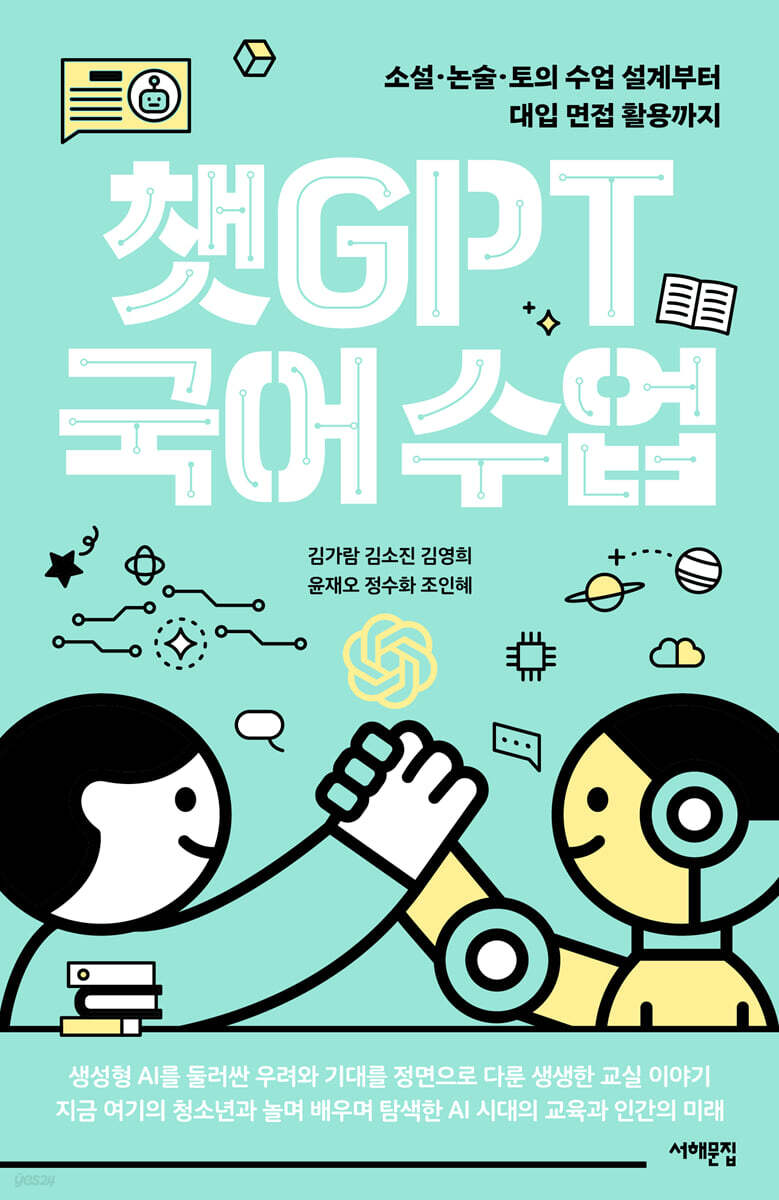
ChatGPT Korean class
 |
Description
Book Introduction
Education in the AI Era: Play, Learn, and Explore with Youth Today
A ChatGPT class story written by six teachers from the Training Department, which plans lectures and organizes study sessions at the National Korean Language Teachers Association.
With the proliferation of educational applications for ChatGPT, I share the shocking results, positive outlook, and implications of AI education I witnessed while using ChatGPT with students in Korean language classes.
Through ChatGPT, you can discover your own potential, break down preconceived notions, and meet students who are growing by verbalizing their own selves, something they couldn't grasp on their own.
This book shows how generative artificial intelligence, the pinnacle of cutting-edge technology, can align with the age-old goal of education: self-discovery.
From the preparation process for novel, essay, interview, and discussion classes to student responses in the classroom and tips for conducting classes, it provides detailed information, making it a reference point for teachers who are considering trying ChatGPT classes as well as those who are contemplating what school classes should include in the age of artificial intelligence.
A ChatGPT class story written by six teachers from the Training Department, which plans lectures and organizes study sessions at the National Korean Language Teachers Association.
With the proliferation of educational applications for ChatGPT, I share the shocking results, positive outlook, and implications of AI education I witnessed while using ChatGPT with students in Korean language classes.
Through ChatGPT, you can discover your own potential, break down preconceived notions, and meet students who are growing by verbalizing their own selves, something they couldn't grasp on their own.
This book shows how generative artificial intelligence, the pinnacle of cutting-edge technology, can align with the age-old goal of education: self-discovery.
From the preparation process for novel, essay, interview, and discussion classes to student responses in the classroom and tips for conducting classes, it provides detailed information, making it a reference point for teachers who are considering trying ChatGPT classes as well as those who are contemplating what school classes should include in the age of artificial intelligence.
- You can preview some of the book's contents.
Preview
index
preface
01 If you say something that is not true as if it were true
― Let's get creative help! A novel rewriting class with ChatGPT.
No, this is AI?
Since the novel is a plausible story, should we try reconstructing the novel with the help of ChatGPT?
The Beginning of the Chat GPT Korean Class _[1st Session] The Difficult Road to Membership Registration
New tools are meant to be played with! _[Second Session] Getting Familiar with ChatGPT
Let's teach Liar Chat GPT like a younger sibling _[Session 3] Teaching Novel Plots
Good Questions Create Good Results _[Session 4] Reconstructing a Novel Plot
Let's create a completely new story _[Session 5] Getting the ideas you need to write a novel
We Need Other Learning Muscles - From Webtoon Storytelling to Simultaneous Reading and Writing Learning
If you can't stop it, tackle it head on.
02 Is the poem created by ChatGPT a literary work?
―Literature 'visible' as literature, the conditions of literature explored through a chain of questions.
The most lyrical literature, poetry
I asked ChatGPT… “It generates poetic-looking text.”
Human Poet vs.
ChatGPT _[Session 1] Comparative Analysis of Han Yong-un's "False Breakup" and ChatGPT's "Withered Rose"
Shocking Results: Kids Who Like ChatGPT Poetry Better - What is a Reader and What is Literature?
A Powerful Tool for Creating Good Questions _[Part 2] Using the 4-Step 'Question Continuum' Method
So, what is literature really? _[3rd period] Logical writing using ChatGPT
Our Attitude to AI: A New Companion
[Reference] 'Creating a Question Continuum' Activity Sheet
03 If someone would write my heart for me
― Constant conversation with yourself: Write affectionate letters with ChatGPT
“Not everyone needs to be a good writer.”
Writing to Love and Accept Yourself _[Session 1] Writing a Kind Letter to Myself
I almost burst into tears _ A letter writing experiment using ChatGPT
"Thought Oralization" in the Writing Process _[Second Session] Rewriting a Letter with ChatGPT
If everyone can take the first step toward writing lightly, _Spitting out, noticing, and speaking again with ChatGPT
Sharing and Evaluation Are Not Fearful - ChatGPT Breaks Down Barriers
The experience of having a piece of writing that moves you
Meet your own Socrates
[Reference Material ①] 'A Letter to Myself' Class Activity Sheet
[Reference Material ②] Activity Sheet after the 'Letter to Myself' class
04 Cultivating Media Literacy
― Refute ChatGPT! A Writing Class for the Age of Confirmation Bias
“What is ChatGPT?”
Now is the time to 'construct' knowledge
A thorough warm-up [sessions 1-5] Persuasive writing A to Z
Finally on the Waves, "ChatGPT Plus" Activity _ [Session 6] Responding to ChatGPT
Critically Understanding Other Perspectives: A New Evolution of Media Literacy
Proving ChatGPT's Fault _[Session 7] Exploring Data for Rebuttal
Opening a Door to New Perception _[Lesson 8] Refuting ChatGPT
I decided to let the waves take me.
[Reference] 'Persuasive Writing with ChatGPT' Class Activity Sheet
05 Each person discovers himself/herself
― Career planning at your fingertips: Prepare for college interviews with ChatGPT.
Am I useful?
ChatGPT Meal Kit _[Session 1] Finding Expected Interview Questions
'M for All of Us' _[Second Session] Rewriting Interview Answers
Turning Small Experiences into Great Skills _[Session 3] Complete an Interview Script with a 'Pair Conversation'
What collaboration leaves behind: the confidence that we can achieve it.
And for interviews that require background knowledge, 'Y of us all'
Finding My Story in Unfamiliar Information - Summarizing and Understanding the Data
30-Minute Miracle - Rediscovering What You Want to Do
Freer than the word useful
06 What keeps me alive as an analog teacher
―Contemplating the relationship between humans and technology through discussions that foster questions.
The digital world blossoming in an analog classroom
Beyond the boundaries between teacher and learner
Let's study ChatGPT properly _[1-2nd period] Things we were really curious about
Learner-led learning _[3rd period] Two questions, a heated discussion
From Theory to Practice - Writing Columns with ChatGPT
Where is this class going? _[Periods 4-6] How to Use ChatGPT Yourself
Nevertheless, the birth of a core question _[Classes 7-10] Exploring ChatGPT through a forum for all grades
Where the Learning Teacher Arrives _[11th Session] A Class of Questions That Keeps You on the Edge
Our coexistence has already begun
[Reference] Books that Help with Learner-Driven, Questioning, and Blended Learning Classes
main
01 If you say something that is not true as if it were true
― Let's get creative help! A novel rewriting class with ChatGPT.
No, this is AI?
Since the novel is a plausible story, should we try reconstructing the novel with the help of ChatGPT?
The Beginning of the Chat GPT Korean Class _[1st Session] The Difficult Road to Membership Registration
New tools are meant to be played with! _[Second Session] Getting Familiar with ChatGPT
Let's teach Liar Chat GPT like a younger sibling _[Session 3] Teaching Novel Plots
Good Questions Create Good Results _[Session 4] Reconstructing a Novel Plot
Let's create a completely new story _[Session 5] Getting the ideas you need to write a novel
We Need Other Learning Muscles - From Webtoon Storytelling to Simultaneous Reading and Writing Learning
If you can't stop it, tackle it head on.
02 Is the poem created by ChatGPT a literary work?
―Literature 'visible' as literature, the conditions of literature explored through a chain of questions.
The most lyrical literature, poetry
I asked ChatGPT… “It generates poetic-looking text.”
Human Poet vs.
ChatGPT _[Session 1] Comparative Analysis of Han Yong-un's "False Breakup" and ChatGPT's "Withered Rose"
Shocking Results: Kids Who Like ChatGPT Poetry Better - What is a Reader and What is Literature?
A Powerful Tool for Creating Good Questions _[Part 2] Using the 4-Step 'Question Continuum' Method
So, what is literature really? _[3rd period] Logical writing using ChatGPT
Our Attitude to AI: A New Companion
[Reference] 'Creating a Question Continuum' Activity Sheet
03 If someone would write my heart for me
― Constant conversation with yourself: Write affectionate letters with ChatGPT
“Not everyone needs to be a good writer.”
Writing to Love and Accept Yourself _[Session 1] Writing a Kind Letter to Myself
I almost burst into tears _ A letter writing experiment using ChatGPT
"Thought Oralization" in the Writing Process _[Second Session] Rewriting a Letter with ChatGPT
If everyone can take the first step toward writing lightly, _Spitting out, noticing, and speaking again with ChatGPT
Sharing and Evaluation Are Not Fearful - ChatGPT Breaks Down Barriers
The experience of having a piece of writing that moves you
Meet your own Socrates
[Reference Material ①] 'A Letter to Myself' Class Activity Sheet
[Reference Material ②] Activity Sheet after the 'Letter to Myself' class
04 Cultivating Media Literacy
― Refute ChatGPT! A Writing Class for the Age of Confirmation Bias
“What is ChatGPT?”
Now is the time to 'construct' knowledge
A thorough warm-up [sessions 1-5] Persuasive writing A to Z
Finally on the Waves, "ChatGPT Plus" Activity _ [Session 6] Responding to ChatGPT
Critically Understanding Other Perspectives: A New Evolution of Media Literacy
Proving ChatGPT's Fault _[Session 7] Exploring Data for Rebuttal
Opening a Door to New Perception _[Lesson 8] Refuting ChatGPT
I decided to let the waves take me.
[Reference] 'Persuasive Writing with ChatGPT' Class Activity Sheet
05 Each person discovers himself/herself
― Career planning at your fingertips: Prepare for college interviews with ChatGPT.
Am I useful?
ChatGPT Meal Kit _[Session 1] Finding Expected Interview Questions
'M for All of Us' _[Second Session] Rewriting Interview Answers
Turning Small Experiences into Great Skills _[Session 3] Complete an Interview Script with a 'Pair Conversation'
What collaboration leaves behind: the confidence that we can achieve it.
And for interviews that require background knowledge, 'Y of us all'
Finding My Story in Unfamiliar Information - Summarizing and Understanding the Data
30-Minute Miracle - Rediscovering What You Want to Do
Freer than the word useful
06 What keeps me alive as an analog teacher
―Contemplating the relationship between humans and technology through discussions that foster questions.
The digital world blossoming in an analog classroom
Beyond the boundaries between teacher and learner
Let's study ChatGPT properly _[1-2nd period] Things we were really curious about
Learner-led learning _[3rd period] Two questions, a heated discussion
From Theory to Practice - Writing Columns with ChatGPT
Where is this class going? _[Periods 4-6] How to Use ChatGPT Yourself
Nevertheless, the birth of a core question _[Classes 7-10] Exploring ChatGPT through a forum for all grades
Where the Learning Teacher Arrives _[11th Session] A Class of Questions That Keeps You on the Edge
Our coexistence has already begun
[Reference] Books that Help with Learner-Driven, Questioning, and Blended Learning Classes
main
Detailed image
.jpg)
Into the book
This summer, as a summer vacation assignment for first-year middle school students, I assigned them to 'read one of the suggested coming-of-age novels and organize it in their own way.'
Some students were talking among themselves, saying, “We can just let ChatGPT do it,” and “No, Bard is better.”
Even though I'm in my first year of middle school, I already know about and have used tools like ChatGPT.
--- p.51
ChatGPT's breakup poem, which included metaphors and symbols, was slightly refined and included in the activity sheet.
The title is “Withered Rose.”
Along with this poem, I chose Han Yong-un's poem "False Farewell" and created an activity sheet to compare the two works.
(…) I asked people to raise their hands for the poem they liked better between (A) and (B) without giving them any information about the creator of the poem.
I naturally expected that there would be many children who would choose (me) with higher literary quality.
(A) I was a little worried that there might not be many children who would choose it because the poem felt too childish and simple.
Then, you may lose interest in the next class that will cover ChatGPT.
I also thought that I should say, 'Still, if artificial intelligence can do this, it's well-written!'
But the results of seeing the number of children who raised their hands were shocking.
Among the 50 or so students in the two classes, 70% said that (A) written by ChatGPT was better.
--- p.62~66
If you tell children who already hate writing to rewrite it over and over again, many of them will give up from the beginning.
However, since ChatGPT is structured to correct things based on their own questions, the children were not afraid to correct things multiple times.
Also, in situations where you are rewriting on your own, you tend to end up only revising the parts that you have received feedback on.
However, since ChatGPT sometimes changed the flow or tone of the entire text depending on the question provided, children had to read the entire text multiple times and re-convey their requests.
--- p.116
Some children had difficulty refuting ChatGPT's opinions.
There were various difficult points.
Because everything ChatGPT said seemed to be correct, I was unable to provide any basis for rebuttal, and I also had a hard time reading ChatGPT's data one by one, fact-checking it, and then finding rebuttal material.
ChatGPT appears to be making claims, but in fact it only lists information, so there were times when it took time to understand the basis.
It can be assumed that one of the reasons for this was that there was little experience in refuting the opinions of others who wrote on the same topic as oneself.
Yet, the children themselves found errors in ChatGPT's writing, which seemed perfect at first glance.
I found this point particularly interesting from a media literacy perspective.
In our previous performance evaluations, we had been working on messages to always be wary of fake news, exaggerated advertisements, and misinformation, but through 'ChatGPT Plus', we were able to confirm that our activities had evolved beyond simple vigilance into activities that allowed us to develop the ability to distinguish between real and fake information.
--- p.143~144
The interview answers were drafted by the students themselves.
From the moment I started writing the draft, I felt like if I used ChatGPT, it wouldn't be about me.
We want to do better with the help of AI, not expect it to think for us.
(…) M’s answers to the questions were filled with experiences that showed him to be an honest and good person, written in his characteristically plain sentences.
However, it was not enough to convince the university that he was a passionate person capable of pursuing in-depth learning.
So I told M to input his draft into the question box of ChatGPT and ask him to supplement it with an interview-ready answer.
(…) The revised results of ChatGPT were exactly in line with the writing purpose of an interview response.
While keeping M's experiences intact in the draft, he emphasized that what he learned and thought at that time became an asset that could help him lead a fulfilling college life.
It was definitely a strategic answer.
--- p.177~182
The dizzying forum class ended with a discussion among the third-year students.
The heated class was cooled down.
We read "The Age of Labor is Over,"9, which we learned about during a training session with the National Korean Language Teachers Association, and discussed the following questions: "Why do humans strive to develop artificial intelligence? Why are people so enthusiastic about ChatGPT? What are the characteristics of ChatGPT that have led to such an explosive response compared to other services?"
At this time, I participated as a recorder.
The students are solely responsible for conducting and participating in the discussion.
The children's growth was amazing.
The process of speaking, listening, and asking questions became natural.
The conversation didn't break off like dumpling dough, but rather, the words between each other were connected by questions.
This was the closest thing to the question-and-answer class I've been wanting to do for a while.
The final discussion touched on 'human attitudes toward developing artificial intelligence.'
What if artificial intelligence were developed simply to satisfy human curiosity or make money? The class closed with a discussion on the ethical development of science and technology that contributes to humanity and society.
Some students were talking among themselves, saying, “We can just let ChatGPT do it,” and “No, Bard is better.”
Even though I'm in my first year of middle school, I already know about and have used tools like ChatGPT.
--- p.51
ChatGPT's breakup poem, which included metaphors and symbols, was slightly refined and included in the activity sheet.
The title is “Withered Rose.”
Along with this poem, I chose Han Yong-un's poem "False Farewell" and created an activity sheet to compare the two works.
(…) I asked people to raise their hands for the poem they liked better between (A) and (B) without giving them any information about the creator of the poem.
I naturally expected that there would be many children who would choose (me) with higher literary quality.
(A) I was a little worried that there might not be many children who would choose it because the poem felt too childish and simple.
Then, you may lose interest in the next class that will cover ChatGPT.
I also thought that I should say, 'Still, if artificial intelligence can do this, it's well-written!'
But the results of seeing the number of children who raised their hands were shocking.
Among the 50 or so students in the two classes, 70% said that (A) written by ChatGPT was better.
--- p.62~66
If you tell children who already hate writing to rewrite it over and over again, many of them will give up from the beginning.
However, since ChatGPT is structured to correct things based on their own questions, the children were not afraid to correct things multiple times.
Also, in situations where you are rewriting on your own, you tend to end up only revising the parts that you have received feedback on.
However, since ChatGPT sometimes changed the flow or tone of the entire text depending on the question provided, children had to read the entire text multiple times and re-convey their requests.
--- p.116
Some children had difficulty refuting ChatGPT's opinions.
There were various difficult points.
Because everything ChatGPT said seemed to be correct, I was unable to provide any basis for rebuttal, and I also had a hard time reading ChatGPT's data one by one, fact-checking it, and then finding rebuttal material.
ChatGPT appears to be making claims, but in fact it only lists information, so there were times when it took time to understand the basis.
It can be assumed that one of the reasons for this was that there was little experience in refuting the opinions of others who wrote on the same topic as oneself.
Yet, the children themselves found errors in ChatGPT's writing, which seemed perfect at first glance.
I found this point particularly interesting from a media literacy perspective.
In our previous performance evaluations, we had been working on messages to always be wary of fake news, exaggerated advertisements, and misinformation, but through 'ChatGPT Plus', we were able to confirm that our activities had evolved beyond simple vigilance into activities that allowed us to develop the ability to distinguish between real and fake information.
--- p.143~144
The interview answers were drafted by the students themselves.
From the moment I started writing the draft, I felt like if I used ChatGPT, it wouldn't be about me.
We want to do better with the help of AI, not expect it to think for us.
(…) M’s answers to the questions were filled with experiences that showed him to be an honest and good person, written in his characteristically plain sentences.
However, it was not enough to convince the university that he was a passionate person capable of pursuing in-depth learning.
So I told M to input his draft into the question box of ChatGPT and ask him to supplement it with an interview-ready answer.
(…) The revised results of ChatGPT were exactly in line with the writing purpose of an interview response.
While keeping M's experiences intact in the draft, he emphasized that what he learned and thought at that time became an asset that could help him lead a fulfilling college life.
It was definitely a strategic answer.
--- p.177~182
The dizzying forum class ended with a discussion among the third-year students.
The heated class was cooled down.
We read "The Age of Labor is Over,"9, which we learned about during a training session with the National Korean Language Teachers Association, and discussed the following questions: "Why do humans strive to develop artificial intelligence? Why are people so enthusiastic about ChatGPT? What are the characteristics of ChatGPT that have led to such an explosive response compared to other services?"
At this time, I participated as a recorder.
The students are solely responsible for conducting and participating in the discussion.
The children's growth was amazing.
The process of speaking, listening, and asking questions became natural.
The conversation didn't break off like dumpling dough, but rather, the words between each other were connected by questions.
This was the closest thing to the question-and-answer class I've been wanting to do for a while.
The final discussion touched on 'human attitudes toward developing artificial intelligence.'
What if artificial intelligence were developed simply to satisfy human curiosity or make money? The class closed with a discussion on the ethical development of science and technology that contributes to humanity and society.
--- p.239~240
Publisher's Review
Middle and high school students are already using ChatGPT.
Just like searching for materials on YouTube, ask ChatGPT about vacation homework.
Students interested in artificial intelligence study the prompts on their own and even use the paid version of ChatGPT.
This generative AI, which answers unlimited questions about far more than teachers, has settled down with children.
What is the role of the teacher now? In the age of ChatGPT, which handles the entire process of searching for information, summarizing content, outlining, and writing, what should Korean language teachers teach? "ChatGPT Korean Class" provides a concrete example of what kind of education is possible when ChatGPT is incorporated into the classroom.
We'll show you in detail how to ride, overcome, and enjoy the wave of ChatGPT, which is so smart it's scary.
If ChatGPT does everything, what will we do during Korean class?
Can the poetry created by ChatGPT be called literature?
What would happen if anyone could write easily?
Can media literacy be fostered with ChatGPT?
How can I get help with career planning and interview preparation?
How to Ride, Surf, and Enjoy the Wave of the Scarily Smart Chat GPT
A vivid classroom story that addresses the concerns and expectations surrounding generative AI head-on!
The authors of "Chat GPT Korean Language Class" are six teachers from the National Korean Language Teachers Association Training Department.
At a time when experts from various fields, including engineering, neuroscience, and trend analysis, were predicting the impact ChatGPT would have on education, we gathered together with the goal of designing lessons that reflect the aspirations of teachers who meet students directly in the classroom.
We planned, shared, and redesigned the ChatGPT class once a month.
Thanks to their tireless efforts, students who could barely write a single line during writing time are taking their first steps toward writing with ChatGPT.
By going so far as to rewrite, you will discover the story you truly wanted to tell, put it into words, and have a complete piece that moves you.
Students who are diligent but lack academic achievement can quickly understand the specialized knowledge required for college admission interviews and develop strategic responses through ChatGPT.
By rewriting ChatGPT's text and connecting it to my own experiences and giving it meaning, I discovered a new career path I hadn't dreamed of before and successfully completed my interview.
Children who preferred ChatGPT's poetry to Han Yong-un's, after learning who the creator was, began to ponder the conditions of literature and became interested in the human capabilities needed in the age of artificial intelligence.
By reconstructing the novel's plot with ChatGPT, you will develop the ability to critically understand the information provided by AI and accurately express your intentions in words.
By writing against ChatGPT, you can understand other perspectives and expand your perspective, thereby breaking away from the attitude of trying to push your own point of view.
Develop media literacy to recognize confirmation bias and discern fake information.
Sometimes classes flow away from the teacher's hands.
However, this process demonstrates the aspects of classes where learner-led learning is realized and the reality of learner-tailored education through ChatGPT.
Through heated discussions and provocative questions, students explore ChatGPT, peering into the relationship between humans and machines and realizing that the artificial intelligence they once feared is actually a mirror reflecting the human face.
To help students navigate the surging waves of ChatGPT, the authors explored various ways to create "the right questions."
We've discovered a powerful tool that helps the entire class generate questions for ChatGPT that elicit continuous and sophisticated answers. The book includes examples of good questions written by students, as well as guide questions that teachers can use when teaching fiction, essay writing, interviews, and discussion classes.
He also shared, without reservation, the mistakes and failures he experienced through physical contact, and the insights he gained from them.
This book will serve as a reference point for teachers contemplating what school classes should include in the age of artificial intelligence.
“The reason why Korean language teachers, who are staunch liberal arts-oriented people, started to focus on artificial intelligence classes, the pinnacle of cutting-edge technology, is because they wanted the many students who were ‘already’ using ChatGPT to not just be amazed by the amazing technology and end up like that.
We wanted to give children the experience of analyzing and interpreting what ChatGPT said and then reconstructing it in their own thoughts and words.
So I couldn't be satisfied with the activity of inputting commands into a machine and receiving a response.
I tried to awaken new thoughts about the world and existence.
I thought that was the only way to call it a Korean language class.” _From the introduction
Just like searching for materials on YouTube, ask ChatGPT about vacation homework.
Students interested in artificial intelligence study the prompts on their own and even use the paid version of ChatGPT.
This generative AI, which answers unlimited questions about far more than teachers, has settled down with children.
What is the role of the teacher now? In the age of ChatGPT, which handles the entire process of searching for information, summarizing content, outlining, and writing, what should Korean language teachers teach? "ChatGPT Korean Class" provides a concrete example of what kind of education is possible when ChatGPT is incorporated into the classroom.
We'll show you in detail how to ride, overcome, and enjoy the wave of ChatGPT, which is so smart it's scary.
If ChatGPT does everything, what will we do during Korean class?
Can the poetry created by ChatGPT be called literature?
What would happen if anyone could write easily?
Can media literacy be fostered with ChatGPT?
How can I get help with career planning and interview preparation?
How to Ride, Surf, and Enjoy the Wave of the Scarily Smart Chat GPT
A vivid classroom story that addresses the concerns and expectations surrounding generative AI head-on!
The authors of "Chat GPT Korean Language Class" are six teachers from the National Korean Language Teachers Association Training Department.
At a time when experts from various fields, including engineering, neuroscience, and trend analysis, were predicting the impact ChatGPT would have on education, we gathered together with the goal of designing lessons that reflect the aspirations of teachers who meet students directly in the classroom.
We planned, shared, and redesigned the ChatGPT class once a month.
Thanks to their tireless efforts, students who could barely write a single line during writing time are taking their first steps toward writing with ChatGPT.
By going so far as to rewrite, you will discover the story you truly wanted to tell, put it into words, and have a complete piece that moves you.
Students who are diligent but lack academic achievement can quickly understand the specialized knowledge required for college admission interviews and develop strategic responses through ChatGPT.
By rewriting ChatGPT's text and connecting it to my own experiences and giving it meaning, I discovered a new career path I hadn't dreamed of before and successfully completed my interview.
Children who preferred ChatGPT's poetry to Han Yong-un's, after learning who the creator was, began to ponder the conditions of literature and became interested in the human capabilities needed in the age of artificial intelligence.
By reconstructing the novel's plot with ChatGPT, you will develop the ability to critically understand the information provided by AI and accurately express your intentions in words.
By writing against ChatGPT, you can understand other perspectives and expand your perspective, thereby breaking away from the attitude of trying to push your own point of view.
Develop media literacy to recognize confirmation bias and discern fake information.
Sometimes classes flow away from the teacher's hands.
However, this process demonstrates the aspects of classes where learner-led learning is realized and the reality of learner-tailored education through ChatGPT.
Through heated discussions and provocative questions, students explore ChatGPT, peering into the relationship between humans and machines and realizing that the artificial intelligence they once feared is actually a mirror reflecting the human face.
To help students navigate the surging waves of ChatGPT, the authors explored various ways to create "the right questions."
We've discovered a powerful tool that helps the entire class generate questions for ChatGPT that elicit continuous and sophisticated answers. The book includes examples of good questions written by students, as well as guide questions that teachers can use when teaching fiction, essay writing, interviews, and discussion classes.
He also shared, without reservation, the mistakes and failures he experienced through physical contact, and the insights he gained from them.
This book will serve as a reference point for teachers contemplating what school classes should include in the age of artificial intelligence.
“The reason why Korean language teachers, who are staunch liberal arts-oriented people, started to focus on artificial intelligence classes, the pinnacle of cutting-edge technology, is because they wanted the many students who were ‘already’ using ChatGPT to not just be amazed by the amazing technology and end up like that.
We wanted to give children the experience of analyzing and interpreting what ChatGPT said and then reconstructing it in their own thoughts and words.
So I couldn't be satisfied with the activity of inputting commands into a machine and receiving a response.
I tried to awaken new thoughts about the world and existence.
I thought that was the only way to call it a Korean language class.” _From the introduction
GOODS SPECIFICS
- Date of issue: October 31, 2023
- Page count, weight, size: 256 pages | 130*200*20mm
- ISBN13: 9791192988344
- ISBN10: 1192988345
You may also like
카테고리
korean


korean

![GQ KOREA Mark (Monthly): December [2025]](http://librairie.coreenne.fr/cdn/shop/files/8ef265dbbfbf186523ed75ba7319009d.jpg?v=1765340328&width=3840)


