

Wild Table
 |
Description
Book Introduction
- A word from MD
- [A Healthy Life Harvested from Nature] A book containing the diary of author Mo Wilde, who lived for a year only on things gathered from nature.
His adventurous table, which he thought would be poor but ended up being both full and generous, makes him want to experience the wild flavors he never imagined.
A book that lets you experience the wild life where health blossoms naturally.
- Essay PD Lee Na-young
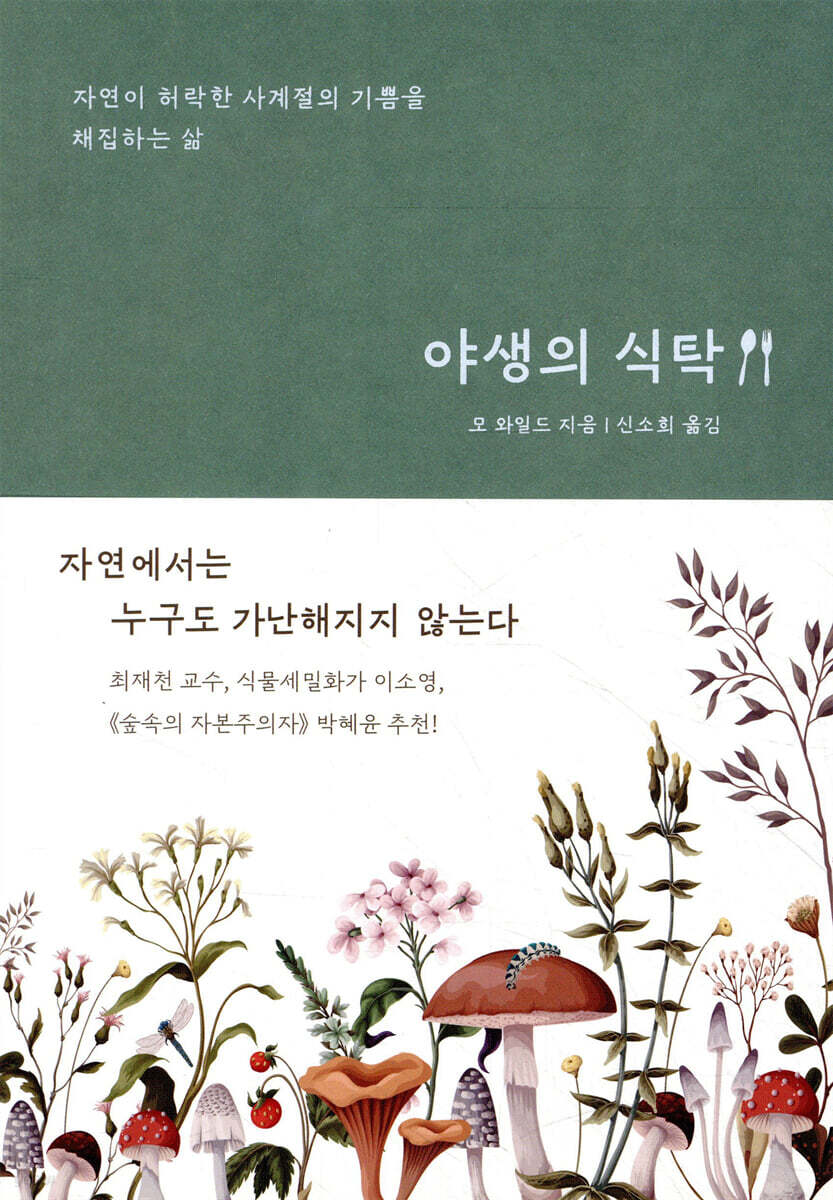
In nature, no one becomes poor.
Ecologist Choi Jae-cheon and botanical artist Lee So-young
『Capitalist in the Forest』 by Park Hye-yoon, highly recommended!
Watching people who are concerned about the climate crisis and the destruction of nature yet willingly plunge into the hell of consumerism and endless desire, Mo Wilde ponders one question.
"If a food crisis truly hits the Earth, will we be able to survive solely on foraging and hunting?" This book is the author's story of a challenge to find the answer: to live solely on foraging and wild foods.
Mo Wild, a nature-loving forager and herbalist, spends a year picking leaves and mushrooms in the forest and foraging for seaweed in the ocean instead of going to the grocery store.
I bake pancakes with acorn flour and try my hand at mackerel fishing for the first time in my life.
Every meal is a struggle.
But, living like this, relying on what nature gives us each season, not only does my stomach feel full, but my heart also feels full.
The moment I focus on the nature before me, which will be served on the dinner table tonight, all complex thoughts disappear and simple joys arise.
I don't envy the expensive food at Michelin star restaurants at all.
As you turn the pages with curiosity, you will soon find yourself following the author through the forest and the sea, and sitting at the table he has invited you to.
This cheerful and adventurous Scottish grandmother fills her table with colorful stories every day, from foraging for mushrooms under dead tree stumps to the history of human food culture, the ecology of plants and animals, and recipes for wild foods that nourish the soul.
It's time to experience the wild flavors and effects you've never felt before.
Ecologist Choi Jae-cheon and botanical artist Lee So-young
『Capitalist in the Forest』 by Park Hye-yoon, highly recommended!
Watching people who are concerned about the climate crisis and the destruction of nature yet willingly plunge into the hell of consumerism and endless desire, Mo Wilde ponders one question.
"If a food crisis truly hits the Earth, will we be able to survive solely on foraging and hunting?" This book is the author's story of a challenge to find the answer: to live solely on foraging and wild foods.
Mo Wild, a nature-loving forager and herbalist, spends a year picking leaves and mushrooms in the forest and foraging for seaweed in the ocean instead of going to the grocery store.
I bake pancakes with acorn flour and try my hand at mackerel fishing for the first time in my life.
Every meal is a struggle.
But, living like this, relying on what nature gives us each season, not only does my stomach feel full, but my heart also feels full.
The moment I focus on the nature before me, which will be served on the dinner table tonight, all complex thoughts disappear and simple joys arise.
I don't envy the expensive food at Michelin star restaurants at all.
As you turn the pages with curiosity, you will soon find yourself following the author through the forest and the sea, and sitting at the table he has invited you to.
This cheerful and adventurous Scottish grandmother fills her table with colorful stories every day, from foraging for mushrooms under dead tree stumps to the history of human food culture, the ecology of plants and animals, and recipes for wild foods that nourish the soul.
It's time to experience the wild flavors and effects you've never felt before.
- You can preview some of the book's contents.
Preview
index
prolog
Part 1 Winter
A few things before we start Chapter 1
Chapter 2, Day 1
Chapter 3: Harvesting Area
Chapter 4: Digging Up Roots
Chapter 5: The Broken Land
Chapter 6: The Change of Seasons
Chapter 7: Hunting and Predation
Chapter 8: Strong Friendship
Part 2 Yarach
Chapter 9: Early Spring Comes
Chapter 10: Barley Hill
Chapter 11 Picking Seaweed
Chapter 12: The Sap Rise
Chapter 13 The Sweetest Thing in the World
Part 3 Spring
Chapter 14: April Snow
Chapter 15: Yellow Fragrance
Chapter 16: Wonders of the Forest
Chapter 17: The Fish Feast
Part 4 Summer
Chapter 18: From Pasture to Cheese
Chapter 19: Treasures of the Tidal Flats
Chapter 20 Under the Sunlight
Chapter 21: Flowers and Fruits
Chapter 22: Summer in Paradise
Chapter 23 Grass and Grain
Chapter 24: Between Abundance and Sorrow
Part 5 Autumn
Chapter 25: Seeds and Honey
Chapter 26: Expectations for Mushrooms
Chapter 27 Autumn Equinox
Chapter 28: Wild Healing
Part 6: The Last Days
Chapter 29: Hope for the Future
Chapter 30 Brave New World
Chapter 31: A Time of Gratitude
Acknowledgements
main
Part 1 Winter
A few things before we start Chapter 1
Chapter 2, Day 1
Chapter 3: Harvesting Area
Chapter 4: Digging Up Roots
Chapter 5: The Broken Land
Chapter 6: The Change of Seasons
Chapter 7: Hunting and Predation
Chapter 8: Strong Friendship
Part 2 Yarach
Chapter 9: Early Spring Comes
Chapter 10: Barley Hill
Chapter 11 Picking Seaweed
Chapter 12: The Sap Rise
Chapter 13 The Sweetest Thing in the World
Part 3 Spring
Chapter 14: April Snow
Chapter 15: Yellow Fragrance
Chapter 16: Wonders of the Forest
Chapter 17: The Fish Feast
Part 4 Summer
Chapter 18: From Pasture to Cheese
Chapter 19: Treasures of the Tidal Flats
Chapter 20 Under the Sunlight
Chapter 21: Flowers and Fruits
Chapter 22: Summer in Paradise
Chapter 23 Grass and Grain
Chapter 24: Between Abundance and Sorrow
Part 5 Autumn
Chapter 25: Seeds and Honey
Chapter 26: Expectations for Mushrooms
Chapter 27 Autumn Equinox
Chapter 28: Wild Healing
Part 6: The Last Days
Chapter 29: Hope for the Future
Chapter 30 Brave New World
Chapter 31: A Time of Gratitude
Acknowledgements
main
Detailed image
.jpg)
Into the book
If you happen to visit a modern supermarket, at first glance the choices seem endless.
Although there are endless displays of brightly colored packaged foods, the choices are actually limited.
It has been revealed that throughout history, humans have eaten over 7,000 different plant species. (…) However, today, more than 50 percent of the world's daily calorie intake comes from just three grains: wheat, corn, and rice.
---From "A Few Things Before Starting Chapter 1"
I once got lost in a huge coniferous forest spanning several hectares and came across a wonderful net mushroom.
(…) Eight years later, I went back to that place without a road, sign, or compass and found the net mushrooms.
My feet remembered the path.
Deep in the forest, I enter a kind of liminal space where all my instincts come back to life.
Something inside me knows the way.
Like a bird flying from the Southern Hemisphere to the Northern Hemisphere, or like a wolf returning to its lair after spending the summer in the tundra.
---From "Chapter 2, Day 1"
The first to arrive on such a ruined land are always the 'tough guy' plants.
Nettles, thistles, dandelions, irises, and the opportunistic mustard and shepherd's purse plants.
As if they knew that if the soil were damaged, humans would starve, these plants all provide a food source rich in nutrients and medicinal properties.
Young nettle leaves, thistle roots and stems, iris buds, and spring primrose leaves are food for the hungry and can be taken by anyone.
It's free for everyone.
---From "Chapter 11: Picking Seaweed"
As you leave the farm road and enter a path that crosses the meadow, a tidal flat appears before your eyes.
A haze rises like a mirage in the desert under the hot sun.
My heart is pounding.
For me, who has been in lockdown for several months, this is a welcome sight, like an oasis in the desert.
When you go down to the tidal flats, you step on food with every step you take.
Acres of food are spread out in a flat, dark green mud pancake, with treacherous waterways running here and there!
---From "Chapter 19 Treasures of the Tidal Flats"
A narrow path winds through a forest of flowering elderberries, so fragrant that it feels like you're touching the flowers with every breath.
It's a paradise for the senses.
The dark purple berries of the elderberry are an important ingredient in sauces and syrups that add flavor to dishes year-round, so I promise to return in the fall when the branches are laden with berries.
The sharp thorns of the ulex surrounding the elder tree deter predators, deer.
As I walk along this fragrant passage, my heart fills with joy.
The grass stalks that grew to reach the thighs bloomed, and the ovaries on the flowers shone silver in the warm, peaceful evening sunlight.
---From "Under the Sunshine of Chapter 20"
The best way to catch an audi is to wait for the rain shower that falls around 2:30 pm each day.
Bees cannot fly when their wings are wet, so they must remain still until the sun comes out and the rain dries.
While the bees hiding under the leaves wait outside, I quickly pick a bowl full of the white, tender berries.
I'm not ignoring the bees, but on the other hand, I feel a little proud that I've subdued them.
Even though it may be childish, the fruits of victory are sweeter.
---From "Chapter 22: Summer in Paradise"
As you forage for wild foods, you create a mental map, the landscape takes on personal meaning, and your memory improves.
I often say something like this.
"Geez, remember when we went into Griffin Forest to take a piss and found a giant net mushroom? Just go down that road for about 500 yards." "Follow the path next to Rob's field.
"I found a place there with a ton of oyster mushrooms 10 years ago." I certainly don't remember supermarket shopping like this! The wild apple trees on the banks of the Avon River will always be remembered as the trees that helped me survive the winter in the Year of the Wild.
---From "Chapter 24: Between Abundance and Sorrow"
Sharing your own foraging site with a forager is a sign of great respect and friendship.
A few years ago when I lived in Perthshire I had a neighbour who foraged for mushrooms.
After six years of knowing him, he showed me where he picked white-wrinkled mushrooms.
It was only then that I realized that he trusted me and that we had become real friends.
Our foraging grounds are often intimate spaces.
It contains his own memories of not only livelihood but also discovery and joy.
We store foraging memories in our brain's hippocampus, and we never forget the place and time we found a giant chanterelle, a jewel-red lingonberry, and six chanterelles all at once.
(...) Therefore, only true friends can enter such a space.
It must be someone we can be sure will cherish and not treat it carelessly, someone who is not greedy and does not destroy nature for profit, someone who treads carefully and gives back as much as they have taken from the earth, and someone who shares a deep love for the natural world.
---From "Chapter 26: Expectations for Mushrooms"
For human healing, not only the connection between mind and body but also the connection with nature are very important.
To quote author and herbalist Stephen Buhner, who has taught me so much, “Extreme pain is a normal response to abnormal stress.
For those who have suffered the most, a connection to the natural landscape is ultimately essential.
“There is an honesty and richness in the wilderness that is so essential for healing neurotic disorders.” (...) I realized that many people today feel deeply divided by the stresses of modern life.
Add to this the burden of maintaining a separate social media persona, a work persona, and another—if possible, authentic—self for family and friends.
Nature does not want this kind of prefabricated self.
The wild awakens our true being, our inner natural state.
---From "Chapter 28: Wild Healing"
Once you start looking for small plants and fungi on the ground, your amygdala immediately becomes focused.
A being that was invisible until just a moment ago suddenly begins to 'become visible'.
The amygdala processes not only sensory information but also emotional responses.
My students experience emotional changes as their senses 'open'.
Many people shed tears of joy.
“I haven’t felt like this since I was a child.” (…) To find the emotional freedom that comes with heightened perception, you don’t have to plan or execute anything.
All you have to do is spend time in nature and gaze at it.
Although there are endless displays of brightly colored packaged foods, the choices are actually limited.
It has been revealed that throughout history, humans have eaten over 7,000 different plant species. (…) However, today, more than 50 percent of the world's daily calorie intake comes from just three grains: wheat, corn, and rice.
---From "A Few Things Before Starting Chapter 1"
I once got lost in a huge coniferous forest spanning several hectares and came across a wonderful net mushroom.
(…) Eight years later, I went back to that place without a road, sign, or compass and found the net mushrooms.
My feet remembered the path.
Deep in the forest, I enter a kind of liminal space where all my instincts come back to life.
Something inside me knows the way.
Like a bird flying from the Southern Hemisphere to the Northern Hemisphere, or like a wolf returning to its lair after spending the summer in the tundra.
---From "Chapter 2, Day 1"
The first to arrive on such a ruined land are always the 'tough guy' plants.
Nettles, thistles, dandelions, irises, and the opportunistic mustard and shepherd's purse plants.
As if they knew that if the soil were damaged, humans would starve, these plants all provide a food source rich in nutrients and medicinal properties.
Young nettle leaves, thistle roots and stems, iris buds, and spring primrose leaves are food for the hungry and can be taken by anyone.
It's free for everyone.
---From "Chapter 11: Picking Seaweed"
As you leave the farm road and enter a path that crosses the meadow, a tidal flat appears before your eyes.
A haze rises like a mirage in the desert under the hot sun.
My heart is pounding.
For me, who has been in lockdown for several months, this is a welcome sight, like an oasis in the desert.
When you go down to the tidal flats, you step on food with every step you take.
Acres of food are spread out in a flat, dark green mud pancake, with treacherous waterways running here and there!
---From "Chapter 19 Treasures of the Tidal Flats"
A narrow path winds through a forest of flowering elderberries, so fragrant that it feels like you're touching the flowers with every breath.
It's a paradise for the senses.
The dark purple berries of the elderberry are an important ingredient in sauces and syrups that add flavor to dishes year-round, so I promise to return in the fall when the branches are laden with berries.
The sharp thorns of the ulex surrounding the elder tree deter predators, deer.
As I walk along this fragrant passage, my heart fills with joy.
The grass stalks that grew to reach the thighs bloomed, and the ovaries on the flowers shone silver in the warm, peaceful evening sunlight.
---From "Under the Sunshine of Chapter 20"
The best way to catch an audi is to wait for the rain shower that falls around 2:30 pm each day.
Bees cannot fly when their wings are wet, so they must remain still until the sun comes out and the rain dries.
While the bees hiding under the leaves wait outside, I quickly pick a bowl full of the white, tender berries.
I'm not ignoring the bees, but on the other hand, I feel a little proud that I've subdued them.
Even though it may be childish, the fruits of victory are sweeter.
---From "Chapter 22: Summer in Paradise"
As you forage for wild foods, you create a mental map, the landscape takes on personal meaning, and your memory improves.
I often say something like this.
"Geez, remember when we went into Griffin Forest to take a piss and found a giant net mushroom? Just go down that road for about 500 yards." "Follow the path next to Rob's field.
"I found a place there with a ton of oyster mushrooms 10 years ago." I certainly don't remember supermarket shopping like this! The wild apple trees on the banks of the Avon River will always be remembered as the trees that helped me survive the winter in the Year of the Wild.
---From "Chapter 24: Between Abundance and Sorrow"
Sharing your own foraging site with a forager is a sign of great respect and friendship.
A few years ago when I lived in Perthshire I had a neighbour who foraged for mushrooms.
After six years of knowing him, he showed me where he picked white-wrinkled mushrooms.
It was only then that I realized that he trusted me and that we had become real friends.
Our foraging grounds are often intimate spaces.
It contains his own memories of not only livelihood but also discovery and joy.
We store foraging memories in our brain's hippocampus, and we never forget the place and time we found a giant chanterelle, a jewel-red lingonberry, and six chanterelles all at once.
(...) Therefore, only true friends can enter such a space.
It must be someone we can be sure will cherish and not treat it carelessly, someone who is not greedy and does not destroy nature for profit, someone who treads carefully and gives back as much as they have taken from the earth, and someone who shares a deep love for the natural world.
---From "Chapter 26: Expectations for Mushrooms"
For human healing, not only the connection between mind and body but also the connection with nature are very important.
To quote author and herbalist Stephen Buhner, who has taught me so much, “Extreme pain is a normal response to abnormal stress.
For those who have suffered the most, a connection to the natural landscape is ultimately essential.
“There is an honesty and richness in the wilderness that is so essential for healing neurotic disorders.” (...) I realized that many people today feel deeply divided by the stresses of modern life.
Add to this the burden of maintaining a separate social media persona, a work persona, and another—if possible, authentic—self for family and friends.
Nature does not want this kind of prefabricated self.
The wild awakens our true being, our inner natural state.
---From "Chapter 28: Wild Healing"
Once you start looking for small plants and fungi on the ground, your amygdala immediately becomes focused.
A being that was invisible until just a moment ago suddenly begins to 'become visible'.
The amygdala processes not only sensory information but also emotional responses.
My students experience emotional changes as their senses 'open'.
Many people shed tears of joy.
“I haven’t felt like this since I was a child.” (…) To find the emotional freedom that comes with heightened perception, you don’t have to plan or execute anything.
All you have to do is spend time in nature and gaze at it.
---From "Chapter 28: Wild Healing"
Publisher's Review
“From today on, I decided to go to the forest instead of the supermarket.”
Seeing people willingly jumping into the hell of endless consumerism despite their concerns about the climate crisis and the destruction of nature, Mo Wilde felt that something extraordinary needed to be done, so he decided to conduct an experiment.
He decided to live for a year without spending any money on groceries, without farming, and only harvesting what he could from the wild nature of central Scotland where he lived.
Of course, being an expert in herbs and harvesting has its advantages.
Even so, is it possible in this day and age to survive solely on wild foods like the ancients? Could he successfully complete his experiment without starving or succumbing to the temptations of food and consumption?
Only things collected from nature here now
A Diary of a Four Seasons Table That Feeds You
When people think of foraging and wild food, many think of the Paleo diet, a Stone Age diet.
However, if we are to follow the natural order, we cannot stick to just one diet.
Paleo is only suitable for the summer months when meat and fish are abundant, veganism is only suitable for the spring months when fresh vegetables are abundant, and a diet high in carbohydrates like potatoes and bread is only suitable for agricultural societies in the winter.
Ultimately, if we want to get every meal from nature, we have no choice but to consult the wisdom of our ancestors, but also to go out and find out for ourselves what we can eat.
Winter, Awakening Your Dormant Wild Self
Mo Wilde had been living almost entirely as a vegetarian, but for the next year he was prepared to eat anything.
Carrots, zucchini, broccoli, and peppers—the vegetables we often think of when we think of vegetables—don't grow wild in Scotland. How would we have survived the long winter without the venison our neighbors brought us?
During the short days, you have to be diligent to pick unfrozen pink purslane leaves and dig up plump, delicious tuberous potatoes.
It's a tough life where you can't eat a single meal without moving your body, but "I always feel better when I go out to gather food.
“Every time I take a deep breath of cold air, I feel energized and like I’m back in my element.”
He may always forget where he put his car keys, but he never forgets where he found food.
A few years ago, I was lost in the woods and found a wonderful mushroom, and eight years later, without a sign or compass, I went back to the same spot and found it again.
Perhaps the genes left behind by our ancient forager ancestors, the wild instincts, are awakened only deep in the forest.
Early Spring Crisis, Barley Pass
Although it is spring according to the season, the wooden house on the hill where the author lives is still isolated due to heavy snow.
With food gathering impossible and his stockpiles of nuts and grains quickly depleting, coupled with the usual depression of this time of year, Mo Wilde loses his appetite and energy.
In Kenya, where he spent his childhood, everyone would wait for the rain to come after the dry season ended.
But the sky was blue every day without a single cloud, and the ground cracked under the merciless sunlight.
Then one day, far beyond the horizon, thunder rumbled and lightning flashed.
Before the first raindrop had even hit the ground, hundreds of plants and trees that had never been seen before suddenly began to sprout.
It was amazing how the plants knew it was going to rain.
If you look closely, you can see the movement of life even in the snow here right now.
In the shady corner, greenery shimmers, and curled buds grow slowly, waiting for the day they will unfold in the sunlight.
As the frozen ground finally thaws, he regains his energy by cooking and eating freshly picked mushrooms.
I broke a birch branch on a spring equinox morning walk and water droplets began to drip down.
It means that the tree is full of water so that sap can be collected.
Could there be a more wonderful promise of spring than this?
Spring, full of greens and intoxicated by the fragrance of flowers
It's definitely spring, seeing primroses in full bloom on the hillside near my house.
It's time to head out to the forest and the sea in search of food.
How many people know the tart flavor of beech leaves and the nutty flavor of hawthorn leaves? The young leaves that sprout during this season are truly delicious, and can be eaten straight from the tree like a giraffe, or used in salads, fermented, or made into alcohol.
Dandelions, which are considered a nuisance weed, are also a welcome food source for those who harvest them.
As he chews on a golden roasted dandelion root drizzled with birch sap syrup, Mo Wilde reflects on where the plant came from.
Dandelions grow along roadsides, even on highway medians, and their strong roots extend deep, breaking through concrete and nourishing the soil.
Not only dandelions, but also many plants that grow in abandoned land, such as burdock, thistle, and burdock, are not only herbs that detoxify the human liver, but also tough workers that detoxify the earth.
Summer waiting for bilberries to ripen
In summer, when the leaves of land plants become tough and seaweed loses its flavor, it is surprisingly difficult to find food.
The author also struggles with the lack of sugars and fats, which are abundant in the modern diet but difficult to obtain in the wild.
There was a moment of dizziness where I lost my mind and ran to a fish and chip shop, but luckily the shop was closed and I was able to avoid the crisis.
Realizing that until fresh fruits like berries become available, he will have to rely on fishing and dairy products to get enough calories, he goes to his friend's farm to get some goat milk.
It is said that in the old days, they practiced nomadic herding, leading their livestock between summer pastures and winter shelters according to the change of seasons.
Mo Wilde, who loves making cheese, imagines a life living in a wooden hut on a ranch, milking cows and making cheese.
Making things with your hands has a similar appeal to gathering.
Digging up burdock roots, peeling them, and sewing up a holey sock stitch by stitch is a kind of meditation.
By investing time and effort like this, I become more grateful for what I have, and that gratitude brings richness to even the most simple life.
Autumn, grateful for nature's abundance and resilience
Autumn, when food is abundant, is the busiest season.
Because I have to pick hazelnuts and collect hazelnut seeds.
All seeds can be slightly toxic to survive, but this is nature's lesson to not be greedy and eat only a little.
Mo Wilde, who was worried about the extinction of mushrooms while picking mushrooms growing in clumps in a pesticide-free meadow, warns that pouring chemical herbicides and pesticides on the ground will also bring about a quicker death for humans than expected.
When the soil and oceans die, what will be left for us? The Earth may be damaged, but not all is lost.
There are pioneer plants that come to restore lands damaged by humans.
Mushrooms, nature's recyclers, are amazing creatures that can even break down petroleum waste.
Experiencing the healing power of nature firsthand through wild eating gave him hope for the future.
“I started this year prepared for poverty and hardship.
But what I found was rather rich.”
As the finish line nears after many twists and turns, Mo Wilde begins to feel a sense of irony.
Despite this difficult and restrictive life, I don't want to end the experiment.
The joy of discovering seasonal ingredients wherever you go, the pure joy of forgetting all other thoughts and immersing yourself in the nature before you, is something that people who buy food in plastic containers at the supermarket will never understand.
What about the joy of not creating waste all day, the joy of living face to face with plants and relying on each other?
One of the many benefits of wild eating is the generosity of neighbors and friends.
As with the ancients, foraging for food in the wild requires the help of others.
This reckless experiment might not have been successful without the neighbors who shared deer, duck, and wild game, the stranger who taught me how to fish on our first meeting, and the fellow foragers who sent me parcels of all sorts of food in case I starved and shared their knowledge of the habitats of creatures they knew nothing about.
Naturally, the abundance we receive from nature also includes the affection we receive from humans, who are part of that nature.
And all of this was not bought with money.
No matter how much the price of food goes up, mushrooms, nettle leaves, and starflowers are still free.
As long as we don't become greedy, wanting more and enjoying it for ourselves, nature's abundance is free for everyone.
Like the line from Soon-ja, played by Youn Yuh-jung in the movie “Minari.”
“Minari grows anywhere like a weed, so anyone can pick it and eat it.
“Whether rich or poor, everyone can eat it and become healthy.”
The path to health for the body and mind of humans and nature
To mark the end of the Year of the Wild, Mo Wild will plant 365 trees, one for each day he lived off nature's bounty.
A true gatherer understands that the basic law of nature is that 'where there is affection, there is also affection'.
So, when we receive what nature gives us for free, we show respect and return it with deep love and gratitude.
The loss of this reciprocal relationship that humans have with all living beings is at the heart of the crisis we face today.
The author intuitively felt that only complete immersion in nature could heal the disconnect between humans and the Earth, and challenged himself to conduct an experiment to prove this.
In conclusion, we have found that surviving in the wild is not only possible, but also a very healthy way of life.
He lost 30 kilograms and was wearing the same size he wore 25 years ago, and his friend, who had diabetes, saw his blood sugar levels return to normal within three months of joining the trial.
Both people had completely changed gut microbiomes.
It's not just my physical health that's changed.
The joy of connecting with nature is food for the weary soul.
Mo Wilde said, “I feel incredibly good, healthier than ever, and happier than I’ve ever been, having to wander the mountains and fields, weather or not.” You don’t have to live in the countryside or follow a strict wild diet to feel this happiness.
It is possible simply by spending more time in nature and listening to what nature has to say.
As Professor Choi Jae-cheon said in his recommendation, “This book contains the path to a healthy body and mind for humans and nature.
I recommend that you always keep it by your side and put it into practice.”
Seeing people willingly jumping into the hell of endless consumerism despite their concerns about the climate crisis and the destruction of nature, Mo Wilde felt that something extraordinary needed to be done, so he decided to conduct an experiment.
He decided to live for a year without spending any money on groceries, without farming, and only harvesting what he could from the wild nature of central Scotland where he lived.
Of course, being an expert in herbs and harvesting has its advantages.
Even so, is it possible in this day and age to survive solely on wild foods like the ancients? Could he successfully complete his experiment without starving or succumbing to the temptations of food and consumption?
Only things collected from nature here now
A Diary of a Four Seasons Table That Feeds You
When people think of foraging and wild food, many think of the Paleo diet, a Stone Age diet.
However, if we are to follow the natural order, we cannot stick to just one diet.
Paleo is only suitable for the summer months when meat and fish are abundant, veganism is only suitable for the spring months when fresh vegetables are abundant, and a diet high in carbohydrates like potatoes and bread is only suitable for agricultural societies in the winter.
Ultimately, if we want to get every meal from nature, we have no choice but to consult the wisdom of our ancestors, but also to go out and find out for ourselves what we can eat.
Winter, Awakening Your Dormant Wild Self
Mo Wilde had been living almost entirely as a vegetarian, but for the next year he was prepared to eat anything.
Carrots, zucchini, broccoli, and peppers—the vegetables we often think of when we think of vegetables—don't grow wild in Scotland. How would we have survived the long winter without the venison our neighbors brought us?
During the short days, you have to be diligent to pick unfrozen pink purslane leaves and dig up plump, delicious tuberous potatoes.
It's a tough life where you can't eat a single meal without moving your body, but "I always feel better when I go out to gather food.
“Every time I take a deep breath of cold air, I feel energized and like I’m back in my element.”
He may always forget where he put his car keys, but he never forgets where he found food.
A few years ago, I was lost in the woods and found a wonderful mushroom, and eight years later, without a sign or compass, I went back to the same spot and found it again.
Perhaps the genes left behind by our ancient forager ancestors, the wild instincts, are awakened only deep in the forest.
Early Spring Crisis, Barley Pass
Although it is spring according to the season, the wooden house on the hill where the author lives is still isolated due to heavy snow.
With food gathering impossible and his stockpiles of nuts and grains quickly depleting, coupled with the usual depression of this time of year, Mo Wilde loses his appetite and energy.
In Kenya, where he spent his childhood, everyone would wait for the rain to come after the dry season ended.
But the sky was blue every day without a single cloud, and the ground cracked under the merciless sunlight.
Then one day, far beyond the horizon, thunder rumbled and lightning flashed.
Before the first raindrop had even hit the ground, hundreds of plants and trees that had never been seen before suddenly began to sprout.
It was amazing how the plants knew it was going to rain.
If you look closely, you can see the movement of life even in the snow here right now.
In the shady corner, greenery shimmers, and curled buds grow slowly, waiting for the day they will unfold in the sunlight.
As the frozen ground finally thaws, he regains his energy by cooking and eating freshly picked mushrooms.
I broke a birch branch on a spring equinox morning walk and water droplets began to drip down.
It means that the tree is full of water so that sap can be collected.
Could there be a more wonderful promise of spring than this?
Spring, full of greens and intoxicated by the fragrance of flowers
It's definitely spring, seeing primroses in full bloom on the hillside near my house.
It's time to head out to the forest and the sea in search of food.
How many people know the tart flavor of beech leaves and the nutty flavor of hawthorn leaves? The young leaves that sprout during this season are truly delicious, and can be eaten straight from the tree like a giraffe, or used in salads, fermented, or made into alcohol.
Dandelions, which are considered a nuisance weed, are also a welcome food source for those who harvest them.
As he chews on a golden roasted dandelion root drizzled with birch sap syrup, Mo Wilde reflects on where the plant came from.
Dandelions grow along roadsides, even on highway medians, and their strong roots extend deep, breaking through concrete and nourishing the soil.
Not only dandelions, but also many plants that grow in abandoned land, such as burdock, thistle, and burdock, are not only herbs that detoxify the human liver, but also tough workers that detoxify the earth.
Summer waiting for bilberries to ripen
In summer, when the leaves of land plants become tough and seaweed loses its flavor, it is surprisingly difficult to find food.
The author also struggles with the lack of sugars and fats, which are abundant in the modern diet but difficult to obtain in the wild.
There was a moment of dizziness where I lost my mind and ran to a fish and chip shop, but luckily the shop was closed and I was able to avoid the crisis.
Realizing that until fresh fruits like berries become available, he will have to rely on fishing and dairy products to get enough calories, he goes to his friend's farm to get some goat milk.
It is said that in the old days, they practiced nomadic herding, leading their livestock between summer pastures and winter shelters according to the change of seasons.
Mo Wilde, who loves making cheese, imagines a life living in a wooden hut on a ranch, milking cows and making cheese.
Making things with your hands has a similar appeal to gathering.
Digging up burdock roots, peeling them, and sewing up a holey sock stitch by stitch is a kind of meditation.
By investing time and effort like this, I become more grateful for what I have, and that gratitude brings richness to even the most simple life.
Autumn, grateful for nature's abundance and resilience
Autumn, when food is abundant, is the busiest season.
Because I have to pick hazelnuts and collect hazelnut seeds.
All seeds can be slightly toxic to survive, but this is nature's lesson to not be greedy and eat only a little.
Mo Wilde, who was worried about the extinction of mushrooms while picking mushrooms growing in clumps in a pesticide-free meadow, warns that pouring chemical herbicides and pesticides on the ground will also bring about a quicker death for humans than expected.
When the soil and oceans die, what will be left for us? The Earth may be damaged, but not all is lost.
There are pioneer plants that come to restore lands damaged by humans.
Mushrooms, nature's recyclers, are amazing creatures that can even break down petroleum waste.
Experiencing the healing power of nature firsthand through wild eating gave him hope for the future.
“I started this year prepared for poverty and hardship.
But what I found was rather rich.”
As the finish line nears after many twists and turns, Mo Wilde begins to feel a sense of irony.
Despite this difficult and restrictive life, I don't want to end the experiment.
The joy of discovering seasonal ingredients wherever you go, the pure joy of forgetting all other thoughts and immersing yourself in the nature before you, is something that people who buy food in plastic containers at the supermarket will never understand.
What about the joy of not creating waste all day, the joy of living face to face with plants and relying on each other?
One of the many benefits of wild eating is the generosity of neighbors and friends.
As with the ancients, foraging for food in the wild requires the help of others.
This reckless experiment might not have been successful without the neighbors who shared deer, duck, and wild game, the stranger who taught me how to fish on our first meeting, and the fellow foragers who sent me parcels of all sorts of food in case I starved and shared their knowledge of the habitats of creatures they knew nothing about.
Naturally, the abundance we receive from nature also includes the affection we receive from humans, who are part of that nature.
And all of this was not bought with money.
No matter how much the price of food goes up, mushrooms, nettle leaves, and starflowers are still free.
As long as we don't become greedy, wanting more and enjoying it for ourselves, nature's abundance is free for everyone.
Like the line from Soon-ja, played by Youn Yuh-jung in the movie “Minari.”
“Minari grows anywhere like a weed, so anyone can pick it and eat it.
“Whether rich or poor, everyone can eat it and become healthy.”
The path to health for the body and mind of humans and nature
To mark the end of the Year of the Wild, Mo Wild will plant 365 trees, one for each day he lived off nature's bounty.
A true gatherer understands that the basic law of nature is that 'where there is affection, there is also affection'.
So, when we receive what nature gives us for free, we show respect and return it with deep love and gratitude.
The loss of this reciprocal relationship that humans have with all living beings is at the heart of the crisis we face today.
The author intuitively felt that only complete immersion in nature could heal the disconnect between humans and the Earth, and challenged himself to conduct an experiment to prove this.
In conclusion, we have found that surviving in the wild is not only possible, but also a very healthy way of life.
He lost 30 kilograms and was wearing the same size he wore 25 years ago, and his friend, who had diabetes, saw his blood sugar levels return to normal within three months of joining the trial.
Both people had completely changed gut microbiomes.
It's not just my physical health that's changed.
The joy of connecting with nature is food for the weary soul.
Mo Wilde said, “I feel incredibly good, healthier than ever, and happier than I’ve ever been, having to wander the mountains and fields, weather or not.” You don’t have to live in the countryside or follow a strict wild diet to feel this happiness.
It is possible simply by spending more time in nature and listening to what nature has to say.
As Professor Choi Jae-cheon said in his recommendation, “This book contains the path to a healthy body and mind for humans and nature.
I recommend that you always keep it by your side and put it into practice.”
GOODS SPECIFICS
- Date of issue: October 25, 2023
- Page count, weight, size: 428 pages | 528g | 148*210*23mm
- ISBN13: 9788960519930
You may also like
카테고리
korean


korean

![GQ KOREA Mark (Monthly): December [2025]](http://librairie.coreenne.fr/cdn/shop/files/8ef265dbbfbf186523ed75ba7319009d.jpg?v=1765340328&width=3840)


