

Henry Kissinger's diplomacy
 |
Description
Book Introduction
A landmark book on diplomacy has been published in Korea.
Henry Kissinger's masterpiece, which provides insight into the era of renewed great power competition.
The world is now at a historical turning point.
Today, the United States and China are increasingly embroiled in strategic competition.
The United States is once again expanding NATO and uniting democratic nations, such as through the Quad and the US-ROK-Japan security cooperation system, to counter the expansion of large authoritarian states like China and Russia, as it did during the Cold War.
In response, China is employing a strategy of dividing and counter-encircling the US camp by expanding the Shanghai Cooperation Organization and BRICS.
Henry Kissinger says a major war between the United States and China is imminent.
In a May 2023 interview with The Economist, Kissinger said, “The current international situation is similar to the one just before the outbreak of World War I.
“If we fail to establish principles of international order that both the United States and China can agree on, World War III could break out within five to ten years,” he warns.
As Kissinger said, will the world follow the path of late 19th-century Europe, which was divided into two camps—the Triple Entente and the Triple Alliance—and unwittingly dragged into a great war? Or will it follow the path of a new Cold War, divided into two camps with different systems and ideologies, engaging in a prolonged competition between systems without a major confrontation?
Or will we be headed down a completely new path we never imagined?
At a time when profound insight is needed into which path is most likely, whether a catastrophe like a great war will actually occur, and what measures can be taken to prevent such a catastrophe, the monumental book 『Diplomacy』 by Henry Kissinger, a master of modern diplomacy, has been published in Korea.
The current world order is an American order, an order dominated by American values.
What is the nature of that order, where did it originate, and how long will it last? Kissinger asks in his book:
“As if by some natural law, in every century there seems to arise a nation with the power, the will, the intellectual and moral drive to shape the entire international system according to its own values.” In the 17th century, the reason of the state of the French chancellor Richelieu was the dominant value, in the 18th century, the British-led concept of the balance of power, and in the 19th century, the cooperative spirit of the Austrian chancellor Metternich was the dominant value of the era.
What broke Metternich's cooperative system was the cold-blooded power politics of Germany's Iron Chancellor Bismarck, and the tragic result of that power politics was World War I.
The United States, which decided the war, rejected the old European order based on the balance of power and power politics and proposed a new world order based on democracy, international law, and collective security. Since then, Wilsonianism has become the foundation of American diplomacy and the foundation of world order.
Henry Kissinger, a representative of realism in American diplomacy, analyzes the foreign policies of the great powers that brought about major changes in the international system, from the Westphalian system after the Thirty Years' War, the Vienna system after the Napoleonic Wars, the Bismarck system after German unification, the Versailles system after World War I, the Cold War system after World War II, and the post-Cold War order. He shows the deepest insight into the origins and essence of American diplomacy, which has led the international system for the past century.
Whether the current international situation will descend into disorder and war, as Kissinger suggested, or into a new Cold War depends largely on America's choices and leadership.
And the choices that South Korea makes in diplomacy also depend on the judgment and prediction of America's choices.
"Henry Kissinger's Diplomacy" will be one of the most relevant and urgent books for understanding the returning era of great power competition and predicting its future.
Henry Kissinger's masterpiece, which provides insight into the era of renewed great power competition.
The world is now at a historical turning point.
Today, the United States and China are increasingly embroiled in strategic competition.
The United States is once again expanding NATO and uniting democratic nations, such as through the Quad and the US-ROK-Japan security cooperation system, to counter the expansion of large authoritarian states like China and Russia, as it did during the Cold War.
In response, China is employing a strategy of dividing and counter-encircling the US camp by expanding the Shanghai Cooperation Organization and BRICS.
Henry Kissinger says a major war between the United States and China is imminent.
In a May 2023 interview with The Economist, Kissinger said, “The current international situation is similar to the one just before the outbreak of World War I.
“If we fail to establish principles of international order that both the United States and China can agree on, World War III could break out within five to ten years,” he warns.
As Kissinger said, will the world follow the path of late 19th-century Europe, which was divided into two camps—the Triple Entente and the Triple Alliance—and unwittingly dragged into a great war? Or will it follow the path of a new Cold War, divided into two camps with different systems and ideologies, engaging in a prolonged competition between systems without a major confrontation?
Or will we be headed down a completely new path we never imagined?
At a time when profound insight is needed into which path is most likely, whether a catastrophe like a great war will actually occur, and what measures can be taken to prevent such a catastrophe, the monumental book 『Diplomacy』 by Henry Kissinger, a master of modern diplomacy, has been published in Korea.
The current world order is an American order, an order dominated by American values.
What is the nature of that order, where did it originate, and how long will it last? Kissinger asks in his book:
“As if by some natural law, in every century there seems to arise a nation with the power, the will, the intellectual and moral drive to shape the entire international system according to its own values.” In the 17th century, the reason of the state of the French chancellor Richelieu was the dominant value, in the 18th century, the British-led concept of the balance of power, and in the 19th century, the cooperative spirit of the Austrian chancellor Metternich was the dominant value of the era.
What broke Metternich's cooperative system was the cold-blooded power politics of Germany's Iron Chancellor Bismarck, and the tragic result of that power politics was World War I.
The United States, which decided the war, rejected the old European order based on the balance of power and power politics and proposed a new world order based on democracy, international law, and collective security. Since then, Wilsonianism has become the foundation of American diplomacy and the foundation of world order.
Henry Kissinger, a representative of realism in American diplomacy, analyzes the foreign policies of the great powers that brought about major changes in the international system, from the Westphalian system after the Thirty Years' War, the Vienna system after the Napoleonic Wars, the Bismarck system after German unification, the Versailles system after World War I, the Cold War system after World War II, and the post-Cold War order. He shows the deepest insight into the origins and essence of American diplomacy, which has led the international system for the past century.
Whether the current international situation will descend into disorder and war, as Kissinger suggested, or into a new Cold War depends largely on America's choices and leadership.
And the choices that South Korea makes in diplomacy also depend on the judgment and prediction of America's choices.
"Henry Kissinger's Diplomacy" will be one of the most relevant and urgent books for understanding the returning era of great power competition and predicting its future.
- You can preview some of the book's contents.
Preview
index
01 New World Order
02 Hinge: Theodore Roosevelt or Woodrow Wilson
03 From Universality to Equilibrium: Richelieu, William of Orange, and Pitt
04 European Cooperation System: UK, Austria, Russia
05 Two Revolutionaries: Bismarck and Napoleon III
06 The Real Politics of Self-Sufficiency
07 Political Destruction of Humanity: European Diplomacy Before World War I
08 Into the Vortex: A Military Destruction Device
09 The New Face of Diplomacy: Wilson and the Treaty of Versailles
10 Winners' Dilemma
11 The Reappearance of Stresemann and the Losers
12 The End of Illusion: Hitler and the Destruction of the Versailles System
13 Stalin's Bazaar
14 Nazi-Soviet Pact
15. Reappearance on the American Stage: Franklin Roosevelt
16 Three Approaches to Peace: Roosevelt, Stalin, and Churchill in World War II
17 The Beginning of the Cold War
18 The Success and Pain of the Lockdown Policy
19 The Dilemma of Containment Policy: The Korean War
20 Negotiations with the Communists: Adenauer, Churchill, and Eisenhower
21. Jumping the Blockade: The Suez Canal Crisis
22 Hungary: Upheaval within the Empire
23 Khrushchev's Ultimatum: The Berlin Crisis of 1958-1963
24 The Concept of Western Unity: Macmillan, De Gaulle, Eisenhower, Kennedy
25 Vietnam: Into the swamp.
Truman and Eisenhower
26 Vietnam: On the Road to Despair.
Kennedy and Johnson
27 Vietnam: Escape.
Nixon
28 Foreign Policy as Geopolitics: Nixon's Triangular Diplomacy
29 Détente and its discontents
30 The End of the Cold War: Reagan and Gorbachev
31 A Look Back at the New World Order
Acknowledgements
List of photos and sources
NOTES
Search
02 Hinge: Theodore Roosevelt or Woodrow Wilson
03 From Universality to Equilibrium: Richelieu, William of Orange, and Pitt
04 European Cooperation System: UK, Austria, Russia
05 Two Revolutionaries: Bismarck and Napoleon III
06 The Real Politics of Self-Sufficiency
07 Political Destruction of Humanity: European Diplomacy Before World War I
08 Into the Vortex: A Military Destruction Device
09 The New Face of Diplomacy: Wilson and the Treaty of Versailles
10 Winners' Dilemma
11 The Reappearance of Stresemann and the Losers
12 The End of Illusion: Hitler and the Destruction of the Versailles System
13 Stalin's Bazaar
14 Nazi-Soviet Pact
15. Reappearance on the American Stage: Franklin Roosevelt
16 Three Approaches to Peace: Roosevelt, Stalin, and Churchill in World War II
17 The Beginning of the Cold War
18 The Success and Pain of the Lockdown Policy
19 The Dilemma of Containment Policy: The Korean War
20 Negotiations with the Communists: Adenauer, Churchill, and Eisenhower
21. Jumping the Blockade: The Suez Canal Crisis
22 Hungary: Upheaval within the Empire
23 Khrushchev's Ultimatum: The Berlin Crisis of 1958-1963
24 The Concept of Western Unity: Macmillan, De Gaulle, Eisenhower, Kennedy
25 Vietnam: Into the swamp.
Truman and Eisenhower
26 Vietnam: On the Road to Despair.
Kennedy and Johnson
27 Vietnam: Escape.
Nixon
28 Foreign Policy as Geopolitics: Nixon's Triangular Diplomacy
29 Détente and its discontents
30 The End of the Cold War: Reagan and Gorbachev
31 A Look Back at the New World Order
Acknowledgements
List of photos and sources
NOTES
Search
Publisher's Review
A classic of international diplomacy for predicting the future of the international system
Is today's world Europe on the eve of World War I, or a new Cold War era?
Kissinger argues that the history of the rise and fall of multi-state world orders is the only experience we can rely on to understand the challenges facing modern politicians, and that history illuminates similarly predictable outcomes in comparable situations through analogy.
Churchill also said that if you want to know the future of international politics, you have to go back to the past.
Because human nature does not change, and under an anarchic international system, the behavior of nations is bound to repeat itself.
Does the great power competition that has resumed in the 21st century resemble the behavior of great powers at any point in the past, and what are the similarities and differences?
Is the future that awaits us a great catastrophe or another cold war?
"Henry Kissinger's Diplomacy" is full of surprising intellectual elements that provide insight into history and allow for inferences about the present and future.
The history of Europe in the late 19th century is divided into two periods: before and after the fall of Ottoman Chancellor Bismarck of unified Germany in 1890.
With German Emperor Wilhelm II taking the helm in place of Bismarck, the situation in Europe became increasingly irreversible.
Everything Bismarck had painstakingly built collapsed.
France joined hands with Russia, and Britain abandoned its role as a balancer and joined in.
Germany was forced to cling to a precarious alliance with the Austrian Empire.
No one could have predicted the catastrophe that would follow, or that it would lead to an even greater catastrophe 20 years later.
However, it is difficult to say whether Bismarck could have prevented the catastrophe even if he had remained in power.
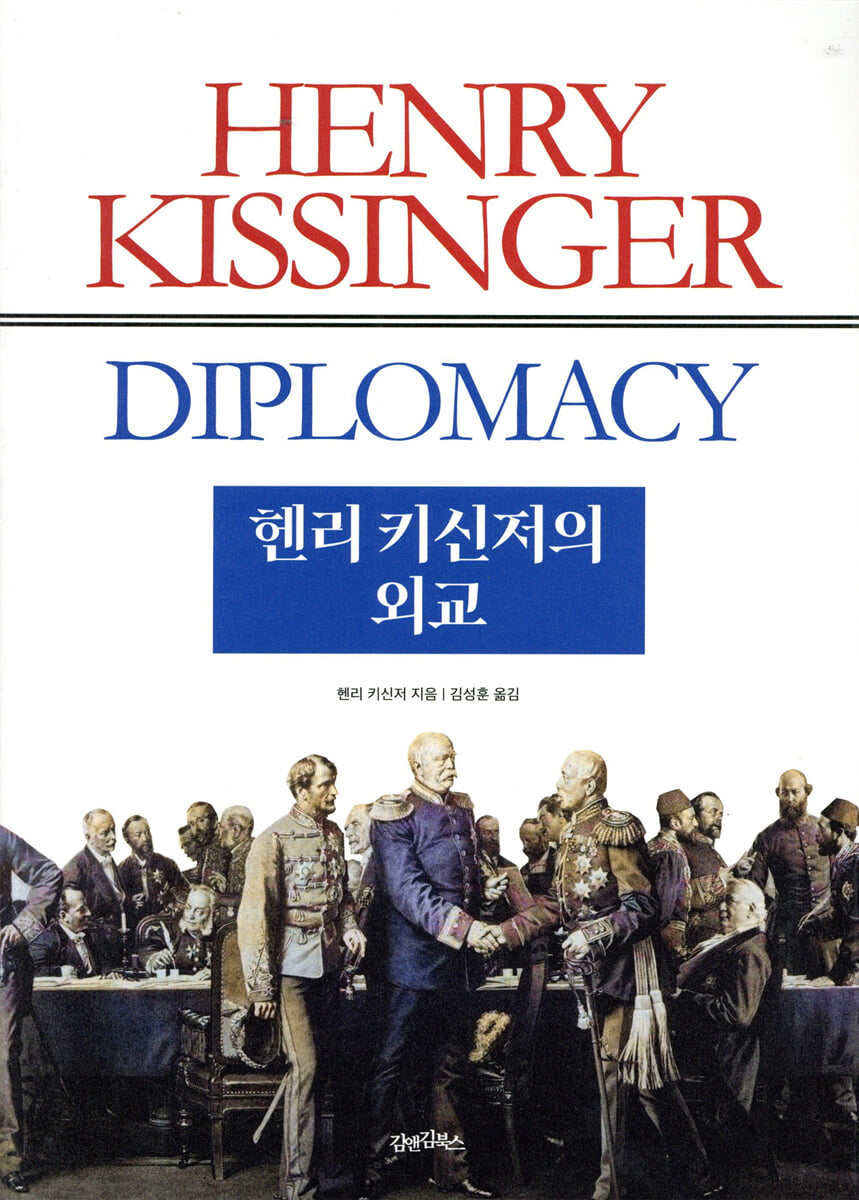
The cover of this book depicts a scene from the Berlin Conference of 1878.
The great powers met to revise the Treaty of San Stefano, the result of the Russo-Turkish War (1877).
It symbolized the pinnacle of the Bismarckian system, but also marked the beginning of its collapse.
Russia harbored a grudge against Germany, and Austria's annexation of Bosnia sowed the seeds of a major conflict.
However, to reach a great war, Germany had to make a series of serious mistakes.
With the outbreak of the Korean War in 1950, the confrontational structure between the East and West became clear, and the United States' policy of containment began in earnest.
There were several crises over Berlin, located within East Germany, and there was also the Cuban Missile Crisis.
Local wars broke out in Vietnam and elsewhere, but they did not escalate into direct conflict between the United States and the Soviet Union.
The Cold War came to an end in 1991 when the Soviet Union collapsed on its own.
It's not that there was no possibility of a great war.
There was a fear that Soviet troops would push across the East German border at any time, and even the Korean War was seen as part of such an attempt.
The nuclear arms race was never ending.
But what was different about Europe in the late 19th century was that both the United States and the Soviet Union feared direct conflict with each other, and a stable balance of power existed between the two blocs.
Perhaps the memory and fear of the Great War were the most important factors in preventing a new one.
On August 19, 2023, the leaders of South Korea, the United States, and Japan agreed on the historic spirit and principles of Camp David.
In effect, South Korea, the United States, and Japan have agreed to engage in comprehensive security cooperation against China, a potential enemy.
This situation is reminiscent, on the one hand, of the process in which France, with which it had been reluctant to form a peacetime alliance, established a less binding alliance in the form of an entente in the run-up to World War I.
On the other hand, it reminds us of the process in which West Germany, which had been in a confrontation with the Soviet bloc across the border, joined NATO and became aligned with the West, ultimately completing the confrontation between the two blocs.
Kissinger's analysis of the containment policy of the postwar Cold War era is full of incisiveness.
What is the difference between a blockade of the Soviet Union and a blockade of China, and what should be different?
Is a blockade of China appropriate and feasible?
To understand and predict the current international situation, it is necessary to look back and infer from the actions of past great powers.
Perhaps this is the most important reason to read this book.
A profound insight into the origins and essence of American diplomacy.
Will America Remain a Wilsonian Nation in the 21st Century?
When the United States entered World War I, it put forward the universal value of “making a world where democracy is safe” as its justification for war, and as a result, it became a Wilsonian country.
Until then, isolationism had dominated the United States.
In keeping with George Washington's maxim, America's foreign policy was to maintain a level-headed attitude regardless of whether European nations were fighting or not.
But Woodrow Wilson had to appeal to Americans' belief in America's exceptionalism to get the isolationist nation into World War I.
It would be impossible to ask the people of the safest country to go to distant battlefields and fight and die without appealing to the moral convictions of the American people.
Wilson said, “It is a fearful thing to drag this great and peaceful people into a most terrible and miserable war.
But we will fight for the universal rule of rights by the cooperation of free peoples, which will bring peace and security to all nations and finally make the world free.”
In this way, Americans embraced the two world wars, the Korean War, and the Cold War as crusades for democracy and as struggles between good and evil, which provided enormous impetus and commitment to American action.
Since Wilson, most American presidents have been unable to articulate their foreign policy objectives without employing Wilsonian rhetoric.
Although Truman had strong geopolitical arguments for entering the Korean War, he explained the war as a defense of universal principles rather than American national interests.
“If the dominance of force in international affairs were to resume, the repercussions would be far-reaching.
America will continue to uphold the rule of law.” Even Nixon, who pursued realpolitik, considered himself a believer in Wilson’s internationalism and hung a portrait of Wilson in the White House Cabinet Office.
The Camp David Accords, signed by the United States, South Korea, and Japan in August 2023, also begin with the following sentence: “We will strengthen cooperation to promote democracy and protect human rights.”
There were great achievements of Wilsonianism.
The ill-fated League of Nations was reborn as the United Nations, the Marshall Plan was implemented to rebuild Europe, large-scale UN forces were dispatched to the Korean War, and the communist forces were successfully contained during the Cold War.
But Wilsonianism also faced great trials.
The Vietnam War weakened Americans' confidence in Wilsonianism and deeply divided American society.
America's attempts to democratize Middle Eastern countries came at a high cost in terms of human lives and regional instability, and ended with America's withdrawal from Afghanistan.
Today, within the United States, opposition to American international intervention is resurgent.
Trump's America First policies are reminiscent of the America First Committee, which opposed the United States' entry into World War II.
Trump says the US must get out of the Russia-Ukraine war.
China rejects the universality of Wilsonianism and asserts Chinese values for world order.
Can Wilsonianism continue to serve as a guide for American diplomacy as America's power and values are challenged from both within and without?
What should Wilsonian American diplomacy be like in an era when America's unilateral power superiority has disappeared?
In a July 2022 interview with the British weekly magazine The Spectator, when asked “How do you think history will judge you?” Kissinger said he was “a proponent of the belief that America, despite its many failures, has been a force for good in the world and is essential to global stability.”
"The Diplomacy of Henry Kissinger" contains Kissinger's struggles over the source of the "force for good" that symbolizes the United States, and how to ensure that idealistic American diplomacy does not fail and maintain an international system dominated by the United States.
Kissinger argues that Wilsonianism, based on universal values, must be combined with realpolitik based on national interests and the balance of power.
In fact, American diplomacy has been in trouble when Wilsonian and realpolitik motivations have diverged, and has never failed when the two have aligned.
Kissinger's Views on the 21st Century International System
Wilsonianism, Realpolitik, and the Choice of American Diplomacy
Kissinger believes that for the international order to exist stably, there must be a state of equilibrium based on the balance of power and be supported by common values.
Kissinger viewed the Vienna System led by Metternich after the Napoleonic Wars as the ideal great power international order.
The empty system was based on a balanced state of affairs based on the Quadruple Alliance of the victorious powers and on the common value of legitimacy.
France, a defeated nation, was also invited to the conference as an equal.
There were no major wars in Europe for over 100 years after the Vienna Agreement of 1814.
On the other hand, the Versailles system that came into being after World War I was unstable in itself.
There was no power or common agreement that could restrain defeated Germany.
It was only a matter of time before the Versailles system collapsed.
Germany's power and ambitions had grown so strong that the status quo could no longer be maintained.
After World War II, defeated Germany was divided and Japan was occupied, but the victorious nations were divided into the United States and the Soviet Union.
A kind of equilibrium existed, and neither side was trying to fundamentally change the status quo.
The Cold War was over, the defeated Soviet Union had disintegrated, and Russia was powerless to change the status quo.
Meanwhile, China has risen, and today's China, like Germany before World War I, has both the motivation and the ability to change the status quo.
The arms race between China and its neighbors is increasing instability, and there is a conflict between the values of democracy and dictatorship.
The Taiwan and South China Sea issues are seen as vital interests by both the United States and China, much like the Balkan Peninsula issue that triggered World War I, making it difficult to find common ground.
This is why Kissinger saw the current international situation as similar to that of Europe just before World War I.
For Kissinger, who studied the Thirty Years' War in Europe, the Napoleonic Wars, and the two World Wars in depth, how to prevent a major war has always been his primary concern.
Kissinger's attempts to improve relations with China in the early 1970s and to leverage this to achieve détente with the Soviet Union also had the clear goal of avoiding the risk of nuclear war.
In an interview with the press, Kissinger said, “It is a dangerous idea to think that China will change or be weakened through pressure.
…China wants to be the dominant power in Asia, not the world, and if the United States and China can both agree on a world order and find a balance, war can be avoided.”
Kissinger's thinking is linked to the time in the early 1970s when he was pushing for détente with the Soviet Union on the brink of nuclear war.
The goal is to find a way for peaceful coexistence between the two hostile camps.
Kissinger believes that the realistic way to avoid a major conflict is for the United States to recognize China's appropriate sphere of influence rather than trying to convert it to democracy.
This is in fact similar to the new type of great power relations theory advocated by China.
However, in Kissinger's case, it may be a means to prevent a major war, while in China's case, it may be a disguised strategy to undermine American hegemony.
China argues that we must return to the pre-Wilson era, and Kissinger says that we will inevitably have to return to a pre-Wilson era to some extent.
Kissinger believes that the United States is just one of many great powers and can no longer impose an order based on universal values.
What choices will American diplomacy make?
Is it possible that the United States will abandon the Wilsonian ideal of a “world safe for democracy”?
For Americans to abandon the Wilsonian goals of a world order based on democracy, national self-determination, international law, and collective security would be to abandon their own exceptionalism and identity.
The United States' participation in two world wars and the Korean War was not for any specific interests, but to protect the value of democracy.
As a realist, Kissinger argues that Wilsonianism is essential for America to navigate an imperfect world.
It suggests that the goals of Wilsonianism can be achieved in a realistic rather than a Wilsonian way.
In fact, American presidents tend to talk like Wilsonians and act like realists.
They instinctively recognize the balance of power above moral values.
Franklin Roosevelt joined hands with the communist Soviet Union to destroy Hitler, and Nixon joined hands with communist China to weaken the Soviet Union.
Reagan did not shy away from dialogue with the Soviet Union, even though he called it an evil empire.
Joe Biden is pursuing a strategy of containing China by establishing multilateral alliances, such as the Quad, a security cooperation body among South Korea, the United States, and Japan.
When the calculation of power is uncertain and fluid, nations are tempted to test their power.
A strategy of maintaining power superiority through a multilateral alliance system is more likely to curb China's adventurous behavior than to incite conflict in the region.
Biden has publicly stated that he would deploy US troops if China invades Taiwan.
This is a natural attitude, considering that the United States is a Wilsonian country.
If West Berlin had been occupied by the Soviet Union during the Cold War, there would have been war.
Wilsonianism fears the collapse of norms and values that would result from allowing the status quo to be changed by force as much as it does from geopolitical threats.
This is also why the United States cannot hastily compromise with Russia on the Ukrainian front.
Ultimately, it was Reagan's pressure strategy, not Kissinger's détente strategy, that ended the Cold War.
If America's international leadership as a Wilsonian nation is maintained, the current international system will resemble the Cold War era more than late 19th-century Europe.
But if the new US administration distances itself from Wilsonianism, China, like Hitler's Germany, will subtly test its power and engage in military adventures.
That is why Kissinger's warning about the coming great war remains valid.
Henry Kissinger's Diplomacy is one of the most in-depth analyses of the Cold War and the policy of containment.
This will allow us to infer whether a containment policy can work in the new Cold War context and what the dilemma is.
Implications for Korea from Henry Kissinger's Diplomacy
US-China competition and the Camp David agreement between South Korea, the US, and Japan
Korea is now at a historical turning point.
The power of the United States to maintain the status quo and the power of China to change the status quo are clashing.
The fate of Korea will depend on the nature and outcome of the clash between the two powers.
One side could collapse, another long-term Cold War could unfold, or, as Kissinger feared, a major war could break out.
As a powerful player in East Asia, the landscape of East Asia is increasingly likely to be determined by Korea's choices and strategies.
On August 19, 2023, South Korea made a historic and significant choice.
Through the Camp David Agreement, the three countries agreed to establish a multilateral security cooperation body based on the value of democracy.
It could be seen that Wilsonianism began to be institutionalized for the first time in East Asia.
The Camp David Agreement between South Korea, the United States, and Japan will be the beginning of an East Asian version of NATO.
A multilateral security cooperation system that goes beyond bilateral relations would be consistent with Wilsonian collective security and would give the United States a superior position to respond to China.
The ROK-US-Japan security cooperation system will also function as an institutional framework to check China and constrain Japan's actions.
Kissinger predicted that Japan would soon develop its own weapons of mass destruction in response to China.
Kissinger sees restraining Japan's unilateral actions as important in the long term as containing China.
British General Ismay, the first NATO Secretary General, once said that NATO's purpose was to "kick the Russians out, bring the Americans in, and keep the Germans down."
This is why an East Asian version of NATO is the best choice for Korea.
The Camp David Agreement between South Korea, the United States, and Japan can be seen as a historic moment for both South Korea and the United States.
For South Korea, the United States is an essential strategic lever for balancing not only China but also Japan.
The Camp David Accords will serve to protect the ROK-US alliance from America's isolationist tendencies.
For the United States, this is the realization of a situation where President Obama and then-President Joe Biden called South Korea a linchpin of American security.
This has a similar aspect to the UK being the lynchpin in America's relations with Europe.
For Britain, the special relationship with the United States meant more than just maintaining influence over American policymaking and providing a counterbalance to the European continent.
Britain knows full well that American non-engagement in the world is far more dangerous to British interests than over-engagement.
If the United States cannot be left alone to ensure global stability and national interests, then South Korea is the country that can play that role in Asia.
Another significance of the Camp David Agreement between South Korea, the US, and Japan is that South Korea acted according to the logic of the balance of power.
Balance of power means that other countries form alliances to check the most threatening country in the region.
China has made no secret of its desire to become the dominant power in East Asia.
The Camp David Accords allowed South Korea to overcome long-standing hostilities and seek alliance with Japan and China.
Before World War I, Britain and France had been long-time rivals, but they formed a loose alliance called the Anglo-French Entente to counter German expansion, which led to victory in World War I.
The unity of France and Germany, enemies of World War II, became another foundation for victory in the Cold War.
The ultimate significance of the Camp David Agreement between South Korea, the United States, and Japan is that it is the first time that support for Korean unification has been included in an international document.
The Camp David spirit states, “We express our support for the bold vision of the Republic of Korea and support a free and peaceful unified Korean Peninsula.”
This opens up the possibility that South Korea will receive support from the United States and Japan in the process of unifying the Korean Peninsula.
Just as the Soviet Union collapsed with the unification of East and West Germany, the unification of the Korean Peninsula could be considered strategically.
Henry Kissinger's Diplomacy contains an in-depth analysis of the United States' position and strategy on the Korean War.
Kissinger said that when South Korean and UN forces decided to advance north across the 38th parallel during the Korean War, they had to make strategic decisions about where to establish a defensive line, keeping in mind the possibility of Chinese intervention.
A must-read for unification strategies in the new Korean Peninsula situation.
Modern history is filled with the agony and determination of leaders who shouldered the fate of their nations.
Richelieu of France did so during the Thirty Years' War, Metternich of Austria did so in 1814, and Bismarck of Germany did so in 1871.
Woodrow Wilson of the United States did so in 1914.
"Henry Kissinger's Diplomacy" reveals the anguish and dilemma of countless national leaders facing diplomatic choices.
And through their choices, it shows how modern history has unfolded.
Sometimes it was inevitable, sometimes it was brilliant, sometimes it was foolish.
"Henry Kissinger's Diplomacy" is a must-read for national leaders in this era who must make diplomatic choices that will determine the fate of their nation.
Is today's world Europe on the eve of World War I, or a new Cold War era?
Kissinger argues that the history of the rise and fall of multi-state world orders is the only experience we can rely on to understand the challenges facing modern politicians, and that history illuminates similarly predictable outcomes in comparable situations through analogy.
Churchill also said that if you want to know the future of international politics, you have to go back to the past.
Because human nature does not change, and under an anarchic international system, the behavior of nations is bound to repeat itself.
Does the great power competition that has resumed in the 21st century resemble the behavior of great powers at any point in the past, and what are the similarities and differences?
Is the future that awaits us a great catastrophe or another cold war?
"Henry Kissinger's Diplomacy" is full of surprising intellectual elements that provide insight into history and allow for inferences about the present and future.
The history of Europe in the late 19th century is divided into two periods: before and after the fall of Ottoman Chancellor Bismarck of unified Germany in 1890.
With German Emperor Wilhelm II taking the helm in place of Bismarck, the situation in Europe became increasingly irreversible.
Everything Bismarck had painstakingly built collapsed.
France joined hands with Russia, and Britain abandoned its role as a balancer and joined in.
Germany was forced to cling to a precarious alliance with the Austrian Empire.
No one could have predicted the catastrophe that would follow, or that it would lead to an even greater catastrophe 20 years later.
However, it is difficult to say whether Bismarck could have prevented the catastrophe even if he had remained in power.
The cover of this book depicts a scene from the Berlin Conference of 1878.
The great powers met to revise the Treaty of San Stefano, the result of the Russo-Turkish War (1877).
It symbolized the pinnacle of the Bismarckian system, but also marked the beginning of its collapse.
Russia harbored a grudge against Germany, and Austria's annexation of Bosnia sowed the seeds of a major conflict.
However, to reach a great war, Germany had to make a series of serious mistakes.
With the outbreak of the Korean War in 1950, the confrontational structure between the East and West became clear, and the United States' policy of containment began in earnest.
There were several crises over Berlin, located within East Germany, and there was also the Cuban Missile Crisis.
Local wars broke out in Vietnam and elsewhere, but they did not escalate into direct conflict between the United States and the Soviet Union.
The Cold War came to an end in 1991 when the Soviet Union collapsed on its own.
It's not that there was no possibility of a great war.
There was a fear that Soviet troops would push across the East German border at any time, and even the Korean War was seen as part of such an attempt.
The nuclear arms race was never ending.
But what was different about Europe in the late 19th century was that both the United States and the Soviet Union feared direct conflict with each other, and a stable balance of power existed between the two blocs.
Perhaps the memory and fear of the Great War were the most important factors in preventing a new one.
On August 19, 2023, the leaders of South Korea, the United States, and Japan agreed on the historic spirit and principles of Camp David.
In effect, South Korea, the United States, and Japan have agreed to engage in comprehensive security cooperation against China, a potential enemy.
This situation is reminiscent, on the one hand, of the process in which France, with which it had been reluctant to form a peacetime alliance, established a less binding alliance in the form of an entente in the run-up to World War I.
On the other hand, it reminds us of the process in which West Germany, which had been in a confrontation with the Soviet bloc across the border, joined NATO and became aligned with the West, ultimately completing the confrontation between the two blocs.
Kissinger's analysis of the containment policy of the postwar Cold War era is full of incisiveness.
What is the difference between a blockade of the Soviet Union and a blockade of China, and what should be different?
Is a blockade of China appropriate and feasible?
To understand and predict the current international situation, it is necessary to look back and infer from the actions of past great powers.
Perhaps this is the most important reason to read this book.
A profound insight into the origins and essence of American diplomacy.
Will America Remain a Wilsonian Nation in the 21st Century?
When the United States entered World War I, it put forward the universal value of “making a world where democracy is safe” as its justification for war, and as a result, it became a Wilsonian country.
Until then, isolationism had dominated the United States.
In keeping with George Washington's maxim, America's foreign policy was to maintain a level-headed attitude regardless of whether European nations were fighting or not.
But Woodrow Wilson had to appeal to Americans' belief in America's exceptionalism to get the isolationist nation into World War I.
It would be impossible to ask the people of the safest country to go to distant battlefields and fight and die without appealing to the moral convictions of the American people.
Wilson said, “It is a fearful thing to drag this great and peaceful people into a most terrible and miserable war.
But we will fight for the universal rule of rights by the cooperation of free peoples, which will bring peace and security to all nations and finally make the world free.”
In this way, Americans embraced the two world wars, the Korean War, and the Cold War as crusades for democracy and as struggles between good and evil, which provided enormous impetus and commitment to American action.
Since Wilson, most American presidents have been unable to articulate their foreign policy objectives without employing Wilsonian rhetoric.
Although Truman had strong geopolitical arguments for entering the Korean War, he explained the war as a defense of universal principles rather than American national interests.
“If the dominance of force in international affairs were to resume, the repercussions would be far-reaching.
America will continue to uphold the rule of law.” Even Nixon, who pursued realpolitik, considered himself a believer in Wilson’s internationalism and hung a portrait of Wilson in the White House Cabinet Office.
The Camp David Accords, signed by the United States, South Korea, and Japan in August 2023, also begin with the following sentence: “We will strengthen cooperation to promote democracy and protect human rights.”
There were great achievements of Wilsonianism.
The ill-fated League of Nations was reborn as the United Nations, the Marshall Plan was implemented to rebuild Europe, large-scale UN forces were dispatched to the Korean War, and the communist forces were successfully contained during the Cold War.
But Wilsonianism also faced great trials.
The Vietnam War weakened Americans' confidence in Wilsonianism and deeply divided American society.
America's attempts to democratize Middle Eastern countries came at a high cost in terms of human lives and regional instability, and ended with America's withdrawal from Afghanistan.
Today, within the United States, opposition to American international intervention is resurgent.
Trump's America First policies are reminiscent of the America First Committee, which opposed the United States' entry into World War II.
Trump says the US must get out of the Russia-Ukraine war.
China rejects the universality of Wilsonianism and asserts Chinese values for world order.
Can Wilsonianism continue to serve as a guide for American diplomacy as America's power and values are challenged from both within and without?
What should Wilsonian American diplomacy be like in an era when America's unilateral power superiority has disappeared?
In a July 2022 interview with the British weekly magazine The Spectator, when asked “How do you think history will judge you?” Kissinger said he was “a proponent of the belief that America, despite its many failures, has been a force for good in the world and is essential to global stability.”
"The Diplomacy of Henry Kissinger" contains Kissinger's struggles over the source of the "force for good" that symbolizes the United States, and how to ensure that idealistic American diplomacy does not fail and maintain an international system dominated by the United States.
Kissinger argues that Wilsonianism, based on universal values, must be combined with realpolitik based on national interests and the balance of power.
In fact, American diplomacy has been in trouble when Wilsonian and realpolitik motivations have diverged, and has never failed when the two have aligned.
Kissinger's Views on the 21st Century International System
Wilsonianism, Realpolitik, and the Choice of American Diplomacy
Kissinger believes that for the international order to exist stably, there must be a state of equilibrium based on the balance of power and be supported by common values.
Kissinger viewed the Vienna System led by Metternich after the Napoleonic Wars as the ideal great power international order.
The empty system was based on a balanced state of affairs based on the Quadruple Alliance of the victorious powers and on the common value of legitimacy.
France, a defeated nation, was also invited to the conference as an equal.
There were no major wars in Europe for over 100 years after the Vienna Agreement of 1814.
On the other hand, the Versailles system that came into being after World War I was unstable in itself.
There was no power or common agreement that could restrain defeated Germany.
It was only a matter of time before the Versailles system collapsed.
Germany's power and ambitions had grown so strong that the status quo could no longer be maintained.
After World War II, defeated Germany was divided and Japan was occupied, but the victorious nations were divided into the United States and the Soviet Union.
A kind of equilibrium existed, and neither side was trying to fundamentally change the status quo.
The Cold War was over, the defeated Soviet Union had disintegrated, and Russia was powerless to change the status quo.
Meanwhile, China has risen, and today's China, like Germany before World War I, has both the motivation and the ability to change the status quo.
The arms race between China and its neighbors is increasing instability, and there is a conflict between the values of democracy and dictatorship.
The Taiwan and South China Sea issues are seen as vital interests by both the United States and China, much like the Balkan Peninsula issue that triggered World War I, making it difficult to find common ground.
This is why Kissinger saw the current international situation as similar to that of Europe just before World War I.
For Kissinger, who studied the Thirty Years' War in Europe, the Napoleonic Wars, and the two World Wars in depth, how to prevent a major war has always been his primary concern.
Kissinger's attempts to improve relations with China in the early 1970s and to leverage this to achieve détente with the Soviet Union also had the clear goal of avoiding the risk of nuclear war.
In an interview with the press, Kissinger said, “It is a dangerous idea to think that China will change or be weakened through pressure.
…China wants to be the dominant power in Asia, not the world, and if the United States and China can both agree on a world order and find a balance, war can be avoided.”
Kissinger's thinking is linked to the time in the early 1970s when he was pushing for détente with the Soviet Union on the brink of nuclear war.
The goal is to find a way for peaceful coexistence between the two hostile camps.
Kissinger believes that the realistic way to avoid a major conflict is for the United States to recognize China's appropriate sphere of influence rather than trying to convert it to democracy.
This is in fact similar to the new type of great power relations theory advocated by China.
However, in Kissinger's case, it may be a means to prevent a major war, while in China's case, it may be a disguised strategy to undermine American hegemony.
China argues that we must return to the pre-Wilson era, and Kissinger says that we will inevitably have to return to a pre-Wilson era to some extent.
Kissinger believes that the United States is just one of many great powers and can no longer impose an order based on universal values.
What choices will American diplomacy make?
Is it possible that the United States will abandon the Wilsonian ideal of a “world safe for democracy”?
For Americans to abandon the Wilsonian goals of a world order based on democracy, national self-determination, international law, and collective security would be to abandon their own exceptionalism and identity.
The United States' participation in two world wars and the Korean War was not for any specific interests, but to protect the value of democracy.
As a realist, Kissinger argues that Wilsonianism is essential for America to navigate an imperfect world.
It suggests that the goals of Wilsonianism can be achieved in a realistic rather than a Wilsonian way.
In fact, American presidents tend to talk like Wilsonians and act like realists.
They instinctively recognize the balance of power above moral values.
Franklin Roosevelt joined hands with the communist Soviet Union to destroy Hitler, and Nixon joined hands with communist China to weaken the Soviet Union.
Reagan did not shy away from dialogue with the Soviet Union, even though he called it an evil empire.
Joe Biden is pursuing a strategy of containing China by establishing multilateral alliances, such as the Quad, a security cooperation body among South Korea, the United States, and Japan.
When the calculation of power is uncertain and fluid, nations are tempted to test their power.
A strategy of maintaining power superiority through a multilateral alliance system is more likely to curb China's adventurous behavior than to incite conflict in the region.
Biden has publicly stated that he would deploy US troops if China invades Taiwan.
This is a natural attitude, considering that the United States is a Wilsonian country.
If West Berlin had been occupied by the Soviet Union during the Cold War, there would have been war.
Wilsonianism fears the collapse of norms and values that would result from allowing the status quo to be changed by force as much as it does from geopolitical threats.
This is also why the United States cannot hastily compromise with Russia on the Ukrainian front.
Ultimately, it was Reagan's pressure strategy, not Kissinger's détente strategy, that ended the Cold War.
If America's international leadership as a Wilsonian nation is maintained, the current international system will resemble the Cold War era more than late 19th-century Europe.
But if the new US administration distances itself from Wilsonianism, China, like Hitler's Germany, will subtly test its power and engage in military adventures.
That is why Kissinger's warning about the coming great war remains valid.
Henry Kissinger's Diplomacy is one of the most in-depth analyses of the Cold War and the policy of containment.
This will allow us to infer whether a containment policy can work in the new Cold War context and what the dilemma is.
Implications for Korea from Henry Kissinger's Diplomacy
US-China competition and the Camp David agreement between South Korea, the US, and Japan
Korea is now at a historical turning point.
The power of the United States to maintain the status quo and the power of China to change the status quo are clashing.
The fate of Korea will depend on the nature and outcome of the clash between the two powers.
One side could collapse, another long-term Cold War could unfold, or, as Kissinger feared, a major war could break out.
As a powerful player in East Asia, the landscape of East Asia is increasingly likely to be determined by Korea's choices and strategies.
On August 19, 2023, South Korea made a historic and significant choice.
Through the Camp David Agreement, the three countries agreed to establish a multilateral security cooperation body based on the value of democracy.
It could be seen that Wilsonianism began to be institutionalized for the first time in East Asia.
The Camp David Agreement between South Korea, the United States, and Japan will be the beginning of an East Asian version of NATO.
A multilateral security cooperation system that goes beyond bilateral relations would be consistent with Wilsonian collective security and would give the United States a superior position to respond to China.
The ROK-US-Japan security cooperation system will also function as an institutional framework to check China and constrain Japan's actions.
Kissinger predicted that Japan would soon develop its own weapons of mass destruction in response to China.
Kissinger sees restraining Japan's unilateral actions as important in the long term as containing China.
British General Ismay, the first NATO Secretary General, once said that NATO's purpose was to "kick the Russians out, bring the Americans in, and keep the Germans down."
This is why an East Asian version of NATO is the best choice for Korea.
The Camp David Agreement between South Korea, the United States, and Japan can be seen as a historic moment for both South Korea and the United States.
For South Korea, the United States is an essential strategic lever for balancing not only China but also Japan.
The Camp David Accords will serve to protect the ROK-US alliance from America's isolationist tendencies.
For the United States, this is the realization of a situation where President Obama and then-President Joe Biden called South Korea a linchpin of American security.
This has a similar aspect to the UK being the lynchpin in America's relations with Europe.
For Britain, the special relationship with the United States meant more than just maintaining influence over American policymaking and providing a counterbalance to the European continent.
Britain knows full well that American non-engagement in the world is far more dangerous to British interests than over-engagement.
If the United States cannot be left alone to ensure global stability and national interests, then South Korea is the country that can play that role in Asia.
Another significance of the Camp David Agreement between South Korea, the US, and Japan is that South Korea acted according to the logic of the balance of power.
Balance of power means that other countries form alliances to check the most threatening country in the region.
China has made no secret of its desire to become the dominant power in East Asia.
The Camp David Accords allowed South Korea to overcome long-standing hostilities and seek alliance with Japan and China.
Before World War I, Britain and France had been long-time rivals, but they formed a loose alliance called the Anglo-French Entente to counter German expansion, which led to victory in World War I.
The unity of France and Germany, enemies of World War II, became another foundation for victory in the Cold War.
The ultimate significance of the Camp David Agreement between South Korea, the United States, and Japan is that it is the first time that support for Korean unification has been included in an international document.
The Camp David spirit states, “We express our support for the bold vision of the Republic of Korea and support a free and peaceful unified Korean Peninsula.”
This opens up the possibility that South Korea will receive support from the United States and Japan in the process of unifying the Korean Peninsula.
Just as the Soviet Union collapsed with the unification of East and West Germany, the unification of the Korean Peninsula could be considered strategically.
Henry Kissinger's Diplomacy contains an in-depth analysis of the United States' position and strategy on the Korean War.
Kissinger said that when South Korean and UN forces decided to advance north across the 38th parallel during the Korean War, they had to make strategic decisions about where to establish a defensive line, keeping in mind the possibility of Chinese intervention.
A must-read for unification strategies in the new Korean Peninsula situation.
Modern history is filled with the agony and determination of leaders who shouldered the fate of their nations.
Richelieu of France did so during the Thirty Years' War, Metternich of Austria did so in 1814, and Bismarck of Germany did so in 1871.
Woodrow Wilson of the United States did so in 1914.
"Henry Kissinger's Diplomacy" reveals the anguish and dilemma of countless national leaders facing diplomatic choices.
And through their choices, it shows how modern history has unfolded.
Sometimes it was inevitable, sometimes it was brilliant, sometimes it was foolish.
"Henry Kissinger's Diplomacy" is a must-read for national leaders in this era who must make diplomatic choices that will determine the fate of their nation.
GOODS SPECIFICS
- Date of issue: August 25, 2023
- Page count, weight, size: 928 pages | 1,394g | 172*238*40mm
- ISBN13: 9788989566892
- ISBN10: 8989566894
You may also like
카테고리
korean


korean

![GQ KOREA Mark (Monthly): December [2025]](http://librairie.coreenne.fr/cdn/shop/files/8ef265dbbfbf186523ed75ba7319009d.jpg?v=1765340328&width=3840)


