

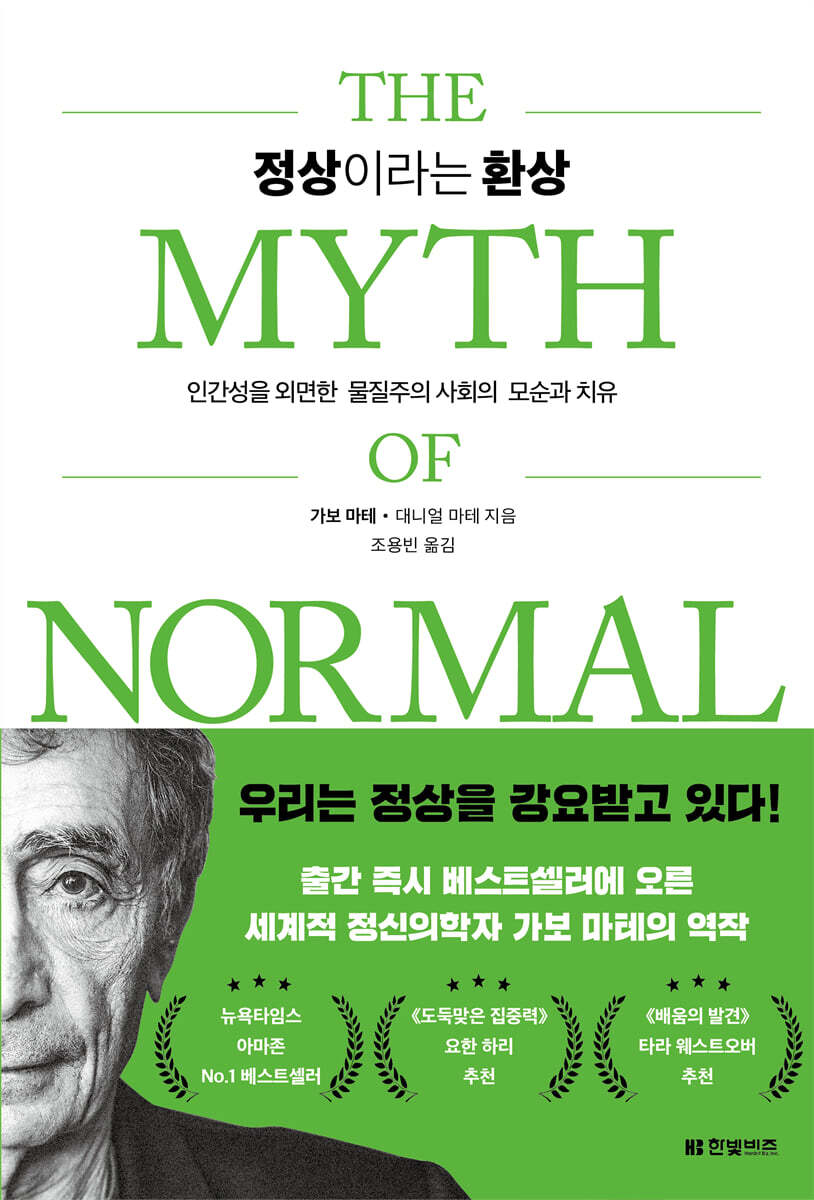
The illusion of normalcy
 |
Description
Book Introduction
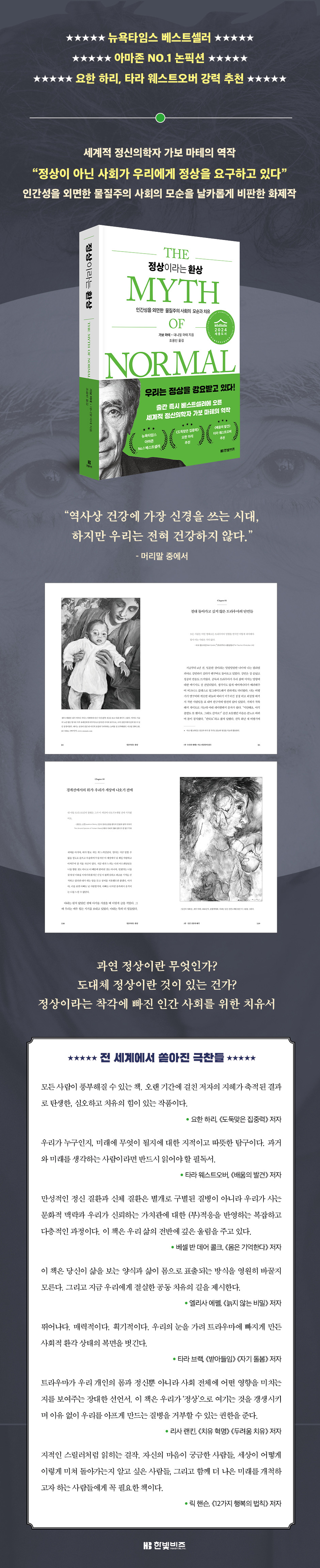
[New York Times] Bestseller
Amazon's No. 1 nonfiction
Highly recommended by Johann Hari and Tara Westover
"A sharp critique of the contradictions of a materialistic society that ignores humanity."
Gabor Maté, a world-renowned Canadian physician who studies the relationships between addiction, trauma, stress, and disease, has published his book, The Illusion of Normalcy.
Gabo Maté, who sensationalized the modern medical world with the message that the anxiety, addictions, and even physical illnesses we suffer from today are potentially caused by the wounds and traumas we experienced in childhood, is a leading authority on stress, mental health, trauma, and addiction.
In this new work, he points to the toxic culture deeply rooted in modern capitalism and materialism as the source of the mental and physical problems we face today, from children to adults.
In other words, the mental and physical illnesses that plague us originate from our own flawed culture.
"The Illusion of Normalcy" became a New York Times bestseller immediately after its publication and is currently an Amazon nonfiction bestseller.
Moreover, even before its publication, the book received rave reviews from world-renowned scholars and bestselling authors, including Johann Hari, Tara Westover, Bessel van der Kolk, Elisa Epel, and Tara Brach.
Why is the world focusing on this book now?
Amazon's No. 1 nonfiction
Highly recommended by Johann Hari and Tara Westover
"A sharp critique of the contradictions of a materialistic society that ignores humanity."
Gabor Maté, a world-renowned Canadian physician who studies the relationships between addiction, trauma, stress, and disease, has published his book, The Illusion of Normalcy.
Gabo Maté, who sensationalized the modern medical world with the message that the anxiety, addictions, and even physical illnesses we suffer from today are potentially caused by the wounds and traumas we experienced in childhood, is a leading authority on stress, mental health, trauma, and addiction.
In this new work, he points to the toxic culture deeply rooted in modern capitalism and materialism as the source of the mental and physical problems we face today, from children to adults.
In other words, the mental and physical illnesses that plague us originate from our own flawed culture.
"The Illusion of Normalcy" became a New York Times bestseller immediately after its publication and is currently an Amazon nonfiction bestseller.
Moreover, even before its publication, the book received rave reviews from world-renowned scholars and bestselling authors, including Johann Hari, Tara Westover, Bessel van der Kolk, Elisa Epel, and Tara Brach.
Why is the world focusing on this book now?
- You can preview some of the book's contents.
Preview
index
Author's Note
preface
Part 1 Our World is Connected
Chapter 1: Aspects of Trauma I Never Want to Return to
Chapter 2: The Intangible World: Emotions, Health, and Mind-Body Unity
Chapter 3 My Brain Is Ringing: Our Highly Connected Bodies
Chapter 4: Everything Surrounding Me: A Dispatch from New Science
Chapter 5: The Rebellion Within: The Mystery of the Recalcitrant Immune System
Chapter 6: It's Not a Thing: Illness as a Process
Chapter 7: Trauma-Induced Conflicts: Attachment vs. Authenticity
Part 2: Distortions in Human Growth
Chapter 8: What Are We Really Like? Human Nature, Human Desires
Chapter 9: Strong or Fragile Foundations: Children's Basic Needs
Chapter 10: Crisis at the Border: Before We Come into the World
Chapter 11: What Are My Options? Childbirth in a Culture Where Medical Care Is Valuable
Chapter 12 Gardening on the Moon: Damaged Parenting
Chapter 13: Forcing the Brain in the Wrong Direction: Sabotage in Children
Chapter 14: The Guarantee of Suffering: How Culture Shapes Our Character
Part 3: Rethinking Abnormality: Pain as an Adaptive Process
Chapter 15: Not Being Yourself: Correcting the Misconceptions About Addiction
Chapter 16: Exposing: A New Perspective on Addiction
Chapter 17: The Inaccurate Map of Pain: What We Get Wrong About Mental Illness
Chapter 18: The Mind Can Create Amazing Things: From Madness to Meaning
Part 4: The Addictiveness of Our Culture
Chapter 19: From Society to Cells: Uncertainty, Conflict, and Loss of Control
Chapter 20: Stealing the Human Mind: Disconnection and Discontent
Chapter 21: Nobody Cares If a Sociopath Kills You: Sociopaths as Strategy
Chapter 22: Wounded Pride: Race and Class Digged into the Skin
Chapter 23: Society's Shock Absorbers: Why Women Are Harsher
Chapter 24 Their Pain is Felt: Politics Steeped in Trauma
Part 5: The Path to Wholeness
Chapter 25: The Spirit of Forward Thinking: The Potential for Healing
Chapter 26: The Four As and the Five Compassion: The Principles of Healing
Chapter 27: A Terrible Gift: Learning from Illness
Chapter 28 Before You Say No to Your Body: The First Step Back to Yourself
Chapter 29: Seeing is Not Believing: Reversing Negative Beliefs
Chapter 30: From Enemy to Friend: Overcoming Disability to Healing
Chapter 31: Jesus in the Tent: Hallucinations and Healing
Chapter 32: My Pure Life: The Retreat
Chapter 33: Destruction of Myths: Dreaming of a Healthier Society
Acknowledgements
main
preface
Part 1 Our World is Connected
Chapter 1: Aspects of Trauma I Never Want to Return to
Chapter 2: The Intangible World: Emotions, Health, and Mind-Body Unity
Chapter 3 My Brain Is Ringing: Our Highly Connected Bodies
Chapter 4: Everything Surrounding Me: A Dispatch from New Science
Chapter 5: The Rebellion Within: The Mystery of the Recalcitrant Immune System
Chapter 6: It's Not a Thing: Illness as a Process
Chapter 7: Trauma-Induced Conflicts: Attachment vs. Authenticity
Part 2: Distortions in Human Growth
Chapter 8: What Are We Really Like? Human Nature, Human Desires
Chapter 9: Strong or Fragile Foundations: Children's Basic Needs
Chapter 10: Crisis at the Border: Before We Come into the World
Chapter 11: What Are My Options? Childbirth in a Culture Where Medical Care Is Valuable
Chapter 12 Gardening on the Moon: Damaged Parenting
Chapter 13: Forcing the Brain in the Wrong Direction: Sabotage in Children
Chapter 14: The Guarantee of Suffering: How Culture Shapes Our Character
Part 3: Rethinking Abnormality: Pain as an Adaptive Process
Chapter 15: Not Being Yourself: Correcting the Misconceptions About Addiction
Chapter 16: Exposing: A New Perspective on Addiction
Chapter 17: The Inaccurate Map of Pain: What We Get Wrong About Mental Illness
Chapter 18: The Mind Can Create Amazing Things: From Madness to Meaning
Part 4: The Addictiveness of Our Culture
Chapter 19: From Society to Cells: Uncertainty, Conflict, and Loss of Control
Chapter 20: Stealing the Human Mind: Disconnection and Discontent
Chapter 21: Nobody Cares If a Sociopath Kills You: Sociopaths as Strategy
Chapter 22: Wounded Pride: Race and Class Digged into the Skin
Chapter 23: Society's Shock Absorbers: Why Women Are Harsher
Chapter 24 Their Pain is Felt: Politics Steeped in Trauma
Part 5: The Path to Wholeness
Chapter 25: The Spirit of Forward Thinking: The Potential for Healing
Chapter 26: The Four As and the Five Compassion: The Principles of Healing
Chapter 27: A Terrible Gift: Learning from Illness
Chapter 28 Before You Say No to Your Body: The First Step Back to Yourself
Chapter 29: Seeing is Not Believing: Reversing Negative Beliefs
Chapter 30: From Enemy to Friend: Overcoming Disability to Healing
Chapter 31: Jesus in the Tent: Hallucinations and Healing
Chapter 32: My Pure Life: The Retreat
Chapter 33: Destruction of Myths: Dreaming of a Healthier Society
Acknowledgements
main
Detailed image
Into the book
The word "normal" in this book's title has an insidious connotation that, far from helping us move toward a healthy future, only hinders us from doing so.
For better or worse, humanity has a genius for getting used to things, especially when the change is gradual.
The new buzzword, the verb "normalize," suggests that something previously abnormal has become normal and is no longer noticeable.
In a social sense, 'normal' means 'there is nothing to see here.'
This means that all systems are functioning properly and no further investigation is necessary.
But the reality I saw was very different.
---From the "Preface"
In fact, trauma is so massive that it affects every country and every person in the world, from past to future.
For example, Canadian Aboriginal peoples remain unjustly shadowed by trauma to this day.
They have been robbed and persecuted for generations by colonial policies, and the suffering of children in particular over the past century is indescribable.
They were separated from their families and sent to church-run boarding schools, where physical, sexual, and emotional abuse was rampant, leading to drug addiction, physical and mental illness, and suicide, and the trauma was passed down from generation to generation.
---From "Chapter 1: Aspects of Trauma I Never Want to Return to"
The disease itself is a collection of everything that has happened in the past and is also a signal of what will happen in the future.
Our emotional system, including our relationship to ourselves, is the most powerful factor in determining our future.
For example, it has been found that feeling helpless and hopeless when diagnosed with breast cancer can have a negative impact on survival even 10 years later.
Conversely, those who experienced reduced depressive symptoms were more likely to survive longer.
---From "Chapter 6: It's Not a Thing: Illness as a Process"
The New York Times published an article in 2018 titled, “Why Modern Parenthood Is Hard: It’s Economic.”
The article states, “Children in America today are likely to be the first generation to be poorer than their parents.
“The best thing a parent can do for their children is to support them in their upward mobility, or at least to help them avoid being pushed out of their current social class.” A close acquaintance recently told me about a scene he had seen.
A middle-class mother yelled at her five-year-old son for procrastinating on his homework.
"If you keep doing that, what will you be when you grow up?" What if my son had responded with something like this? "Aren't you worried about my mental state when I grow up?"
---From "Chapter 12 Gardening on the Moon: Damaged Parenting"
One of the great achievements of mass consumer culture is that it has convinced us that what we passionately desire and what we need are the same.
Julia Kristeva, a French psychoanalyst of Bulgarian origin, says:
“Just as products are created to satisfy desires, desires are also created.
We consume our needs without realizing that these ‘needs’ are artificially created.”
---From "Chapter 14: The Guarantee of Suffering: How Culture Shapes Our Character"
To view addiction as a "bad choice" is, frankly, the same as scolding someone by saying, "It's all your damn fault."
This perspective is not only woefully ineffective, it also tells us nothing.
In all my years of practice, I have never once heard anyone say that they 'chose' to be an addict in any way.
We've never heard of patients slowly crumbling in the Downtown Eastside, or addicts disappearing unnoticed on the streets, in hotel rooms, or in Vancouver's drug alleys.
---From "Chapter 15: Not Being Yourself: Correcting the Errors About Addiction"
One of Robin Williams' most beloved works is the Academy Award-winning film Good Will Hunting.
Here he plays a kind psychologist who helps a Boston janitor who is furious after an incident where he attacked a police officer.
This brilliant young man, played by Matt Damon, was a diamond in the rough, but he buried his weaknesses in a hardened shell of anger and resistance.
The most iconic scene is when Williams repeatedly tells Damon the simple but powerful line, “It’s not your fault,” which eventually causes Damon to break down and sob into Williams’ arms.
The words, "It's not your fault," convey not only the unwavering compassion Damon longs for, but also wisdom.
From behavioral disorders to serious mental illnesses, it's not anyone's fault, and as we've seen, it's not the brain or genes' fault.
It's a wound that hasn't healed properly that shows up on the outside, and there's always a reason for that.
---From "Chapter 18 The Mind Can Create Amazing Things: From Madness to Meaning"
Over a period of about 15 years, from the late 1970s to the mid-1990s, the percentage of workers at major American companies who said they were "always worried about getting fired" nearly doubled, from 24 percent to 46 percent.
People in occupations where they are constantly pressed for time, constantly changing, and have excessive workloads, and these factors show no signs of abating, often experience increased stress and poor health.
The most common symptom of stress is inflammation.
I have seen this connection between the two many times in the patients I see.
Inflammation has a wide range of health implications, from autoimmune diseases to cardiovascular disease of the heart and brain, cancer, and depression.
---From Chapter 19, “From Society to Cells: Uncertainty, Conflict, and Loss of Control”
Self-restraint behaviors in childhood are further reinforced in a gender-determined social environment.
Many women end up falling into self-silencing, which is “the tendency to suppress one’s thoughts and feelings to maintain the safety of relationships, especially intimate ones.”
This chronic denial of one's experiences can have fatal consequences.
A study that followed over 2,000 women for over a decade found that “women who suppress their emotions when they have a conflict with their spouse are four times more likely to die than those who express their feelings.”
It was the same at home and at work.
Another study found that women who worked under authoritarian bosses and suppressed their anger were more likely to develop heart disease.
In an environment where expressing anger directly can lead to a high risk of losing one's job, this is a natural adaptive response.
---From "Chapter 23: Society's Shock Absorbers: Why It's Harsher for Women"
The first step toward wholeness is acknowledging our own suffering and the suffering of the world.
This doesn't mean we're caught up in a whirlpool of endless pain, depression, and especially sacrifice.
A new, rigid identity built on 'trauma', or the 'healing' associated with it, can also be a trap of the same kind.
True healing is opening ourselves up most honestly and objectively to the truth about our lives, past and present.
We need to acknowledge where we have been hurt and accurately examine the impact of that hurt, not only on ourselves but also on others around us.
---From "Chapter 25: The Spirit of Forward Thinking: The Possibility of Healing"
In his book “The Stress of Life,” renowned physician Janos Selye writes, “What’s inside must come out.
Otherwise, it will explode in the wrong place or become full of complaints,” he said.
Something inside me has something to say, and if I don't express it, it will suffocate in silence.
The books I write, including this one, are a response to an inner need to go out.
---From "Chapter 28: Before You Say You're Not a Body: The First Step Back to Yourself"
A few years ago, while researching material for this book, I had the opportunity to speak with Noam Chomsky, the father of modern linguistics and a philosopher, social activist, and cultural critic.
I asked this intellectual giant, who calls himself a “tactical pessimist and strategic optimist,” whether he still feels positive about the future.
He answered with a smile.
“If you can't be an optimist, you might as well commit suicide.
So the answer is obviously yes.
Because I am an optimist.
I just try my best to correct it.
I don't know if that's possible or not.
This is the slogan that made Antonio Gramsci famous: "Be pessimistic with your reason, but optimistic with your will."
“There is no other choice.”
For better or worse, humanity has a genius for getting used to things, especially when the change is gradual.
The new buzzword, the verb "normalize," suggests that something previously abnormal has become normal and is no longer noticeable.
In a social sense, 'normal' means 'there is nothing to see here.'
This means that all systems are functioning properly and no further investigation is necessary.
But the reality I saw was very different.
---From the "Preface"
In fact, trauma is so massive that it affects every country and every person in the world, from past to future.
For example, Canadian Aboriginal peoples remain unjustly shadowed by trauma to this day.
They have been robbed and persecuted for generations by colonial policies, and the suffering of children in particular over the past century is indescribable.
They were separated from their families and sent to church-run boarding schools, where physical, sexual, and emotional abuse was rampant, leading to drug addiction, physical and mental illness, and suicide, and the trauma was passed down from generation to generation.
---From "Chapter 1: Aspects of Trauma I Never Want to Return to"
The disease itself is a collection of everything that has happened in the past and is also a signal of what will happen in the future.
Our emotional system, including our relationship to ourselves, is the most powerful factor in determining our future.
For example, it has been found that feeling helpless and hopeless when diagnosed with breast cancer can have a negative impact on survival even 10 years later.
Conversely, those who experienced reduced depressive symptoms were more likely to survive longer.
---From "Chapter 6: It's Not a Thing: Illness as a Process"
The New York Times published an article in 2018 titled, “Why Modern Parenthood Is Hard: It’s Economic.”
The article states, “Children in America today are likely to be the first generation to be poorer than their parents.
“The best thing a parent can do for their children is to support them in their upward mobility, or at least to help them avoid being pushed out of their current social class.” A close acquaintance recently told me about a scene he had seen.
A middle-class mother yelled at her five-year-old son for procrastinating on his homework.
"If you keep doing that, what will you be when you grow up?" What if my son had responded with something like this? "Aren't you worried about my mental state when I grow up?"
---From "Chapter 12 Gardening on the Moon: Damaged Parenting"
One of the great achievements of mass consumer culture is that it has convinced us that what we passionately desire and what we need are the same.
Julia Kristeva, a French psychoanalyst of Bulgarian origin, says:
“Just as products are created to satisfy desires, desires are also created.
We consume our needs without realizing that these ‘needs’ are artificially created.”
---From "Chapter 14: The Guarantee of Suffering: How Culture Shapes Our Character"
To view addiction as a "bad choice" is, frankly, the same as scolding someone by saying, "It's all your damn fault."
This perspective is not only woefully ineffective, it also tells us nothing.
In all my years of practice, I have never once heard anyone say that they 'chose' to be an addict in any way.
We've never heard of patients slowly crumbling in the Downtown Eastside, or addicts disappearing unnoticed on the streets, in hotel rooms, or in Vancouver's drug alleys.
---From "Chapter 15: Not Being Yourself: Correcting the Errors About Addiction"
One of Robin Williams' most beloved works is the Academy Award-winning film Good Will Hunting.
Here he plays a kind psychologist who helps a Boston janitor who is furious after an incident where he attacked a police officer.
This brilliant young man, played by Matt Damon, was a diamond in the rough, but he buried his weaknesses in a hardened shell of anger and resistance.
The most iconic scene is when Williams repeatedly tells Damon the simple but powerful line, “It’s not your fault,” which eventually causes Damon to break down and sob into Williams’ arms.
The words, "It's not your fault," convey not only the unwavering compassion Damon longs for, but also wisdom.
From behavioral disorders to serious mental illnesses, it's not anyone's fault, and as we've seen, it's not the brain or genes' fault.
It's a wound that hasn't healed properly that shows up on the outside, and there's always a reason for that.
---From "Chapter 18 The Mind Can Create Amazing Things: From Madness to Meaning"
Over a period of about 15 years, from the late 1970s to the mid-1990s, the percentage of workers at major American companies who said they were "always worried about getting fired" nearly doubled, from 24 percent to 46 percent.
People in occupations where they are constantly pressed for time, constantly changing, and have excessive workloads, and these factors show no signs of abating, often experience increased stress and poor health.
The most common symptom of stress is inflammation.
I have seen this connection between the two many times in the patients I see.
Inflammation has a wide range of health implications, from autoimmune diseases to cardiovascular disease of the heart and brain, cancer, and depression.
---From Chapter 19, “From Society to Cells: Uncertainty, Conflict, and Loss of Control”
Self-restraint behaviors in childhood are further reinforced in a gender-determined social environment.
Many women end up falling into self-silencing, which is “the tendency to suppress one’s thoughts and feelings to maintain the safety of relationships, especially intimate ones.”
This chronic denial of one's experiences can have fatal consequences.
A study that followed over 2,000 women for over a decade found that “women who suppress their emotions when they have a conflict with their spouse are four times more likely to die than those who express their feelings.”
It was the same at home and at work.
Another study found that women who worked under authoritarian bosses and suppressed their anger were more likely to develop heart disease.
In an environment where expressing anger directly can lead to a high risk of losing one's job, this is a natural adaptive response.
---From "Chapter 23: Society's Shock Absorbers: Why It's Harsher for Women"
The first step toward wholeness is acknowledging our own suffering and the suffering of the world.
This doesn't mean we're caught up in a whirlpool of endless pain, depression, and especially sacrifice.
A new, rigid identity built on 'trauma', or the 'healing' associated with it, can also be a trap of the same kind.
True healing is opening ourselves up most honestly and objectively to the truth about our lives, past and present.
We need to acknowledge where we have been hurt and accurately examine the impact of that hurt, not only on ourselves but also on others around us.
---From "Chapter 25: The Spirit of Forward Thinking: The Possibility of Healing"
In his book “The Stress of Life,” renowned physician Janos Selye writes, “What’s inside must come out.
Otherwise, it will explode in the wrong place or become full of complaints,” he said.
Something inside me has something to say, and if I don't express it, it will suffocate in silence.
The books I write, including this one, are a response to an inner need to go out.
---From "Chapter 28: Before You Say You're Not a Body: The First Step Back to Yourself"
A few years ago, while researching material for this book, I had the opportunity to speak with Noam Chomsky, the father of modern linguistics and a philosopher, social activist, and cultural critic.
I asked this intellectual giant, who calls himself a “tactical pessimist and strategic optimist,” whether he still feels positive about the future.
He answered with a smile.
“If you can't be an optimist, you might as well commit suicide.
So the answer is obviously yes.
Because I am an optimist.
I just try my best to correct it.
I don't know if that's possible or not.
This is the slogan that made Antonio Gramsci famous: "Be pessimistic with your reason, but optimistic with your will."
“There is no other choice.”
---From "Chapter 33: Destruction of Myths: Dreaming of a Healthier Society"
Publisher's Review
"We live in an age where health is paramount, yet we're not healthy at all."
A sensational piece that stabbed modern capitalist society.
Author Gabo Maté begins his book by pointing out the irony of our current society: “Despite the advancement of medical technology and knowledge, chronic physical and mental illnesses are on the rise in modern society.”
As he says, we live in the most health-conscious era in history, yet why aren't we all healthy? Gabo Maté asserts that modern society creates conceptual blind spots that prevent us from clearly seeing the plight we face.
In other words, illness is a consequence of the entire life a person has lived, and such blind spots are so widespread in our culture that they prevent us from thinking about the connection between our health and our social lives.
The author points to the distorted concept of 'normalcy' in today's materialistic culture as the root of this tragic phenomenon.
He emphasizes that many things considered normal in our society are in fact neither healthy nor natural, and that meeting modern society's standards of normalcy requires us to follow very abnormal desires, which can be very harmful to us physically and mentally.
In short, “the distorted concept of normalcy that permeates our culture is the biggest obstacle to creating a healthy world.”
"An abnormal society demands normality from us."
A healing book for a human society that is deluded by the illusion of normalcy.
Are we living normally today? Or rather, aren't we hiding our true selves and trying to brighten things up in an effort to live as if we were normal? Aren't we struggling to meet society's standards of normalcy?
Gabo Mate asks us a fundamental question: why do we have a standard of normality at all?
He particularly points out the current medical world, which divides people with physical and mental illness into normal and abnormal categories and arbitrarily defines them with disease codes.
Furthermore, we strongly criticize this society that has fallen into the distorted illusion of normality and is shackling us all to fit into the normal frame.
He emphasizes, “If we want to see everything as it is, we must be willing, even madly, to break free from the illusion of normalcy.”
That is, our healing can only begin when we free ourselves from the illusion of normality and the compulsion to be normal.
After reading this book, you will broaden your understanding of humanity by reflecting not only on your own life trajectory but also on the people around you, including your beloved family and friends.
You will find what will comfort you, what you need to overcome and shed, and furthermore, you will find yourself on the path to healing by objectifying yourself through your own strength.
A sensational piece that stabbed modern capitalist society.
Author Gabo Maté begins his book by pointing out the irony of our current society: “Despite the advancement of medical technology and knowledge, chronic physical and mental illnesses are on the rise in modern society.”
As he says, we live in the most health-conscious era in history, yet why aren't we all healthy? Gabo Maté asserts that modern society creates conceptual blind spots that prevent us from clearly seeing the plight we face.
In other words, illness is a consequence of the entire life a person has lived, and such blind spots are so widespread in our culture that they prevent us from thinking about the connection between our health and our social lives.
The author points to the distorted concept of 'normalcy' in today's materialistic culture as the root of this tragic phenomenon.
He emphasizes that many things considered normal in our society are in fact neither healthy nor natural, and that meeting modern society's standards of normalcy requires us to follow very abnormal desires, which can be very harmful to us physically and mentally.
In short, “the distorted concept of normalcy that permeates our culture is the biggest obstacle to creating a healthy world.”
"An abnormal society demands normality from us."
A healing book for a human society that is deluded by the illusion of normalcy.
Are we living normally today? Or rather, aren't we hiding our true selves and trying to brighten things up in an effort to live as if we were normal? Aren't we struggling to meet society's standards of normalcy?
Gabo Mate asks us a fundamental question: why do we have a standard of normality at all?
He particularly points out the current medical world, which divides people with physical and mental illness into normal and abnormal categories and arbitrarily defines them with disease codes.
Furthermore, we strongly criticize this society that has fallen into the distorted illusion of normality and is shackling us all to fit into the normal frame.
He emphasizes, “If we want to see everything as it is, we must be willing, even madly, to break free from the illusion of normalcy.”
That is, our healing can only begin when we free ourselves from the illusion of normality and the compulsion to be normal.
After reading this book, you will broaden your understanding of humanity by reflecting not only on your own life trajectory but also on the people around you, including your beloved family and friends.
You will find what will comfort you, what you need to overcome and shed, and furthermore, you will find yourself on the path to healing by objectifying yourself through your own strength.
GOODS SPECIFICS
- Date of issue: March 15, 2024
- Page count, weight, size: 604 pages | 878g | 152*224*35mm
- ISBN13: 9791157847273
You may also like
카테고리
korean


korean

![GQ KOREA Mark (Monthly): December [2025]](http://librairie.coreenne.fr/cdn/shop/files/8ef265dbbfbf186523ed75ba7319009d.jpg?v=1765340328&width=3840)


