

Aristotle's Poetics
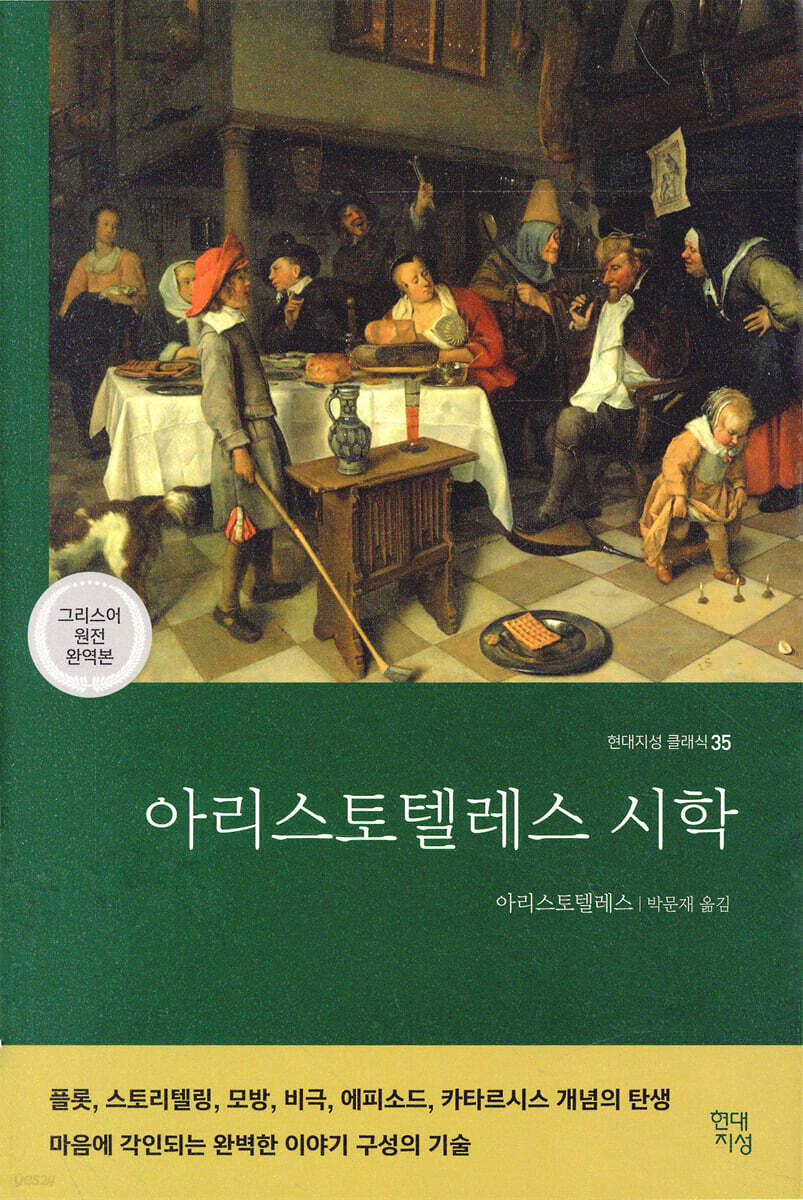 |
Description
Book Introduction
The birth of the concepts of plot, storytelling, imitation, tragedy, episode, and catharsis.
The art of perfect storytelling that leaves an impression on the heart
Even after 2,400 years, Aristotle's Poetics (hereafter referred to as Poetics), which contains "methods of drama composition, development, and plot construction" that are still relevant, meets readers as the 35th volume of the Modern Intellectual Classics.
『Poetics』 is a book in which Aristotle intensively explores 'tragedy', which was an important part of Greek life at the time, and presents the essence and principles of poetry.
The term 'poetry' used here is a broad concept that includes tragedy, comedy, epic, and lyric poetry.
Aristotle considers “plot” to be the most important and repeatedly emphasizes it.
A plot is a unified whole composed of several actions and events, and tragedy aims to achieve emotional purification (catharsis) based on the plot, thereby developing a mature personality and leading a virtuous life.
Plato belittled emotions, but Aristotle believed that emotions expressed in actions reveal human character and thoughts, and thus play an important role in the process of practicing virtue.
Therefore, Aristotle repeatedly emphasized that the unique goal of tragedy is to arouse fear and pity, experience catharsis (purification), and enjoy pleasure in the process.
Experiencing such emotions through tragedy can be a great help in regulating your emotions in real life and channeling them in a positive direction.
He discovered that tragedy and epic, which were deeply rooted in the lives of the Greeks at the time, were not mere entertainment, but were connected to his own philosophical system of ethics and politics. He saw this tragic element as a human act that achieved the goal of philosophy in life.
The true value of 『Poetics』 lies in the fact that it shows that humans can discover the essence of truth and goodness in the things they instinctively do while living, and enjoy true 'happiness' (ε?δαιμον?α, eudaimonia), which is the goal pursued by philosophy.
The art of perfect storytelling that leaves an impression on the heart
Even after 2,400 years, Aristotle's Poetics (hereafter referred to as Poetics), which contains "methods of drama composition, development, and plot construction" that are still relevant, meets readers as the 35th volume of the Modern Intellectual Classics.
『Poetics』 is a book in which Aristotle intensively explores 'tragedy', which was an important part of Greek life at the time, and presents the essence and principles of poetry.
The term 'poetry' used here is a broad concept that includes tragedy, comedy, epic, and lyric poetry.
Aristotle considers “plot” to be the most important and repeatedly emphasizes it.
A plot is a unified whole composed of several actions and events, and tragedy aims to achieve emotional purification (catharsis) based on the plot, thereby developing a mature personality and leading a virtuous life.
Plato belittled emotions, but Aristotle believed that emotions expressed in actions reveal human character and thoughts, and thus play an important role in the process of practicing virtue.
Therefore, Aristotle repeatedly emphasized that the unique goal of tragedy is to arouse fear and pity, experience catharsis (purification), and enjoy pleasure in the process.
Experiencing such emotions through tragedy can be a great help in regulating your emotions in real life and channeling them in a positive direction.
He discovered that tragedy and epic, which were deeply rooted in the lives of the Greeks at the time, were not mere entertainment, but were connected to his own philosophical system of ethics and politics. He saw this tragic element as a human act that achieved the goal of philosophy in life.
The true value of 『Poetics』 lies in the fact that it shows that humans can discover the essence of truth and goodness in the things they instinctively do while living, and enjoy true 'happiness' (ε?δαιμον?α, eudaimonia), which is the goal pursued by philosophy.
- You can preview some of the book's contents.
Preview
index
Chapter 1: Poetry as Imitation and the Means of Imitation
Chapter 2: Objects of Imitation
Chapter 3: Imitation Methods
Chapter 4: The Origin and Development of Poetry
Chapter 5: The History of Comedy and Epic
Chapter 6: Definition and Components of Tragedy
Chapter 7: The Plot of Tragedy and Its Length
Chapter 8 Unity of Plot
Chapter 9: The Necessity and Probability of Plot
Chapter 10 Types of Plots
Chapter 11: Elements of Plot: Twist, Cognition, and Suffering
Chapter 12: The Elements of Tragedy: Song
Chapter 13: The Object of Plot Imitatives
Chapter 14: Plot Goals: Fear and Pity
Chapter 15: The Components of Tragedy: Character
Chapter 16 Cognition
Chapter 17: Plot Structure: Scenes, Outlines, and Episodes
Chapter 18: Plot Structure: Conflict and Resolution
Chapter 19: The Components of Tragedy: Thought
Chapter 20: The Components of Tragedy: The Components of Dialogue
Chapter 21: Components of Tragedy: Types of Nouns
Chapter 22: Characteristics an Ambassador Should Have: Clarity and Freshness
Chapter 23: Epic
Chapter 24 Epic and Tragedy
Chapter 25: Criticism of the Epic and Its Solutions
Chapter 26: A Tragedy Superior to Epic
clear
Aristotle's Chronology
Chapter 2: Objects of Imitation
Chapter 3: Imitation Methods
Chapter 4: The Origin and Development of Poetry
Chapter 5: The History of Comedy and Epic
Chapter 6: Definition and Components of Tragedy
Chapter 7: The Plot of Tragedy and Its Length
Chapter 8 Unity of Plot
Chapter 9: The Necessity and Probability of Plot
Chapter 10 Types of Plots
Chapter 11: Elements of Plot: Twist, Cognition, and Suffering
Chapter 12: The Elements of Tragedy: Song
Chapter 13: The Object of Plot Imitatives
Chapter 14: Plot Goals: Fear and Pity
Chapter 15: The Components of Tragedy: Character
Chapter 16 Cognition
Chapter 17: Plot Structure: Scenes, Outlines, and Episodes
Chapter 18: Plot Structure: Conflict and Resolution
Chapter 19: The Components of Tragedy: Thought
Chapter 20: The Components of Tragedy: The Components of Dialogue
Chapter 21: Components of Tragedy: Types of Nouns
Chapter 22: Characteristics an Ambassador Should Have: Clarity and Freshness
Chapter 23: Epic
Chapter 24 Epic and Tragedy
Chapter 25: Criticism of the Epic and Its Solutions
Chapter 26: A Tragedy Superior to Epic
clear
Aristotle's Chronology
Into the book
In general, poetry seems to have arisen from two innate causes in human beings.
Humans have an instinct for imitation from an early age.
What distinguishes humans from other animals is that they initially learn through imitation, are best at imitating, and find joy in what they imitate.
This fact can be proven by experience.
Even shapes that are disgusting in themselves, such as very disgusting animals or corpses, can be enjoyed when they are copied.
Because learning is an extremely enjoyable activity not only for philosophers but also for ordinary people (although their learning abilities may be less).
It is for this very reason that people enjoy seeing things that have been imitated.
Because we infer and learn what we are imitating.
If the real thing is unfamiliar, we find pleasure in the imitation technique, color, and other reasons rather than in the imitation itself.
In this way, since imitation, as well as melody and rhythm (rhyme is clearly a part of rhythm), are part of human nature, people who are instinctively and strongly drawn to these things first imitated them spontaneously, and then gradually developed into poetry.
--- 「Chapter 4.
From “The Origin and Development of Poetry”
Tragedy is a method of purifying emotions by imitating a single, magnificent and complete event through the performance of actors, not through recitation, using all sorts of spiced language, and thereby making us feel pity and fear.
“Seasoned language” means language or song with rhythm and melody, and “placed here and there” means using only poetry in some parts and song again in other parts.
Since the imitation of tragedy is expressed through the actor's performance, it is natural that the visual element takes up a part of the tragedy first.
The reason why it is song and dialogue next is because in tragedy, dialogue and song are the means that actors use to express imitation.
A line is an arrangement of words that has a rhythm, and the meaning of a song is known to everyone.
Tragedy is also an imitation of action.
An action is something that the actor does, and the actor cannot help but have certain characteristics depending on his or her personality and thoughts.
(…) But the most important of the six elements is the plot, which constitutes the actions or events.
Because tragedy imitates actions and life, not people.
(The happiness and unhappiness of life lie in actions, and the purpose of tragedy is not character but action.
(A person's character determines his or her character, but his or her happiness and unhappiness are determined by his or her actions.) Therefore, tragedy does not use actions to imitate character, but rather involves character in order to imitate action.
So the purpose of tragedy is action and plot, and purpose is the most important of all.
--- Chapter 6.
From “Definition and Components of Tragedy”
On the other hand, Homer, although he excelled in other respects, seems to have known this very well, whether by learning or by nature.
When writing the Odyssey, Homer did not cover everything that happened to the protagonist.
For example, it does not cover the protagonist's injury on Mount Parnassus or his feigned insanity to avoid going to war.
This was because these two events were not connected in terms of probability or necessity to anything else that happened to the protagonist.
On the contrary, Homer composed the Odyssey around the single, unified action mentioned above, and the same was true of the Iliad.
Just as other imitative arts imitate a single object as a single whole, so too must the plot of tragedy imitate actions or events as a unified whole.
Therefore, the plot must be structured so that if any one part of the various events that make up the plot is moved or removed, the entire plot becomes tangled and disordered.
If there is no difference in the presence or absence of a part, then that part cannot be said to be part of the whole.
--- Chapter 8.
From “Unity of Plot”
Therefore, poetry is more philosophical and noble than history.
Poetry tends to speak of the universal, while history speaks primarily of the individual and the particular.
“Universals” are about how a person speaks and acts in such and such a case, according to probability or necessity.
Although poetry gives specific names to its characters, its goals are universal.
“The individual and particular” concerns, for example, what Alcibiades did and what happened.
This is very evident in comedy.
In comedy, the plot is constructed according to probability and then the characters are given names that fit the plot.
This is different from a satirical poet writing a poem about a specific individual.
Tragedy, on the other hand, stubbornly uses the names of real people.
Because it has to be possible to be persuasive.
It may be hard to believe that something that hasn't happened yet is possible, but what has already happened is certainly possible.
Because if there was no possibility, it wouldn't have happened at all.
--- Chapter 9.
From “The Inevitability and Probability of Plot”
The best tragedies have complex, not simple, plots, and contain acts or events that evoke fear and pity (this is the unique characteristic of the imitation called tragedy).
That is why we should not show noble people being happy and then becoming unhappy.
Because such things evoke not fear or pity, but a feeling of rejection.
Next, we must not show the evildoer becoming happy after suffering misfortune.
Because such a thing is the furthest thing from being tragic, and cannot produce the slightest effect of tragedy.
People cannot accept it, and they feel neither pity nor fear.
--- 「Chapter 13.
Among the "objects of imitation of the plot"
Homer is praiseworthy for much, but he is especially praiseworthy for knowing what a poet should not do.
A poet must be extremely careful not to speak out himself.
Because such behavior is not something a poet, an imitator, should do.
While other poets, with little or no imitation, stir themselves up throughout the play themselves, Homer, after a few brief introductory lines, immediately introduces a man, a woman, or some other character, each with a distinct individuality.
(…) It was also Homer who properly taught other poets how to lie plausibly.
One way is to deceive through faulty reasoning.
That is, let us assume that if the first thing exists or happens, the second thing also exists or happens.
When a second thing exists or happens, people assume that the first thing also exists or happens.
But that is a wrong inference.
--- 「Chapter 24.
From "Epic and Tragedy"
You should choose something that is impossible but probable rather than something that is possible but unbelievable.
You shouldn't build your plot around unbelievable things.
It's best not to include anything unbelievable in the plot.
If we cannot avoid including such an incredible event, we should leave it outside the work, like the setting in Oedipus the King where the protagonist does not know how Laius died, and not inside it, like the person reporting on the Pythian festival in Electra or the person in The Mysians who leaves Tegea and does not say a word until he arrives in Mysia.
Humans have an instinct for imitation from an early age.
What distinguishes humans from other animals is that they initially learn through imitation, are best at imitating, and find joy in what they imitate.
This fact can be proven by experience.
Even shapes that are disgusting in themselves, such as very disgusting animals or corpses, can be enjoyed when they are copied.
Because learning is an extremely enjoyable activity not only for philosophers but also for ordinary people (although their learning abilities may be less).
It is for this very reason that people enjoy seeing things that have been imitated.
Because we infer and learn what we are imitating.
If the real thing is unfamiliar, we find pleasure in the imitation technique, color, and other reasons rather than in the imitation itself.
In this way, since imitation, as well as melody and rhythm (rhyme is clearly a part of rhythm), are part of human nature, people who are instinctively and strongly drawn to these things first imitated them spontaneously, and then gradually developed into poetry.
--- 「Chapter 4.
From “The Origin and Development of Poetry”
Tragedy is a method of purifying emotions by imitating a single, magnificent and complete event through the performance of actors, not through recitation, using all sorts of spiced language, and thereby making us feel pity and fear.
“Seasoned language” means language or song with rhythm and melody, and “placed here and there” means using only poetry in some parts and song again in other parts.
Since the imitation of tragedy is expressed through the actor's performance, it is natural that the visual element takes up a part of the tragedy first.
The reason why it is song and dialogue next is because in tragedy, dialogue and song are the means that actors use to express imitation.
A line is an arrangement of words that has a rhythm, and the meaning of a song is known to everyone.
Tragedy is also an imitation of action.
An action is something that the actor does, and the actor cannot help but have certain characteristics depending on his or her personality and thoughts.
(…) But the most important of the six elements is the plot, which constitutes the actions or events.
Because tragedy imitates actions and life, not people.
(The happiness and unhappiness of life lie in actions, and the purpose of tragedy is not character but action.
(A person's character determines his or her character, but his or her happiness and unhappiness are determined by his or her actions.) Therefore, tragedy does not use actions to imitate character, but rather involves character in order to imitate action.
So the purpose of tragedy is action and plot, and purpose is the most important of all.
--- Chapter 6.
From “Definition and Components of Tragedy”
On the other hand, Homer, although he excelled in other respects, seems to have known this very well, whether by learning or by nature.
When writing the Odyssey, Homer did not cover everything that happened to the protagonist.
For example, it does not cover the protagonist's injury on Mount Parnassus or his feigned insanity to avoid going to war.
This was because these two events were not connected in terms of probability or necessity to anything else that happened to the protagonist.
On the contrary, Homer composed the Odyssey around the single, unified action mentioned above, and the same was true of the Iliad.
Just as other imitative arts imitate a single object as a single whole, so too must the plot of tragedy imitate actions or events as a unified whole.
Therefore, the plot must be structured so that if any one part of the various events that make up the plot is moved or removed, the entire plot becomes tangled and disordered.
If there is no difference in the presence or absence of a part, then that part cannot be said to be part of the whole.
--- Chapter 8.
From “Unity of Plot”
Therefore, poetry is more philosophical and noble than history.
Poetry tends to speak of the universal, while history speaks primarily of the individual and the particular.
“Universals” are about how a person speaks and acts in such and such a case, according to probability or necessity.
Although poetry gives specific names to its characters, its goals are universal.
“The individual and particular” concerns, for example, what Alcibiades did and what happened.
This is very evident in comedy.
In comedy, the plot is constructed according to probability and then the characters are given names that fit the plot.
This is different from a satirical poet writing a poem about a specific individual.
Tragedy, on the other hand, stubbornly uses the names of real people.
Because it has to be possible to be persuasive.
It may be hard to believe that something that hasn't happened yet is possible, but what has already happened is certainly possible.
Because if there was no possibility, it wouldn't have happened at all.
--- Chapter 9.
From “The Inevitability and Probability of Plot”
The best tragedies have complex, not simple, plots, and contain acts or events that evoke fear and pity (this is the unique characteristic of the imitation called tragedy).
That is why we should not show noble people being happy and then becoming unhappy.
Because such things evoke not fear or pity, but a feeling of rejection.
Next, we must not show the evildoer becoming happy after suffering misfortune.
Because such a thing is the furthest thing from being tragic, and cannot produce the slightest effect of tragedy.
People cannot accept it, and they feel neither pity nor fear.
--- 「Chapter 13.
Among the "objects of imitation of the plot"
Homer is praiseworthy for much, but he is especially praiseworthy for knowing what a poet should not do.
A poet must be extremely careful not to speak out himself.
Because such behavior is not something a poet, an imitator, should do.
While other poets, with little or no imitation, stir themselves up throughout the play themselves, Homer, after a few brief introductory lines, immediately introduces a man, a woman, or some other character, each with a distinct individuality.
(…) It was also Homer who properly taught other poets how to lie plausibly.
One way is to deceive through faulty reasoning.
That is, let us assume that if the first thing exists or happens, the second thing also exists or happens.
When a second thing exists or happens, people assume that the first thing also exists or happens.
But that is a wrong inference.
--- 「Chapter 24.
From "Epic and Tragedy"
You should choose something that is impossible but probable rather than something that is possible but unbelievable.
You shouldn't build your plot around unbelievable things.
It's best not to include anything unbelievable in the plot.
If we cannot avoid including such an incredible event, we should leave it outside the work, like the setting in Oedipus the King where the protagonist does not know how Laius died, and not inside it, like the person reporting on the Pythian festival in Electra or the person in The Mysians who leaves Tegea and does not say a word until he arrives in Mysia.
--- 「Chapter 24.
From "Epic and Tragedy"
From "Epic and Tragedy"
Publisher's Review
For empathetic writing
A full-fledged narrative structure theory with philosophical and academic insights
There are writings and stories that leave an unforgettable joy and lingering impression once heard.
The story is obviously tragic and not a positive one, but you find yourself empathizing with it and becoming completely captivated by the story's charm.
Even though it's a 'ridiculous' story that can't happen in reality, it's so believable that you can't help but watch it over and over again without realizing how much time passes.
『Poetics』 is a work that presents the essence and principles of poetry by intensively exploring “tragedy,” which was a very important part of the lives of Greeks at the time.
The term 'poetry' used here is a broad concept that includes tragedy, comedy, epic, and lyric poetry.
In short, this book systematically organizes the principles of storytelling that resonated with people and made them empathize, and introduces “how empathetic writing and plot composition are possible” in an easy-to-understand manner for the general public, using examples from various plays and epics that were widely read at the time.
In the time of Aristotle, specialized skills and practical learning, called 'techne' (τ?χνη) in Greek, were popular among intellectuals in Athens.
The Sophists popularized this techne, but their obsession with practicality and immediate effects often led them to fall into sophistry and self-contradiction.
Aristotle defined techne as “the ability to create something related to a field based on an essential understanding of that field” (Nicomachean Ethics), and viewed philosophy, logic, metaphysics, as well as politics, law, medicine, poetry, and rhetoric, as all belonging to ‘techne.’
The clue to the integration of modern concepts of scholarship and practicality was already provided by Aristotle 2,400 years ago.
『Poetics』 presents a thorough analysis of the popular code of this techne in relation to 'tragedy'.
In today's terms, it is a masterpiece that systematically organizes the pleasure and benefits we get from novels and dramas, and is the first in human history to systematize "why that drama became popular" and "why people continue to be enthusiastic about this novel (story) even though they know it is fiction."
Stories and narratives of success and survival
The “tragedy → purification → joy” code
In 『Poetics』, plot is considered the most important element of poetry and is repeatedly emphasized.
In tragedy, the plot is a unified whole composed of several actions and events, and the tragedy aims to achieve emotional purification (catharsis) and a mature personality through this plot, leading to a life of virtue.
Therefore, it was important for the poet to present events that were inevitable or probable rather than to accurately describe what actually happened.
Aristotle believed that emotions play an important role in the process of practicing virtue because personality and thoughts are revealed in emotions expressed through actions.
Emotions influence people's judgment by bringing about pleasure or pain, and tragedy, among them, brings pleasure to people by arousing and purifying fear and pity.
This is where the famous term catharsis (purification) comes into play.
The audience experiences fear and pity indirectly and to an appropriate degree through the life of the tragic protagonist, not through their own actual life, and in the process, the purification of emotions, or catharsis, occurs.
This way, you can maintain your emotions at an appropriate level and develop your personality and character in a virtuous way.
Experiencing such emotions through tragedy can be a great help in regulating emotions in real life and channeling them in a positive direction.
And the poet's main role was to present as tragedy the acts and events that arouse fear and pity.
To develop a mature personality and enhance virtue through purification of emotions.
"Aristotle's Poetics," introduced as the 35th volume of the Modern Intellectual Classics, is not only a direct translation of the original Greek text, but also offers a 16-page, detailed translator's note, introducing the historical background, fundamental concepts, and structure of Aristotle's writing, facilitating a deeper and more three-dimensional understanding of the reader.
Above all, we have attempted to provide a complete explanation of the text of 『Poetry』, which is over 100 pages long, with over 200 detailed footnotes, so that it can be easily reviewed by researchers.
『Poetics』 is largely divided into three parts.
Part 1 (chapters 1-5) deals with poetry in general, Part 2 (chapters 6-22) introduces tragedy in earnest, and Part 3 (chapters 23-26) concludes by comparing epic poetry with tragedy.
Aristotle found that tragedy and epic, deeply rooted in the life of the Greeks of his time, were connected to his own philosophical system of ethics and politics.
Tragedy and epic were not seen as mere entertainment, but as human activities that achieve philosophical goals in life.
It is also interesting that it presents it as a way to enjoy true 'happiness' (ε?δαιμον?α, eudaimonia), which is the goal pursued by philosophy, by not only stopping at self-satisfaction through the purification of emotions, but also contributing to the development of a mature personality and virtue.
Therefore, it is perhaps natural and expected that we experience emotional changes and catharsis through novels and dramas, and gain surprising comfort and insight into our lives here.
Because people have been doing that for thousands of years.
This book shows how to construct a story that the public seeks out, cheers for, and cannot forget.
Even if you encounter tragedy in life, you will learn to live like the main character in a drama.
A full-fledged narrative structure theory with philosophical and academic insights
There are writings and stories that leave an unforgettable joy and lingering impression once heard.
The story is obviously tragic and not a positive one, but you find yourself empathizing with it and becoming completely captivated by the story's charm.
Even though it's a 'ridiculous' story that can't happen in reality, it's so believable that you can't help but watch it over and over again without realizing how much time passes.
『Poetics』 is a work that presents the essence and principles of poetry by intensively exploring “tragedy,” which was a very important part of the lives of Greeks at the time.
The term 'poetry' used here is a broad concept that includes tragedy, comedy, epic, and lyric poetry.
In short, this book systematically organizes the principles of storytelling that resonated with people and made them empathize, and introduces “how empathetic writing and plot composition are possible” in an easy-to-understand manner for the general public, using examples from various plays and epics that were widely read at the time.
In the time of Aristotle, specialized skills and practical learning, called 'techne' (τ?χνη) in Greek, were popular among intellectuals in Athens.
The Sophists popularized this techne, but their obsession with practicality and immediate effects often led them to fall into sophistry and self-contradiction.
Aristotle defined techne as “the ability to create something related to a field based on an essential understanding of that field” (Nicomachean Ethics), and viewed philosophy, logic, metaphysics, as well as politics, law, medicine, poetry, and rhetoric, as all belonging to ‘techne.’
The clue to the integration of modern concepts of scholarship and practicality was already provided by Aristotle 2,400 years ago.
『Poetics』 presents a thorough analysis of the popular code of this techne in relation to 'tragedy'.
In today's terms, it is a masterpiece that systematically organizes the pleasure and benefits we get from novels and dramas, and is the first in human history to systematize "why that drama became popular" and "why people continue to be enthusiastic about this novel (story) even though they know it is fiction."
Stories and narratives of success and survival
The “tragedy → purification → joy” code
In 『Poetics』, plot is considered the most important element of poetry and is repeatedly emphasized.
In tragedy, the plot is a unified whole composed of several actions and events, and the tragedy aims to achieve emotional purification (catharsis) and a mature personality through this plot, leading to a life of virtue.
Therefore, it was important for the poet to present events that were inevitable or probable rather than to accurately describe what actually happened.
Aristotle believed that emotions play an important role in the process of practicing virtue because personality and thoughts are revealed in emotions expressed through actions.
Emotions influence people's judgment by bringing about pleasure or pain, and tragedy, among them, brings pleasure to people by arousing and purifying fear and pity.
This is where the famous term catharsis (purification) comes into play.
The audience experiences fear and pity indirectly and to an appropriate degree through the life of the tragic protagonist, not through their own actual life, and in the process, the purification of emotions, or catharsis, occurs.
This way, you can maintain your emotions at an appropriate level and develop your personality and character in a virtuous way.
Experiencing such emotions through tragedy can be a great help in regulating emotions in real life and channeling them in a positive direction.
And the poet's main role was to present as tragedy the acts and events that arouse fear and pity.
To develop a mature personality and enhance virtue through purification of emotions.
"Aristotle's Poetics," introduced as the 35th volume of the Modern Intellectual Classics, is not only a direct translation of the original Greek text, but also offers a 16-page, detailed translator's note, introducing the historical background, fundamental concepts, and structure of Aristotle's writing, facilitating a deeper and more three-dimensional understanding of the reader.
Above all, we have attempted to provide a complete explanation of the text of 『Poetry』, which is over 100 pages long, with over 200 detailed footnotes, so that it can be easily reviewed by researchers.
『Poetics』 is largely divided into three parts.
Part 1 (chapters 1-5) deals with poetry in general, Part 2 (chapters 6-22) introduces tragedy in earnest, and Part 3 (chapters 23-26) concludes by comparing epic poetry with tragedy.
Aristotle found that tragedy and epic, deeply rooted in the life of the Greeks of his time, were connected to his own philosophical system of ethics and politics.
Tragedy and epic were not seen as mere entertainment, but as human activities that achieve philosophical goals in life.
It is also interesting that it presents it as a way to enjoy true 'happiness' (ε?δαιμον?α, eudaimonia), which is the goal pursued by philosophy, by not only stopping at self-satisfaction through the purification of emotions, but also contributing to the development of a mature personality and virtue.
Therefore, it is perhaps natural and expected that we experience emotional changes and catharsis through novels and dramas, and gain surprising comfort and insight into our lives here.
Because people have been doing that for thousands of years.
This book shows how to construct a story that the public seeks out, cheers for, and cannot forget.
Even if you encounter tragedy in life, you will learn to live like the main character in a drama.
GOODS SPECIFICS
- Date of issue: March 3, 2021
- Page count, weight, size: 136 pages | 222g | 150*225*20mm
- ISBN13: 9791166812453
- ISBN10: 1166812456
You may also like
카테고리
korean


korean

![GQ KOREA Mark (Monthly): December [2025]](http://librairie.coreenne.fr/cdn/shop/files/8ef265dbbfbf186523ed75ba7319009d.jpg?v=1765340328&width=3840)


