

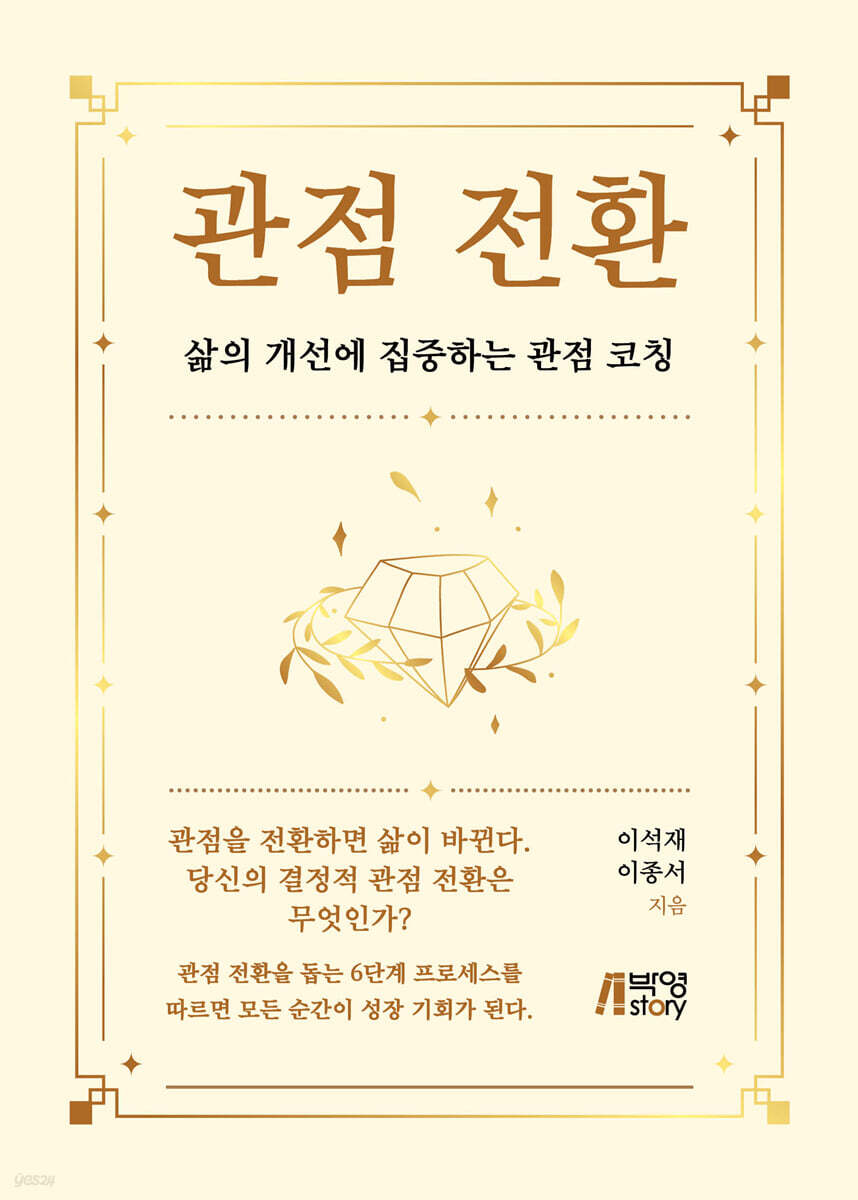
change of perspective
 |
Description
Book Introduction
Are you looking at it from a decisive perspective now?
“Everything about other people that annoys us
“It can lead us on the path to understanding ourselves.”
- Carl Gustav Jung (C.
G. Jung), analytical psychologist
Changing your perspective is like trying to change your life.
Because when your perspective changes, you create changes in yourself that allow you to see the world differently and pursue a different life.
A unique perspective can also represent a person's identity.
At the root of this perspective is egocentrism.
It is the fundamental psychology that characterizes one's own uniqueness.
People think, feel, and act according to their own perspectives.
A perspective is a particular way of seeing and understanding an object of perception.
It is the basis of how we view ourselves, others, and the environment.
Because of this, perspectives do not change easily.
People often face major challenges in life.
We must wisely address issues that affect the direction and content of our lives, such as marriage, employment, career development, interpersonal relationships and stress management, job changes, and starting a business.
What is your perspective on these challenges? To cut to the chase, it's not the challenges you face, but your perspective that influences what happens next.
So, we need to have a critical perspective.
Criticality means an attribute that increases the likelihood of achieving a desired outcome in a given context.
Therefore, a critical perspective has value and meaning that increases the likelihood of achieving the outcomes you want in your life.
So, from now on, let's take a closer look at changing perspectives.
“Everything about other people that annoys us
“It can lead us on the path to understanding ourselves.”
- Carl Gustav Jung (C.
G. Jung), analytical psychologist
Changing your perspective is like trying to change your life.
Because when your perspective changes, you create changes in yourself that allow you to see the world differently and pursue a different life.
A unique perspective can also represent a person's identity.
At the root of this perspective is egocentrism.
It is the fundamental psychology that characterizes one's own uniqueness.
People think, feel, and act according to their own perspectives.
A perspective is a particular way of seeing and understanding an object of perception.
It is the basis of how we view ourselves, others, and the environment.
Because of this, perspectives do not change easily.
People often face major challenges in life.
We must wisely address issues that affect the direction and content of our lives, such as marriage, employment, career development, interpersonal relationships and stress management, job changes, and starting a business.
What is your perspective on these challenges? To cut to the chase, it's not the challenges you face, but your perspective that influences what happens next.
So, we need to have a critical perspective.
Criticality means an attribute that increases the likelihood of achieving a desired outcome in a given context.
Therefore, a critical perspective has value and meaning that increases the likelihood of achieving the outcomes you want in your life.
So, from now on, let's take a closer look at changing perspectives.
index
Introduction: Are we now looking at it from a decisive perspective? 1
PART 1: HOW TO EXPLORE PERSPECTIVE SHIFT
CHAPTER 01 Understanding the Current Perspective 18
Clearly Recognizing the Point of View 19
26 How to see the same situation differently
Viewing through reverse thinking 34
Seeing Myself Through Others 40
Facing Life Rather Than Avoiding It 46
CHAPTER 02 Connecting Perspectives with Your Inner Self 52
The Use of Change Demands in Perspective and Inner Connection 53
74 To focus on changing defensive psychology
Awareness of Inner Positive Resources 86
91 To fully feel the emotions conveyed by the perspective
Record what the perspective tells me 97
CHAPTER 03 Expanding to a Systems Perspective 100
Multidimensional Perspective 101
Stepping Out of Your Comfort Zone 112
Asking and Answering Questions with Curiosity 124
The Mind's Wandering Psychology and Changing Perspectives 133
Stop Judging and See the Whole Picture 147
PART 2: HOW TO REALIZE A SHIFT OF PERSPECTIVE
CHAPTER 04 Embracing the Explored Perspective 160
How to Connect Perspective and Life Purpose 161
Facing Perspectives Without Criticizing 169
The Psychology of Accepting Myself Completely 177
Have a Flexible Mind 186
The Psychology of Acceptance of Effective Roles 197
CHAPTER 05 Choosing a Critical Perspective 208
209 Representative Viewpoints with High Effectiveness
Focus on important and meaningful perspectives 216
Leading and Driving Change 222
Unlocking and Unleashing Your Potential 232
Pursuing a Better Life 239
CHAPTER 06 Applying Your Chosen Perspective to Life 248
249 Publicly Declaring a Commitment
5 Steps to Taking Decisive Action 253
Effectively Reinforcing Execution Intentions 259
Checking the process and results of execution 270
Successful Case Study of a Perspective Shift 278
Outgoing Text: The Blind Men and the Elephant Story 291
Reference 294
PART 1: HOW TO EXPLORE PERSPECTIVE SHIFT
CHAPTER 01 Understanding the Current Perspective 18
Clearly Recognizing the Point of View 19
26 How to see the same situation differently
Viewing through reverse thinking 34
Seeing Myself Through Others 40
Facing Life Rather Than Avoiding It 46
CHAPTER 02 Connecting Perspectives with Your Inner Self 52
The Use of Change Demands in Perspective and Inner Connection 53
74 To focus on changing defensive psychology
Awareness of Inner Positive Resources 86
91 To fully feel the emotions conveyed by the perspective
Record what the perspective tells me 97
CHAPTER 03 Expanding to a Systems Perspective 100
Multidimensional Perspective 101
Stepping Out of Your Comfort Zone 112
Asking and Answering Questions with Curiosity 124
The Mind's Wandering Psychology and Changing Perspectives 133
Stop Judging and See the Whole Picture 147
PART 2: HOW TO REALIZE A SHIFT OF PERSPECTIVE
CHAPTER 04 Embracing the Explored Perspective 160
How to Connect Perspective and Life Purpose 161
Facing Perspectives Without Criticizing 169
The Psychology of Accepting Myself Completely 177
Have a Flexible Mind 186
The Psychology of Acceptance of Effective Roles 197
CHAPTER 05 Choosing a Critical Perspective 208
209 Representative Viewpoints with High Effectiveness
Focus on important and meaningful perspectives 216
Leading and Driving Change 222
Unlocking and Unleashing Your Potential 232
Pursuing a Better Life 239
CHAPTER 06 Applying Your Chosen Perspective to Life 248
249 Publicly Declaring a Commitment
5 Steps to Taking Decisive Action 253
Effectively Reinforcing Execution Intentions 259
Checking the process and results of execution 270
Successful Case Study of a Perspective Shift 278
Outgoing Text: The Blind Men and the Elephant Story 291
Reference 294
Publisher's Review
Why a Change of Perspective Is Important
The perspective you choose determines the quality of your life.
Perspective taking in life is the ability to see a situation from another person's perspective in addition to your own.
Therefore, taking a critical perspective facilitates a shift in perspective.
Here, perspective shifting is an influential factor that increases the likelihood of achieving the desired outcome.
A shift in perspective is the result of a fierce effort to break free from self-centeredness and embark on a path to becoming a better version of yourself.
It is also an opportunity to discover potential we were unaware of, and it is a self-directed activity that opens up infinite possibilities.
Unfortunately, despite the importance of shifting perspectives in life, it has been difficult to understand the psychological principles of how shifting perspectives works or how to effectively do so.
Moreover, there is still no coaching theory or related professional book on perspective shifting.
I will explain this through various examples throughout this book, but let me give you an example of a critical perspective.
We often wait for something in life.
The dictionary definition of 'wait' is 'to hope for someone or a time to come.'
It has the meaning of passively looking forward and expecting.
Team Leader Kim Dae-gi, who demonstrates performance-oriented leadership, participated in the leadership coaching program provided by the company.
He realized in the middle of coaching that 'waiting' means 'being considerate of the other person.'
I was always performance-oriented when it came to handling work and maintaining interpersonal relationships.
One day, I realized that I was narrow-minded and only saw and acted from my own perspective.
Here, ‘consideration’ is the decisive point.
Consideration, as Team Leader Kim sees it, is an active activity of paying attention to the perspectives of others.
Only when he let go of his self-centered perspective did he have the space to accept others.
I experienced a shift in perspective from the conventional (passive, self-centered) view of waiting to a new (active, other-centered) way of thinking and understanding based on the choice of a decisive perspective.
Through these experiences, he transformed from a performance-oriented leader to a presence-oriented leader who respects others while also pursuing results.
We can easily find examples all around us of how a leader's shift in perspective has profoundly impacted the lives of people around the world.
Representative examples include Samsung Electronics, which recognized the technological importance and influence of semiconductors and focused its entire company's capabilities on semiconductor development; Tesla, which defined automobiles, centered on internal combustion engines, as moving computers; Apple, which developed new products and services through the editing and integration of information technology and built a unique ecosystem; and Amazon, which read the environmental changes toward a hyper-connected society and built a distribution empire through bold investments.
The fundamental competitive edge demonstrated by these companies' CEOs is a shift in perspective.
This completely changed my existing way of life and thinking.
Even after years of global crisis and a new administration, a shift in perspective is desperately needed across all aspects of our lives.
Everyone can look at the issues they face in life from a different perspective and, through a change in perspective, create a better life environment.
Learning to shift your perspective can help you approach life with a more balanced perspective.
By abandoning the dichotomous thinking of situations as either positive or negative and viewing them from a systemic and integrative perspective, we can wisely address life's challenges.
But shifting perspectives doesn't always happen naturally.
You need to stop what you are doing, analyze the situation, and examine your feelings.
We must change our outward-focused (doing) gaze to one that turns inward to solve life's problems, to a being-focused gaze.
Unfortunately, even this change of perspective is not familiar.
Changing your perspective from old to new is uncomfortable, but it's worth it.
Even a one-time change of perspective can have a positive impact on your life.
However, in a dynamic and unpredictable environment, we must learn how to achieve consistent and sustainable perspective shifts.
These are the decisions you need to make to live the life you want.
Furthermore, for these decisions to lead to the life you want, it requires courage and determination to change, and even self-directed action.
A 6-Step Process to Complete a Perspective Shift
Shifting perspectives can be done on your own or with professional help.
As a professional coach and social psychologist, I have studied the psychological mechanisms that change people's thoughts and behaviors.
In the process, we reinterpreted perspective-taking (Epley et al., 2004) and perspective shifting (Mezirow, 1978) in interpersonal psychology from the perspective of effectiveness coaching (Lee, 2014; 2020a), and developed a six-step perspective shifting process based on this.
In this process, I realized that clearly identifying and understanding existing perspectives is the beginning of a change in perspective.
Therefore, in order to complete a shift in perspective, we must first explore perspective.
Building on this learning and perspective-shifting process, I've helped corporate leaders, couples, students, and those on career breaks transform their perspectives for the past 23 years.
It's about changing people's existing perspectives into new perspectives that can achieve the desired results.
This work has been called ‘perspective coaching’ (Lee Seok-jae, 2014; 2023).
The psychological mechanisms through which perspective shifting occurs have two levels: shallow, short-term influence, and deep, long-term, enduring influence.
The latter requires a structured process.
However, running some processes causes a temporary shift in perspective.
This book focuses on the latter.
The representative attributes of the concepts that make up the six steps for a change in perspective are exploring perspectives to prepare for a change in perception and putting the explored perspectives into practice in life.
These two categories are each implemented in three specific implementations, each of which unfolds in stages.
Each run was used as the title of Chapters 1 through 6 of this book.
Perspective ExplorationPerspective Realization1.
Understand the current perspective. 2.
Connect your perspective with your inner self. 3.
Expand to a systems perspective. 4.
Accept the perspectives explored. 5.
Choose a decisive perspective. 6.
Apply your chosen perspective to your life.
The Six-Step Process of Perspective Shifting (Lee Seok-jae, 2014; 2023)
When we try to change our perspective, our inner self instinctively resists.
At this time, people may fabricate feelings or say things that are not true as truth.
Sometimes, during an important meeting, the other person suddenly picks up their phone and loses focus on the conversation.
This behavior is considered rude and an act of disrespect towards you.
But on the other hand, that person may be texting a sick family member.
I may have been having trouble concentrating on conversations even before I met you.
When you open your existing perspective to all possibilities, the meaning of the other person's actions becomes apparent.
Exploring perspectives in our own lives allows us to see and respond to situations with a balanced perspective, rather than being swayed by the negative thoughts that automatically arise in uncomfortable situations.
You can also take this as an opportunity to let go of stereotypes and prejudices you've learned throughout life and develop a growth-oriented mindset.
It's an opportunity to reinvent yourself into a more positive person than before.
“What is your critical point of view right now?”
This question is simple, yet has the power to kill.
A decisive perspective increases the likelihood of achieving desired outcomes.
I hope you too will read this book and find your own critical perspective.
Reasons for writing and structure of the book
The main reason I wrote this book was to make it easy for anyone to apply the six steps outlined above to their own lives to help shift their perspective.
Through this book, I would like to share with you in detail the coaching perspectives I have established through 23 years of coaching experience, accumulated knowledge, and field verification.
Additionally, the co-author, an HR consulting expert, presents the necessary strategies and techniques from a systems perspective.
This is to help people overcome the psychological anxiety and stress that comes with being tied down by their own perspectives, leading to a life of helplessness.
The goal is to help you find your own perspective that will increase your chances of achieving the life you want.
This book is divided into two parts.
In Part 1, we introduced the perspective exploration activities necessary in the preparatory stage for a perspective shift to occur.
Part 2 then presents perspective realization activities to help individuals accept and choose new perspectives and apply them to their lives.
You can use these six step-by-step exercises to shift your perspective and improve your life in both your personal and professional lives.
We also present five representative skills that can be used to ensure that each step of execution is aligned with perspective exploration and realization.
We've also included practical examples to help you understand the step-by-step implementation and practical techniques.
To protect privacy and personal information, the protagonist's name has been changed to a pseudonym, and his job title has been changed to fit the context.
Applying a shift in perspective to your life
Anyone with a strong desire to fundamentally change their thoughts, feelings, and behaviors toward life's challenges can easily utilize perspective shifting.
This may allow you to experience new freedom in your existing life.
I hope this helps you take charge of your life, unleash your potential, and achieve the results you desire.
I also hope this book will serve as a practical guide and reference for coaches, counselors, organizational leaders, talent developers, educators, teachers, nurses, and anyone else who helps others change and grow.
[Six-Step Perspective Shift Process Case Study]
To help you understand the six-step perspective shift process developed through perspective coaching, we'll briefly introduce a case study that provides an overview of the entire process.
Imagine yourself as the protagonist of this case, Executive Director Jiwon Kim (a coaching client), and follow the conversation with the coach.
Step 1: Identify Your Current Perspective
The coach begins the conversation with the following question:
“Sir, what would you like to talk about today?
“I am in conflict with another executive due to differences of opinion about developing new overseas markets.”
“Is the issue a difference of opinion or a conflict?”
“Today I would like to talk about differences of opinion.”
“Then, please summarize in one word the topic you want to address.”
“There is a difference of opinion about developing new overseas markets.”
"What difference of opinion do you see? What do you see, sir?"
“This is the business outlook.
I have already reviewed this issue, and even if it were to be pursued, I believe the business outlook is pessimistic because it would not be competitive.”
“I would say that the current outlook on the business is pessimistic.”
“Yes.”
In the first step, we find the topic (issue, problem, etc.) that the customer wants to solve.
Next, we elicit the customer's perspective on the topic, and the customer proactively names his or her perspective (e.g., pessimistic business outlook).
Step 2: Connect your perspective with your inner self.
A perspective is a customer's viewpoint and way of understanding a particular object or phenomenon.
Through questions and listening, the coach guides the client to shift their gaze from outward to inward.
At this time, the customer's mental model operates in consciousness.
A mental model is an internally represented system of thought (or cognitive structure) that serves as a cognitive framework through which a client views and understands himself and his surroundings.
Based on this, when we look outside, our perspective is revealed.
The connection between perspectives and mental models occurs naturally as clients and coaches engage in conversations with each other.
At this stage, an environment is created where customers can learn and grow.
“How do you feel when you see a pessimistic outlook for your business?”
“I feel frustrated.
On the other hand, I feel annoyed.
“It happens often, so I’m okay with it.”
“You seem to be feeling suffocated.
I think that when you say it's okay, you're suppressing something inside.
What is it that is suppressing?”
“In fact, I think the decision was definitely made at the company level when the same proposal was made last year.
We do not consider it realistic and will not pursue it.
I think it's useless."
From these conversations, the coach learned that the client was committed to making responsible decisions as an organizational leader.
The coach asks questions to help people become more aware of their pessimistic view of the differences of opinion.
The coach also asks the client what actions he or she took afterward, what the results of those actions were, and how satisfied he or she was with the results.
These questions help customers think about the value and meaning of their current perspective.
The clearer these thoughts are, the greater the possibility of change.
Step 3: Expand to a systems perspective
In this step, we apply the activities developed in the previous two steps to other perspectives.
We use a systems approach to look at the issues our clients want to address from multiple perspectives.
New perspectives can be chosen by the client or suggested by the coach.
If your coach brings up the idea of a "new opportunity," start the conversation like this:
“What would it take to make the current situation a new opportunity for you?”
“Given our current management performance, it is true that changes are needed at the company level rather than on an individual level.
There's also some self-reflection among management, who are finding themselves falling behind competitors due to their conservative management strategies. At the very least, there's discussion about the need to create best practices for change and innovation as we explore overseas markets.
“Listening to what you said, sir, it seems you’re not unconditionally opposed to new challenges.”
“Yes, that’s right.
I think one way is to select overseas markets and try to challenge them.”
“What are your selection criteria, sir?”
“It’s the potential market size.”
At this stage, the coach presented the perspective of a 'new opportunity' and found a new perspective of 'potential market size' that the client had in mind.
Next, we explore new perspectives on values, feelings, and behaviors.
You can brainstorm with your clients to find additional perspectives.
The key here is to elicit the customer's perspective and explore that perspective.
Steps 1 through 3 lay the foundation for a change in perception for a change in perspective.
From step 4 onwards, decisions are made to change perspectives.
Step 4: Accept the perspective you explored.
The various perspectives a customer explores influence his or her subsequent thoughts, feelings, and actions.
Therefore, coaches help clients ensure that the perspectives they explore have lasting impact.
The fundamental help is to connect the client's perspective with his or her life purpose.
Accepting the perspective explored is a decision to choose a decisive perspective.
Acceptance allows us to finalize our perception of reality and release our inner resistance.
It also creates a psychological state that allows you to move into a proactive stage of choosing critical perspectives that increase the likelihood of achieving the desired outcome.
“How does prioritizing potential market size relate to your life values?”
“The coach asked an important question.
I have established and adhere to fairness as an important life value.
In the current situation, I value fairness from the company's perspective more than my own.
As an executive, my thoughts and actions must contribute to the company.”
After connecting the client's perspective with the life purpose he or she seeks (values and meaning, results, and positive influence), we help them organize their thoughts and develop a concrete action plan to select the perspective that will be most effective in the next step.
Step 5: Choose a Critical Perspective
At this stage, the client examines the various perspectives explored and ultimately selects the one that is most effective.
A high-impact perspective is one that increases the likelihood that the customer will achieve the desired outcome.
In this way, acceptance and choice are important decisions and are closely linked.
“Let’s briefly review the perspectives we’ve discussed so far (reviewing each perspective and its main points).
Which perspective do you find most useful?
“I guess it’s about considering the potential market size.”
Coaches can also creatively suggest selection criteria based on the nature of the issue the client brings to address.
For example, “Of all the perspectives we’ve looked at so far, which one resonates most with you?”
Next, we help you develop an action plan by asking questions like, "What will you do to develop overseas markets, considering their potential market size? By when? How will your coach know you've done so?"
Step 6: Apply Your Chosen Perspective to Your Life
In the final stage, the coach encourages the client to put into practice the action plan he or she has developed.
We also monitor and provide feedback on customer practices from an observer's perspective.
If your execution goes off track, we provide specific feedback on what needs to be corrected to help you achieve your desired results.
Through this process, customers complete a shift in perspective.
If you proceed without the help of external experts, you will check and provide feedback yourself.
When developing new overseas markets, clients have shifted their focus from "business prospects" to "potential market size," reflecting the value of "fairness."
The new perspectives resulting from this shift in perspective are applied to subsequent conversations with other executives and serve as a basis for judgment.
Successfully shifting your perspective in various aspects of your life will complement and modify your existing mental models.
The perspective you choose determines the quality of your life.
Perspective taking in life is the ability to see a situation from another person's perspective in addition to your own.
Therefore, taking a critical perspective facilitates a shift in perspective.
Here, perspective shifting is an influential factor that increases the likelihood of achieving the desired outcome.
A shift in perspective is the result of a fierce effort to break free from self-centeredness and embark on a path to becoming a better version of yourself.
It is also an opportunity to discover potential we were unaware of, and it is a self-directed activity that opens up infinite possibilities.
Unfortunately, despite the importance of shifting perspectives in life, it has been difficult to understand the psychological principles of how shifting perspectives works or how to effectively do so.
Moreover, there is still no coaching theory or related professional book on perspective shifting.
I will explain this through various examples throughout this book, but let me give you an example of a critical perspective.
We often wait for something in life.
The dictionary definition of 'wait' is 'to hope for someone or a time to come.'
It has the meaning of passively looking forward and expecting.
Team Leader Kim Dae-gi, who demonstrates performance-oriented leadership, participated in the leadership coaching program provided by the company.
He realized in the middle of coaching that 'waiting' means 'being considerate of the other person.'
I was always performance-oriented when it came to handling work and maintaining interpersonal relationships.
One day, I realized that I was narrow-minded and only saw and acted from my own perspective.
Here, ‘consideration’ is the decisive point.
Consideration, as Team Leader Kim sees it, is an active activity of paying attention to the perspectives of others.
Only when he let go of his self-centered perspective did he have the space to accept others.
I experienced a shift in perspective from the conventional (passive, self-centered) view of waiting to a new (active, other-centered) way of thinking and understanding based on the choice of a decisive perspective.
Through these experiences, he transformed from a performance-oriented leader to a presence-oriented leader who respects others while also pursuing results.
We can easily find examples all around us of how a leader's shift in perspective has profoundly impacted the lives of people around the world.
Representative examples include Samsung Electronics, which recognized the technological importance and influence of semiconductors and focused its entire company's capabilities on semiconductor development; Tesla, which defined automobiles, centered on internal combustion engines, as moving computers; Apple, which developed new products and services through the editing and integration of information technology and built a unique ecosystem; and Amazon, which read the environmental changes toward a hyper-connected society and built a distribution empire through bold investments.
The fundamental competitive edge demonstrated by these companies' CEOs is a shift in perspective.
This completely changed my existing way of life and thinking.
Even after years of global crisis and a new administration, a shift in perspective is desperately needed across all aspects of our lives.
Everyone can look at the issues they face in life from a different perspective and, through a change in perspective, create a better life environment.
Learning to shift your perspective can help you approach life with a more balanced perspective.
By abandoning the dichotomous thinking of situations as either positive or negative and viewing them from a systemic and integrative perspective, we can wisely address life's challenges.
But shifting perspectives doesn't always happen naturally.
You need to stop what you are doing, analyze the situation, and examine your feelings.
We must change our outward-focused (doing) gaze to one that turns inward to solve life's problems, to a being-focused gaze.
Unfortunately, even this change of perspective is not familiar.
Changing your perspective from old to new is uncomfortable, but it's worth it.
Even a one-time change of perspective can have a positive impact on your life.
However, in a dynamic and unpredictable environment, we must learn how to achieve consistent and sustainable perspective shifts.
These are the decisions you need to make to live the life you want.
Furthermore, for these decisions to lead to the life you want, it requires courage and determination to change, and even self-directed action.
A 6-Step Process to Complete a Perspective Shift
Shifting perspectives can be done on your own or with professional help.
As a professional coach and social psychologist, I have studied the psychological mechanisms that change people's thoughts and behaviors.
In the process, we reinterpreted perspective-taking (Epley et al., 2004) and perspective shifting (Mezirow, 1978) in interpersonal psychology from the perspective of effectiveness coaching (Lee, 2014; 2020a), and developed a six-step perspective shifting process based on this.
In this process, I realized that clearly identifying and understanding existing perspectives is the beginning of a change in perspective.
Therefore, in order to complete a shift in perspective, we must first explore perspective.
Building on this learning and perspective-shifting process, I've helped corporate leaders, couples, students, and those on career breaks transform their perspectives for the past 23 years.
It's about changing people's existing perspectives into new perspectives that can achieve the desired results.
This work has been called ‘perspective coaching’ (Lee Seok-jae, 2014; 2023).
The psychological mechanisms through which perspective shifting occurs have two levels: shallow, short-term influence, and deep, long-term, enduring influence.
The latter requires a structured process.
However, running some processes causes a temporary shift in perspective.
This book focuses on the latter.
The representative attributes of the concepts that make up the six steps for a change in perspective are exploring perspectives to prepare for a change in perception and putting the explored perspectives into practice in life.
These two categories are each implemented in three specific implementations, each of which unfolds in stages.
Each run was used as the title of Chapters 1 through 6 of this book.
Perspective ExplorationPerspective Realization1.
Understand the current perspective. 2.
Connect your perspective with your inner self. 3.
Expand to a systems perspective. 4.
Accept the perspectives explored. 5.
Choose a decisive perspective. 6.
Apply your chosen perspective to your life.
The Six-Step Process of Perspective Shifting (Lee Seok-jae, 2014; 2023)
When we try to change our perspective, our inner self instinctively resists.
At this time, people may fabricate feelings or say things that are not true as truth.
Sometimes, during an important meeting, the other person suddenly picks up their phone and loses focus on the conversation.
This behavior is considered rude and an act of disrespect towards you.
But on the other hand, that person may be texting a sick family member.
I may have been having trouble concentrating on conversations even before I met you.
When you open your existing perspective to all possibilities, the meaning of the other person's actions becomes apparent.
Exploring perspectives in our own lives allows us to see and respond to situations with a balanced perspective, rather than being swayed by the negative thoughts that automatically arise in uncomfortable situations.
You can also take this as an opportunity to let go of stereotypes and prejudices you've learned throughout life and develop a growth-oriented mindset.
It's an opportunity to reinvent yourself into a more positive person than before.
“What is your critical point of view right now?”
This question is simple, yet has the power to kill.
A decisive perspective increases the likelihood of achieving desired outcomes.
I hope you too will read this book and find your own critical perspective.
Reasons for writing and structure of the book
The main reason I wrote this book was to make it easy for anyone to apply the six steps outlined above to their own lives to help shift their perspective.
Through this book, I would like to share with you in detail the coaching perspectives I have established through 23 years of coaching experience, accumulated knowledge, and field verification.
Additionally, the co-author, an HR consulting expert, presents the necessary strategies and techniques from a systems perspective.
This is to help people overcome the psychological anxiety and stress that comes with being tied down by their own perspectives, leading to a life of helplessness.
The goal is to help you find your own perspective that will increase your chances of achieving the life you want.
This book is divided into two parts.
In Part 1, we introduced the perspective exploration activities necessary in the preparatory stage for a perspective shift to occur.
Part 2 then presents perspective realization activities to help individuals accept and choose new perspectives and apply them to their lives.
You can use these six step-by-step exercises to shift your perspective and improve your life in both your personal and professional lives.
We also present five representative skills that can be used to ensure that each step of execution is aligned with perspective exploration and realization.
We've also included practical examples to help you understand the step-by-step implementation and practical techniques.
To protect privacy and personal information, the protagonist's name has been changed to a pseudonym, and his job title has been changed to fit the context.
Applying a shift in perspective to your life
Anyone with a strong desire to fundamentally change their thoughts, feelings, and behaviors toward life's challenges can easily utilize perspective shifting.
This may allow you to experience new freedom in your existing life.
I hope this helps you take charge of your life, unleash your potential, and achieve the results you desire.
I also hope this book will serve as a practical guide and reference for coaches, counselors, organizational leaders, talent developers, educators, teachers, nurses, and anyone else who helps others change and grow.
[Six-Step Perspective Shift Process Case Study]
To help you understand the six-step perspective shift process developed through perspective coaching, we'll briefly introduce a case study that provides an overview of the entire process.
Imagine yourself as the protagonist of this case, Executive Director Jiwon Kim (a coaching client), and follow the conversation with the coach.
Step 1: Identify Your Current Perspective
The coach begins the conversation with the following question:
“Sir, what would you like to talk about today?
“I am in conflict with another executive due to differences of opinion about developing new overseas markets.”
“Is the issue a difference of opinion or a conflict?”
“Today I would like to talk about differences of opinion.”
“Then, please summarize in one word the topic you want to address.”
“There is a difference of opinion about developing new overseas markets.”
"What difference of opinion do you see? What do you see, sir?"
“This is the business outlook.
I have already reviewed this issue, and even if it were to be pursued, I believe the business outlook is pessimistic because it would not be competitive.”
“I would say that the current outlook on the business is pessimistic.”
“Yes.”
In the first step, we find the topic (issue, problem, etc.) that the customer wants to solve.
Next, we elicit the customer's perspective on the topic, and the customer proactively names his or her perspective (e.g., pessimistic business outlook).
Step 2: Connect your perspective with your inner self.
A perspective is a customer's viewpoint and way of understanding a particular object or phenomenon.
Through questions and listening, the coach guides the client to shift their gaze from outward to inward.
At this time, the customer's mental model operates in consciousness.
A mental model is an internally represented system of thought (or cognitive structure) that serves as a cognitive framework through which a client views and understands himself and his surroundings.
Based on this, when we look outside, our perspective is revealed.
The connection between perspectives and mental models occurs naturally as clients and coaches engage in conversations with each other.
At this stage, an environment is created where customers can learn and grow.
“How do you feel when you see a pessimistic outlook for your business?”
“I feel frustrated.
On the other hand, I feel annoyed.
“It happens often, so I’m okay with it.”
“You seem to be feeling suffocated.
I think that when you say it's okay, you're suppressing something inside.
What is it that is suppressing?”
“In fact, I think the decision was definitely made at the company level when the same proposal was made last year.
We do not consider it realistic and will not pursue it.
I think it's useless."
From these conversations, the coach learned that the client was committed to making responsible decisions as an organizational leader.
The coach asks questions to help people become more aware of their pessimistic view of the differences of opinion.
The coach also asks the client what actions he or she took afterward, what the results of those actions were, and how satisfied he or she was with the results.
These questions help customers think about the value and meaning of their current perspective.
The clearer these thoughts are, the greater the possibility of change.
Step 3: Expand to a systems perspective
In this step, we apply the activities developed in the previous two steps to other perspectives.
We use a systems approach to look at the issues our clients want to address from multiple perspectives.
New perspectives can be chosen by the client or suggested by the coach.
If your coach brings up the idea of a "new opportunity," start the conversation like this:
“What would it take to make the current situation a new opportunity for you?”
“Given our current management performance, it is true that changes are needed at the company level rather than on an individual level.
There's also some self-reflection among management, who are finding themselves falling behind competitors due to their conservative management strategies. At the very least, there's discussion about the need to create best practices for change and innovation as we explore overseas markets.
“Listening to what you said, sir, it seems you’re not unconditionally opposed to new challenges.”
“Yes, that’s right.
I think one way is to select overseas markets and try to challenge them.”
“What are your selection criteria, sir?”
“It’s the potential market size.”
At this stage, the coach presented the perspective of a 'new opportunity' and found a new perspective of 'potential market size' that the client had in mind.
Next, we explore new perspectives on values, feelings, and behaviors.
You can brainstorm with your clients to find additional perspectives.
The key here is to elicit the customer's perspective and explore that perspective.
Steps 1 through 3 lay the foundation for a change in perception for a change in perspective.
From step 4 onwards, decisions are made to change perspectives.
Step 4: Accept the perspective you explored.
The various perspectives a customer explores influence his or her subsequent thoughts, feelings, and actions.
Therefore, coaches help clients ensure that the perspectives they explore have lasting impact.
The fundamental help is to connect the client's perspective with his or her life purpose.
Accepting the perspective explored is a decision to choose a decisive perspective.
Acceptance allows us to finalize our perception of reality and release our inner resistance.
It also creates a psychological state that allows you to move into a proactive stage of choosing critical perspectives that increase the likelihood of achieving the desired outcome.
“How does prioritizing potential market size relate to your life values?”
“The coach asked an important question.
I have established and adhere to fairness as an important life value.
In the current situation, I value fairness from the company's perspective more than my own.
As an executive, my thoughts and actions must contribute to the company.”
After connecting the client's perspective with the life purpose he or she seeks (values and meaning, results, and positive influence), we help them organize their thoughts and develop a concrete action plan to select the perspective that will be most effective in the next step.
Step 5: Choose a Critical Perspective
At this stage, the client examines the various perspectives explored and ultimately selects the one that is most effective.
A high-impact perspective is one that increases the likelihood that the customer will achieve the desired outcome.
In this way, acceptance and choice are important decisions and are closely linked.
“Let’s briefly review the perspectives we’ve discussed so far (reviewing each perspective and its main points).
Which perspective do you find most useful?
“I guess it’s about considering the potential market size.”
Coaches can also creatively suggest selection criteria based on the nature of the issue the client brings to address.
For example, “Of all the perspectives we’ve looked at so far, which one resonates most with you?”
Next, we help you develop an action plan by asking questions like, "What will you do to develop overseas markets, considering their potential market size? By when? How will your coach know you've done so?"
Step 6: Apply Your Chosen Perspective to Your Life
In the final stage, the coach encourages the client to put into practice the action plan he or she has developed.
We also monitor and provide feedback on customer practices from an observer's perspective.
If your execution goes off track, we provide specific feedback on what needs to be corrected to help you achieve your desired results.
Through this process, customers complete a shift in perspective.
If you proceed without the help of external experts, you will check and provide feedback yourself.
When developing new overseas markets, clients have shifted their focus from "business prospects" to "potential market size," reflecting the value of "fairness."
The new perspectives resulting from this shift in perspective are applied to subsequent conversations with other executives and serve as a basis for judgment.
Successfully shifting your perspective in various aspects of your life will complement and modify your existing mental models.
GOODS SPECIFICS
- Date of issue: September 30, 2025
- Page count, weight, size: 308 pages | 151*211*30mm
- ISBN13: 9791172791599
- ISBN10: 1172791597
You may also like
카테고리
korean


korean

![GQ KOREA Mark (Monthly): December [2025]](http://librairie.coreenne.fr/cdn/shop/files/8ef265dbbfbf186523ed75ba7319009d.jpg?v=1765340328&width=3840)


