

All About Critical Theory
 |
Description
Book Introduction
Tyson's masterpiece, which presents the foundations of critical theory, was discovered and read through word of mouth.
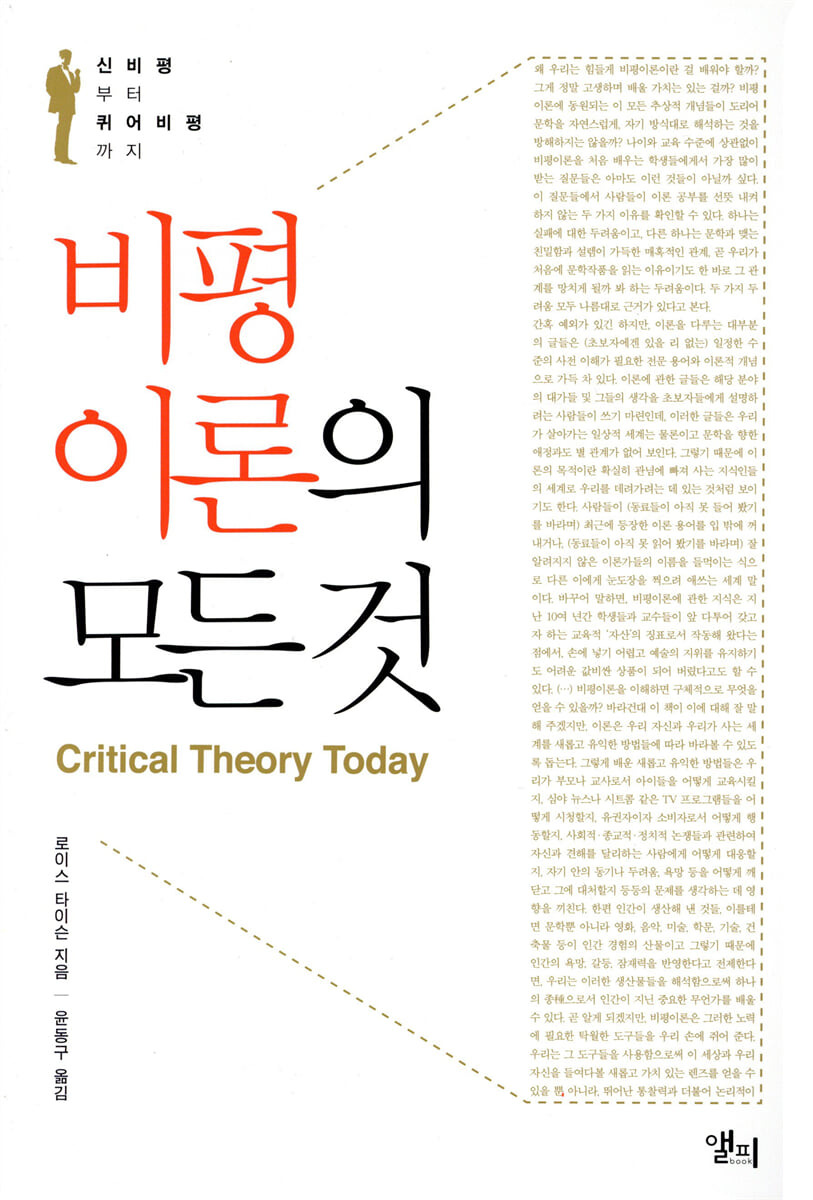
"All About Critical Theory" is a translation of the second edition of Michael Tyson's "Critical Theory Today."
This book, which has been widely recommended and well-received since its first publication in 1999, to the point that domestic readers have been purchasing and reading the original text, argues and persuades throughout the book of the practical utility of critical theory.
The author argues that critical theory is of great use in helping us better observe the world and understand our lives.
The author uses The Great Gatsby as a revelation and applies various critical theories to show that the novel can present completely different perspectives depending on which theory is used to view it.
At the same time, the most important thing that critical theory teaches us is that there are not just one but many ways to understand the world.
Over 13 chapters, the book provides detailed explanations of the core concepts and terms of each theory, and provides various examples of how the concepts and analytical methods used in critical theory can be applied to literary analysis.
In particular, each chapter includes a detailed analysis of The Great Gatsby using the relevant critical theory, an analysis of other literary works in the form of questions, [Further Reading], [Important Theory Books] on the relevant theory, and [References], which will be useful for both beginners and advanced readers of critical theory.
"All About Critical Theory" is a translation of the second edition of Michael Tyson's "Critical Theory Today."
This book, which has been widely recommended and well-received since its first publication in 1999, to the point that domestic readers have been purchasing and reading the original text, argues and persuades throughout the book of the practical utility of critical theory.
The author argues that critical theory is of great use in helping us better observe the world and understand our lives.
The author uses The Great Gatsby as a revelation and applies various critical theories to show that the novel can present completely different perspectives depending on which theory is used to view it.
At the same time, the most important thing that critical theory teaches us is that there are not just one but many ways to understand the world.
Over 13 chapters, the book provides detailed explanations of the core concepts and terms of each theory, and provides various examples of how the concepts and analytical methods used in critical theory can be applied to literary analysis.
In particular, each chapter includes a detailed analysis of The Great Gatsby using the relevant critical theory, an analysis of other literary works in the form of questions, [Further Reading], [Important Theory Books] on the relevant theory, and [References], which will be useful for both beginners and advanced readers of critical theory.
- You can preview some of the book's contents.
Preview
index
For teachers who want to teach using this book
Acknowledgements
Chapter 1: Things I Wanted to Know About Critical Theory but Never Dare to Ask
A vague sense of anxiety or rejection about the theory
What's the 'use' of knowing the theory?
Different lenses through which to view the world
Why I Chose 'The Great Gatsby'
What is criticism?
Reading along the grain/reading against the grain
Chapter 2: Psychoanalytic Criticism
Origin of the Unconscious
Defense, Anxiety, and Core Issues
Dreams and symbols of dreams
The meaning of death
The meaning of sexual desire
Lacanian psychoanalysis
Classical psychoanalysis and literature
Questions a Psychoanalytic Critic Might Ask
“What does love have to do with it?”
-A Psychoanalytic Reading of The Great Gatsby
Advanced Study: Psychoanalytic Approaches to Other Literary Works
Further Reading
Important theoretical books
References
Chapter 3: Marxist Criticism
Basic Assumptions of Marxism
American class system
The role of ideology
human behavior, products, and families
Marxism and Literature
Questions a Marxist Critic Might Ask
What I have tells who I am.
-A Marxist Reading of The Great Gatsby
Advanced Study: A Marxist Approach to Other Literature
Further Reading
Important theoretical books
References
Chapter 4 Feminist Criticism
traditional gender roles
A Brief Look at the Premises of Feminism
Beyond Patriarchy
French feminism
multicultural feminism
Feminism and Literature
Questions a Feminist Critic Might Ask
“…If this continues, I’ll throw everything away…”
-A Feminist Reading of The Great Gatsby
In-Depth Study: Feminist Approaches to Other Literary Works
Further Reading
Important theoretical books
References
Chapter 5 New Criticism
'The text itself'
Literary language and organic unity
New Criticism as Immanent and Objective Criticism
The single best interpretation
Questions posed to literary texts by new critics
“Immortal Song” Called by Longing
-A New Critical Reading of The Great Gatsby
Advanced Study: New Critical Approaches to Other Literary Works
Further Reading
Important theoretical books
References
Chapter 6: Reader Response Criticism
Reciprocal Reader Response Theory
Influence Stylistics
Subjective Reader Response Theory
Psychological reader response theory
Social Reader Response Theory
Defining the reader
Questions Reader-Response Theory Critics Might Ask
Project the reader
:Critical Reading: Reader Response Theory for The Great Gatsby
Advanced Study: A Reader-Response Theory Approach to Other Literary Works
Further Reading
Important theoretical books
References
Chapter 7 Structuralist Criticism
structural linguistics
structural anthropology
Semiotics
Structuralism and Literature
Structure of literary genres
Structure of Literary Interpretation
Questions a structuralist critic might ask
“Ask and you will find.”… …and you will lose.
: A structuralist reading of The Great Gatsby
Advanced Study: A Structuralist Approach to Other Literary Works
Further Reading
Important theoretical books
References
Chapter 8: Deconstructive Criticism
Deconstructing language
Dismantle the world
Deconstructing human identity
Deconstructing literature
Questions a Deconstruction Critic Might Ask
“…the homecoming train of my youth, my heart pounding…”
: A deconstructive reading of The Great Gatsby
Advanced Study: A Deconstructive Approach to Other Literary Works
Further Reading
Important theoretical books
References
Chapter 9: New Historicism and Cultural Criticism
New Historicism
New Historicism and Literature
cultural criticism
Cultural Criticism and Literature
Questions for New Historicism and Cultural Criticism Theorists
self-made man discourse
: A New Historicist Reading of The Great Gatsby
Advanced Study: A New Historicist/Cultural Critical Approach to Other Literary Works
Further Reading
Important theoretical books
References
Chapter 10: Lesbian, Gay, and Queer Criticism
Marginalization of lesbians and gay men
lesbian criticism
gay criticism
Queer criticism
Some features shared by lesbian, gay, and queer criticism
Questions Lesbian, Gay, and Queer Critics Might Ask
Would Nick Carraway be willing to come out?
A Queer Critical Reading of The Great Gatsby
Advanced Study: Lesbian, Gay, and Queer Approaches to Other Literature
Further Reading
Important theoretical books
References
Chapter 11 African American Literary Criticism
Issues related to racism and the history of African American literature
Recent Developments: Critical Race Theory
African American Literary Criticism and Works
Questions an African American Critic Might Ask
But where is Harlem?
: An African American Literary Criticism of The Great Gatsby
Advanced Study: African American Literary Critical Approaches to Other Literature
Further Reading
Important theoretical books
References
Chapter 12: Postcolonial Criticism
Postcolonial identity
Debates related to decolonization
Postcolonial Criticism and Literature
Questions Postcolonial Critics Might Ask
Colonies within
: A Postcolonial Reading of The Great Gatsby
Advanced Study: A Colonial Approach to Other Literature
Further Reading
Important theoretical books
References
Chapter 13: Drawing the Overall Outline
Translator's note
Search
Acknowledgements
Chapter 1: Things I Wanted to Know About Critical Theory but Never Dare to Ask
A vague sense of anxiety or rejection about the theory
What's the 'use' of knowing the theory?
Different lenses through which to view the world
Why I Chose 'The Great Gatsby'
What is criticism?
Reading along the grain/reading against the grain
Chapter 2: Psychoanalytic Criticism
Origin of the Unconscious
Defense, Anxiety, and Core Issues
Dreams and symbols of dreams
The meaning of death
The meaning of sexual desire
Lacanian psychoanalysis
Classical psychoanalysis and literature
Questions a Psychoanalytic Critic Might Ask
“What does love have to do with it?”
-A Psychoanalytic Reading of The Great Gatsby
Advanced Study: Psychoanalytic Approaches to Other Literary Works
Further Reading
Important theoretical books
References
Chapter 3: Marxist Criticism
Basic Assumptions of Marxism
American class system
The role of ideology
human behavior, products, and families
Marxism and Literature
Questions a Marxist Critic Might Ask
What I have tells who I am.
-A Marxist Reading of The Great Gatsby
Advanced Study: A Marxist Approach to Other Literature
Further Reading
Important theoretical books
References
Chapter 4 Feminist Criticism
traditional gender roles
A Brief Look at the Premises of Feminism
Beyond Patriarchy
French feminism
multicultural feminism
Feminism and Literature
Questions a Feminist Critic Might Ask
“…If this continues, I’ll throw everything away…”
-A Feminist Reading of The Great Gatsby
In-Depth Study: Feminist Approaches to Other Literary Works
Further Reading
Important theoretical books
References
Chapter 5 New Criticism
'The text itself'
Literary language and organic unity
New Criticism as Immanent and Objective Criticism
The single best interpretation
Questions posed to literary texts by new critics
“Immortal Song” Called by Longing
-A New Critical Reading of The Great Gatsby
Advanced Study: New Critical Approaches to Other Literary Works
Further Reading
Important theoretical books
References
Chapter 6: Reader Response Criticism
Reciprocal Reader Response Theory
Influence Stylistics
Subjective Reader Response Theory
Psychological reader response theory
Social Reader Response Theory
Defining the reader
Questions Reader-Response Theory Critics Might Ask
Project the reader
:Critical Reading: Reader Response Theory for The Great Gatsby
Advanced Study: A Reader-Response Theory Approach to Other Literary Works
Further Reading
Important theoretical books
References
Chapter 7 Structuralist Criticism
structural linguistics
structural anthropology
Semiotics
Structuralism and Literature
Structure of literary genres
Structure of Literary Interpretation
Questions a structuralist critic might ask
“Ask and you will find.”… …and you will lose.
: A structuralist reading of The Great Gatsby
Advanced Study: A Structuralist Approach to Other Literary Works
Further Reading
Important theoretical books
References
Chapter 8: Deconstructive Criticism
Deconstructing language
Dismantle the world
Deconstructing human identity
Deconstructing literature
Questions a Deconstruction Critic Might Ask
“…the homecoming train of my youth, my heart pounding…”
: A deconstructive reading of The Great Gatsby
Advanced Study: A Deconstructive Approach to Other Literary Works
Further Reading
Important theoretical books
References
Chapter 9: New Historicism and Cultural Criticism
New Historicism
New Historicism and Literature
cultural criticism
Cultural Criticism and Literature
Questions for New Historicism and Cultural Criticism Theorists
self-made man discourse
: A New Historicist Reading of The Great Gatsby
Advanced Study: A New Historicist/Cultural Critical Approach to Other Literary Works
Further Reading
Important theoretical books
References
Chapter 10: Lesbian, Gay, and Queer Criticism
Marginalization of lesbians and gay men
lesbian criticism
gay criticism
Queer criticism
Some features shared by lesbian, gay, and queer criticism
Questions Lesbian, Gay, and Queer Critics Might Ask
Would Nick Carraway be willing to come out?
A Queer Critical Reading of The Great Gatsby
Advanced Study: Lesbian, Gay, and Queer Approaches to Other Literature
Further Reading
Important theoretical books
References
Chapter 11 African American Literary Criticism
Issues related to racism and the history of African American literature
Recent Developments: Critical Race Theory
African American Literary Criticism and Works
Questions an African American Critic Might Ask
But where is Harlem?
: An African American Literary Criticism of The Great Gatsby
Advanced Study: African American Literary Critical Approaches to Other Literature
Further Reading
Important theoretical books
References
Chapter 12: Postcolonial Criticism
Postcolonial identity
Debates related to decolonization
Postcolonial Criticism and Literature
Questions Postcolonial Critics Might Ask
Colonies within
: A Postcolonial Reading of The Great Gatsby
Advanced Study: A Colonial Approach to Other Literature
Further Reading
Important theoretical books
References
Chapter 13: Drawing the Overall Outline
Translator's note
Search
Publisher's Review
Tyson's masterpiece, which I found and read through word of mouth.
Since the 2000s, critical theory has developed in at least two directions.
Some theorists who had been discussed only at the graduate level began to appear in undergraduate classes, and some theories that had been primarily discussed in other academic disciplines began to be frequently used as basic frameworks in literary studies.
It is very natural to talk about critical theory in this way, connecting it with universities and academia.
So, is critical theory the exclusive domain of the 'ivory tower'?
Since the first edition was published in 1999, Tyson's "Critical Theory Today" has been a must-read for readers desperate for a proper introduction to critical theory. The second edition (2006) of this book, "All About Critical Theory," is none other than Tyson's "Critical Theory Today." The book's brilliance lies in its insistence and persuasiveness throughout, including the preface and chapter 1, on the practical "utility" of critical theory, a field previously perceived as the exclusive preserve of academia.
Why study critical theory? What is the purpose of studying critical theory? Author Lois Tyson answers.
“Criticism is very useful for looking at the world and understanding our lives better!”
The structure and readership of this book
This book, "All About Critical Theory," demonstrates that critical theory not only contributes to understanding literary texts in relation to reality, but also helps us view the world we live in from our own perspective.
Over 13 chapters, the book provides detailed explanations of the core concepts and terms of each theory, and provides various examples of how the concepts and analytical methods used in critical theory can be applied to literary analysis.
In particular, each chapter provides a detailed analysis of The Great Gatsby using the relevant critical theory, and analyses of other literary works in the form of questions, as well as [Further Reading], [Important Theory Books], and [References], which will be useful to both beginners and advanced readers of critical theory.
Whether you're a student just beginning to study theory, a professor who hasn't yet fully explored theory and wants to become more familiar with its perspectives, or a reader who feels burdened by theory, this book can serve as a true "basic" guide.
"The Great Gatsby": A Perceptive Analysis Through 11 Theoretical Frameworks
This book, "All About Critical Theory," introduces critical theory, focusing primarily on literature.
The two reasons given by the author are as follows:
First, it is because most readers encounter critical theory from the perspective of students learning literature or teachers teaching literature. Second, it is because literature, as a 'laboratory' of human life, presents specific examples of human experience that all readers can share.
For this reason, a very thorough text in which the author applies all the theories introduced in the book in order was published in 1925 by F.
Scott Fitzgerald's famous novel, The Great Gatsby.
As we all know, this novel is considered a canon of English literature and is a “great and entertaining novel” that has already been read and impressed by countless readers.
However, the reason the author chose The Great Gatsby is, above all, because this novel fits well with various critical theories.
This means that depending on which theoretical framework one fits into, this novel reveals completely different perspectives.
Should we focus on capitalism or on homosexuality?
For example, if we look at The Great Gatsby through the lens of Marxist criticism, it becomes clear that the novel exposes the dark side of capitalism.
The novel vividly portrays the lives of those who have achieved economic prosperity, and sharply points out how the American Dream not only fails to fulfill expectations but also contributes to the corruption of individual values.
In other words, The Great Gatsby is a novel that carries out a sharp critique of American capitalist culture and the ideology that fuels it.
But when we examine The Great Gatsby through the lens of the recently popular lesbian, gay, and queer critical theories, we see that the homosexual subtexts that secretly permeate the novel's dramatic scenes obscure its overtly heterosexual narrative.
Why are all the characters in the novel drawn to adultery? Why does Gatsby's pink suit function as a gay/lesbian symbol? Why does Nick, the narrator, perceive Gatsby as a depiction of a woman he admires?
The perspectives of many, not just one, on the world
Of course, this book does not only analyze The Great Gatsby.
A diverse spectrum of critical theories is explored across a diverse range of literary texts, including a deconstructive interpretation of Mary Shelley's Frankenstein (1818), a Marxist analysis of Toni Morrison's The Bluest Eye, a gay-critical analysis of Walt Whitman's "Song of Myself," and a postcolonial critique of Joseph Conrad's "Heart of Darkness."
There is a trap that readers can easily fall into at this point.
This is precisely what happens when you fit text and theory together, distorting the details of both.
Gatsby's oft-mentioned "pink suit" may be an obvious gay code, but it could also be a symbol of the vulgarity of capitalism.
This book, "All About Critical Theory," sees critical theory as a "bouquet" of various flowers, and emphasizes that the most important thing that critical theory teaches us is that there are not just one but "many" ways in which we understand the world.
Since the 2000s, critical theory has developed in at least two directions.
Some theorists who had been discussed only at the graduate level began to appear in undergraduate classes, and some theories that had been primarily discussed in other academic disciplines began to be frequently used as basic frameworks in literary studies.
It is very natural to talk about critical theory in this way, connecting it with universities and academia.
So, is critical theory the exclusive domain of the 'ivory tower'?
Since the first edition was published in 1999, Tyson's "Critical Theory Today" has been a must-read for readers desperate for a proper introduction to critical theory. The second edition (2006) of this book, "All About Critical Theory," is none other than Tyson's "Critical Theory Today." The book's brilliance lies in its insistence and persuasiveness throughout, including the preface and chapter 1, on the practical "utility" of critical theory, a field previously perceived as the exclusive preserve of academia.
Why study critical theory? What is the purpose of studying critical theory? Author Lois Tyson answers.
“Criticism is very useful for looking at the world and understanding our lives better!”
The structure and readership of this book
This book, "All About Critical Theory," demonstrates that critical theory not only contributes to understanding literary texts in relation to reality, but also helps us view the world we live in from our own perspective.
Over 13 chapters, the book provides detailed explanations of the core concepts and terms of each theory, and provides various examples of how the concepts and analytical methods used in critical theory can be applied to literary analysis.
In particular, each chapter provides a detailed analysis of The Great Gatsby using the relevant critical theory, and analyses of other literary works in the form of questions, as well as [Further Reading], [Important Theory Books], and [References], which will be useful to both beginners and advanced readers of critical theory.
Whether you're a student just beginning to study theory, a professor who hasn't yet fully explored theory and wants to become more familiar with its perspectives, or a reader who feels burdened by theory, this book can serve as a true "basic" guide.
"The Great Gatsby": A Perceptive Analysis Through 11 Theoretical Frameworks
This book, "All About Critical Theory," introduces critical theory, focusing primarily on literature.
The two reasons given by the author are as follows:
First, it is because most readers encounter critical theory from the perspective of students learning literature or teachers teaching literature. Second, it is because literature, as a 'laboratory' of human life, presents specific examples of human experience that all readers can share.
For this reason, a very thorough text in which the author applies all the theories introduced in the book in order was published in 1925 by F.
Scott Fitzgerald's famous novel, The Great Gatsby.
As we all know, this novel is considered a canon of English literature and is a “great and entertaining novel” that has already been read and impressed by countless readers.
However, the reason the author chose The Great Gatsby is, above all, because this novel fits well with various critical theories.
This means that depending on which theoretical framework one fits into, this novel reveals completely different perspectives.
Should we focus on capitalism or on homosexuality?
For example, if we look at The Great Gatsby through the lens of Marxist criticism, it becomes clear that the novel exposes the dark side of capitalism.
The novel vividly portrays the lives of those who have achieved economic prosperity, and sharply points out how the American Dream not only fails to fulfill expectations but also contributes to the corruption of individual values.
In other words, The Great Gatsby is a novel that carries out a sharp critique of American capitalist culture and the ideology that fuels it.
But when we examine The Great Gatsby through the lens of the recently popular lesbian, gay, and queer critical theories, we see that the homosexual subtexts that secretly permeate the novel's dramatic scenes obscure its overtly heterosexual narrative.
Why are all the characters in the novel drawn to adultery? Why does Gatsby's pink suit function as a gay/lesbian symbol? Why does Nick, the narrator, perceive Gatsby as a depiction of a woman he admires?
The perspectives of many, not just one, on the world
Of course, this book does not only analyze The Great Gatsby.
A diverse spectrum of critical theories is explored across a diverse range of literary texts, including a deconstructive interpretation of Mary Shelley's Frankenstein (1818), a Marxist analysis of Toni Morrison's The Bluest Eye, a gay-critical analysis of Walt Whitman's "Song of Myself," and a postcolonial critique of Joseph Conrad's "Heart of Darkness."
There is a trap that readers can easily fall into at this point.
This is precisely what happens when you fit text and theory together, distorting the details of both.
Gatsby's oft-mentioned "pink suit" may be an obvious gay code, but it could also be a symbol of the vulgarity of capitalism.
This book, "All About Critical Theory," sees critical theory as a "bouquet" of various flowers, and emphasizes that the most important thing that critical theory teaches us is that there are not just one but "many" ways in which we understand the world.
GOODS SPECIFICS
- Date of publication: April 18, 2012
- Page count, weight, size: 952 pages | 1,340g | 153*225*40mm
- ISBN13: 9788992151412
- ISBN10: 8992151411
You may also like
카테고리
korean


korean

![GQ KOREA Mark (Monthly): December [2025]](http://librairie.coreenne.fr/cdn/shop/files/8ef265dbbfbf186523ed75ba7319009d.jpg?v=1765340328&width=3840)


