

Songmyeong Seongrihak
 |
Description
Book Introduction
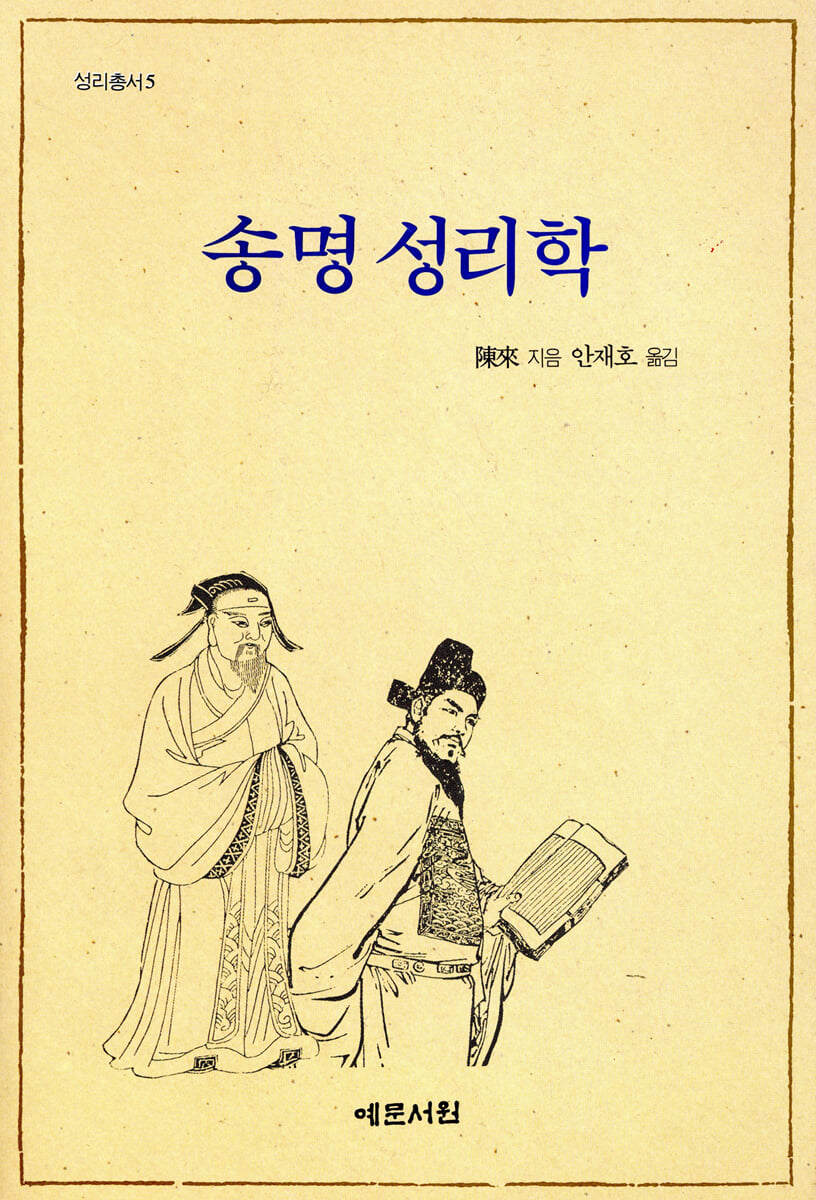
Through the 22 representative thinkers of the Song and Ming dynasties, the Neo-Confucianism of the time is reconstructed. In the Song dynasty section, the compilation of Neo-Confucianism and the subsequent succession and overcoming process are shown with Zhu Xi at the center, and in the Ming dynasty section, the establishment of Yangmingism and its branching process are traced with Wang Shouren at the center.
It allowed us to examine the flow of Song and Ming Neo-Confucianism, which progressed from Gihak to Ihak and from Ihak to Simhak, while pursuing the ideal of Ipingeuk.
It allowed us to examine the flow of Song and Ming Neo-Confucianism, which progressed from Gihak to Ihak and from Ihak to Simhak, while pursuing the ideal of Ipingeuk.
index
1.
Leading words
2.
A pioneer of Song and Ming Neo-Confucianism
3.
The establishment and development of Northern Song Neo-Confucianism
4.
The development of Southern Song Neo-Confucianism
5.
Confucianism in the mid-to-late Ming Dynasty
6.
Concluding remarks
Leading words
2.
A pioneer of Song and Ming Neo-Confucianism
3.
The establishment and development of Northern Song Neo-Confucianism
4.
The development of Southern Song Neo-Confucianism
5.
Confucianism in the mid-to-late Ming Dynasty
6.
Concluding remarks
Into the book
The cultural transition that began in the mid-Tang Dynasty and became stable and established during the Northern Song Dynasty was part of the process of 'modernization'.
This form of modern culture can be thought of as an intermediate form between the spirit of the Middle Ages and modern industrial civilization, and its basic spirit is a prominent secularity, rationality, and commonness.
The evaluation of Songmyeong Confucianism as a whole should be conducted anew under this background.
In this sense, Confucianism should not be evaluated as a declining form of consciousness in the late feudal society or as an embodiment of the ideas of the declining feudal society.
Confucianism is a cultural expression of the pre-modern era, shedding its medieval spirit, and is part of a cultural transition born from adapting to and harmonizing with the social changes of modernization. Therefore, only after granting it this status will we be able to truly understand Confucianism.
This form of modern culture can be thought of as an intermediate form between the spirit of the Middle Ages and modern industrial civilization, and its basic spirit is a prominent secularity, rationality, and commonness.
The evaluation of Songmyeong Confucianism as a whole should be conducted anew under this background.
In this sense, Confucianism should not be evaluated as a declining form of consciousness in the late feudal society or as an embodiment of the ideas of the declining feudal society.
Confucianism is a cultural expression of the pre-modern era, shedding its medieval spirit, and is part of a cultural transition born from adapting to and harmonizing with the social changes of modernization. Therefore, only after granting it this status will we be able to truly understand Confucianism.
--- p.44~45
GOODS SPECIFICS
- Date of issue: December 31, 1997
- Page count, weight, size: 590 pages | 148*210*35mm
- ISBN13: 9788976460608
- ISBN10: 897646060X
You may also like
카테고리
korean


korean

![GQ KOREA Mark (Monthly): December [2025]](http://librairie.coreenne.fr/cdn/shop/files/8ef265dbbfbf186523ed75ba7319009d.jpg?v=1765340328&width=3840)


