

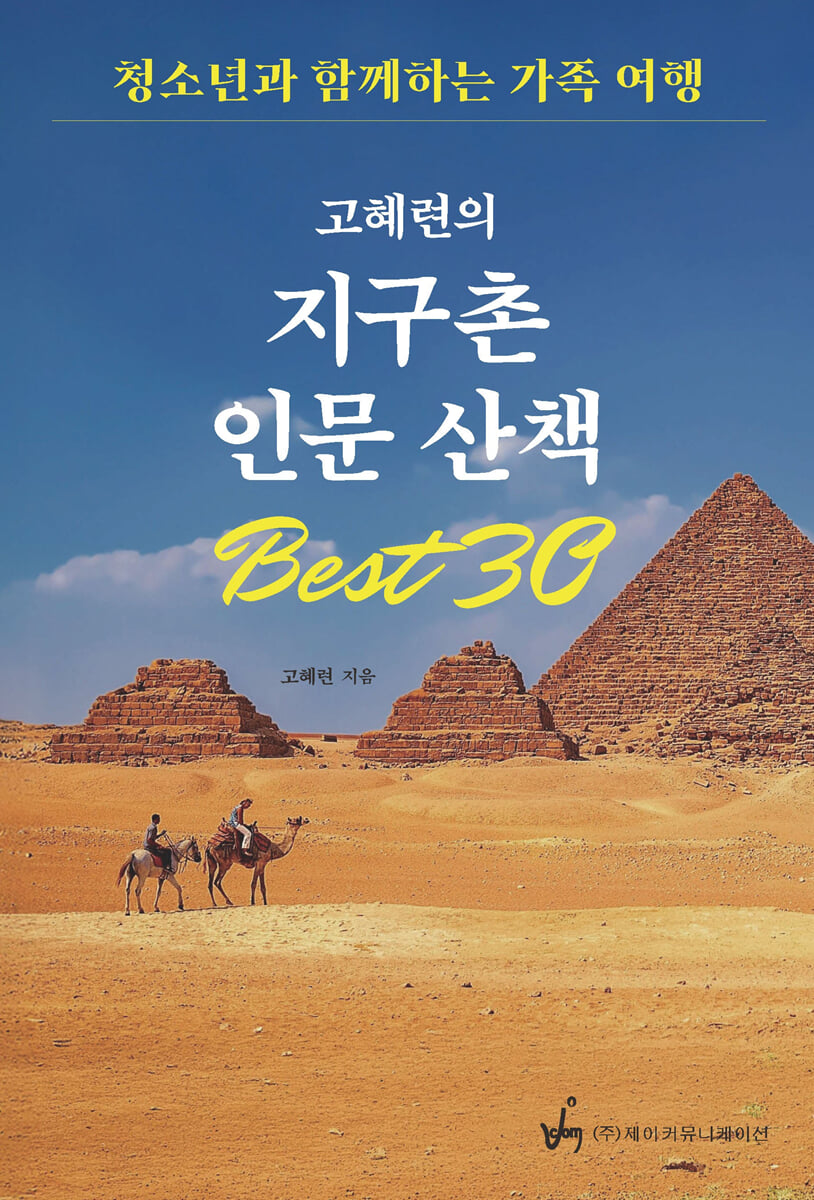
Go Hye-ryeon's Top 30 Global Humanities Walks
 |
Description
Book Introduction
Wherever you go, let's leave with a basic understanding of the country's history and the people and culture contained within it.
That way, I can learn more, feel more, empathize more, and fully digest it as my own.
It's ordinary, but that's the essence.
To truly understand something, you need a foundation! "You see as much as you know" is a maxim we shouldn't overstate.
First, I will encourage myself with small actions that give me confidence.
Let's leave after learning the circumstances surrounding why their history flowed that way and changed the countries and the world we know today.
Only when humans searched for the existence of the Creator thousands of years ago, how divine authority was exercised, how divine authority functioned to check royal authority, and why the luxurious royal family, once so powerful and eternal, collapsed and fell to pieces, will they be able to feel the sorrows of human life within that splendid palace.
And it is no coincidence that so many brilliant writers and musicians have hung out there, making people all over the world cry.
Aren't you curious about what the birthplace of human civilization has become like today?
I have established travel as one of the three pillars of my life, and I have selected the places I must see while traveling around the world whenever I have time.
Due to space constraints, the remaining recommended locations will be included in the next installment.
As a parent, what's the most meaningful and valuable gift you can give your young adult, whose horizons are just beginning to open? I'd say it's a trip to explore the world.
These are words that come from my own direct and indirect experiences over many years.
Normally, parents and children live in the same house, but their conversations are limited to daily life and school events.
It is not easy for children to express their concerns or interests to their parents with a serious expression.
During the trip, you will have the opportunity to talk naturally about your child's interests, career paths, friendships with friends, and relationships with teachers without feeling burdened or awkward.
This book was written with the hope that you and your beloved family and friends will be able to experience and gain more from your travels together.
That way, I can learn more, feel more, empathize more, and fully digest it as my own.
It's ordinary, but that's the essence.
To truly understand something, you need a foundation! "You see as much as you know" is a maxim we shouldn't overstate.
First, I will encourage myself with small actions that give me confidence.
Let's leave after learning the circumstances surrounding why their history flowed that way and changed the countries and the world we know today.
Only when humans searched for the existence of the Creator thousands of years ago, how divine authority was exercised, how divine authority functioned to check royal authority, and why the luxurious royal family, once so powerful and eternal, collapsed and fell to pieces, will they be able to feel the sorrows of human life within that splendid palace.
And it is no coincidence that so many brilliant writers and musicians have hung out there, making people all over the world cry.
Aren't you curious about what the birthplace of human civilization has become like today?
I have established travel as one of the three pillars of my life, and I have selected the places I must see while traveling around the world whenever I have time.
Due to space constraints, the remaining recommended locations will be included in the next installment.
As a parent, what's the most meaningful and valuable gift you can give your young adult, whose horizons are just beginning to open? I'd say it's a trip to explore the world.
These are words that come from my own direct and indirect experiences over many years.
Normally, parents and children live in the same house, but their conversations are limited to daily life and school events.
It is not easy for children to express their concerns or interests to their parents with a serious expression.
During the trip, you will have the opportunity to talk naturally about your child's interests, career paths, friendships with friends, and relationships with teachers without feeling burdened or awkward.
This book was written with the hope that you and your beloved family and friends will be able to experience and gain more from your travels together.
index
Part 1 = The First Step to a Great Family Trip
1.
Prologue - Preface
2.
Let's go, into the joy of escape
3.
Why Humanities Travelogue
4.
Family Travel - The Most Valuable Gift You Can Give Your Teenagers
Part 2 = I Want to Go There - Best of the Global Humanities Travelogue
1.
Ephesus, the greatest evangelist center where the New Testament was written two thousand years ago in a bastion of idolatry.
A central city on the Aegean coast, a center of idol worship, including the goddess Artemis.
One of the three largest commercial cities in the Mediterranean, with over 200 communities.
The holy place where the Apostle Paul, who was a Roman persecutor who led the arrest of Jesus and transformed into a worshipper, advanced in his evangelization.
The place where John the Baptist and the Virgin Mary spent their later years and died.
The Asrahan Chronicles are a 'time savings account', and there are attractions such as the Celsus Library, the best library in ancient times, a huge open-air concert hall, a pleasure district, a baptismal site, and an ancient toilet.
2.
The birthplace of the bohemian spirit.
Prague - the 'Paris of Eastern Europe'
The capital of the Holy Roman Emperor Charles IV, who displayed his power on the banks of the Moldau River.
A city that condenses the history of endless foreign invasion, oppression, and anger into art.
The Prague Spring Music Festival, held annually on the anniversary of the death of Czech national musician Smetana
'My Homeland' is always the opening song
Home of Kafka and Milan Kundera, pioneers of existentialist literature.
A place that produced brilliant musicians, including Dvorak, who raised the bar with his "New World Symphony."
Birthplace of German lyric poet Rainer Maria Rilke.
3.
Florence, the cradle of geniuses like da Vinci, Michelangelo, Galileo, and Rossini who brought about the Renaissance
The Medici family served as the birthplace of the Renaissance, known as the 'City of Flowers' and the 'City of Art'.
The hometown of Michelangelo and Leonardo da Vinci, a grid-planned city from the 1st century BC.
The Duomo, a landmark of Florence, boasts a massive cupola that is a stunning display of medieval architectural technology.
The hometown of Dante, who sublimated his love for a woman on the banks of the Arno River into the Divine Comedy.
Machiavelli, who was born here, wrote 'The Prince' and dedicated it to the Medici family.
4.
Ronda, beloved by Hemingway, who used the violent deaths of the bullring as a driving force for his writing.
A place where the great writer, searching for a fierce punch that shakes the soul, became intensely obsessed.
For four years, he watched over 1,000 bullfights and devoted himself to writing in a mountain village fortress.
The birthplace and residence of the famous works 'The Sun Also Rises' and 'A Dangerous Summer' is also real.
Hemingway, known as the 'adopted son of Ronda', is greeted by a statue of Hemingway on the promenade he used to walk.
The blood-splattering red cape of the matador and the soul-sucking flamenco of the wanderer. The birthplace of bullfighting still stands strong.
5.
Xi'an, the capital of 13 ancient Chinese dynasties and the starting point of the Silk Road
The tomb of Qin Shi Huang, who dreamed of immortality, and the Terracotta Army, the bodyguard of the dead, are must-sees.
Hot spring baths where the love story of Emperor Xuanzong of Tang and Yang Guifei is told are also popular.
The place where the An Lushan Rebellion broke out, which led to the downfall of Emperor Xuanzong and the suicide of Yang Guifei.
The starting point for the revival of the Chinese Communist Party and the downfall of Chiang Kai-shek, the birthplace of the Xi'an Incident.
It was the starting point of the Silk Road and the capital of 13 dynasties in China's 2,000-year history.
The capital of the Central Plains, Xi'an, Shaanxi Province = Xi'an, Shaanxi Province = Chang'an during the Tang Dynasty
The birthplace of President Xi Jinping and his wife, and the current center of the 'Belt and Road' with explosive population growth.
6.
Athens: A Museum of All Humanity, the Birthplace of Democracy, and the Roots of Western Culture and Civilization
The Parthenon Temple on the Acropolis Hill is the first World Cultural Heritage Site.
The UNESCO symbol logo also depicts the Parthenon.
The ancient Agora was the political, economic, and cultural center of Athens from the 6th century BC.
After the construction of water and drainage facilities, a temple, shops, a market, and a court were built in the center of the square.
The stage for debates between ancient sages and philosophers, including Socrates, Plato, and Aristotle.
The cave prison where Socrates died by taking poison also draws attention.
The Kerameikos Museum area is where over a thousand tombs from the 5th century BC have been excavated.
7.
Frankfurt, the hometown of Goethe, the great writer who transcended the centuries and the unparalleled genius
The gateway to Central Europe, the birthplace of Goethe, the symbol and icon of the German spirit
The birthplace and museum of the author of 'Faust' and 'The Sorrows of Young Werther'
Near his birthplace, there is a church where he was baptized, a statue, and a walking path where he used to walk, attracting many tourists.
159 Goethe-Instituts were established in his honor in 98 countries around the world.
South Korea is also developing a Goethe Village in Yeoju, Gyeonggi Province.
8. Salzburg, the city of music and festivals where Mozart lives and breathes
The birthplace of the musical prodigy, Mozart, and home to 4,000 music festivals annually.
The 'City of Salt' welcomes you with chocolates bearing his likeness.
The setting of the film "Amadeus" and the birthplace of the second-in-command complex = "Salieri Syndrome."
The filming location for 'The Sound of Music', featuring the most beautiful garden, Mirabell Palace
Birthplace of the Christmas carol "Silent Night, Holy Night"
9.
Machu Picchu, the glorious ancient capital of the Inca Empire that disappeared from the world - Cusco
The Lost City in the Sky, one of the New Seven Wonders of the World, and the City of the Sun
Cusco, known as the 'navel in the middle of the world', is full of mystery that transcends time and space.
A thousand natives buried alive 100 elderly people and a virgin on the top of the 'Secret City' mountain.
The body disappeared without a trace, and even after 100 years of being exhumed, it remains a mystery.
The elaborate structures, terraced fields, and salt pans built on a ridge with an incline of over 50 degrees are breathtaking.
‘Slow travel’ where time seems to stand still allows your imagination to run wild.
10.
Budapest, the "Pearl of the Danube," the "Hungarian Champs-Élysées," boasting Europe's best nightscape.
The legend of the "Beautiful Blue Danube" and the place where "Hungarian Rhapsody" captivates the heart
Liszt, a master of piano and composition, and the 'king of newspapers around the world' who established the Pulitzer Prize
Joseph Pulitzer's birthplace.
A science and technology powerhouse that has produced 17 Nobel Prize winners
Buda Castle, famous for its museums and art galleries, and St. Stephen's Basilica, which honors Hungary's first Christian king, are the king's grand tombs.
Ural-Altaic language family similar to Korean
The 120 outdoor hot springs are also a point of interest.
Built in 1913, it is the largest thermal complex in Europe.
The Széchenyi Baths are very popular for their warm groundwater drawn from 1.2 km underground.
11.
Copenhagen, the land of fairy tales and a famous merchant's port, where Andersen's spirit lives on
The souls of the author of 'The Little Mermaid', Andersen, and existentialist philosopher Kierkegaard seem to be real.
At the seaside Nyhavn harbor, there is the house where Andersen lived and the statue of the Little Mermaid, things to see.
The background stage of 'Hamlet', the artistic spirit with a vitality that transcends time and space, lives and breathes.
The birthplace of Lego games, a powerful nation boasting a per capita GDP of $70,000.
The birthplace of Tivoli Gardens, the model for Disneyland, a world-famous amusement park.
12.
Rome, the cradle of all art, a source of pride for all mankind, spanning three thousand years.
The entire city, a cultural heritage site, is a treasure of mankind, as the saying goes, 'All roads lead to Rome.'
A four-story building made of 240 doorways, connected like Lego blocks, 2,000 years ago.
The Colosseum and the Trevi Fountain, which are considered the most beautiful, are its pride and joy.
The center of Renaissance culture, masters such as Michelangelo, Raphael, and Bramante held an art feast for the Pope.
The hit film 'Roman Holiday', which premiered in 1953, remains Rome's best-known publicity ambassador.
13.
Dubrovnik, the jewel of the Adriatic Sea, embracing God's hidden "Garden of the Gods."
The essence of sacred beauty, Plitvice Lakes National Park, 16 lakes in primeval forest
The turquoise lake is a spectacular sight, with over 90 waterfalls.
It was spotlighted as the background for the movie 'Avatar'.
Praise pours in, calling it a 'forest of fairies' and 'a place that humbles humans.'
The walkway on the wall to defend against external invaders, the five fortresses and 16 towers are also exquisite.
A fantastic heavenly landscape, far removed from the stigma of being called the 'powder keg of Europe'
A splendid 'imperial city' and 'resort city' built by a 3rd century Roman emperor near Split on the Adriatic Sea.
14.
Oslo, the city of Grieg, Munch, and Henrik Ibsen, amidst the majestic fjord scenery
Magnificent scenery, including the Sognefjord, the world's longest fjord.
The endless white birch forest is a dazzling work of art by the Creator.
The country of Edvard Munch, a leading figure in European modern art and a pioneer of expressionism who painted 'The Scream'.
Nationalist composer Grieg's 'Solveigschaft' resonates throughout the mountain train.
The birthplace of playwright Henrik Ibsen, and the homeland of Nansen and Amundsen, pioneers of polar exploration.
The Nobel Peace Prize ceremony at the end of each year attracts the world's attention.
15.
Pyramids, Sphinxes, Temples, Valley of the Kings, Funerary Temples, and Obelisks - Giza and Luxor
The lower reaches of the Nile River, the birthplace of the four great civilizations.
Full of relics from an ancient dynasty from 4,500 years ago.
The three pyramids located in the middle of a vast sand field are challenging and threatening.
The world's best and most exquisite treasure trove, the Egyptian Museum houses a treasure trove of artifacts from temples and pharaohs.
It has over 100,000 relics and has contributed greatly to the development of humankind and archaeology.
The Saqqara archaeological site near Giza, with its royal and noble tombs and funerary temples, is a sight to see.
The Valley of the Kings, located in Luxor, is home to the Luxor Temple, built in the 14th century BC. The obelisk of Ramses II of the 19th Dynasty stands proudly.
16.
Venice, the "drawing room of Europe" admired even by Napoleon, is the world's greatest playground.
The "Jewel of the Adriatic" is made up of 15 canals, 120 islands connected by 400 bridges.
The 'City of Water', which prospered through maritime trade after the fall of the Western Roman Empire.
The birthplace of Marco Polo, author of 'The Travels of Marco Polo', and the international airport is also named after him.
The city by the sea where Casanova played.
The famous Basilica of St. Mark, where the tomb of Mark, the author of the Gospel of Mark in the New Testament, is enshrined.
Enjoy spring skiing in the nearby Dolomites, where the 'Italian Alps' are a sight to behold.
17.
The unfortunate genius painter Van Gogh spent his final years in Provence, fighting illness - Arles
One of the three most prosperous cities during the ancient Roman Empire.
Built 2,100 years ago.
A huge amphitheater that could accommodate 25,000 people.
It resembles the Roman Colosseum.
The 'Espace van Gogh' sanatorium, where the 35-year-old Van Gogh was hospitalized for mental illness and painted manically.
He cut off his ear due to a feud with Gauguin and spent 18 months recuperating here, producing over 100 works.
The yellow café where coffee lover Van Gogh often visited and painted 'Café Terrace at Night' is still in business.
18.
Lisbon, the home of the Age of Exploration, a land of adventure that expands the world map.
Cabo da Joca, the "King of the Sea," the westernmost village in Europe, a forward base for rugged sea exploration.
The remains of Vasco da Gama, the discoverer of the sea route to India, and the patriotic poet Camões are enshrined in the Jerónimos Monastery.
The first circumnavigation of the world under the leadership and support of the maritime king Henry.
A place where the adventures of explorers Magellan, Columbus, and Amerigo Vespucci, who discovered the American continent, were dazzling.
Pilgrims line up to the Basilica of Our Lady of Fatima, one of the world's three major Marian apparition sites.
19.
The world's longest country, the capital of a cultural powerhouse - Santiago
The name of the city of Santiago comes from Saint James, the first martyr among the twelve disciples of Jesus.
The country of Pinochet, the "problematic man" who achieved economic development while wielding the iron fist of dictatorship.
The presidential office, Moneda Palace, is where President Allende was assassinated in a military coup.
The country of Chilean folk poet, Nobel Prize winner, and poet Pablo Neruda
Santiago International Airport is covered in Samsung advertisements, as if it were a Samsung Electronics showroom.
20.
Waitomo - A dreamlike volcanic region that will take you back to the primeval times
Tens of thousands of fireflies create a magical world inside the Waitomo Caves in New Zealand's North Island.
Rotorua, the "Sulphur City," boasts 60 hot springs in the volcanic zone and the steamy "Hell's Valley."
A 'living skyscraper' over 100 meters tall, the highlight of the arboretum is the dense redwood forest.
A traditional folk show by the Maori people who fought in the Korean War, and a delicious traditional cuisine.
21. Stockholm, the city of the world's greatest awards, the Nobel Prize, and the legendary pop group ABBA.
The city where the Nobel Prize is awarded attracts worldwide attention every December.
The results of the Pope's power struggle are clearly evident.
Nobel died on December 10th, and was awarded in six fields including physics, literature, physiology and medicine.
Each winner will receive 10 million kroner.
The birthplace of the group ABBA, which rocked the 1970s and 1980s with songs like 'Dancing Queen'.
A city that produces excellent brands such as IKEA, Volvo, and Ericsson, a kingdom of peace and romance.
22.
Assisi, a mountain village steeped in the fragrance of St. Francis, the saint of love and devotion.
The resting place of the souls of poor, barefoot Italian saints who were born and died
The "Prayer for Peace" he sang brought peace, comfort, and love to the hearts of people around the world.
Congregations honoring Francis have been established around the world, including in Korea.
The biographical novel written by Hermann Hesse, a poet who pursued a life of seeking the Way, over a period of 10 years stands out.
23.
Recoleta, a massive "house cemetery" in the heart of the city where tango flows - Buenos Aires
Cemeteries and tango, a place of polar opposites, the 'Paris of South America', the 'village of the dead'.
Thousands of expensive house graveyards worth hundreds of millions of won serve as tourist attractions.
Located in a wealthy neighborhood in the heart of Argentina's capital.
The lesson of 'Remember Death' is conveyed.
'Let all who live be glad' too.
The body of former President Eva Perón, a former singer, has been moved in after wandering for 20 years.
Attracting tourists.
Eva's life story was made into a huge hit when it was performed as a musical called 'Evita'.
In La Boca, the port and birthplace of tango, the wave of 'non-stop dancing' is strong, with tango lovers dancing and vibrant markets and shops.
24.
Angkor Wat, the world's largest Buddhist temple built 900 years ago in the jungle
The largest temple built of stone by the Khmer people.
Buried in the jungle, forgotten as a 'ghost town', excavated 500 years later.
It is a huge site with a total area of approximately 26,000 pyeong, 1.5 km east-west and 1.3 km north-south.
The whereabouts of the 1 million residents who disappeared at that time are still a mystery.
UNESCO designated World Heritage Site.
One of the 'Seven Wonders of the World'.
A spectacular sunrise view from the 5km-long moat in front of the temple.
France, which ruled Cambodia in the 1800s, smuggled various artifacts to the Louvre Museum.
The original sound is like this.
25.
Vienna, a place steeped in the glory, decline, and misfortune of the 600-year-old Habsburg dynasty that ruled Europe.
The Schönbrunn Palace, which shows the peak of royal splendor during its heyday, is located here.
Schönbrunn Palace, whose name means 'beautiful spring water', was the summer residence of the Habsburg family.
The goal is to be grander and more splendid than the Palace of Versailles, which is being built by the French Bourbon dynasty.
The portraits of royalty hanging here reveal the connections and problems of a vast empire.
An empire built on marriage.
Instead of going to war with neighboring countries, they formed alliances and avoided war.
Repeated inbreeding with blood relatives causes an explosion of recessive genes.
A series of miscarriages, deformities, and mentally retarded children led to the downfall of a 600-year-old royal family.
26.
A heavenly destination, the world's largest salt flat, located 3,700 meters above sea level - Uyuni
The total area is 11,000㎢.
The salt desert, which is more than 18 times the size of Seoul, is amazing.
About 40,000 years ago, a huge lake (Lake Minchin) evaporated, creating a 1.1 billion-ton salt flat. The sky and stars are reflected on the flat salt flat, giving the feeling of traveling to another planet.
A bar of salt's influence on human survival, economy, war, power, and history.
This desert holds 70% of the world's lithium reserves, essential for electric car batteries, smartphone batteries, and energy storage devices.
It is likely to serve as a major turning point for the Bolivian economy in the future.
Also worth experiencing is the 'Salt Hotel', with its unique rooms and furniture made from salt bricks.
27.
Barcelona: The home of works by Gaudi, the "god-given architect," Picasso, Miró, and Dalí.
All of Gaudi's works, called "God's agents," have been designated as World Heritage sites.
The Vatican is working to canonize Gaudí.
There is a long line of visitors to the Picasso Museum, where he stayed during his youth.
The Joan Miró and Salvador Dali museums, renowned surrealist painters, are also a must-see.
28.
The world's smallest country, the world's most spiritually powerful: Vatican City.
The 'humiliation of Canossa' is a vivid example of the struggle for power between the emperor, the secular power, and the pope, the representative of the Catholic Church, in the history of the Crusades.
The world's smallest micronation, but with the greatest influence, was built on the rock of Peter, to whom Jesus declared, "I will give you the keys to the kingdom of heaven."
Pope Francis, the "Vicar of Christ," a saint of the weak and poor, passed away in April 25, with some 60 world leaders attending his funeral.
The world's attention is focused on the election of Pope Leo XIV in early May through a conclave to elect a new pope.
29.
Ulaanbaatar: Where the Spirit of Genghis Khan, the "Eternal Emperor of Mongolia" who shook world history, Lives Alive
In the 13th century, there are airports, banknotes, and equestrian statues commemorating the 'terrifying conqueror' who ruled half the world.
A miracle born from the collaboration of Genghis Khan's leadership, genius in military tactics, and agile and brave horses.
The beauty of the vast grasslands, the culture and food of the nomads, the fantastic scenery and the starlight and rainbows.
A swift transformation to regain its former glory after its rebirth as a democratic republic, with mining and tourism expected to develop.
30.
Helsinki, the land of white nights and polar nights, the place where the spirit of the patriotic martyr Sibelius lives on.
The symphonic poem "Finlandia" unites the world, shedding the oppression of the great powers and emerging as a "welfare state."
A country with 160,000 islands and 180,000 lakes, the birthplace of the sauna.
A design powerhouse that produced Tove Jansson, who created the world-famous character "Moomin," and architect Alvar Aalto.
The place where Santa Claus, who children all over the world are crazy about, lives.
Epilogue - The Journey's Final Destination
1.
Prologue - Preface
2.
Let's go, into the joy of escape
3.
Why Humanities Travelogue
4.
Family Travel - The Most Valuable Gift You Can Give Your Teenagers
Part 2 = I Want to Go There - Best of the Global Humanities Travelogue
1.
Ephesus, the greatest evangelist center where the New Testament was written two thousand years ago in a bastion of idolatry.
A central city on the Aegean coast, a center of idol worship, including the goddess Artemis.
One of the three largest commercial cities in the Mediterranean, with over 200 communities.
The holy place where the Apostle Paul, who was a Roman persecutor who led the arrest of Jesus and transformed into a worshipper, advanced in his evangelization.
The place where John the Baptist and the Virgin Mary spent their later years and died.
The Asrahan Chronicles are a 'time savings account', and there are attractions such as the Celsus Library, the best library in ancient times, a huge open-air concert hall, a pleasure district, a baptismal site, and an ancient toilet.
2.
The birthplace of the bohemian spirit.
Prague - the 'Paris of Eastern Europe'
The capital of the Holy Roman Emperor Charles IV, who displayed his power on the banks of the Moldau River.
A city that condenses the history of endless foreign invasion, oppression, and anger into art.
The Prague Spring Music Festival, held annually on the anniversary of the death of Czech national musician Smetana
'My Homeland' is always the opening song
Home of Kafka and Milan Kundera, pioneers of existentialist literature.
A place that produced brilliant musicians, including Dvorak, who raised the bar with his "New World Symphony."
Birthplace of German lyric poet Rainer Maria Rilke.
3.
Florence, the cradle of geniuses like da Vinci, Michelangelo, Galileo, and Rossini who brought about the Renaissance
The Medici family served as the birthplace of the Renaissance, known as the 'City of Flowers' and the 'City of Art'.
The hometown of Michelangelo and Leonardo da Vinci, a grid-planned city from the 1st century BC.
The Duomo, a landmark of Florence, boasts a massive cupola that is a stunning display of medieval architectural technology.
The hometown of Dante, who sublimated his love for a woman on the banks of the Arno River into the Divine Comedy.
Machiavelli, who was born here, wrote 'The Prince' and dedicated it to the Medici family.
4.
Ronda, beloved by Hemingway, who used the violent deaths of the bullring as a driving force for his writing.
A place where the great writer, searching for a fierce punch that shakes the soul, became intensely obsessed.
For four years, he watched over 1,000 bullfights and devoted himself to writing in a mountain village fortress.
The birthplace and residence of the famous works 'The Sun Also Rises' and 'A Dangerous Summer' is also real.
Hemingway, known as the 'adopted son of Ronda', is greeted by a statue of Hemingway on the promenade he used to walk.
The blood-splattering red cape of the matador and the soul-sucking flamenco of the wanderer. The birthplace of bullfighting still stands strong.
5.
Xi'an, the capital of 13 ancient Chinese dynasties and the starting point of the Silk Road
The tomb of Qin Shi Huang, who dreamed of immortality, and the Terracotta Army, the bodyguard of the dead, are must-sees.
Hot spring baths where the love story of Emperor Xuanzong of Tang and Yang Guifei is told are also popular.
The place where the An Lushan Rebellion broke out, which led to the downfall of Emperor Xuanzong and the suicide of Yang Guifei.
The starting point for the revival of the Chinese Communist Party and the downfall of Chiang Kai-shek, the birthplace of the Xi'an Incident.
It was the starting point of the Silk Road and the capital of 13 dynasties in China's 2,000-year history.
The capital of the Central Plains, Xi'an, Shaanxi Province = Xi'an, Shaanxi Province = Chang'an during the Tang Dynasty
The birthplace of President Xi Jinping and his wife, and the current center of the 'Belt and Road' with explosive population growth.
6.
Athens: A Museum of All Humanity, the Birthplace of Democracy, and the Roots of Western Culture and Civilization
The Parthenon Temple on the Acropolis Hill is the first World Cultural Heritage Site.
The UNESCO symbol logo also depicts the Parthenon.
The ancient Agora was the political, economic, and cultural center of Athens from the 6th century BC.
After the construction of water and drainage facilities, a temple, shops, a market, and a court were built in the center of the square.
The stage for debates between ancient sages and philosophers, including Socrates, Plato, and Aristotle.
The cave prison where Socrates died by taking poison also draws attention.
The Kerameikos Museum area is where over a thousand tombs from the 5th century BC have been excavated.
7.
Frankfurt, the hometown of Goethe, the great writer who transcended the centuries and the unparalleled genius
The gateway to Central Europe, the birthplace of Goethe, the symbol and icon of the German spirit
The birthplace and museum of the author of 'Faust' and 'The Sorrows of Young Werther'
Near his birthplace, there is a church where he was baptized, a statue, and a walking path where he used to walk, attracting many tourists.
159 Goethe-Instituts were established in his honor in 98 countries around the world.
South Korea is also developing a Goethe Village in Yeoju, Gyeonggi Province.
8. Salzburg, the city of music and festivals where Mozart lives and breathes
The birthplace of the musical prodigy, Mozart, and home to 4,000 music festivals annually.
The 'City of Salt' welcomes you with chocolates bearing his likeness.
The setting of the film "Amadeus" and the birthplace of the second-in-command complex = "Salieri Syndrome."
The filming location for 'The Sound of Music', featuring the most beautiful garden, Mirabell Palace
Birthplace of the Christmas carol "Silent Night, Holy Night"
9.
Machu Picchu, the glorious ancient capital of the Inca Empire that disappeared from the world - Cusco
The Lost City in the Sky, one of the New Seven Wonders of the World, and the City of the Sun
Cusco, known as the 'navel in the middle of the world', is full of mystery that transcends time and space.
A thousand natives buried alive 100 elderly people and a virgin on the top of the 'Secret City' mountain.
The body disappeared without a trace, and even after 100 years of being exhumed, it remains a mystery.
The elaborate structures, terraced fields, and salt pans built on a ridge with an incline of over 50 degrees are breathtaking.
‘Slow travel’ where time seems to stand still allows your imagination to run wild.
10.
Budapest, the "Pearl of the Danube," the "Hungarian Champs-Élysées," boasting Europe's best nightscape.
The legend of the "Beautiful Blue Danube" and the place where "Hungarian Rhapsody" captivates the heart
Liszt, a master of piano and composition, and the 'king of newspapers around the world' who established the Pulitzer Prize
Joseph Pulitzer's birthplace.
A science and technology powerhouse that has produced 17 Nobel Prize winners
Buda Castle, famous for its museums and art galleries, and St. Stephen's Basilica, which honors Hungary's first Christian king, are the king's grand tombs.
Ural-Altaic language family similar to Korean
The 120 outdoor hot springs are also a point of interest.
Built in 1913, it is the largest thermal complex in Europe.
The Széchenyi Baths are very popular for their warm groundwater drawn from 1.2 km underground.
11.
Copenhagen, the land of fairy tales and a famous merchant's port, where Andersen's spirit lives on
The souls of the author of 'The Little Mermaid', Andersen, and existentialist philosopher Kierkegaard seem to be real.
At the seaside Nyhavn harbor, there is the house where Andersen lived and the statue of the Little Mermaid, things to see.
The background stage of 'Hamlet', the artistic spirit with a vitality that transcends time and space, lives and breathes.
The birthplace of Lego games, a powerful nation boasting a per capita GDP of $70,000.
The birthplace of Tivoli Gardens, the model for Disneyland, a world-famous amusement park.
12.
Rome, the cradle of all art, a source of pride for all mankind, spanning three thousand years.
The entire city, a cultural heritage site, is a treasure of mankind, as the saying goes, 'All roads lead to Rome.'
A four-story building made of 240 doorways, connected like Lego blocks, 2,000 years ago.
The Colosseum and the Trevi Fountain, which are considered the most beautiful, are its pride and joy.
The center of Renaissance culture, masters such as Michelangelo, Raphael, and Bramante held an art feast for the Pope.
The hit film 'Roman Holiday', which premiered in 1953, remains Rome's best-known publicity ambassador.
13.
Dubrovnik, the jewel of the Adriatic Sea, embracing God's hidden "Garden of the Gods."
The essence of sacred beauty, Plitvice Lakes National Park, 16 lakes in primeval forest
The turquoise lake is a spectacular sight, with over 90 waterfalls.
It was spotlighted as the background for the movie 'Avatar'.
Praise pours in, calling it a 'forest of fairies' and 'a place that humbles humans.'
The walkway on the wall to defend against external invaders, the five fortresses and 16 towers are also exquisite.
A fantastic heavenly landscape, far removed from the stigma of being called the 'powder keg of Europe'
A splendid 'imperial city' and 'resort city' built by a 3rd century Roman emperor near Split on the Adriatic Sea.
14.
Oslo, the city of Grieg, Munch, and Henrik Ibsen, amidst the majestic fjord scenery
Magnificent scenery, including the Sognefjord, the world's longest fjord.
The endless white birch forest is a dazzling work of art by the Creator.
The country of Edvard Munch, a leading figure in European modern art and a pioneer of expressionism who painted 'The Scream'.
Nationalist composer Grieg's 'Solveigschaft' resonates throughout the mountain train.
The birthplace of playwright Henrik Ibsen, and the homeland of Nansen and Amundsen, pioneers of polar exploration.
The Nobel Peace Prize ceremony at the end of each year attracts the world's attention.
15.
Pyramids, Sphinxes, Temples, Valley of the Kings, Funerary Temples, and Obelisks - Giza and Luxor
The lower reaches of the Nile River, the birthplace of the four great civilizations.
Full of relics from an ancient dynasty from 4,500 years ago.
The three pyramids located in the middle of a vast sand field are challenging and threatening.
The world's best and most exquisite treasure trove, the Egyptian Museum houses a treasure trove of artifacts from temples and pharaohs.
It has over 100,000 relics and has contributed greatly to the development of humankind and archaeology.
The Saqqara archaeological site near Giza, with its royal and noble tombs and funerary temples, is a sight to see.
The Valley of the Kings, located in Luxor, is home to the Luxor Temple, built in the 14th century BC. The obelisk of Ramses II of the 19th Dynasty stands proudly.
16.
Venice, the "drawing room of Europe" admired even by Napoleon, is the world's greatest playground.
The "Jewel of the Adriatic" is made up of 15 canals, 120 islands connected by 400 bridges.
The 'City of Water', which prospered through maritime trade after the fall of the Western Roman Empire.
The birthplace of Marco Polo, author of 'The Travels of Marco Polo', and the international airport is also named after him.
The city by the sea where Casanova played.
The famous Basilica of St. Mark, where the tomb of Mark, the author of the Gospel of Mark in the New Testament, is enshrined.
Enjoy spring skiing in the nearby Dolomites, where the 'Italian Alps' are a sight to behold.
17.
The unfortunate genius painter Van Gogh spent his final years in Provence, fighting illness - Arles
One of the three most prosperous cities during the ancient Roman Empire.
Built 2,100 years ago.
A huge amphitheater that could accommodate 25,000 people.
It resembles the Roman Colosseum.
The 'Espace van Gogh' sanatorium, where the 35-year-old Van Gogh was hospitalized for mental illness and painted manically.
He cut off his ear due to a feud with Gauguin and spent 18 months recuperating here, producing over 100 works.
The yellow café where coffee lover Van Gogh often visited and painted 'Café Terrace at Night' is still in business.
18.
Lisbon, the home of the Age of Exploration, a land of adventure that expands the world map.
Cabo da Joca, the "King of the Sea," the westernmost village in Europe, a forward base for rugged sea exploration.
The remains of Vasco da Gama, the discoverer of the sea route to India, and the patriotic poet Camões are enshrined in the Jerónimos Monastery.
The first circumnavigation of the world under the leadership and support of the maritime king Henry.
A place where the adventures of explorers Magellan, Columbus, and Amerigo Vespucci, who discovered the American continent, were dazzling.
Pilgrims line up to the Basilica of Our Lady of Fatima, one of the world's three major Marian apparition sites.
19.
The world's longest country, the capital of a cultural powerhouse - Santiago
The name of the city of Santiago comes from Saint James, the first martyr among the twelve disciples of Jesus.
The country of Pinochet, the "problematic man" who achieved economic development while wielding the iron fist of dictatorship.
The presidential office, Moneda Palace, is where President Allende was assassinated in a military coup.
The country of Chilean folk poet, Nobel Prize winner, and poet Pablo Neruda
Santiago International Airport is covered in Samsung advertisements, as if it were a Samsung Electronics showroom.
20.
Waitomo - A dreamlike volcanic region that will take you back to the primeval times
Tens of thousands of fireflies create a magical world inside the Waitomo Caves in New Zealand's North Island.
Rotorua, the "Sulphur City," boasts 60 hot springs in the volcanic zone and the steamy "Hell's Valley."
A 'living skyscraper' over 100 meters tall, the highlight of the arboretum is the dense redwood forest.
A traditional folk show by the Maori people who fought in the Korean War, and a delicious traditional cuisine.
21. Stockholm, the city of the world's greatest awards, the Nobel Prize, and the legendary pop group ABBA.
The city where the Nobel Prize is awarded attracts worldwide attention every December.
The results of the Pope's power struggle are clearly evident.
Nobel died on December 10th, and was awarded in six fields including physics, literature, physiology and medicine.
Each winner will receive 10 million kroner.
The birthplace of the group ABBA, which rocked the 1970s and 1980s with songs like 'Dancing Queen'.
A city that produces excellent brands such as IKEA, Volvo, and Ericsson, a kingdom of peace and romance.
22.
Assisi, a mountain village steeped in the fragrance of St. Francis, the saint of love and devotion.
The resting place of the souls of poor, barefoot Italian saints who were born and died
The "Prayer for Peace" he sang brought peace, comfort, and love to the hearts of people around the world.
Congregations honoring Francis have been established around the world, including in Korea.
The biographical novel written by Hermann Hesse, a poet who pursued a life of seeking the Way, over a period of 10 years stands out.
23.
Recoleta, a massive "house cemetery" in the heart of the city where tango flows - Buenos Aires
Cemeteries and tango, a place of polar opposites, the 'Paris of South America', the 'village of the dead'.
Thousands of expensive house graveyards worth hundreds of millions of won serve as tourist attractions.
Located in a wealthy neighborhood in the heart of Argentina's capital.
The lesson of 'Remember Death' is conveyed.
'Let all who live be glad' too.
The body of former President Eva Perón, a former singer, has been moved in after wandering for 20 years.
Attracting tourists.
Eva's life story was made into a huge hit when it was performed as a musical called 'Evita'.
In La Boca, the port and birthplace of tango, the wave of 'non-stop dancing' is strong, with tango lovers dancing and vibrant markets and shops.
24.
Angkor Wat, the world's largest Buddhist temple built 900 years ago in the jungle
The largest temple built of stone by the Khmer people.
Buried in the jungle, forgotten as a 'ghost town', excavated 500 years later.
It is a huge site with a total area of approximately 26,000 pyeong, 1.5 km east-west and 1.3 km north-south.
The whereabouts of the 1 million residents who disappeared at that time are still a mystery.
UNESCO designated World Heritage Site.
One of the 'Seven Wonders of the World'.
A spectacular sunrise view from the 5km-long moat in front of the temple.
France, which ruled Cambodia in the 1800s, smuggled various artifacts to the Louvre Museum.
The original sound is like this.
25.
Vienna, a place steeped in the glory, decline, and misfortune of the 600-year-old Habsburg dynasty that ruled Europe.
The Schönbrunn Palace, which shows the peak of royal splendor during its heyday, is located here.
Schönbrunn Palace, whose name means 'beautiful spring water', was the summer residence of the Habsburg family.
The goal is to be grander and more splendid than the Palace of Versailles, which is being built by the French Bourbon dynasty.
The portraits of royalty hanging here reveal the connections and problems of a vast empire.
An empire built on marriage.
Instead of going to war with neighboring countries, they formed alliances and avoided war.
Repeated inbreeding with blood relatives causes an explosion of recessive genes.
A series of miscarriages, deformities, and mentally retarded children led to the downfall of a 600-year-old royal family.
26.
A heavenly destination, the world's largest salt flat, located 3,700 meters above sea level - Uyuni
The total area is 11,000㎢.
The salt desert, which is more than 18 times the size of Seoul, is amazing.
About 40,000 years ago, a huge lake (Lake Minchin) evaporated, creating a 1.1 billion-ton salt flat. The sky and stars are reflected on the flat salt flat, giving the feeling of traveling to another planet.
A bar of salt's influence on human survival, economy, war, power, and history.
This desert holds 70% of the world's lithium reserves, essential for electric car batteries, smartphone batteries, and energy storage devices.
It is likely to serve as a major turning point for the Bolivian economy in the future.
Also worth experiencing is the 'Salt Hotel', with its unique rooms and furniture made from salt bricks.
27.
Barcelona: The home of works by Gaudi, the "god-given architect," Picasso, Miró, and Dalí.
All of Gaudi's works, called "God's agents," have been designated as World Heritage sites.
The Vatican is working to canonize Gaudí.
There is a long line of visitors to the Picasso Museum, where he stayed during his youth.
The Joan Miró and Salvador Dali museums, renowned surrealist painters, are also a must-see.
28.
The world's smallest country, the world's most spiritually powerful: Vatican City.
The 'humiliation of Canossa' is a vivid example of the struggle for power between the emperor, the secular power, and the pope, the representative of the Catholic Church, in the history of the Crusades.
The world's smallest micronation, but with the greatest influence, was built on the rock of Peter, to whom Jesus declared, "I will give you the keys to the kingdom of heaven."
Pope Francis, the "Vicar of Christ," a saint of the weak and poor, passed away in April 25, with some 60 world leaders attending his funeral.
The world's attention is focused on the election of Pope Leo XIV in early May through a conclave to elect a new pope.
29.
Ulaanbaatar: Where the Spirit of Genghis Khan, the "Eternal Emperor of Mongolia" who shook world history, Lives Alive
In the 13th century, there are airports, banknotes, and equestrian statues commemorating the 'terrifying conqueror' who ruled half the world.
A miracle born from the collaboration of Genghis Khan's leadership, genius in military tactics, and agile and brave horses.
The beauty of the vast grasslands, the culture and food of the nomads, the fantastic scenery and the starlight and rainbows.
A swift transformation to regain its former glory after its rebirth as a democratic republic, with mining and tourism expected to develop.
30.
Helsinki, the land of white nights and polar nights, the place where the spirit of the patriotic martyr Sibelius lives on.
The symphonic poem "Finlandia" unites the world, shedding the oppression of the great powers and emerging as a "welfare state."
A country with 160,000 islands and 180,000 lakes, the birthplace of the sauna.
A design powerhouse that produced Tove Jansson, who created the world-famous character "Moomin," and architect Alvar Aalto.
The place where Santa Claus, who children all over the world are crazy about, lives.
Epilogue - The Journey's Final Destination
Publisher's Review
Go Hye-ryeon's Top 30 Global Humanities Walks - Family Travel with Teens
What are the best places to travel on this modern global village for a humanistic stroll? A recently published travelogue offering a clear and concise answer to this question has garnered significant attention.
This book is 'Go Hye-ryeon's Global Humanities Walk - Best 30', written by a columnist and journalist who has traveled all over the world for the past 30 years.
Author Go Hye-ryeon, a field reporter, correspondent, international student, and travel enthusiast, has traveled to over 70 countries and corners of the globe. She has carefully selected and published 30 places that contain the winding flow of history on Earth, the lives of great figures who have contributed to the development of humanity, the lessons and philosophies they impart, and the hidden stories behind them.
The author emphasizes that “family travel, where children and parents experience and learn life philosophy and wisdom together at the world’s historical sites, is a rapidly growing trend these days,” and that “travel is an act of learning about the exciting world’s history on the spot.”
His argument is that “if you look at the history and culture that shook the globe over the past several thousand years, and the places where the protagonists lived, and understand the context three-dimensionally, your perspective on the world will change significantly.”
The columnist said, “If you know how humans searched for the existence of the Creator thousands of years ago and exercised divine authority, how political divine authority worked to check the power of kings, why luxurious royal families that seemed powerful and eternal collapsed and were shattered, and why so many great writers and musicians were born in one place and have shaken the souls of all mankind until the present age, you will be able to see the world properly.” He added, “Travel is the most valuable investment you can make in your future self.”
In other words, he repeatedly emphasizes that the journey of running to a distant world with excitement is “not just about seeing new scenery, but also about gaining new eyes.”
A true journey is one that simultaneously allows you to discover yourself deep within.
He said, “You see as much as you know, so if you want to gain true enlightenment from your trip, it is essential to carry prior knowledge with you,” and “I have compiled into a book the things that families, including teenagers, must know before going.”
This book provides an interesting and detailed introduction to the meaning contained in Ephesus, a stronghold of idolatry 2,000 years ago where half of the New Testament was written and became the first and greatest gospel place in human history; Prague, the center of the Kingdom of Bohemia and called the “Paris of Eastern Europe”; Xi’an, the capital of 13 ancient Chinese dynasties and the starting point of the Silk Road; and Arles, where the ill-fated genius painter Van Gogh painted hundreds of fiery paintings while fighting illness.
In addition, it introduces Salzburg, the birthplace of the incomparable genius musician Mozart; Machu Picchu, the splendid ancient capital of the Inca Empire that has disappeared from the world; the history of the vast salt flats of Uyuni located on top of a 3,700m mountain in South America; Gaudi, the “architect sent by God” who made all seven of his architectural works in the city of Barcelona a World Heritage Site; and the hometowns of the works of artists who followed in his footsteps, Picasso, Miró, and Dali.
These 30 places eloquently demonstrate the value and importance of humanities travel, and the charm and taste of travel.
What are the best places to travel on this modern global village for a humanistic stroll? A recently published travelogue offering a clear and concise answer to this question has garnered significant attention.
This book is 'Go Hye-ryeon's Global Humanities Walk - Best 30', written by a columnist and journalist who has traveled all over the world for the past 30 years.
Author Go Hye-ryeon, a field reporter, correspondent, international student, and travel enthusiast, has traveled to over 70 countries and corners of the globe. She has carefully selected and published 30 places that contain the winding flow of history on Earth, the lives of great figures who have contributed to the development of humanity, the lessons and philosophies they impart, and the hidden stories behind them.
The author emphasizes that “family travel, where children and parents experience and learn life philosophy and wisdom together at the world’s historical sites, is a rapidly growing trend these days,” and that “travel is an act of learning about the exciting world’s history on the spot.”
His argument is that “if you look at the history and culture that shook the globe over the past several thousand years, and the places where the protagonists lived, and understand the context three-dimensionally, your perspective on the world will change significantly.”
The columnist said, “If you know how humans searched for the existence of the Creator thousands of years ago and exercised divine authority, how political divine authority worked to check the power of kings, why luxurious royal families that seemed powerful and eternal collapsed and were shattered, and why so many great writers and musicians were born in one place and have shaken the souls of all mankind until the present age, you will be able to see the world properly.” He added, “Travel is the most valuable investment you can make in your future self.”
In other words, he repeatedly emphasizes that the journey of running to a distant world with excitement is “not just about seeing new scenery, but also about gaining new eyes.”
A true journey is one that simultaneously allows you to discover yourself deep within.
He said, “You see as much as you know, so if you want to gain true enlightenment from your trip, it is essential to carry prior knowledge with you,” and “I have compiled into a book the things that families, including teenagers, must know before going.”
This book provides an interesting and detailed introduction to the meaning contained in Ephesus, a stronghold of idolatry 2,000 years ago where half of the New Testament was written and became the first and greatest gospel place in human history; Prague, the center of the Kingdom of Bohemia and called the “Paris of Eastern Europe”; Xi’an, the capital of 13 ancient Chinese dynasties and the starting point of the Silk Road; and Arles, where the ill-fated genius painter Van Gogh painted hundreds of fiery paintings while fighting illness.
In addition, it introduces Salzburg, the birthplace of the incomparable genius musician Mozart; Machu Picchu, the splendid ancient capital of the Inca Empire that has disappeared from the world; the history of the vast salt flats of Uyuni located on top of a 3,700m mountain in South America; Gaudi, the “architect sent by God” who made all seven of his architectural works in the city of Barcelona a World Heritage Site; and the hometowns of the works of artists who followed in his footsteps, Picasso, Miró, and Dali.
These 30 places eloquently demonstrate the value and importance of humanities travel, and the charm and taste of travel.
GOODS SPECIFICS
- Date of issue: December 25, 2025
- Page count, weight, size: 400 pages | 153*225*30mm
- ISBN13: 9791198480521
- ISBN10: 1198480521
You may also like
카테고리
korean


korean

![GQ KOREA Mark (Monthly): December [2025]](http://librairie.coreenne.fr/cdn/shop/files/8ef265dbbfbf186523ed75ba7319009d.jpg?v=1765340328&width=3840)


