

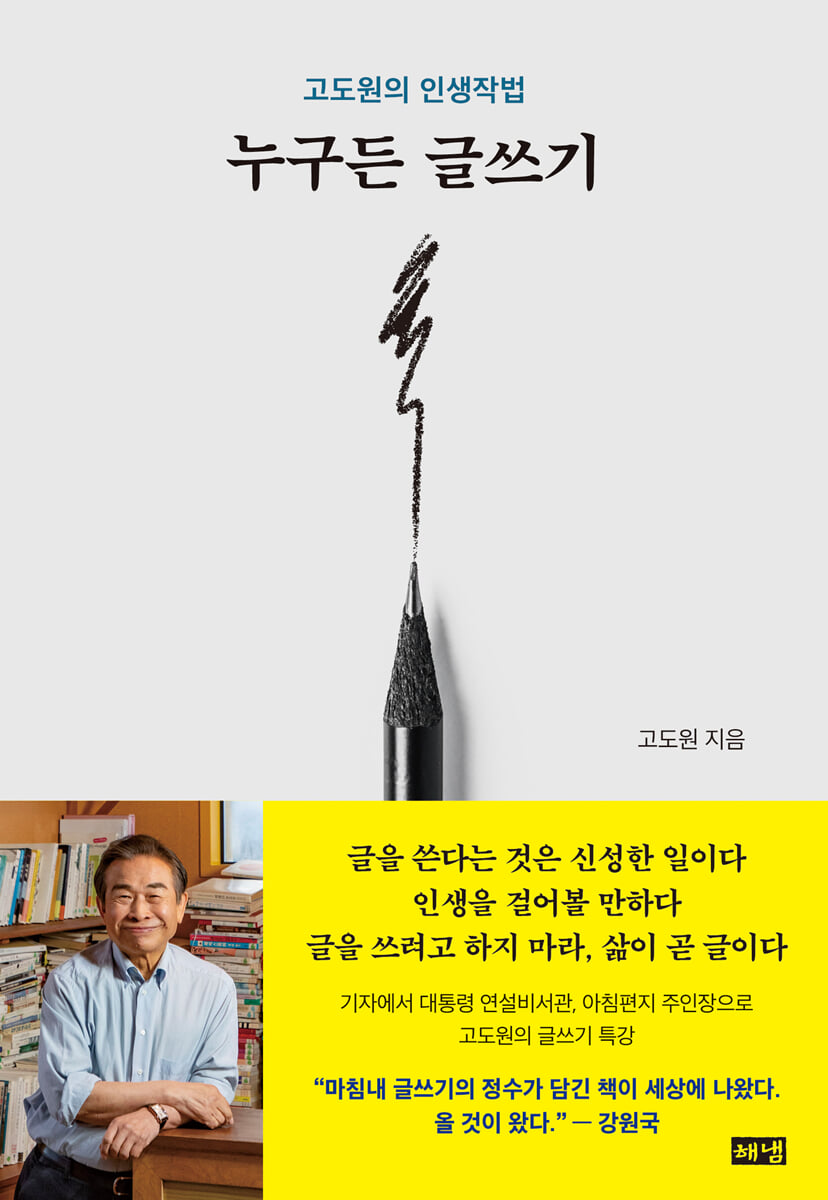
Anyone can write
 |
Description
Book Introduction
“Writing is the gateway to dreams.”
From inspirational phrases to healing language, to resonant short sentences in a sophisticated font.
The writing philosophy and secrets of the "dreaming writer" Koh Do-won, who has matured through writing and rewriting.
‘Godowon’s Morning Letter’ started in 2001 to help me breathe.
After finishing my five-year tenure as the Presidential Speech Secretary in 2003, I wrote down in a notebook the 'Twelve Dream Stories' that came to mind during my trip to Europe, and subsequently introduced them in my morning letter.
From delivering free morning letters to the people of Korea to establishing the meditation center Deep in the Mountains, Ongdalsam, and the story commerce platform, Kkotpinun Achimaeul, the starting point of great achievements that did not remain as his own dreams was his clear and appealing writing that moved people's hearts.
It still provides hope and energy for life to 4 million members every morning.
Even after that, his writings became turning points that opened the way for water at every critical juncture in the morning letter and the deep mountain spring, and helped overcome crises.
Therefore, if we were to summarize author Ko Do-won's writing in one word, it could be said to be 'writing that makes dreams come true.'
Writing became an opportunity, money, energy, and a center of gravity.
His life as a writer and his writing secrets, which have expanded over the past 40 years from a journalist's writing to a president's writing and then to healing writing, are contained in "Writing for Anyone."
From inspirational phrases to healing language, to resonant short sentences in a sophisticated font.
The writing philosophy and secrets of the "dreaming writer" Koh Do-won, who has matured through writing and rewriting.
‘Godowon’s Morning Letter’ started in 2001 to help me breathe.
After finishing my five-year tenure as the Presidential Speech Secretary in 2003, I wrote down in a notebook the 'Twelve Dream Stories' that came to mind during my trip to Europe, and subsequently introduced them in my morning letter.
From delivering free morning letters to the people of Korea to establishing the meditation center Deep in the Mountains, Ongdalsam, and the story commerce platform, Kkotpinun Achimaeul, the starting point of great achievements that did not remain as his own dreams was his clear and appealing writing that moved people's hearts.
It still provides hope and energy for life to 4 million members every morning.
Even after that, his writings became turning points that opened the way for water at every critical juncture in the morning letter and the deep mountain spring, and helped overcome crises.
Therefore, if we were to summarize author Ko Do-won's writing in one word, it could be said to be 'writing that makes dreams come true.'
Writing became an opportunity, money, energy, and a center of gravity.
His life as a writer and his writing secrets, which have expanded over the past 40 years from a journalist's writing to a president's writing and then to healing writing, are contained in "Writing for Anyone."
- You can preview some of the book's contents.
Preview
index
Prologue: Anyone Can Write
Chapter 1: Your Life is Your Writing
· When does the writing begin?
· Connect the dots of experience with a line.
Writing builds confidence
· Both happiness and unhappiness are material for writing.
· As life matures, so too does writing.
· Love and passion, the core fuel of writing
# My first writing in my life
Chapter 2: How to Begin Writing, the Six W Principles
· About the 6 principles
· The 6 W's of Writing ① Who Writes?
· The 6 W's of Writing ② When to Write
· Six principles of writing ③ Where is the writing done?
· The 6 W's of Writing④ 'What' to Write
· The 6 W's of Writing ⑤ How to Write
· The 6 W's of Writing⑥ Why do we write?
# Why do I write?
Chapter 3: Captivating Writing Skills
· Create a frame, then break it.
· Even writing needs seasoning
· Fill your language reservoir to the brim
· How to write the first line
· The power to make you read till the end
· Subtraction, not addition
Write like you're drawing a picture
· Open the door to your senses
· Bet your life on just one person
· Clearly highlight the focus and core
· Sometimes, provoke with expressions that cross the line.
· How should I come up with a title and name?
· Writing, rewriting, and rewriting short sentences
# How I came to have my own writing style, 'Godowonche'
Chapter 4: Daily Writing and Reading Habits
· Become a 'writer' first
· The writing also grows
· Connect speaking to writing
· Your hands must be faster than your thoughts.
· Like pulling silk from a mulberry tree
· Reading, a channel of indirect experience
· Reading methods and reading environment for writing
· Behind immortal language lies reading.
# What and how do dreams come true?
Chapter 5: Writing is Healing, Writing is Growth
'Morning Letter': A Turning Point in the Crisis
· Go to the root of the wound and write
· Why writing is meditation
· Writing is patience
· The secret to overcoming a slump
· You have to listen well to write well.
# The poet who was the prophet of his own life, Ki Hyeong-do
# Kang Won-guk, the mastermind behind the writing craze
Appendix_ Writings by Leaders and Ghostwriters
· What should a leader's writing be like?
· To become a good ghostwriter
· President Kim Dae-jung's 'ghostwriter' and speech secretary
Chapter 1: Your Life is Your Writing
· When does the writing begin?
· Connect the dots of experience with a line.
Writing builds confidence
· Both happiness and unhappiness are material for writing.
· As life matures, so too does writing.
· Love and passion, the core fuel of writing
# My first writing in my life
Chapter 2: How to Begin Writing, the Six W Principles
· About the 6 principles
· The 6 W's of Writing ① Who Writes?
· The 6 W's of Writing ② When to Write
· Six principles of writing ③ Where is the writing done?
· The 6 W's of Writing④ 'What' to Write
· The 6 W's of Writing ⑤ How to Write
· The 6 W's of Writing⑥ Why do we write?
# Why do I write?
Chapter 3: Captivating Writing Skills
· Create a frame, then break it.
· Even writing needs seasoning
· Fill your language reservoir to the brim
· How to write the first line
· The power to make you read till the end
· Subtraction, not addition
Write like you're drawing a picture
· Open the door to your senses
· Bet your life on just one person
· Clearly highlight the focus and core
· Sometimes, provoke with expressions that cross the line.
· How should I come up with a title and name?
· Writing, rewriting, and rewriting short sentences
# How I came to have my own writing style, 'Godowonche'
Chapter 4: Daily Writing and Reading Habits
· Become a 'writer' first
· The writing also grows
· Connect speaking to writing
· Your hands must be faster than your thoughts.
· Like pulling silk from a mulberry tree
· Reading, a channel of indirect experience
· Reading methods and reading environment for writing
· Behind immortal language lies reading.
# What and how do dreams come true?
Chapter 5: Writing is Healing, Writing is Growth
'Morning Letter': A Turning Point in the Crisis
· Go to the root of the wound and write
· Why writing is meditation
· Writing is patience
· The secret to overcoming a slump
· You have to listen well to write well.
# The poet who was the prophet of his own life, Ki Hyeong-do
# Kang Won-guk, the mastermind behind the writing craze
Appendix_ Writings by Leaders and Ghostwriters
· What should a leader's writing be like?
· To become a good ghostwriter
· President Kim Dae-jung's 'ghostwriter' and speech secretary
Detailed image
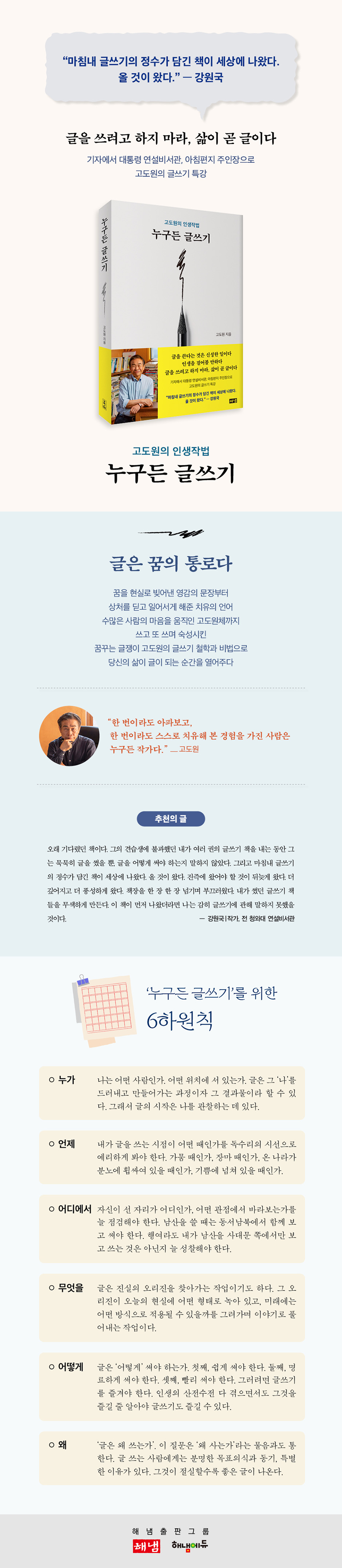
Into the book
“Get sick at least once,
Anyone who has ever tried to heal themselves
“Anyone is a writer”
Writing and life are intertwined.
It's like a fish swimming in water.
Fish don't learn to swim.
They swim in water from birth.
The same goes for writing.
Even people who don't know much about grammar can write delicious articles.
No, rather, you shouldn't think about grammar when writing.
Grammar exists, but writing is not grammar.
Isn't it true that children don't learn grammar and then speak?
A child born with a gift for the gab can easily lose that talent the moment he or she starts studying grammar.
In writing, more important than grammar is living like swimming.
Because that life soon becomes writing.
--- From "1-5 As life ripens, so does writing"
As you continue to write, you will discover that writing also has the power to quell that passion.
If I had continued to live with the same fiery passion I had in my youth, I would not have become the writer I am today.
Because I wrote, I was able to quench and cool this passion.
Because I was able to do that, I can live a little more calmly and peacefully today.
If it weren't for that, what would I be like now?
Writing is like water that puts out fire.
Writing made me gentle and transformed me into a soft and mellow person, completely different from the past.
--- From "1-6 Love and Passion, the Core Fuel of Writing"
What kind of person am I now?
Where are you standing?
It is important to understand this me.
Writing can be said to be both a process of revealing and creating the 'self' and its result.
In some ways, writing is a way to reflect on one's life and a way to complete one's life.
So the beginning of the writing is to observe myself.
Observing and reflecting on myself, that is where the training of writing begins.
--- From “2-2 Six Principles of Writing ① Who Writes?”
Writing requires a sense of balance.
A sense of balance can be achieved when you stand in a neutral and middle position.
This is the so-called 'middle road'.
What is the middle ground? It's not the middle.
It is important to distinguish right from wrong in the middle, but that only amounts to mechanical neutrality and is not neutrality in the proper sense or the right way.
Therefore, writers must agonize over which path is appropriate and just in this era, and which path is truly the right path.
Neutrality and the middle way are about moving your position in the right direction one step at a time through constant self-examination and reflection.
Of course, it's a difficult story.
But we always have to look at this part.
I must decide my position by judging whether it is in the south or the north, and whether it is in line with the cause or not.
--- From “2-4 Six Principles of Writing ③ Where is the Writing Place?”
There are surprisingly many people who say, “I’m not good at expressing myself” when writing.
The phrase "I can't express myself well" can have several meanings.
It could mean that you are unable to express yourself accurately, or it could be a confession that you do not have enough words to use.
To use an analogy to the situation of drawing, it means that you do not have enough colored pencils.
Without a variety of colors, a painting would be monotonous.
There is no comparison between a picture drawn with 50 crayons and a picture drawn with 12 crayons.
No matter how good the artist's skills are, there are limits to them.
To a writer, colored pencils are words.
It's vocabulary.
The more vocabulary and words you have, the richer, more colorful and more accurate your writing will be.
--- From "3-3 Fill the Language Storehouse"
Writing is like chopping logs.
Logs must be chopped into small pieces for firewood to be placed in the fireplace.
When a person receives a whole log and doesn't know what to do with it, when he receives well-split firewood, he throws it into the fireplace without hesitation.
Chopping logs is also a skill.
How elaborately, how usefully, how sharply it is cut.
This too requires practice and training.
The act of chopping a log with an axe is rewriting and rewriting.
Writing is not just a story.
This is a revised story.
It is a refined and corrected story.
You can fix and refine it as much as you want.
--- From "3-13 Writing, Rewriting, and Revising Short Sentences"
Anyone who wants to write must write every day 'as a habit'.
There will come a day when that routine that has become routine will see the light of day.
Whatever the topic or material, writing should become a habit, a routine.
If you are a student, try writing for the school newspaper or magazine. If you are an office worker, try writing for the company newsletter.
Another way is to contribute to newspapers, magazines, and publishing houses.
There are more places than you might think where you can send your writing.
It's okay if I get rejected.
If you keep challenging yourself, one day you may receive a request for a large manuscript fee.
Then the path to becoming a ‘writer’ opens.
When I was in college, I contributed to a magazine called Samteo.
After that article came out, I received over 500 fan letters.
And I received requests for manuscripts in various forms from many places.
That experience gave me confidence and joy in writing.
--- From "4-1 Become a 'Writer' First"
Writing also has a healing effect.
It is a process of looking back at myself to the deepest part of my pain and wounds.
It is a matter of going into the root and writing it down on your own.
Tears will surely flow.
If you cry and write a lot, you will end up vomiting out even the bitterest of sorrows.
Something just pops up.
It explodes.
Sobbing.
A purifying effect occurs in my body and mind.
That is healing writing.
Write down the most painful part of your life.
For example, if it's 'A mother who was hurt by her son', start writing from that part.
It doesn't have to be a beautiful sentence.
I might cry for half a day while writing this.
Let's write it down as we feel it.
If you endure and write like that for half a day, one day, two days, three days, a turning point will inevitably come.
Anyone who has ever tried to heal themselves
“Anyone is a writer”
Writing and life are intertwined.
It's like a fish swimming in water.
Fish don't learn to swim.
They swim in water from birth.
The same goes for writing.
Even people who don't know much about grammar can write delicious articles.
No, rather, you shouldn't think about grammar when writing.
Grammar exists, but writing is not grammar.
Isn't it true that children don't learn grammar and then speak?
A child born with a gift for the gab can easily lose that talent the moment he or she starts studying grammar.
In writing, more important than grammar is living like swimming.
Because that life soon becomes writing.
--- From "1-5 As life ripens, so does writing"
As you continue to write, you will discover that writing also has the power to quell that passion.
If I had continued to live with the same fiery passion I had in my youth, I would not have become the writer I am today.
Because I wrote, I was able to quench and cool this passion.
Because I was able to do that, I can live a little more calmly and peacefully today.
If it weren't for that, what would I be like now?
Writing is like water that puts out fire.
Writing made me gentle and transformed me into a soft and mellow person, completely different from the past.
--- From "1-6 Love and Passion, the Core Fuel of Writing"
What kind of person am I now?
Where are you standing?
It is important to understand this me.
Writing can be said to be both a process of revealing and creating the 'self' and its result.
In some ways, writing is a way to reflect on one's life and a way to complete one's life.
So the beginning of the writing is to observe myself.
Observing and reflecting on myself, that is where the training of writing begins.
--- From “2-2 Six Principles of Writing ① Who Writes?”
Writing requires a sense of balance.
A sense of balance can be achieved when you stand in a neutral and middle position.
This is the so-called 'middle road'.
What is the middle ground? It's not the middle.
It is important to distinguish right from wrong in the middle, but that only amounts to mechanical neutrality and is not neutrality in the proper sense or the right way.
Therefore, writers must agonize over which path is appropriate and just in this era, and which path is truly the right path.
Neutrality and the middle way are about moving your position in the right direction one step at a time through constant self-examination and reflection.
Of course, it's a difficult story.
But we always have to look at this part.
I must decide my position by judging whether it is in the south or the north, and whether it is in line with the cause or not.
--- From “2-4 Six Principles of Writing ③ Where is the Writing Place?”
There are surprisingly many people who say, “I’m not good at expressing myself” when writing.
The phrase "I can't express myself well" can have several meanings.
It could mean that you are unable to express yourself accurately, or it could be a confession that you do not have enough words to use.
To use an analogy to the situation of drawing, it means that you do not have enough colored pencils.
Without a variety of colors, a painting would be monotonous.
There is no comparison between a picture drawn with 50 crayons and a picture drawn with 12 crayons.
No matter how good the artist's skills are, there are limits to them.
To a writer, colored pencils are words.
It's vocabulary.
The more vocabulary and words you have, the richer, more colorful and more accurate your writing will be.
--- From "3-3 Fill the Language Storehouse"
Writing is like chopping logs.
Logs must be chopped into small pieces for firewood to be placed in the fireplace.
When a person receives a whole log and doesn't know what to do with it, when he receives well-split firewood, he throws it into the fireplace without hesitation.
Chopping logs is also a skill.
How elaborately, how usefully, how sharply it is cut.
This too requires practice and training.
The act of chopping a log with an axe is rewriting and rewriting.
Writing is not just a story.
This is a revised story.
It is a refined and corrected story.
You can fix and refine it as much as you want.
--- From "3-13 Writing, Rewriting, and Revising Short Sentences"
Anyone who wants to write must write every day 'as a habit'.
There will come a day when that routine that has become routine will see the light of day.
Whatever the topic or material, writing should become a habit, a routine.
If you are a student, try writing for the school newspaper or magazine. If you are an office worker, try writing for the company newsletter.
Another way is to contribute to newspapers, magazines, and publishing houses.
There are more places than you might think where you can send your writing.
It's okay if I get rejected.
If you keep challenging yourself, one day you may receive a request for a large manuscript fee.
Then the path to becoming a ‘writer’ opens.
When I was in college, I contributed to a magazine called Samteo.
After that article came out, I received over 500 fan letters.
And I received requests for manuscripts in various forms from many places.
That experience gave me confidence and joy in writing.
--- From "4-1 Become a 'Writer' First"
Writing also has a healing effect.
It is a process of looking back at myself to the deepest part of my pain and wounds.
It is a matter of going into the root and writing it down on your own.
Tears will surely flow.
If you cry and write a lot, you will end up vomiting out even the bitterest of sorrows.
Something just pops up.
It explodes.
Sobbing.
A purifying effect occurs in my body and mind.
That is healing writing.
Write down the most painful part of your life.
For example, if it's 'A mother who was hurt by her son', start writing from that part.
It doesn't have to be a beautiful sentence.
I might cry for half a day while writing this.
Let's write it down as we feel it.
If you endure and write like that for half a day, one day, two days, three days, a turning point will inevitably come.
--- From "5-2 Entering the Root of the Wound and Writing"
Publisher's Review
Your life is your writing
Author Ko Do-won also went through many hardships before he could achieve his dream of writing.
I started writing because I didn't have money to buy crayons, because I had a crush on someone, because I needed a scholarship, because I was indignant, because I had nothing else to do.
I didn't just write it, I wrote it with all my heart for myself, for one person, and for the world.
My attitude towards life and my attitude towards writing were no different.
Not only in moments of joy and happiness, but also in difficult and hurtful times, he did not give in to them, but rather used those wounds as material for his writing.
In this book, the secrets of writing, which were the driving force that enabled him to transform his experiences into a decisive weapon in his work and life, are revealed in five chapters.
Chapter 1 tells us that the starting point of the writing is the fragments of my life, the feelings and thoughts that came to mind when I met the people.
Chapter 2 sequentially examines the '6 W' principles, which are the basic principles for maintaining a balanced voice in writing.
In Chapter 3, we will learn specific writing techniques, including the introduction, development, turn, and conclusion structure, rhetoric, and how to train and refine your own writing style.
Chapter 4 introduces note-taking, which is the beginning of almost everything, and reading methods that allow you to read as many books as possible for a specific purpose. It also recommends creating an environment where you can write and read every day and maintaining your own writing routine.
Chapter 5 emphasizes that writing is a powerful healing agent and a tool for growth through the experience of overcoming a deep slump through writing.
This book is not just a writing guide, it is a life writing guide.
His life shaped his writing, allowing him to tell deeper stories.
At the end of each chapter, there is an anecdote that was a major turning point in the writer's life, leading to the fulfillment of his dream.
Reading, which supported me during the harsh times when I was expelled under Emergency Measure No. 9, the resonant short sentences "Godowonche" created through countless revisions and refinements in "Deep-Rooted Tree," and even the time of patience that I had to endure extreme pain while working tirelessly as President Kim Dae-jung's speechwriter, are all recorded in this book.
What the author wants to convey through these numerous stories is, 'Before writing, live well first.'
Because everyone lives their own life, and that life soon becomes writing.
This is a realization that author Ko Do-won has gained through extensive experience, and it's also why his writing secrets are so compelling. In an era where technological advancements like AI allow for the pain of creative writing to be replaced by the ability to produce a high-quality piece in minutes, writing itself can be considered unnecessary.
But that is why the writer insists that anyone can and should write.
The time spent thinking about and writing about one's own life accumulates into one's own unique asset.
Because this kind of writing can provide at least some opportunity for self-healing and growth.
Become a writer today
As writing platforms diversify, anyone can write at any time. In our daily lives, inseparable from social media, we must express ourselves even in a single, condensed sentence.
While writing skills have become increasingly important, they can be challenging for those who lack the talent or skills to write.
Author Ko Do-won says that writing is not the exclusive domain of writers.
He argues that even ordinary people can write, and that their writing can change their lives.
Rather than trying to do well by comparing yourself to others, I urge you to live your own life well first.
It encourages you to accumulate the things you feel and think about in it, and resolve to "I'll try it too" starting today.
Then your own writing will begin.
Author Ko Do-won also went through many hardships before he could achieve his dream of writing.
I started writing because I didn't have money to buy crayons, because I had a crush on someone, because I needed a scholarship, because I was indignant, because I had nothing else to do.
I didn't just write it, I wrote it with all my heart for myself, for one person, and for the world.
My attitude towards life and my attitude towards writing were no different.
Not only in moments of joy and happiness, but also in difficult and hurtful times, he did not give in to them, but rather used those wounds as material for his writing.
In this book, the secrets of writing, which were the driving force that enabled him to transform his experiences into a decisive weapon in his work and life, are revealed in five chapters.
Chapter 1 tells us that the starting point of the writing is the fragments of my life, the feelings and thoughts that came to mind when I met the people.
Chapter 2 sequentially examines the '6 W' principles, which are the basic principles for maintaining a balanced voice in writing.
In Chapter 3, we will learn specific writing techniques, including the introduction, development, turn, and conclusion structure, rhetoric, and how to train and refine your own writing style.
Chapter 4 introduces note-taking, which is the beginning of almost everything, and reading methods that allow you to read as many books as possible for a specific purpose. It also recommends creating an environment where you can write and read every day and maintaining your own writing routine.
Chapter 5 emphasizes that writing is a powerful healing agent and a tool for growth through the experience of overcoming a deep slump through writing.
This book is not just a writing guide, it is a life writing guide.
His life shaped his writing, allowing him to tell deeper stories.
At the end of each chapter, there is an anecdote that was a major turning point in the writer's life, leading to the fulfillment of his dream.
Reading, which supported me during the harsh times when I was expelled under Emergency Measure No. 9, the resonant short sentences "Godowonche" created through countless revisions and refinements in "Deep-Rooted Tree," and even the time of patience that I had to endure extreme pain while working tirelessly as President Kim Dae-jung's speechwriter, are all recorded in this book.
What the author wants to convey through these numerous stories is, 'Before writing, live well first.'
Because everyone lives their own life, and that life soon becomes writing.
This is a realization that author Ko Do-won has gained through extensive experience, and it's also why his writing secrets are so compelling. In an era where technological advancements like AI allow for the pain of creative writing to be replaced by the ability to produce a high-quality piece in minutes, writing itself can be considered unnecessary.
But that is why the writer insists that anyone can and should write.
The time spent thinking about and writing about one's own life accumulates into one's own unique asset.
Because this kind of writing can provide at least some opportunity for self-healing and growth.
Become a writer today
As writing platforms diversify, anyone can write at any time. In our daily lives, inseparable from social media, we must express ourselves even in a single, condensed sentence.
While writing skills have become increasingly important, they can be challenging for those who lack the talent or skills to write.
Author Ko Do-won says that writing is not the exclusive domain of writers.
He argues that even ordinary people can write, and that their writing can change their lives.
Rather than trying to do well by comparing yourself to others, I urge you to live your own life well first.
It encourages you to accumulate the things you feel and think about in it, and resolve to "I'll try it too" starting today.
Then your own writing will begin.
GOODS SPECIFICS
- Date of issue: August 1, 2025
- Page count, weight, size: 272 pages | 438g | 145*210*20mm
- ISBN13: 9791167141200
- ISBN10: 1167141202
You may also like
카테고리
korean


korean

![GQ KOREA Mark (Monthly): December [2025]](http://librairie.coreenne.fr/cdn/shop/files/8ef265dbbfbf186523ed75ba7319009d.jpg?v=1765340328&width=3840)


