

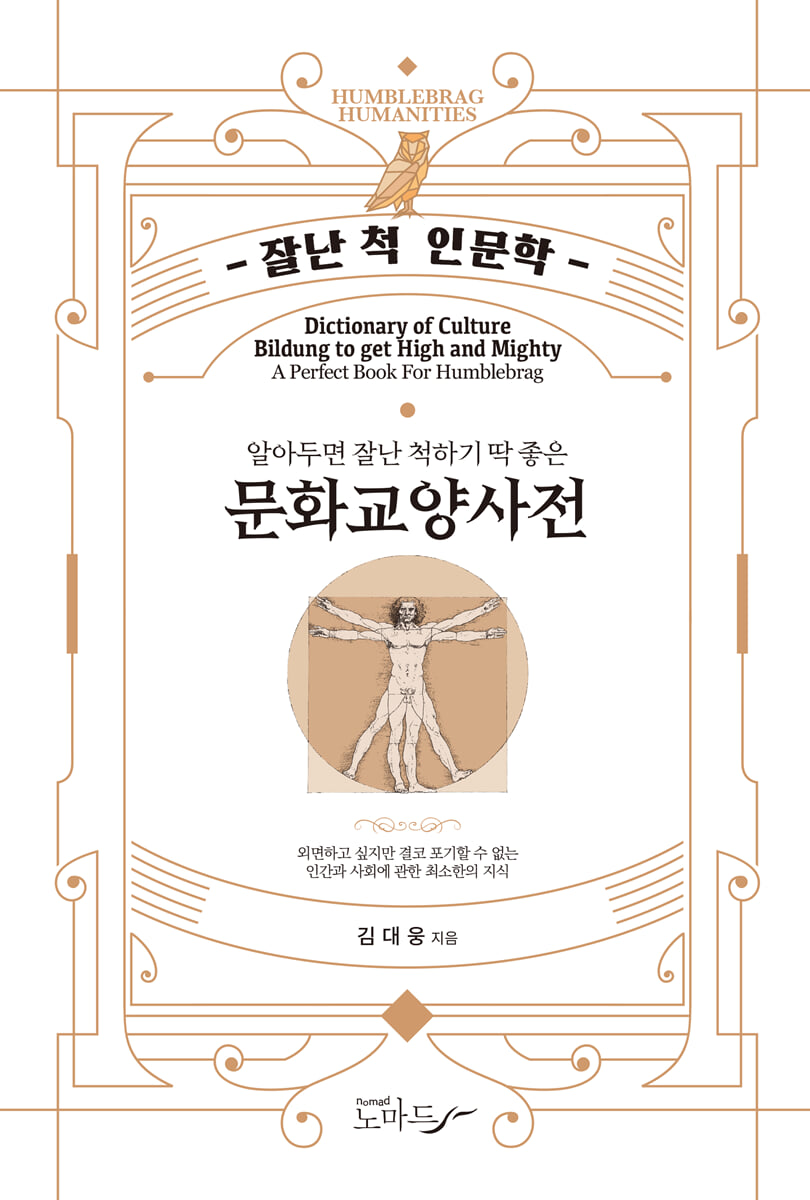
A cultural dictionary perfect for showing off your knowledge
 |
Description
Book Introduction
Are all humans descendants of one mother?
Whether our skin is black or white or we speak different languages, all of humanity is descended from the same mother.
All human beings, regardless of race, can be said to be brothers and sisters.
Then this question arises:
How is that possible? Around 150,000 to 200,000 years ago, among Homo sapiens living in Africa, there was a mother who could be considered an ancestor of modern humans.
She was the mother of all mankind, commonly referred to as 'Mitochondrial Eve'.
Mitochondria are tiny organelles found in almost all eukaryotic cells that produce the energy needed for cell function.
Of course, a man's sperm and a woman's eggs also contain mitochondria.
However, when a man and a woman mate and fertilization occurs, the mitochondria in the head of the sperm are all destroyed by the egg.
Therefore, all living things are inherited through the maternal line, with only the female mitochondria remaining and passed down from daughter to daughter.
Based on these characteristics, tracing back mitochondria has led to the discovery that they can be traced back to the mother of all humans who lived approximately 150,000 to 200,000 years ago, and that ancestral mother is called 'Mitochondrial Eve'.
So, all human beings, regardless of race, are descendants of one mother and are of the same blood.
There is no need to be picky, they are all relatives.
Wars that occur over territorial disputes, ethnic conflicts, etc. are no different from fighting between brothers.
Racism is a stupid thing to do, like spitting in your own face while lying down.
Some readers may find this information unrelated, but others may be completely unaware of it.
No matter which page you open, this book is full of interesting topics that stimulate intellectual curiosity.
The subject matter is weighty, but the content is appropriately deep and easy to understand.
Whether our skin is black or white or we speak different languages, all of humanity is descended from the same mother.
All human beings, regardless of race, can be said to be brothers and sisters.
Then this question arises:
How is that possible? Around 150,000 to 200,000 years ago, among Homo sapiens living in Africa, there was a mother who could be considered an ancestor of modern humans.
She was the mother of all mankind, commonly referred to as 'Mitochondrial Eve'.
Mitochondria are tiny organelles found in almost all eukaryotic cells that produce the energy needed for cell function.
Of course, a man's sperm and a woman's eggs also contain mitochondria.
However, when a man and a woman mate and fertilization occurs, the mitochondria in the head of the sperm are all destroyed by the egg.
Therefore, all living things are inherited through the maternal line, with only the female mitochondria remaining and passed down from daughter to daughter.
Based on these characteristics, tracing back mitochondria has led to the discovery that they can be traced back to the mother of all humans who lived approximately 150,000 to 200,000 years ago, and that ancestral mother is called 'Mitochondrial Eve'.
So, all human beings, regardless of race, are descendants of one mother and are of the same blood.
There is no need to be picky, they are all relatives.
Wars that occur over territorial disputes, ethnic conflicts, etc. are no different from fighting between brothers.
Racism is a stupid thing to do, like spitting in your own face while lying down.
Some readers may find this information unrelated, but others may be completely unaware of it.
No matter which page you open, this book is full of interesting topics that stimulate intellectual curiosity.
The subject matter is weighty, but the content is appropriately deep and easy to understand.
index
01 human
All mankind descends from one mother.
The driving force of evolution is mating.
Does human evolution end with Homo sapiens?
Selfish genes and altruistic genes
The human body is full of flaws
Creationism and Evolution
Will human sex evolve?
What is the relationship between lifespan and body size?
02 Man & Woman
Why do women have less hair than men?
Goal-oriented and direction-oriented
A History of Men's Violence and Women's Nagging
Why women have a longer life expectancy than men
Why do couples look alike?
The History of Prostitution and the Birth of Marriage
Will the institution of marriage finally disappear?
The man and woman who left the most descendants
What is the essence of misandry?
Do humans have a killing instinct?
03 Nation
The concept and distinction of race, ethnicity, and nation
The Korean people are not a single ethnic group.
Chinese characters were created by our people.
Nation and State
What is the difference between democracy and liberal democracy?
Extremism and populism
Why are Jews so hated?
Is there intelligent life on Earth?
The true nature of ghosts, ghosts, goblins, and zombies
04 Human Heart
Why do humans want to be recognized?
The Reclusive Loner and the Lone Wolf
Is decision-making disorder a mental illness?
Why trauma doesn't go away
Why We Are Not Happy Even in an Abundant Life
Why are unhappy people unhappy?
Human nature does not change.
Is humanity innate or made?
Are my thoughts uniquely my own?
Is human memory reliable?
Ultimate desire and instrumental desire
05 Change
Clash of Civilizations: Why Do Christianity and Islam Fight?
What do millennials seek?
Is the biggest factor in success effort or luck?
How much influence does chance have on life?
Life reversals and small happiness
MeToo and HimToo
Why is everything getting faster?
Anxiety and anger: keywords of modern society
06 Equality & Inequality
Is inequality an inevitable law of nature?
Why doesn't poverty disappear even as civilization advances?
Why do we want to be rich?
red flag
Why are there no room for moderation and centrism?
The voice of the people is the voice of God.
07 Justice, Present, Future
Does justice ultimately prevail?
Does the trial really reveal the truth?
The most representative fake news in history
The fundamental differences between Eastern and Western philosophy
In the era of the Fourth Industrial Revolution, is labor facing its end?
Will artificial intelligence pose a threat to humanity?
placards, banners, and pickets
08 gene
Is an embryo a gene or a lump of cells?
What is the difference between genetic engineering and eugenics?
Is infanticide a maternal instinct?
Are intelligence and personality inherited?
All About GMO Foods
What is the placebo effect?
What is epigenetics?
Obesity and the yo-yo effect
09 Sex & Love
The functional relationship between gender and power
History of Sex Positions
The history of panties
What is the difference between copulation and sex?
What is the true nature of love?
Why do we watch porn?
Are voyeurism and exhibitionism diseases?
All mankind descends from one mother.
The driving force of evolution is mating.
Does human evolution end with Homo sapiens?
Selfish genes and altruistic genes
The human body is full of flaws
Creationism and Evolution
Will human sex evolve?
What is the relationship between lifespan and body size?
02 Man & Woman
Why do women have less hair than men?
Goal-oriented and direction-oriented
A History of Men's Violence and Women's Nagging
Why women have a longer life expectancy than men
Why do couples look alike?
The History of Prostitution and the Birth of Marriage
Will the institution of marriage finally disappear?
The man and woman who left the most descendants
What is the essence of misandry?
Do humans have a killing instinct?
03 Nation
The concept and distinction of race, ethnicity, and nation
The Korean people are not a single ethnic group.
Chinese characters were created by our people.
Nation and State
What is the difference between democracy and liberal democracy?
Extremism and populism
Why are Jews so hated?
Is there intelligent life on Earth?
The true nature of ghosts, ghosts, goblins, and zombies
04 Human Heart
Why do humans want to be recognized?
The Reclusive Loner and the Lone Wolf
Is decision-making disorder a mental illness?
Why trauma doesn't go away
Why We Are Not Happy Even in an Abundant Life
Why are unhappy people unhappy?
Human nature does not change.
Is humanity innate or made?
Are my thoughts uniquely my own?
Is human memory reliable?
Ultimate desire and instrumental desire
05 Change
Clash of Civilizations: Why Do Christianity and Islam Fight?
What do millennials seek?
Is the biggest factor in success effort or luck?
How much influence does chance have on life?
Life reversals and small happiness
MeToo and HimToo
Why is everything getting faster?
Anxiety and anger: keywords of modern society
06 Equality & Inequality
Is inequality an inevitable law of nature?
Why doesn't poverty disappear even as civilization advances?
Why do we want to be rich?
red flag
Why are there no room for moderation and centrism?
The voice of the people is the voice of God.
07 Justice, Present, Future
Does justice ultimately prevail?
Does the trial really reveal the truth?
The most representative fake news in history
The fundamental differences between Eastern and Western philosophy
In the era of the Fourth Industrial Revolution, is labor facing its end?
Will artificial intelligence pose a threat to humanity?
placards, banners, and pickets
08 gene
Is an embryo a gene or a lump of cells?
What is the difference between genetic engineering and eugenics?
Is infanticide a maternal instinct?
Are intelligence and personality inherited?
All About GMO Foods
What is the placebo effect?
What is epigenetics?
Obesity and the yo-yo effect
09 Sex & Love
The functional relationship between gender and power
History of Sex Positions
The history of panties
What is the difference between copulation and sex?
What is the true nature of love?
Why do we watch porn?
Are voyeurism and exhibitionism diseases?
Detailed image
.jpg)
Into the book
All animals evolve, but humans in particular have been able to reign supreme over all animals through several groundbreaking evolutionary processes.
For example, the core elements of human evolution include upright walking on two feet, the use and development of tools, a dramatic increase in brain capacity, hunting and gathering, the disappearance of body hair, the use of language, the use of fire, and constant movement.
So what was the driving force behind this fundamental evolution? What, exactly, drove such a groundbreaking evolution? It was humanity's unique mating ritual: sex.
(syncopation)
As humans began to walk upright on two feet, men and women were able to face each other.
The male genitals, which were not very visible, became clearly visible, and when women, like other animals, mated in the doggy position, their buttocks, which had attracted the male's attention, became invisible, they evolved to have large breasts similar in shape to their buttocks.
And the woman's lips resembled a vagina laid sideways.
Not only that, it became possible to have a missionary position, where the woman lies down and the man climbs on top of her body to mate.
As the man and woman pressed their bodies together and looked at each other closely, their intimacy and bonding increased significantly, and the delicate caressing further stimulated their sexual urges.
Additionally, as their brain capacity increased, they developed self-awareness, unlike animals, and began to perceive the amazing 'pleasure' that can only be obtained from mating.
This was an absolutely amazing experience.
--- From "The driving force of evolution is mating"
About 2 million years ago, humans finally took their true form as Homo erectus began to stand upright and walk on two feet.
They obtained their food by hunting and gathering.
Men hunted to obtain meat, while women obtained plant foods such as fruits, roots, and nuts.
Men who went out hunting had to persistently pursue their prey, such as wild boars or rabbits, without letting go and had to capture them at all costs.
It's about focusing only on the target without paying attention to anything else.
In contrast, women had to search all over the place to find berries and nuts and search here and there to find plant foods.
So once they found a place rich in berries or nuts, they had to remember that place to continue obtaining food.
In conclusion, men have a goal-oriented nature and women have a direction-oriented nature.
--- From "Goal Orientation and Direction Orientation"
Is there intelligent life on Earth? World-renowned British physicist Dr. Stephen Hawking has declared, "There is intelligent life on Earth."
Moreover, almost all space scientists believe that there is intelligent life out there.
'Intelligent life' refers to a life form that has superior intelligence like humans on Earth and can think rationally, judge, decide, and plan.
In fact, the size of the universe is so vast that it is beyond our imagination, and there are countless stars and planets.
Among those enormous planets, there are countless planets whose climate and other environments are considered similar to Earth's.
It is only natural to assume that intelligent life could exist among them, just like on Earth.
Of course, it is a guess, but it is difficult for anyone to deny such a fact.
However, even if intelligent life exists in outer space, numerous problems arise regarding accidental encounters or intentional contact with Earthlings.
First of all, the distance between planets is too far.
The size of space is infinite.
Once outside the solar system, even the closest planets would have to travel hundreds, thousands, or even tens of thousands of light years or more at the speed of light.
It is a distance that our science cannot even imagine and cannot possibly reach.
There are approximately 100 billion planets in the Milky Way galaxy alone, 50 billion of which are rocky planets like Earth.
In particular, the space in the galaxy that is relatively close to Earth and has various environmental conditions similar to Earth, making it possible for life to exist, is called the Goldilocks Zone or Habitable Zone.
Even in this Goldilocks Zone, there are a whopping 500 million planets.
Earth has been transmitting regular radio waves to this area for over 30 years, but there has been no response, and no meaningful transmissions from space have been detected.
--- From "Is there intelligent life on Earth?"
'Memory' is the act of preserving or recalling things experienced, witnessed, or acquired in the past by engraving them in one's mind.
In short, memory is the brain's ability to store and retrieve all the information it acquires.
Because the brain has the ability to store information, it is capable of thinking, judging, deciding, choosing, learning, predicting, and imagining (inferring).
The brain has the function of forgetting along with the function of remembering.
Forgetting, the opposite of remembering, is forgetting something or a fact that you remember.
Forgetting has its problems, but it also has its advantages.
Forgetting allows us to forget memories that fade over time or trivial things that we didn't think were important, to forget old knowledge or information so we can acquire and learn new things, and to gradually forget painful experiences so we can maintain a sense of calm.
Our minds are healthy only when these memories and forgetting are in harmony.
(syncopation)
In this way, various factors such as individual differences in memory and forgetting, disease, psychology, and prejudice affect our memories.
In addition, the habit of thinking self-centeredly in one's own favor also distorts the accuracy of memory.
Also, memory varies greatly depending on each person's intellectual level, status and position, education, occupation, environment, gender, etc.
Accordingly, the experiences are different and the information and knowledge remembered are also very different.
Additionally, the level and value of information to be remembered and the amount of information stored in the brain differ from person to person.
When recalling such memories, it makes a big difference in judgment, perspective, and level.
Therefore, it is natural that our memories contain more errors and mistakes than objective accuracy.
Ultimately, it can be said that human memory is never trustworthy.
Moreover, our inaccurate memories can easily distort any fact or truth.
For example, the core elements of human evolution include upright walking on two feet, the use and development of tools, a dramatic increase in brain capacity, hunting and gathering, the disappearance of body hair, the use of language, the use of fire, and constant movement.
So what was the driving force behind this fundamental evolution? What, exactly, drove such a groundbreaking evolution? It was humanity's unique mating ritual: sex.
(syncopation)
As humans began to walk upright on two feet, men and women were able to face each other.
The male genitals, which were not very visible, became clearly visible, and when women, like other animals, mated in the doggy position, their buttocks, which had attracted the male's attention, became invisible, they evolved to have large breasts similar in shape to their buttocks.
And the woman's lips resembled a vagina laid sideways.
Not only that, it became possible to have a missionary position, where the woman lies down and the man climbs on top of her body to mate.
As the man and woman pressed their bodies together and looked at each other closely, their intimacy and bonding increased significantly, and the delicate caressing further stimulated their sexual urges.
Additionally, as their brain capacity increased, they developed self-awareness, unlike animals, and began to perceive the amazing 'pleasure' that can only be obtained from mating.
This was an absolutely amazing experience.
--- From "The driving force of evolution is mating"
About 2 million years ago, humans finally took their true form as Homo erectus began to stand upright and walk on two feet.
They obtained their food by hunting and gathering.
Men hunted to obtain meat, while women obtained plant foods such as fruits, roots, and nuts.
Men who went out hunting had to persistently pursue their prey, such as wild boars or rabbits, without letting go and had to capture them at all costs.
It's about focusing only on the target without paying attention to anything else.
In contrast, women had to search all over the place to find berries and nuts and search here and there to find plant foods.
So once they found a place rich in berries or nuts, they had to remember that place to continue obtaining food.
In conclusion, men have a goal-oriented nature and women have a direction-oriented nature.
--- From "Goal Orientation and Direction Orientation"
Is there intelligent life on Earth? World-renowned British physicist Dr. Stephen Hawking has declared, "There is intelligent life on Earth."
Moreover, almost all space scientists believe that there is intelligent life out there.
'Intelligent life' refers to a life form that has superior intelligence like humans on Earth and can think rationally, judge, decide, and plan.
In fact, the size of the universe is so vast that it is beyond our imagination, and there are countless stars and planets.
Among those enormous planets, there are countless planets whose climate and other environments are considered similar to Earth's.
It is only natural to assume that intelligent life could exist among them, just like on Earth.
Of course, it is a guess, but it is difficult for anyone to deny such a fact.
However, even if intelligent life exists in outer space, numerous problems arise regarding accidental encounters or intentional contact with Earthlings.
First of all, the distance between planets is too far.
The size of space is infinite.
Once outside the solar system, even the closest planets would have to travel hundreds, thousands, or even tens of thousands of light years or more at the speed of light.
It is a distance that our science cannot even imagine and cannot possibly reach.
There are approximately 100 billion planets in the Milky Way galaxy alone, 50 billion of which are rocky planets like Earth.
In particular, the space in the galaxy that is relatively close to Earth and has various environmental conditions similar to Earth, making it possible for life to exist, is called the Goldilocks Zone or Habitable Zone.
Even in this Goldilocks Zone, there are a whopping 500 million planets.
Earth has been transmitting regular radio waves to this area for over 30 years, but there has been no response, and no meaningful transmissions from space have been detected.
--- From "Is there intelligent life on Earth?"
'Memory' is the act of preserving or recalling things experienced, witnessed, or acquired in the past by engraving them in one's mind.
In short, memory is the brain's ability to store and retrieve all the information it acquires.
Because the brain has the ability to store information, it is capable of thinking, judging, deciding, choosing, learning, predicting, and imagining (inferring).
The brain has the function of forgetting along with the function of remembering.
Forgetting, the opposite of remembering, is forgetting something or a fact that you remember.
Forgetting has its problems, but it also has its advantages.
Forgetting allows us to forget memories that fade over time or trivial things that we didn't think were important, to forget old knowledge or information so we can acquire and learn new things, and to gradually forget painful experiences so we can maintain a sense of calm.
Our minds are healthy only when these memories and forgetting are in harmony.
(syncopation)
In this way, various factors such as individual differences in memory and forgetting, disease, psychology, and prejudice affect our memories.
In addition, the habit of thinking self-centeredly in one's own favor also distorts the accuracy of memory.
Also, memory varies greatly depending on each person's intellectual level, status and position, education, occupation, environment, gender, etc.
Accordingly, the experiences are different and the information and knowledge remembered are also very different.
Additionally, the level and value of information to be remembered and the amount of information stored in the brain differ from person to person.
When recalling such memories, it makes a big difference in judgment, perspective, and level.
Therefore, it is natural that our memories contain more errors and mistakes than objective accuracy.
Ultimately, it can be said that human memory is never trustworthy.
Moreover, our inaccurate memories can easily distort any fact or truth.
--- From "Is Human Memory Reliable?"
Publisher's Review
If you are the master of life, you should know this much.
What do you talk about when you meet friends, at gatherings, or with coworkers? Isn't it gossip about celebrity news, gossip about your boss, or pointless small talk? The world is so complex and complicated! There's so much to know, but the reality is that it's so complex and difficult that it's almost overwhelming.
But you cannot deny that you are a leading player in politics, economy, society, and culture, whether you know it or not.
Now, let's turn our attention to the world's affairs, even if it's just a superficial glance, rather than the fragmentary and provocative articles circulating on the Internet.
Why? Because we are the main characters of this world.
Here, in 『Cultural Dictionary: Perfect for Showing Off Your Knowledge』, we've included some light but useful knowledge.
It focuses on the minimal knowledge about humanity and society that we want to ignore but can never give up, various discourses that have recently become social issues, and practical and realistic knowledge that can be useful if known.
In particular, we have tried to explain in detail and in an easy-to-understand manner specialized knowledge that is essential to know beyond textbook knowledge or general knowledge that everyone knows.
A profound and profound perspective on humanity and society
These days, there are many programs on TV that provide various information and knowledge.
It is conducted in a format that is both informative and fun, such as quizzes, talks, and lectures, and also has high viewership ratings.
In addition, there are channels specializing in documentaries on culture, history, etc., and there are also a wide variety of other channels.
Does this mean the viewers' standards have improved? In any case, it's a desirable phenomenon.
In fact, we live in an age where information and knowledge are flooding in.
Online media, including the Internet, are constantly pouring out all kinds of information and knowledge, and various mass media, including TV and newspapers, are busy delivering new information and knowledge, so much so that it is confusing.
Information and knowledge can be inconvenient and frustrating if they are lacking, but too much of it can also be detrimental.
It's hard to pick out what you need, and not all of the information and knowledge is useful.
There are some things that are completely useless and flimsy, some that are ambiguous in accuracy and truth, some that have conflicting views and interpretations, some that are uncertain, and even so-called 'fake news' that is rampant, making things even more confusing.
In times like these, the 『Cultural Dictionary: Perfect for Showing Off Your Knowledge』 presents various perspectives on humans and society.
Knowledge that goes one step deeper than the common sense I know
"The Cultural Dictionary: Perfect for Showing Off Your Knowledge" covers various areas of human and social development that every leading figure in this society must know in the overwhelming flood of information.
We looked at various aspects of humans, the main characters that lead society, including humans, men and women, and the human mind.
Furthermore, it illuminates various aspects that occur in a society created by humans, such as equality and inequality, justice, sex and love.
In addition, we did not miss any of the ongoing discourses, such as genetics and the Fourth Industrial Revolution.
However, even though the topic may seem heavy, the content is written in interesting and easy sentences that anyone can approach without feeling burdened.
As you read, your perspective on the world will become a little deeper and broader.
What do you talk about when you meet friends, at gatherings, or with coworkers? Isn't it gossip about celebrity news, gossip about your boss, or pointless small talk? The world is so complex and complicated! There's so much to know, but the reality is that it's so complex and difficult that it's almost overwhelming.
But you cannot deny that you are a leading player in politics, economy, society, and culture, whether you know it or not.
Now, let's turn our attention to the world's affairs, even if it's just a superficial glance, rather than the fragmentary and provocative articles circulating on the Internet.
Why? Because we are the main characters of this world.
Here, in 『Cultural Dictionary: Perfect for Showing Off Your Knowledge』, we've included some light but useful knowledge.
It focuses on the minimal knowledge about humanity and society that we want to ignore but can never give up, various discourses that have recently become social issues, and practical and realistic knowledge that can be useful if known.
In particular, we have tried to explain in detail and in an easy-to-understand manner specialized knowledge that is essential to know beyond textbook knowledge or general knowledge that everyone knows.
A profound and profound perspective on humanity and society
These days, there are many programs on TV that provide various information and knowledge.
It is conducted in a format that is both informative and fun, such as quizzes, talks, and lectures, and also has high viewership ratings.
In addition, there are channels specializing in documentaries on culture, history, etc., and there are also a wide variety of other channels.
Does this mean the viewers' standards have improved? In any case, it's a desirable phenomenon.
In fact, we live in an age where information and knowledge are flooding in.
Online media, including the Internet, are constantly pouring out all kinds of information and knowledge, and various mass media, including TV and newspapers, are busy delivering new information and knowledge, so much so that it is confusing.
Information and knowledge can be inconvenient and frustrating if they are lacking, but too much of it can also be detrimental.
It's hard to pick out what you need, and not all of the information and knowledge is useful.
There are some things that are completely useless and flimsy, some that are ambiguous in accuracy and truth, some that have conflicting views and interpretations, some that are uncertain, and even so-called 'fake news' that is rampant, making things even more confusing.
In times like these, the 『Cultural Dictionary: Perfect for Showing Off Your Knowledge』 presents various perspectives on humans and society.
Knowledge that goes one step deeper than the common sense I know
"The Cultural Dictionary: Perfect for Showing Off Your Knowledge" covers various areas of human and social development that every leading figure in this society must know in the overwhelming flood of information.
We looked at various aspects of humans, the main characters that lead society, including humans, men and women, and the human mind.
Furthermore, it illuminates various aspects that occur in a society created by humans, such as equality and inequality, justice, sex and love.
In addition, we did not miss any of the ongoing discourses, such as genetics and the Fourth Industrial Revolution.
However, even though the topic may seem heavy, the content is written in interesting and easy sentences that anyone can approach without feeling burdened.
As you read, your perspective on the world will become a little deeper and broader.
GOODS SPECIFICS
- Date of issue: January 12, 2025
- Page count, weight, size: 448 pages | 152*225*30mm
- ISBN13: 9791186288900
- ISBN10: 1186288906
You may also like
카테고리
korean


korean

![GQ KOREA Mark (Monthly): December [2025]](http://librairie.coreenne.fr/cdn/shop/files/8ef265dbbfbf186523ed75ba7319009d.jpg?v=1765340328&width=3840)


