

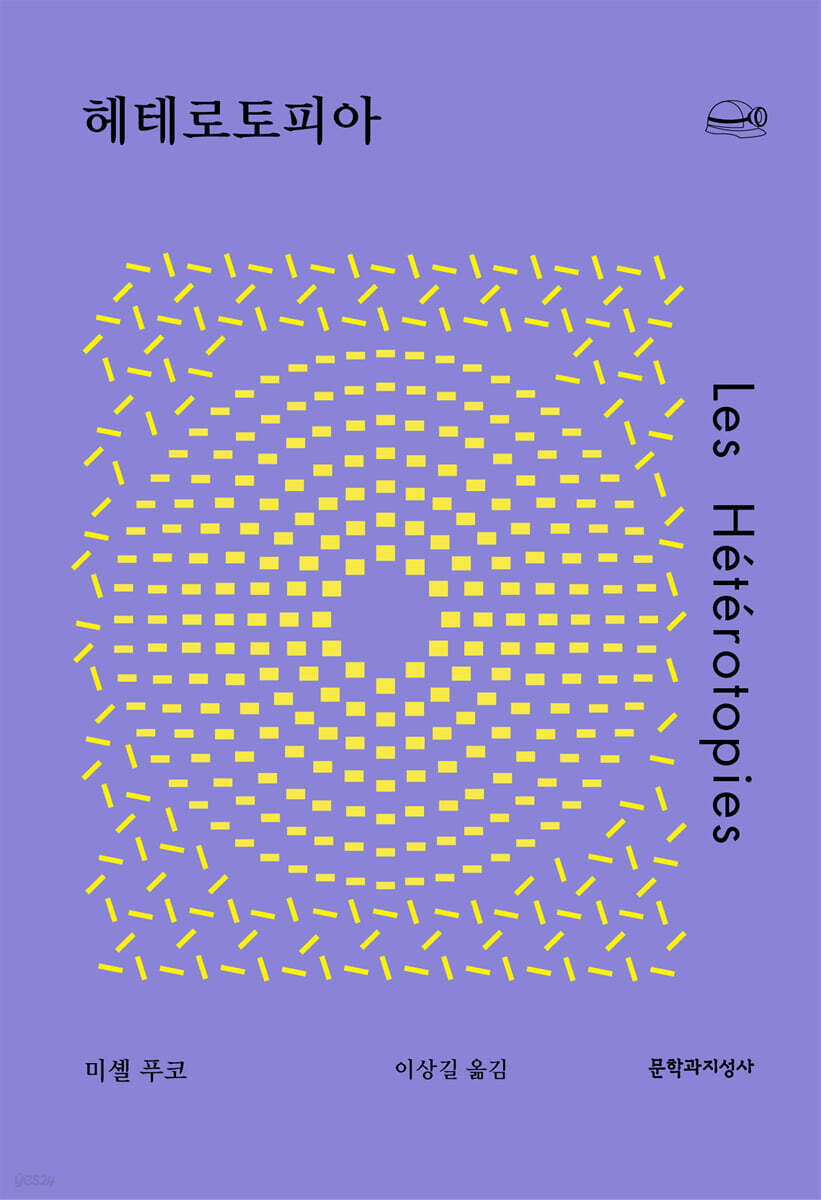
Heterotopia
 |
Description
Book Introduction
“These anti-spaces, these utopias that have locations.
Children know it perfectly.
It is, of course, deep in the garden.
It is, of course, an attic, and an Indian tent erected in the middle of the attic,
Or Thursday afternoon, my parents' big bed."
Foucault's controversial and polyphonic essays, born from thought experiments
The revised edition of 『Heterotopia』 (first published in 2014), which contains Foucault's unique thoughts on space, has been reorganized and published as the 'Quarry Series.'
It is introduced simultaneously with the anthology 『Power and Space』, which contains writings that reveal Foucault's unique perspective on power and space.
We call a perfect world, or a world with values that run counter to the society we live in, but which in reality does not exist anywhere, a utopia.
It exists only in human imagination.
But what would places that perform utopian functions while still being locable on a real map look like? What would we call them?
Heterotopie! Michel Foucault calls this a place that exists in reality, yet also "objects" to and overturns all other places—a kind of "realized utopia," so to speak, a place that actually has a location but is outside all other places.
The attic, the Indian tent, Mom and Dad's bed on Thursday afternoon, the mirror, the library, the cemetery, the brothel, the resort... Foucault summons up these places, which at first glance seem difficult to find similarities with, one after another to explain the concept of 'heterotopia.'
『Les Heterotopies』 is a translation of Foucault's essays that discuss the unfinished concept of 'heterotopia', which Foucault attempted to conceptualize independently as a space contrasting with utopia but later abandoned.
The book contains interesting writings, including two lecture manuscripts that discuss heterotopia in earnest: “Heterotopia” (1966) and “In Other Spaces” (1967); “The Utopian Body” (1966), which phenomenologically describes the “place” of the body in relation to utopia; an interview with Paul Rabinow (1982), which clearly reveals Foucault’s perspective on space and architecture in relation to the issues of governmentality and freedom; and Daniel Deferre’s commentary on “Heterotopia.”
Children know it perfectly.
It is, of course, deep in the garden.
It is, of course, an attic, and an Indian tent erected in the middle of the attic,
Or Thursday afternoon, my parents' big bed."
Foucault's controversial and polyphonic essays, born from thought experiments
The revised edition of 『Heterotopia』 (first published in 2014), which contains Foucault's unique thoughts on space, has been reorganized and published as the 'Quarry Series.'
It is introduced simultaneously with the anthology 『Power and Space』, which contains writings that reveal Foucault's unique perspective on power and space.
We call a perfect world, or a world with values that run counter to the society we live in, but which in reality does not exist anywhere, a utopia.
It exists only in human imagination.
But what would places that perform utopian functions while still being locable on a real map look like? What would we call them?
Heterotopie! Michel Foucault calls this a place that exists in reality, yet also "objects" to and overturns all other places—a kind of "realized utopia," so to speak, a place that actually has a location but is outside all other places.
The attic, the Indian tent, Mom and Dad's bed on Thursday afternoon, the mirror, the library, the cemetery, the brothel, the resort... Foucault summons up these places, which at first glance seem difficult to find similarities with, one after another to explain the concept of 'heterotopia.'
『Les Heterotopies』 is a translation of Foucault's essays that discuss the unfinished concept of 'heterotopia', which Foucault attempted to conceptualize independently as a space contrasting with utopia but later abandoned.
The book contains interesting writings, including two lecture manuscripts that discuss heterotopia in earnest: “Heterotopia” (1966) and “In Other Spaces” (1967); “The Utopian Body” (1966), which phenomenologically describes the “place” of the body in relation to utopia; an interview with Paul Rabinow (1982), which clearly reveals Foucault’s perspective on space and architecture in relation to the issues of governmentality and freedom; and Daniel Deferre’s commentary on “Heterotopia.”
- You can preview some of the book's contents.
Preview
index
Note
Heterotopia
Utopian body
Other spaces
Space, Knowledge, and Power: An Interview with Paul Rabinow
Release: "Heterotopia" - Venice, Berlin,
A Conceptual Journey Between Los Angeles_Daniel DePere
Translator's Note
Heterotopia
Utopian body
Other spaces
Space, Knowledge, and Power: An Interview with Paul Rabinow
Release: "Heterotopia" - Venice, Berlin,
A Conceptual Journey Between Los Angeles_Daniel DePere
Translator's Note
Into the book
This semi-space, the utopias localisees.
Children know it perfectly.
It is, of course, deep in the garden.
It is, of course, an attic, or more likely an Indian tent pitched in the middle of the attic, or—on a Thursday afternoon—the parents' large bed.
It is in this very large bed that the children discover the ocean.
Because you can swim between the bed sheets there.
This big bed is also heaven.
Because it can bounce on the spring.
It's a forest.
Because you can hide there.
It is night.
Because you turn into a ghost by covering yourself with a blanket there.
It is finally a pleasure.
Because I'll get in trouble when my parents come back.
--- p.13, from "Heterotopia"
My body, it is a place that is forced upon me, a place I cannot do anything about.
Ultimately, I think we created all these utopias to confront this place and to make people forget this place.
Where does the allure, beauty, and wonder of utopia come from? Utopia is a place outside of all other places.
But that is the place where I will have a body without a body.
A body that is beautiful, clear, transparent, luminous, agile, of immense strength, infinitely enduring, delicate, unnoticeable, protected, and always beautiful.
The primal utopia, the utopia that resides most deeply in the human heart, is the utopia of the formless body.
--- p.30, from “Utopian Body”
To share love is to feel your own body regaining itself.
It is finally the body that exists in the hands of the other, with its full density, outside of all utopias.
Under the touch of the hand of the typist crossing you, all kinds of parts of your body that were previously invisible begin to exist.
Your lips become sensual in response to his, and your face acquires certainty before his half-closed eyes.
Now there is a gaze that wants to see your closed eyelids.
Love, like a mirror, and like death, softens the utopia of your body.
--- p.40, from “Utopian Body”
Perhaps in every culture and civilization there are places designed into the very fabric of society, places that are real, practical places, but also a kind of counter-arrangement, a utopia that has actually been realized.
In it, actual arrangements, all the different actual arrangements within our culture, are represented, challenged, and overturned at the same time.
It can actually define locations, but they are places outside of all places.
This place is so different from all the arrangements it speaks of and reflects that I would call it a heterotopia, as opposed to a utopia.
--- p.51, from “Other Spaces”
But today, as these heterotopias of crisis disappear, they seem to be replaced by what might be called heterotopias of deviation.
It includes individuals whose behavior deviates from the demands of social norms or the average.
Sanatoriums, mental hospitals, and of course prisons are examples of such places.
Perhaps we should add nursing homes here.
So to speak, nursing homes are on the border between the heterotopia of crisis and the heterotopia of deviation.
After all, it is a crisis, but in our society where leisure activities are the rule and inaction is a deviation, aging can also be considered a kind of deviation.
--- p.54, from “Other Spaces”
But in the 17th century, and even until the end of the 17th century, museums and libraries were still places where individual choices were expressed.
On the other hand, the idea of accumulating everything, of constructing a kind of universal archive, the will to confine all time, all eras, all forms, all tastes in one place, the idea of constructing a place that is outside of time and yet imperishable, that will contain all time, the project of accumulating time eternally and infinitely in some fixed place—all this belongs to our modernity.
Museums and libraries are heterotopias unique to 19th-century Western culture.
Children know it perfectly.
It is, of course, deep in the garden.
It is, of course, an attic, or more likely an Indian tent pitched in the middle of the attic, or—on a Thursday afternoon—the parents' large bed.
It is in this very large bed that the children discover the ocean.
Because you can swim between the bed sheets there.
This big bed is also heaven.
Because it can bounce on the spring.
It's a forest.
Because you can hide there.
It is night.
Because you turn into a ghost by covering yourself with a blanket there.
It is finally a pleasure.
Because I'll get in trouble when my parents come back.
--- p.13, from "Heterotopia"
My body, it is a place that is forced upon me, a place I cannot do anything about.
Ultimately, I think we created all these utopias to confront this place and to make people forget this place.
Where does the allure, beauty, and wonder of utopia come from? Utopia is a place outside of all other places.
But that is the place where I will have a body without a body.
A body that is beautiful, clear, transparent, luminous, agile, of immense strength, infinitely enduring, delicate, unnoticeable, protected, and always beautiful.
The primal utopia, the utopia that resides most deeply in the human heart, is the utopia of the formless body.
--- p.30, from “Utopian Body”
To share love is to feel your own body regaining itself.
It is finally the body that exists in the hands of the other, with its full density, outside of all utopias.
Under the touch of the hand of the typist crossing you, all kinds of parts of your body that were previously invisible begin to exist.
Your lips become sensual in response to his, and your face acquires certainty before his half-closed eyes.
Now there is a gaze that wants to see your closed eyelids.
Love, like a mirror, and like death, softens the utopia of your body.
--- p.40, from “Utopian Body”
Perhaps in every culture and civilization there are places designed into the very fabric of society, places that are real, practical places, but also a kind of counter-arrangement, a utopia that has actually been realized.
In it, actual arrangements, all the different actual arrangements within our culture, are represented, challenged, and overturned at the same time.
It can actually define locations, but they are places outside of all places.
This place is so different from all the arrangements it speaks of and reflects that I would call it a heterotopia, as opposed to a utopia.
--- p.51, from “Other Spaces”
But today, as these heterotopias of crisis disappear, they seem to be replaced by what might be called heterotopias of deviation.
It includes individuals whose behavior deviates from the demands of social norms or the average.
Sanatoriums, mental hospitals, and of course prisons are examples of such places.
Perhaps we should add nursing homes here.
So to speak, nursing homes are on the border between the heterotopia of crisis and the heterotopia of deviation.
After all, it is a crisis, but in our society where leisure activities are the rule and inaction is a deviation, aging can also be considered a kind of deviation.
--- p.54, from “Other Spaces”
But in the 17th century, and even until the end of the 17th century, museums and libraries were still places where individual choices were expressed.
On the other hand, the idea of accumulating everything, of constructing a kind of universal archive, the will to confine all time, all eras, all forms, all tastes in one place, the idea of constructing a place that is outside of time and yet imperishable, that will contain all time, the project of accumulating time eternally and infinitely in some fixed place—all this belongs to our modernity.
Museums and libraries are heterotopias unique to 19th-century Western culture.
--- p.58, from “Other Spaces”
Publisher's Review
An absolutely different space, standing against all places
Foucault first used the concept of 'heterotopia' in his book 'Words and Things' published in April 1966.
In the introduction to this book, Foucault expresses his dismay at the strange animal taxonomy (“a) belonging to the emperor, b) fragrant, c) tame [……] m) just broken from a jar, n) looking like a fly from a distance”) of “a certain Chinese encyclopedia” from Borges’s essay “The Analytical Language of John Wilkins,” and names this absurd “textual space” heterotopia.
Foucault speaks of heterotopia as “things ‘staying,’ ‘sitting,’ and ‘positioning’ in such different places that it is impossible to find a receiving space for them or to identify a common place under these different places,” subtly subverting language and destroying the syntax that holds words and things together.
It testifies to the impossibility in which our thinking is situated, to the limits of our thinking, to the impossibility of thinking under our discourse.
And on December 7th of the same year, Foucault appeared in a special lecture series organized by a radio channel on the topic of 'Utopia and Literature', and brought up the concept of heterotopia, which he had only lightly mentioned in 'Words and Things', and discussed it in earnest (the title of the lecture at the time of broadcast was 'Actual Utopia, or 'Place Other than Place'', but the title was changed to 'Heterotopia' when it was published as a CD and book). For some reason, Foucault shifted the axis of meaning of this term from 'text space' to 'social space'.
Heterotopia, a space “absolutely different from all other places,” a “kind of counterspace” designed to neutralize or purify “all other places”, has the following characteristics:
First, heterotopias exist in every society and every culture.
Second, its mode of existence and operation is not the same but changes historically (graveyard).
Third, heterotopias can overlap multiple spaces in one place (theater, Persian garden).
Fourth, heterotopias involve a break with traditional time, a kind of heterochronie (museums, resorts).
Fifth, heterotopia has a system of openings and closings that isolates it from the surrounding world (American motel).
That is, it is open and closed at the same time.
Sixth, heterotopia functions as a challenge to the rest of space.
That is, it 'makes real space look different', for example, by making a space that was thought to be solidly real look like a mirage (a red-light district), or by making an imperial space that was thought to be firmly ordered look like a mess (a meticulously planned colony).
On March 14, 1967, Foucault was invited to a study group of Parisian architects, where he significantly revised and supplemented the manuscript of a radio lecture and discussed 'heterotopia' once again under the title "Other Spaces."
However, after this, the term heterotopia no longer appears in Foucault's works.
Until "Other Spaces" was officially published in 1984, the year of Foucault's death, these two essays were barely discussed, or could not have been (because there were not many ways to access them).
However, with the publication of “Other Spaces,” the idea of heterotopia aroused keen interest and emerged as one of Foucault’s most controversial concepts.
The paradoxical productivity fostered by Foucault's "inherited thought"
Think outside of what can be thought!
Considering the logical rigor and meticulous analysis of sources that Foucault demonstrated in his other works, there has been considerable criticism that the concept of heterotopia is ambiguous, full of logical leaps, and that the spaces presented as examples of heterotopia are inconsistent and useless.
Daniel Deferre, Foucault's long-time lover and author of the commentary on "Heterotopia," also evaluated these writings as belonging to a "literary game" (in which Foucault took a kind of deviation from his own intellectual path) and as "secondary texts" (in Foucault's overall works).
But does that mean we can dismiss it as irrelevant? Since its "rediscovery," Foucault's concept of heterotopia has continued to evolve, spawning controversial interpretations in diverse fields such as literature, art, architecture, urban planning, and sociology.
The ideas contained in these manuscripts, despite their vague and sketchy nature, or perhaps because of it, seem to stimulate new thinking and research.
The fascinating results of numerous research papers, academic books, and works of art inspired by it attest to the paradoxical productivity that this 'herited thought' was fostering.
Professor Lee Sang-gil, a sociologist who translated this book, suggests looking at the unfamiliar panorama of concrete natural spaces symbolized by Cheonggyecheon and the Four Major Rivers, and on the other hand, the plaza where the slogan "Occupy" resonates, the Duriban and Hope Bus, and the SNS space where everyday chatter, heated political debate, and swearing mix, from the perspective of heterotopia.
Daniel Deferre cites Felix Gonzalez-Torres's work "Untitled," which evokes the void left by his lover Foucault, who died of AIDS, as an example of a brilliant artistic embodiment of heterotopia.
And he emphasizes that this concept is still open to multiple interpretations, saying, “Didn’t Foucault declare several times that he hoped for users rather than readers?”
The layout and boundaries of the various social spaces surrounding us, the imagination that gave birth to them and the rationality and possibilities they contain, a space that crosses them—in short, a counterspace that violates the limits of spatial existence.
Heterotopia allows us to face the cracks and gaps that appear when the utopia that fulfilled human desires and impulses in the imagination is pulled by the gravity of reality.
Through this, we are able to look again at the ‘outside’ space, and here, new horizons of imagination and reality open up.
Foucault first used the concept of 'heterotopia' in his book 'Words and Things' published in April 1966.
In the introduction to this book, Foucault expresses his dismay at the strange animal taxonomy (“a) belonging to the emperor, b) fragrant, c) tame [……] m) just broken from a jar, n) looking like a fly from a distance”) of “a certain Chinese encyclopedia” from Borges’s essay “The Analytical Language of John Wilkins,” and names this absurd “textual space” heterotopia.
Foucault speaks of heterotopia as “things ‘staying,’ ‘sitting,’ and ‘positioning’ in such different places that it is impossible to find a receiving space for them or to identify a common place under these different places,” subtly subverting language and destroying the syntax that holds words and things together.
It testifies to the impossibility in which our thinking is situated, to the limits of our thinking, to the impossibility of thinking under our discourse.
And on December 7th of the same year, Foucault appeared in a special lecture series organized by a radio channel on the topic of 'Utopia and Literature', and brought up the concept of heterotopia, which he had only lightly mentioned in 'Words and Things', and discussed it in earnest (the title of the lecture at the time of broadcast was 'Actual Utopia, or 'Place Other than Place'', but the title was changed to 'Heterotopia' when it was published as a CD and book). For some reason, Foucault shifted the axis of meaning of this term from 'text space' to 'social space'.
Heterotopia, a space “absolutely different from all other places,” a “kind of counterspace” designed to neutralize or purify “all other places”, has the following characteristics:
First, heterotopias exist in every society and every culture.
Second, its mode of existence and operation is not the same but changes historically (graveyard).
Third, heterotopias can overlap multiple spaces in one place (theater, Persian garden).
Fourth, heterotopias involve a break with traditional time, a kind of heterochronie (museums, resorts).
Fifth, heterotopia has a system of openings and closings that isolates it from the surrounding world (American motel).
That is, it is open and closed at the same time.
Sixth, heterotopia functions as a challenge to the rest of space.
That is, it 'makes real space look different', for example, by making a space that was thought to be solidly real look like a mirage (a red-light district), or by making an imperial space that was thought to be firmly ordered look like a mess (a meticulously planned colony).
On March 14, 1967, Foucault was invited to a study group of Parisian architects, where he significantly revised and supplemented the manuscript of a radio lecture and discussed 'heterotopia' once again under the title "Other Spaces."
However, after this, the term heterotopia no longer appears in Foucault's works.
Until "Other Spaces" was officially published in 1984, the year of Foucault's death, these two essays were barely discussed, or could not have been (because there were not many ways to access them).
However, with the publication of “Other Spaces,” the idea of heterotopia aroused keen interest and emerged as one of Foucault’s most controversial concepts.
The paradoxical productivity fostered by Foucault's "inherited thought"
Think outside of what can be thought!
Considering the logical rigor and meticulous analysis of sources that Foucault demonstrated in his other works, there has been considerable criticism that the concept of heterotopia is ambiguous, full of logical leaps, and that the spaces presented as examples of heterotopia are inconsistent and useless.
Daniel Deferre, Foucault's long-time lover and author of the commentary on "Heterotopia," also evaluated these writings as belonging to a "literary game" (in which Foucault took a kind of deviation from his own intellectual path) and as "secondary texts" (in Foucault's overall works).
But does that mean we can dismiss it as irrelevant? Since its "rediscovery," Foucault's concept of heterotopia has continued to evolve, spawning controversial interpretations in diverse fields such as literature, art, architecture, urban planning, and sociology.
The ideas contained in these manuscripts, despite their vague and sketchy nature, or perhaps because of it, seem to stimulate new thinking and research.
The fascinating results of numerous research papers, academic books, and works of art inspired by it attest to the paradoxical productivity that this 'herited thought' was fostering.
Professor Lee Sang-gil, a sociologist who translated this book, suggests looking at the unfamiliar panorama of concrete natural spaces symbolized by Cheonggyecheon and the Four Major Rivers, and on the other hand, the plaza where the slogan "Occupy" resonates, the Duriban and Hope Bus, and the SNS space where everyday chatter, heated political debate, and swearing mix, from the perspective of heterotopia.
Daniel Deferre cites Felix Gonzalez-Torres's work "Untitled," which evokes the void left by his lover Foucault, who died of AIDS, as an example of a brilliant artistic embodiment of heterotopia.
And he emphasizes that this concept is still open to multiple interpretations, saying, “Didn’t Foucault declare several times that he hoped for users rather than readers?”
The layout and boundaries of the various social spaces surrounding us, the imagination that gave birth to them and the rationality and possibilities they contain, a space that crosses them—in short, a counterspace that violates the limits of spatial existence.
Heterotopia allows us to face the cracks and gaps that appear when the utopia that fulfilled human desires and impulses in the imagination is pulled by the gravity of reality.
Through this, we are able to look again at the ‘outside’ space, and here, new horizons of imagination and reality open up.
GOODS SPECIFICS
- Date of issue: December 11, 2023
- Page count, weight, size: 144 pages | 158g | 128*187*8mm
- ISBN13: 9788932042411
You may also like
카테고리
korean


korean

![GQ KOREA Mark (Monthly): December [2025]](http://librairie.coreenne.fr/cdn/shop/files/8ef265dbbfbf186523ed75ba7319009d.jpg?v=1765340328&width=3840)


