

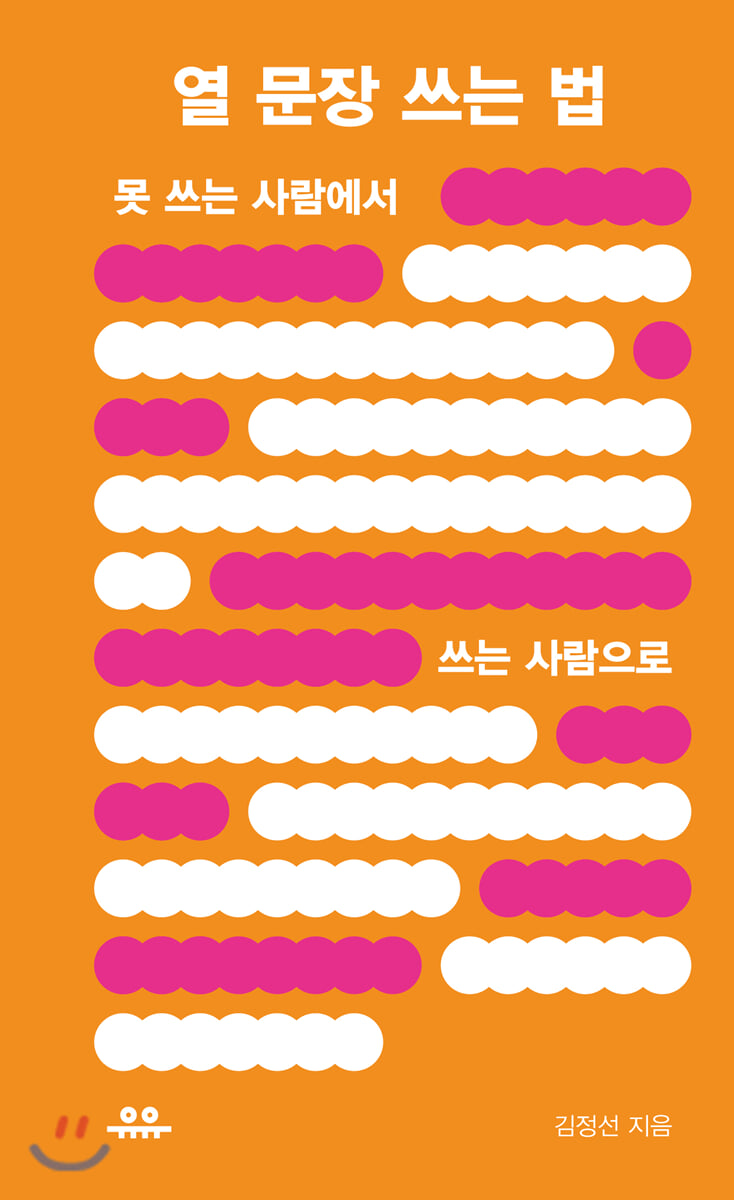
How to write ten sentences
 |
Description
Book Introduction
- A word from MD
-
I want to write something greatA new writing guide by Kim Jeong-seon, author of "Are My Sentences That Strange?" and "The Taste of Verbs."
I have compiled the writing know-how I have accumulated over 27 years of working as a sentence repairman.
Writing requires a lot of practice for everyone, and this book will help reduce that time a little.
March 10, 2020. Humanities PD Son Min-gyu
"How to Write Ten Sentences" contains methods for dividing, shortening, expanding, and revising a single sentence to create ten sentences, or a single piece of writing.
In this process, we naturally learn how to refine the sentences we write.
The author makes full use of his professional skills to provide explanations of conjunctions and demonstrative pronouns, as well as tips on using verbs.
If you keep practicing and practicing according to the author's guidance, you will soon become a 'writer', and the 'strange sentences' you write will become sentences that accurately contain your feelings and thoughts, and a piece of writing made up of neat sentences that are quite readable.
In this process, we naturally learn how to refine the sentences we write.
The author makes full use of his professional skills to provide explanations of conjunctions and demonstrative pronouns, as well as tips on using verbs.
If you keep practicing and practicing according to the author's guidance, you will soon become a 'writer', and the 'strange sentences' you write will become sentences that accurately contain your feelings and thoughts, and a piece of writing made up of neat sentences that are quite readable.
- You can preview some of the book's contents.
Preview
index
Introduction
1. Why Writing is Difficult
2 From one sentence
3. Write a long sentence
4. Why you need to practice writing long sentences
5 From 'My Only' to 'Everyone's Language'
6 Natural writing?
7. Write about 'yours', not 'mine'
8. Meeting a self so unfamiliar to me
9 Why is writing a problem now?
10 And, so, but
11 Divide into several sentences
12 Writing is a task that fills time, not space.
13 Differences between speaking and writing
14 When to write short and when to write long
15 If you record my words, you will hear, “I said this?”
16 Is this a writing filled with sincerity and truth?
17 Practice writing according to the given amount
18 A sense of time engraved in the body
19 Write a diary in a set amount
20 When and how should I write?
21 Go back to the beginning
22 One long sentence again
23 Writing Short Sentences
24 sentences and between sentences
+ Noun-based sentences and verb-based sentences
1. Why Writing is Difficult
2 From one sentence
3. Write a long sentence
4. Why you need to practice writing long sentences
5 From 'My Only' to 'Everyone's Language'
6 Natural writing?
7. Write about 'yours', not 'mine'
8. Meeting a self so unfamiliar to me
9 Why is writing a problem now?
10 And, so, but
11 Divide into several sentences
12 Writing is a task that fills time, not space.
13 Differences between speaking and writing
14 When to write short and when to write long
15 If you record my words, you will hear, “I said this?”
16 Is this a writing filled with sincerity and truth?
17 Practice writing according to the given amount
18 A sense of time engraved in the body
19 Write a diary in a set amount
20 When and how should I write?
21 Go back to the beginning
22 One long sentence again
23 Writing Short Sentences
24 sentences and between sentences
+ Noun-based sentences and verb-based sentences
Publisher's Review
Why is writing so difficult?
"The Taste of Verbs" and "Are My Sentences That Strange?" by Kim Jeong-seon, a sentence repairman who has been looking at proofreading papers for 27 years and refining awkward sentences into flowing ones, are guides to using Korean parts of speech and refining sentences.
This book, which is a unique mix of practical knowledge and stories about the Korean language, has become a steady seller among readers through word of mouth.
After publishing this book, the author became a professional proofreader and gave lectures on how to polish sentences, how to write good sentences, and even how to write well.
I finally realized this after giving lectures all over the country.
Many people are interested in writing and are stressed because of it.
We have entered an era where everyone has to write and be required to write, whether at work, at school, or even on social media.
And then I realize something new.
Most writing books you see in bookstores "assume that the reader is already familiar with writing Korean sentences, and they develop the content and provide tips."
Koreans speak and write in Korean.
Is this obvious? But because of this obviousness, we mistakenly believe we're fluent in Korean.
If I just write down my feelings and thoughts, and the story of my life, it can be conveyed well to anyone.
If it were easy, there would be no need to read books on writing like this.
How difficult is it to put into words all the emotions, thoughts, and opinions tangled in my head?
The author suggests:
You need to understand that writing is an act of translating 'your own language' into 'everyone's language', and you need to get used to writing Korean sentences.
To do that, let's first write ten sentences.
Let's practice together so that we can write at least ten sentences without difficulty, so that we can go from someone who can't write to someone who can write.
How to turn one sentence into ten sentences, into a piece of writing
If a person who can't write wants to become a writer, he or she must first try writing one sentence.
One long sentence.
By writing long sentences without interruption, you can write your own story without interruption. In the process of trying to somehow connect the content, you can train yourself to make the subject and predicate respond and create a flow within the sentence through conjunctions.
Starting with this, you will learn how to naturally refine your sentences, compose your writing, and sense the flow of time within your writing by dividing one sentence into several sentences and practicing shortening and lengthening them.
Also, by practicing writing with a different speaker as the subject instead of 'I', you can become accustomed to separating 'I', the subject of the writing, from 'I', the speaker in the writing, and you can also get a chance to use expressions that you don't normally use.
In this way, 『How to Write Ten Sentences』 contains the method of dividing, shortening, extending, and revising one sentence to create ten sentences, or one piece of writing.
You may not have noticed, but in this process, we naturally learn how to refine the sentences we write.
The author makes full use of his professional skills to provide explanations of conjunctions and demonstrative pronouns, as well as tips on using verbs.
If you keep practicing and practicing according to the author's guidance, you will soon become a 'writer', and the 'strange sentences' you write will become sentences that accurately contain your feelings and thoughts, and a piece of writing made up of neat sentences that are quite readable.
If you're someone who "can't write," a beginner who always has trouble completing a piece of writing, or someone who can write a little but feels stuck and can't move forward, start practicing writing with this book.
Above all, don't forget that 'repeated practice' is the most important.
"The Taste of Verbs" and "Are My Sentences That Strange?" by Kim Jeong-seon, a sentence repairman who has been looking at proofreading papers for 27 years and refining awkward sentences into flowing ones, are guides to using Korean parts of speech and refining sentences.
This book, which is a unique mix of practical knowledge and stories about the Korean language, has become a steady seller among readers through word of mouth.
After publishing this book, the author became a professional proofreader and gave lectures on how to polish sentences, how to write good sentences, and even how to write well.
I finally realized this after giving lectures all over the country.
Many people are interested in writing and are stressed because of it.
We have entered an era where everyone has to write and be required to write, whether at work, at school, or even on social media.
And then I realize something new.
Most writing books you see in bookstores "assume that the reader is already familiar with writing Korean sentences, and they develop the content and provide tips."
Koreans speak and write in Korean.
Is this obvious? But because of this obviousness, we mistakenly believe we're fluent in Korean.
If I just write down my feelings and thoughts, and the story of my life, it can be conveyed well to anyone.
If it were easy, there would be no need to read books on writing like this.
How difficult is it to put into words all the emotions, thoughts, and opinions tangled in my head?
The author suggests:
You need to understand that writing is an act of translating 'your own language' into 'everyone's language', and you need to get used to writing Korean sentences.
To do that, let's first write ten sentences.
Let's practice together so that we can write at least ten sentences without difficulty, so that we can go from someone who can't write to someone who can write.
How to turn one sentence into ten sentences, into a piece of writing
If a person who can't write wants to become a writer, he or she must first try writing one sentence.
One long sentence.
By writing long sentences without interruption, you can write your own story without interruption. In the process of trying to somehow connect the content, you can train yourself to make the subject and predicate respond and create a flow within the sentence through conjunctions.
Starting with this, you will learn how to naturally refine your sentences, compose your writing, and sense the flow of time within your writing by dividing one sentence into several sentences and practicing shortening and lengthening them.
Also, by practicing writing with a different speaker as the subject instead of 'I', you can become accustomed to separating 'I', the subject of the writing, from 'I', the speaker in the writing, and you can also get a chance to use expressions that you don't normally use.
In this way, 『How to Write Ten Sentences』 contains the method of dividing, shortening, extending, and revising one sentence to create ten sentences, or one piece of writing.
You may not have noticed, but in this process, we naturally learn how to refine the sentences we write.
The author makes full use of his professional skills to provide explanations of conjunctions and demonstrative pronouns, as well as tips on using verbs.
If you keep practicing and practicing according to the author's guidance, you will soon become a 'writer', and the 'strange sentences' you write will become sentences that accurately contain your feelings and thoughts, and a piece of writing made up of neat sentences that are quite readable.
If you're someone who "can't write," a beginner who always has trouble completing a piece of writing, or someone who can write a little but feels stuck and can't move forward, start practicing writing with this book.
Above all, don't forget that 'repeated practice' is the most important.
GOODS SPECIFICS
- Date of issue: March 4, 2020
- Page count, weight, size: 160 pages | 138g | 115*188*20mm
- ISBN13: 9791189683337
- ISBN10: 1189683334
You may also like
카테고리
korean


korean

![GQ KOREA Mark (Monthly): December [2025]](http://librairie.coreenne.fr/cdn/shop/files/8ef265dbbfbf186523ed75ba7319009d.jpg?v=1765340328&width=3840)


