

Art and Humanities Travel × Spain
 |
Description
Book Introduction
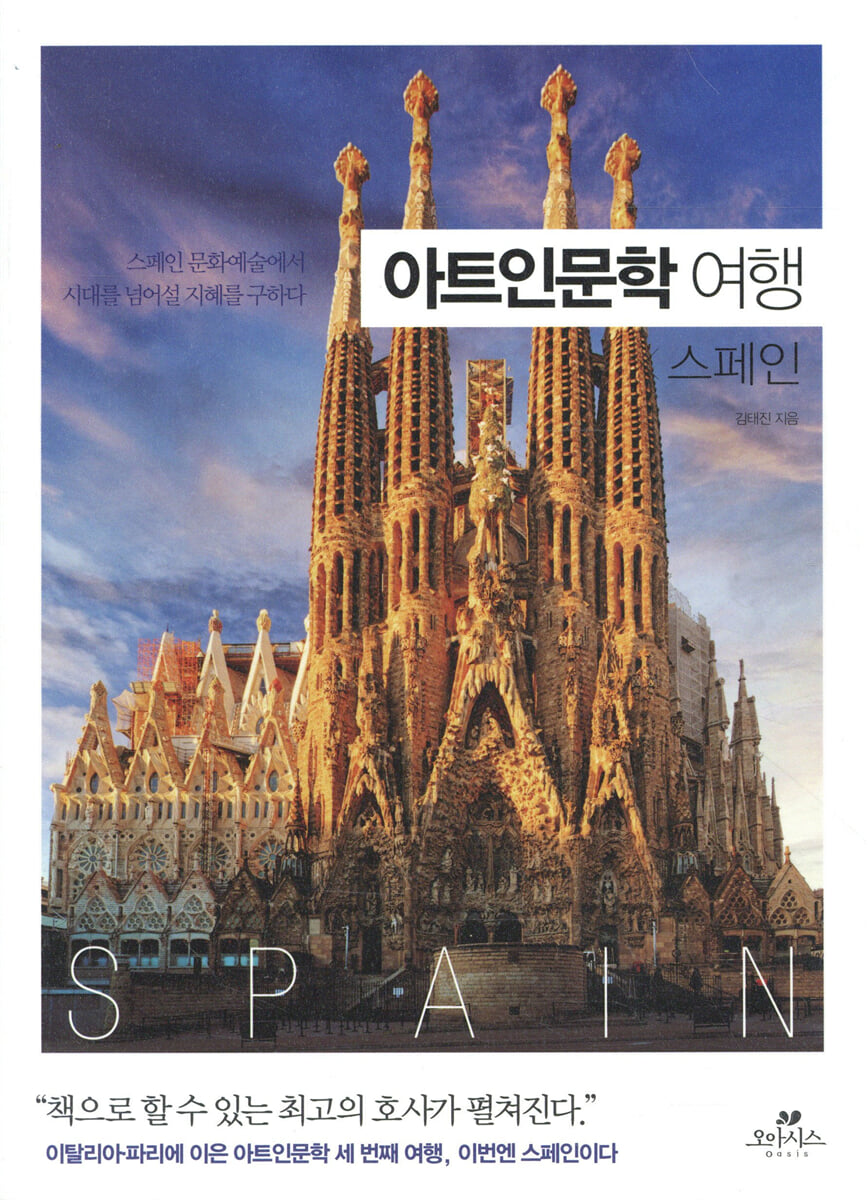
“The most beautiful and intelligent journey in the world, this time to Spain!” A journey through Spanish culture and arts to find the Don Quixote within me. The world's most beautiful and intellectual journey, 'Art and Humanities Journey', returns with a Spanish edition. The 'Art and Humanities Travel Series', which was first introduced in 2015 and has now become a genre in its own right, has come to readers with 'Art and Humanities Travel x Spain', which covers Spanish culture and arts, following the Italian Renaissance and Paris editions. Like its predecessors, this film beautifully and harmoniously blends tourist attractions, historical events, and art stories with vivid photographs that convey the diverse beauty of Spain. This book travels to each city in Spain, including Granada, Toledo, Madrid, Barcelona, and Figueres, and meets historical figures and artists who shaped present-day Spain. By looking at Spanish artists who have left their mark on human history, such as Isabel I, El Greco, Velazquez, Gaudi, and Dali, along with Columbus, Philip II, Goya, and Gala who were by their side, it helps us to view Spanish history and art in a three-dimensional way. Under the meticulous direction of Kim Tae-jin, a serious yet captivating storyteller, the history of Spanish art and culture is brought together in perfect harmony, presenting a stunning spectacle with over 100 photographs of Spanish art and culture, 60 or so illustrated plates, and 80 photographs taken during a field trip to Spain. The moment you open the book, you will experience the emotion of art with your whole body as the pictures, architecture, text, and story come together. |
- You can preview some of the book's contents.
Preview
index
Prologue: The Two Faces of Spain and the Two Voices Within Me
letter.
Two eras that have passed through Spain since the modern era
Part 1.
After the Reconquista, Spain of Ideology
Chapter 1.
Catholic Queen and Adventurer Isabella and Columbus
What the Moors left behind
Columbus, the adventurer who went west
Isabella, Queen of the Catholics
When the Alhambra awakens again
Juana, Her Royal Chapel
Stories from Granada
Art plus.
Art museums in Andalusia
Travel Plus.
Beaches of the Sun, Malaga, Ronda, Nerja
A slice of history.
Massacre recorded as conquest
Chapter 2.
The King and the Painter of the Empire_ Felipe and El Greco
Toledo Cathedral, the headquarters of Catholicism in Spain
El Greco, the painter who embraced the Mediterranean
King Felipe II, who owned the whole world
Two men standing in front of a painting
Two Miracles, Santo Tomé Church
Stories from Toledo
Art plus.
The Fossil of Glory, El Escorial
Travel Plus.
In Search of the Knight of La Mancha
A slice of history.
Invincible Fleet Armada
Chapter 3.
Two court painters_ Velazquez and Goya
All stories begin at the Gate of the Sun
Golden Age Painters at the Prado
The painter who disappeared forever
Masterpieces from Velázquez at the Prado
The Black House of the Deaf
Goya's masterpieces at the Prado
Stories from Madrid
Art plus.
Art museums in Madrid
Travel Plus.
Segovia, the jewel of Castile
A slice of history.
What Napoleon brought
Part 2.
After the World's Fair, Catalonia's Desire
Chapter 4.
Architects and Patrons_ Gaudi and Güell
A park called Fortress
Walking through the Gothic Quarter, to the Neri Cathedral
Genius or madman
A connection that connects our hearts like old friends
Gaudí in the city center
A miracle that is still being built
Stories from Barcelona
Art plus.
A competition venue for modern architects
Travel Plus.
Montserrat, the spiritual home of Catalonia
A slice of history.
It rained down on Guernica
Chapter 5.
Genius and the Muse_ Dali and Gala
When an eccentric genius meets his muse
Dali's Kingdom, Dali's Egg
A castle dedicated to the Muse
Fall asleep on stage
The story told by Figueres
Art plus.
Masters born in Catalonia
Travel Plus.
Contemporary art in Spain
A slice of history.
Operation Anubis
The final chapter.
Don Quixote Goes Alone
Epilogue The song he sings
Reference books
letter.
Two eras that have passed through Spain since the modern era
Part 1.
After the Reconquista, Spain of Ideology
Chapter 1.
Catholic Queen and Adventurer Isabella and Columbus
What the Moors left behind
Columbus, the adventurer who went west
Isabella, Queen of the Catholics
When the Alhambra awakens again
Juana, Her Royal Chapel
Stories from Granada
Art plus.
Art museums in Andalusia
Travel Plus.
Beaches of the Sun, Malaga, Ronda, Nerja
A slice of history.
Massacre recorded as conquest
Chapter 2.
The King and the Painter of the Empire_ Felipe and El Greco
Toledo Cathedral, the headquarters of Catholicism in Spain
El Greco, the painter who embraced the Mediterranean
King Felipe II, who owned the whole world
Two men standing in front of a painting
Two Miracles, Santo Tomé Church
Stories from Toledo
Art plus.
The Fossil of Glory, El Escorial
Travel Plus.
In Search of the Knight of La Mancha
A slice of history.
Invincible Fleet Armada
Chapter 3.
Two court painters_ Velazquez and Goya
All stories begin at the Gate of the Sun
Golden Age Painters at the Prado
The painter who disappeared forever
Masterpieces from Velázquez at the Prado
The Black House of the Deaf
Goya's masterpieces at the Prado
Stories from Madrid
Art plus.
Art museums in Madrid
Travel Plus.
Segovia, the jewel of Castile
A slice of history.
What Napoleon brought
Part 2.
After the World's Fair, Catalonia's Desire
Chapter 4.
Architects and Patrons_ Gaudi and Güell
A park called Fortress
Walking through the Gothic Quarter, to the Neri Cathedral
Genius or madman
A connection that connects our hearts like old friends
Gaudí in the city center
A miracle that is still being built
Stories from Barcelona
Art plus.
A competition venue for modern architects
Travel Plus.
Montserrat, the spiritual home of Catalonia
A slice of history.
It rained down on Guernica
Chapter 5.
Genius and the Muse_ Dali and Gala
When an eccentric genius meets his muse
Dali's Kingdom, Dali's Egg
A castle dedicated to the Muse
Fall asleep on stage
The story told by Figueres
Art plus.
Masters born in Catalonia
Travel Plus.
Contemporary art in Spain
A slice of history.
Operation Anubis
The final chapter.
Don Quixote Goes Alone
Epilogue The song he sings
Reference books
Detailed image

Into the book
“El Greco, Gaudi and Dali… They were the creators of Spanish art and made me dream of traveling to Spain.
As I prepared for my trip, I searched and searched for the source of their creativity, something that could encompass each of their individual personalities.
Then one day, by chance, a person came to mind.
A wandering knight with the aspects of both a seeker and a madman.
It was Don Quixote.
I felt like I had discovered the most crucial topic that would permeate the entire trip, an important clue to the implications that could be applied to our times.
So from then on, my trip to Spain became a trip to meet Don Quixote.” --- p.5
El Greco always argued with his clients because he demanded high prices for his paintings.
This was both a way to preserve his reputation as a top painter and a way to satisfy his own desires.
After he became successful, he spent money lavishly, decorating his house extravagantly and buying luxury goods.
During meal times, he invited the best musicians to play music in the next room.
Even for such a luxurious life, he could not lower the price of his paintings.
Instead, I believed that if I painted unique and outstanding pictures that no one could follow, people would be forced to look for my pictures.
El Greco is also called the terminator of the Renaissance.
This is because he was a painter who grew up in the Byzantine world, but who absorbed all of Renaissance painting as his own while traveling through Venice and Rome.
After settling in Spain, he created unprecedented works based on this foundation, and became one of the most important painters in the history of Western art, providing endless inspiration to 20th-century expressionist painters.
--- p.133
Let us remember that Cervantes was very good at satire.
This passage contains an important message from the author.
It's about something we're losing.
We always put something in front of us and ask ourselves whether it is a 'princess or not'.
And then we put off doing the important things that really need to be done.
What if you have two children? What if you don't know each other?
The author says:
Our lives are at a standstill right now.
In other words, it is important to keep something in mind and ‘move forward’.
Military achievements, love, honor.
It doesn't have to be exactly this.
Anyway, we have to work harder, love more, and protect ourselves.
Then, Don Quixote, who was a false knight, grows into a true knight-errant.
And this is also the moment when the woman he had in mind transforms into the true Princess Dulcinea.
--- p.144
We have not yet encountered Velázquez's masterpiece.
[Maids].
This masterpiece, which is over 3 meters tall, is located in the center of the main hall of the Prado Palace.
This is Velazquez's room.
If you go in front of this painting, it will already be occupied by so many people that there will be no room to stand.
Because it is the painting that everyone who visits the Prado Museum wants to see the most.
The fame attached to this painting is truly remarkable.
First of all, this painting has been selected as one of the greatest works of art ever created by humans.
This was the result of a survey conducted by a British magazine about 30 years ago.
In that survey, which targeted art professionals rather than the general public, [Ladies and Men] confidently took first place, beating out [Mona Lisa] and others.
An anecdote about Picasso also contributed to the painting's fame.
It is said that Picasso was so inspired by this painting that he later created as many as 50 paintings based on this painting.
Even if we look at this work solely from a technical standpoint, its influence on later painters is enormous, but the reason it resonated so widely across culture lies elsewhere.
It is because it twists the relationship between the painter and the model, and between the painter and the audience, to a completely different level.
--- p.178
Around the time Gaudí debuted as an architect, a stage was being created in Barcelona where he could fully demonstrate his potential.
In times like these, we say that we met at the right time or that we were lucky.
There are two main reasons why he received help from the times.
One is the issue of livelihood.
As the construction market was at its peak, he had a lot of work to do.
The second is freedom.
Because there was a lack of excellent architects, Gaudí was able to push his ideas through in his relationship with the building owner.
Considering Gaudí's prickly personality, it is easy to understand how helpful these elements would have been.
But Gaudí's greatness cannot be explained simply by the fact that he met a good era.
He is not an architect who went with the times and lived with the flow.
Rather, he stood tall above his time, and thus transformed the city he lived in into a completely different city.
In that sense, he was the perfect Don Quixote --- p.272
After being expelled from Surrealism, Dali left these words:
“If there is one difference between the surrealists and me, it is that I am (the only) surrealist,” he said, expressing his convictions.
“I am only a Daliist.
It will be like that until I die.
I don't believe in any revolution.
“All I believe in is my qualities, nurtured in a great tradition.” The popularity Dali enjoyed at that time was beyond imagination.
Dali's retrospective held at the Museum of Modern Art in New York in 1941 was a huge success, attracting a huge crowd.
André Breton gave this nickname to Dali, who was not picky about anything that would make money.
Avida Dollars (those who are hungry for dollars).
--- p.319
Think of Don Quixote, who has been silently waiting for you to look at him for a long time.
I hope to meet Don Quixote by any chance.
That's the beginning.
If you get to meet, have a private conversation.
The longer and deeper the time, the better.
Even if Sancho suddenly interrupts, try to calm him down and just focus on your conversation with Don Quixote.
Then, before long, you will be overcome by a very strange feeling.
It's a feeling of vagueness or deep regret.
These signals are very positive.
You are doing well.
I hope that you will come to this realization.
It's like the realization that I, who embrace Don Quixote, am a really good person.
Feelings of hope, excitement, and grandeur will soon fill your heart with courage, and you will begin to see the path you want to take, or the path you must take.
I really hope so.
As I prepared for my trip, I searched and searched for the source of their creativity, something that could encompass each of their individual personalities.
Then one day, by chance, a person came to mind.
A wandering knight with the aspects of both a seeker and a madman.
It was Don Quixote.
I felt like I had discovered the most crucial topic that would permeate the entire trip, an important clue to the implications that could be applied to our times.
So from then on, my trip to Spain became a trip to meet Don Quixote.” --- p.5
El Greco always argued with his clients because he demanded high prices for his paintings.
This was both a way to preserve his reputation as a top painter and a way to satisfy his own desires.
After he became successful, he spent money lavishly, decorating his house extravagantly and buying luxury goods.
During meal times, he invited the best musicians to play music in the next room.
Even for such a luxurious life, he could not lower the price of his paintings.
Instead, I believed that if I painted unique and outstanding pictures that no one could follow, people would be forced to look for my pictures.
El Greco is also called the terminator of the Renaissance.
This is because he was a painter who grew up in the Byzantine world, but who absorbed all of Renaissance painting as his own while traveling through Venice and Rome.
After settling in Spain, he created unprecedented works based on this foundation, and became one of the most important painters in the history of Western art, providing endless inspiration to 20th-century expressionist painters.
--- p.133
Let us remember that Cervantes was very good at satire.
This passage contains an important message from the author.
It's about something we're losing.
We always put something in front of us and ask ourselves whether it is a 'princess or not'.
And then we put off doing the important things that really need to be done.
What if you have two children? What if you don't know each other?
The author says:
Our lives are at a standstill right now.
In other words, it is important to keep something in mind and ‘move forward’.
Military achievements, love, honor.
It doesn't have to be exactly this.
Anyway, we have to work harder, love more, and protect ourselves.
Then, Don Quixote, who was a false knight, grows into a true knight-errant.
And this is also the moment when the woman he had in mind transforms into the true Princess Dulcinea.
--- p.144
We have not yet encountered Velázquez's masterpiece.
[Maids].
This masterpiece, which is over 3 meters tall, is located in the center of the main hall of the Prado Palace.
This is Velazquez's room.
If you go in front of this painting, it will already be occupied by so many people that there will be no room to stand.
Because it is the painting that everyone who visits the Prado Museum wants to see the most.
The fame attached to this painting is truly remarkable.
First of all, this painting has been selected as one of the greatest works of art ever created by humans.
This was the result of a survey conducted by a British magazine about 30 years ago.
In that survey, which targeted art professionals rather than the general public, [Ladies and Men] confidently took first place, beating out [Mona Lisa] and others.
An anecdote about Picasso also contributed to the painting's fame.
It is said that Picasso was so inspired by this painting that he later created as many as 50 paintings based on this painting.
Even if we look at this work solely from a technical standpoint, its influence on later painters is enormous, but the reason it resonated so widely across culture lies elsewhere.
It is because it twists the relationship between the painter and the model, and between the painter and the audience, to a completely different level.
--- p.178
Around the time Gaudí debuted as an architect, a stage was being created in Barcelona where he could fully demonstrate his potential.
In times like these, we say that we met at the right time or that we were lucky.
There are two main reasons why he received help from the times.
One is the issue of livelihood.
As the construction market was at its peak, he had a lot of work to do.
The second is freedom.
Because there was a lack of excellent architects, Gaudí was able to push his ideas through in his relationship with the building owner.
Considering Gaudí's prickly personality, it is easy to understand how helpful these elements would have been.
But Gaudí's greatness cannot be explained simply by the fact that he met a good era.
He is not an architect who went with the times and lived with the flow.
Rather, he stood tall above his time, and thus transformed the city he lived in into a completely different city.
In that sense, he was the perfect Don Quixote --- p.272
After being expelled from Surrealism, Dali left these words:
“If there is one difference between the surrealists and me, it is that I am (the only) surrealist,” he said, expressing his convictions.
“I am only a Daliist.
It will be like that until I die.
I don't believe in any revolution.
“All I believe in is my qualities, nurtured in a great tradition.” The popularity Dali enjoyed at that time was beyond imagination.
Dali's retrospective held at the Museum of Modern Art in New York in 1941 was a huge success, attracting a huge crowd.
André Breton gave this nickname to Dali, who was not picky about anything that would make money.
Avida Dollars (those who are hungry for dollars).
--- p.319
Think of Don Quixote, who has been silently waiting for you to look at him for a long time.
I hope to meet Don Quixote by any chance.
That's the beginning.
If you get to meet, have a private conversation.
The longer and deeper the time, the better.
Even if Sancho suddenly interrupts, try to calm him down and just focus on your conversation with Don Quixote.
Then, before long, you will be overcome by a very strange feeling.
It's a feeling of vagueness or deep regret.
These signals are very positive.
You are doing well.
I hope that you will come to this realization.
It's like the realization that I, who embrace Don Quixote, am a really good person.
Feelings of hope, excitement, and grandeur will soon fill your heart with courage, and you will begin to see the path you want to take, or the path you must take.
I really hope so.
--- p.361
Publisher's Review
“Only Don Quixotes change the world!”
A cultural and artistic journey through Spain to find the Don Quixote within me.
Beginning in Granada in southern Spain, traveling around Madrid in central Spain and ending in Barcelona in the northeast, this book's journey covers the Spanish Empire's rise to prominence with the dawn of the modern era, its subsequent decline, and the artistic renaissance that began with the 20th century.
As the story continues with the stories of Spanish historical figures such as Queen Isabella, Columbus, Philip II, and General Franco, readers will learn all about Spain's must-see architectural landmarks, including the Alhambra, El Escorial, and Sagrada Familia.
You will also gain a deeper understanding of the lives and major works of Spain's greatest art masters, including El Greco, Velazquez, Goya, Picasso, and Dali.
You will be able to experience the true face of Spain beyond the level of tourism.
The charm of this book does not end here.
Like previous works, this journey continues the humanistic theme of 'creativity'.
In doing so, we share important questions and suggestions for living in the era of the Fourth Industrial Revolution, which has now become a reality.
Through the analogy between Don Quixote, who dreams recklessly and boldly, and Sancho, who is worldly and realistic, beside him, it helps us to read more deeply about the challenges and dedication of artists hidden within history and art, as well as the limitations and prospects of the times.
By tracing the footsteps of all these Don Quixotes, we can gain wisdom for living in this age.
200% collectible value! A beautiful and fantastical fusion of Spain, art, and humanities.
From the 15th century to the present, Spanish history and culture in one book.
Professor Taejin Kim, who has been honored with the Best Teacher Award and the Most Inspiring Class, demonstrates his talent as a natural storyteller, using the theme of Don Quixote as the warp and the lives of Spanish artists from the pre- and post-modern era as the woof.
It's a fun and light read, with a flavorful blend of history and art stories and in-depth humanities knowledge, but the insights gained are profound and moving.
This book goes beyond simply viewing the paintings, artworks, and beautiful architecture found in Spain. It also helps you experience a variety of things: 'reading' the era, 'feeling' the senses, and 'facing' life.
“A book written with incredible ease and beauty.”, “I only found a more interesting journey after returning from it.”, “I couldn’t be happier while reading it.”, “A book that leaves a deep lingering thought about what kind of life to live.” Many who encountered the art and humanities journey did not hesitate to call this book the best book they had ever read.
This book was created in response to the fervent requests of readers who read the Paris, Italy edition.
Reader reviews of the Art and Humanities Tour prove that art, humanities, and travel are life skills that help us grow and see reality in a strange way.
This book will confirm that the humanities help us see our reality in a new way, and that, as a result, we can no longer return to our 'previous selves.'
I'm already curious to see where author Kim Tae-jin, a natural storyteller, will travel next.
A cultural and artistic journey through Spain to find the Don Quixote within me.
Beginning in Granada in southern Spain, traveling around Madrid in central Spain and ending in Barcelona in the northeast, this book's journey covers the Spanish Empire's rise to prominence with the dawn of the modern era, its subsequent decline, and the artistic renaissance that began with the 20th century.
As the story continues with the stories of Spanish historical figures such as Queen Isabella, Columbus, Philip II, and General Franco, readers will learn all about Spain's must-see architectural landmarks, including the Alhambra, El Escorial, and Sagrada Familia.
You will also gain a deeper understanding of the lives and major works of Spain's greatest art masters, including El Greco, Velazquez, Goya, Picasso, and Dali.
You will be able to experience the true face of Spain beyond the level of tourism.
The charm of this book does not end here.
Like previous works, this journey continues the humanistic theme of 'creativity'.
In doing so, we share important questions and suggestions for living in the era of the Fourth Industrial Revolution, which has now become a reality.
Through the analogy between Don Quixote, who dreams recklessly and boldly, and Sancho, who is worldly and realistic, beside him, it helps us to read more deeply about the challenges and dedication of artists hidden within history and art, as well as the limitations and prospects of the times.
By tracing the footsteps of all these Don Quixotes, we can gain wisdom for living in this age.
200% collectible value! A beautiful and fantastical fusion of Spain, art, and humanities.
From the 15th century to the present, Spanish history and culture in one book.
Professor Taejin Kim, who has been honored with the Best Teacher Award and the Most Inspiring Class, demonstrates his talent as a natural storyteller, using the theme of Don Quixote as the warp and the lives of Spanish artists from the pre- and post-modern era as the woof.
It's a fun and light read, with a flavorful blend of history and art stories and in-depth humanities knowledge, but the insights gained are profound and moving.
This book goes beyond simply viewing the paintings, artworks, and beautiful architecture found in Spain. It also helps you experience a variety of things: 'reading' the era, 'feeling' the senses, and 'facing' life.
“A book written with incredible ease and beauty.”, “I only found a more interesting journey after returning from it.”, “I couldn’t be happier while reading it.”, “A book that leaves a deep lingering thought about what kind of life to live.” Many who encountered the art and humanities journey did not hesitate to call this book the best book they had ever read.
This book was created in response to the fervent requests of readers who read the Paris, Italy edition.
Reader reviews of the Art and Humanities Tour prove that art, humanities, and travel are life skills that help us grow and see reality in a strange way.
This book will confirm that the humanities help us see our reality in a new way, and that, as a result, we can no longer return to our 'previous selves.'
I'm already curious to see where author Kim Tae-jin, a natural storyteller, will travel next.
GOODS SPECIFICS
- Date of issue: March 18, 2019
- Page count, weight, size: 372 pages | 571g | 152*210*18mm
- ISBN13: 9791188674558
- ISBN10: 1188674552
You may also like
카테고리
korean


korean

![GQ KOREA Mark (Monthly): December [2025]](http://librairie.coreenne.fr/cdn/shop/files/8ef265dbbfbf186523ed75ba7319009d.jpg?v=1765340328&width=3840)


