

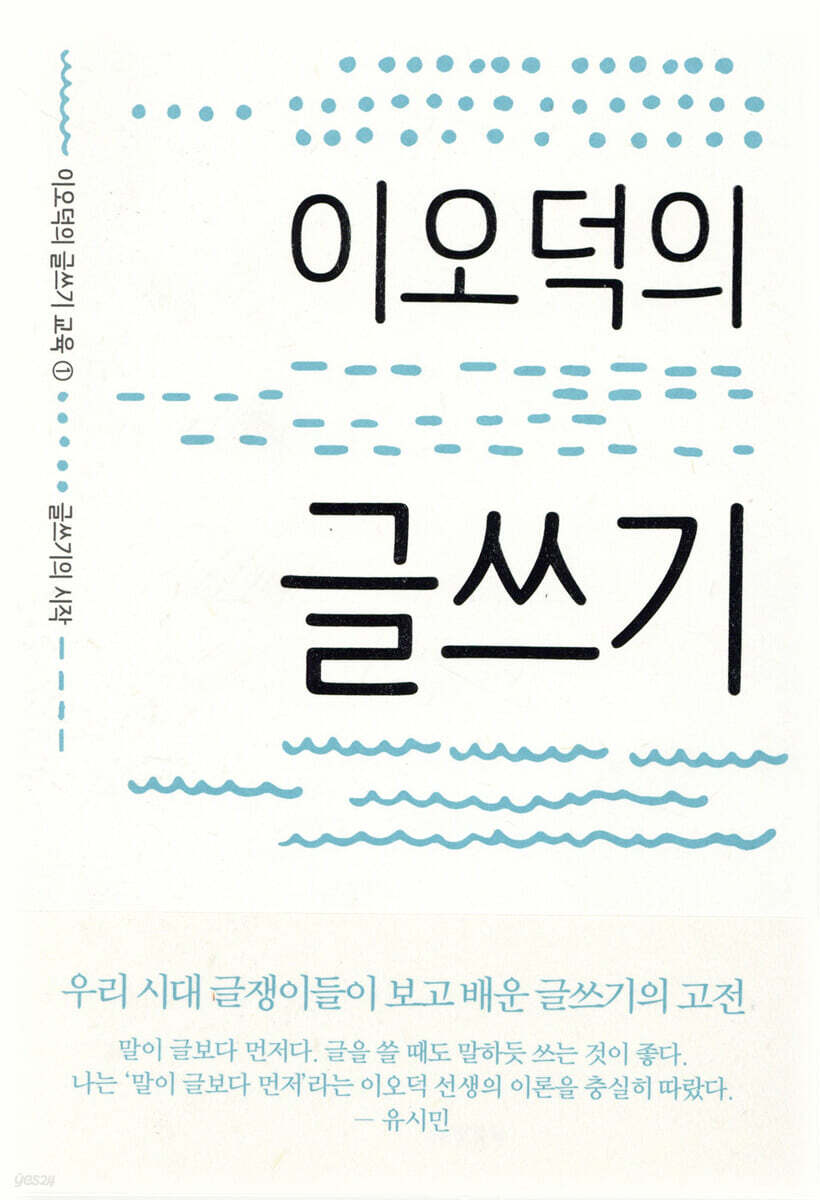
Iodeok Lee's writing
 |
Description
Book Introduction
Writing, how to do it?
I start with Iodeok's writing!
Why have we become so afraid of writing and find it so difficult? It's because we understand that speech and writing are distinct, that "writing = literature," and that we've been taught that writing should be written in beautiful, elegant sentences, like something out of a book.
Is that really what writing is?
This book clearly states that it is not.
Writing isn't something only special people can do; it's something everyone can do, just like breathing. "Lee O-deok's Writing" is a book that reveals the truth about writing that Lee O-deok only realized after teaching children in class, and provides a glimpse into Lee O-deok's writing style.
It allows us to establish a new perspective on writing, starting with the questions of why we write and what kind of writing we should write, and what constitutes good writing and bad writing.
Not only teachers and parents, but anyone who knows the right way to write will enjoy writing.
I start with Iodeok's writing!
Why have we become so afraid of writing and find it so difficult? It's because we understand that speech and writing are distinct, that "writing = literature," and that we've been taught that writing should be written in beautiful, elegant sentences, like something out of a book.
Is that really what writing is?
This book clearly states that it is not.
Writing isn't something only special people can do; it's something everyone can do, just like breathing. "Lee O-deok's Writing" is a book that reveals the truth about writing that Lee O-deok only realized after teaching children in class, and provides a glimpse into Lee O-deok's writing style.
It allows us to establish a new perspective on writing, starting with the questions of why we write and what kind of writing we should write, and what constitutes good writing and bad writing.
Not only teachers and parents, but anyone who knows the right way to write will enjoy writing.
- You can preview some of the book's contents.
Preview
index
Preface to the First Edition
Chapter 1: Writing to Save Children
Do children inherently dislike writing? | 'Writing' instruction that makes children foolish | Expressive education that saves children | Let's give children freedom of expression | Children's writing and children's literature are different | Let's teach them to write honest and valuable writing.
Chapter 2: How to Teach Children to Write
How to teach writing | Twelve methods of teaching writing | Have children write with life | Have children write with words that accurately express facts | Have children write about their actual actions | Have children write about embarrassing events | Why do people write lies? | Writing that imitates, writing that creates | Do not imitate literary works | Do not imitate adults | Why do adults write like this? | How to teach children to write poetry
Chapter 3: How to Read Children's Writing
How to view children's writing | Misunderstandings about children's writing | The image of mothers in children's writing | Writing that is forced, writing that is written because they want to write | How to view the winning works of writing contests | Animals in children's writing | Writing by children whose lives have been taken away | Writing published in children's newspapers | Words and writing that give strength to the shoulders
Chapter 4: Teaching Writing to Children
Let's learn from children | This ugly habit of looking down on what's mine | Children's writings that enlighten adults | Writings by working children | Poems written by children | Past and present of rural areas as seen in children's writings | A child who has not lost himself
Chapter 5: Correcting Faulty Writing Instructions
Does embellishment make good writing? | Does imitating writing from books make good writing? | Why can't we write as we feel? | What kind of writing is truly childlike? | Why are we prevented from writing honestly? | Are children's writings not worthy of being published as books? | Why are honest writings hindered? | Sick adults don't understand what children say. | The words of sick adults spread to children.
Chapter 1: Writing to Save Children
Do children inherently dislike writing? | 'Writing' instruction that makes children foolish | Expressive education that saves children | Let's give children freedom of expression | Children's writing and children's literature are different | Let's teach them to write honest and valuable writing.
Chapter 2: How to Teach Children to Write
How to teach writing | Twelve methods of teaching writing | Have children write with life | Have children write with words that accurately express facts | Have children write about their actual actions | Have children write about embarrassing events | Why do people write lies? | Writing that imitates, writing that creates | Do not imitate literary works | Do not imitate adults | Why do adults write like this? | How to teach children to write poetry
Chapter 3: How to Read Children's Writing
How to view children's writing | Misunderstandings about children's writing | The image of mothers in children's writing | Writing that is forced, writing that is written because they want to write | How to view the winning works of writing contests | Animals in children's writing | Writing by children whose lives have been taken away | Writing published in children's newspapers | Words and writing that give strength to the shoulders
Chapter 4: Teaching Writing to Children
Let's learn from children | This ugly habit of looking down on what's mine | Children's writings that enlighten adults | Writings by working children | Poems written by children | Past and present of rural areas as seen in children's writings | A child who has not lost himself
Chapter 5: Correcting Faulty Writing Instructions
Does embellishment make good writing? | Does imitating writing from books make good writing? | Why can't we write as we feel? | What kind of writing is truly childlike? | Why are we prevented from writing honestly? | Are children's writings not worthy of being published as books? | Why are honest writings hindered? | Sick adults don't understand what children say. | The words of sick adults spread to children.
Detailed image
Into the book
Let's write about life.
Let's write life.
That life is not someone else's life, it is my own life.
We must rediscover what is mine, what is ours, that we have so far considered insignificant, hidden, and despised, and we must cherish, reveal, and nurture those poor, small things.
The treasure trove of writing, shining with dazzling gold, is not in the splendid streets of some distant land, nor beyond the rainbow in the sky, but only in our daily lives, stained with worries, sighs, laughter, tears, and anguish, within my own life.
--- p.114
Adults' writing is no different from children's writing.
If anything, it could be said that it's about writing more complex ideas than children often have, as easily as possible, in a way that makes them readable like children's writing.
Yes, that's right.
I believe that the best writing that adults should aim for is writing that is easy to read, like children's writing.
Let's write life.
That life is not someone else's life, it is my own life.
We must rediscover what is mine, what is ours, that we have so far considered insignificant, hidden, and despised, and we must cherish, reveal, and nurture those poor, small things.
The treasure trove of writing, shining with dazzling gold, is not in the splendid streets of some distant land, nor beyond the rainbow in the sky, but only in our daily lives, stained with worries, sighs, laughter, tears, and anguish, within my own life.
--- p.114
Adults' writing is no different from children's writing.
If anything, it could be said that it's about writing more complex ideas than children often have, as easily as possible, in a way that makes them readable like children's writing.
Yes, that's right.
I believe that the best writing that adults should aim for is writing that is easy to read, like children's writing.
--- p.159
Publisher's Review
Why writing?
Can only special people write?
Let's consider this question first.
Why have we become afraid of writing and find it difficult?
That's because we know that speech and writing are different, because we know that 'writing = literature', and because we haven't learned that writing is about honestly telling one's own story, but rather that we have to write in beautiful and cool sentences that sound plausible, like those in a book.
There are many reasons why we feel small when we write.
Is that really what writing is? Is it something only special people can write?
Iodeok clearly states that it is not so.
The truth about writing that Iodeok finally realized while teaching children at the school.
Writing is not something that only people with special 'literary' talent can write.
Writing is something that everyone can and should write, just like breathing.
This is especially true in an age like ours where all cultures are becoming dehumanized.
“Everyone, from the mechanic to the cleaner to the owner of the grocery store, should use it.”
A society where “everyone enjoys singing, drawing, and writing as a hobby and part of life” is a normal society.
A society where everyone reveals themselves regardless of occupation, status, age, gender, or anything else is a natural and obvious phenomenon.
What if, in some corner, anyone's expression was blocked? But when I think about it, it seems we've never had a society where anyone—whether a mechanic, a janitor, or a grocery store owner—can freely express themselves through writing.
We've entered an era where everyone can and must write, but are we truly expressing what we want to say freely, without any restraint? If we were, we wouldn't have any reason to hesitate before the word "writing."
"Lee O-deok's Writing" makes us reflect on our writing and corrects the misconceptions we had about writing.
It allows us to establish a new perspective on writing, starting with the questions of why we write and what kind of writing we should write, and what constitutes good writing and bad writing.
You can find answers to where to start writing and where to begin untangling the tangled threads of writing.
Anyone who knows the right way to write will enjoy writing.
Become a writer
Finding your own path
Here is one person's confession.
“In the writing you wrote, you told me many stories.
'A working person must write to make it a living, true piece of writing.
It's the same story as 'A democratic society is about living together.'
Among them, this one sentence, 'If you copy and paste what I say, it will become a good piece of writing', changed my life.
I lived harder than anyone else, but I was ashamed of my poor life, and I felt pathetic for not being able to learn.
Then, at one point, I put into practice the teacher's teaching that I should write down my life story as if I were telling it to someone, and my life changed.
From the moment I started writing, it felt like someone was comforting and encouraging me about my life, which I had been ashamed of.
It's already been over 20 years since I started writing like this.
“I came to appreciate the value of the life I had lived, and I stopped feeling ashamed of not having learned.” (Choo Song-rye, Disabled Person’s Assistant)
Iodeok Lee said, “Writing is as easy as talking.”
Because writing comes from speech.
But what about us today? Unlike the ancients who lived in reality and reality, we live in books, writing, and the words they contain, driven by ideas and thoughts.
My head is full of the words I read in books, so when I write, it's not words I say, but the words I read in the book come out in writing.
So dead writing is written.
Yet, I consider it a great piece of writing and feel ashamed of the fact that it is an easy read.
I think that writing that honestly tells one's own story and life has less value as writing, and writing that is written with words and ideas that seem sophisticated is considered good writing.
Do such writings truly move our hearts? Are they inspiring? How does such writing change my life?
“Writing comes from speech, and speech comes from thought.
Thoughts come from life, and life is living life.
“Language must be learned from life to become living language, and of course, writing is the same.”
In simple terms, in your own words, write what you want to write.
As we say, let's write in our own language so that it can be conveyed well.
And let's write life.
In simple terms, writing what you want to write in your own words, that is, writing about life.
This is Iodeok's writing.
“What is life? It’s eating, working, and talking.”
All the stories of life, whether sad, happy, suffering, or worried, should be written down.
Any writing becomes a lie when it leaves life.
Life becomes writing, and as I write, I look back on myself and feel the preciousness of my life, and with that strength, I go back to living my daily life.
So, to Iodeok, “writing was the way (truth).”
This is because the relationship between words, writing, and life is like this.
What we seek to achieve through writing is the lives of each of us, which we have turned our backs on and ignored, thinking they were small and insignificant.
A writer is a person who finds a way.
A teacher of writing is someone who helps students find their way, someone who shows them the way.
In this vast ocean where it is difficult to stand as a complete 'self', the way to find oneself and live one's life fully is writing.
A newly published collection of Lee O-deok's writing education
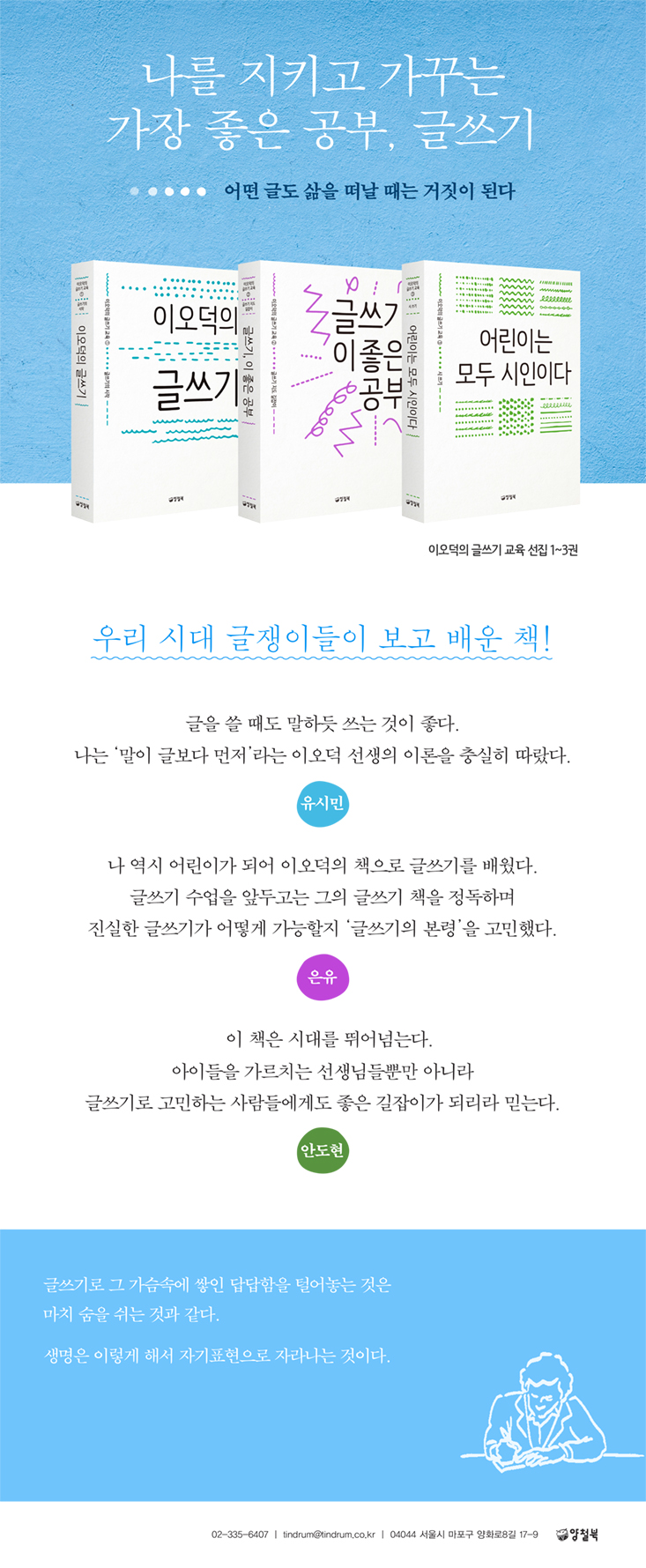
To enable more people to experience Mr. Iodeok Lee's writing, we have compiled all of his writing books that were previously scattered and published them as an anthology.
The anthology is largely divided into 'Introduction to Writing and Guidebooks/Writing with Youth and Children/Children's Writing Collection', so that readers can find and read books according to their own needs among Mr. Lee O-deok's many writing books, and the titles of the books have been changed to suit the nature of the books.
Also, the books that will be published first this time, 『Lee O-deok's Writing』, 『Writing, This Good Study』, and 『Children Are All Poets』, are written by Lee O-deok before he firmly established the Korean language movement, and therefore contain words that should never be used, such as '~deung' and '~jeok', as well as Chinese characters that are not commonly used now.
This was translated into Korean as much as possible, and the children's writings and the dates of writing in the book were slightly different in each book published so I corrected them by looking at Mr. Iodeok Lee's records and the children's writings that were collected.
I hope that more people will find their own path through Iodeok's writing.
Can only special people write?
Let's consider this question first.
Why have we become afraid of writing and find it difficult?
That's because we know that speech and writing are different, because we know that 'writing = literature', and because we haven't learned that writing is about honestly telling one's own story, but rather that we have to write in beautiful and cool sentences that sound plausible, like those in a book.
There are many reasons why we feel small when we write.
Is that really what writing is? Is it something only special people can write?
Iodeok clearly states that it is not so.
The truth about writing that Iodeok finally realized while teaching children at the school.
Writing is not something that only people with special 'literary' talent can write.
Writing is something that everyone can and should write, just like breathing.
This is especially true in an age like ours where all cultures are becoming dehumanized.
“Everyone, from the mechanic to the cleaner to the owner of the grocery store, should use it.”
A society where “everyone enjoys singing, drawing, and writing as a hobby and part of life” is a normal society.
A society where everyone reveals themselves regardless of occupation, status, age, gender, or anything else is a natural and obvious phenomenon.
What if, in some corner, anyone's expression was blocked? But when I think about it, it seems we've never had a society where anyone—whether a mechanic, a janitor, or a grocery store owner—can freely express themselves through writing.
We've entered an era where everyone can and must write, but are we truly expressing what we want to say freely, without any restraint? If we were, we wouldn't have any reason to hesitate before the word "writing."
"Lee O-deok's Writing" makes us reflect on our writing and corrects the misconceptions we had about writing.
It allows us to establish a new perspective on writing, starting with the questions of why we write and what kind of writing we should write, and what constitutes good writing and bad writing.
You can find answers to where to start writing and where to begin untangling the tangled threads of writing.
Anyone who knows the right way to write will enjoy writing.
Become a writer
Finding your own path
Here is one person's confession.
“In the writing you wrote, you told me many stories.
'A working person must write to make it a living, true piece of writing.
It's the same story as 'A democratic society is about living together.'
Among them, this one sentence, 'If you copy and paste what I say, it will become a good piece of writing', changed my life.
I lived harder than anyone else, but I was ashamed of my poor life, and I felt pathetic for not being able to learn.
Then, at one point, I put into practice the teacher's teaching that I should write down my life story as if I were telling it to someone, and my life changed.
From the moment I started writing, it felt like someone was comforting and encouraging me about my life, which I had been ashamed of.
It's already been over 20 years since I started writing like this.
“I came to appreciate the value of the life I had lived, and I stopped feeling ashamed of not having learned.” (Choo Song-rye, Disabled Person’s Assistant)
Iodeok Lee said, “Writing is as easy as talking.”
Because writing comes from speech.
But what about us today? Unlike the ancients who lived in reality and reality, we live in books, writing, and the words they contain, driven by ideas and thoughts.
My head is full of the words I read in books, so when I write, it's not words I say, but the words I read in the book come out in writing.
So dead writing is written.
Yet, I consider it a great piece of writing and feel ashamed of the fact that it is an easy read.
I think that writing that honestly tells one's own story and life has less value as writing, and writing that is written with words and ideas that seem sophisticated is considered good writing.
Do such writings truly move our hearts? Are they inspiring? How does such writing change my life?
“Writing comes from speech, and speech comes from thought.
Thoughts come from life, and life is living life.
“Language must be learned from life to become living language, and of course, writing is the same.”
In simple terms, in your own words, write what you want to write.
As we say, let's write in our own language so that it can be conveyed well.
And let's write life.
In simple terms, writing what you want to write in your own words, that is, writing about life.
This is Iodeok's writing.
“What is life? It’s eating, working, and talking.”
All the stories of life, whether sad, happy, suffering, or worried, should be written down.
Any writing becomes a lie when it leaves life.
Life becomes writing, and as I write, I look back on myself and feel the preciousness of my life, and with that strength, I go back to living my daily life.
So, to Iodeok, “writing was the way (truth).”
This is because the relationship between words, writing, and life is like this.
What we seek to achieve through writing is the lives of each of us, which we have turned our backs on and ignored, thinking they were small and insignificant.
A writer is a person who finds a way.
A teacher of writing is someone who helps students find their way, someone who shows them the way.
In this vast ocean where it is difficult to stand as a complete 'self', the way to find oneself and live one's life fully is writing.
A newly published collection of Lee O-deok's writing education
To enable more people to experience Mr. Iodeok Lee's writing, we have compiled all of his writing books that were previously scattered and published them as an anthology.
The anthology is largely divided into 'Introduction to Writing and Guidebooks/Writing with Youth and Children/Children's Writing Collection', so that readers can find and read books according to their own needs among Mr. Lee O-deok's many writing books, and the titles of the books have been changed to suit the nature of the books.
Also, the books that will be published first this time, 『Lee O-deok's Writing』, 『Writing, This Good Study』, and 『Children Are All Poets』, are written by Lee O-deok before he firmly established the Korean language movement, and therefore contain words that should never be used, such as '~deung' and '~jeok', as well as Chinese characters that are not commonly used now.
This was translated into Korean as much as possible, and the children's writings and the dates of writing in the book were slightly different in each book published so I corrected them by looking at Mr. Iodeok Lee's records and the children's writings that were collected.
I hope that more people will find their own path through Iodeok's writing.
GOODS SPECIFICS
- Date of issue: May 18, 2017
- Page count, weight, size: 400 pages | 458g | 140*205*30mm
- ISBN13: 9788963722337
- ISBN10: 8963722333
You may also like
카테고리
korean


korean

![GQ KOREA Mark (Monthly): December [2025]](http://librairie.coreenne.fr/cdn/shop/files/8ef265dbbfbf186523ed75ba7319009d.jpg?v=1765340328&width=3840)


