

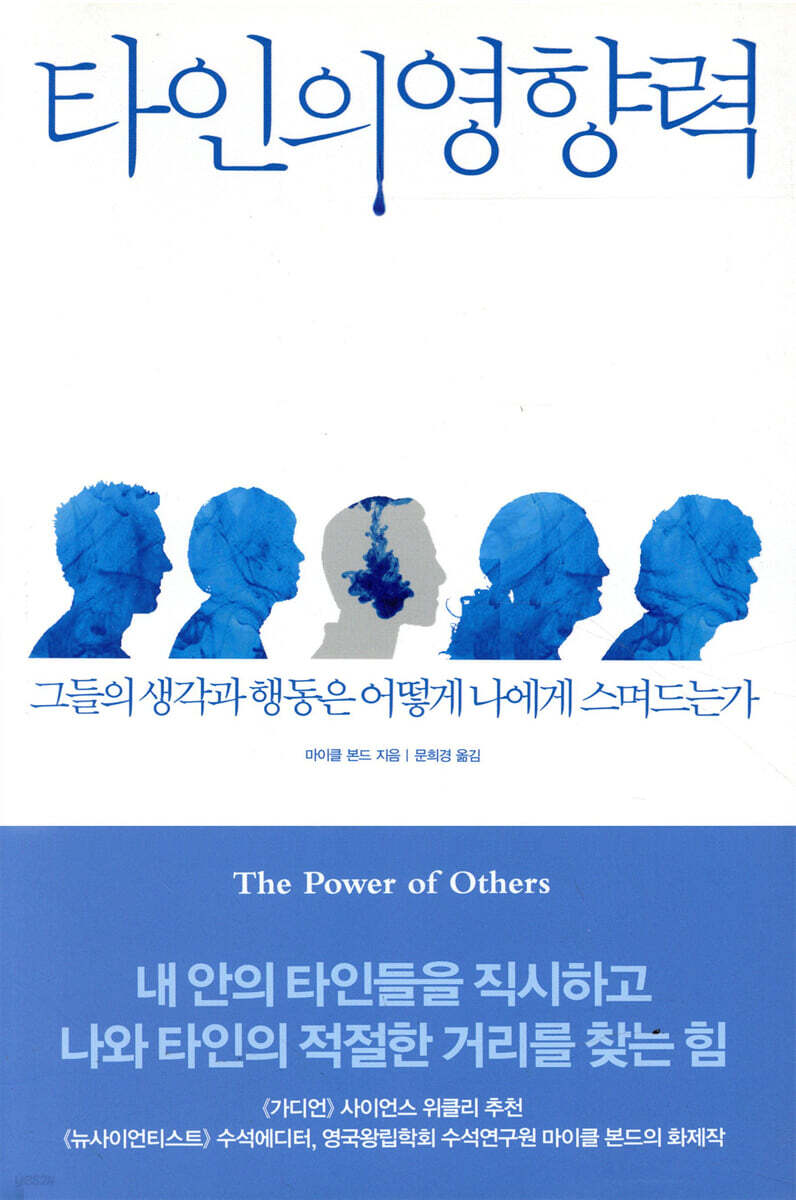
Influence of others
 |
Description
Book Introduction
The power to face the other within oneself and to observe crowd phenomena Finding an appropriate distance from others At the forefront of psychology in building smart social connections [New Scientist] Michael Bond, a renowned journalist and former senior editor and fellow of the Royal Society, delves into the multi-layered impact of others on us. The author combines historical events, social issues, and the latest research in psychology, and interviews diverse individuals to guide readers through engaging storytelling. He says we live in an age of 'social small groups'. Individuals belong to many groups in many different ways, and are more connected and extensive with others than at any time in human history. Within that network of relationships, we think, judge, and act while being influenced by others, big or small. This book allows us to see the influence of others working within us, from emotional contagion to sympathy psychology, nudge strategies, groupthink, the chameleon effect, the Lucifer effect, the bystander effect, and the sociology of loneliness, and to grasp the movements of others around us and the meaning contained within them. Anyone who has ever struggled with the desire to positively influence others by connecting and communicating more with others, or the desire to be alone and feel tired of living consciously of others, will find in this book a starting point for finding a sense of balance between the extremes and establishing an appropriate distance from others. |
- You can preview some of the book's contents.
Preview
index
Entering
-Knowing 'them'
1.
How do other people's emotions seep into me?
- Mass hypnosis effect, emotional contagion
Banks go bankrupt due to false rumors / The chameleon effect: the reason for overeating / What matters more to athletes than winning or losing / The impact of Botox on relationships / Productivity comes from the break room / Even psychotherapists are not immune to the emotions of others / The phenomenon of information concentration
*How sensitive are you to other people's emotions? - Emotional Contagion Test
2.
What to Read in the Faces of the Crowd
-A new understanding of madness, warmth, and crowd psychology
Hitler's "Mob Psychology" / Rational Riots / The Eccentric Psychologist Who Jumped into the Hooligans / The Harshest Courts on Group Action / The Fourth Rescue Worker / The Psychology of Disaster / The Warmth of the Crowd / The Path to Change
*What should you do if there's smoke in the building? - How to survive a crowd emergency
3.
The most independent people in the world
-What determines an explorer's success
The World's 'Coldest Journey' Expedition / Psychological Tests Don't Predict Behavior / 520 Days of Isolation: A Simulation of Mars Exploration / The Hidden Hero of Everest Climbing / Why Smoking Increased Among Participants in Group Therapy for Smoking Cessation / Why We Are Drawn to Extremes / The Secret to Winning the Tour de France / The Ice Team's Real Obstacles, More Harsh Than the Cold
Are You Free from Your Organization's Dominant Thinking? - 8 Symptoms of Groupthink
4.
The immense power of a happy minority
-The Psychology of Organizations: Reading through Camaraderie
Leading a ragtag band of rebels to victory / "We are the happy few" / The end of an army whose trust has collapsed / A ritual that strengthens bonds / Seven men who survived the bombing / The great achievements of the New York Fire Department
5.
Can you say 'no' when everyone else says 'yes'?
-The Psychology Laboratory of Sympathy
The Eichmanns of the World / Milgram's Obedience Experiment / People Who Insist White Is Black / The Lucifer Effect, After the Stanford Prison Experiment / The Eighteen-Year-Old Boy Who Committed Suicide / The Sociology of Suicide Terrorism / "It's Not Suicide" / Armed Group Leaders Use Culture / The Desire to Become Important to Someone
*How to Generate Creative Ideas in Brainstorming? - Effective Brainstorming Methods
6.
The Little Hero Within Me, the Mystery of Goodness
-The Psychology of Resistance and Altruism
The Driving Force of Resistance / What Villains and Heroes Have in Common / What Makes War Heroes Different / The BBC Prison Experiment Shows New Solidarity / Only by Acknowledging Our Weakness Can We Become Stronger
What if you see someone collapse on your way to work? - The Bystander Effect
7.
Why do we take sides?
The psychology of transforming hostility into solidarity
Collapsed Cooperation / The 'Hobbesian Trap' Caused by the Fear of Death / How Bush Gained 90 Percent Support / The Impact of the Economy on Psychology, Authoritarian Syndrome, and the Turtling Phenomenon / People Seeking Coexistence / When the Media Distorts the World
8.
Even when I'm alone, I'm not alone
-The sociology of solitude: overcoming loneliness
The Discontinued Blindfold Experiment / "Our bodies devise ways to make friends" / The Cinema of Prisoners in Solitary Confinement / The Psychological Warfare of the Interrogator Who Defeated the Leader of a Terrorist Organization / Solitude in a Crowd / The Lone Wolf / The Mind That Doesn't Isolate
Going out
-The reason I can be 'me'
main
References
Acknowledgements
Search
-Knowing 'them'
1.
How do other people's emotions seep into me?
- Mass hypnosis effect, emotional contagion
Banks go bankrupt due to false rumors / The chameleon effect: the reason for overeating / What matters more to athletes than winning or losing / The impact of Botox on relationships / Productivity comes from the break room / Even psychotherapists are not immune to the emotions of others / The phenomenon of information concentration
*How sensitive are you to other people's emotions? - Emotional Contagion Test
2.
What to Read in the Faces of the Crowd
-A new understanding of madness, warmth, and crowd psychology
Hitler's "Mob Psychology" / Rational Riots / The Eccentric Psychologist Who Jumped into the Hooligans / The Harshest Courts on Group Action / The Fourth Rescue Worker / The Psychology of Disaster / The Warmth of the Crowd / The Path to Change
*What should you do if there's smoke in the building? - How to survive a crowd emergency
3.
The most independent people in the world
-What determines an explorer's success
The World's 'Coldest Journey' Expedition / Psychological Tests Don't Predict Behavior / 520 Days of Isolation: A Simulation of Mars Exploration / The Hidden Hero of Everest Climbing / Why Smoking Increased Among Participants in Group Therapy for Smoking Cessation / Why We Are Drawn to Extremes / The Secret to Winning the Tour de France / The Ice Team's Real Obstacles, More Harsh Than the Cold
Are You Free from Your Organization's Dominant Thinking? - 8 Symptoms of Groupthink
4.
The immense power of a happy minority
-The Psychology of Organizations: Reading through Camaraderie
Leading a ragtag band of rebels to victory / "We are the happy few" / The end of an army whose trust has collapsed / A ritual that strengthens bonds / Seven men who survived the bombing / The great achievements of the New York Fire Department
5.
Can you say 'no' when everyone else says 'yes'?
-The Psychology Laboratory of Sympathy
The Eichmanns of the World / Milgram's Obedience Experiment / People Who Insist White Is Black / The Lucifer Effect, After the Stanford Prison Experiment / The Eighteen-Year-Old Boy Who Committed Suicide / The Sociology of Suicide Terrorism / "It's Not Suicide" / Armed Group Leaders Use Culture / The Desire to Become Important to Someone
*How to Generate Creative Ideas in Brainstorming? - Effective Brainstorming Methods
6.
The Little Hero Within Me, the Mystery of Goodness
-The Psychology of Resistance and Altruism
The Driving Force of Resistance / What Villains and Heroes Have in Common / What Makes War Heroes Different / The BBC Prison Experiment Shows New Solidarity / Only by Acknowledging Our Weakness Can We Become Stronger
What if you see someone collapse on your way to work? - The Bystander Effect
7.
Why do we take sides?
The psychology of transforming hostility into solidarity
Collapsed Cooperation / The 'Hobbesian Trap' Caused by the Fear of Death / How Bush Gained 90 Percent Support / The Impact of the Economy on Psychology, Authoritarian Syndrome, and the Turtling Phenomenon / People Seeking Coexistence / When the Media Distorts the World
8.
Even when I'm alone, I'm not alone
-The sociology of solitude: overcoming loneliness
The Discontinued Blindfold Experiment / "Our bodies devise ways to make friends" / The Cinema of Prisoners in Solitary Confinement / The Psychological Warfare of the Interrogator Who Defeated the Leader of a Terrorist Organization / Solitude in a Crowd / The Lone Wolf / The Mind That Doesn't Isolate
Going out
-The reason I can be 'me'
main
References
Acknowledgements
Search
Into the book
We think we are in control of our lives, but often the opposite is true.
The circumstances we find ourselves in, and especially the people around us, control our thoughts and actions far more than we might realize.
Other people influence what we wear, what music we like, what we eat (and how much we eat), who we vote for, and how we invest our money.
Other people influence our psychological state, that is, changes in our moods and emotions.
Furthermore, others influence our moral values, that is, our decisions about whether to act well or badly.
--- p.10
Crowds can be a threat to social order, but they can also bring about positive change.
Over the past quarter-century, crowds have abolished unjust tax systems, halted the destruction of our precious natural environment, overthrown dictators, and driven political and economic change across the globe.
Raycher said that crowds “always bring about the possibility of resistance.
Crowds can commit terrible atrocities, but they are also a tool for the powerless to speak out.
“The crowd is the road to change,” he says.
--- p.92
Explorers are a fascinating breed for behavioral researchers.
Above all, because explorers constantly confront the great challenges of human nature.
Whether you're exploring the polar regions, climbing a mountain, attempting a world record or setting a personal best, you inevitably need to be highly motivated, obsessive, and single-minded in your pursuit of your goals.
Explorers want to be the first, the fastest, or the most unique.
However, in the extreme environments where explorers operate, it is rare for them to achieve their goals alone.
--- p.102
When we share our experiences with others, “our sense of self extends to them, and they in effect become part of us.” --- p.150
The forces that determine our actions are very strong and often beyond our control.
But others are clearly what makes us special, and sociality is what defines us as a species.
--- p.324
We are swept away by various currents, but it is the people swimming together who make us who we are.
The circumstances we find ourselves in, and especially the people around us, control our thoughts and actions far more than we might realize.
Other people influence what we wear, what music we like, what we eat (and how much we eat), who we vote for, and how we invest our money.
Other people influence our psychological state, that is, changes in our moods and emotions.
Furthermore, others influence our moral values, that is, our decisions about whether to act well or badly.
--- p.10
Crowds can be a threat to social order, but they can also bring about positive change.
Over the past quarter-century, crowds have abolished unjust tax systems, halted the destruction of our precious natural environment, overthrown dictators, and driven political and economic change across the globe.
Raycher said that crowds “always bring about the possibility of resistance.
Crowds can commit terrible atrocities, but they are also a tool for the powerless to speak out.
“The crowd is the road to change,” he says.
--- p.92
Explorers are a fascinating breed for behavioral researchers.
Above all, because explorers constantly confront the great challenges of human nature.
Whether you're exploring the polar regions, climbing a mountain, attempting a world record or setting a personal best, you inevitably need to be highly motivated, obsessive, and single-minded in your pursuit of your goals.
Explorers want to be the first, the fastest, or the most unique.
However, in the extreme environments where explorers operate, it is rare for them to achieve their goals alone.
--- p.102
When we share our experiences with others, “our sense of self extends to them, and they in effect become part of us.” --- p.150
The forces that determine our actions are very strong and often beyond our control.
But others are clearly what makes us special, and sociality is what defines us as a species.
--- p.324
We are swept away by various currents, but it is the people swimming together who make us who we are.
--- p.327
Publisher's Review
The power to face the other within oneself and to observe crowd phenomena
Finding an appropriate distance from others
At the forefront of psychology in building smart social connections
[New Scientist] Michael Bond, a renowned journalist and former senior editor and fellow of the Royal Society, delves into the multi-layered impact of others on us.
The author combines historical events, social issues, and the latest research in psychology, and interviews diverse individuals to guide readers through engaging storytelling.
He says we live in an age of 'social small groups'.
Individuals belong to many groups in many different ways, and are more connected and extensive with others than at any time in human history.
We think, judge, and act within that network of relationships, influencing others in both large and small ways.
This book allows us to see the influence of others working within us, from emotional contagion to sympathy psychology, nudge strategies, groupthink, the chameleon effect, the Lucifer effect, the bystander effect, and the sociology of loneliness, and to grasp the movements of others around us and the meaning contained within them.
Anyone who has ever struggled with the desire to positively influence others by connecting and communicating more with others, or the desire to be alone and feel tired of living consciously of others, will find in this book a starting point for finding a sense of balance between the extremes and establishing an appropriate distance from others.
The presence of others can sometimes lead us astray.
The absence of others pushes us down a rougher path.
We are sometimes swept up in the crowd, more often than not we are hurt by others, and often we are powerless under the pressure of the group.
Examples of how the presence of others can lead us astray are easily found in this book, such as the increase in smoking among participants in group therapy for smoking cessation (groupthink), the incident where a solid bank went bankrupt overnight due to a false rumor (emotional contagion), a society where conflict between groups has become extreme due to the fear tactics of the government and the media (authoritarian syndrome and the turtling phenomenon), and experimental participants who, while following others and calling something white black, claimed to have answered with their own thoughts and judgment (conformity psychology).
-Is it possible for 'me' to be an independent being? However, when we are not influenced by others, we are forced into a more difficult path.
How long would we last if we were blindfolded and alone in a soundproof room? In experiments studying social isolation and sensory deprivation, most participants couldn't last even a day.
In this short period of time, he reported vivid hallucinations, developed severe delusions, and lost his sense of self.
We are beings who verify our senses and thoughts through others and establish our identity.
The author says, “The forces that determine our actions are very powerful and often beyond our control.
However, he emphasizes that “others are clearly what makes us special, and sociality is what defines us as a species.”
-How do other people's emotions seep into me? We believe that we make our own choices and actions in our daily lives, but when we chat with colleagues, speak at a meeting, click "like" or "retweet" on social media, or even eat a meal, we absorb other people's feelings and imitate their actions.
It reveals the mechanisms by which emotions are transmitted, such as the chameleon effect and information overload, and presents criteria for how to respond when strong claims and emotions spread rapidly.
Can you say "no" when everyone else says "yes"? When those around you call something white black, can you counter that it's white? We often believe we can resist peer pressure.
However, the conformity experiment of Solomon Asch, the psychologist who was Stanley Milgram's mentor and inspired the electric shock experiment, is not so positive.
When individuals have different opinions from members of the group they belong to, they become psychologically unstable, and to relieve this anxiety, they tend to try to align their opinions with the majority opinion, even if it is wrong.
Yet, in the experiment, a quarter of the group's judgment remained unshaken.
The probability increases even more if there is just one person who expresses the correct opinion.
The author awakens the heroism within us by revealing that heroes are born from the power to resist conformity and obedience, and that heroic actions are not a personal trait but a social drive.
In addition, the author asks whether we should read madness in the faces of the crowd or create warmth within them (Chapter 2), what is the source of the powerful power of the happy minority (Chapter 4), and why we take sides (Chapter 7), making us look again at our own thoughts and actions, which we were usually unaware of, in the context of our relationships with others, organizations, and society.
It is time to move beyond the psychology of knowing myself and finding myself and consider the self that exists within a social network.
Even when we are alone, we are not alone. Even the most independent explorers achieved their goals by connecting with others, and even those isolated at the end of the world miraculously survived by not losing touch with their companions, transcending physical distance.
We, who live in the midst of the storms of society, are by no means isolated islands.
There are times when we might run aground and sink, but we are all in the same boat.
This book will be a compass that will help us sense the waves that arise between us and others, read the flow of the waves called the crowd, and guide us and our ship toward the destination we should pursue.
Michael Bond, Senior Editor, New Scientist, and Senior Fellow of the Royal Society
The social psychology behavioral rules he proposes
Understand the mechanisms by which emotions spread and detect signs of contagion.
Three Steps to Surviving a Major Disaster
To avoid falling into the 'Hobbes' trap', a fear tactic used by the government and media
How to know when to follow the crowd and when to go your own way
The qualities of a leader and the secrets of teamwork learned from military dynamics.
Two Tips for Effective Brainstorming
Learn the heroic mentality of resisting groupthink and prejudice and drawing others in.
An explorer stranded on the Arctic ice cap reveals humanity's most powerful survival mechanism.
Michael Bond is a science journalist who has spent the past several decades analyzing scientific and psychological research, exploring various social phenomena, and writing with a deep interest in human behavior and nature.
Based on his knowledge of social psychology and a deep understanding of human nature, the concrete and practical guidelines he offers serve as life wisdom that enables us, as social beings, to wisely judge and act on how to accept influence from others and how to confront social phenomena.
The author's insights into whether people who are easily infected with the emotions of others and unconsciously imitate their behavior can be defined as irrational, what is the power of those who do not lose themselves in a crowd and create warmth rather than madness, where does the difference come from in those who do not get caught up in groupthink and stand up to prejudice, and how to overcome social isolation offer hope for the kind of society that can be created through the solidarity and dynamism of influential individuals along with the power to read the public.
Recommendation
The laws of our behavior, uncovered by renowned science writer Michael Bond.
It delves into the tension between crowd psychology and individual thinking, how people around me determine everything about me.
_《The Guardian》
A book that presents a valuable topic in an interesting way.
It provides an intellectual reading experience.
_《Circus Review》
Let us acknowledge that our emotions and social responses are shaped by the emotions, feelings, and body language of others.
They have little of their own feelings, thoughts, or judgments.
_《Psycentral》
Through a wealth of case studies and psychological experiments, it convincingly demonstrates that virtually every aspect of our lives is driven by others.
_《Daily Mail》
Recommended for readers interested in human behavior and social psychology in the face of disaster.
_《Library Journal》
Easy, engaging and fun.
We think of ourselves as free individuals, but our choices are often influenced by others without us even realizing it.
William Poundstone, author of Are You Smart Enough to Work at Google?
An important and excellent book.
It reminds us that we are never alone.
David McRaney, author of The Psychology of Illusion
Finding an appropriate distance from others
At the forefront of psychology in building smart social connections
[New Scientist] Michael Bond, a renowned journalist and former senior editor and fellow of the Royal Society, delves into the multi-layered impact of others on us.
The author combines historical events, social issues, and the latest research in psychology, and interviews diverse individuals to guide readers through engaging storytelling.
He says we live in an age of 'social small groups'.
Individuals belong to many groups in many different ways, and are more connected and extensive with others than at any time in human history.
We think, judge, and act within that network of relationships, influencing others in both large and small ways.
This book allows us to see the influence of others working within us, from emotional contagion to sympathy psychology, nudge strategies, groupthink, the chameleon effect, the Lucifer effect, the bystander effect, and the sociology of loneliness, and to grasp the movements of others around us and the meaning contained within them.
Anyone who has ever struggled with the desire to positively influence others by connecting and communicating more with others, or the desire to be alone and feel tired of living consciously of others, will find in this book a starting point for finding a sense of balance between the extremes and establishing an appropriate distance from others.
The presence of others can sometimes lead us astray.
The absence of others pushes us down a rougher path.
We are sometimes swept up in the crowd, more often than not we are hurt by others, and often we are powerless under the pressure of the group.
Examples of how the presence of others can lead us astray are easily found in this book, such as the increase in smoking among participants in group therapy for smoking cessation (groupthink), the incident where a solid bank went bankrupt overnight due to a false rumor (emotional contagion), a society where conflict between groups has become extreme due to the fear tactics of the government and the media (authoritarian syndrome and the turtling phenomenon), and experimental participants who, while following others and calling something white black, claimed to have answered with their own thoughts and judgment (conformity psychology).
-Is it possible for 'me' to be an independent being? However, when we are not influenced by others, we are forced into a more difficult path.
How long would we last if we were blindfolded and alone in a soundproof room? In experiments studying social isolation and sensory deprivation, most participants couldn't last even a day.
In this short period of time, he reported vivid hallucinations, developed severe delusions, and lost his sense of self.
We are beings who verify our senses and thoughts through others and establish our identity.
The author says, “The forces that determine our actions are very powerful and often beyond our control.
However, he emphasizes that “others are clearly what makes us special, and sociality is what defines us as a species.”
-How do other people's emotions seep into me? We believe that we make our own choices and actions in our daily lives, but when we chat with colleagues, speak at a meeting, click "like" or "retweet" on social media, or even eat a meal, we absorb other people's feelings and imitate their actions.
It reveals the mechanisms by which emotions are transmitted, such as the chameleon effect and information overload, and presents criteria for how to respond when strong claims and emotions spread rapidly.
Can you say "no" when everyone else says "yes"? When those around you call something white black, can you counter that it's white? We often believe we can resist peer pressure.
However, the conformity experiment of Solomon Asch, the psychologist who was Stanley Milgram's mentor and inspired the electric shock experiment, is not so positive.
When individuals have different opinions from members of the group they belong to, they become psychologically unstable, and to relieve this anxiety, they tend to try to align their opinions with the majority opinion, even if it is wrong.
Yet, in the experiment, a quarter of the group's judgment remained unshaken.
The probability increases even more if there is just one person who expresses the correct opinion.
The author awakens the heroism within us by revealing that heroes are born from the power to resist conformity and obedience, and that heroic actions are not a personal trait but a social drive.
In addition, the author asks whether we should read madness in the faces of the crowd or create warmth within them (Chapter 2), what is the source of the powerful power of the happy minority (Chapter 4), and why we take sides (Chapter 7), making us look again at our own thoughts and actions, which we were usually unaware of, in the context of our relationships with others, organizations, and society.
It is time to move beyond the psychology of knowing myself and finding myself and consider the self that exists within a social network.
Even when we are alone, we are not alone. Even the most independent explorers achieved their goals by connecting with others, and even those isolated at the end of the world miraculously survived by not losing touch with their companions, transcending physical distance.
We, who live in the midst of the storms of society, are by no means isolated islands.
There are times when we might run aground and sink, but we are all in the same boat.
This book will be a compass that will help us sense the waves that arise between us and others, read the flow of the waves called the crowd, and guide us and our ship toward the destination we should pursue.
Michael Bond, Senior Editor, New Scientist, and Senior Fellow of the Royal Society
The social psychology behavioral rules he proposes
Understand the mechanisms by which emotions spread and detect signs of contagion.
Three Steps to Surviving a Major Disaster
To avoid falling into the 'Hobbes' trap', a fear tactic used by the government and media
How to know when to follow the crowd and when to go your own way
The qualities of a leader and the secrets of teamwork learned from military dynamics.
Two Tips for Effective Brainstorming
Learn the heroic mentality of resisting groupthink and prejudice and drawing others in.
An explorer stranded on the Arctic ice cap reveals humanity's most powerful survival mechanism.
Michael Bond is a science journalist who has spent the past several decades analyzing scientific and psychological research, exploring various social phenomena, and writing with a deep interest in human behavior and nature.
Based on his knowledge of social psychology and a deep understanding of human nature, the concrete and practical guidelines he offers serve as life wisdom that enables us, as social beings, to wisely judge and act on how to accept influence from others and how to confront social phenomena.
The author's insights into whether people who are easily infected with the emotions of others and unconsciously imitate their behavior can be defined as irrational, what is the power of those who do not lose themselves in a crowd and create warmth rather than madness, where does the difference come from in those who do not get caught up in groupthink and stand up to prejudice, and how to overcome social isolation offer hope for the kind of society that can be created through the solidarity and dynamism of influential individuals along with the power to read the public.
Recommendation
The laws of our behavior, uncovered by renowned science writer Michael Bond.
It delves into the tension between crowd psychology and individual thinking, how people around me determine everything about me.
_《The Guardian》
A book that presents a valuable topic in an interesting way.
It provides an intellectual reading experience.
_《Circus Review》
Let us acknowledge that our emotions and social responses are shaped by the emotions, feelings, and body language of others.
They have little of their own feelings, thoughts, or judgments.
_《Psycentral》
Through a wealth of case studies and psychological experiments, it convincingly demonstrates that virtually every aspect of our lives is driven by others.
_《Daily Mail》
Recommended for readers interested in human behavior and social psychology in the face of disaster.
_《Library Journal》
Easy, engaging and fun.
We think of ourselves as free individuals, but our choices are often influenced by others without us even realizing it.
William Poundstone, author of Are You Smart Enough to Work at Google?
An important and excellent book.
It reminds us that we are never alone.
David McRaney, author of The Psychology of Illusion
GOODS SPECIFICS
- Date of publication: June 22, 2015
- Page count, weight, size: 383 pages | 662g | 153*225*27mm
- ISBN13: 9788997379668
- ISBN10: 8997379666
You may also like
카테고리
korean


korean

![GQ KOREA Mark (Monthly): December [2025]](http://librairie.coreenne.fr/cdn/shop/files/8ef265dbbfbf186523ed75ba7319009d.jpg?v=1765340328&width=3840)


