

spirit of the law
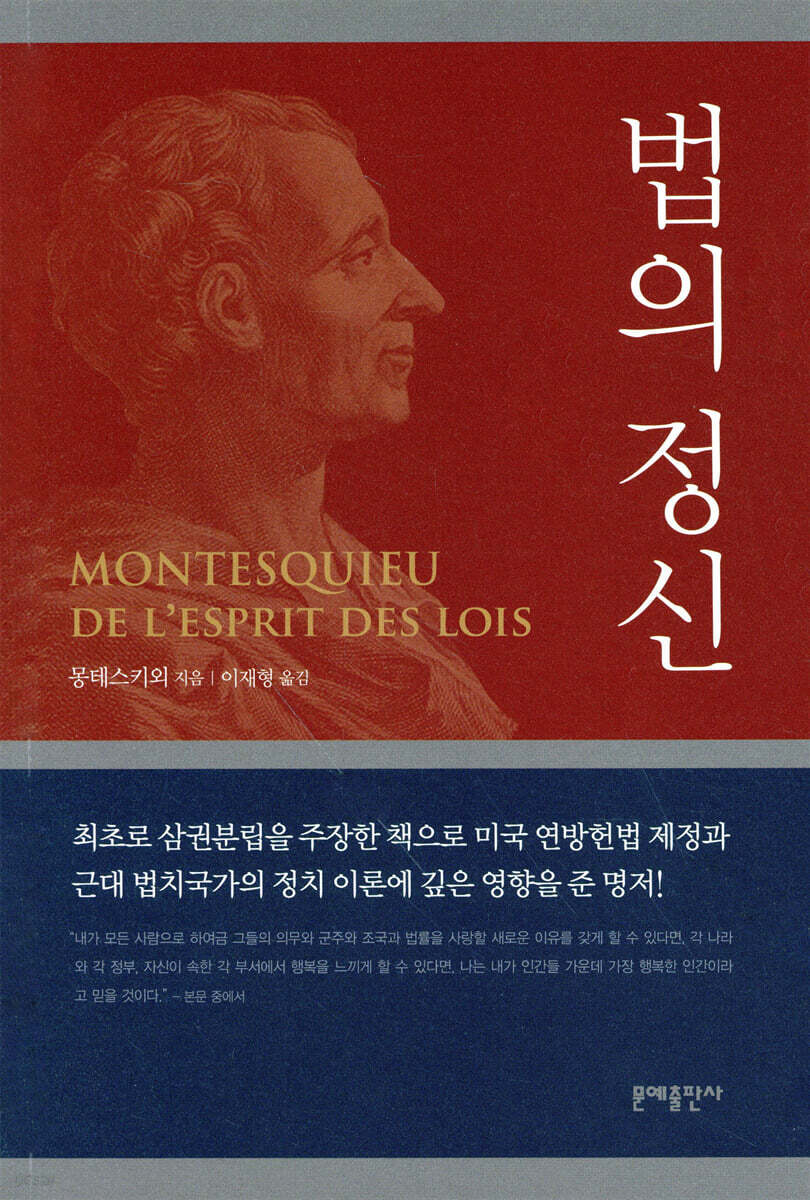 |
Description
Book Introduction
A masterpiece that combines the insight of a master and 20 years of effort.
A famous work that had a profound influence on the establishment of the U.S. Constitution and the political theory of the modern rule of law.
“The Spirit of the Laws,” which begins with the famous definition that “law in the broadest sense is a necessary relation deriving from the nature of things,” is the magnum opus of the great French philosopher Montesquieu, written over a long period of 20 years.
He believed that truth, virtue, and happiness were all one, and he argued that laws should not be created anew but restored to their original state. He wrote this book with a free spirit and deep insight, casting aside all moral, political, and religious prejudices.
In particular, it is a pioneering work that first advocated the separation of powers, including the separation of legislative, executive, and judicial powers, and it also had a great influence on the establishment of the U.S. Constitution and the political theory of the modern constitutional state.
He compared and analyzed various forms of government, including monarchy, absolutism, and republicanism, discussed the relationship between law and customs, and explored a wide range of topics, including the relationship between law and commerce, the relationship between law and religion, and the relationship between law and the use of currency. His discussions on law pique the interest of readers.
Montesquieu regarded laws as relations, as relations that hold between themselves and as relations that they hold with everything else, and he used the inductive method to analyze and organize these numerous relations.
That is, he studied in an original way by exploring the spirit of the law, deriving hypotheses from historical facts, and then applying them to historical experience.
The fundamental and original perspective of this book is that law is not a universal and transcendent command, but rather an inevitable relationship related to various individual phenomena and conditions, such as local customs, religion, and national character.
The spirit of law refers to the recognition and maintenance of the entire society built under these various relationships, and the political intelligence that acts on these relationships. The main content of this book is to explain this.
A famous work that had a profound influence on the establishment of the U.S. Constitution and the political theory of the modern rule of law.
“The Spirit of the Laws,” which begins with the famous definition that “law in the broadest sense is a necessary relation deriving from the nature of things,” is the magnum opus of the great French philosopher Montesquieu, written over a long period of 20 years.
He believed that truth, virtue, and happiness were all one, and he argued that laws should not be created anew but restored to their original state. He wrote this book with a free spirit and deep insight, casting aside all moral, political, and religious prejudices.
In particular, it is a pioneering work that first advocated the separation of powers, including the separation of legislative, executive, and judicial powers, and it also had a great influence on the establishment of the U.S. Constitution and the political theory of the modern constitutional state.
He compared and analyzed various forms of government, including monarchy, absolutism, and republicanism, discussed the relationship between law and customs, and explored a wide range of topics, including the relationship between law and commerce, the relationship between law and religion, and the relationship between law and the use of currency. His discussions on law pique the interest of readers.
Montesquieu regarded laws as relations, as relations that hold between themselves and as relations that they hold with everything else, and he used the inductive method to analyze and organize these numerous relations.
That is, he studied in an original way by exploring the spirit of the law, deriving hypotheses from historical facts, and then applying them to historical experience.
The fundamental and original perspective of this book is that law is not a universal and transcendent command, but rather an inevitable relationship related to various individual phenomena and conditions, such as local customs, religion, and national character.
The spirit of law refers to the recognition and maintenance of the entire society built under these various relationships, and the political intelligence that acts on these relationships. The main content of this book is to explain this.
- You can preview some of the book's contents.
Preview
index
A word from the author
introduction
Part 1
Part 1 General Law
Part 2: Laws that directly derive from the nature of identity
Part 3: The Three Principles of Identity
Part 4: Educational methods must be related to the principle of identity.
Article 5: Laws enacted by legislators must be related to the principle of identity.
Part 6: The Simplicity of Civil and Criminal Law, the Form of Trial, and the Consequences of Various Statutory Principles Related to Sentencing
Chapter 7: Sumptuousness and the Three Principles of Identity, Concerning the Status of Women
Chapter 8: The Corruption of the Principles Constituting the Three Stagnations
Part 2
Chapter 9: The Relationship Between Law and Defense
Chapter 10: The Relationship Between Law and Attack Power
Chapter 11: How to Form Political Freedom in Relations with the State Organization
Chapter 12: How to Form Political Freedom in Relations with Citizens
Chapter 13: The Relationship Between Tax Collection and the Size of Public Revenue and Freedom
Part 3
Chapter 14: The Relationship Between Law and Local Customs
Chapter 15: The Relationship Between Civil Slavery Law and Tradition
Chapter 16: The Relationship Between Domestic Slavery Law and Tradition
Chapter 17: The Relationship Between Political Slavery Law and Tradition
Chapter 18: The Relationship Between Law and Soil
Chapter 19: The Relationship Between Law and the General Spirit of the People, Customs, and the Principles of Forming Lifestyles
Part 4
Chapter 20: The Nature and Characteristics of Commercial Law
Part 21: The Relationship Between Commerce and Law in Global Transformation
Chapter 22: The Relationship Between Law and the Use of Money
Chapter 23: The Relationship Between Law and Population
Part 5
Chapter 24: The Relationship Between Law and Doctrine in Practice and Religion Considered in Itself
Chapter 25: The Relationship Between Law and the Existence of Religion in Each Country and Its Foreign Policy
Chapter 26: The Ability to Judge in the Relationship Between Law and Nature
Part 6
Chapter 27: The Origins and Innovations of Roman Law on Inheritance
Chapter 28: The Origins and Innovations of Civil Law among the Franks
Chapter 29 How to Make Laws
Chapter 30: The Frankish Feudal Law Theory in Relation to the Establishment of a Monarchy
Chapter 31: The Relationship Between Frankish Feudal Law Theory and Its Changes in Monarchy
Commentary on the work
Table of Contents for the 1757 edition
introduction
Part 1
Part 1 General Law
Part 2: Laws that directly derive from the nature of identity
Part 3: The Three Principles of Identity
Part 4: Educational methods must be related to the principle of identity.
Article 5: Laws enacted by legislators must be related to the principle of identity.
Part 6: The Simplicity of Civil and Criminal Law, the Form of Trial, and the Consequences of Various Statutory Principles Related to Sentencing
Chapter 7: Sumptuousness and the Three Principles of Identity, Concerning the Status of Women
Chapter 8: The Corruption of the Principles Constituting the Three Stagnations
Part 2
Chapter 9: The Relationship Between Law and Defense
Chapter 10: The Relationship Between Law and Attack Power
Chapter 11: How to Form Political Freedom in Relations with the State Organization
Chapter 12: How to Form Political Freedom in Relations with Citizens
Chapter 13: The Relationship Between Tax Collection and the Size of Public Revenue and Freedom
Part 3
Chapter 14: The Relationship Between Law and Local Customs
Chapter 15: The Relationship Between Civil Slavery Law and Tradition
Chapter 16: The Relationship Between Domestic Slavery Law and Tradition
Chapter 17: The Relationship Between Political Slavery Law and Tradition
Chapter 18: The Relationship Between Law and Soil
Chapter 19: The Relationship Between Law and the General Spirit of the People, Customs, and the Principles of Forming Lifestyles
Part 4
Chapter 20: The Nature and Characteristics of Commercial Law
Part 21: The Relationship Between Commerce and Law in Global Transformation
Chapter 22: The Relationship Between Law and the Use of Money
Chapter 23: The Relationship Between Law and Population
Part 5
Chapter 24: The Relationship Between Law and Doctrine in Practice and Religion Considered in Itself
Chapter 25: The Relationship Between Law and the Existence of Religion in Each Country and Its Foreign Policy
Chapter 26: The Ability to Judge in the Relationship Between Law and Nature
Part 6
Chapter 27: The Origins and Innovations of Roman Law on Inheritance
Chapter 28: The Origins and Innovations of Civil Law among the Franks
Chapter 29 How to Make Laws
Chapter 30: The Frankish Feudal Law Theory in Relation to the Establishment of a Monarchy
Chapter 31: The Relationship Between Frankish Feudal Law Theory and Its Changes in Monarchy
Commentary on the work
Table of Contents for the 1757 edition
Into the book
There's one thing I'd like to ask for your understanding on, and I'm worried that people might not understand.
I ask that you take a moment to read and not judge the work that has been done over 20 years.
The point is, don't accept or condemn someone after reading just a few sentences, but read the entire book from beginning to end before doing so.
If you want to know what the author's intention is, you have to know the purpose of the book before you can figure out that intention.
---From the "Preface"
Just as in monarchies education seeks only to raise the mental standard, so in despotism education seeks only to lower it.
In a totalitarian regime, education must be slavish.
Since no one can become a tyrant without being a slave, slave training is good even when giving orders.
--- p.57
In every nation there are always people who are outstanding in terms of birth, wealth, or fame.
If they were absorbed into the nation, or had but one vote like everyone else, the liberty which all enjoy would become slavery to them, and they would show no interest in preserving it.
Because most of the votes will be against their wishes.
Therefore, the proportion of their participation in legislation should be proportional to the other advantages they have within the country.
This will be accomplished by forming a body that has the right to stop the people from doing what they want to do, just as the people have the right to stop them from doing what they want to do.
--- p.136
The senator with the most children was listed first on the list.
He was the first to express his opinion in the Senate.
People with children could hold office even before reaching the required age, as the period was shortened by one year for each child.
In Rome, a man with three children was exempt from all personal burdens.
I ask that you take a moment to read and not judge the work that has been done over 20 years.
The point is, don't accept or condemn someone after reading just a few sentences, but read the entire book from beginning to end before doing so.
If you want to know what the author's intention is, you have to know the purpose of the book before you can figure out that intention.
---From the "Preface"
Just as in monarchies education seeks only to raise the mental standard, so in despotism education seeks only to lower it.
In a totalitarian regime, education must be slavish.
Since no one can become a tyrant without being a slave, slave training is good even when giving orders.
--- p.57
In every nation there are always people who are outstanding in terms of birth, wealth, or fame.
If they were absorbed into the nation, or had but one vote like everyone else, the liberty which all enjoy would become slavery to them, and they would show no interest in preserving it.
Because most of the votes will be against their wishes.
Therefore, the proportion of their participation in legislation should be proportional to the other advantages they have within the country.
This will be accomplished by forming a body that has the right to stop the people from doing what they want to do, just as the people have the right to stop them from doing what they want to do.
--- p.136
The senator with the most children was listed first on the list.
He was the first to express his opinion in the Senate.
People with children could hold office even before reaching the required age, as the period was shortened by one year for each child.
In Rome, a man with three children was exempt from all personal burdens.
--- p.274~275
Publisher's Review
A masterpiece that combines the insight of a master and 20 years of effort.
A famous work that had a profound influence on the establishment of the U.S. Constitution and the political theory of the modern rule of law.
“The Spirit of the Laws,” which begins with the famous definition that “law in the broadest sense is a necessary relation deriving from the nature of things,” is the magnum opus of the great French philosopher Montesquieu, written over a long period of 20 years.
He believed that truth, virtue, and happiness were all one, and he argued that laws should not be created anew but restored to their original state. He wrote this book with a free spirit and deep insight, casting aside all moral, political, and religious prejudices.
In particular, it is a pioneering work that first advocated the separation of powers, including the separation of legislative, executive, and judicial powers, and it also had a great influence on the establishment of the U.S. Constitution and the political theory of the modern constitutional state.
He compared and analyzed various forms of government, including monarchy, absolutism, and republicanism, discussed the relationship between law and customs, and explored a wide range of topics, including the relationship between law and commerce, the relationship between law and religion, and the relationship between law and the use of currency. His discussions on law pique the interest of readers.
Montesquieu regarded laws as relations, as relations that hold between themselves and as relations that they hold with everything else, and he used the inductive method to analyze and organize these numerous relations.
That is, he studied in an original way by exploring the spirit of the law, deriving hypotheses from historical facts, and then applying them to historical experience.
The fundamental and original perspective of this book is that law is not a universal and transcendent command, but rather an inevitable relationship related to various individual phenomena and conditions, such as local customs, customs, religion, and national character.
The spirit of law refers to the recognition and maintenance of the entire society built under these various relationships, and the political intelligence that acts on these relationships. The main content of this book is to explain this.
? A captivating work by the best writer, in which metaphor, exaggeration, and lyricism are fully displayed.
A book that broadens your horizons of understanding through an understanding of the "spirit of the law."
In The Spirit of the Laws, Montesquieu introduces several developmental devices to capture the reader's attention, and he uses a variety of writing styles with remarkable skill.
Sometimes he speaks in lyrical prose, sometimes he pours out harsh sarcasm, sometimes he uses Bossuetian language, and sometimes he uses Voltaireian language.
Conversely, a single word can contain rich metaphors and symbols.
Although some of his writings may be somewhat exaggerated or unnatural, no one can deny that Montesquieu was by far the best writer among the many talented writers of his time.
The Spirit of the Laws, with its free use of metaphors and symbols, appears to be captivating and easy to read on the surface, but it requires careful reflection to grasp the meaning contained within.
Montesquieu also showed variety in the structure of the book. He divided the book into several parts, and these parts were further divided into several chapters. Most of these chapters were short, and some were very short, to create the effect of concentration and emphasis.
As you read this book, you will be able to happily explore the roots of the foundation on which today's laws were created.
In other words, this book, which helps us understand today's law and political phenomena, society, and each nation through an understanding of the 'spirit of the law,' is not only essential for those studying law, but is also an excellent classic recommended to anyone who wants to broaden their horizons of knowledge by understanding the basis and roots of today's law.
In particular, the book "The Spirit of Law," recently published by Munye Publishing, is a condensed version of the most famous and essential chapters from the extensive prequel, allowing readers to encounter the essence of the ideas that form the core of "The Spirit of Law."
To aid readers' understanding, a detailed commentary on The Spirit of the Laws and the table of contents for the 1757 complete edition are included.
A famous work that had a profound influence on the establishment of the U.S. Constitution and the political theory of the modern rule of law.
“The Spirit of the Laws,” which begins with the famous definition that “law in the broadest sense is a necessary relation deriving from the nature of things,” is the magnum opus of the great French philosopher Montesquieu, written over a long period of 20 years.
He believed that truth, virtue, and happiness were all one, and he argued that laws should not be created anew but restored to their original state. He wrote this book with a free spirit and deep insight, casting aside all moral, political, and religious prejudices.
In particular, it is a pioneering work that first advocated the separation of powers, including the separation of legislative, executive, and judicial powers, and it also had a great influence on the establishment of the U.S. Constitution and the political theory of the modern constitutional state.
He compared and analyzed various forms of government, including monarchy, absolutism, and republicanism, discussed the relationship between law and customs, and explored a wide range of topics, including the relationship between law and commerce, the relationship between law and religion, and the relationship between law and the use of currency. His discussions on law pique the interest of readers.
Montesquieu regarded laws as relations, as relations that hold between themselves and as relations that they hold with everything else, and he used the inductive method to analyze and organize these numerous relations.
That is, he studied in an original way by exploring the spirit of the law, deriving hypotheses from historical facts, and then applying them to historical experience.
The fundamental and original perspective of this book is that law is not a universal and transcendent command, but rather an inevitable relationship related to various individual phenomena and conditions, such as local customs, customs, religion, and national character.
The spirit of law refers to the recognition and maintenance of the entire society built under these various relationships, and the political intelligence that acts on these relationships. The main content of this book is to explain this.
? A captivating work by the best writer, in which metaphor, exaggeration, and lyricism are fully displayed.
A book that broadens your horizons of understanding through an understanding of the "spirit of the law."
In The Spirit of the Laws, Montesquieu introduces several developmental devices to capture the reader's attention, and he uses a variety of writing styles with remarkable skill.
Sometimes he speaks in lyrical prose, sometimes he pours out harsh sarcasm, sometimes he uses Bossuetian language, and sometimes he uses Voltaireian language.
Conversely, a single word can contain rich metaphors and symbols.
Although some of his writings may be somewhat exaggerated or unnatural, no one can deny that Montesquieu was by far the best writer among the many talented writers of his time.
The Spirit of the Laws, with its free use of metaphors and symbols, appears to be captivating and easy to read on the surface, but it requires careful reflection to grasp the meaning contained within.
Montesquieu also showed variety in the structure of the book. He divided the book into several parts, and these parts were further divided into several chapters. Most of these chapters were short, and some were very short, to create the effect of concentration and emphasis.
As you read this book, you will be able to happily explore the roots of the foundation on which today's laws were created.
In other words, this book, which helps us understand today's law and political phenomena, society, and each nation through an understanding of the 'spirit of the law,' is not only essential for those studying law, but is also an excellent classic recommended to anyone who wants to broaden their horizons of knowledge by understanding the basis and roots of today's law.
In particular, the book "The Spirit of Law," recently published by Munye Publishing, is a condensed version of the most famous and essential chapters from the extensive prequel, allowing readers to encounter the essence of the ideas that form the core of "The Spirit of Law."
To aid readers' understanding, a detailed commentary on The Spirit of the Laws and the table of contents for the 1757 complete edition are included.
GOODS SPECIFICS
- Date of issue: May 20, 2015
- Page count, weight, size: 400 pages | 578g | 152*224*30mm
- ISBN13: 9788931009507
- ISBN10: 893100950X
You may also like
카테고리
korean


korean

![GQ KOREA Mark (Monthly): December [2025]](http://librairie.coreenne.fr/cdn/shop/files/8ef265dbbfbf186523ed75ba7319009d.jpg?v=1765340328&width=3840)


