

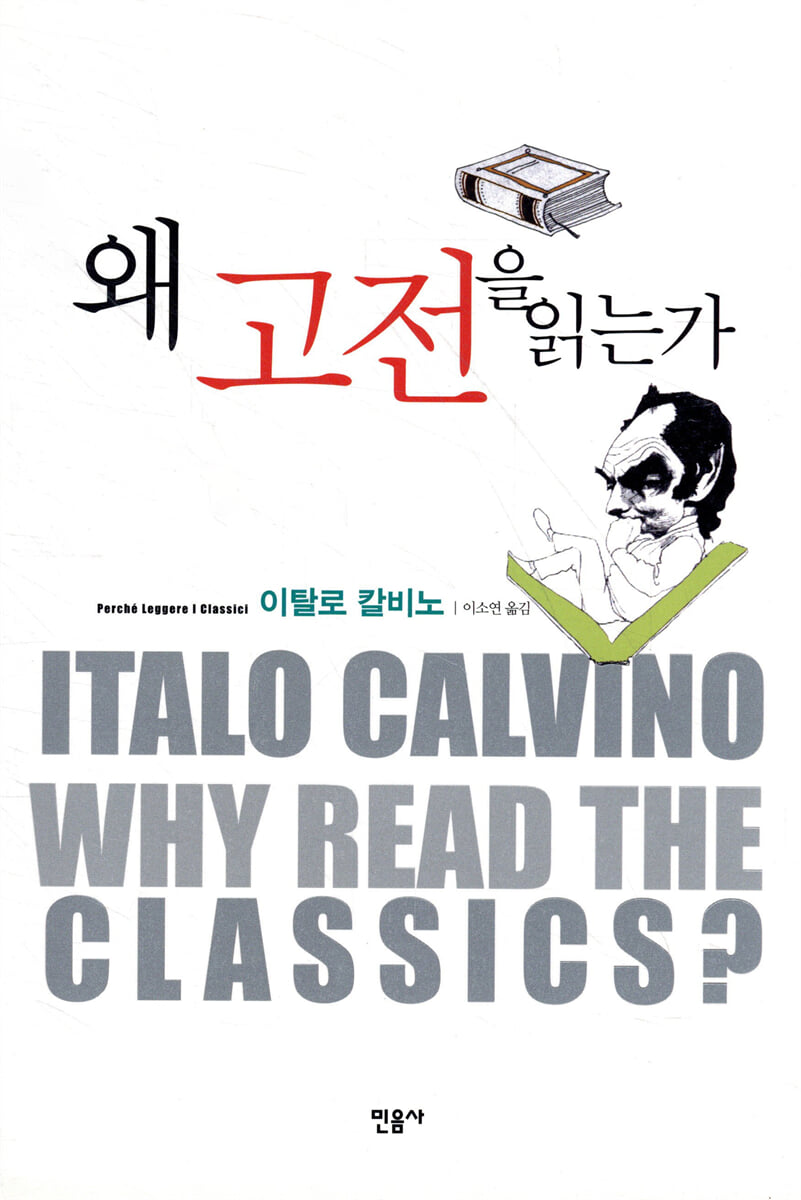
Why read classics
 |
Description
Book Introduction
This is a personal reading of some 30 classic authors and their works written by Italo Calvino, who is considered one of the three great masters of modern literature along with Borges and Marquez, from ancient authors such as Homer and Ovid to modern authors such as Stendhal, Tolstoy, Flaubert, and Balzac, as well as Mark Twain, Charles Dickens, Henry James, and Borges.
Hearing Calvino's passionate praise and ingenious commentary on his authors contained in this book, readers will feel as if they are browsing a shelf of his favorite books, and before they know it, they will find themselves infected by his passion.
Hearing Calvino's passionate praise and ingenious commentary on his authors contained in this book, readers will feel as if they are browsing a shelf of his favorite books, and before they know it, they will find themselves infected by his passion.
- You can preview some of the book's contents.
Preview
index
introduction
Why read classics
The Odyssey in the Odyssey
Xenophon's Anabasis
Ovid and the Contiguity of the Universe
Sky, Man, and Elephant
The Seven Princesses of Nezami
Tirang Lo Blanc
The structure of 『The Madness of Orlando』
Ariosto's clear line
Girolamo Cardano
Galileo and the Great Book of Nature
Cyrano in the Moon
A Journal of Robinson Crusoe and the Virtues of a Merchant
On the narrative pace of Candide
Denis Diderot's Jacques the Fatalist
Jamaria Ortez
Stendhal and Knowledge as a Cloud of Dust
For new readers of Stendhal's The Abbey of Parma
Balzac and the City as a Novel
Charles Dickens's "Our Mutual Friend"
Flaubert's Three Tales
Tolstoy's The Two Light Cavalry
Mark Twain's The Man Who Corrupted Hadleyburg
Henry James's Daisy Miller
Robert Louis Stevenson's "The House by the Sea"
Conrad and the Captain
Pasternak and Revolution
Carlo Emilio Gada's Artichoke-like World
Gada's "The Terrible Chaos of Merulana Street"
Eugenio Montale's poem "One Morning"
The Cliffs of Montale
Hemingway and Our Generation
Francis Ponge
Jorge Luis Borges
Raymond Queneau's philosophy
Pavese and human sacrifice
Editor's Note
Translator's Note - Following Calvino's Literary Map
Why read classics
The Odyssey in the Odyssey
Xenophon's Anabasis
Ovid and the Contiguity of the Universe
Sky, Man, and Elephant
The Seven Princesses of Nezami
Tirang Lo Blanc
The structure of 『The Madness of Orlando』
Ariosto's clear line
Girolamo Cardano
Galileo and the Great Book of Nature
Cyrano in the Moon
A Journal of Robinson Crusoe and the Virtues of a Merchant
On the narrative pace of Candide
Denis Diderot's Jacques the Fatalist
Jamaria Ortez
Stendhal and Knowledge as a Cloud of Dust
For new readers of Stendhal's The Abbey of Parma
Balzac and the City as a Novel
Charles Dickens's "Our Mutual Friend"
Flaubert's Three Tales
Tolstoy's The Two Light Cavalry
Mark Twain's The Man Who Corrupted Hadleyburg
Henry James's Daisy Miller
Robert Louis Stevenson's "The House by the Sea"
Conrad and the Captain
Pasternak and Revolution
Carlo Emilio Gada's Artichoke-like World
Gada's "The Terrible Chaos of Merulana Street"
Eugenio Montale's poem "One Morning"
The Cliffs of Montale
Hemingway and Our Generation
Francis Ponge
Jorge Luis Borges
Raymond Queneau's philosophy
Pavese and human sacrifice
Editor's Note
Translator's Note - Following Calvino's Literary Map
Into the book
In this book, we see Calvino as a pure reader, recalling his pure passion for a work and the joy he feels when opening it again, rather than as an intellectual who 'forces' numerous recommended books or must-read lists and explains their necessity.
The necessity of the 'classics' that Calvino talks about as a reader lies in the fact that the classics serve as a certain structure and rule for writing and reading, and as a treasure trove of other potential possibilities.
To summarize the various essays in this book, new writing and reading emerge from the freedom that this structure of the "classic" offers.
―From the translator's note
Without this foundation, how can we possibly understand and enjoy the passages Calvino describes with such familiarity? However, I believe this "book of the future" will, in fact, open new horizons for our understanding of classics, a field that has been largely focused on 19th-century Anglo-American novels, and contribute, if only slightly, to introducing us to classics still unfamiliar to us.
So, this book is both for future readers and a book that constantly invites and stimulates us in the present.
--- From the translator's note
Classics are what help us understand who we are and where we come from.
… … The only thing we can admit is that it is better to read the classics than not to read them.
The necessity of the 'classics' that Calvino talks about as a reader lies in the fact that the classics serve as a certain structure and rule for writing and reading, and as a treasure trove of other potential possibilities.
To summarize the various essays in this book, new writing and reading emerge from the freedom that this structure of the "classic" offers.
―From the translator's note
Without this foundation, how can we possibly understand and enjoy the passages Calvino describes with such familiarity? However, I believe this "book of the future" will, in fact, open new horizons for our understanding of classics, a field that has been largely focused on 19th-century Anglo-American novels, and contribute, if only slightly, to introducing us to classics still unfamiliar to us.
So, this book is both for future readers and a book that constantly invites and stimulates us in the present.
--- From the translator's note
Classics are what help us understand who we are and where we come from.
… … The only thing we can admit is that it is better to read the classics than not to read them.
---From "Why Read Classics"
Publisher's Review
Homer, Ovid, Diderot, Stendhal, Balzac, Dickens, Tolstoy, Hemingway, Borges… …
Italo Calvino, a master of modern literature, offers passionate praise and original interpretations of renowned classical authors.
Italo Calvino, who is considered one of the three great masters of modern literature along with Borges and Márquez, has published a personal reading journal by Minumsa on some 30 classic authors and their works, ranging from ancient authors such as Homer and Ovid to Stendhal, Tolstoy, Flaubert, Balzac, and modern authors such as Mark Twain, Charles Dickens, Henry James, and Borges.
Listening to Calvino's passionate praise and ingenious explanations for these authors, readers will feel as if they are browsing a bookshelf filled with his favorite books, and before they know it, they will find themselves infected by his passion.
This book is a map marking the milestones of world literature, and a spice that adds flavor to the dish of classics.
★ The Reading Journey of Italo Calvino, a Master of 20th-Century Literature
Italo Calvino (1923-1985) is a truly representative novelist of the 20th century, praised as “one of the three great masters of modern literature” and “the writer who most vividly shows the fantasy that is the true face of modern Italian novels”, as well as “the greatest writer of modern Italian literature, a writer who precisely weaves reality and fantasy, skillfully infiltrates Eastern wisdom and foresight into his works, and who foresees the form of the ‘future’ novel in all aspects.”
This book, "Why Read Classics," is a collection of his writings, which he occasionally published in daily newspaper reviews, book prefaces, and speeches from the 1950s until his death in 1985, and which he also had a strong fan base in Korea.
Most of the thirty-six essays in the book are short, less than a few pages long.
But even from this short passage, we can sufficiently guess what books Calvino himself cherished and read, and how passionate his love for them was.
Above all, as the title of the book is “Why Read the Classics,” Calvino lists fourteen reasons why we should read the classics “again” in the introduction, and then wonderfully guides us through the works that he personally considered canonical, using sophisticated yet lively language.
His essays, which sometimes feature blatant reverence, sometimes meticulous stylistic analysis, or a keen insight into the subject matter from a historical perspective, without the use of grand critical jargon, offer an opportunity to look at the classics in a new way, free from the sense of duty that comes with relying on tradition and authority.
The value of this book is not limited to its role as a guide to the classics.
This book, which is a passionate ode to the authors that Calvino has read since childhood and an informal conversation with them, provides a rare opportunity to meet Calvino 'as a reader' rather than as a writer.
It also provides a clue to understanding his literary world by following his reading journey.
Thus, we feel as if we are browsing a writer's bookshelf, chatting with him, and listening to his vivid and honest voice.
★ Why should we read the classics?
The books that everyone has already tasted a little bit through textbooks during their school days, books that feel like they have been read even if they haven't been read all the way through, books that seem old and boring - these are the meaning of 'classics' that have taken root in our minds.
But why now, again, 'Why are we reading the classics?'
This is also the title of the first essay that opens the book, and in this essay, Calvino explains why we should read the classics by comparing it to the definition of a classic.
He says in a pretended cheerful tone.
“A classic is a book about which people usually say, ‘I’m rereading ……,’ but never ‘I’m reading …….’”
And then he goes on to talk about thirteen more reasons.
To summarize, it is as follows.
1.
A classic is a book about which people usually say, “I’m rereading …” but never “I’m reading …”
2.
A classic is a book that provides a valuable experience to readers who read it and come to love it.
But only those who have the opportunity to read with pleasure under the best conditions can have such a rich experience.
3.
Classics are books that have a special influence.
Such works exert their special influence when they are imprinted in our imagination as unforgettable things, or when they hide in the strata of memory, masked as the personal or collective unconscious.
4.
A classic is a book that, every time you reread it, you feel like you're discovering something new.
5.
A classic is a book that gives us the feeling of having read it before, even when we read it for the first time, and of being 'read again'.
6.
A classic is a book that has an infinite amount to tell its readers.
7.
Classics are books that return with the shadows of previous interpretations, bringing back before our eyes the traces of the past that they left behind in one culture or another.
8.
A classic is a work that constantly creates a cloud of critical discourse surrounding it.
And such clouds of criticism always dissipate on their own.
9.
A classic is a book that, the more you think you know something by hearing about it from other people, the more original and unexpected stories and creative things you discover when you actually read it.
10.
A classic is a name given to all books that reveal the entire universe, like a talisman of ancient Chinese society.
11.
A classic cannot exist independently of us; it is a book that helps us define ourselves within our relationship with that work, and ultimately within our relationship with that work.
12.
A classic is a work that belongs to a hierarchy that exists among them.
Anyone who has read many other classics can easily recognize the position a work occupies in the lineage of classics.
13.
It is a classic book that makes all other writings dealing with reality fade into background noise.
That doesn't mean the classics can eliminate this noise.
14.
A classic is a work that endures like the sound of a blast furnace, and this is true even when it is surrounded by writings about the present that are the furthest from the classics.
According to Calvino, there are 14 definitions of classics.
If a classic is a book with these characteristics, then this means that a book can be considered a classic only if it satisfies at least these 14 conditions.
In other words, in order to be qualified as a 'classic', one must pass such a difficult test.
It is a test that takes a very long time, from generation to generation, to find out whether one has passed or not.
Therefore, it is precisely in this respect that the classics demonstrate their absolute value, and that is why we must read them.
Not a summary or commentary, but the work itself.
Because “a classic is a work that constantly creates clouds of critical discourse surrounding it, but these clouds of criticism always dissipate on their own” (Definition 8). Reading criticism about classics is often a waste of time.
It is much more important to read, savor, and reread.
These explanations are not deontic reasons for “why …… should be done.”
This is because Calvino himself believed that one should not read the classics out of a sense of duty, but rather one should recognize their value and read them voluntarily.
So the answer to the question “Why read the classics?” itself is somewhat lacking.
However, since I have explained the reasons for the classics at length above, readers will want to read the classics.
This is probably what Calvino intended.
The irony is that the 14 things that Calvino defined as a classic “give us the feeling of having read it before, of ‘reading it again,’ even when we read it for the first time,” which proves that Calvino’s book itself is another classic.
In fact, a review in The Times said, “This book itself is another classic.”
★ The 'flavor of the classics' becomes deeper and richer through Calvino's eyes.
In that sense, all the works covered in this book will have passed the 'classic review' mentioned above.
As these works have passed Calvino's strict scrutiny, that is, as works that have been "imprinted in his imagination as unforgettable things" (Definition 3), Calvino's affection for these works is extremely fervent.
The passion is so contagious that readers become curious enough to want to read the work themselves.
The list of writers he discusses is extremely wide and diverse, from ancient Greek and Roman writers such as Homer, Pliny, and Xenophon, to Diderot and Voltaire of the 18th-century French Enlightenment, to Daniel Defoe of Robinson Crusoe, who is often considered a pioneer of the modern novel, to Dickens of 19th-century British literature, to Tolstoy of 19th-century Russian literature, to Pasternak, who created the modern epic through Doctor Zhivago, to Italian medieval and Renaissance writers and modern writers, to Francis Ponge, Raymond Queneau, and Borges, who showed new potential for 20th-century modern literature.
Even as he deals with this enormous list, Calvino, like a skilled schoolmaster, distills the essence of these writers into vivid prose.
For example, “Money played an important role in 19th-century novels.
For Balzac, it was the driving force behind his work, and for Dickens, it was a wonderful tool for testing the human mind.
But in Mark Twain's work, money was a mirror that played with vertigo in front of an empty space.” (pp. 239-240)
In his estimation, Robert Louis Stevenson (author of Treasure Island and Dr. Jekyll and Mr. Hyde) can also be placed alongside Voltaire and Henry James.
Also, in his 1955 glowing review of Robinson Crusoe, he called Daniel Defoe “the founder of modern journalism.”
And in a 1954 piece, he wrote, “There was a time when Hemingway was a god to me.
That period was also a good time that remains as a happy memory for me.
Even if we exclude all the generously sarcastic attitudes that we usually adopt when looking back on the things we were engrossed in during our youth or the fashions of the time” (p. 323), he confesses that when he rereads it later, he felt disgusted by Hemingway’s “indifferent attitude toward violent times” (“It even induces hatred and nausea” (pp. 323-324)). Yet, he finds a cool-headed attitude again and praises Hemingway’s dry yet realistic writing (“But Hemingway’s style is always dry, and his writing is never muddy or stale.
“His feet are always firmly planted on the ground.” (p. 325)) And in his 1984 article on Borges, he shows how much influence Borges had on him.
According to him, Charles Dickens's "Our Mutual Friend" is such a thrilling book that it's worth putting aside everything else and heading straight to your library to read.
He also emphasizes how many young readers will “be drawn into the work from the first page, knowing that this is the novel they always wanted to read, that it will be a landmark for other novels to come, that this is the best novel ever written” (p. 199).
There are several Odysseys within the Odyssey, and some offer a new interpretation that the real protagonist of Pasternak's great work, Doctor Zhivago, is not Zhivago but Lara, and others explain that Cyrano de Bergerac, who appeared as the protagonist of the film because of his ugly nose, is a pioneer of modern science fiction.
From Ovid to Pavese, Xenophon to Dickens, Galileo to Gadda, Calvino treats the classics he loved with fresh, readable, and witty prose.
"Why Read the Classics" is an original work that excites us as much as Calvino's avant-garde novels.
The essays describing writers who may be somewhat unfamiliar to modern readers pique readers' curiosity about writers we might otherwise overlook, such as Francis Ponge and Eugenio Montale.
It is unfortunate that the works of these authors cannot be read in Korean, which makes them worthy of being called classics.
In this book, Italo Calvino offers a unique definition of what constitutes a classic, and examines the works of writers from antiquity to early modern Europe, the novels of 19th-century masters, the American writers who influenced him, and his own contemporaries.
This book is a fascinating look at Calvino's perspective on literature and the key texts that profoundly influenced this representative 20th-century writer.
In this book, readers will discover that he is also an outstanding essayist and critic.
Italo Calvino, a master of modern literature, offers passionate praise and original interpretations of renowned classical authors.
Italo Calvino, who is considered one of the three great masters of modern literature along with Borges and Márquez, has published a personal reading journal by Minumsa on some 30 classic authors and their works, ranging from ancient authors such as Homer and Ovid to Stendhal, Tolstoy, Flaubert, Balzac, and modern authors such as Mark Twain, Charles Dickens, Henry James, and Borges.
Listening to Calvino's passionate praise and ingenious explanations for these authors, readers will feel as if they are browsing a bookshelf filled with his favorite books, and before they know it, they will find themselves infected by his passion.
This book is a map marking the milestones of world literature, and a spice that adds flavor to the dish of classics.
★ The Reading Journey of Italo Calvino, a Master of 20th-Century Literature
Italo Calvino (1923-1985) is a truly representative novelist of the 20th century, praised as “one of the three great masters of modern literature” and “the writer who most vividly shows the fantasy that is the true face of modern Italian novels”, as well as “the greatest writer of modern Italian literature, a writer who precisely weaves reality and fantasy, skillfully infiltrates Eastern wisdom and foresight into his works, and who foresees the form of the ‘future’ novel in all aspects.”
This book, "Why Read Classics," is a collection of his writings, which he occasionally published in daily newspaper reviews, book prefaces, and speeches from the 1950s until his death in 1985, and which he also had a strong fan base in Korea.
Most of the thirty-six essays in the book are short, less than a few pages long.
But even from this short passage, we can sufficiently guess what books Calvino himself cherished and read, and how passionate his love for them was.
Above all, as the title of the book is “Why Read the Classics,” Calvino lists fourteen reasons why we should read the classics “again” in the introduction, and then wonderfully guides us through the works that he personally considered canonical, using sophisticated yet lively language.
His essays, which sometimes feature blatant reverence, sometimes meticulous stylistic analysis, or a keen insight into the subject matter from a historical perspective, without the use of grand critical jargon, offer an opportunity to look at the classics in a new way, free from the sense of duty that comes with relying on tradition and authority.
The value of this book is not limited to its role as a guide to the classics.
This book, which is a passionate ode to the authors that Calvino has read since childhood and an informal conversation with them, provides a rare opportunity to meet Calvino 'as a reader' rather than as a writer.
It also provides a clue to understanding his literary world by following his reading journey.
Thus, we feel as if we are browsing a writer's bookshelf, chatting with him, and listening to his vivid and honest voice.
★ Why should we read the classics?
The books that everyone has already tasted a little bit through textbooks during their school days, books that feel like they have been read even if they haven't been read all the way through, books that seem old and boring - these are the meaning of 'classics' that have taken root in our minds.
But why now, again, 'Why are we reading the classics?'
This is also the title of the first essay that opens the book, and in this essay, Calvino explains why we should read the classics by comparing it to the definition of a classic.
He says in a pretended cheerful tone.
“A classic is a book about which people usually say, ‘I’m rereading ……,’ but never ‘I’m reading …….’”
And then he goes on to talk about thirteen more reasons.
To summarize, it is as follows.
1.
A classic is a book about which people usually say, “I’m rereading …” but never “I’m reading …”
2.
A classic is a book that provides a valuable experience to readers who read it and come to love it.
But only those who have the opportunity to read with pleasure under the best conditions can have such a rich experience.
3.
Classics are books that have a special influence.
Such works exert their special influence when they are imprinted in our imagination as unforgettable things, or when they hide in the strata of memory, masked as the personal or collective unconscious.
4.
A classic is a book that, every time you reread it, you feel like you're discovering something new.
5.
A classic is a book that gives us the feeling of having read it before, even when we read it for the first time, and of being 'read again'.
6.
A classic is a book that has an infinite amount to tell its readers.
7.
Classics are books that return with the shadows of previous interpretations, bringing back before our eyes the traces of the past that they left behind in one culture or another.
8.
A classic is a work that constantly creates a cloud of critical discourse surrounding it.
And such clouds of criticism always dissipate on their own.
9.
A classic is a book that, the more you think you know something by hearing about it from other people, the more original and unexpected stories and creative things you discover when you actually read it.
10.
A classic is a name given to all books that reveal the entire universe, like a talisman of ancient Chinese society.
11.
A classic cannot exist independently of us; it is a book that helps us define ourselves within our relationship with that work, and ultimately within our relationship with that work.
12.
A classic is a work that belongs to a hierarchy that exists among them.
Anyone who has read many other classics can easily recognize the position a work occupies in the lineage of classics.
13.
It is a classic book that makes all other writings dealing with reality fade into background noise.
That doesn't mean the classics can eliminate this noise.
14.
A classic is a work that endures like the sound of a blast furnace, and this is true even when it is surrounded by writings about the present that are the furthest from the classics.
According to Calvino, there are 14 definitions of classics.
If a classic is a book with these characteristics, then this means that a book can be considered a classic only if it satisfies at least these 14 conditions.
In other words, in order to be qualified as a 'classic', one must pass such a difficult test.
It is a test that takes a very long time, from generation to generation, to find out whether one has passed or not.
Therefore, it is precisely in this respect that the classics demonstrate their absolute value, and that is why we must read them.
Not a summary or commentary, but the work itself.
Because “a classic is a work that constantly creates clouds of critical discourse surrounding it, but these clouds of criticism always dissipate on their own” (Definition 8). Reading criticism about classics is often a waste of time.
It is much more important to read, savor, and reread.
These explanations are not deontic reasons for “why …… should be done.”
This is because Calvino himself believed that one should not read the classics out of a sense of duty, but rather one should recognize their value and read them voluntarily.
So the answer to the question “Why read the classics?” itself is somewhat lacking.
However, since I have explained the reasons for the classics at length above, readers will want to read the classics.
This is probably what Calvino intended.
The irony is that the 14 things that Calvino defined as a classic “give us the feeling of having read it before, of ‘reading it again,’ even when we read it for the first time,” which proves that Calvino’s book itself is another classic.
In fact, a review in The Times said, “This book itself is another classic.”
★ The 'flavor of the classics' becomes deeper and richer through Calvino's eyes.
In that sense, all the works covered in this book will have passed the 'classic review' mentioned above.
As these works have passed Calvino's strict scrutiny, that is, as works that have been "imprinted in his imagination as unforgettable things" (Definition 3), Calvino's affection for these works is extremely fervent.
The passion is so contagious that readers become curious enough to want to read the work themselves.
The list of writers he discusses is extremely wide and diverse, from ancient Greek and Roman writers such as Homer, Pliny, and Xenophon, to Diderot and Voltaire of the 18th-century French Enlightenment, to Daniel Defoe of Robinson Crusoe, who is often considered a pioneer of the modern novel, to Dickens of 19th-century British literature, to Tolstoy of 19th-century Russian literature, to Pasternak, who created the modern epic through Doctor Zhivago, to Italian medieval and Renaissance writers and modern writers, to Francis Ponge, Raymond Queneau, and Borges, who showed new potential for 20th-century modern literature.
Even as he deals with this enormous list, Calvino, like a skilled schoolmaster, distills the essence of these writers into vivid prose.
For example, “Money played an important role in 19th-century novels.
For Balzac, it was the driving force behind his work, and for Dickens, it was a wonderful tool for testing the human mind.
But in Mark Twain's work, money was a mirror that played with vertigo in front of an empty space.” (pp. 239-240)
In his estimation, Robert Louis Stevenson (author of Treasure Island and Dr. Jekyll and Mr. Hyde) can also be placed alongside Voltaire and Henry James.
Also, in his 1955 glowing review of Robinson Crusoe, he called Daniel Defoe “the founder of modern journalism.”
And in a 1954 piece, he wrote, “There was a time when Hemingway was a god to me.
That period was also a good time that remains as a happy memory for me.
Even if we exclude all the generously sarcastic attitudes that we usually adopt when looking back on the things we were engrossed in during our youth or the fashions of the time” (p. 323), he confesses that when he rereads it later, he felt disgusted by Hemingway’s “indifferent attitude toward violent times” (“It even induces hatred and nausea” (pp. 323-324)). Yet, he finds a cool-headed attitude again and praises Hemingway’s dry yet realistic writing (“But Hemingway’s style is always dry, and his writing is never muddy or stale.
“His feet are always firmly planted on the ground.” (p. 325)) And in his 1984 article on Borges, he shows how much influence Borges had on him.
According to him, Charles Dickens's "Our Mutual Friend" is such a thrilling book that it's worth putting aside everything else and heading straight to your library to read.
He also emphasizes how many young readers will “be drawn into the work from the first page, knowing that this is the novel they always wanted to read, that it will be a landmark for other novels to come, that this is the best novel ever written” (p. 199).
There are several Odysseys within the Odyssey, and some offer a new interpretation that the real protagonist of Pasternak's great work, Doctor Zhivago, is not Zhivago but Lara, and others explain that Cyrano de Bergerac, who appeared as the protagonist of the film because of his ugly nose, is a pioneer of modern science fiction.
From Ovid to Pavese, Xenophon to Dickens, Galileo to Gadda, Calvino treats the classics he loved with fresh, readable, and witty prose.
"Why Read the Classics" is an original work that excites us as much as Calvino's avant-garde novels.
The essays describing writers who may be somewhat unfamiliar to modern readers pique readers' curiosity about writers we might otherwise overlook, such as Francis Ponge and Eugenio Montale.
It is unfortunate that the works of these authors cannot be read in Korean, which makes them worthy of being called classics.
In this book, Italo Calvino offers a unique definition of what constitutes a classic, and examines the works of writers from antiquity to early modern Europe, the novels of 19th-century masters, the American writers who influenced him, and his own contemporaries.
This book is a fascinating look at Calvino's perspective on literature and the key texts that profoundly influenced this representative 20th-century writer.
In this book, readers will discover that he is also an outstanding essayist and critic.
GOODS SPECIFICS
- Date of issue: October 5, 2008
- Format: Hardcover book binding method guide
- Page count, weight, size: 394 pages | 615g | 153*224*30mm
- ISBN13: 9788937481994
- ISBN10: 8937481995
You may also like
카테고리
korean


korean

![GQ KOREA Mark (Monthly): December [2025]](http://librairie.coreenne.fr/cdn/shop/files/8ef265dbbfbf186523ed75ba7319009d.jpg?v=1765340328&width=3840)


