

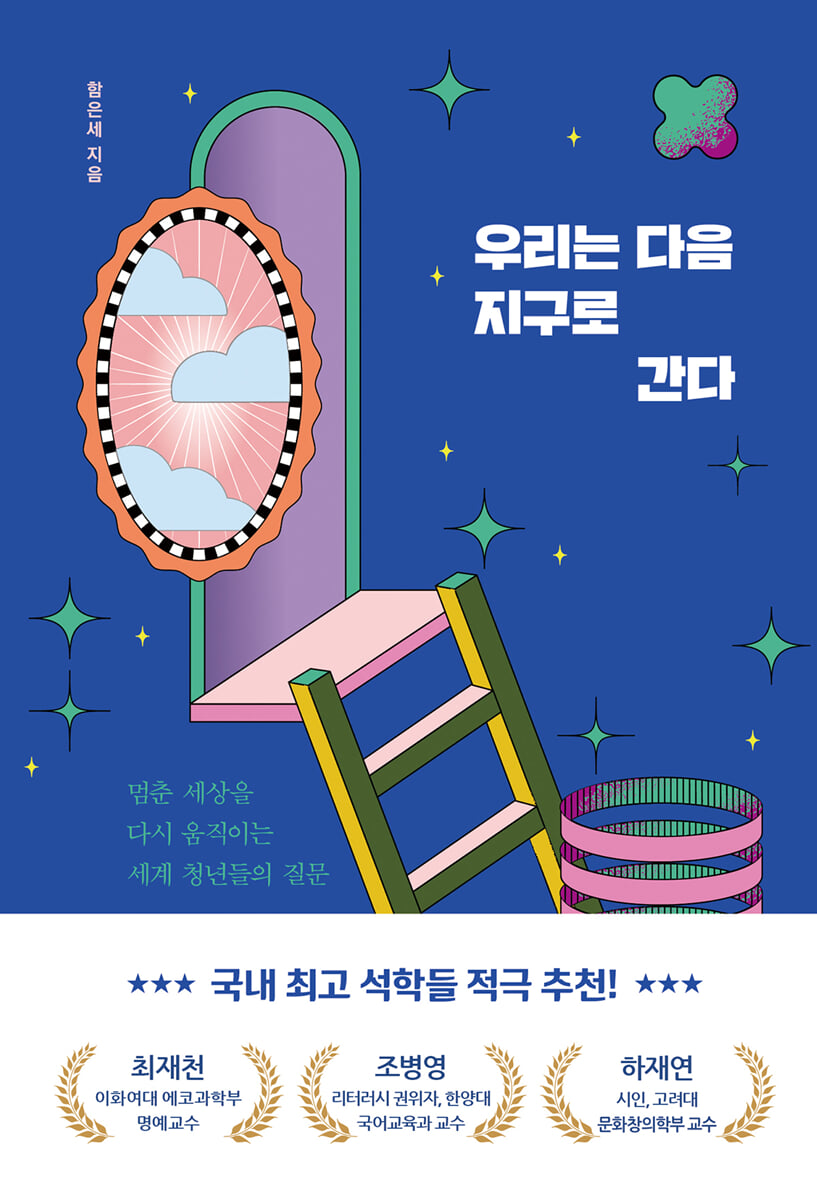
We go to the next Earth
 |
Description
Book Introduction
A book full of freshness and excitement from learning from below.
Choi Jae-cheon (Professor Emeritus, Department of Eco-Science, Ewha Womans University)
These questions, learned through experience, are better than the IB essay answers.
Jo Byeong-yeong (Professor, Department of Korean Language Education, Hanyang University)
Like the gentle and quiet sound of drums heard from afar, it conveys deep comfort and hope.
Ha Jae-yeon (poet and professor of cultural creativity at Korea University)
How should we live, what should we love, and how should we get through this era?
A record of questions written by a generation that lived through an era of despair, together with the youth of the world.
The author, who became an "out-of-school youth" at eighteen, went through about 85 personas, including part-timer, backpacker, surfer, writer, lecturer, and planner, to reach the present age of twenty-four.
Initially, I planned to write 'Stories from the World Outside School' based on my personal experiences, but I realized something after witnessing the events of December 3, 2024.
That we need to tell ‘our story’, not ‘my story’.
As a young person living in the 21st century, I have compiled the questions I have been asking and the things I must ask, and sent them to various friends at home and abroad to get answers.
Private stories became public stories, and anger at the times took a cool-headed turn.
This book is not about young people alone, but about the world's youth who ask all of us:
Would you like to go to the next Earth together?
Choi Jae-cheon (Professor Emeritus, Department of Eco-Science, Ewha Womans University)
These questions, learned through experience, are better than the IB essay answers.
Jo Byeong-yeong (Professor, Department of Korean Language Education, Hanyang University)
Like the gentle and quiet sound of drums heard from afar, it conveys deep comfort and hope.
Ha Jae-yeon (poet and professor of cultural creativity at Korea University)
How should we live, what should we love, and how should we get through this era?
A record of questions written by a generation that lived through an era of despair, together with the youth of the world.
The author, who became an "out-of-school youth" at eighteen, went through about 85 personas, including part-timer, backpacker, surfer, writer, lecturer, and planner, to reach the present age of twenty-four.
Initially, I planned to write 'Stories from the World Outside School' based on my personal experiences, but I realized something after witnessing the events of December 3, 2024.
That we need to tell ‘our story’, not ‘my story’.
As a young person living in the 21st century, I have compiled the questions I have been asking and the things I must ask, and sent them to various friends at home and abroad to get answers.
Private stories became public stories, and anger at the times took a cool-headed turn.
This book is not about young people alone, but about the world's youth who ask all of us:
Would you like to go to the next Earth together?
- You can preview some of the book's contents.
Preview
index
Recommendation 006
A book full of freshness and excitement, learning from below _ Choi Jae-cheon (Professor Emeritus, Department of Eco-Science, Ewha Womans University)
Questions about Life Learned Through the Body _ Jo Byeong-yeong (Professor, Department of Korean Language Education, Hanyang University)
Ham Eun-se, a young man who showed the details of his worries and choices _ Ha Jae-yeon (poet, professor of cultural creativity at Korea University)
Prologue: Towards a World Where You Can Tell the Stories You Want 014
thema 1.
Life is still difficult though
★ Do I really have to go to school? 022
★ Is there such a thing as a life that's already too late? 032
★ What is an ordinary life? 042
★ What should I do if I don't have anything I want to do? 052
★ Is a stable life the only answer? 062
★ What is the meaning of studying? 074
★ What does it mean to become a true adult? 086
[Youth of the World Now]
☆ What value do we need most right now? 096
☆ What is the greatest danger facing us now? 101
thema 2.
I often want to shake up the world
★ Will Power Change You? 108
★ Is there such a thing as something unrelated to me? 118
★ Why Fight a Battle You Can't Win? 128
★ What is true justice? 138
★ Can we give everyone an equal opportunity? 148
★ Can't you be an expert without a degree? 158
★ Can Our Anger Become a Driving Force for Social Change? 170
★ Is political correctness always right? 180
★ Can the world really change? 190
[Youth of the World Now]
☆ What is true democracy? 200
☆ What will the future society look like? 206
thema 3.
Nevertheless, it must be done
★ Can a victim become a perpetrator? 212
★ Is the community more important than the individual? 224
★ Why Do We Hate Each Other? 234
★ Do I have to be happy? 244
★ What's the difference between understanding and empathy? 254
★ Is it important to make a lot of money? 264
★ How can I live as my true self? 274
[Youth of the World Now]
☆ What does a healthy community need? 284
☆ How can we create a better society? 289
☆ Can a Nation Sustain? 294
Are the people truly the masters of their country? 299
A book full of freshness and excitement, learning from below _ Choi Jae-cheon (Professor Emeritus, Department of Eco-Science, Ewha Womans University)
Questions about Life Learned Through the Body _ Jo Byeong-yeong (Professor, Department of Korean Language Education, Hanyang University)
Ham Eun-se, a young man who showed the details of his worries and choices _ Ha Jae-yeon (poet, professor of cultural creativity at Korea University)
Prologue: Towards a World Where You Can Tell the Stories You Want 014
thema 1.
Life is still difficult though
★ Do I really have to go to school? 022
★ Is there such a thing as a life that's already too late? 032
★ What is an ordinary life? 042
★ What should I do if I don't have anything I want to do? 052
★ Is a stable life the only answer? 062
★ What is the meaning of studying? 074
★ What does it mean to become a true adult? 086
[Youth of the World Now]
☆ What value do we need most right now? 096
☆ What is the greatest danger facing us now? 101
thema 2.
I often want to shake up the world
★ Will Power Change You? 108
★ Is there such a thing as something unrelated to me? 118
★ Why Fight a Battle You Can't Win? 128
★ What is true justice? 138
★ Can we give everyone an equal opportunity? 148
★ Can't you be an expert without a degree? 158
★ Can Our Anger Become a Driving Force for Social Change? 170
★ Is political correctness always right? 180
★ Can the world really change? 190
[Youth of the World Now]
☆ What is true democracy? 200
☆ What will the future society look like? 206
thema 3.
Nevertheless, it must be done
★ Can a victim become a perpetrator? 212
★ Is the community more important than the individual? 224
★ Why Do We Hate Each Other? 234
★ Do I have to be happy? 244
★ What's the difference between understanding and empathy? 254
★ Is it important to make a lot of money? 264
★ How can I live as my true self? 274
[Youth of the World Now]
☆ What does a healthy community need? 284
☆ How can we create a better society? 289
☆ Can a Nation Sustain? 294
Are the people truly the masters of their country? 299
Detailed image

Into the book
I don't know what that damn mediocrity is, but there are few societies that force us to be mediocre so much.
No matter how much we sing the song of "discovering creative and convergent talent" all day long, it is ironic to expect the emergence of such people in a country that tells those pursuing their dreams and passion to "come to their senses" and asks those who push themselves to their limits, "Why bother living and suffering?"
I am convinced that if we stopped sending art students to college entrance exams and sent fewer science students to science high schools, this country would experience much greater spiritual enrichment and brighter possibilities than it does now.
The day when Korean society as a whole breaks free from obsessive mediocrity, we can leap to the next level.
I really want to see more 'people who are sane because they're not in their right mind'.
--- pp.50-51 「thema1.
Life is still difficult, but what is an ordinary life?
Critical thinking is a value desperately needed in our time. In today's world, where AI advances, misinformation proliferates, and digital content overflows, media literacy and the ability to discern biased and misleading information are becoming increasingly important.
Critical thinking will increasingly become a core competency that helps people make more accurate and thoughtful decisions over time.
--- p.97 「Question No.
1│What is the value we need most now? (Leilani Australia, majoring in archaeology)
The next step we need to take is to teach those who have gained power how to act, regardless of the size of the power.
Isn't the ultimate goal of those in power not the 'acquisition' of power, but the 'use' of power?
But why does the world only teach how to acquire power, and not how to properly conduct oneself afterward? With so many instances of those in power and those outlawed demonstrating little distinction, and the world's universal morality crumbling, now is the time for society and the entire global community to urgently demand education on this topic.
We need to start from the basics: with power comes responsibility, and no matter how great one's power, it does not give one the right to take over the lives of others.
There is little time left to put the brakes on a reality overflowing with 'philosophical cannibals'.
--- p.117 「thema2.
I often want to shake up the world │ Will things change if I have power?
Democracy is not simply about voting and majority rule, it's about power over who designs the system.
In the 21st century, it is not ‘votes’ but ‘codes’ that move power.
Within algorithms, platforms, and AI decision-making systems, democracy becomes closer to the "right to design order" than to "freedom of choice."
So true democracy only works when citizens can participate in and redesign the algorithms that govern them.
--- p.117 「Question No.
3│What is true democracy? (Jeong Eun-soo, Republic of Korea, former special researcher at the Taejae Research Foundation)
Lately, it seems like there's been a rise in the number of people willing to push others into a hole for their own good, even when it's not an apocalyptic movie situation.
Compared to the situation in the movie, which is bound to change dramatically because the question of life and death has suddenly arrived, this is an expression on a fairly everyday level.
A way of thinking that goes beyond individualism and borders on isolationism has been considered 'cool and natural' for some time now.
Even when someone starves without a proper meal, gets injured while working in a dangerous field without safety equipment, has their existence denied and is asked to remain silent, is murdered by a lover or spouse, or takes their own life because they cannot overcome the pain of life, it is not uncommon to observe people mocking the tragedy as if it were "none of my business."
The fragmentation of society, revealed in layers upon layers, feels dangerous because those who maintain this attitude are not simply indifferent to others, but rather derive pleasure by suppressing the values of the community or forcibly depriving other members of their rights to feed their own ego.
--- pp.228-229 「thema3.
Nevertheless, what must be done│Is the community more important than the individual?
Political education is key.
We need to empower members of society, especially young people, to participate in political decisions, to raise awareness of relevant issues, and to inspire them to become stakeholders in shaping political structures.
Young people have the power and potential to create lasting, positive political change.
That is why politics should not be the exclusive domain of the elite.
We need to build a political ecosystem that is accessible to everyone.
It's also important to help people believe that the power to bring about change exists within us.
And I hope we all aspire to be good role models for others.
It's an attitude of dreaming of growing into a better person and treating others the way I want to be treated.
No matter how much we sing the song of "discovering creative and convergent talent" all day long, it is ironic to expect the emergence of such people in a country that tells those pursuing their dreams and passion to "come to their senses" and asks those who push themselves to their limits, "Why bother living and suffering?"
I am convinced that if we stopped sending art students to college entrance exams and sent fewer science students to science high schools, this country would experience much greater spiritual enrichment and brighter possibilities than it does now.
The day when Korean society as a whole breaks free from obsessive mediocrity, we can leap to the next level.
I really want to see more 'people who are sane because they're not in their right mind'.
--- pp.50-51 「thema1.
Life is still difficult, but what is an ordinary life?
Critical thinking is a value desperately needed in our time. In today's world, where AI advances, misinformation proliferates, and digital content overflows, media literacy and the ability to discern biased and misleading information are becoming increasingly important.
Critical thinking will increasingly become a core competency that helps people make more accurate and thoughtful decisions over time.
--- p.97 「Question No.
1│What is the value we need most now? (Leilani Australia, majoring in archaeology)
The next step we need to take is to teach those who have gained power how to act, regardless of the size of the power.
Isn't the ultimate goal of those in power not the 'acquisition' of power, but the 'use' of power?
But why does the world only teach how to acquire power, and not how to properly conduct oneself afterward? With so many instances of those in power and those outlawed demonstrating little distinction, and the world's universal morality crumbling, now is the time for society and the entire global community to urgently demand education on this topic.
We need to start from the basics: with power comes responsibility, and no matter how great one's power, it does not give one the right to take over the lives of others.
There is little time left to put the brakes on a reality overflowing with 'philosophical cannibals'.
--- p.117 「thema2.
I often want to shake up the world │ Will things change if I have power?
Democracy is not simply about voting and majority rule, it's about power over who designs the system.
In the 21st century, it is not ‘votes’ but ‘codes’ that move power.
Within algorithms, platforms, and AI decision-making systems, democracy becomes closer to the "right to design order" than to "freedom of choice."
So true democracy only works when citizens can participate in and redesign the algorithms that govern them.
--- p.117 「Question No.
3│What is true democracy? (Jeong Eun-soo, Republic of Korea, former special researcher at the Taejae Research Foundation)
Lately, it seems like there's been a rise in the number of people willing to push others into a hole for their own good, even when it's not an apocalyptic movie situation.
Compared to the situation in the movie, which is bound to change dramatically because the question of life and death has suddenly arrived, this is an expression on a fairly everyday level.
A way of thinking that goes beyond individualism and borders on isolationism has been considered 'cool and natural' for some time now.
Even when someone starves without a proper meal, gets injured while working in a dangerous field without safety equipment, has their existence denied and is asked to remain silent, is murdered by a lover or spouse, or takes their own life because they cannot overcome the pain of life, it is not uncommon to observe people mocking the tragedy as if it were "none of my business."
The fragmentation of society, revealed in layers upon layers, feels dangerous because those who maintain this attitude are not simply indifferent to others, but rather derive pleasure by suppressing the values of the community or forcibly depriving other members of their rights to feed their own ego.
--- pp.228-229 「thema3.
Nevertheless, what must be done│Is the community more important than the individual?
Political education is key.
We need to empower members of society, especially young people, to participate in political decisions, to raise awareness of relevant issues, and to inspire them to become stakeholders in shaping political structures.
Young people have the power and potential to create lasting, positive political change.
That is why politics should not be the exclusive domain of the elite.
We need to build a political ecosystem that is accessible to everyone.
It's also important to help people believe that the power to bring about change exists within us.
And I hope we all aspire to be good role models for others.
It's an attitude of dreaming of growing into a better person and treating others the way I want to be treated.
--- p.292 「Question No.
6 │How can we create a better society? (Svenja, Germany, social worker)
6 │How can we create a better society? (Svenja, Germany, social worker)
Publisher's Review
Why are you asking the question?
Even if there is just one person who raises questions about justice and coexistence, freedom and responsibility, that society can keep alive the spark of hope for the future.
This is a question that most people want to avoid because they know that such a big and heavy question must not be stopped under any circumstances, and that it is slow and difficult.
The good news is that there are young people who ask these questions, and who wholeheartedly answer and put them into practice.
The pessimistic voices about the younger generation that have become so prevalent recently make us realize that they are nothing more than groundless fears when compared to the concerns and choices of the young people contained in this book.
More important than going fast is getting where you need to go.
Life in Korea is all about learning how to win the competition, and winning means reaching your goal faster than others.
The author says, 'Life is not F1, it's a long, drawn-out, situational drama with no intermission.
He protests, saying, 'The race doesn't stop just because it's broken and torn apart once, nor does the match end after running the same track for dozens of laps.'
More important than going faster than others is knowing where you need to go and running towards that goal at your own pace.
Even if you run on the same track as others, life is a competition with yourself.
Others are just a backdrop to the world where my race unfolds, not opponents I must overtake or finish lines I must jump over.
So, the only thing we have to remember and face is ourselves, and that is the message that conveys a poignant message about the importance of each and every one of us.
From my story to our story, to the next Earth
The author explores a wide range of topics, from defining the digital age to the harmful effects of PC-ism, asking questions and seeking answers.
Because I want to have the ‘power to question.’
The power to question is the most ultimate and sacred social ability granted to humans and the driving force for change.
Everyone may have different ideas about what constitutes a good, healthy, and desirable change, but at least in order to live as a citizen rather than a member of the crowd in this society, we must cultivate an eye to discern what kind of change is being given to us.
This book emphasizes that this is the capacity and role of citizens.
In the process, we learn:
The power to change the world is not in grand ideals, but in our hearts that ask and live today.
It has always been the youth who set the world in motion again when it has stopped.
Even if there is just one person who raises questions about justice and coexistence, freedom and responsibility, that society can keep alive the spark of hope for the future.
This is a question that most people want to avoid because they know that such a big and heavy question must not be stopped under any circumstances, and that it is slow and difficult.
The good news is that there are young people who ask these questions, and who wholeheartedly answer and put them into practice.
The pessimistic voices about the younger generation that have become so prevalent recently make us realize that they are nothing more than groundless fears when compared to the concerns and choices of the young people contained in this book.
More important than going fast is getting where you need to go.
Life in Korea is all about learning how to win the competition, and winning means reaching your goal faster than others.
The author says, 'Life is not F1, it's a long, drawn-out, situational drama with no intermission.
He protests, saying, 'The race doesn't stop just because it's broken and torn apart once, nor does the match end after running the same track for dozens of laps.'
More important than going faster than others is knowing where you need to go and running towards that goal at your own pace.
Even if you run on the same track as others, life is a competition with yourself.
Others are just a backdrop to the world where my race unfolds, not opponents I must overtake or finish lines I must jump over.
So, the only thing we have to remember and face is ourselves, and that is the message that conveys a poignant message about the importance of each and every one of us.
From my story to our story, to the next Earth
The author explores a wide range of topics, from defining the digital age to the harmful effects of PC-ism, asking questions and seeking answers.
Because I want to have the ‘power to question.’
The power to question is the most ultimate and sacred social ability granted to humans and the driving force for change.
Everyone may have different ideas about what constitutes a good, healthy, and desirable change, but at least in order to live as a citizen rather than a member of the crowd in this society, we must cultivate an eye to discern what kind of change is being given to us.
This book emphasizes that this is the capacity and role of citizens.
In the process, we learn:
The power to change the world is not in grand ideals, but in our hearts that ask and live today.
It has always been the youth who set the world in motion again when it has stopped.
GOODS SPECIFICS
- Date of issue: December 15, 2025
- Page count, weight, size: 304 pages | 378g | 128*188*18mm
- ISBN13: 9791124070246
- ISBN10: 1124070249
You may also like
카테고리
korean


korean

![GQ KOREA Mark (Monthly): December [2025]](http://librairie.coreenne.fr/cdn/shop/files/8ef265dbbfbf186523ed75ba7319009d.jpg?v=1765340328&width=3840)


