

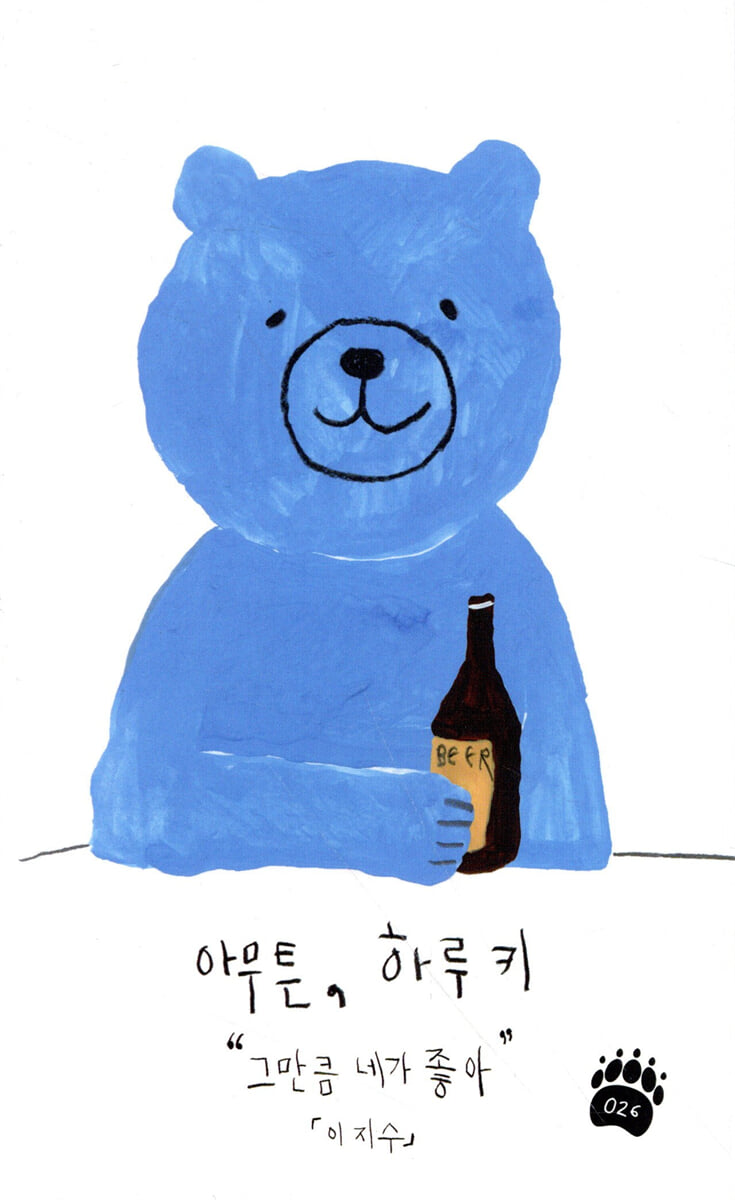
Anyway, Haruki
 |
Description
Book Introduction
The author, who became a translator after being drawn to Haruki Murakami's writings as a child,
Haruki-esque moments salvaged from the cool, cucumber-like everyday life
“If I said I liked Haruki, I would feel like I was that kind of person.”
Anyway, the twenty-sixth protagonist in the series is Japanese author Haruki Murakami.
Haruki, who has so many fans around the world that the term 'Harukist' was coined, is also the first 'person' to appear in the series.
This is Lee Ji-su's first essay collection, which translated Yoko Sano's "What is Life?" and Hirokazu Koreeda's "Thoughts While Making Movies." It contains fourteen affectionate and thoughtful essays that enter through the entrance called "Haruki" but ultimately exit through the exit called "me."
The author, who first entered Haruki Murakami's world with "Hear the Wind Sing" in middle school, is now a Japanese translator in his mid-thirties. However, Haruki Murakami's sentences, which he "memorized without even digesting them and stuck to his heart," always transport him back to the heart of his youth, no matter when or where.
For readers who have passed through, or are still passing through, the long tunnel of youth with Haruki, this book will remind them of some dazzling moments from the past that they had forgotten in the hustle and bustle of everyday life.
Haruki-esque moments salvaged from the cool, cucumber-like everyday life
“If I said I liked Haruki, I would feel like I was that kind of person.”
Anyway, the twenty-sixth protagonist in the series is Japanese author Haruki Murakami.
Haruki, who has so many fans around the world that the term 'Harukist' was coined, is also the first 'person' to appear in the series.
This is Lee Ji-su's first essay collection, which translated Yoko Sano's "What is Life?" and Hirokazu Koreeda's "Thoughts While Making Movies." It contains fourteen affectionate and thoughtful essays that enter through the entrance called "Haruki" but ultimately exit through the exit called "me."
The author, who first entered Haruki Murakami's world with "Hear the Wind Sing" in middle school, is now a Japanese translator in his mid-thirties. However, Haruki Murakami's sentences, which he "memorized without even digesting them and stuck to his heart," always transport him back to the heart of his youth, no matter when or where.
For readers who have passed through, or are still passing through, the long tunnel of youth with Haruki, this book will remind them of some dazzling moments from the past that they had forgotten in the hustle and bustle of everyday life.
- You can preview some of the book's contents.
Preview
index
Everything passes and we become adults.
- Listen to the Song of the Wind
Where that sentence took me
- 『Norwegian Wood』
If it wasn't good, it wasn't good, and if it was funny, it was funny. Life as a foreigner
- 『Sad Foreign Language』
The sound of a bicycle coming towards me in the middle of the night
- "On the Miracle of Midnight, or the Usefulness of Stories"
What and how far can a fan endure?
- 『Killing the Knight Commander』
Men making pasta and listening to jazz
- South of the Border, West of the Sun
What awaits at the return point
- "Poolside"
A wonderful and monumental love that destroyed Angkor Wat and burned the forests of India.
- Sputnik's Lover
Translator as a profession
- The Novelist as a Profession
Where there is an entrance, there is an exit.
- Pinball of 1973
I can write as much as I want about this kind of stuff
- Murakami Radio 1, 2, 3
Soul Brother, Soul Sister
- 『Valentine's Day's Mumalrang』
What I want from the writer
- The Adventures of Sheep Chasing
Epilogue
- Anyway, if you have to write something
- Listen to the Song of the Wind
Where that sentence took me
- 『Norwegian Wood』
If it wasn't good, it wasn't good, and if it was funny, it was funny. Life as a foreigner
- 『Sad Foreign Language』
The sound of a bicycle coming towards me in the middle of the night
- "On the Miracle of Midnight, or the Usefulness of Stories"
What and how far can a fan endure?
- 『Killing the Knight Commander』
Men making pasta and listening to jazz
- South of the Border, West of the Sun
What awaits at the return point
- "Poolside"
A wonderful and monumental love that destroyed Angkor Wat and burned the forests of India.
- Sputnik's Lover
Translator as a profession
- The Novelist as a Profession
Where there is an entrance, there is an exit.
- Pinball of 1973
I can write as much as I want about this kind of stuff
- Murakami Radio 1, 2, 3
Soul Brother, Soul Sister
- 『Valentine's Day's Mumalrang』
What I want from the writer
- The Adventures of Sheep Chasing
Epilogue
- Anyway, if you have to write something
Into the book
On days when I missed intimate communication, I read Norwegian Wood alone in bed.
As fate would have it, the textbook for a Japanese university class was that very novel.
In the class held once a week, we progressed one chapter at a time, and since my reading speed was as slow as a turtle's, there were always sentences left to read.
And in some ways it was a salvation.
--- From "Where That Sentence Takes Me"
I recently reread this book, which I read in my twenties, and this passage, which I had previously glossed over, brought back to me the feeling of being a mere stranger that I had experienced about ten years ago.
If I hadn't had the experience of being 'an incompetent foreigner' who 'had no choice but to become completely myself', I might have mistaken myself for a sophisticated and cultured person until the very end.
But when I removed my native language and culture, what remained was a clumsy human being who couldn't even put his shoes away properly in someone else's hallway, who was easily flustered by unexpected considerations, and who lacked quick reflexes.
That was good.
Thanks to you, I was able to get to know a side of myself that I never knew before.
--- From "If it wasn't right, it wasn't right, and if it was funny, it was funny: Life as a Foreigner"
We only dated for a year, but it took much longer to break up.
That child gave me many happy and warm memories, but it also caused me vivid pain for a long time.
Things that destroy me inside, like regret, sadness, and self-pity.
--- From "The Sound of a Bicycle Coming to Me in the Middle of the Night"
Haruki Murakami said, “One of the things I love most in this uncertain world is partial love,” and maybe I, too, love Haruki Murakami in a partial way, so I buy any new book he publishes without fail.
But I hope Haruki doesn't become a writer who sells books with his name alone.
Sometimes I feel a sense of sadness that readers who were once enthusiastic about Japanese literature no longer read Banana Yoshimoto, Ryu Murakami, or Kaori Ekuni.
As a long-time fan, I honestly feel that I don't want to feel the same loneliness from Haruki.
--- From "What and How Far Can a Fan's Heart Endure"
If someone were to ask me which of Haruki Murakami's novels has the best introduction, I would say without hesitation, "Sputnik Lovers."
A love like a whirlwind that rushes across the vast plains, a love so magnificent and monumental that it mercilessly demolishes Angkor Wat and burns down the forests of India with a pack of tigers.
How could I, a teenager when I read this book, not fantasize about such a love?
--- From "The Wonderful and Monumental Love That Destroyed Angkor Wat and Burned the Forests of India"
When I got home, Dee was in a brown box the same color as her fur, her eyes closed quietly on the cushion she had loved when she was alive.
It smelled like fragrant shampoo, as if it had been washed at the hospital, and its fur was softer than ever.
There was no dandruff either.
Zorba was so frightened by the loud cries of the people that he hid behind the rice cooker and refused to come out.
But the doctor said that if they didn't say goodbye, Zorba would continue to look for Di at home.
My husband and I had to drag Zorba out before we left for the pet funeral.
Zorba cried sharply, not even bothering to look at or smell his cold brother.
--- From "Where there is an entrance, there is an exit"
A while ago, I was reading Haruki Murakami's essay collection, "The Secret of the Long-Lived Cat," in a public place, and at a certain point, I found myself muttering involuntarily.
I ended up laughing out loud.
This is because the metaphor of ‘a face as cool as a cucumber’ came out.
What kind of expression do you have to make to make your face as cool as a cucumber?
I imagined a scene where British actor Benedict Cumberbatch, nicknamed "Cucumberbatch" because he resembles a cucumber, was crunching a cucumber with a very cool expression.
--- From "I can write as much as I want like this"
As a side note, my favorite anecdote among Haruki and Mizumaru's is the story about the illustration of 'General Romel eating beef cutlets in a train dining car.'
Haruki wanted to see Mizumaru, who can draw any illustration, struggle even just once, so he wrote an article on the subject of 'General Romel eating a beef cutlet in a train dining car', but Mizumaru drew it easily.
Haruki thought that even if he threw a difficult topic like 'Engels looking at Karl Marx shaving his beard with warm eyes' at Mizumaru, it would be a piece of cake for him, so he decided to give him a hard time with a simple topic and wrote three articles in a row about tofu, but Mizumaru just drew these as well without any problem.
As fate would have it, the textbook for a Japanese university class was that very novel.
In the class held once a week, we progressed one chapter at a time, and since my reading speed was as slow as a turtle's, there were always sentences left to read.
And in some ways it was a salvation.
--- From "Where That Sentence Takes Me"
I recently reread this book, which I read in my twenties, and this passage, which I had previously glossed over, brought back to me the feeling of being a mere stranger that I had experienced about ten years ago.
If I hadn't had the experience of being 'an incompetent foreigner' who 'had no choice but to become completely myself', I might have mistaken myself for a sophisticated and cultured person until the very end.
But when I removed my native language and culture, what remained was a clumsy human being who couldn't even put his shoes away properly in someone else's hallway, who was easily flustered by unexpected considerations, and who lacked quick reflexes.
That was good.
Thanks to you, I was able to get to know a side of myself that I never knew before.
--- From "If it wasn't right, it wasn't right, and if it was funny, it was funny: Life as a Foreigner"
We only dated for a year, but it took much longer to break up.
That child gave me many happy and warm memories, but it also caused me vivid pain for a long time.
Things that destroy me inside, like regret, sadness, and self-pity.
--- From "The Sound of a Bicycle Coming to Me in the Middle of the Night"
Haruki Murakami said, “One of the things I love most in this uncertain world is partial love,” and maybe I, too, love Haruki Murakami in a partial way, so I buy any new book he publishes without fail.
But I hope Haruki doesn't become a writer who sells books with his name alone.
Sometimes I feel a sense of sadness that readers who were once enthusiastic about Japanese literature no longer read Banana Yoshimoto, Ryu Murakami, or Kaori Ekuni.
As a long-time fan, I honestly feel that I don't want to feel the same loneliness from Haruki.
--- From "What and How Far Can a Fan's Heart Endure"
If someone were to ask me which of Haruki Murakami's novels has the best introduction, I would say without hesitation, "Sputnik Lovers."
A love like a whirlwind that rushes across the vast plains, a love so magnificent and monumental that it mercilessly demolishes Angkor Wat and burns down the forests of India with a pack of tigers.
How could I, a teenager when I read this book, not fantasize about such a love?
--- From "The Wonderful and Monumental Love That Destroyed Angkor Wat and Burned the Forests of India"
When I got home, Dee was in a brown box the same color as her fur, her eyes closed quietly on the cushion she had loved when she was alive.
It smelled like fragrant shampoo, as if it had been washed at the hospital, and its fur was softer than ever.
There was no dandruff either.
Zorba was so frightened by the loud cries of the people that he hid behind the rice cooker and refused to come out.
But the doctor said that if they didn't say goodbye, Zorba would continue to look for Di at home.
My husband and I had to drag Zorba out before we left for the pet funeral.
Zorba cried sharply, not even bothering to look at or smell his cold brother.
--- From "Where there is an entrance, there is an exit"
A while ago, I was reading Haruki Murakami's essay collection, "The Secret of the Long-Lived Cat," in a public place, and at a certain point, I found myself muttering involuntarily.
I ended up laughing out loud.
This is because the metaphor of ‘a face as cool as a cucumber’ came out.
What kind of expression do you have to make to make your face as cool as a cucumber?
I imagined a scene where British actor Benedict Cumberbatch, nicknamed "Cucumberbatch" because he resembles a cucumber, was crunching a cucumber with a very cool expression.
--- From "I can write as much as I want like this"
As a side note, my favorite anecdote among Haruki and Mizumaru's is the story about the illustration of 'General Romel eating beef cutlets in a train dining car.'
Haruki wanted to see Mizumaru, who can draw any illustration, struggle even just once, so he wrote an article on the subject of 'General Romel eating a beef cutlet in a train dining car', but Mizumaru drew it easily.
Haruki thought that even if he threw a difficult topic like 'Engels looking at Karl Marx shaving his beard with warm eyes' at Mizumaru, it would be a piece of cake for him, so he decided to give him a hard time with a simple topic and wrote three articles in a row about tofu, but Mizumaru just drew these as well without any problem.
--- From "Soul Brother, Soul Sister"
Publisher's Review
1
Novelist Haruki Murakami has been a must-have item for the steel mill since the series was first planned.
If a (living) human were to appear in this series as "one thing worth thinking about," I thought it would be good if Haruki cut the first tape.
That's because Haruki is one of the few writers with strong tastes, with clearly divided likes and dislikes.
I even suggested writing a list of candidates who could be said to be the "Haruki of this area," but finding someone who would be like Haruki turned out to be more difficult than I thought.
Then, after many twists and turns, the mission went to translator Lee Ji-su, who had never translated a Haruki Murakami book before.
(Are you curious about the twists and turns? They're detailed in the epilogue of "Anyway, Haruki," "If I Have to Write Anything"...)
2
The day I received the manuscript from him, I exclaimed inwardly, 'Haruki has finally found his master!'
The calm yet firm attitude and voice that only someone who has loved something for a long time can have are evident throughout the writing.
After reading the 400-page manuscript while sitting down, I immediately took out a volume of Haruki Murakami's prose from the bookshelf and read it.
It made me want to read Haruki again, so it's a success.
3
As expected from a world-renowned author, there are already many books published based on Haruki Murakami.
In particular, there are many attempts to 'read Haruki' by focusing on a single keyword that appears in his writing, such as music (mainly jazz), food (mainly beer), animals (mainly cats), or hobbies (mainly running and traveling).
Instead of using such a familiar method, author Lee Ji-soo brings Haruki back from his own unique memories.
It's not about reading Haruki, but reading 'myself' through the prism of Haruki.
This is the most brilliant point of this book.
4
Having first entered the world of Haruki Murakami with "Hear the Wind Sing" in middle school, he now recalls Haruki Murakami's words that he encountered at crucial moments in his life.
So, this book is an intimate story of the author, who became a translator out of a desire to read Haruki Murakami in the original, and his relationship with Haruki Murakami's sentences. At the same time, it can be said to be a story of growth for a Haruki-ist who enters through the entrance called 'Haruki' and finally exits through the exit called 'me', like the line in 'Pinball 1973' that says, "If there's an entrance, there's an exit."
5
Author George Young, who wrote “Anyway, Foreign Language,” mentioned Haruki Murakami in his book and said the following:
“That’s how ‘when’ Haruki becomes ‘still’ Haruki.” 『Anyway, Haruki』 tells us in a warm and thoughtful voice why ‘when’ Haruki is ‘still’, ‘still’, ‘anyway’ Haruki.
Like Watanabe in “Norwegian Wood,” who says the two words “I like you” with great care.
Novelist Haruki Murakami has been a must-have item for the steel mill since the series was first planned.
If a (living) human were to appear in this series as "one thing worth thinking about," I thought it would be good if Haruki cut the first tape.
That's because Haruki is one of the few writers with strong tastes, with clearly divided likes and dislikes.
I even suggested writing a list of candidates who could be said to be the "Haruki of this area," but finding someone who would be like Haruki turned out to be more difficult than I thought.
Then, after many twists and turns, the mission went to translator Lee Ji-su, who had never translated a Haruki Murakami book before.
(Are you curious about the twists and turns? They're detailed in the epilogue of "Anyway, Haruki," "If I Have to Write Anything"...)
2
The day I received the manuscript from him, I exclaimed inwardly, 'Haruki has finally found his master!'
The calm yet firm attitude and voice that only someone who has loved something for a long time can have are evident throughout the writing.
After reading the 400-page manuscript while sitting down, I immediately took out a volume of Haruki Murakami's prose from the bookshelf and read it.
It made me want to read Haruki again, so it's a success.
3
As expected from a world-renowned author, there are already many books published based on Haruki Murakami.
In particular, there are many attempts to 'read Haruki' by focusing on a single keyword that appears in his writing, such as music (mainly jazz), food (mainly beer), animals (mainly cats), or hobbies (mainly running and traveling).
Instead of using such a familiar method, author Lee Ji-soo brings Haruki back from his own unique memories.
It's not about reading Haruki, but reading 'myself' through the prism of Haruki.
This is the most brilliant point of this book.
4
Having first entered the world of Haruki Murakami with "Hear the Wind Sing" in middle school, he now recalls Haruki Murakami's words that he encountered at crucial moments in his life.
So, this book is an intimate story of the author, who became a translator out of a desire to read Haruki Murakami in the original, and his relationship with Haruki Murakami's sentences. At the same time, it can be said to be a story of growth for a Haruki-ist who enters through the entrance called 'Haruki' and finally exits through the exit called 'me', like the line in 'Pinball 1973' that says, "If there's an entrance, there's an exit."
5
Author George Young, who wrote “Anyway, Foreign Language,” mentioned Haruki Murakami in his book and said the following:
“That’s how ‘when’ Haruki becomes ‘still’ Haruki.” 『Anyway, Haruki』 tells us in a warm and thoughtful voice why ‘when’ Haruki is ‘still’, ‘still’, ‘anyway’ Haruki.
Like Watanabe in “Norwegian Wood,” who says the two words “I like you” with great care.
GOODS SPECIFICS
- Date of issue: January 31, 2020
- Page count, weight, size: 168 pages | 188g | 110*178*14mm
- ISBN13: 9791188343294
- ISBN10: 1188343297
You may also like
카테고리
korean


korean

![GQ KOREA Mark (Monthly): December [2025]](http://librairie.coreenne.fr/cdn/shop/files/8ef265dbbfbf186523ed75ba7319009d.jpg?v=1765340328&width=3840)


