

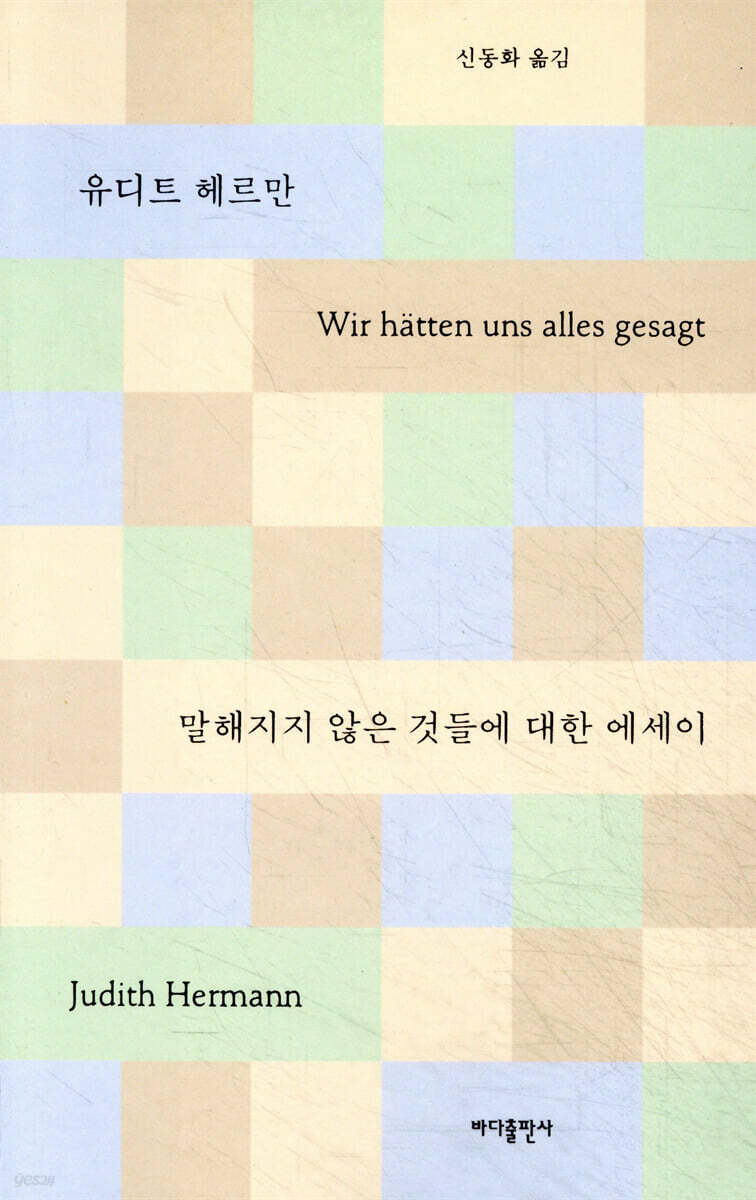
Essays on Things Unspoken
 |
Description
Book Introduction
Wilhelm Rabe Literature Prize
Judith Herrmann, the "Silent Writer," the Pinnacle of Literature
'The writer's job is not to write well,
'Taking out the truth'
Creative writing is often thought of as the art of creating fiction.
A person who knows a lot of words, speaks fluently, and has a rich imagination is considered a good writer.
But there are novelists who value truth above all else, and who write about truths they wish to hide and not reveal.
This is Judith Hermann, the “writer who writes silence” and the “writer of silence.” Her novels are literally filled with silence.
The characters have secrets, they are silent, and there are deep gaps between sentences.
So, when reading Judith Herrmann's novels, one's attention is drawn more to what is unsaid than to what is revealed. This book, "Essays on Things Unsaid," which won the Wilhelm Rabe Prize for Literature, which recognizes works that excel in literary experimentation and linguistic innovation, is the most honest and personal work of Judith Herrmann, a representative German writer.
This book explores whether it is possible to be truthful while remaining silent.
Judith Herrmann, the "Silent Writer," the Pinnacle of Literature
'The writer's job is not to write well,
'Taking out the truth'
Creative writing is often thought of as the art of creating fiction.
A person who knows a lot of words, speaks fluently, and has a rich imagination is considered a good writer.
But there are novelists who value truth above all else, and who write about truths they wish to hide and not reveal.
This is Judith Hermann, the “writer who writes silence” and the “writer of silence.” Her novels are literally filled with silence.
The characters have secrets, they are silent, and there are deep gaps between sentences.
So, when reading Judith Herrmann's novels, one's attention is drawn more to what is unsaid than to what is revealed. This book, "Essays on Things Unsaid," which won the Wilhelm Rabe Prize for Literature, which recognizes works that excel in literary experimentation and linguistic innovation, is the most honest and personal work of Judith Herrmann, a representative German writer.
This book explores whether it is possible to be truthful while remaining silent.
- You can preview some of the book's contents.
Preview
index
Ⅰ
Ⅱ
Ⅲ
Ⅱ
Ⅲ
Detailed image

Into the book
My family was a cocoon that surrounded me, held me together, and kept me safe.
Ada's views pulled a thread from this cocoon, loosening it, and later other events completely dismantled it.
But Ada, who had the child on her lap, cradled against her pretty chest, her husband behind her, and others behind him, was the first to break this chain.
--- pp.25-26
They are clear, they are true, and there is nothing to shake these sentences about.
The sentences that lead us into a story come from the middle world, are opaque, interpretable, and changeable, which means they can change the world.
I can change the world, my world, through stories.
--- p.82
When I was thirty, I became a mother, and the first summer I spent with my child, we went to my grandmother's house at the beach.
It had been a very long time since I had been there since my grandmother's death.
My uncle was setting up shop in the room below the stairs, and our appearance brought him out of his slumber, a sleep that was like a kicked-out daydream, and he rubbed his eyes and said:
It's a person.
--- p.140
My father took the crushed mini bundt cakes and a saucer out of his bag, painstakingly peeled the plastic wrap off the cakes, and carefully placed them on the saucer.
For a moment I felt that this situation was unbearable.
It's painful and embarrassing.
I was embarrassed.
After a while, the feeling passed.
The shame subsided, faded, and then suddenly disappeared.
--- p.190
Either I was dreaming it, or I made it up like everything else.
A Russian grandmother, bread soup, a father dressed as the Queen of the Night, a puppet theater, my bed behind the puppet theater, a bed that looked like it belonged in a Gulag camp, something I'd read about, and a wrinkled apple in the gap between the bed and the plywood wall, the edge of a loaf of bread.
A phrase my mother often said to me - You exaggerate, Judith.
You are exaggerating.
Ada's views pulled a thread from this cocoon, loosening it, and later other events completely dismantled it.
But Ada, who had the child on her lap, cradled against her pretty chest, her husband behind her, and others behind him, was the first to break this chain.
--- pp.25-26
They are clear, they are true, and there is nothing to shake these sentences about.
The sentences that lead us into a story come from the middle world, are opaque, interpretable, and changeable, which means they can change the world.
I can change the world, my world, through stories.
--- p.82
When I was thirty, I became a mother, and the first summer I spent with my child, we went to my grandmother's house at the beach.
It had been a very long time since I had been there since my grandmother's death.
My uncle was setting up shop in the room below the stairs, and our appearance brought him out of his slumber, a sleep that was like a kicked-out daydream, and he rubbed his eyes and said:
It's a person.
--- p.140
My father took the crushed mini bundt cakes and a saucer out of his bag, painstakingly peeled the plastic wrap off the cakes, and carefully placed them on the saucer.
For a moment I felt that this situation was unbearable.
It's painful and embarrassing.
I was embarrassed.
After a while, the feeling passed.
The shame subsided, faded, and then suddenly disappeared.
--- p.190
Either I was dreaming it, or I made it up like everything else.
A Russian grandmother, bread soup, a father dressed as the Queen of the Night, a puppet theater, my bed behind the puppet theater, a bed that looked like it belonged in a Gulag camp, something I'd read about, and a wrinkled apple in the gap between the bed and the plywood wall, the edge of a loaf of bread.
A phrase my mother often said to me - You exaggerate, Judith.
You are exaggerating.
--- p.229
Publisher's Review
“To reveal and to conceal, to show secretly and to conceal publicly.
“It is presented literary using all kinds of tricks.”
Süddeutsche Zeitung
“Judith Hermann’s books are unwavering explorations of human history.”
Neue Zürcher Zeitung
From the 'Nobel Prize in Literature Candidates'
Frankfurt Rundschau
“I know that sentence and I am keeping it a secret.”
What is not said is more important than what is revealed.
“Silent Writer” who pays attention
Judith Herrmann is a writer with a keen sense of what her family and history want to hide, and what she herself wants to hide.
What we should pay attention to in his writing is not what is revealed, but what is not said.
He says that writing is not about telling fiction, but about telling the truth, but about choosing what to hide or exclude.
So he writes while deleting, and writes silence.
He knows the truth, human psychology, and the content of conversations, but he keeps it a secret.
In this book, he explains why he did not choose that sentence, that character, or that setting when writing a novel.
It mainly explores psychological elements such as one's own trauma and uncertainty of memory, and reveals a literary desire to express the enigmatic nature of life.
Moreover, in the midst of these numerous decisions, the author expresses not only his autonomy and boldness, but also his reflections and regrets.
He strongly argues against the critical assessment that he is a writer with “nothing to say.”
“Creating something is not about escaping from reality and entering another reality.
That's exactly what I don't want.
“I want to enter into a unique and incomprehensible reality, to write about my inability to understand reality, and to argue that reality is largely incomprehensible.” (p. 124)
This book begins with a literature lecture titled "We Should Have Said Everything - On Silence and Hiding in Writing" given at the University of Frankfurt. However, rather than mentioning trends in German literature or theories of writing, it directly addresses life and memory, which are the source of creative work, and emphasizes the importance of facts and truth.
As he does so, he struggles with how much he can trust his memories, what to write and what to erase, and where the story begins and ends.
He confesses that he wants to be truthful in his life and writing, saying, “I never want to lie anymore,” but that “I’m no longer sure which parts of the story are real and which parts are made up, and which parts contain the so-called autobiographical truth” (p. 69).
“To leave the original to me”
Silence is not a void
A space where the most powerful narratives blossom
Judith Hermann is called “the writer who uses silence as language” and “the writer of silence.”
For him, literature is an act of filling silence and void, and an exploration of things that cannot be expressed in words.
Through her writing, she carefully touches on the complex emotions and relationships of life, moments that have been overlooked or secrets that have been deliberately kept hidden.
Hermann's sentences encourage readers to ask questions rather than providing complete answers, and he believes that true understanding can be found in the gaps between them.
For her, writing is, above all, a conscious act that transcends time.
By condensing past trauma, present anxiety, and vague expectations for the future into a single text, she attempts to control the flow of time.
For example, when transforming personal experiences such as his relationship with Ada or his meeting with Dr. Drahuis into literature, Hermann blurs the line between fact and fiction, forcing the reader to forget the distinction between memory and imagination.
This goes beyond a simple autobiographical record, showing that writing itself is a dynamic process of healing and discovering new wounds at the same time.
Her work is made up of the resonance created by the unspoken.
'Hiding and revealing' is not a simple evasion or concealment, but a strategy of condensing the truth that cannot be expressed in words into literature.
For him, silence is not a void, but rather a space where the most powerful narratives blossom.
Life experiences are reconstructed in the work, and literary truth is pursued rather than factual truth.
This essay is a declaration to directly confront the reality that has appeared in my previous works, and another artistic approach to the 'unspoken things.'
Hermann penetrates the space of silence, and remains one of the most sophisticated sculptors of trauma and memory in German literature.
“Nothing is right anymore,
“Everything is true”
Things that are true even when they are twisted and distorted
Born in 1970, Judith Hermann belongs to a generation shrouded in silence, helplessness, and guilt, formed after her grandparents, who were subjects of the Nazi era, and her parents, who experienced the division and regime change of Germany.
In particular, he grew up with a father who suffered from severe depression throughout his life, and a mother who distanced herself from the family due to her role as the head of the household. He was cared for by his Russian grandmother in place of his parents, and from an early age, he had to confront the trauma, mental illness, and hidden secrets that were ingrained in his family.
As a result, he learned the subtle art of 'hiding' and 'revealing' in loneliness and anxiety, which later became a core motif in his literary world.
In her 30s, Judith Herrmann lived in communal living with her "chosen family" in a seaside villa, which was also the main setting of her masterpiece, "The Summer House and After."
Ada, the central figure of 'The Chosen Family', shows Hermann the possibility of a bond beyond his biological family and plays an important role in Hermann's life as a friend who opens his inner self.
However, this relationship does not last in reality, and Ada is reborn as the character 'Effie' in Hermann's novel collection 'Letipark'.
Ada became the foundation for new creations while resolving some of Hermann's trauma, but at the same time, it remained 'unspoken'.
Psychoanalyst Dr. Dreyfus was also deeply involved in her life and literature.
During his ten years of analytic therapy, he was such a secretive figure that he only expressed his opinions in about five statements.
Dr. Dreyfus becomes the motif for the character 'Dr. Gupta' in Hermann's short story 'The Dream' in 'Letipark'.
The first scene of this book, Essays on Things Unsaid, is the reunion with Dr. Dreyfus, which takes place long after ten years of psychoanalysis, and this may be because it fully shows the relationship between the real Dr. Dreyfus and the fictional 'Dr. Gupta'.
They have a conversation they have never had before, especially about Leti Park, but due to their conflicting pasts, the conversation fails and ends up not continuing.
However, after this sudden meeting, Dr. Dreyfus, who had read Letipark, which featured a character based on himself, 'Dr. Gupta', wrote a letter to Hermann.
“In the end, nothing is true anymore, but everything is true.”
“It is presented literary using all kinds of tricks.”
Süddeutsche Zeitung
“Judith Hermann’s books are unwavering explorations of human history.”
Neue Zürcher Zeitung
From the 'Nobel Prize in Literature Candidates'
Frankfurt Rundschau
“I know that sentence and I am keeping it a secret.”
What is not said is more important than what is revealed.
“Silent Writer” who pays attention
Judith Herrmann is a writer with a keen sense of what her family and history want to hide, and what she herself wants to hide.
What we should pay attention to in his writing is not what is revealed, but what is not said.
He says that writing is not about telling fiction, but about telling the truth, but about choosing what to hide or exclude.
So he writes while deleting, and writes silence.
He knows the truth, human psychology, and the content of conversations, but he keeps it a secret.
In this book, he explains why he did not choose that sentence, that character, or that setting when writing a novel.
It mainly explores psychological elements such as one's own trauma and uncertainty of memory, and reveals a literary desire to express the enigmatic nature of life.
Moreover, in the midst of these numerous decisions, the author expresses not only his autonomy and boldness, but also his reflections and regrets.
He strongly argues against the critical assessment that he is a writer with “nothing to say.”
“Creating something is not about escaping from reality and entering another reality.
That's exactly what I don't want.
“I want to enter into a unique and incomprehensible reality, to write about my inability to understand reality, and to argue that reality is largely incomprehensible.” (p. 124)
This book begins with a literature lecture titled "We Should Have Said Everything - On Silence and Hiding in Writing" given at the University of Frankfurt. However, rather than mentioning trends in German literature or theories of writing, it directly addresses life and memory, which are the source of creative work, and emphasizes the importance of facts and truth.
As he does so, he struggles with how much he can trust his memories, what to write and what to erase, and where the story begins and ends.
He confesses that he wants to be truthful in his life and writing, saying, “I never want to lie anymore,” but that “I’m no longer sure which parts of the story are real and which parts are made up, and which parts contain the so-called autobiographical truth” (p. 69).
“To leave the original to me”
Silence is not a void
A space where the most powerful narratives blossom
Judith Hermann is called “the writer who uses silence as language” and “the writer of silence.”
For him, literature is an act of filling silence and void, and an exploration of things that cannot be expressed in words.
Through her writing, she carefully touches on the complex emotions and relationships of life, moments that have been overlooked or secrets that have been deliberately kept hidden.
Hermann's sentences encourage readers to ask questions rather than providing complete answers, and he believes that true understanding can be found in the gaps between them.
For her, writing is, above all, a conscious act that transcends time.
By condensing past trauma, present anxiety, and vague expectations for the future into a single text, she attempts to control the flow of time.
For example, when transforming personal experiences such as his relationship with Ada or his meeting with Dr. Drahuis into literature, Hermann blurs the line between fact and fiction, forcing the reader to forget the distinction between memory and imagination.
This goes beyond a simple autobiographical record, showing that writing itself is a dynamic process of healing and discovering new wounds at the same time.
Her work is made up of the resonance created by the unspoken.
'Hiding and revealing' is not a simple evasion or concealment, but a strategy of condensing the truth that cannot be expressed in words into literature.
For him, silence is not a void, but rather a space where the most powerful narratives blossom.
Life experiences are reconstructed in the work, and literary truth is pursued rather than factual truth.
This essay is a declaration to directly confront the reality that has appeared in my previous works, and another artistic approach to the 'unspoken things.'
Hermann penetrates the space of silence, and remains one of the most sophisticated sculptors of trauma and memory in German literature.
“Nothing is right anymore,
“Everything is true”
Things that are true even when they are twisted and distorted
Born in 1970, Judith Hermann belongs to a generation shrouded in silence, helplessness, and guilt, formed after her grandparents, who were subjects of the Nazi era, and her parents, who experienced the division and regime change of Germany.
In particular, he grew up with a father who suffered from severe depression throughout his life, and a mother who distanced herself from the family due to her role as the head of the household. He was cared for by his Russian grandmother in place of his parents, and from an early age, he had to confront the trauma, mental illness, and hidden secrets that were ingrained in his family.
As a result, he learned the subtle art of 'hiding' and 'revealing' in loneliness and anxiety, which later became a core motif in his literary world.
In her 30s, Judith Herrmann lived in communal living with her "chosen family" in a seaside villa, which was also the main setting of her masterpiece, "The Summer House and After."
Ada, the central figure of 'The Chosen Family', shows Hermann the possibility of a bond beyond his biological family and plays an important role in Hermann's life as a friend who opens his inner self.
However, this relationship does not last in reality, and Ada is reborn as the character 'Effie' in Hermann's novel collection 'Letipark'.
Ada became the foundation for new creations while resolving some of Hermann's trauma, but at the same time, it remained 'unspoken'.
Psychoanalyst Dr. Dreyfus was also deeply involved in her life and literature.
During his ten years of analytic therapy, he was such a secretive figure that he only expressed his opinions in about five statements.
Dr. Dreyfus becomes the motif for the character 'Dr. Gupta' in Hermann's short story 'The Dream' in 'Letipark'.
The first scene of this book, Essays on Things Unsaid, is the reunion with Dr. Dreyfus, which takes place long after ten years of psychoanalysis, and this may be because it fully shows the relationship between the real Dr. Dreyfus and the fictional 'Dr. Gupta'.
They have a conversation they have never had before, especially about Leti Park, but due to their conflicting pasts, the conversation fails and ends up not continuing.
However, after this sudden meeting, Dr. Dreyfus, who had read Letipark, which featured a character based on himself, 'Dr. Gupta', wrote a letter to Hermann.
“In the end, nothing is true anymore, but everything is true.”
GOODS SPECIFICS
- Date of issue: August 22, 2025
- Page count, weight, size: 236 pages | 254g | 123*190*12mm
- ISBN13: 9791166893728
- ISBN10: 1166893723
You may also like
카테고리
korean


korean

![GQ KOREA Mark (Monthly): December [2025]](http://librairie.coreenne.fr/cdn/shop/files/8ef265dbbfbf186523ed75ba7319009d.jpg?v=1765340328&width=3840)


