

Words of transfer
 |
Description
Book Introduction
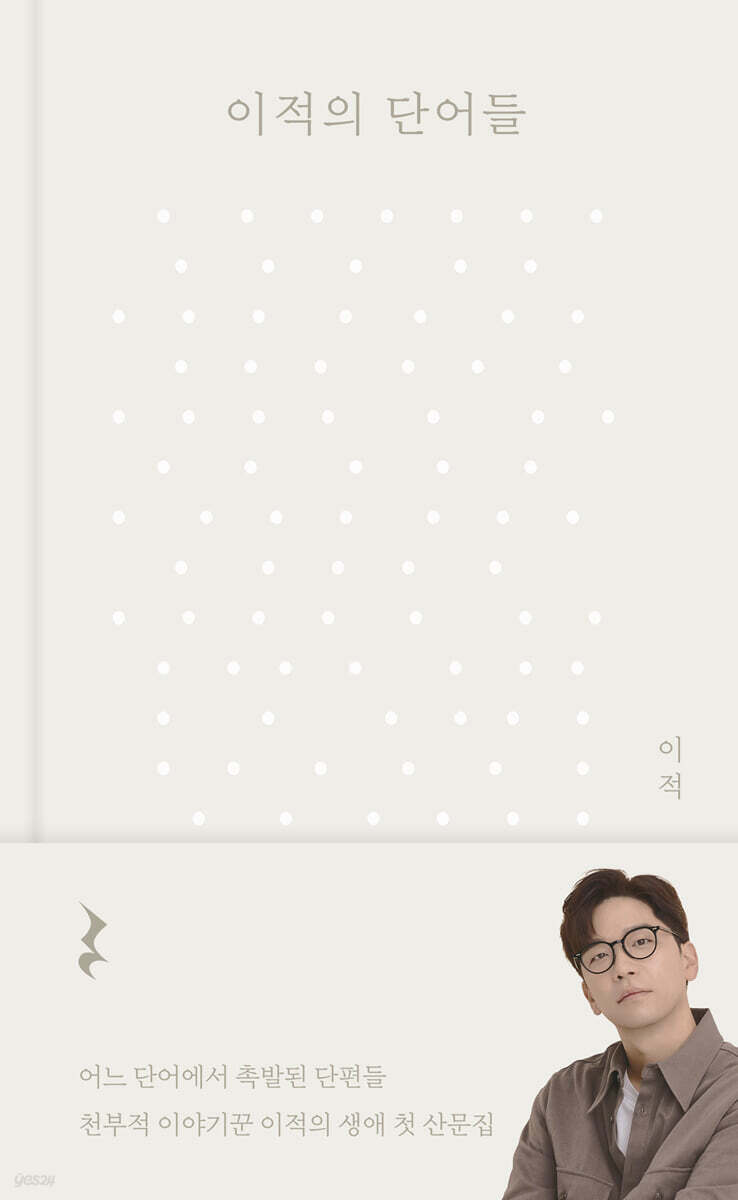
What we've been waiting for so long The first prose collection of the life of the gifted storyteller Lee Juck. There was a man who bought a new laptop to write a new book. He spent three years writing the manuscript, occasionally posting short pieces on his social media. It raised a problematic topic, conveyed a social resonance, and evoked public sympathy. One day, I spent two seasons revising the accumulated short stories and examining unpublished works that had not been shown anywhere. Those who were quick-witted noticed. That he was making a book. A singer-songwriter and natural storyteller who needs no adjectives before his name. This is how Lee Jeok wrote his first collection of prose. Just before the deadline, he said he hoped it would be a “timeless book” that would stay with us for a long time without being influenced by trends. "Words of Transfer" is a collection of essays that weave together stories triggered by certain words. Although it wears the guise of prose, it actually straddles the line between poetry and novels. It criticizes the reality we take for granted and unfolds a new world like a bird's feather, depicting "hope and salvation." Divided into five parts—The Breadth of Life, The Height of Imagination, The Differences of Language, The Depth of Song, and The Length of Oneself—the book delves into the heart of the story without beating around the bush, and its sharp humor will have you hitting your knees. It breaks away from the prose we have seen so far and emanates meaning at the midpoint between everyday life and fantasy. The transfer washed and washed the language, finding proper sentences and honest rhetoric. He expresses his perspective on the world through his paintings, and his eyes resemble those of a boy looking at a pottery that endures the fire of a 1,250-degree kiln, and the gaze of an old man looking at it. He describes the writing as a bolt of lightning striking from the tip of a pen. Writing the circumstances surrounding the lightning strike is narration, but writing the moment the lightning strikes is spirit. This book contains such a sparkling spirit. Solid fragments that don't sound like grunts because they lack finesse awaken joy and sorrow. |
- You can preview some of the book's contents.
Preview
index
Jeonju.
word
Part 1.
The breadth of life
Life · Life 2 · Wisdom · Star · Redfish · Wounds · Shoes · Earphones · Vicious Cycle · Crossroads · Dustpan · Motion Sickness · Value · Voting · Banknotes · Go-Stop · Time · Christmas · Year-end
Part 2.
Height of imagination
Movie theater · Reset · Ramen · Karma · Bag · Lighter · AI · Insulation · Devil · Zombie · Virtual human · Water skipping · Immortality · Library · Water drop · Parallel universe · Central line · Insomnia · Phobia · Snowman · Crisis · Train · Shower ball · Pillow · Toilet paper · Revolving door · Dimple · Cell
Part 3.
Language differences
Front and back · fear · fullness · change · lie down · rice cake · cliché · empathy · gas · part · kindness · taste · toothbrush · cause and effect
Part 4.
Depth of the song
Guitar · Dance · Creation · Thought Experiment · Multitasking · Goose · Rain · Sky · Laundry · Knot · Lies · Let It Go · Rabbit · Live · Noise Between Floors · Concert · Piano
Part 5.
own length
Seed · Irritation · Case · Cotton candy · Tears · Benign paroxysmal positional vertigo · Persistence · Sustainability · Obsession · Sleep · Three meals a day · Age · Coffee · Alcohol · Mirror · Greed · Success · Side effects · Beard · Freedom · Worry
The last one.
forest
word
Part 1.
The breadth of life
Life · Life 2 · Wisdom · Star · Redfish · Wounds · Shoes · Earphones · Vicious Cycle · Crossroads · Dustpan · Motion Sickness · Value · Voting · Banknotes · Go-Stop · Time · Christmas · Year-end
Part 2.
Height of imagination
Movie theater · Reset · Ramen · Karma · Bag · Lighter · AI · Insulation · Devil · Zombie · Virtual human · Water skipping · Immortality · Library · Water drop · Parallel universe · Central line · Insomnia · Phobia · Snowman · Crisis · Train · Shower ball · Pillow · Toilet paper · Revolving door · Dimple · Cell
Part 3.
Language differences
Front and back · fear · fullness · change · lie down · rice cake · cliché · empathy · gas · part · kindness · taste · toothbrush · cause and effect
Part 4.
Depth of the song
Guitar · Dance · Creation · Thought Experiment · Multitasking · Goose · Rain · Sky · Laundry · Knot · Lies · Let It Go · Rabbit · Live · Noise Between Floors · Concert · Piano
Part 5.
own length
Seed · Irritation · Case · Cotton candy · Tears · Benign paroxysmal positional vertigo · Persistence · Sustainability · Obsession · Sleep · Three meals a day · Age · Coffee · Alcohol · Mirror · Greed · Success · Side effects · Beard · Freedom · Worry
The last one.
forest
Detailed image

Into the book
“It seems like it was just yesterday that I was a child, but now it’s only a day or two before I go,” said the grandmother. The child asked teasingly, “Hey, Grandma, so you’re saying that life is five days in total?”
Then the grandmother smiled, looked at the child blankly, and muttered.
"okay.
“That is indeed so.”
---From "Life 2"
We walk into Plato's cave and stare blankly at our own shadows, cast by the fire on the cave walls.
As someone began to mutter a spell and someone else began to recite a tribal legend passed down from time immemorial, the little boy who had been playing around, almost listening, put his hands together and projected a small bird shadow onto the wall, bursting into laughter.
We will sit together, holding our breath, blushing as if for the first time, and be captivated by the miracle of the moment when a story magically emerges and then disappears.
Where the lights go out and the light comes in, where dreams illuminated by light shine, the only darkness we willingly enter, in the movie theater.
---From "Movie Theater"
No matter how long he waited at the baggage claim area at the airport, C's bag never came out.
In the end, there was only one bag that looked like that bag spinning around.
C quietly picked it up and walked away.
If you ask the airline, you won't even get this.
What did I hear? My heart is pounding.
---From "Bag"
The phrases “look ten years ahead” and “look ten years into the future” mean exactly the same thing.
Isn't it strange? You can see it if you replace "front and back" with the interchangeable Chinese characters "front (前)" and "back (後)".
'10 years ago' means the past, and '10 years later' means the future.
But how did both ‘10 years ahead’ and ‘10 years later’ come to mean the future?
Does this mean that the front and back of time are the same?
Does this mean that whether we go forward or backward, we are ultimately flowing into the future?
When we look at the 'front and back' of time and the 'back and forth', where are our eyes directed and where are our backs turned?
---From "front and back"
I think I'll do the laundry by hand.
I think the washing machine will do the laundry.
So I couldn't sing, "I need to do laundry."
I wanted to erase all traces of old love through a series of actions: taking water, squeezing it until not a single drop came out, and then throwing away the remaining water.
But that's not as easy as it sounds, so even if it rains in the afternoon, I continue doing the laundry I started until my wrists fall off.
He kept wiping the sweat that flowed down his forehead and into his eyes with his shoulder.
I kept telling myself that these were not tears.
---From "Laundry"
It's been 10 years since I developed kidney stones.
In my case, the signal comes especially during the cold, windy season, and after various experiences, I learned that it is not good to sleep on the left side, so I have been sleeping only on the right side for a long time.
Sometimes, when I turn slightly to the left while sleeping, I feel dizzy.
A precursor to 'rotational vertigo', where the world spins like in Hitchcock's film 'Vertigo'.
A subtle sway that only calms down when you turn your body to the right abruptly, as if pulling your foot off the edge of a dizzying cliff.
Just a slight change in the position of a small stone in your ear that you didn't even know was there completely shakes the stability of the world.
How fragile are human beings.
Then the grandmother smiled, looked at the child blankly, and muttered.
"okay.
“That is indeed so.”
---From "Life 2"
We walk into Plato's cave and stare blankly at our own shadows, cast by the fire on the cave walls.
As someone began to mutter a spell and someone else began to recite a tribal legend passed down from time immemorial, the little boy who had been playing around, almost listening, put his hands together and projected a small bird shadow onto the wall, bursting into laughter.
We will sit together, holding our breath, blushing as if for the first time, and be captivated by the miracle of the moment when a story magically emerges and then disappears.
Where the lights go out and the light comes in, where dreams illuminated by light shine, the only darkness we willingly enter, in the movie theater.
---From "Movie Theater"
No matter how long he waited at the baggage claim area at the airport, C's bag never came out.
In the end, there was only one bag that looked like that bag spinning around.
C quietly picked it up and walked away.
If you ask the airline, you won't even get this.
What did I hear? My heart is pounding.
---From "Bag"
The phrases “look ten years ahead” and “look ten years into the future” mean exactly the same thing.
Isn't it strange? You can see it if you replace "front and back" with the interchangeable Chinese characters "front (前)" and "back (後)".
'10 years ago' means the past, and '10 years later' means the future.
But how did both ‘10 years ahead’ and ‘10 years later’ come to mean the future?
Does this mean that the front and back of time are the same?
Does this mean that whether we go forward or backward, we are ultimately flowing into the future?
When we look at the 'front and back' of time and the 'back and forth', where are our eyes directed and where are our backs turned?
---From "front and back"
I think I'll do the laundry by hand.
I think the washing machine will do the laundry.
So I couldn't sing, "I need to do laundry."
I wanted to erase all traces of old love through a series of actions: taking water, squeezing it until not a single drop came out, and then throwing away the remaining water.
But that's not as easy as it sounds, so even if it rains in the afternoon, I continue doing the laundry I started until my wrists fall off.
He kept wiping the sweat that flowed down his forehead and into his eyes with his shoulder.
I kept telling myself that these were not tears.
---From "Laundry"
It's been 10 years since I developed kidney stones.
In my case, the signal comes especially during the cold, windy season, and after various experiences, I learned that it is not good to sleep on the left side, so I have been sleeping only on the right side for a long time.
Sometimes, when I turn slightly to the left while sleeping, I feel dizzy.
A precursor to 'rotational vertigo', where the world spins like in Hitchcock's film 'Vertigo'.
A subtle sway that only calms down when you turn your body to the right abruptly, as if pulling your foot off the edge of a dizzying cliff.
Just a slight change in the position of a small stone in your ear that you didn't even know was there completely shakes the stability of the world.
How fragile are human beings.
---From "Bipolar Disorder"
Publisher's Review
Fragments triggered by certain words chosen by Lee Jeok
Esprit, a lightning bolt in a confusing world
Lee Jeok, a natural storyteller, wrote his first collection of prose based on the motif of 'words'.
Sometimes he analyzes language with keen insight like a mathematician, sometimes he sees through the enigmatic side of life like a philosopher, and sometimes he lets his imagination spark like a novelist.
The words he chose are imbued with the worries and desires of everyday life, the joys and sorrows of a musician, and the despair and hopes of living as a member of this world.
With what mindset did he select the 101 words included? He must have long cherished and collected fragments of the world and thoughts surrounding them: memorable events, ultimate values, social issues, human aspects, spontaneous ideas, moments of joy, sorrow, and pleasure.
So, his writing feels time and depth.
What is the word that made me who I am today?
Life begins with calling and writing a word.
At birth, a life is given a one-word name.
That life grows by learning the single word 'mom' and 'dad' and naming what it loves.
Thus, the words surrounding humans are more than just letters consisting of a few syllables; they are like 'boxes of meaning' with hundreds of meanings.
"Words of Transfer" is a collection of such word boxes.
Part 1 draws the 'point, line, and surface' of life and measures its area.
We look back on the questions and goals that a child faces as he or she grows into an adult, examine the lines of wounds that resemble crumpled paper and leave traces, and find the aspects that are right for him or her.
Just as the value of a "mask" has changed from pandemic to endemic, it highlights the existence of things in our lives that change and things that should not change.
Part 2 contains novel-like reality and novel-like reality.
It features a strange story about a reset button that “returns you and everything around you to five years ago,” a demon that appears “while you’re sitting on the toilet one sunny Saturday morning,” and a virtual human who has had his prime and is quickly forgotten by the public.
The innocent jokes and strangely twisted writing shine through.
Part 3 expands semantic thinking beyond the morphological analysis of language.
“Look forward” and “look back” have the same meaning, but the former is looking towards you, while the latter is looking away.
“You’ve changed” and “You’ve changed so much I didn’t know” seem similar at first glance, but the former is closer to “disconnection” and the latter is closer to “transformation.”
‘To poop’ and ‘to poop’, ‘gas’ and ‘gas’, ‘fear’ and ‘afraid’, etc.
It shows an effort to perceive the hidden meaning of similar yet different languages and to recognize them accurately with precise words.
Part 4 looks back on the path taken by Lee Juck, who creates “music that endures time.”
If you are a fan of his, these are probably articles you would be curious about.
From Carnival's "Goose's Dream" to "Trace," a song from his 6th regular album, this album documents the birth of Lee Juck's musical world and lyrics.
We can live without music, but our lives will be better with music.
“Is there a way to play the guitar without embracing it?” Don’t famous songs usually flow out while embracing the sadness inside of life?
The origin of the lyrics, which carry a deep resonance, can be found in Part 4.
Part 5 reflects on one's past, present, and future and measures the length of one's life.
The feelings of middle age and the changes in sleeping conditions due to benign paroxysmal positional vertigo.
Still the same obsession and flexible greed.
Each episode, beginning with “Seed” and ending with “Worry,” reflects on the “finiteness of life” and my potential, and arrives at the freedom we so desperately seek.
What is freedom?
It's not the feeling of struggling to stay dry when it rains, but something you can only feel when you're completely soaked.
Only when we accept our worries and discouragement can we find peace.
A man whose hands are as attuned to the typewriter as they are to the keyboard, the books he writes resemble his music.
The 101st poem, which begins with the preface “Words” and ends with the postface “Forest,” sketches “the landscape of the mind. / Sometimes a lifeless landscape” and concludes with the word “rest.”
Why is it a break?
Isn't it because when we breathe well, whether we write, sing, or live, we can maintain our vitality?
Lee Jeok wrote as if he were giving a reading in a small theater, and you might savor the sentences in the book and hum:
“Now I know.
“There was a reason for those tears.”
Esprit, a lightning bolt in a confusing world
Lee Jeok, a natural storyteller, wrote his first collection of prose based on the motif of 'words'.
Sometimes he analyzes language with keen insight like a mathematician, sometimes he sees through the enigmatic side of life like a philosopher, and sometimes he lets his imagination spark like a novelist.
The words he chose are imbued with the worries and desires of everyday life, the joys and sorrows of a musician, and the despair and hopes of living as a member of this world.
With what mindset did he select the 101 words included? He must have long cherished and collected fragments of the world and thoughts surrounding them: memorable events, ultimate values, social issues, human aspects, spontaneous ideas, moments of joy, sorrow, and pleasure.
So, his writing feels time and depth.
What is the word that made me who I am today?
Life begins with calling and writing a word.
At birth, a life is given a one-word name.
That life grows by learning the single word 'mom' and 'dad' and naming what it loves.
Thus, the words surrounding humans are more than just letters consisting of a few syllables; they are like 'boxes of meaning' with hundreds of meanings.
"Words of Transfer" is a collection of such word boxes.
Part 1 draws the 'point, line, and surface' of life and measures its area.
We look back on the questions and goals that a child faces as he or she grows into an adult, examine the lines of wounds that resemble crumpled paper and leave traces, and find the aspects that are right for him or her.
Just as the value of a "mask" has changed from pandemic to endemic, it highlights the existence of things in our lives that change and things that should not change.
Part 2 contains novel-like reality and novel-like reality.
It features a strange story about a reset button that “returns you and everything around you to five years ago,” a demon that appears “while you’re sitting on the toilet one sunny Saturday morning,” and a virtual human who has had his prime and is quickly forgotten by the public.
The innocent jokes and strangely twisted writing shine through.
Part 3 expands semantic thinking beyond the morphological analysis of language.
“Look forward” and “look back” have the same meaning, but the former is looking towards you, while the latter is looking away.
“You’ve changed” and “You’ve changed so much I didn’t know” seem similar at first glance, but the former is closer to “disconnection” and the latter is closer to “transformation.”
‘To poop’ and ‘to poop’, ‘gas’ and ‘gas’, ‘fear’ and ‘afraid’, etc.
It shows an effort to perceive the hidden meaning of similar yet different languages and to recognize them accurately with precise words.
Part 4 looks back on the path taken by Lee Juck, who creates “music that endures time.”
If you are a fan of his, these are probably articles you would be curious about.
From Carnival's "Goose's Dream" to "Trace," a song from his 6th regular album, this album documents the birth of Lee Juck's musical world and lyrics.
We can live without music, but our lives will be better with music.
“Is there a way to play the guitar without embracing it?” Don’t famous songs usually flow out while embracing the sadness inside of life?
The origin of the lyrics, which carry a deep resonance, can be found in Part 4.
Part 5 reflects on one's past, present, and future and measures the length of one's life.
The feelings of middle age and the changes in sleeping conditions due to benign paroxysmal positional vertigo.
Still the same obsession and flexible greed.
Each episode, beginning with “Seed” and ending with “Worry,” reflects on the “finiteness of life” and my potential, and arrives at the freedom we so desperately seek.
What is freedom?
It's not the feeling of struggling to stay dry when it rains, but something you can only feel when you're completely soaked.
Only when we accept our worries and discouragement can we find peace.
A man whose hands are as attuned to the typewriter as they are to the keyboard, the books he writes resemble his music.
The 101st poem, which begins with the preface “Words” and ends with the postface “Forest,” sketches “the landscape of the mind. / Sometimes a lifeless landscape” and concludes with the word “rest.”
Why is it a break?
Isn't it because when we breathe well, whether we write, sing, or live, we can maintain our vitality?
Lee Jeok wrote as if he were giving a reading in a small theater, and you might savor the sentences in the book and hum:
“Now I know.
“There was a reason for those tears.”
GOODS SPECIFICS
- Date of issue: May 25, 2023
- Format: Hardcover book binding method guide
- Page count, weight, size: 224 pages | 346g | 125*205*20mm
- ISBN13: 9788934978831
- ISBN10: 893497883X
You may also like
카테고리
korean


korean

![GQ KOREA Mark (Monthly): December [2025]](http://librairie.coreenne.fr/cdn/shop/files/8ef265dbbfbf186523ed75ba7319009d.jpg?v=1765340328&width=3840)


