

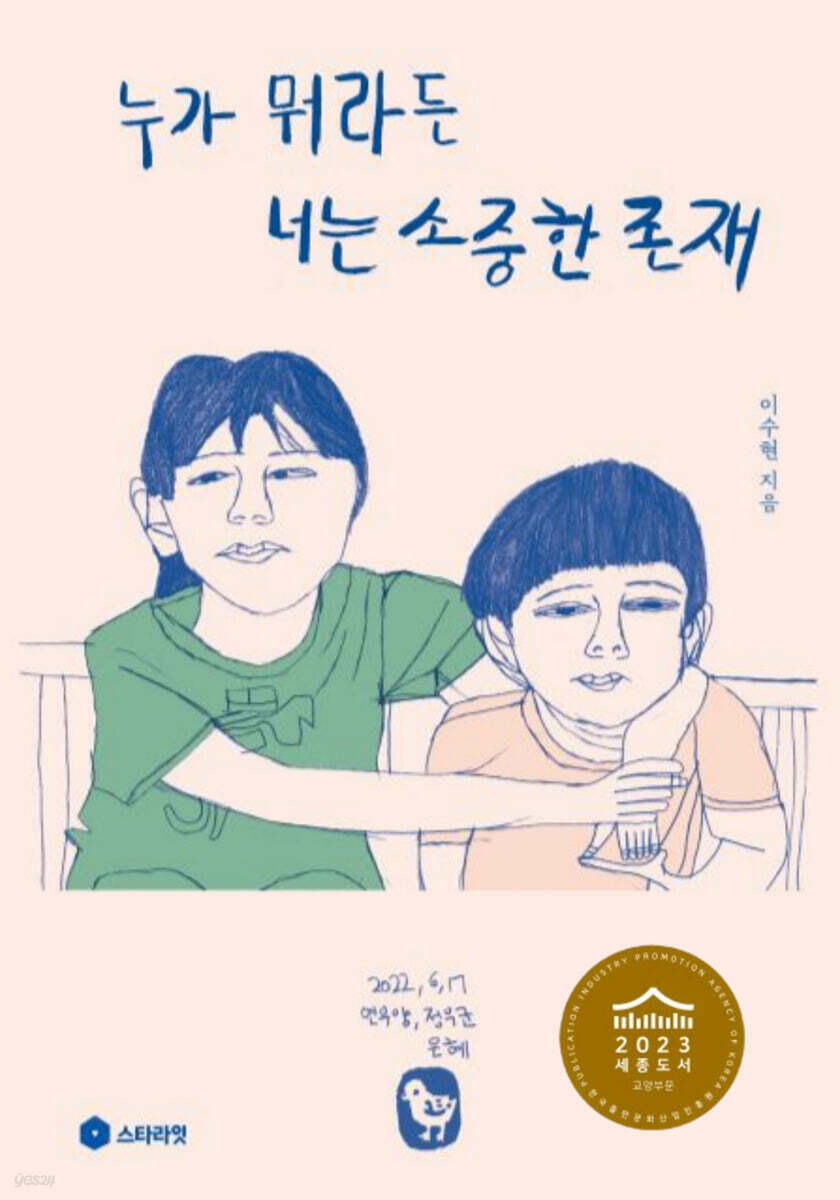
No matter what anyone says, you are precious
 |
Description
Book Introduction
“Our outings are not common at all “I hope it can become a very common outing among ordinary people······.” It is not easy for children with developmental disabilities to even go to the playground. Children sometimes look down on them because they make meaningless noises, repeat the same words, and behave in unusual ways. What's even more heartbreaking is the unspoken look that says, 'Our child shouldn't be next to that person.' As a mother of a disabled child, I have been in this situation hundreds of times and it breaks my heart every time. It is even more frustrating because I cannot go to the hospital to fix my child's behavior, which is 'a little different from other children'. A life where even common outings cannot be taken lightly. The author calmly reveals the unspeakable pain and wounds she experienced while raising a child with a developmental disability, as well as the moments of hope that came to her like gifts amidst them. |
- You can preview some of the book's contents.
Preview
index
Recommendation
Author's Note
Chapter 1 Courage
#1.
sudden misfortune
#2.
Today, I'm going to press the 'emotion' button again.
#3.
A common outing
#4.
Should I have immigrated?
#5.
Whose fault is it?
Chapter 2 Me
#1.
A daughter who resembles me
#2.
difficult choice
#3.
My head is my heart
#4.
I build muscle instead of red lipstick
#5.
Building mental muscle
#6.
Reminiscences of a Spring Day
Chapter 3 Family
#1.
Man peeling apples
#2.
I'm sorry, Mom
#3.
There's a reason for everything
#4.
Love in home cooking
#5.
Dad's birthday party
#6.
Raising a child is difficult.
Chapter 4 Children
#1.
Face it head on
#2.
I want to take the class too
#3.
The pain in your eyes
#4.
child with an umbrella
#5.
May wisdom be with me
#6.
Friends are what you make of them
#7.
No matter what anyone says
#8.
A child who doesn't call me mom
#9.
When a child is injured
#10.
invisible discrimination
#11.
I tried it and it worked
Chapter 5 Friends
#1.
Best beauty salon
#2.
Our house teacher Sullivan
#3.
A child raised together
#4.
Do you have to be good at using chopsticks to eat well?
#5.
true friend
#6.
Someone I want to talk to
#7.
About comfort
Chapter 6: A Song to Sing Together
#1.
Teacher, did I do well?
#2.
Yesul's sincerity
#3.
So what if I'm not good at English?
#4.
Teachers are people too
#5.
I love you, teacher
#6.
A song to sing together
To my beloved daughter and son
People who support us
Author's Note
Chapter 1 Courage
#1.
sudden misfortune
#2.
Today, I'm going to press the 'emotion' button again.
#3.
A common outing
#4.
Should I have immigrated?
#5.
Whose fault is it?
Chapter 2 Me
#1.
A daughter who resembles me
#2.
difficult choice
#3.
My head is my heart
#4.
I build muscle instead of red lipstick
#5.
Building mental muscle
#6.
Reminiscences of a Spring Day
Chapter 3 Family
#1.
Man peeling apples
#2.
I'm sorry, Mom
#3.
There's a reason for everything
#4.
Love in home cooking
#5.
Dad's birthday party
#6.
Raising a child is difficult.
Chapter 4 Children
#1.
Face it head on
#2.
I want to take the class too
#3.
The pain in your eyes
#4.
child with an umbrella
#5.
May wisdom be with me
#6.
Friends are what you make of them
#7.
No matter what anyone says
#8.
A child who doesn't call me mom
#9.
When a child is injured
#10.
invisible discrimination
#11.
I tried it and it worked
Chapter 5 Friends
#1.
Best beauty salon
#2.
Our house teacher Sullivan
#3.
A child raised together
#4.
Do you have to be good at using chopsticks to eat well?
#5.
true friend
#6.
Someone I want to talk to
#7.
About comfort
Chapter 6: A Song to Sing Together
#1.
Teacher, did I do well?
#2.
Yesul's sincerity
#3.
So what if I'm not good at English?
#4.
Teachers are people too
#5.
I love you, teacher
#6.
A song to sing together
To my beloved daughter and son
People who support us
Detailed image
.jpg)
Into the book
For the past few years, I've tried to hide it if I could.
Whether we went to a restaurant, a cafe, or even took the elevator, we always pushed the children to a corner.
I was afraid of how other people would view my children, and I felt uncomfortable that they would look down on me for raising a child with disabilities.
When my child was running around in a crowded place making meaningless noises, I often felt pain from the stares of people and had to urge my child to hurry home.
I was distressed because I felt like I was being treated as an inferior being and was receiving pity from people just because I had a disabled child.
It took me a long time to realize that disability is not something to be ashamed of, nor is it something to be hidden or concealed.
Now, I have shed the half-truth that kept my children hidden, and have found the courage to proudly put my children 'in front' of me.
I am slowly realizing that a life where I willingly show and share even my bruised and painful self is more beautiful than a life where I only show my pretty side to others.
---From the author's note
Should I say it's a mother-in-law?
In my daughter, I see myself taking care of my younger sibling when I was little.
Although Yeonwoo was never asked or told to take care of her younger sibling, at some point she started taking care of her younger sibling on her own.
Whenever we go out together, I follow my younger sibling who runs around distractedly, feeling anxious and afraid of getting lost.
When taking the elevator, he pulls his younger sibling out first to make sure the doors don't close and prevent him from getting off, and then gets off himself.
Whenever there's a line at the playground, he always puts his younger sibling in front of him.
If your younger sibling falls, you help them up, and if you go to an unfamiliar place, you hold their hand tightly.
---From "Chapter 2 Me"
I sometimes imagine this.
"What would my life be like if my children weren't disabled? What would my life be like if my children weren't disabled?" I believe the answer to that question should be the same, no matter what my children look like.
Whether my children are disabled or not, I should be able to answer that I live an equally independent and happy life.
No matter what my situation or circumstances are, I must be happy first before I can take care of others.
Isn't that the beginning of a healthy life?
---From "Chapter 2 Me"
My mother always tried to comfort me rather than express her frustration.
But I could tell by the moistness in my mother's eyes every time we had a video call.
Every day, I pray and cry inwardly.
An old man who had no spare money in his pocket sent more money on Children's Day.
The moment I saw the three characters of my mother's name printed on the bankbook, tears welled up in my eyes.
Our kids don't even know what Children's Day is...
I called you with an apologetic heart.
---From "Chapter 3 Family"
Since it said 'kids in our class', I naturally thought that my child's picture would be included.
With a flushed face, I replayed the video again, hoping to find my child in the background of other children's photos, just in case I had missed him.
My child didn't appear anywhere in the video, and I cried for a long time, unable to calm my heart from the pain and disappointment.
---From "Chapter 4 Children"
"auntie.
When I first met Yeonwoo, he only talked to himself every day and we couldn't have a good conversation, but now he's talking a lot more.
“It’s really gotten better.” The child’s way of speaking, as if imitating an adult, was somehow cute and unique, and I burst out laughing.
The children were truly happy to see Yeonwoo grow up.
For Yeonwoo, her classmates were the best play therapists and speech therapists.
Yeonwoo is learning how to live together like that.
Yeonwoo's friends are also learning.
Within the framework of integrated education, a microcosm of a society where we live together.
Whether we went to a restaurant, a cafe, or even took the elevator, we always pushed the children to a corner.
I was afraid of how other people would view my children, and I felt uncomfortable that they would look down on me for raising a child with disabilities.
When my child was running around in a crowded place making meaningless noises, I often felt pain from the stares of people and had to urge my child to hurry home.
I was distressed because I felt like I was being treated as an inferior being and was receiving pity from people just because I had a disabled child.
It took me a long time to realize that disability is not something to be ashamed of, nor is it something to be hidden or concealed.
Now, I have shed the half-truth that kept my children hidden, and have found the courage to proudly put my children 'in front' of me.
I am slowly realizing that a life where I willingly show and share even my bruised and painful self is more beautiful than a life where I only show my pretty side to others.
---From the author's note
Should I say it's a mother-in-law?
In my daughter, I see myself taking care of my younger sibling when I was little.
Although Yeonwoo was never asked or told to take care of her younger sibling, at some point she started taking care of her younger sibling on her own.
Whenever we go out together, I follow my younger sibling who runs around distractedly, feeling anxious and afraid of getting lost.
When taking the elevator, he pulls his younger sibling out first to make sure the doors don't close and prevent him from getting off, and then gets off himself.
Whenever there's a line at the playground, he always puts his younger sibling in front of him.
If your younger sibling falls, you help them up, and if you go to an unfamiliar place, you hold their hand tightly.
---From "Chapter 2 Me"
I sometimes imagine this.
"What would my life be like if my children weren't disabled? What would my life be like if my children weren't disabled?" I believe the answer to that question should be the same, no matter what my children look like.
Whether my children are disabled or not, I should be able to answer that I live an equally independent and happy life.
No matter what my situation or circumstances are, I must be happy first before I can take care of others.
Isn't that the beginning of a healthy life?
---From "Chapter 2 Me"
My mother always tried to comfort me rather than express her frustration.
But I could tell by the moistness in my mother's eyes every time we had a video call.
Every day, I pray and cry inwardly.
An old man who had no spare money in his pocket sent more money on Children's Day.
The moment I saw the three characters of my mother's name printed on the bankbook, tears welled up in my eyes.
Our kids don't even know what Children's Day is...
I called you with an apologetic heart.
---From "Chapter 3 Family"
Since it said 'kids in our class', I naturally thought that my child's picture would be included.
With a flushed face, I replayed the video again, hoping to find my child in the background of other children's photos, just in case I had missed him.
My child didn't appear anywhere in the video, and I cried for a long time, unable to calm my heart from the pain and disappointment.
---From "Chapter 4 Children"
"auntie.
When I first met Yeonwoo, he only talked to himself every day and we couldn't have a good conversation, but now he's talking a lot more.
“It’s really gotten better.” The child’s way of speaking, as if imitating an adult, was somehow cute and unique, and I burst out laughing.
The children were truly happy to see Yeonwoo grow up.
For Yeonwoo, her classmates were the best play therapists and speech therapists.
Yeonwoo is learning how to live together like that.
Yeonwoo's friends are also learning.
Within the framework of integrated education, a microcosm of a society where we live together.
---From "Chapter 6: Songs We Sing Together"
Publisher's Review
A misfortune that struck one day
“Then one day, the child started acting strangely.
“A feeling of inexplicable anxiety came over me.”
I thought he was gifted.
She was the envy of other mothers as she read fairy tales in original texts that were difficult to find in the United States, and the online cafe she started to provide information quickly grew to thousands of members through word of mouth.
Then one day, the child's eyes suddenly began to change.
I went to the hospital with a confused mind······.
The author, an English teacher who passed the teacher certification exam, is making every effort to raise her child as a gifted child during her parental leave.
I was living a happy life, educating my child with English textbooks, but one day, my child was diagnosed with a developmental disability, and even my second child, who was my last hope, was diagnosed with a developmental disability.
The author raises the child alone in pain, blocking out all expectations and attention from those around him.
A story that started on social media
“The world of social media was also a world where people lived and smelled like people.
“It was a virtual space, but there was a warm feeling because there were people there.”
Raising an ordinary child is accompanied by the pain of human growth, but if the child has a developmental disability or is on the autism spectrum, the parents fall into a swamp of pain so deep that it could kill them.
Even if it's not my child, what if my neighbor's child has a developmental disability? How should we accept the one or two children with developmental disabilities in every classroom these days? Should the parents who gave birth to these children be solely responsible? The author, raising two children with disabilities, endured days when she felt like dying, and decided to share the reality of families with developmental disabilities on social media.
Now, her writing has resonated deeply with 5,000 readers every day, and her tearful account of her daily life has been compiled into essays.
Down syndrome caricature artist "Jeong Eun-hye" contributed cover illustration and handwriting.
It wasn't that people were indifferent.
There are basic 'compassion' and 'love' in the human heart.
It's because they don't know the life of a disabled person's family.
Her writing has the power and energy to warm the hearts of those who are indifferent to others.
She is the one who needs to be comforted, but the people who read the article are comforted.
I look back on my wounds.
I forgive you.
Parents will understand and embrace their children more, and children will understand and embrace their parents more.
Kim Tae-eun, CEO of Starlight Publishing, which published this book, said, “This book will not only raise awareness of disabilities but also tell the stories of people with disabilities and their families, providing a new perspective on how we can live together not only at home, but also at school, work, and throughout society.”
Also, cartoonist Jang Cha-hyeon, mother of Down syndrome caricature artist Jeong Eun-hye, said in her recommendation, “Discovering a child’s potential is not something external, but an inner strength that only a mother possesses.
He emphasized once again the importance of parents' educational philosophy, saying, "It is important to raise children by recognizing their 'children's identity' and breaking away from narrow-minded perspectives and thinking."
As we hear heartbreaking news about parents raising children with developmental disabilities, I hope that author Lee Su-hyeon's book, "No Matter What People Say, You Are Precious," will help families with disabilities understand each other better and become a bridge to living together.
“Then one day, the child started acting strangely.
“A feeling of inexplicable anxiety came over me.”
I thought he was gifted.
She was the envy of other mothers as she read fairy tales in original texts that were difficult to find in the United States, and the online cafe she started to provide information quickly grew to thousands of members through word of mouth.
Then one day, the child's eyes suddenly began to change.
I went to the hospital with a confused mind······.
The author, an English teacher who passed the teacher certification exam, is making every effort to raise her child as a gifted child during her parental leave.
I was living a happy life, educating my child with English textbooks, but one day, my child was diagnosed with a developmental disability, and even my second child, who was my last hope, was diagnosed with a developmental disability.
The author raises the child alone in pain, blocking out all expectations and attention from those around him.
A story that started on social media
“The world of social media was also a world where people lived and smelled like people.
“It was a virtual space, but there was a warm feeling because there were people there.”
Raising an ordinary child is accompanied by the pain of human growth, but if the child has a developmental disability or is on the autism spectrum, the parents fall into a swamp of pain so deep that it could kill them.
Even if it's not my child, what if my neighbor's child has a developmental disability? How should we accept the one or two children with developmental disabilities in every classroom these days? Should the parents who gave birth to these children be solely responsible? The author, raising two children with disabilities, endured days when she felt like dying, and decided to share the reality of families with developmental disabilities on social media.
Now, her writing has resonated deeply with 5,000 readers every day, and her tearful account of her daily life has been compiled into essays.
Down syndrome caricature artist "Jeong Eun-hye" contributed cover illustration and handwriting.
It wasn't that people were indifferent.
There are basic 'compassion' and 'love' in the human heart.
It's because they don't know the life of a disabled person's family.
Her writing has the power and energy to warm the hearts of those who are indifferent to others.
She is the one who needs to be comforted, but the people who read the article are comforted.
I look back on my wounds.
I forgive you.
Parents will understand and embrace their children more, and children will understand and embrace their parents more.
Kim Tae-eun, CEO of Starlight Publishing, which published this book, said, “This book will not only raise awareness of disabilities but also tell the stories of people with disabilities and their families, providing a new perspective on how we can live together not only at home, but also at school, work, and throughout society.”
Also, cartoonist Jang Cha-hyeon, mother of Down syndrome caricature artist Jeong Eun-hye, said in her recommendation, “Discovering a child’s potential is not something external, but an inner strength that only a mother possesses.
He emphasized once again the importance of parents' educational philosophy, saying, "It is important to raise children by recognizing their 'children's identity' and breaking away from narrow-minded perspectives and thinking."
As we hear heartbreaking news about parents raising children with developmental disabilities, I hope that author Lee Su-hyeon's book, "No Matter What People Say, You Are Precious," will help families with disabilities understand each other better and become a bridge to living together.
GOODS SPECIFICS
- Publication date: July 27, 2022
- Page count, weight, size: 244 pages | 292g | 128*188*12mm
- ISBN13: 9791197135477
- ISBN10: 1197135472
You may also like
카테고리
korean


korean

![GQ KOREA Mark (Monthly): December [2025]](http://librairie.coreenne.fr/cdn/shop/files/8ef265dbbfbf186523ed75ba7319009d.jpg?v=1765340328&width=3840)


