

The mother tongue of drinkers
 |
Description
Book Introduction
“The handwriting that says ‘All about Anju’ is for the drunkards of this land.
“What a simple menu of truth it was.”
All about life and all about food written by novelist Kwon Yeo-seon
The power of one's native language felt in stories about eating and drinking
Author Kwon Yeo-seon, who awakens the beauty of elegant sentences and has become the most trusted name in Korean literature.
The author, who has been dedicated to writing for over a quarter of a century, has won numerous prestigious awards, including the 8th Kim Seung-ok Literary Award in 2023, the 15th Kim Yu-jeong Literary Award in 2021, the 19th Lee Hyo-seok Literary Award in 2018, the 47th Dong-in Literary Award in 2016, the 18th Dong-ri Literary Award in 2015, the 44th Hankook Ilbo Literary Award in 2012, the 32nd Yi Sang Literary Award in 2008, and the 15th Oh Young-su Literary Award in 2007, and has constantly been nominated for novel of the year by fellow novelists.
In particular, from 『Hello, Drunkard』(Changbi, 2016), which talks about alcohol and life with affection, to her most recent work 『Each Season』(Munhakdongne, 2023), she received praise for “being able to find a novel that is most suitable for this life without rushing or getting ahead of it is a fortune that only Kwon Yeo-seon readers can enjoy.”
"What Shall We Eat Today?", published in 2018 by the author who "knows the best novel for this life," is the author's first and only collection of prose.
This book, which describes alcohol, snacks, and food with a unique wit, has established itself as a 'delicious prose of life' for many readers.
Thanks to the support of readers who have been waiting for a sequel, we are presenting a special revised edition to commemorate the 6th anniversary of the publication.
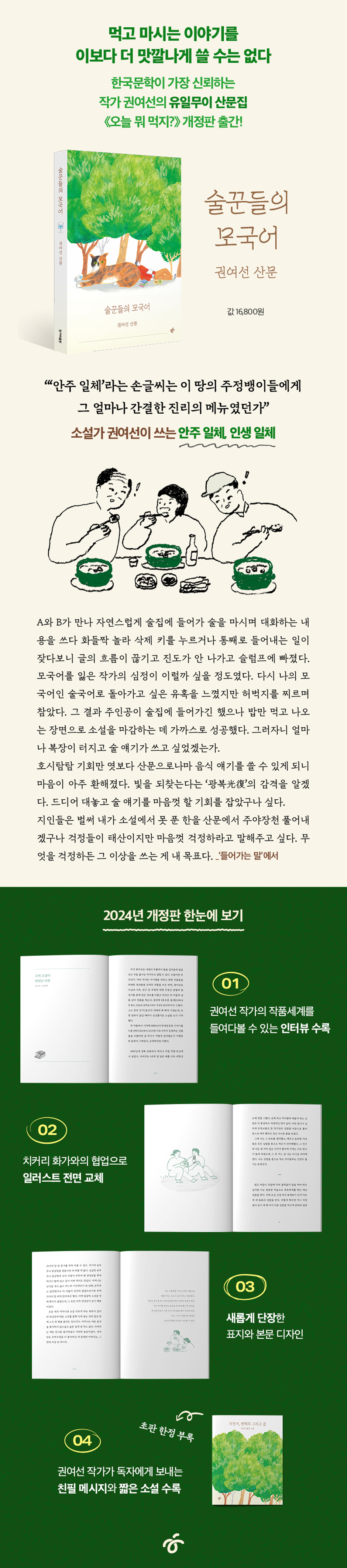
We collaborated with artist Chicory, who is beloved for his lovely paintings, to completely replace the illustrations in the text, and included an in-depth interview with the artist that delves into his world of work.
The author, who has been praised as the 'dignity of alcohol literature,' once again awakens us to the richness of prose that only Kwon Yeo-seon can write, through stories about eating and drinking that she was unable to fully express in her work.
I kept talking about alcohol whenever I had a chance during interviews or readings, and people around me advised me that it would be bad for the author if he continued to be fixed in that image.
I came to my senses and realized that this couldn't go on, so I made a drunken promise to myself that I would write novels without drinking a single drop of alcohol for the time being.
So, I had a lot of trouble writing the next novel.
As I was writing about A and B meeting, naturally going to a bar, drinking, and talking, I would often get startled and hit the delete button or delete the whole thing, which would break the flow of the writing, stop progressing, and I would fall into a slump.
It was to the point where I wondered if this was how a writer who had lost his native language felt.
I was tempted to go back to my native language, Sulguk, but I resisted, biting my thigh.
As a result, the novel barely manages to end with a scene where the protagonist enters a bar but only eats and comes out.
So how much did you want to talk about clothes and alcohol?
“What a simple menu of truth it was.”
All about life and all about food written by novelist Kwon Yeo-seon
The power of one's native language felt in stories about eating and drinking
Author Kwon Yeo-seon, who awakens the beauty of elegant sentences and has become the most trusted name in Korean literature.
The author, who has been dedicated to writing for over a quarter of a century, has won numerous prestigious awards, including the 8th Kim Seung-ok Literary Award in 2023, the 15th Kim Yu-jeong Literary Award in 2021, the 19th Lee Hyo-seok Literary Award in 2018, the 47th Dong-in Literary Award in 2016, the 18th Dong-ri Literary Award in 2015, the 44th Hankook Ilbo Literary Award in 2012, the 32nd Yi Sang Literary Award in 2008, and the 15th Oh Young-su Literary Award in 2007, and has constantly been nominated for novel of the year by fellow novelists.
In particular, from 『Hello, Drunkard』(Changbi, 2016), which talks about alcohol and life with affection, to her most recent work 『Each Season』(Munhakdongne, 2023), she received praise for “being able to find a novel that is most suitable for this life without rushing or getting ahead of it is a fortune that only Kwon Yeo-seon readers can enjoy.”
"What Shall We Eat Today?", published in 2018 by the author who "knows the best novel for this life," is the author's first and only collection of prose.
This book, which describes alcohol, snacks, and food with a unique wit, has established itself as a 'delicious prose of life' for many readers.
Thanks to the support of readers who have been waiting for a sequel, we are presenting a special revised edition to commemorate the 6th anniversary of the publication.
We collaborated with artist Chicory, who is beloved for his lovely paintings, to completely replace the illustrations in the text, and included an in-depth interview with the artist that delves into his world of work.
The author, who has been praised as the 'dignity of alcohol literature,' once again awakens us to the richness of prose that only Kwon Yeo-seon can write, through stories about eating and drinking that she was unable to fully express in her work.
I kept talking about alcohol whenever I had a chance during interviews or readings, and people around me advised me that it would be bad for the author if he continued to be fixed in that image.
I came to my senses and realized that this couldn't go on, so I made a drunken promise to myself that I would write novels without drinking a single drop of alcohol for the time being.
So, I had a lot of trouble writing the next novel.
As I was writing about A and B meeting, naturally going to a bar, drinking, and talking, I would often get startled and hit the delete button or delete the whole thing, which would break the flow of the writing, stop progressing, and I would fall into a slump.
It was to the point where I wondered if this was how a writer who had lost his native language felt.
I was tempted to go back to my native language, Sulguk, but I resisted, biting my thigh.
As a result, the novel barely manages to end with a scene where the protagonist enters a bar but only eats and comes out.
So how much did you want to talk about clothes and alcohol?
- You can preview some of the book's contents.
Preview
index
Introduction_A Novelist's Guide to Gastronomy
Part 1: Spring, a time of rapid progress
Lilac and Sundae
Dumplings that are like dumplings
Kimbap is good
The flower of flowers, the buchimgae flower
The marriage of salted seafood and porridge
Part 2: Summer Comes with Such a Thrillingly Attractive Step
Cotton of cotton
Mulhoe, and that too special!
The season of dandelions
Summer side dish competition
Part 3: The Endlessly Sweet, Sweet, Sweet Autumn Rainbow
Pot noodles and croquettes
Temperature of meals
Autumn Radish Three-Layer Cake
The first taste of winter, hands coming out of the neck in part 4
That soup, that gamjatang
Solfood braised cockle
A hearty meal of fish cake skewers
The era of home cooking
Part 5 My Special Treat
A historic squid frying restaurant
Squeak squeak mackerel
A holiday table full of soybean powder
I lost to Ganjjajang
Interview: Why His Novels Are Delicious
Part 1: Spring, a time of rapid progress
Lilac and Sundae
Dumplings that are like dumplings
Kimbap is good
The flower of flowers, the buchimgae flower
The marriage of salted seafood and porridge
Part 2: Summer Comes with Such a Thrillingly Attractive Step
Cotton of cotton
Mulhoe, and that too special!
The season of dandelions
Summer side dish competition
Part 3: The Endlessly Sweet, Sweet, Sweet Autumn Rainbow
Pot noodles and croquettes
Temperature of meals
Autumn Radish Three-Layer Cake
The first taste of winter, hands coming out of the neck in part 4
That soup, that gamjatang
Solfood braised cockle
A hearty meal of fish cake skewers
The era of home cooking
Part 5 My Special Treat
A historic squid frying restaurant
Squeak squeak mackerel
A holiday table full of soybean powder
I lost to Ganjjajang
Interview: Why His Novels Are Delicious
Detailed image
Into the book
That's exactly what alcoholics are like.
There are many tasteless foods in the world, but there are no tasteless side dishes.
There is nothing you can't eat if you put the word 'side dish' after the food.
--- p.7
Like that, my taste buds grew and grew along with soju.
--- p.23
Kimbap is a generous food.
As long as you have seaweed and rice, the other ingredients don't matter.
Kimbap is a beautiful food.
If you just get the colors of the ingredients right, there is no food more beautiful than this.
So, perhaps kimbap is imbued with the allure of flower viewing and outings.
Not because it's easy to carry, but because it resembles a flower garden in itself.
--- p.39
I first fasted in my late twenties.
It wasn't to lose weight or for political purposes.
There are times in life when I feel like there's something useless inside me, and that was a time when that was particularly true.
A time when, like a drawer that had not been organized for a long time, shabby regrets piled up, pieces of broken plans were scattered, and dark, gloomy gloom settled like dust.
I impulsively started fasting because I wanted to completely empty my mind and body.
Anyone who has ever fasted will know.
Fasting is a battle against appetite, but it is also a battle against time.
There is no day as long as the first day of fasting.
Strangely, time doesn't pass if you don't eat anything.
When we starve, we realize how minutely our days are structured around eating.
--- p.61
Since my first fast, I have fasted once every few years.
While fasting, I open up the old drawers inside me and take out things one by one and look at them.
I carefully look back on my past and carefully consider the relationships I have now.
Then, all of a sudden, I get the feeling that I'm going crazy for ramen with a beaten egg.
I ask myself if I am happy and if I am still dreaming, what is that dream?
I am startled when I recall the mistakes of my youth that I had completely forgotten, and I am saddened when I think of those who have left me.
I find myself thinking about eating spicy pickled turnips mixed with gochujang, feeling sad that I couldn't become a painter for such a trivial reason, and feeling deeply grateful that someone like me became a novelist despite all that.
I don't think all these feelings are useless.
They are young, wounded emotions, like orphans, curled up inside me, waiting for me to turn around and caress them someday.
Only after I do that do they finally fall into a quiet sleep.
--- pp.68~69
If fasting is a short death, then the porridge and salted seafood eaten after fasting are definitely the food of resurrection.
--- p.69
Now, I've become someone who goes crazy over mul naengmyeon, and I've come to understand a hundred times what my senior said a long time ago, "Cold noodles are the best for a hangover." Whenever I see someone ordering bibim naengmyeon at a mul naengmyeon specialty restaurant, I feel sorry for them and unknowingly wrench my hands.
--- p.82
The taste was truly refreshing and invigorating, from the soft and slurpable sashimi to the crunchy seafood, fresh vegetables, and spicy and sour soup.
It was a taste that blew away all the sweat, heat, and the burden of the writing ahead of me all at once.
--- p.89
When I eat rice mixed with soybean paste and red pepper paste in broad summer afternoons, I finally feel like my mind and body are one.
Summer was once a season of sweat and bugs for me, a season of insomnia and heartbreak, but in truth it was always a season of sweet potatoes.
I was destined to love the season I was born in, the heat of that summer, and the dandelion that was imbued with that intense heat.
I couldn't find a better reason for my crazy love of spicy food.
--- pp.102~103
The unique flavor of shiitake mushrooms, which subtly retain the crisp autumn sunlight and the bitter taste of the earth, is difficult to describe in words.
I just think this is what black meat tastes like.
--- p.113
Right now, in my freezer, there are frozen bags of dried pollack and dried radish greens, and in the refrigerator, there are braised beef, seasoned cucumbers, and pickled skin.
No more words are needed.
Even if you pour a bottle of soju right now, you can immediately prepare a table full of side dishes.
If there's one thing studying and drinking have in common, it's that you need to prepare in advance to get good results.
No, if you think about it, everything in the world is like that.
--- pp.117~118
A glutton's desire for temperature is as great as his desire for taste.
Even though the weather is still hot during the day, autumn is already in my mouth and I am craving hot soup.
--- p.121
To eat something and feel satisfied, taste and temperature are important, but eating it in your preferred style is also important.
There is a saying that even dogs don't touch their food while eating, and that is probably because dogs also have the right to enjoy their food in the style they want.
--- p.124
Each person's tongue contains the history of how they have lived.
So the individuality of the tongue is absolute, and its individuality is not averaged.
--- p.136
Talking about food often leads to unexpectedly desirable drinking situations like this.
But the reason we talk about food so persistently, the reason we can't stop talking about it, is because it's the best way to soothe the tongue's cries with the tongue.
Because the taste buds on the tongue understand the language of the tongue and receive tremendous comfort.
--- pp.139~140
Those that sprout in the spring grow vigorously in the summer and finally reach full maturity in the fall.
In that sense, I think that autumn is not a season of decline but a season of peak taste.
The climax is expressed in sweetness.
All foods are sweetest in the fall.
--- p.143
I put a piece of cooked radish on a spoonful of rice and then put the dried pollack on top.
I take a bite of the small three-tiered cake made with new rice, autumn radish, and dried pollack meat.
Eating them separately and eating them together has a completely different taste.
People who haven't tried it really don't know.
This endlessly sweet and tangy autumn rainbow created by the combination of rice, radish, and dried pollack.
Lastly, take a spoonful of the savory and sweet soybean paste stew with crab legs.
Then my tongue becomes tinged with humble happiness like a maple leaf.
--- p.152
Sometimes, I just can't stand the urge to eat some soup.
When you really want to eat something, you say, "My hand is coming out of my throat," and when that happens, it feels like a big ladle is coming out of my throat.
It feels like I can't live without scooping up a big ladleful of that broth, that very broth, that first taste of that broth, not any other broth.
--- p.162
For most people, home cooking means a simple but delicious meal prepared with care.
When we hear the words "home-cooked meals," everyone makes a nostalgic expression and quietly swallows the saliva in their mouths. I wonder if this isn't just the fantasy of people who only want to eat home-cooked meals, not cook them.
The moment the gentle anticipation of “What should I eat today?” turns into “What should I eat today?”, it becomes a heavy obligation.
If eating at home is a home-cooked meal, how can it all be simple and delicious when each household has a different person holding the kitchen knife?
It is clear that people who are convinced that home-cooked meals are always delicious are happy people, but it is not right.
There are many tasteless foods in the world, but there are no tasteless side dishes.
There is nothing you can't eat if you put the word 'side dish' after the food.
--- p.7
Like that, my taste buds grew and grew along with soju.
--- p.23
Kimbap is a generous food.
As long as you have seaweed and rice, the other ingredients don't matter.
Kimbap is a beautiful food.
If you just get the colors of the ingredients right, there is no food more beautiful than this.
So, perhaps kimbap is imbued with the allure of flower viewing and outings.
Not because it's easy to carry, but because it resembles a flower garden in itself.
--- p.39
I first fasted in my late twenties.
It wasn't to lose weight or for political purposes.
There are times in life when I feel like there's something useless inside me, and that was a time when that was particularly true.
A time when, like a drawer that had not been organized for a long time, shabby regrets piled up, pieces of broken plans were scattered, and dark, gloomy gloom settled like dust.
I impulsively started fasting because I wanted to completely empty my mind and body.
Anyone who has ever fasted will know.
Fasting is a battle against appetite, but it is also a battle against time.
There is no day as long as the first day of fasting.
Strangely, time doesn't pass if you don't eat anything.
When we starve, we realize how minutely our days are structured around eating.
--- p.61
Since my first fast, I have fasted once every few years.
While fasting, I open up the old drawers inside me and take out things one by one and look at them.
I carefully look back on my past and carefully consider the relationships I have now.
Then, all of a sudden, I get the feeling that I'm going crazy for ramen with a beaten egg.
I ask myself if I am happy and if I am still dreaming, what is that dream?
I am startled when I recall the mistakes of my youth that I had completely forgotten, and I am saddened when I think of those who have left me.
I find myself thinking about eating spicy pickled turnips mixed with gochujang, feeling sad that I couldn't become a painter for such a trivial reason, and feeling deeply grateful that someone like me became a novelist despite all that.
I don't think all these feelings are useless.
They are young, wounded emotions, like orphans, curled up inside me, waiting for me to turn around and caress them someday.
Only after I do that do they finally fall into a quiet sleep.
--- pp.68~69
If fasting is a short death, then the porridge and salted seafood eaten after fasting are definitely the food of resurrection.
--- p.69
Now, I've become someone who goes crazy over mul naengmyeon, and I've come to understand a hundred times what my senior said a long time ago, "Cold noodles are the best for a hangover." Whenever I see someone ordering bibim naengmyeon at a mul naengmyeon specialty restaurant, I feel sorry for them and unknowingly wrench my hands.
--- p.82
The taste was truly refreshing and invigorating, from the soft and slurpable sashimi to the crunchy seafood, fresh vegetables, and spicy and sour soup.
It was a taste that blew away all the sweat, heat, and the burden of the writing ahead of me all at once.
--- p.89
When I eat rice mixed with soybean paste and red pepper paste in broad summer afternoons, I finally feel like my mind and body are one.
Summer was once a season of sweat and bugs for me, a season of insomnia and heartbreak, but in truth it was always a season of sweet potatoes.
I was destined to love the season I was born in, the heat of that summer, and the dandelion that was imbued with that intense heat.
I couldn't find a better reason for my crazy love of spicy food.
--- pp.102~103
The unique flavor of shiitake mushrooms, which subtly retain the crisp autumn sunlight and the bitter taste of the earth, is difficult to describe in words.
I just think this is what black meat tastes like.
--- p.113
Right now, in my freezer, there are frozen bags of dried pollack and dried radish greens, and in the refrigerator, there are braised beef, seasoned cucumbers, and pickled skin.
No more words are needed.
Even if you pour a bottle of soju right now, you can immediately prepare a table full of side dishes.
If there's one thing studying and drinking have in common, it's that you need to prepare in advance to get good results.
No, if you think about it, everything in the world is like that.
--- pp.117~118
A glutton's desire for temperature is as great as his desire for taste.
Even though the weather is still hot during the day, autumn is already in my mouth and I am craving hot soup.
--- p.121
To eat something and feel satisfied, taste and temperature are important, but eating it in your preferred style is also important.
There is a saying that even dogs don't touch their food while eating, and that is probably because dogs also have the right to enjoy their food in the style they want.
--- p.124
Each person's tongue contains the history of how they have lived.
So the individuality of the tongue is absolute, and its individuality is not averaged.
--- p.136
Talking about food often leads to unexpectedly desirable drinking situations like this.
But the reason we talk about food so persistently, the reason we can't stop talking about it, is because it's the best way to soothe the tongue's cries with the tongue.
Because the taste buds on the tongue understand the language of the tongue and receive tremendous comfort.
--- pp.139~140
Those that sprout in the spring grow vigorously in the summer and finally reach full maturity in the fall.
In that sense, I think that autumn is not a season of decline but a season of peak taste.
The climax is expressed in sweetness.
All foods are sweetest in the fall.
--- p.143
I put a piece of cooked radish on a spoonful of rice and then put the dried pollack on top.
I take a bite of the small three-tiered cake made with new rice, autumn radish, and dried pollack meat.
Eating them separately and eating them together has a completely different taste.
People who haven't tried it really don't know.
This endlessly sweet and tangy autumn rainbow created by the combination of rice, radish, and dried pollack.
Lastly, take a spoonful of the savory and sweet soybean paste stew with crab legs.
Then my tongue becomes tinged with humble happiness like a maple leaf.
--- p.152
Sometimes, I just can't stand the urge to eat some soup.
When you really want to eat something, you say, "My hand is coming out of my throat," and when that happens, it feels like a big ladle is coming out of my throat.
It feels like I can't live without scooping up a big ladleful of that broth, that very broth, that first taste of that broth, not any other broth.
--- p.162
For most people, home cooking means a simple but delicious meal prepared with care.
When we hear the words "home-cooked meals," everyone makes a nostalgic expression and quietly swallows the saliva in their mouths. I wonder if this isn't just the fantasy of people who only want to eat home-cooked meals, not cook them.
The moment the gentle anticipation of “What should I eat today?” turns into “What should I eat today?”, it becomes a heavy obligation.
If eating at home is a home-cooked meal, how can it all be simple and delicious when each household has a different person holding the kitchen knife?
It is clear that people who are convinced that home-cooked meals are always delicious are happy people, but it is not right.
--- p.183
Publisher's Review
Kwon Yeo-seon, the most trusted novelist in Korean literature today
The only prose collection, "What Shall We Eat Today?", has been revised and published.
“The handwriting that says ‘All about Anju’ is for the drunkards of this land.
“What a simple menu of truth it was.”
All about life and all about food written by novelist Kwon Yeo-seon
The power of one's native language felt in stories about eating and drinking
Author Kwon Yeo-seon, who awakens the beauty of elegant sentences and has become the most trusted name in Korean literature.
The author, who has been dedicated to writing for over a quarter of a century, has won numerous prestigious awards, including the 8th Kim Seung-ok Literary Award in 2023, the 15th Kim Yu-jeong Literary Award in 2021, the 19th Lee Hyo-seok Literary Award in 2018, the 47th Dong-in Literary Award in 2016, the 18th Dong-ri Literary Award in 2015, the 44th Hankook Ilbo Literary Award in 2012, the 32nd Yi Sang Literary Award in 2008, and the 15th Oh Young-su Literary Award in 2007, and has constantly been nominated for novel of the year by fellow novelists.
In particular, from “Hello, Drunkard” (Changbi, 2016), which talks about alcohol and life with affection, to her most recent work “Each Season” (Munhakdongne, 2023), she received praise for “being able to find a novel that is most suitable for this life without rushing or getting ahead of it, which is a fortune that only Kwon Yeo-seon readers can enjoy.”
Published in 2018 by the author who “knows the best novel for this life,” “What Shall We Eat Today?” is the author’s first and only collection of prose.
This book, which describes alcohol, snacks, and food with a unique wit, has established itself as a 'delicious prose of life' for many readers.
Thanks to the support of readers who have been waiting for a sequel, we are presenting a special revised edition to commemorate the 6th anniversary of the publication.
We collaborated with artist Chicory, who is beloved for his lovely paintings, to completely replace the illustrations in the text, and included an in-depth interview with the artist that delves into his world of work.
The author, who has been praised as the 'dignity of alcohol literature,' once again awakens us to the richness of prose that only Kwon Yeo-seon can write, through stories about eating and drinking that she was unable to fully express in her work.
I kept talking about alcohol whenever I had a chance during interviews or readings, and people around me advised me that it would be bad for the author if he continued to be fixed in that image.
I came to my senses and realized that this couldn't go on, so I made a drunken promise to myself that I would write novels without drinking a single drop of alcohol for the time being.
So, I had a lot of trouble writing the next novel.
As I was writing about A and B meeting, naturally going to a bar, drinking, and talking, I would often get startled and hit the delete button or delete the whole thing, which would break the flow of the writing, stop progressing, and I would fall into a slump.
It was to the point where I wondered if this was how a writer who had lost his native language felt.
I was tempted to go back to my native language, Sulguk, but I resisted, biting my thigh.
As a result, the novel barely manages to end with a scene where the protagonist enters a bar but only eats and comes out.
So how much did you want to talk about clothes and alcohol?
I was so happy to finally be able to write about food, even if only in prose, after waiting for an opportunity.
I understand the thrill of ‘liberation’, the restoration of light.
I feel like I finally have a chance to talk openly about alcohol.
The counter-question, “I thought it was a food-related essay, but why alcohol?” is truly meaningless to me. _From the ‘Introduction’
The book introduces a variety of foods suitable for each season, spread across 5 parts and 20 chapters.
For the author, who began to broaden his palate and experience a new world of taste after eating sundae for the first time in college ('Lilac and Sundae'), the act of eating divides each day into small details, and food is an important medium that 'creates crisis and conflict' and 'provides reconciliation and comfort.'
The love for spicy food ('the season of spicy food') is like fate, and the 'gangi' tasted after fasting is nothing less than a food of resurrection ('the marriage of salted seafood and porridge').
Even in meetings with writers from the creative village ('Temperature of School Lunch') and with readers from the local Chinese restaurant ('I Lost, to Ganjjajang'), food plays a truly important role in forming new relationships.
In addition, by listening to the story of selecting seasonal ingredients, meticulously preparing them, cooking them, and eating them, you can experience the satisfaction of eating the best food, and the power of your native language that is close to pleasure.
This collection of essays is a feast prepared with the 'language of the tongue' that Kwon Yeo-seon has not been able to fully express in her novels and will never be able to do so in the future.
Food can create crisis and conflict, or it can provide reconciliation and comfort.
A family is a group of people who eat together, so while love and passion are important for living together, the taste of the soup or kimchi is equally important.
It's not just family members.
All human relationships are like that, including friends, seniors and juniors, colleagues, and relatives.
I believe that food is the element that unites people in the simplest of joys.
The gentle excitement and pleasure of sitting around a delicious meal, the lively sense of solidarity when we encourage each other to eat, the boundless joy when we taste the food and lock eyes with each other.
I cannot imagine a more beautiful sight, or a warmer sympathy._From the text
Author's Note
As I was writing about A and B meeting, naturally going to a bar, drinking, and talking, I would often get startled and hit the delete button or delete the whole thing, which would break the flow of the writing, stop progressing, and I would fall into a slump.
It was to the point where I wondered if this was how a writer who had lost his native language felt.
I was tempted to go back to my native language, Sulguk, but I resisted, biting my thigh.
As a result, the novel barely manages to end with a scene where the protagonist enters a bar but only eats and comes out.
So how much did you want to talk about clothes and alcohol?
I was so happy to finally be able to write about food, even if only in prose, after waiting for an opportunity.
I understand the thrill of ‘liberation’, the restoration of light.
I feel like I finally have a chance to talk openly about alcohol.
(…) My acquaintances are already worried that I will pour out all my unfinished work in prose, but I want to tell them to worry as much as they want.
My goal is to write more than I care about.
The only prose collection, "What Shall We Eat Today?", has been revised and published.
“The handwriting that says ‘All about Anju’ is for the drunkards of this land.
“What a simple menu of truth it was.”
All about life and all about food written by novelist Kwon Yeo-seon
The power of one's native language felt in stories about eating and drinking
Author Kwon Yeo-seon, who awakens the beauty of elegant sentences and has become the most trusted name in Korean literature.
The author, who has been dedicated to writing for over a quarter of a century, has won numerous prestigious awards, including the 8th Kim Seung-ok Literary Award in 2023, the 15th Kim Yu-jeong Literary Award in 2021, the 19th Lee Hyo-seok Literary Award in 2018, the 47th Dong-in Literary Award in 2016, the 18th Dong-ri Literary Award in 2015, the 44th Hankook Ilbo Literary Award in 2012, the 32nd Yi Sang Literary Award in 2008, and the 15th Oh Young-su Literary Award in 2007, and has constantly been nominated for novel of the year by fellow novelists.
In particular, from “Hello, Drunkard” (Changbi, 2016), which talks about alcohol and life with affection, to her most recent work “Each Season” (Munhakdongne, 2023), she received praise for “being able to find a novel that is most suitable for this life without rushing or getting ahead of it, which is a fortune that only Kwon Yeo-seon readers can enjoy.”
Published in 2018 by the author who “knows the best novel for this life,” “What Shall We Eat Today?” is the author’s first and only collection of prose.
This book, which describes alcohol, snacks, and food with a unique wit, has established itself as a 'delicious prose of life' for many readers.
Thanks to the support of readers who have been waiting for a sequel, we are presenting a special revised edition to commemorate the 6th anniversary of the publication.
We collaborated with artist Chicory, who is beloved for his lovely paintings, to completely replace the illustrations in the text, and included an in-depth interview with the artist that delves into his world of work.
The author, who has been praised as the 'dignity of alcohol literature,' once again awakens us to the richness of prose that only Kwon Yeo-seon can write, through stories about eating and drinking that she was unable to fully express in her work.
I kept talking about alcohol whenever I had a chance during interviews or readings, and people around me advised me that it would be bad for the author if he continued to be fixed in that image.
I came to my senses and realized that this couldn't go on, so I made a drunken promise to myself that I would write novels without drinking a single drop of alcohol for the time being.
So, I had a lot of trouble writing the next novel.
As I was writing about A and B meeting, naturally going to a bar, drinking, and talking, I would often get startled and hit the delete button or delete the whole thing, which would break the flow of the writing, stop progressing, and I would fall into a slump.
It was to the point where I wondered if this was how a writer who had lost his native language felt.
I was tempted to go back to my native language, Sulguk, but I resisted, biting my thigh.
As a result, the novel barely manages to end with a scene where the protagonist enters a bar but only eats and comes out.
So how much did you want to talk about clothes and alcohol?
I was so happy to finally be able to write about food, even if only in prose, after waiting for an opportunity.
I understand the thrill of ‘liberation’, the restoration of light.
I feel like I finally have a chance to talk openly about alcohol.
The counter-question, “I thought it was a food-related essay, but why alcohol?” is truly meaningless to me. _From the ‘Introduction’
The book introduces a variety of foods suitable for each season, spread across 5 parts and 20 chapters.
For the author, who began to broaden his palate and experience a new world of taste after eating sundae for the first time in college ('Lilac and Sundae'), the act of eating divides each day into small details, and food is an important medium that 'creates crisis and conflict' and 'provides reconciliation and comfort.'
The love for spicy food ('the season of spicy food') is like fate, and the 'gangi' tasted after fasting is nothing less than a food of resurrection ('the marriage of salted seafood and porridge').
Even in meetings with writers from the creative village ('Temperature of School Lunch') and with readers from the local Chinese restaurant ('I Lost, to Ganjjajang'), food plays a truly important role in forming new relationships.
In addition, by listening to the story of selecting seasonal ingredients, meticulously preparing them, cooking them, and eating them, you can experience the satisfaction of eating the best food, and the power of your native language that is close to pleasure.
This collection of essays is a feast prepared with the 'language of the tongue' that Kwon Yeo-seon has not been able to fully express in her novels and will never be able to do so in the future.
Food can create crisis and conflict, or it can provide reconciliation and comfort.
A family is a group of people who eat together, so while love and passion are important for living together, the taste of the soup or kimchi is equally important.
It's not just family members.
All human relationships are like that, including friends, seniors and juniors, colleagues, and relatives.
I believe that food is the element that unites people in the simplest of joys.
The gentle excitement and pleasure of sitting around a delicious meal, the lively sense of solidarity when we encourage each other to eat, the boundless joy when we taste the food and lock eyes with each other.
I cannot imagine a more beautiful sight, or a warmer sympathy._From the text
Author's Note
As I was writing about A and B meeting, naturally going to a bar, drinking, and talking, I would often get startled and hit the delete button or delete the whole thing, which would break the flow of the writing, stop progressing, and I would fall into a slump.
It was to the point where I wondered if this was how a writer who had lost his native language felt.
I was tempted to go back to my native language, Sulguk, but I resisted, biting my thigh.
As a result, the novel barely manages to end with a scene where the protagonist enters a bar but only eats and comes out.
So how much did you want to talk about clothes and alcohol?
I was so happy to finally be able to write about food, even if only in prose, after waiting for an opportunity.
I understand the thrill of ‘liberation’, the restoration of light.
I feel like I finally have a chance to talk openly about alcohol.
(…) My acquaintances are already worried that I will pour out all my unfinished work in prose, but I want to tell them to worry as much as they want.
My goal is to write more than I care about.
GOODS SPECIFICS
- Date of issue: September 15, 2024
- Page count, weight, size: 236 pages | 304g | 124*188*15mm
- ISBN13: 9791172131265
You may also like
카테고리
korean


korean

![GQ KOREA Mark (Monthly): December [2025]](http://librairie.coreenne.fr/cdn/shop/files/8ef265dbbfbf186523ed75ba7319009d.jpg?v=1765340328&width=3840)


