

unfinished business
 |
Description
Book Introduction
'Has this book said everything it needed to say?'
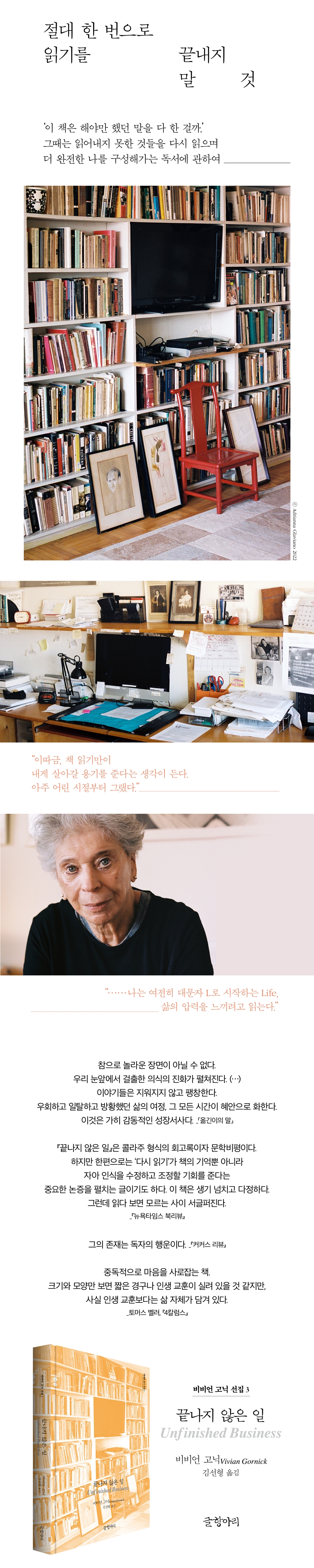
… … I still start Life with a capital L,
I read to feel the pressure of life.
The final book in Vivian Gonick's collection.
"Unfinished Business" is Vivian Gonick's latest work, published at the age of eighty-four. It examines the act of reading and rereading, which has been the basis of self-awareness demonstrated in her previous works, as a method of self-discovery and a passage to self-expansion.
As a constantly evolving reader, his genes are the material of evolution that allows him to approach his 'best self' as an individual who has constructed his identity, as an author with a self-narrative and persona.
Life is not self-controlled, and the divided self is at the mercy of the world.
The character of "Unfinished Business" is a reader who rereads and rereads the book to "feel the pressure of life," to imagine the struggles of such an imperfect human existence.
'Never stop reading in one sitting'—the ten essays in this book demonstrate that the writing, which allows one to feel the author's raw emotions, comes from this endless reading, which is intense and even structured.
For a writer who never gives up on being himself, reading, like writing, becomes first-person for him.
… … I still start Life with a capital L,
I read to feel the pressure of life.
The final book in Vivian Gonick's collection.
"Unfinished Business" is Vivian Gonick's latest work, published at the age of eighty-four. It examines the act of reading and rereading, which has been the basis of self-awareness demonstrated in her previous works, as a method of self-discovery and a passage to self-expansion.
As a constantly evolving reader, his genes are the material of evolution that allows him to approach his 'best self' as an individual who has constructed his identity, as an author with a self-narrative and persona.
Life is not self-controlled, and the divided self is at the mercy of the world.
The character of "Unfinished Business" is a reader who rereads and rereads the book to "feel the pressure of life," to imagine the struggles of such an imperfect human existence.
'Never stop reading in one sitting'—the ten essays in this book demonstrate that the writing, which allows one to feel the author's raw emotions, comes from this endless reading, which is intense and even structured.
For a writer who never gives up on being himself, reading, like writing, becomes first-person for him.
- You can preview some of the book's contents.
Preview
Detailed image
Into the book
The fear and ignorance that splitting the self causes, the shame that arises from it, the mystery that covers us like a shroud and dries us to death, have always been the crux of literature.
And I also came to understand the power of a good book to move us, the source of that power implicitly inherent in writing.
That power is captured and contained somewhere in the nerves of prose.
It was an imagination that invariably (as if coming from the primal unconscious) persistently captivated us.
It was an imaginary vision of a human being whose cracks had healed, whose parts had come together, whose thirst for connection had been quenched in a breathtaking way, and who was now functioning well.
My thoughts are the same, both in the past and now.
Great literature is not the achievement of a unified existence, but rather the record of the struggles of human beings struggling toward that achievement.
--- p.26
I know, I know, that never happened. I went back to that day, and each time, I imagined that if I just threw myself into this psychological chaos entangled with my memories, completely immersed myself, I'd emerge a free woman.
But as I approached the chaos, I would turn around and dodge like Duras.
Unlike Duras, I did not fall down without thinking and suffer from a fever of desire.
Now I know that it was a calculation to conceal, rather than confirm, the emotional free fall to which Duras devoted her life.
Yet, in the end, I come to the conclusion that I too am bound by the same obsession as Duras, because just as he devoted his life to the oblivion of sexuality and was unable to achieve freedom, my adult knowledge has not freed me from the narcissistic wound.
--- p.88
Ginzburg remembers the emotional abuse he experienced in his family growing up, how angry he and his siblings were at his parents who would constantly yell at each other, and how the whole family suffered as a result of his father's outrageous mood swings.
Self-defense creates emotional distance, which later comes at a heavy price.
In his teens, he began to feel unrealistic about himself and soon everyone around him felt unrealistic, so he developed a “stone face” and became belligerent and quarrelsome about everything.
“Sometimes we would sit alone in our rooms all afternoon, lost in thought.
I felt a vague sense of dizziness and wondered if other people really existed, or if they were just beings we imagined.
(…) Is it possible that one day we suddenly turn around and find nothing, no one, and only an empty void to stare at?” This all-encompassing spiritual distance soon becomes a license to enjoy the pleasure of perversion by committing acts of cruelty against others.
--- pp.162~163
Gonick, who once said that storytelling was “making a way in the wilderness,” developed first-person writing into memoir, social criticism, in-depth psychological exploration, and literary criticism, personally opening up the possibility of a rich humanity that accumulates three-dimensionally over time.
"Unfinished Business" recreates Gonick's famous "persona" in a complex and three-dimensional form fit for the 21st century.
By unconditionally affirming the consciousness, memories, and selves of the past, and ingeniously 'integrating' them with the hard-won insight of the present, he pushes them to a new level with much more delicate nuances.
Therefore, the act of reading privately and intimately in “Unfinished Work” is an act of fiercely public practice.
Gonik actively draws us in as readers and makes us participate in it.
(…) vividly shows how consciousness is developed.
He now knows all too well that the inner self must be the place of reform, because the inner self must be externalized and the world is created from within.
The process of rereading, revising and supplementing existing readings and adding layers of nuance is a constant reform of the subject.
It is an act of inevitably rewriting and rewriting the self.
And I also came to understand the power of a good book to move us, the source of that power implicitly inherent in writing.
That power is captured and contained somewhere in the nerves of prose.
It was an imagination that invariably (as if coming from the primal unconscious) persistently captivated us.
It was an imaginary vision of a human being whose cracks had healed, whose parts had come together, whose thirst for connection had been quenched in a breathtaking way, and who was now functioning well.
My thoughts are the same, both in the past and now.
Great literature is not the achievement of a unified existence, but rather the record of the struggles of human beings struggling toward that achievement.
--- p.26
I know, I know, that never happened. I went back to that day, and each time, I imagined that if I just threw myself into this psychological chaos entangled with my memories, completely immersed myself, I'd emerge a free woman.
But as I approached the chaos, I would turn around and dodge like Duras.
Unlike Duras, I did not fall down without thinking and suffer from a fever of desire.
Now I know that it was a calculation to conceal, rather than confirm, the emotional free fall to which Duras devoted her life.
Yet, in the end, I come to the conclusion that I too am bound by the same obsession as Duras, because just as he devoted his life to the oblivion of sexuality and was unable to achieve freedom, my adult knowledge has not freed me from the narcissistic wound.
--- p.88
Ginzburg remembers the emotional abuse he experienced in his family growing up, how angry he and his siblings were at his parents who would constantly yell at each other, and how the whole family suffered as a result of his father's outrageous mood swings.
Self-defense creates emotional distance, which later comes at a heavy price.
In his teens, he began to feel unrealistic about himself and soon everyone around him felt unrealistic, so he developed a “stone face” and became belligerent and quarrelsome about everything.
“Sometimes we would sit alone in our rooms all afternoon, lost in thought.
I felt a vague sense of dizziness and wondered if other people really existed, or if they were just beings we imagined.
(…) Is it possible that one day we suddenly turn around and find nothing, no one, and only an empty void to stare at?” This all-encompassing spiritual distance soon becomes a license to enjoy the pleasure of perversion by committing acts of cruelty against others.
--- pp.162~163
Gonick, who once said that storytelling was “making a way in the wilderness,” developed first-person writing into memoir, social criticism, in-depth psychological exploration, and literary criticism, personally opening up the possibility of a rich humanity that accumulates three-dimensionally over time.
"Unfinished Business" recreates Gonick's famous "persona" in a complex and three-dimensional form fit for the 21st century.
By unconditionally affirming the consciousness, memories, and selves of the past, and ingeniously 'integrating' them with the hard-won insight of the present, he pushes them to a new level with much more delicate nuances.
Therefore, the act of reading privately and intimately in “Unfinished Work” is an act of fiercely public practice.
Gonik actively draws us in as readers and makes us participate in it.
(…) vividly shows how consciousness is developed.
He now knows all too well that the inner self must be the place of reform, because the inner self must be externalized and the world is created from within.
The process of rereading, revising and supplementing existing readings and adding layers of nuance is a constant reform of the subject.
It is an act of inevitably rewriting and rewriting the self.
--- pp.244~245
Publisher's Review
The final book in Vivian Gonick's collection.
"Unfinished Business" is Gonick's latest work, published at the age of eighty-four, and examines the act of (re)reading, which has been the basis of self-awareness demonstrated in his previous works, as a method of self-discovery and a path to self-expansion.
As a constantly evolving reader, his genes are the material of consciousness that allows him to approach a more complete and essential self, his 'best self', as an individual who has constructed his identity and as an author who has developed his own self-narrative and persona.
Never stop reading in one sitting—this endless history of reading, intense and even constructive, is rewritten at every moment, drawing the reader's self-awareness out of the vacuum and allowing them to experience a more complete and essential self beyond the realm of insight and ideology.
Things that can't be done:
The History of Reading as a Chronicle of the Mind
“In my experience, rereading books that were important in my early years often feels like lying on a long chair undergoing psychoanalysis.” (9) Vivian Gonick, 84, personally analyzes her relationship with the books she has read and reread throughout her life since her youth. Her book, Unfinished Business, begins by evoking the intimate space of a psychoanalyst’s room.
The fact that Gonick likened the theme of this book, 'rereading,' from the beginning to a deep exploration of the inner world should be seen as an inevitable direction rather than a natural departure or an artificial structure.
As the original subtitle, 'Notes of a Chronic Re-reader', suggests, re-reading is an unstoppable business for him, who must constantly become himself.
It has become my lifelong quest to try to get as close to an integrated self as possible.
(…) Again, I read it differently. (25)
As long as the book is printed, the people inside it are forever stuck in the same conditions, making unchanging choices and living as they always have.
But the person reading it is constantly changing.
So, some readings may not end in one sitting.
The immutability of the text ironically becomes the axis through which the reader can confirm the mutability of his own mind.
Readers who reread the same text experience a different reading experience each time and feel a change in themselves.
The child who flipped through picture books, the girl who held Little Women in her hands, encountered a world that she could accept on her own, and developed her own unique relationship with several important books.
As he lets go of his infatuation with Colette and becomes a reader who sees himself reflected in Duras, he discovers countless new facts and reestablishes relationships with numerous characters.
This is where the need for rereading arises.
Returning again and again to texts we thought we knew, continually discovering things we know for the first time, and thereby reconstructing the self and the world, is a new and bewildering experience, as if reliving the past.
Because just as what you write is yourself, what you read is also yourself.
In her book on writing, Situations and Stories, Vivian Gornick poses the following central question for memoir:
“The question a good memoir clearly asks is, ‘Who am I?’
Who exactly is the "I" who determines the meaning of this story, salvaged straight from life? This is the question the memoirist must confront.
As a deep exploration, not an answer.
(…) something we can truly call ourselves.
I cannot explain or illuminate it as a common disaster or random political misfortune.
“The ‘becoming’ human being that existentialists talk about, or in the language of our time, the true self.” (108-109) He expresses this intention more clearly in his concluding remarks.
“From the beginning, I thought that teaching writing meant teaching people to read until they could clearly see what drives them.
(…) The reason why some writing touches our hearts is because it provides us with information about ourselves that is necessary at the time of reading.” (184, 188) The writer’s qualities of self-focus and clear self-awareness are also reproduced in the readers of “Unfinished Business,” a book about reading and rereading.
This reading is inseparable from the grammar of his memoirs, which is characterized by 'personal' and 'persona'.
If we need to know “who is speaking, what is being said, and what is the relationship between the two” in order to establish a person and present a persona, it is equally natural to read “to know better who we are and how we will live in the future under conditions full of constraints” (60).
When I first read it, I was struck by a profound realization about what kind of person I was at that moment, and later, I began to reflect on what kind of person I was becoming.
But after living long enough to feel like someone else, I was more surprised than anyone else to discover that I had become what I am today. (150-151)
Evolution of consciousness,
To escape myself by becoming myself
But who was this "me" I so desperately wanted to know, that even after 80 years, I'm still amazed? Early in his life, aspiring writer Gonick, who submitted a piece to the Village Voice without much thought, replied to editor Dan Wolff's question, "So, who are you?" with, "I don't know.
He gives a bewildered answer, “Who am I?”
This bewilderment, even after I was in my forties or eighties, even in those revolutionary moments when I could say, “I can explain myself to myself,” still occasionally raises doubts about the temporality of that knowledge.
It constantly drives him forward, reminding him of “the narrow-minded predicament of experience that one has become immersed in self-division” and “the gap between theory and practice,” as if to prove how it is possible to know one’s own true nature, and makes him realize at every moment that “insight alone can achieve nothing.”
The inherent contradictions in my personality tormented me every day.
Behavioral patterns that I had previously ignored suddenly appeared in a huge way and attacked me.
I lived my life believing that I was an ordinary, decent person who highly valued what is commonly called a 'good character'.
But now that I look back, my actions weren't like that at all.
In conversations, he would interrupt others and argue belligerently, he regarded family gatherings as dull and trivial, and in the studio he acted utterly selfishly.
While I was longing for an intimate relationship and withering away (at least that's what I thought), I was cutting off relationships one by one.
Because I ignored everything else and was faithful only to what I judged to be my own desires, I neglected the desires of my friends and lovers.
It is a narrow-minded experience that we have become so engrossed in our own division that we end up in a predicament.
How creepy it feels now! (24-25)
The reason why the rereading of "Unfinished Business" does not stop at the mere self-reunion of an anxious soul is because the desire to approach a "unified self, a more complete self" paradoxically liberates him from his imperfect self and allows him to recognize the otherness of the past.
He understands me, who is no longer me, who is alien, with a chilling depth.
But at the same time, I know that 'I' (person) can be separated from the self (ego).
It is a persona of life that is born through reading.
The inner reality, which the author calls 'truth,' is more vividly illuminated through this imperfect persona, this first-person narrator, than through the perfect self, the best self.
“Now I had to wrestle with myself for a day.
One part of me fought against another, and while reason told me to shake off this or that behavior, my compulsion told me not to listen to reason.
“I was frustrated and frustrated again, suffering from that vicious sense of defeat.” (25) So he had no choice but to listen to the appeals of his imperfect selves and imagine a perfect self from them.
In that respect, the works cited in “Unfinished Business” reflect a certain degree of bias.
Gonick also acknowledged this bias in “Situation and Story.”
“When I look through my writing, I am struck by the serious bias I see, which is also reflected in the books I read and the way I read them.
Whenever I talk about a memoir or essay I'm passionate about, I think of other essays and memoirs I'm ignoring, and people who point out things the books I'm reading are overlooking.
Every time that happened, I immediately agreed and said, "Yes, that's right."
(…) My interests clearly have limits.” (189) But what is clear is that these limits are precisely the core and essence of Gonik’s canon—the texts he rereads throughout his life.
The fear and ignorance that splitting the self causes, the shame that arises from it, the mystery that covers us like a shroud and dries us to death, have always been the crux of literature.
And I also came to understand the power of a good book to move us, the source of that power implicitly inherent in writing.
That power is captured and contained somewhere in the nerves of prose.
It was an imagination that invariably (as if coming from the primal unconscious) persistently captivated us.
It was an imaginary vision of a human being whose cracks had healed, whose parts had come together, whose thirst for connection had been quenched in a breathtaking way, and who was now functioning well.
My thoughts are the same, both in the past and now.
Great literature is not the achievement of a unified existence, but rather a record of the struggles of human beings struggling toward that achievement. (26)
This passionate reader, conscious of self-division and making it his life's task to approach a unified self, is drawn to divided human beings and experiences the power of text in imagining their unified existence.
Jewish, female, from the slums, working class, New Yorker… … The conditions of life in which Gonick was born fixed his primal senses in a place where he could not help but feel existential anxiety.
The feeling that one does not belong in whole or in part to this world, the feeling of being exploited and excluded even in relationships one desperately longs for genuine connection, the specific misfortunes that are made invisible, whether overt or subtly, are the material of this reading.
“My purpose in reading has always been one and only one.
“I read the book to feel the pressure of life, Life written with a capital L, which is revealed (thrillingly) through the protagonist’s actions as he becomes entangled in external forces that he cannot control.” (13) As a reader, Gonick seems to be attempting to resist the “world that does not allow me to live as myself” by feeling that pressure, and to discover the “missing inner life” that he has not yet been able to externalize.
The translator, who has “rewritten” “Unfinished Business” through translation and interpretation, which can be called the ultimate rereading, calls this unyielding attempt at integration “a moving narrative of growth.”
The translator's note, which elucidates the meaning of "unfinished work" with brilliant insight and testifies to its significance with delicate writing, once again confirms that the reader's horizon is indeed the work's horizon.
Gonick honestly looks at the ambitions and failures of immature consciousness(s) that try to feel the “pressure of life.”
Memory is imperfect, and we can only encounter books, people, and the world within the limits of where we once stood.
If we do not change, the world we see will not change either.
But we are always changing, and so to encounter the breadth and depth of the world contained in great literature, we must travel through time and space, returning again and again.
Through repeated returns to core texts, we rewrite our stories and reinvent our consciousness.
So what's really impressive is that the reading of an 80-year-old doesn't nullify the reading of a 20-year-old.
At that moment, the meanings that could only be discovered with a flawed, shaky, and imperfect consciousness do not disappear but remain in the record.
(…) Consciousness evolves slowly, firmly, and deepening over a long period of time, while being shaken, mistaken, distorted, and misinterpreted.
This beautiful evolution ultimately affirms our lives as humans, the meaning of our time and accumulated experiences.
If we become the fertilizer of wisdom, endlessly discovering new knowledge, then the time of our lives, spent in pain, ignorance, and longing, cannot at any moment become meaningless. (242-243)
"Unfinished Business" is Gonick's latest work, published at the age of eighty-four, and examines the act of (re)reading, which has been the basis of self-awareness demonstrated in his previous works, as a method of self-discovery and a path to self-expansion.
As a constantly evolving reader, his genes are the material of consciousness that allows him to approach a more complete and essential self, his 'best self', as an individual who has constructed his identity and as an author who has developed his own self-narrative and persona.
Never stop reading in one sitting—this endless history of reading, intense and even constructive, is rewritten at every moment, drawing the reader's self-awareness out of the vacuum and allowing them to experience a more complete and essential self beyond the realm of insight and ideology.
Things that can't be done:
The History of Reading as a Chronicle of the Mind
“In my experience, rereading books that were important in my early years often feels like lying on a long chair undergoing psychoanalysis.” (9) Vivian Gonick, 84, personally analyzes her relationship with the books she has read and reread throughout her life since her youth. Her book, Unfinished Business, begins by evoking the intimate space of a psychoanalyst’s room.
The fact that Gonick likened the theme of this book, 'rereading,' from the beginning to a deep exploration of the inner world should be seen as an inevitable direction rather than a natural departure or an artificial structure.
As the original subtitle, 'Notes of a Chronic Re-reader', suggests, re-reading is an unstoppable business for him, who must constantly become himself.
It has become my lifelong quest to try to get as close to an integrated self as possible.
(…) Again, I read it differently. (25)
As long as the book is printed, the people inside it are forever stuck in the same conditions, making unchanging choices and living as they always have.
But the person reading it is constantly changing.
So, some readings may not end in one sitting.
The immutability of the text ironically becomes the axis through which the reader can confirm the mutability of his own mind.
Readers who reread the same text experience a different reading experience each time and feel a change in themselves.
The child who flipped through picture books, the girl who held Little Women in her hands, encountered a world that she could accept on her own, and developed her own unique relationship with several important books.
As he lets go of his infatuation with Colette and becomes a reader who sees himself reflected in Duras, he discovers countless new facts and reestablishes relationships with numerous characters.
This is where the need for rereading arises.
Returning again and again to texts we thought we knew, continually discovering things we know for the first time, and thereby reconstructing the self and the world, is a new and bewildering experience, as if reliving the past.
Because just as what you write is yourself, what you read is also yourself.
In her book on writing, Situations and Stories, Vivian Gornick poses the following central question for memoir:
“The question a good memoir clearly asks is, ‘Who am I?’
Who exactly is the "I" who determines the meaning of this story, salvaged straight from life? This is the question the memoirist must confront.
As a deep exploration, not an answer.
(…) something we can truly call ourselves.
I cannot explain or illuminate it as a common disaster or random political misfortune.
“The ‘becoming’ human being that existentialists talk about, or in the language of our time, the true self.” (108-109) He expresses this intention more clearly in his concluding remarks.
“From the beginning, I thought that teaching writing meant teaching people to read until they could clearly see what drives them.
(…) The reason why some writing touches our hearts is because it provides us with information about ourselves that is necessary at the time of reading.” (184, 188) The writer’s qualities of self-focus and clear self-awareness are also reproduced in the readers of “Unfinished Business,” a book about reading and rereading.
This reading is inseparable from the grammar of his memoirs, which is characterized by 'personal' and 'persona'.
If we need to know “who is speaking, what is being said, and what is the relationship between the two” in order to establish a person and present a persona, it is equally natural to read “to know better who we are and how we will live in the future under conditions full of constraints” (60).
When I first read it, I was struck by a profound realization about what kind of person I was at that moment, and later, I began to reflect on what kind of person I was becoming.
But after living long enough to feel like someone else, I was more surprised than anyone else to discover that I had become what I am today. (150-151)
Evolution of consciousness,
To escape myself by becoming myself
But who was this "me" I so desperately wanted to know, that even after 80 years, I'm still amazed? Early in his life, aspiring writer Gonick, who submitted a piece to the Village Voice without much thought, replied to editor Dan Wolff's question, "So, who are you?" with, "I don't know.
He gives a bewildered answer, “Who am I?”
This bewilderment, even after I was in my forties or eighties, even in those revolutionary moments when I could say, “I can explain myself to myself,” still occasionally raises doubts about the temporality of that knowledge.
It constantly drives him forward, reminding him of “the narrow-minded predicament of experience that one has become immersed in self-division” and “the gap between theory and practice,” as if to prove how it is possible to know one’s own true nature, and makes him realize at every moment that “insight alone can achieve nothing.”
The inherent contradictions in my personality tormented me every day.
Behavioral patterns that I had previously ignored suddenly appeared in a huge way and attacked me.
I lived my life believing that I was an ordinary, decent person who highly valued what is commonly called a 'good character'.
But now that I look back, my actions weren't like that at all.
In conversations, he would interrupt others and argue belligerently, he regarded family gatherings as dull and trivial, and in the studio he acted utterly selfishly.
While I was longing for an intimate relationship and withering away (at least that's what I thought), I was cutting off relationships one by one.
Because I ignored everything else and was faithful only to what I judged to be my own desires, I neglected the desires of my friends and lovers.
It is a narrow-minded experience that we have become so engrossed in our own division that we end up in a predicament.
How creepy it feels now! (24-25)
The reason why the rereading of "Unfinished Business" does not stop at the mere self-reunion of an anxious soul is because the desire to approach a "unified self, a more complete self" paradoxically liberates him from his imperfect self and allows him to recognize the otherness of the past.
He understands me, who is no longer me, who is alien, with a chilling depth.
But at the same time, I know that 'I' (person) can be separated from the self (ego).
It is a persona of life that is born through reading.
The inner reality, which the author calls 'truth,' is more vividly illuminated through this imperfect persona, this first-person narrator, than through the perfect self, the best self.
“Now I had to wrestle with myself for a day.
One part of me fought against another, and while reason told me to shake off this or that behavior, my compulsion told me not to listen to reason.
“I was frustrated and frustrated again, suffering from that vicious sense of defeat.” (25) So he had no choice but to listen to the appeals of his imperfect selves and imagine a perfect self from them.
In that respect, the works cited in “Unfinished Business” reflect a certain degree of bias.
Gonick also acknowledged this bias in “Situation and Story.”
“When I look through my writing, I am struck by the serious bias I see, which is also reflected in the books I read and the way I read them.
Whenever I talk about a memoir or essay I'm passionate about, I think of other essays and memoirs I'm ignoring, and people who point out things the books I'm reading are overlooking.
Every time that happened, I immediately agreed and said, "Yes, that's right."
(…) My interests clearly have limits.” (189) But what is clear is that these limits are precisely the core and essence of Gonik’s canon—the texts he rereads throughout his life.
The fear and ignorance that splitting the self causes, the shame that arises from it, the mystery that covers us like a shroud and dries us to death, have always been the crux of literature.
And I also came to understand the power of a good book to move us, the source of that power implicitly inherent in writing.
That power is captured and contained somewhere in the nerves of prose.
It was an imagination that invariably (as if coming from the primal unconscious) persistently captivated us.
It was an imaginary vision of a human being whose cracks had healed, whose parts had come together, whose thirst for connection had been quenched in a breathtaking way, and who was now functioning well.
My thoughts are the same, both in the past and now.
Great literature is not the achievement of a unified existence, but rather a record of the struggles of human beings struggling toward that achievement. (26)
This passionate reader, conscious of self-division and making it his life's task to approach a unified self, is drawn to divided human beings and experiences the power of text in imagining their unified existence.
Jewish, female, from the slums, working class, New Yorker… … The conditions of life in which Gonick was born fixed his primal senses in a place where he could not help but feel existential anxiety.
The feeling that one does not belong in whole or in part to this world, the feeling of being exploited and excluded even in relationships one desperately longs for genuine connection, the specific misfortunes that are made invisible, whether overt or subtly, are the material of this reading.
“My purpose in reading has always been one and only one.
“I read the book to feel the pressure of life, Life written with a capital L, which is revealed (thrillingly) through the protagonist’s actions as he becomes entangled in external forces that he cannot control.” (13) As a reader, Gonick seems to be attempting to resist the “world that does not allow me to live as myself” by feeling that pressure, and to discover the “missing inner life” that he has not yet been able to externalize.
The translator, who has “rewritten” “Unfinished Business” through translation and interpretation, which can be called the ultimate rereading, calls this unyielding attempt at integration “a moving narrative of growth.”
The translator's note, which elucidates the meaning of "unfinished work" with brilliant insight and testifies to its significance with delicate writing, once again confirms that the reader's horizon is indeed the work's horizon.
Gonick honestly looks at the ambitions and failures of immature consciousness(s) that try to feel the “pressure of life.”
Memory is imperfect, and we can only encounter books, people, and the world within the limits of where we once stood.
If we do not change, the world we see will not change either.
But we are always changing, and so to encounter the breadth and depth of the world contained in great literature, we must travel through time and space, returning again and again.
Through repeated returns to core texts, we rewrite our stories and reinvent our consciousness.
So what's really impressive is that the reading of an 80-year-old doesn't nullify the reading of a 20-year-old.
At that moment, the meanings that could only be discovered with a flawed, shaky, and imperfect consciousness do not disappear but remain in the record.
(…) Consciousness evolves slowly, firmly, and deepening over a long period of time, while being shaken, mistaken, distorted, and misinterpreted.
This beautiful evolution ultimately affirms our lives as humans, the meaning of our time and accumulated experiences.
If we become the fertilizer of wisdom, endlessly discovering new knowledge, then the time of our lives, spent in pain, ignorance, and longing, cannot at any moment become meaningless. (242-243)
GOODS SPECIFICS
- Date of issue: April 29, 2024
- Format: Hardcover book binding method guide
- Page count, weight, size: 248 pages | 110*175*20mm
- ISBN13: 9791169092333
- ISBN10: 1169092330
You may also like
카테고리
korean


korean

![GQ KOREA Mark (Monthly): December [2025]](http://librairie.coreenne.fr/cdn/shop/files/8ef265dbbfbf186523ed75ba7319009d.jpg?v=1765340328&width=3840)


