

Ten Thoughts on Life
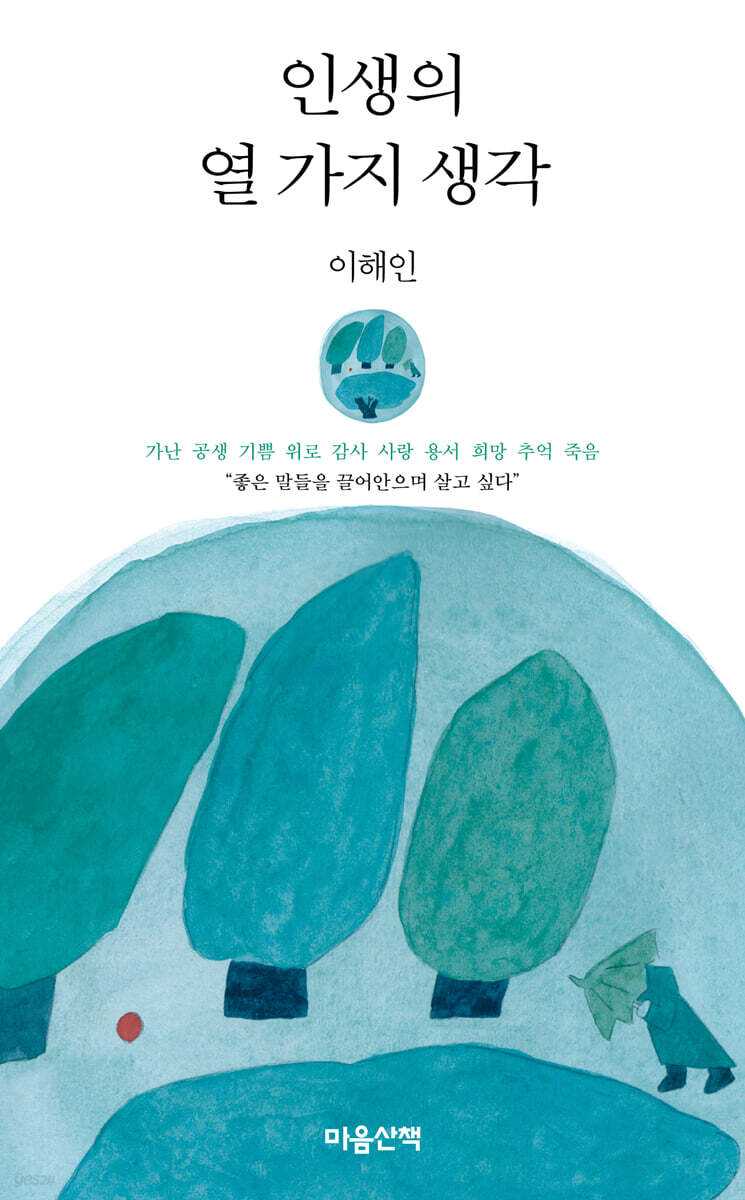 |
Description
Book Introduction
“It can’t be grandiose from above. “Everything above is small” When we laugh, we have fun together A little comforter who shares your sorrow when you cry Ten Thoughts on Life from Sister Lee Hae-in Sister Lee Hae-in's new collection of essays, Ten Thoughts on Life, has been published by Maumsanchaek. Sister Hae-in Lee, who has long been a friendly and caring comforter to many who seek comfort, as she often says, “I may not be a mother to all the children in the world, but I want to be an aunt to them.” As a monk and poet who has practiced love for over half a century, he now shares his thoughts on ten key points in life. Sister Lee Hae-in categorized the values and concepts that she had dealt with urgently in her prayers and poems into ten keywords: ‘poverty, coexistence, joy, consolation, gratitude, love, forgiveness, hope, memory, and death.’ Each chapter is composed of a piece written “with the intention of organizing life” and the nuns’ poetry and prose, which are good to read together for better understanding. The newly presented prose is concise yet brimming with insight and wisdom condensed over a long period of time. He talks about the joy of life, of being grateful for everything, loving others, and sharing and giving to one another, while also sharing more profound thoughts about 'death'. Sister Hae-in Lee, winner of the 26th Korean Catholic Literature Award, said in her acceptance speech, “I will become a little nun and a little poet who walks the path with more joy and gratitude in prayer.” As he walks the arduous path of life, he gradually becomes a 'smaller person', and the works he leaves behind will have greater power and reach farther. Mature and solid reflections will become the foundation for living each day faithfully. Because we are alive, we meet people, preserve the traces they leave behind, and maintain pleasant relationships. Even after I leave this world, I believe these traces will not remain as a thing of the past, but will become a source of new strength for people. _From page 8, “Introduction” |
- You can preview some of the book's contents.
Preview
index
At the beginning of the book
poverty
symbiosis
delight
consolation
thanks
love
forgiveness
hope
memory
death
poverty
symbiosis
delight
consolation
thanks
love
forgiveness
hope
memory
death
Detailed image

Into the book
I think about poverty again.
Poverty is not about not having anything, but about sharing what you have, being content, and achieving peace of mind.
Actually, I like the word 'poverty' more than 'clean poverty'.
Clear poverty.
--- p.21
Looking at someone who is crying when everyone else is laughing, holding the hand of someone who is lonely, that's what living together is all about.
--- p.40
Joy doesn't have to happen just because something good happens. If you live with the belief that you are alive and that good days will come, the spirituality of joy will arise naturally.
--- p.61
Many of the poems I write are the result of people seeking me out for comfort.
I want to continue to play the role of a comforter, sharing joy with you when you laugh and sorrow with you when you cry.
--- p.80
You have to find the person who is alone in the darkness and full of resentment.
We've all faced times and moments like that in our lives.
We need to create an opportunity to restore gratitude.
--- pp.104~105
Love is attention.
If you don't pay attention, you won't see anything.
Love begins with looking at the other person well.
--- p.123
Forgiveness happens within your own heart.
Flowers should speak more than people.
--- p.146
I believe that living an ordinary life is the path to extraordinary hope.
If I live each day well, I will be able to move towards a good future.
Time passes and we move forward little by little.
--- p.165
If we practice the small deaths that come to us in life before our physical and bodily deaths, won't we be able to face the big death that will eventually come to us?
Poverty is not about not having anything, but about sharing what you have, being content, and achieving peace of mind.
Actually, I like the word 'poverty' more than 'clean poverty'.
Clear poverty.
--- p.21
Looking at someone who is crying when everyone else is laughing, holding the hand of someone who is lonely, that's what living together is all about.
--- p.40
Joy doesn't have to happen just because something good happens. If you live with the belief that you are alive and that good days will come, the spirituality of joy will arise naturally.
--- p.61
Many of the poems I write are the result of people seeking me out for comfort.
I want to continue to play the role of a comforter, sharing joy with you when you laugh and sorrow with you when you cry.
--- p.80
You have to find the person who is alone in the darkness and full of resentment.
We've all faced times and moments like that in our lives.
We need to create an opportunity to restore gratitude.
--- pp.104~105
Love is attention.
If you don't pay attention, you won't see anything.
Love begins with looking at the other person well.
--- p.123
Forgiveness happens within your own heart.
Flowers should speak more than people.
--- p.146
I believe that living an ordinary life is the path to extraordinary hope.
If I live each day well, I will be able to move towards a good future.
Time passes and we move forward little by little.
--- p.165
If we practice the small deaths that come to us in life before our physical and bodily deaths, won't we be able to face the big death that will eventually come to us?
--- p.206
Publisher's Review
“Let’s look at the person crying when everyone else is laughing.”
Life together, the power to move forward together
The unique feature of 『Ten Thoughts on Life』 is that it presents new writings under a single theme alongside Sister Hae-in's works that complement it.
Each topic is a question that we embrace and ponder throughout our lives.
The message that runs through all ten stories is that we are not beings who live alone, but rather coexist and thrive together as we navigate life.
He says that in order to love others, we must look at them carefully; in order to share with our neighbors, we must always be grateful; and in order to shake off the pain of our hearts, we must forgive those who have wronged us as if we were giving them flowers.
A grateful heart ultimately leads to a heart that shares with our neighbors.
Gratitude is not just about affirming my own life, but also about helping others.
I want to sing those words like a breath, so that the first and last prayer of my day, the first and last prayer of my year, will be “Thank you.”
_From page 105, “Thanks”
Sister Lee Hae-in remained faithful to the life of a nun who practices spirituality, but never stopped speaking out to society.
As can be seen in his response to the accusation that “nuns are leftists” by saying “We are on the side of the weak” (『Lee Hae-in’s Words』), his interest was always directed towards those who did not receive social protection.
Ultimately, the answer is coexistence.
From everyday communal life in the convent to the recurring tragedies like COVID-19, Sister Hae-in emphasizes the meaning of living together and the need to reach out and speak to those who are marginalized.
We will act first and foremost for those who are grieving.
I wonder if that is the small comforter role given to me for coexistence.
We always practice living well together and staying warm with each other's warmth while we live.
_From page 41, “Symbiosis”
“Let us wait for and use death well in our lives.”
Life is a journey to return home after completing a pilgrimage on earth.
Another thing to note is the nun's mature thinking about 'death'.
It is said that in the convent, before going to bed, they say the final prayer, “Lord, grant me rest in peace this night and a holy death.”
That is, waking up from sleep is nothing but a small birth, and falling asleep is nothing but a small death.
But even for the nuns who were reminded every day that life and death were connected, the prospect of imminent death was a source of fear.
In “Hope is Awake,” a collection of records and poems from the year and a half after he was diagnosed with cancer, he tried to calmly accept death, but he also revealed his human inner feelings, saying, “When my body gets weaker/ My faith should become stronger/ But for now/ I’m just afraid” (“Prayer on a Sick Day”).
Sister Hae-in, who has undergone long training at the 'School of Pain', repeatedly calls herself a "pilgrim on the road to death" and tells us to practice the death we face every day.
This book, which is filled with the words he wanted to leave behind as a monk, will, as he said, “reach out to someone and be of help, joy, and a new way of thinking about death.”
If we practice the small deaths that come to us in life before our physical and bodily deaths, won't we be able to face the big death that will eventually come to us?
Rather than fearing death itself, think of it as an extension of life, a natural progression toward its end, like a flower withering or a tree shedding its clothes.
It's a journey back home, you know.
_From page 206, “Death”
Author's Note
I hope this book reaches someone and helps them, brings them joy, and gives them new perspectives on death.
All I have is a heart to pray and the power to write, so you can think of it as giving everything.
There are many things that happen that are beyond human control.
I believe that bad things, as well as good things, cannot happen through human power alone.
Anything is a grace.
I live each day by praying constantly and writing constantly.
Life together, the power to move forward together
The unique feature of 『Ten Thoughts on Life』 is that it presents new writings under a single theme alongside Sister Hae-in's works that complement it.
Each topic is a question that we embrace and ponder throughout our lives.
The message that runs through all ten stories is that we are not beings who live alone, but rather coexist and thrive together as we navigate life.
He says that in order to love others, we must look at them carefully; in order to share with our neighbors, we must always be grateful; and in order to shake off the pain of our hearts, we must forgive those who have wronged us as if we were giving them flowers.
A grateful heart ultimately leads to a heart that shares with our neighbors.
Gratitude is not just about affirming my own life, but also about helping others.
I want to sing those words like a breath, so that the first and last prayer of my day, the first and last prayer of my year, will be “Thank you.”
_From page 105, “Thanks”
Sister Lee Hae-in remained faithful to the life of a nun who practices spirituality, but never stopped speaking out to society.
As can be seen in his response to the accusation that “nuns are leftists” by saying “We are on the side of the weak” (『Lee Hae-in’s Words』), his interest was always directed towards those who did not receive social protection.
Ultimately, the answer is coexistence.
From everyday communal life in the convent to the recurring tragedies like COVID-19, Sister Hae-in emphasizes the meaning of living together and the need to reach out and speak to those who are marginalized.
We will act first and foremost for those who are grieving.
I wonder if that is the small comforter role given to me for coexistence.
We always practice living well together and staying warm with each other's warmth while we live.
_From page 41, “Symbiosis”
“Let us wait for and use death well in our lives.”
Life is a journey to return home after completing a pilgrimage on earth.
Another thing to note is the nun's mature thinking about 'death'.
It is said that in the convent, before going to bed, they say the final prayer, “Lord, grant me rest in peace this night and a holy death.”
That is, waking up from sleep is nothing but a small birth, and falling asleep is nothing but a small death.
But even for the nuns who were reminded every day that life and death were connected, the prospect of imminent death was a source of fear.
In “Hope is Awake,” a collection of records and poems from the year and a half after he was diagnosed with cancer, he tried to calmly accept death, but he also revealed his human inner feelings, saying, “When my body gets weaker/ My faith should become stronger/ But for now/ I’m just afraid” (“Prayer on a Sick Day”).
Sister Hae-in, who has undergone long training at the 'School of Pain', repeatedly calls herself a "pilgrim on the road to death" and tells us to practice the death we face every day.
This book, which is filled with the words he wanted to leave behind as a monk, will, as he said, “reach out to someone and be of help, joy, and a new way of thinking about death.”
If we practice the small deaths that come to us in life before our physical and bodily deaths, won't we be able to face the big death that will eventually come to us?
Rather than fearing death itself, think of it as an extension of life, a natural progression toward its end, like a flower withering or a tree shedding its clothes.
It's a journey back home, you know.
_From page 206, “Death”
Author's Note
I hope this book reaches someone and helps them, brings them joy, and gives them new perspectives on death.
All I have is a heart to pray and the power to write, so you can think of it as giving everything.
There are many things that happen that are beyond human control.
I believe that bad things, as well as good things, cannot happen through human power alone.
Anything is a grace.
I live each day by praying constantly and writing constantly.
GOODS SPECIFICS
- Date of issue: June 10, 2023
- Page count, weight, size: 228 pages | 123*198*20mm
- ISBN13: 9788960908147
- ISBN10: 8960908142
You may also like
카테고리
korean


korean

![GQ KOREA Mark (Monthly): December [2025]](http://librairie.coreenne.fr/cdn/shop/files/8ef265dbbfbf186523ed75ba7319009d.jpg?v=1765340328&width=3840)


